A wing sail is a solid or semi-rigid aerofoil, a wing shaped like an aeroplane wing instead of a sheet of fabric, that replaces a conventional mainsail on a boat and turns wind into forward motion mainly through lift rather than drag. It is the rig you see on foiling race boats and on modern cargo ships trying to cut fuel use. Here is the short answer first, then the mechanism in full.
The catch is that “wing” in a search result can mean three completely different things. Search engines mix them constantly, so it is worth clearing that up before the physics gets confusing.
Wing sail (wingsail): a sail. A rigid or semi-rigid lifting surface fixed to a vertical spar, working above the waterline.
Wing foiling: a sport and a board. A rider stands on a hydrofoil board and is propelled across the water on that foil.
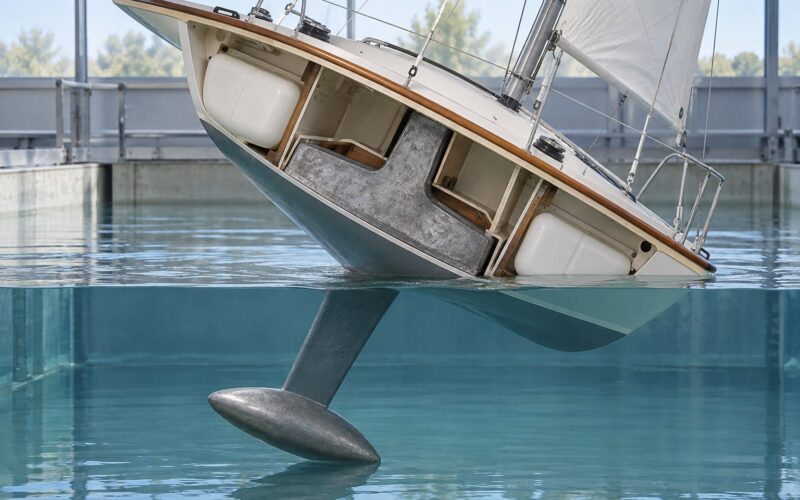
Hydrofoil (on a boat): a lifting fin under the hull. It raises the boat out of the water so the wetted surface shrinks and drag drops.
All three use the same aerodynamics. Only the first one is a sail.
Table of Contents
- What Is a Wing Sail?
- How Does a Wing Sail Work?
- The Main Parts of a Wing Sail
- Wing Sail vs. Conventional Sail: What Changes?
- How Wind Angle, Speed, and Trim Affect Performance
- Why Foils and Control Surfaces Matter
- Building or Testing a Wing Sail on a Small Boat
- What Is a Wing Sail and How Does It Work in a Sailing Robot?
- Frequently Asked Questions
- Key Takeaways and Where to Start
What Is a Wing Sail?
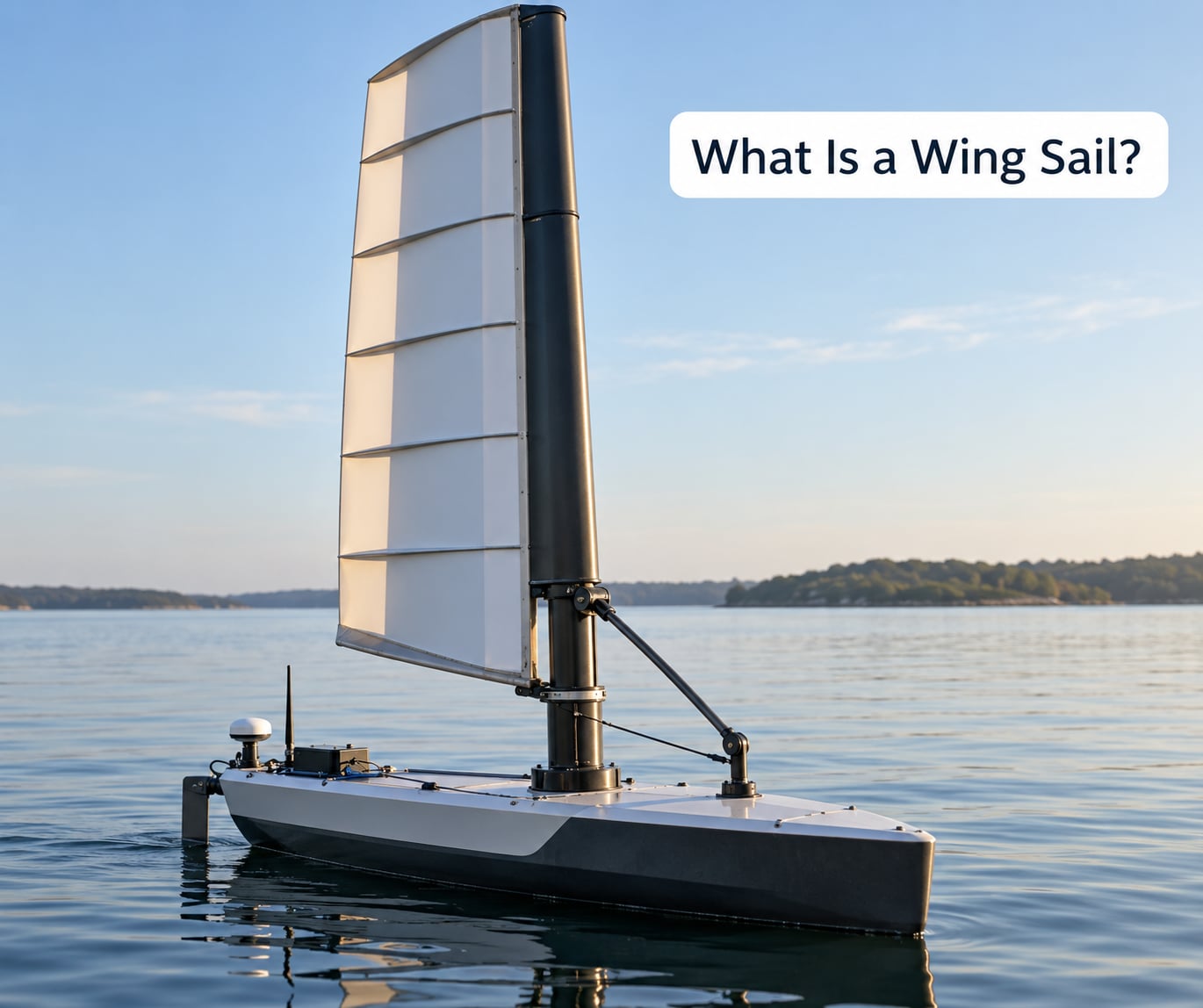
A wing sail is a variable-camber aerodynamic structure fitted to a vessel in place of conventional sails. It is also called a twin-skin sail or a double skin sail, and depending on the build you may see it described as soft or hard.
The defining idea is simple. A conventional sail is mostly a flat sheet of cloth that takes whatever shape the wind and the sheets give it. A wing carries a designed airfoil cross-section, built to hold that shape, so the wing can be trimmed to a known angle of attack instead of being pushed around by the rig.
That difference is where nearly all of the efficiency argument comes from. A well-built wing has a better lift-to-drag ratio than a soft sail of the same area, holds a consistent shape as wind strength changes, and needs no shrouds or stays because the wing itself is the structure that resists the load.
Soft wings exist too, and they are not a compromise so much as a different tool. A twin-skin soft wing is two fabric membranes sewn around the edges, forming a sealed airfoil that holds a shape without a rigid spar. It sits between a flat junk sail and a full carbon wing.
How Does a Wing Sail Work?
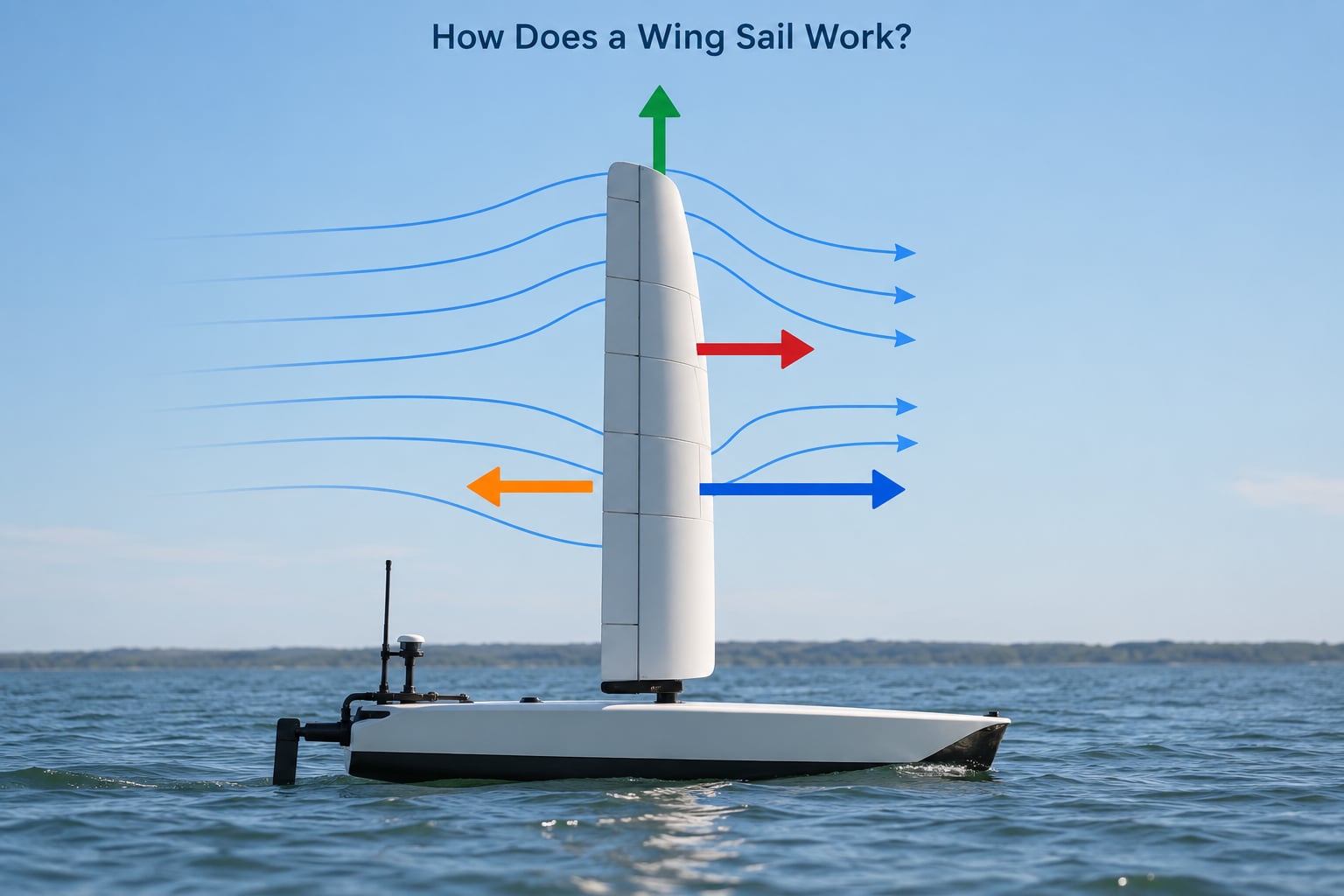
Here is the force sequence, step by step. Once you can picture these four steps, the rest of the article is detail.
1. The airfoil section splits the airflow. The wing’s cross-section is asymmetric. The upper surface is long and curved, the lower surface shorter and flatter, and the gap between them is the camber. Air travelling over the curved upper surface speeds up, and by the time it rejoins the air below, the pressure on the two surfaces is different. That pressure difference is lift, acting roughly perpendicular to the apparent wind.
2. Camber is set by the flap and the whole wing. A trailing-edge flap deflects downwards, which increases camber, which increases lift at a given angle of attack. More camber helps in light air. On a new tack, or when the wind strengthens, camber is reduced so the wing does not stall. Some rigs vary camber along the span, tip to base, so the outer sections stay slightly flatter than the root.
3. The wing rotates on its spar to face the apparent wind. The spar stands free, with no standing rigging holding it up. A tab or the wing’s own aerodynamic forces push the spar around, and the whole assembly turns through 360 degrees to sit at the right angle to the wind. The sailor trims that angle of incidence by changing the wing’s angle relative to the spar.
4. Lift is resolved into forward thrust. Lift only pushes perpendicular to the apparent wind. The boat’s keel, board, weight and hydrodynamic lateral resistance take the sideways component, and what is left points forward along the boat’s heading. The wing keeps working as the boat accelerates, because the apparent wind changes as boat speed changes.
One way to picture the last step: the wing is a lever between the wind and the water. Push sideways, the water pushes back, and the craft goes forward. Get the wing’s trim wrong and the force rotates away from the boat’s heading, which costs speed and puts load on the rig instead of into the hull.
Why a wing holds its shape when a soft sail does not
A soft sail changes depth, twists and flogs because cloth has almost no bending stiffness. A rigid wing is a sandwich panel: thin composite skins bonded to a lightweight core, which gives it bending stiffness for very little mass. The core can be a honeycomb, a foam, or on the Oceanbird Wing 560 a recycled PET core, with the 40 metre flap built from glass fibre skins around 370,000 recycled plastic bottles per wing.
That stiffness is not decoration. Without it the wing would twist, the camber would vary unpredictably, and the aerodynamic efficiency that justifies the whole design would disappear. Oceanbird’s own composite engineers make the point directly: if you use solid steel or solid composite, it is quite heavy, whereas a sandwich gives higher bending stiffness at far lower mass.
The Main Parts of a Wing Sail
Knowing the parts makes the mechanism easier to picture. Each one has a job, and removing any of them costs you something specific.
- Planform — the shape you see from above or from the side. Tapered high-aspect layouts suit upwind work, wider ones suit reaching and downwind.
- Leading edge — the front of the airfoil. It sets the upper-surface curve, so its profile largely determines how the wing handles a gust. On larger designs it holds a slat that can open to delay stall.
- Trailing edge — the back, where the flap hinges. This is the primary camber control.
- Flap — a movable trailing segment, usually driven hydraulically, that sets camber and therefore lift. Some rigs use several independently driven segments for finer control and for varying camber along the span.
- Spar — the unstayed vertical mast. It carries bending and torsional load from the wing down into the hull, and it is the axis the rig rotates about.
- Ribs and internal structure — the load paths inside the wing. They decide how the panel bends and how the camber is distributed.
- Skin — composite laminate or fabric. It is the surface the airflow actually touches.
- Trim tab or luffing control — the device that sets the wing’s angle to the spar, and in automatic systems the one that furls or parks the wing.
- Foundation and hardware — the bearing, the tab, the hydraulics and, on commercial systems, a redundant backup pump so the wing can always be stowed.
Soft, rigid and twin-skin: three ways to build one
Soft wing sail. No rigid spar, no panel. The wing is fabric on a frame or purely a shaped membrane, so it can be lowered, rolled and stowed in a bag. The compromise is that the shape is still partly at the mercy of the wind, and the loaded area is small.
Twin-skin soft wing. Two layers of fabric sewn along the leading edge, trailing edge and tips to form a closed aerofoil. Stiffened battens or compression posts hold the shape between the skins. Sailmakers building in this style treat it as a structural project, working hard on load paths and stitched seams, and it is the version most people can realistically build at small scale.
Rigid wing sail. A composite structure on an unstayed rotating spar, with powered camber control. This is the version used on foiling America’s Cup boats, SailGP boats, C-Class catamarans and wind-assisted commercial ships. Highest efficiency, heaviest structure, most complicated to handle.
Wing Sail vs. Conventional Sail: What Changes?
A wing is a different machine, not a strict upgrade. The table below is the honest version, including the columns that favour cloth.
| Criterion | Wing sail | Conventional soft sail |
|---|---|---|
| How thrust is made | Mostly lift from a designed airfoil | Part lift, part drag from a shaped cloth sheet |
| Lift-to-drag ratio | High, and stays high as the wind builds | Moderate, and degrades as the sail flogs |
| Shape under load | Held by structure, predictable | Set by sheets, weight and clew tension |
| Standing rigging | None; the spar is unstayed | Forestay, backstay, cap shrouds |
| Sails carried | One wing replaces main and jib | Main plus headsail |
| Reefing | Fixed area unless the design is built to reduce it | Standard: shorten, furl or rotate the sail |
| Weight distribution | Heavy mass high up, raising the centre of gravity | Lighter, and weight is easy to move |
| Storage and transport | Rigid wings must be stepped and unstepped by gear or a crane | Drop the sail into a bag |
| Upwind pointing | Points higher | Limited by clew and sheet geometry |
| Build and maintenance | Composite work, hydraulics, sensors, frequent inspection | Sailmaker skills and routine patching |
| Failure mode | Structural or hydraulic loss of control authority | Flogging, torn cloth |
| Best fit | Race boats, foiling craft, wind-assisted shipping | Cruising, small boats, short-handed sailing |
Rigid wings that must be reefed are the design problem most discussed on boatdesign.net, where builders work on ways to lower a rear section of the wing and cut its area while trading away drive for reduced drag when pointing into the wind. The same forum carries a blunt counter-argument worth repeating: a rigid wing sail will not outperform a conventional sail in every condition. That is true, and it is why nobody fits one to a cruising boat as a matter of course.
How Wind Angle, Speed, and Trim Affect Performance
Everything above assumes the wing is trimmed for its apparent wind, which is the wind the boat actually feels: true wind plus the wind created by the boat moving through it. Pointing higher makes the boat faster, which increases apparent wind, which changes the angle the wing has to sit at. Trim is a loop, not a setting.
- Close-hauled. Apparent wind is close to the bow. The wing works at a small angle of attack and most of the force is lift. Lift-to-drag ratio matters most here, which is why wings earn their place on foiling boats that spend their time upwind.
- Reaching. The wing is broadside to the apparent wind, its angle of attack is low, and drag is a larger share of the force. Wings work well here, though soft sails with a well-shaped roach are competitive.
- Broad reach and running. The apparent wind moves aft and the required angle of attack increases. Past a point the wing is working mostly as a drag device, and a soft sail with a large roach can match or beat it. A wing needs reefing here more than upwind.
- Heel. A wing’s centre of effort moves as camber changes. Heeling force rises with apparent wind and with camber, and on a narrow multihull that is the limit long before the wing stalls.
Camber, twist and stall are the three terms that explain most wing handling. More camber means more lift and more drag at the same angle of attack. Twist lets the outer span run at a slightly lower angle than the root, so the tip keeps flying in a twisty flow while the root carries the load. Stall happens when the angle of attack exceeds what the section can hold, and it arrives suddenly: lift drops, drag climbs, the wing stops driving, and the boat slows until apparent wind falls and it flies again. Pilots describe the consequence bluntly, with warnings that trimming a wingsail wrongly can capsize the boat.
Why Foils and Control Surfaces Matter
A wing produces a large sideways force, and something has to take it. On a conventional boat that job belongs to the keel and the hull, plus the boat’s weight. On a foiling craft the hydrofoils do it, which lets the hull leave the water entirely and cuts drag so hard that a wing sail becomes the sensible way to fill the gap in available drive.
That is the connection between two things the SERP likes to blur. A hydrofoil is not a sail and a wingsail is not a foil, but on a foiling boat the two work as one propulsion system: the foil carries the load and the wing provides the thrust.
Control surfaces are how the wing is trimmed. The flap sets camber, and camber sets how much lift the wing makes at a given angle. A trim tab or a variable-incidence mounting sets the wing’s angle relative to the spar, which is the coarse control. On rotating rigs, turning the spar sets the heading relative to the wind, which is the fine control. Together they let a pilot or an autopilot hold a target lift coefficient across a wide range of wind speeds.
How wing-sail control differs from sheeting a soft sail
On a soft sail you change the shape by pulling a sheet. Tighten the leech, the draft deepens, the leech falls off, and gusts get absorbed and spilled by the cloth itself. The sail tells you what it is doing through the sheet tension and the telltales.
On a wing sail there is no sheet to pull, and the wing does not spill gusts for you. You command a shape and a setting: flap position, angle of incidence, spar rotation. That is a sharper, faster control, and it is why wings suit a foil carrying a hard sensor set. It is also why a wing demands more attention. A mis-trimmed wing does not get sloppy, it stalls or generates far more load than the hull expects, and on a high-speed multihull that arrives as a capsize risk rather than a slow passage.
Building or Testing a Wing Sail on a Small Boat
Working on a wing at small scale is a composites and structures project before it is a sailing project. The safe path looks like this.
Start from a proven design. Use a published or open-source geometry, or scale an existing one. The airfoil section, span-to-chord ratio and flap layout are solved problems, and inventing your own is the fastest route to a wing that will not fly.
Calculate the loads before you cut anything. Estimate the peak aerodynamic load from area, wind speed and a sensible dynamic pressure, then add margin for gusts. Size the spar for bending and torsion, and remember that the biggest structural risk in a wing is a fatigue failure at a joint, not a static break in the middle of the panel.
Choose materials by stiffness per unit mass. Sandwich panels with composite skins and a lightweight core are the standard answer. On a small boat, foam cores and taped seams can get you most of the way; the trade-off is more weight and more sensitivity to damage.
Protect every edge and every cut point. Sharp edges, exposed foam and drilled holes are where small wings fail first. Seal the skins, round the leading edge, and treat any through-fastener as a stress concentration to be reinforced.
Instrument before you launch. A wind sensor, an angle-of-attack sensor on the wing, a load cell at the spar base, and a GPS speed log are enough to turn guesswork into data. On a robotics platform these are the same instruments the autopilot uses, so the test bench and the vehicle share the design.
Log the whole run. Record wind angle, wind speed, boat speed, flap position, angle of incidence and the reaction. Without that log, the only thing you will know at the end is whether the boat moved.
How Do You Test a Wing Sail?
Test in stages, and treat every stage as a pass-fail gate rather than a launch.
- Static checks first. With the rig on a stand, confirm the spar is plumb, the flap travels its full range without binding, and the tab sets the intended angles of incidence. Measure the camber at the root and the tip.
- Low-power airflow test. Point the wing at a fan or a steady blower and watch the telltales or a strip of tape. Cuff or flutter at the trailing edge means the section is stalled or the flap is mis-set.
- First water run in light air. Keep the crew small, stay in a sheltered area, and check the load cell continuously. Success is a stable heading, no oscillation, and sail force that increases smoothly as you increase flap.
- Trim sweep. At steady wind speed, step through angle of incidence in small increments and note peak thrust and the point where thrust falls away. That fall-off is your stall boundary, and you now own a number instead of a theory.
- Power up and observe the rig. Increase wind and watch spar deflection, panel twist and control response. Success is that nothing surprises you and the boat tells you clearly, through heel, before anything bends.
- Log it, then change one thing. Write down the configuration with every run. One variable per test is the only way the data stays useful.
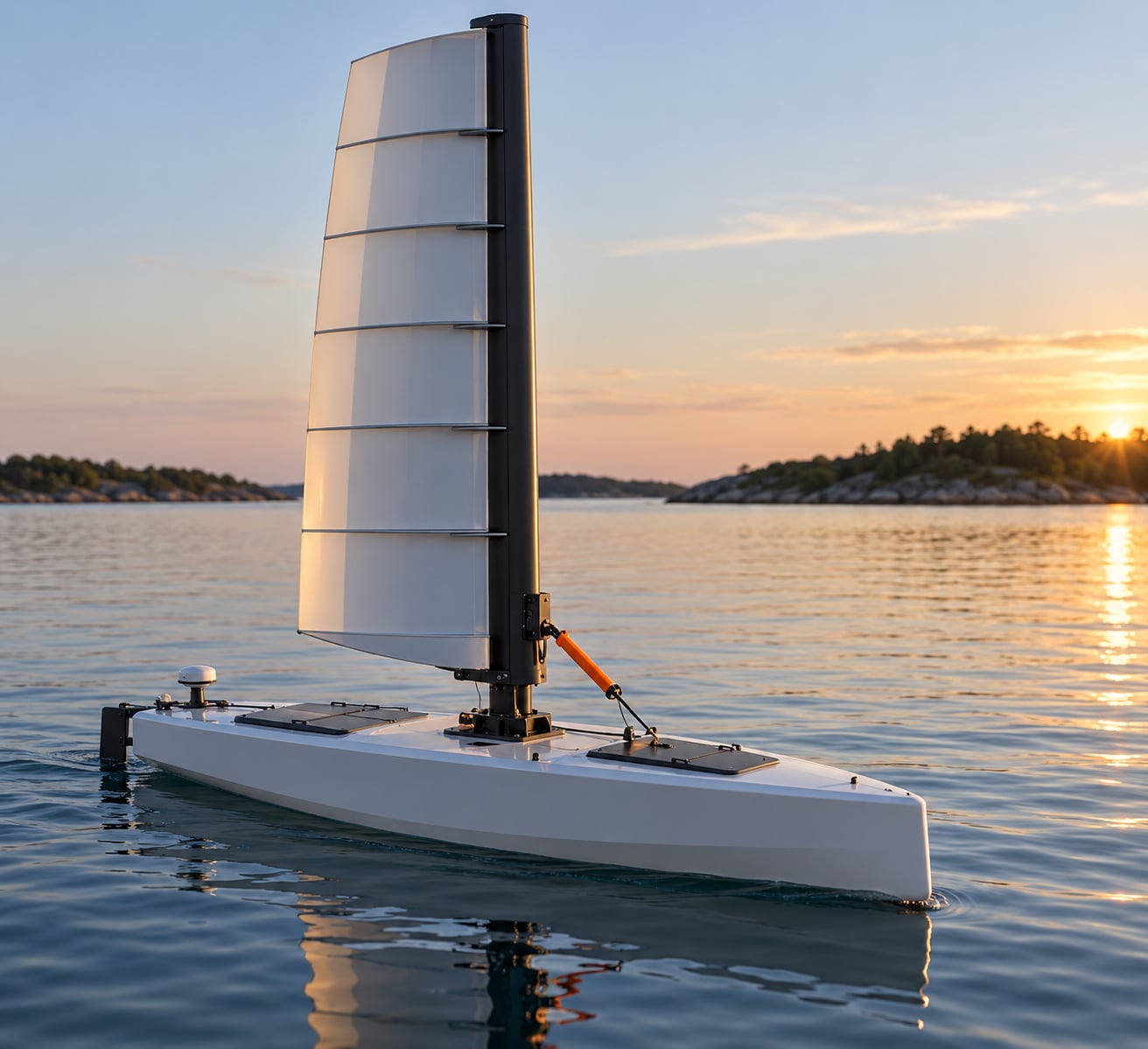
What Is a Wing Sail and How Does It Work in a Sailing Robot?
On an autonomous sailing robot the wing is not just a sail, it is an actuator. That single fact changes the design. A human crew compensates continuously for gusts through feel; a robot has to measure and correct, so the wing’s control surface needs a sensor reading and a repeatable response.
The loop usually looks like this: a wind sensor and an angle-of-attack sensor give apparent wind speed and the current angle of incidence, an autopilot computes the heading error, and a small actuator sets the tab or rotates the spar. Add a load cell at the spar base and thrust from GPS speed, and the vehicle can detect the moment it stops making progress.
Low mass and predictable loads matter more here than in any other application. An unmanned craft has a limited power budget for the control system, and a wing that suddenly stalls or bends unpredictably can push it beyond its course-keeping ability. Designers therefore favour known airfoil sections, generous structural margin, and control schemes that put the wing in a known state whenever the sensors disagree with each other.
Safe-state behaviour is the part people skip. A robot with a wing should be able to luff, park or fully stow on a sensor fault, on loss of the autopilot link, and on an over-current in the flap actuator. Commercial systems treat this as a design requirement rather than a feature: redundant hydraulic lines, hoses and a backup pump, with the wing always stowable, so a failure ends with the rig feathered and the vessel drifting rather than with an uncommanded wing loading up the hull.
Frequently Asked Questions
Can a wing sail work in light wind?
Yes, but it needs a designed light-air setting rather than more angle of attack. A wing makes its lift from camber, so in light air you increase flap deflection to deepen the airfoil and raise the lift coefficient. There is a limit: past a certain camber the flow over the upper surface separates and the wing stalls instead of pulling harder. Light-air performance also depends on wetted area, so a small clean hull and foils matter more than raw sail area.
Do you need foils for a wing sail?
No. A wingsail is a sail rig and works on any hull that can resist the sideways force it generates. A keel, a board and the boat’s own weight are enough on most sailing yachts. Foils come in on foiling boats, where the underwater foil carries the lateral load and lifts the hull clear of the water, cutting drag so much that the wing becomes the sensible way to supply the missing thrust. Foils and wings are separate systems that happen to work together on the same craft.
Are wing sails better than traditional sails?
Better at what, and worse at other things. A rigid wing has a better lift-to-drag ratio, holds its shape as the wind builds, points higher and needs no standing rigging. A conventional soft sail is lighter, can be reefed in seconds, drops into a bag for storage, and is far cheaper to build and repair. Riggers on design forums are blunt about this: a rigid wing sail will not outperform a conventional sail in every condition. Cruise in ordinary weather and cloth usually wins on practicality.
What causes a wing sail to stall?
Stall comes from the angle of attack exceeding what the airfoil section can carry, and too much camber is often the trigger. Gusts, an over-set flap, or a sudden drop in apparent wind as the boat accelerates can all push the section past the point where the flow stays attached. Lift then collapses, drag rises sharply, the wing stops driving and the boat loses speed. Stall is abrupt rather than gradual, which is why wings carry sensors and why control authority matters more on a wing than on a soft sail.
Can you put a wing sail on a small sailing robot?
Yes, and it is one of the better fits for small autonomous craft. The wing becomes a repeatable actuator: measure apparent wind and angle of attack, compute a heading error, then set the trim tab or rotate the spar. A small composite or twin-skin wing suits a small hull better than a large one because of wetted drag. Instrument it properly, keep the structural margin generous, and design a safe state that parks the wing on a sensor fault or autopilot link loss.
Key Takeaways and Where to Start
A wing sail is a shaped lifting surface, and that is the whole idea. Airflow over a cambered section creates lift, most of the sideways component of that lift is taken by the keel or the foils, and what remains is forward thrust. Flaps and trim tabs manage the camber and the angle, and the spar rotates the whole rig to face the apparent wind.
Where to start depends on what you are doing. If you want to understand it, look at a real airfoil section with the camber line drawn on it, then read how a leading-edge slat and a trailing-edge flap change that shape. If you are designing something, start from a proven airfoil and panel layout, size the spar from real load estimates, and treat the flap system as the part most likely to limit you. If you are instrumenting a craft, log apparent wind, angle of attack and sail force together from the first run, because a wing sail is nearly impossible to tune on feel alone.
And test slowly. Static checks, then low-power airflow, then a light-air water run, then a trim sweep to find your own stall boundary. That last number is the one that keeps a wing honest.