A boat is self-righting when its center of gravity sits low enough, and its buoyancy is distributed widely enough, that the righting moment stays positive all the way through a capsize — so once the wind, wave or crew that pushed it over is removed, the hull rolls back upright on its own. Designers test for that with a righting arm curve, and the honest answer to what makes a boat self righting comes down to four things: weight placement, hull form, reserve buoyancy, and how little the boat is trying to hold itself upside down.
Most people meet this question the hard way. A boat goes over, everyone waits for it to come back, and it sits there inverted, pumping water with an open locker somewhere below the waterline. That boat is not necessarily badly built. It is very often a boat whose righting arm curve crossed zero somewhere past 90 degrees and never came back.
This guide walks through the physics first, because the physics is what settles most of the arguments you will have with other boat owners. Then it covers ballast choices, hull shapes, the failure modes that stop a self-righting boat from actually righting, and a staged heel test you can run on a small prototype without putting anyone in the water. I have kept the numbers concrete throughout, since vague claims about a boat being “really stable” tell you nothing at all.
Table of Contents
- What Does It Mean for a Boat to Be Self-Righting?
- What Makes a Boat Self-Righting? The Main Forces
- How Does Center of Gravity Affect Self-Righting?
- How Do Ballast and Weight Distribution Help?
- What Hull Shapes Are Best for Self-Righting?
- Why Does a Self-Righting Boat Sometimes Fail to Recover?
- How Do You Test Whether a Boat Is Self-Righting?
- Self-Righting Boat Design Choices at a Glance
- Frequently Asked Questions
- Is a self-righting boat the same as a stable boat?
- What is the most important factor in making a boat self-righting?
- Can a boat with a high center of gravity still self-right?
- Does adding more ballast always make a boat safer?
- How much heel should a self-righting boat be able to recover from?
- Can small sailing robots or ocean drones be designed to self-right?
- Conclusion
What Does It Mean for a Boat to Be Self-Righting?
Self-righting describes a boat’s behavior after a capsize, not its behavior while sailing. A stable boat resists a heel angle and returns to upright from a knockdown of 60 or 70 degrees. A self-righting boat keeps that recovery going past 90 degrees and all the way to 180, mast pointing straight down, until it comes back.
That difference is the whole distinction, and it matters more than the marketing language suggests. On the leading sailing forum, owners and designers agree on the strict reading: if a boat capsizes completely, the mast pointing straight down, then that inverted attitude must not be stable. A boat that is comfortable upside down is not self-righting, however steady it feels on a reach.
Two different recovery events
It helps to separate two things people both call recovery. The first is rolling back from a large heel angle while still floating normally — the everyday knockdown recovery, where a gust or a wave rolls the boat past 60 degrees and it comes back. The second is a true capsize, where the hull passes through 90 degrees, and from there either returns or does not.
Self-righting is specifically about the second event. A boat can pass the first test routinely and fail the second completely, and that gap is where most disappointment lives. Sailors on cruising forums tend to describe 131 degrees of knockdown as a practical capsize threshold for a monohull, which is a useful way to think about it: past a certain angle, the recovery stops being a matter of seamanship and starts being a matter of hull geometry.
Self-righting is also not the same as non-capsizable, and no boat is non-capsizable. Every design has an angle at which the righting moment crosses through zero. A non-capsizable boat is simply one where that angle sits beyond the conditions any crew would survive, which is a much higher bar.
What Makes a Boat Self-Righting? The Main Forces
Two forces act on a floating boat, and they never stop acting. Weight pulls down through the center of gravity, and buoyancy pushes up through the center of buoyancy. Upright, the two act on the same vertical line. Heeled, they act on different vertical lines, and the horizontal gap between them is what does the work.
That gap has a name. The righting arm, written GZ, is the horizontal distance between the center of buoyancy and the center of gravity measured at any given heel angle. Multiply GZ by the boat’s displacement, and you get the righting moment — the turning force that tries to roll the boat back upright, measured in newton-metres.
Here is the mechanism in four steps, and it is worth following closely because every other idea in this article is a variation on it:
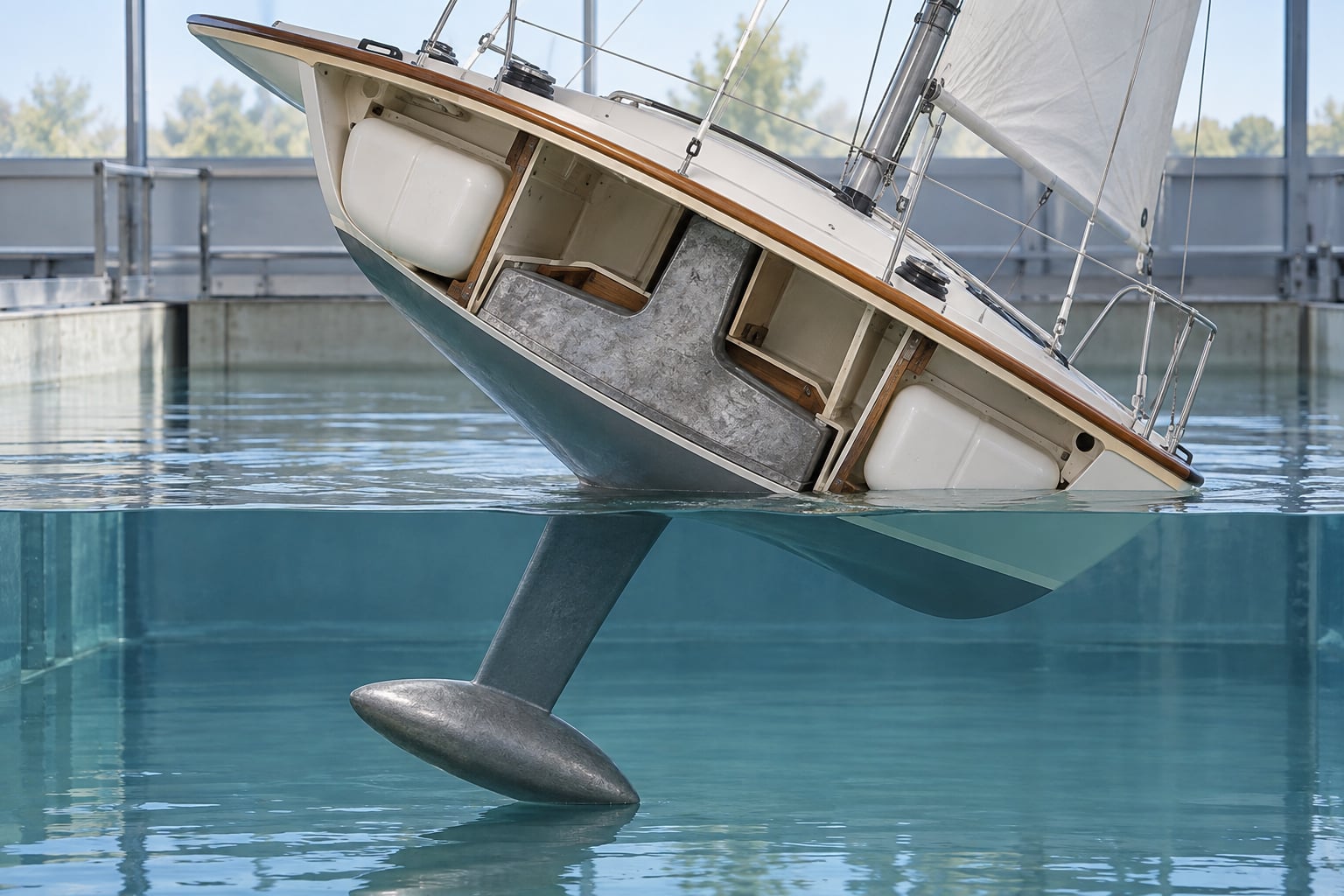
- Weight pulls down through the center of gravity, which sits low in a well-ballasted boat — usually in a ballast keel hanging below the hull.
- Buoyancy pushes up through the center of buoyancy, which shifts toward the immersed, leeward side as the boat heels.
- The righting arm (GZ) is the horizontal offset between the two points, and it grows as the boat heels until the shape of the hull stops helping.
- Righting moment equals displacement multiplied by GZ, and it is what accelerates the boat back toward upright once the capsizing force is removed.
Plot GZ against heel angle and you get the righting arm curve, the single most useful document in stability work. It rises from the origin, usually peaks somewhere between 30 and 60 degrees, and then falls back to zero. That second zero is the angle of vanishing stability, and it is the number a designer is really hunting for.
Below that angle the curve is positive and the boat wants to come back. Above it, GZ is negative, meaning the hull is stable inverted — it is trying to stay that way. Any competitor that stops at the definition misses this: self-righting is a statement about the tail of the curve, not the peak.
Reserve buoyancy and where the volume sits
The other geometric lever is how much displaced volume remains available when the boat is on its side or upside down. This is reserve buoyancy, the unused capacity of air-filled structure above the waterline at rest. A deep, narrow hull has little of it. A buoyant capsule or a catamaran hull has a lot, and that is why air-filled volume is the first thing designers reach for on uncrewed craft that must recover with nobody aboard to help.
Worked example: a small keelboat at two heel angles
Take a 1200 kg displacement prototype with a ballast keel. At 20 degrees of heel, a typical GZ of 0.18 m gives a righting moment of 1200 kg multiplied by 9.81 m/s², so about 2120 N multiplied by 0.18 m, which comes to roughly 380 N·m. Now push it to 70 degrees, where the hull has flared a lot and the bulb is fully exposed: if GZ is still 0.24 m, the righting moment rises to about 570 N·m.
Now flip it upside down. Inverted, the keel’s weight hangs above the buoyancy of the hull, G goes negative, and unless the deck structure or an air chamber puts enough buoyancy up high, the curve crosses zero and the boat stays there. That is the whole test in three numbers, and it is why “low center of gravity” is an incomplete answer to what makes a boat self righting.
How Does Center of Gravity Affect Self-Righting?
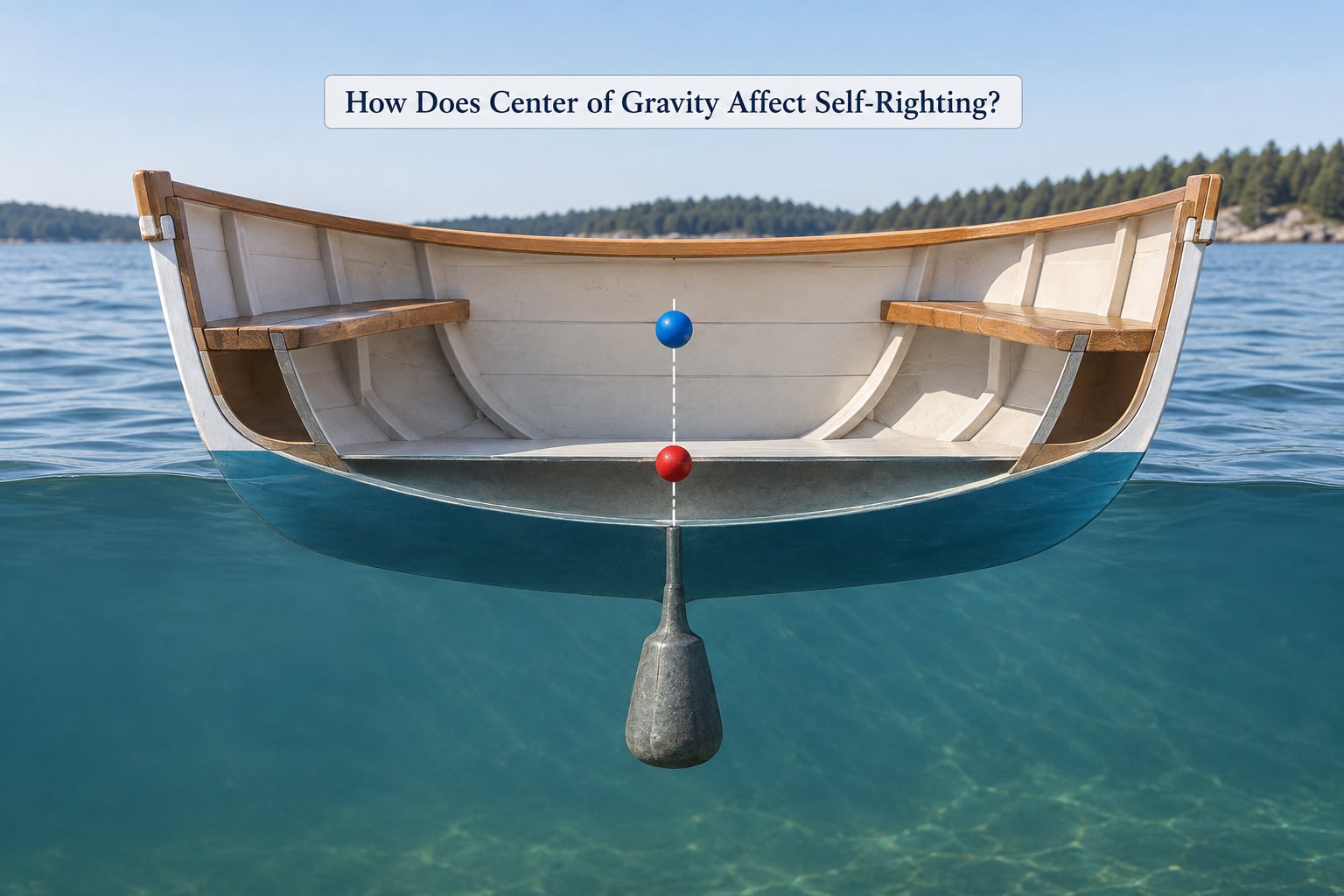
Center of gravity position is the single most powerful lever a designer has, and it works in two directions at once. Dropping G vertically gives initial stability: the boat feels stiff and comes back quickly from small angles, which is measured as metacentric height. That is the part everyone notices when they first get aboard.
Moving G horizontally away from the centerline does the opposite, and this is where the confusion lives. A keel hung low and directly under the hull keeps G near the centerline even when the boat is over, so as the hull heels the weight vector stays nearly plumb and contributes almost nothing to the righting moment. A fixed weight far out on a wing or at the end of a long dinghy keel swings out to leeward and pushes the boat further over.
Both effects are real, and they are why a boat can be stiff, pleasant to sail, and still not be self-righting. The vertical position of G controls how hard the boat works against a small heel. The horizontal position of G at large heel controls whether the boat wants to keep going or come back.
Watch what happens to the same hull with different loading. Two crew sitting to leeward for a race start effectively move G to leeward and reduce the righting moment at the exact moment it is needed. Stowing gear in lockers low and centered, and keeping the crew’s weight near the centerline, are free stability.
Angle of loll is the other side of this. A boat with a high center of gravity and enough buoyancy can sit at a steady heel angle instead of rolling upright, because the righting curve passes through zero early and the boat balances in the trough. It looks like a rigging fault, and it is not — it is a weight distribution problem, and no amount of reefing will fix it.
How Do Ballast and Weight Distribution Help?
Ballast does three jobs at once: it puts weight low, it adds displacement for that weight, and it moves the center of buoyancy of the hull relative to the center of gravity. How you choose it changes the failure modes.
Fixed ballast keel. A lead or cast-iron bulb on a fin keel. This is the classic ocean-going arrangement and it is the most forgiving: nothing shifts, nothing leaks, nothing moves in a seaway. Its costs are draft, drag and the labor of handling the boat with a crane.
Liquid ballast. Water in a tank or a flooded ballast chamber. It can be adjusted and it is cheap, but a tank with a free surface introduces the free surface effect: liquid moving to the low side shifts the effective center of gravity toward the centerline, cancelling a real part of the righting arm. A tank that is full, baffled, or divided into small cells is not free surface, and the difference between those three conditions is the difference between ballast and a liability.
Moveable ballast. A daggerboard, a wing keel that swivels, a jib winch run to the opposite side, or crew piling onto the windward deck. This is active righting, and it is how racing catamarans recover from a knockdown. The limitation is that it needs a crew, so it stops working exactly when the crew is cold, hurt, or holding on for dear life.
Distributed fixed weight. Batteries low and centered, a fuel tank in the bilge, tooling stowed down below. Cheap, silent, always there, and often the best answer for an uncrewed surface vessel where nothing can be adjusted at sea.
The recurring theme is that ballast is not one decision but two. How low it sits determines the initial stiffness. How it is constrained determines whether it still counts when the boat is at 100 degrees, which is the only angle that matters for self-righting.
What Hull Shapes Are Best for Self-Righting?
Hull form decides the shape of the righting arm curve, and the relationships are counter-intuitive enough that a lot of people get them backwards. Wide does not automatically mean self-righting. It means more initial stability, up to a point.
Here is how the common features affect recovery:
| Hull feature | Effect on self-righting | Watch out for |
|---|---|---|
| Low ballast keel | Keeps G low and near the centerline; the single most reliable recovery mechanism | Draft, drag and handling weight |
| Wide beam | Large initial stability and a broad, buoyant shape when inverted | Beyond a certain width it capsizes easily and has less reserve buoyancy when inverted |
| High freeboard and high sides | More reserve buoyancy and a greater downflooding angle | More windage, which can hold the boat over |
| Tumblehome (sides leaning inboard) | Loss of waterplane area as the boat heels, so the righting arm peaks early and falls away | Worse for self-righting than a flared or vertical topside |
| Flared or vertical topsides | Waterplane area holds up as the boat heels, extending the curve toward 90 degrees | Spray and cockpit flooding in a seaway |
| Enclosed capsule or enclosed cockpit | Large air-filled volume that stays buoyant when inverted; common on rescue craft and uncrewed vessels | Volume lost to any leak or open hatch |
| Watertight bulkheads and a self-bailing cockpit | Stops progressive flooding, which is the most common cause of a failed recovery | Bulkheads only work if they are actually sealed and stiffened |
The counter-case worth dwelling on comes from the top-ranking forum discussion on self-righting design, where designers point out that some boats with extreme beam actually reduce or defeat self-righting. The reason is that a very wide, shallow hull has a lot of buoyancy near the centerline and very little weight far from it. Past about 90 degrees, that broad shallow shape is no longer an advantage, and the boat has already spent its reserve buoyancy getting there.
Recovery thresholds also differ by vessel type, and the numbers are more useful than adjectives:
- Self-righting lifeboats are specified to return upright from roughly 90 degrees of tilt, typically using a wide triangular hull plan with multiple air chambers.
- Cruising monohulls turn over somewhere around 120 to 135 degrees of knockdown, which is why 131 degrees keeps coming up as a practical threshold in owner discussions.
- Racing catamarans and full-inversion designs are engineered to recover from a complete 180 degrees, mast pointing straight down.
- Uncrewed surface vessels in ocean robotics are commonly required to self-right after a full 180-degree rotation, because no crew is present to help and the vehicle may be upside down for hours before anyone notices.
Why Does a Self-Righting Boat Sometimes Fail to Recover?
A boat that rights itself in a spreadsheet and stays inverted at sea has usually lost to one of a small number of things. In rough order of how often I see them, they are:
Progressive flooding. A downflooding point is an opening — an open locker, a companionway hatch, a scupper, a bilge pump outlet — that lets water in once the boat heels past a certain angle. Each compartment that fills stops contributing its share of reserve buoyancy, and the loss accumulates until the righting arm curve flattens out.
Free surface effect. Loose water in a flooded hull or an unfilled ballast tank shifts its effective center of gravity to the centerline every time the boat rolls, cancelling righting moment precisely when it is needed. A swamped open boat often will not right no matter how much lead hangs off it.
Windage. Tall topsides, a mast with a furled or bent spar, a cabin full of standing water, an open hatch — all of it pushes against the wind on the wrong side of the center of gravity. A self-righting boat with a lot of windage and no crew on deck has to overcome an external force that does not go away just because the boat is stable.
A high center of gravity. Crew on deck, a raised flybridge, stacked gear, a heavy engine high in the frame. This is the one owners control directly, and it is the most common reason a boat that rights at 30 degrees of heel will not right at 150.
Angle of loll. The boat settles at a stable intermediate heel, often on one tack, and never generates a moment to pass back through upright.
Snagging. A keel, rudder, mast or antenna buried in a wave crest or caught on debris can hold the hull at an angle no righting moment can clear. This is the failure mode that no amount of design work removes, and it is why an offshore self-righting design still carries a sea anchor and a manual recovery plan.
The general lesson is that theoretical stability and real stability are different quantities. A model says the righting moment is positive at 170 degrees. The sea says there is a 40-knot gust on the backstay at the same moment. The gap between those two statements is where capsize rescues come from.
How Do You Test Whether a Boat Is Self-Righting?
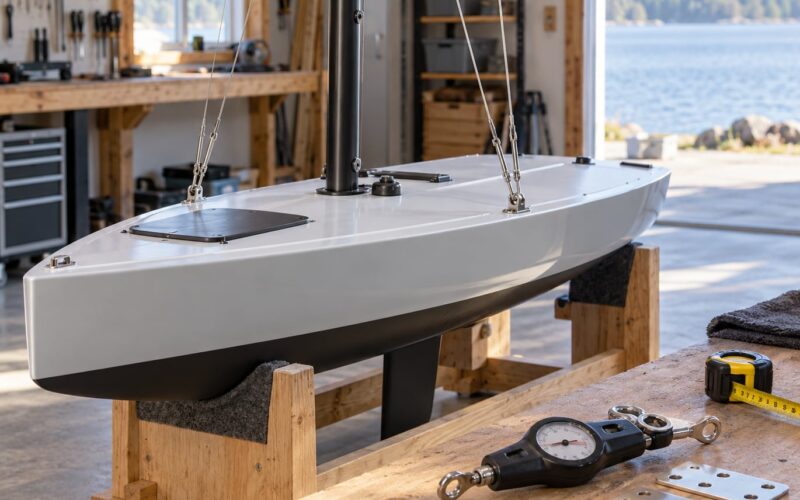
Never test this by capsizing a boat full of people in open water. Every proper protocol I know of, from the offshore racing rules to the trials used on ocean robotics, does it in a tank, in sheltered water, or by simulation first. A staged approach for a small prototype looks like this.
1. Do a mass and balance audit first. Weigh every item you intend to carry, including tools, batteries, fuel and spares, and calculate the loaded center of gravity. Most failed designs are failed here, before anyone gets the hull wet, because a builder never added the weight of the electronics.
2. Measure or compute the righting arm curve. In a tank, heel the boat in small increments, from upright through 20, 40, 60, 90, 120, 150 and 180 degrees, and record the restoring moment at each step using a load cell, a spring scale or a known ballast moment. A smartphone inclinometer plus a cheap force sensor is enough to find the zero crossings, which are the angles that matter.
3. Confirm the inverted attitude is unstable. Hold the boat at 180 degrees and let go. If it sits there without rolling back through vertical, the righting arm is negative inverted and the design has failed the self-righting test no matter how good the peak value looked.
4. Repeat it, and repeat it loaded. Run the test at least three times, because wave-like disturbances and surface tension create a real amount of run-to-run scatter near the zero crossings. Then repeat with the boat at its loaded condition, with tanks full, gear stowed in place, and a representative mass in the cockpit.
5. Test the failure cases deliberately. Add water to the lowest compartment, then to a tank, and watch how much righting moment disappears. Open a hatch at 90 degrees and see whether the curve collapses. These tests tell you more about survival than the clean upright run does.
6. Document everything. Record heel angle, restoring moment, ballast condition and hatch state for every run. A capsize trial that nobody wrote down is an anecdote, and the difference between an anecdote and evidence is the whole reason this design work gets taken seriously.
Self-Righting Boat Design Choices at a Glance
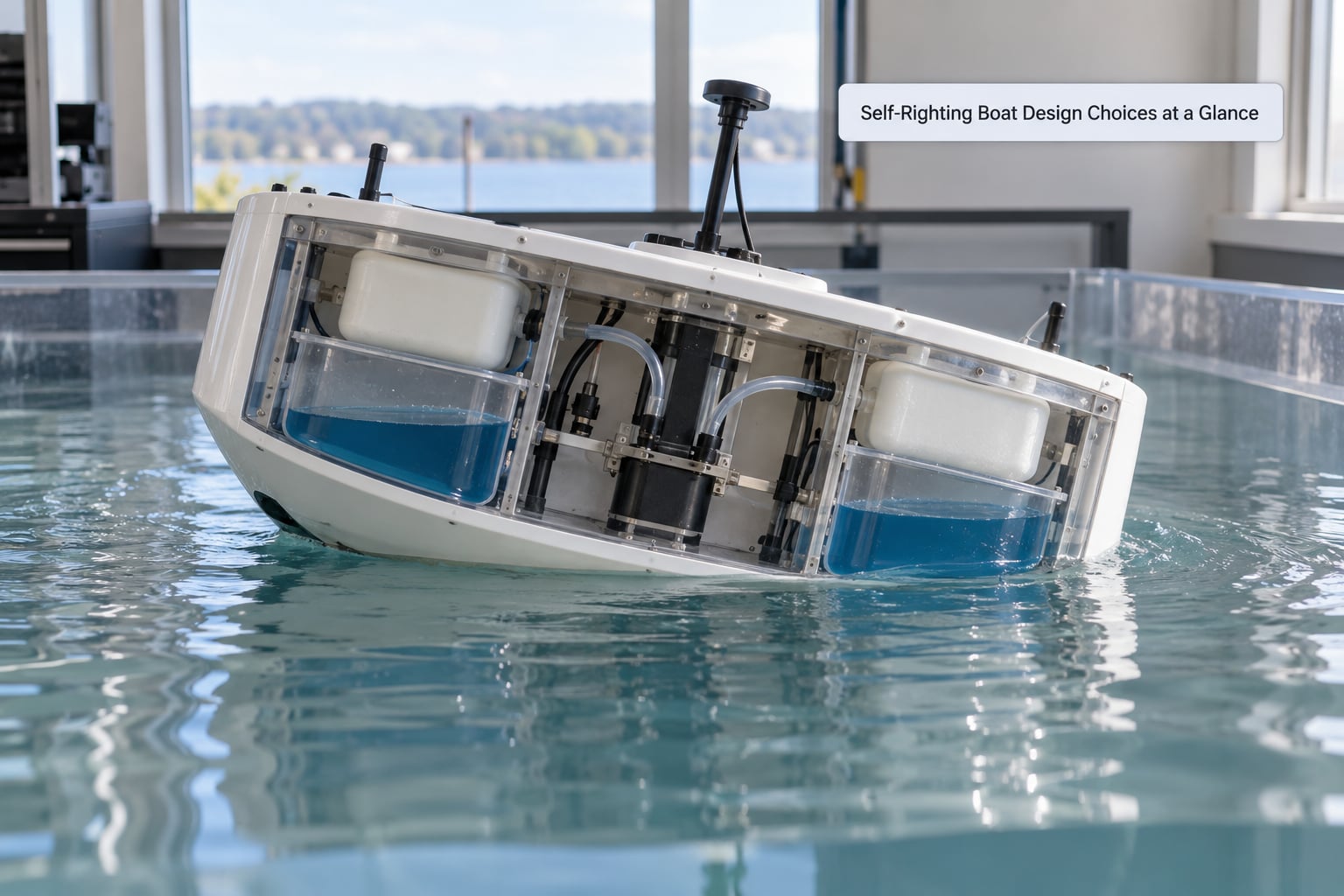
There are a handful of ways to buy yourself recovery, and they trade off differently. This is the comparison I would hand a student building a first prototype:
| Mechanism | Main benefit | Limitation | Best suited to |
|---|---|---|---|
| Ballast keel with a deep bulb | Largest, most predictable righting moment; nothing can move or leak | Draft, drag and ground handling cost | Cruising monohulls, ocean robotics hulls |
| Low fixed weight, distributed and secured | Cheap, silent, always present, no moving parts | Must be re-audited every time something is stowed | Uncrewed surface vessels, small prototypes |
| Wing or daggerboard ballast | Huge initial stability and dramatic knockdown performance | Ballast swings to leeward at large heel, reducing righting moment | Racing multihulls, keelboats, dinghies |
| Moveable ballast operated by crew | Active, powerful righting that can recover a fully inverted catamaran | Useless when there is no crew, which is the case that matters most | Team-raced catamarans, crewed racing |
| Enclosed capsule hull and air chambers | Large reserve buoyancy when inverted; recovers to 90 degrees or beyond | Any leak or open hatch removes the advantage | Rescue craft, lifeboats, workboats |
| Inflatable buoyancy bag | Cheap, stowable, deployable on demand after a capsize | Manual deployment, stored volume, inflation time | Coastal and racing safety equipment |
| Mast float and recovery ropes | Makes a mast-up capsize survivable and easier to escape from | Does nothing for an inverted hull | Solo sailors, RC and model craft |
| Watertight bulkheads and a self-bailing cockpit | Preserves reserve buoyancy through the whole recovery | Only works if seals, stiffeners and drains are maintained | Any offshore design |
For a typical small sailing robot or ocean drone, the winning combination is a low fixed weight, a fully enclosed hull with plenty of air volume, watertight internal divisions, and low windage, verified by a 180-degree tank trial with no crew aboard. That is the same shortlist an engineer at a robotics boat manufacturer works through, with many mass-and-balance iterations, until the righting arm never goes negative.
Frequently Asked Questions
Is a self-righting boat the same as a stable boat?
No. A stable boat resists heel and recovers from a knockdown, often somewhere between 50 and 80 degrees. A self-righting boat keeps a positive righting moment all the way through 180 degrees, so it recovers from a complete capsize with the mast pointing straight down. Plenty of boats are extremely stable and still sit inverted after going over.
What is the most important factor in making a boat self-righting?
Keeping the center of gravity low and near the centerline, so it stays under the center of buoyancy through the whole capsize. Weight low in a ballast keel is the most reliable mechanism there is. It is not sufficient on its own, though, because the hull also needs reserve buoyancy and the inverted attitude has to be unstable.
Can a boat with a high center of gravity still self-right?
Yes, if the hull has enough reserve buoyancy and the deck structure is sufficiently buoyant. A high center of gravity costs initial stability and slows recovery, so the design must carry more reserve buoyancy to compensate. Boats with heavy topsides, tall cabins and open cockpits usually manage small knockdowns but fail at 90 degrees or beyond.
Does adding more ballast always make a boat safer?
No. Ballast adds righting moment, but it also adds draft, drag and displacement, which hurts speed and handling. It can also make a boat harder to recover by hand after a capsize. Stability and performance pull in opposite directions, and the useful goal is the least ballast that delivers the recovery angle you actually need.
How much heel should a self-righting boat be able to recover from?
The requirement depends on the vessel. Fully enclosed lifeboats are typically specified to recover from about 90 degrees, cruising monohulls tend to turn over between 120 and 135 degrees, and catamarans and uncrewed ocean vehicles are commonly engineered to recover from a full 180-degree inversion. Always ask for the specific tested angle, not the phrase self-righting.
Can small sailing robots or ocean drones be designed to self-right?
Yes, and it is usually a design requirement rather than a bonus. Small autonomous craft have no crew to right them, so they rely on a low center of gravity, an enclosed hull with large air-filled volume, watertight internal compartments and low windage. The design is then verified by tank trials that confirm recovery from a full 180-degree rotation.
Conclusion
So, what makes a boat self righting? A positive righting moment that holds all the way to 180 degrees, which in practice means a center of gravity kept low and near the centerline, ballast that cannot shift when the boat is inverted, hull forms and freeboard that preserve reserve buoyancy, and as little windage as the vessel can get away with.
If you are evaluating a boat, work through those four in that order. Start with reserve buoyancy at 90 degrees, then look at where the ballast sits and what holds it there, then confirm the loaded center of gravity, and only then trust the brochure. And if you are building, prove it in a tank at staged heel angles, loaded, with the hatches open and the tanks full, because the design that fails is nearly always the one that was only ever tested upright.