A stuffing box is the fitting where the propeller shaft passes through the hull, and it works by squeezing soft packing material against the spinning shaft so the shaft turns freely while most of the water stays outside. A small, steady drip is not a fault. It is the water film that keeps the packing cool.
That is the short version of how a stuffing box works: a compressible packing is loaded into a housing, a nut presses it inward against the shaft, and the gap that remains lets a trickle of water through for lubrication. Everything else on a boat of this type exists to control that gap.
Owners usually meet the term in one of two situations: a boat is taking on more water than it should below the waterline, or a repacking job comes up at haul-out time. Both come back to the same two questions, which packing is in there and how tightly is it set.
Table of Contents
- What Is a Stuffing Box and How Does It Work?
- How a Stuffing Box Works Step by Step
- What Parts Make Up a Stuffing Box?
- Why Does a Stuffing Box Leak Water?
- What Is Stuffing Box Packing Made Of?
- How Much Should a Stuffing Box Leak?
- How Do You Adjust or Replace Stuffing Box Packing?
- What Problems Can Occur in a Stuffing Box?
- How a Stuffing Box Differs from a Shaft Seal
- Frequently Asked Questions
- What to Do First
What Is a Stuffing Box and How Does It Work?
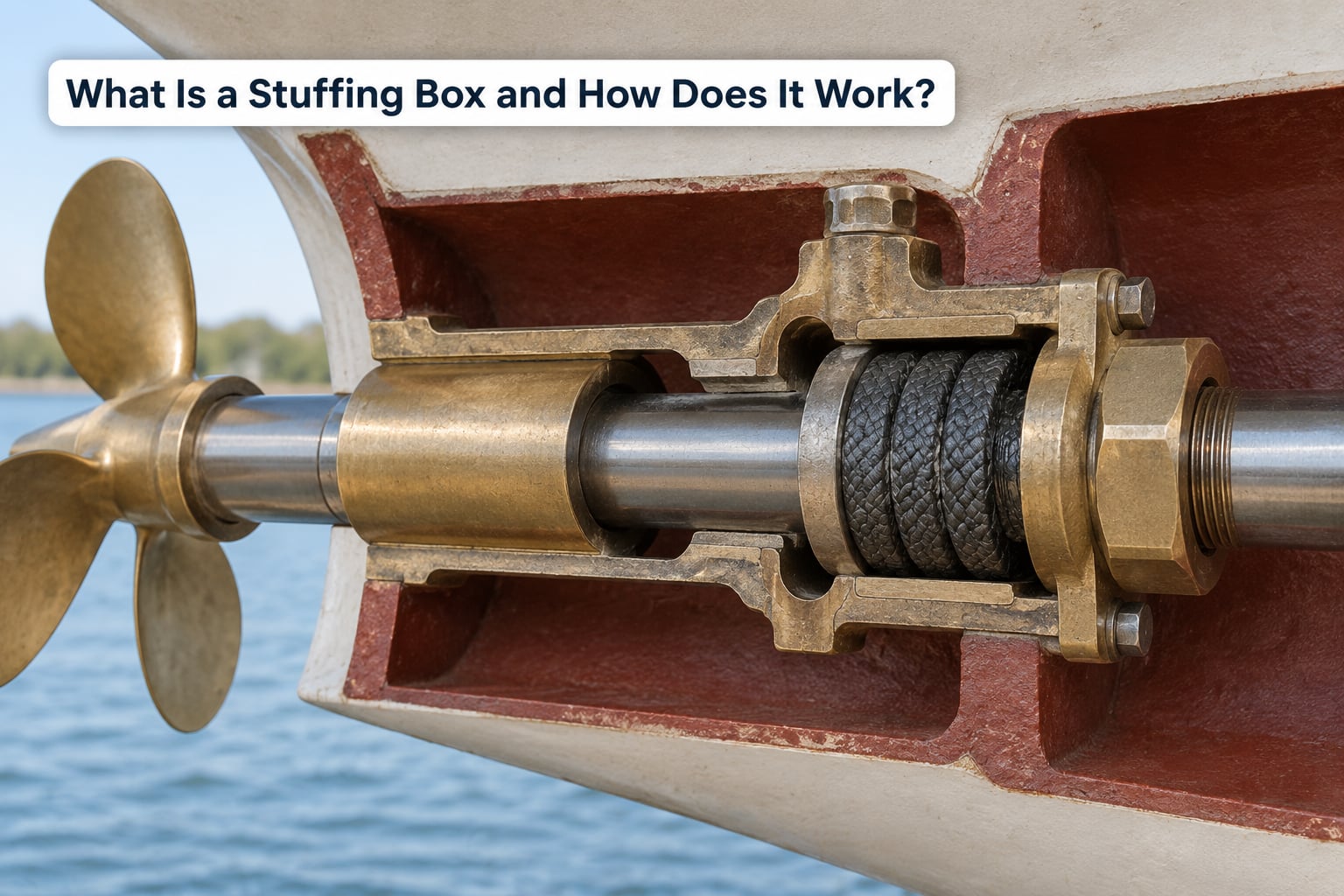
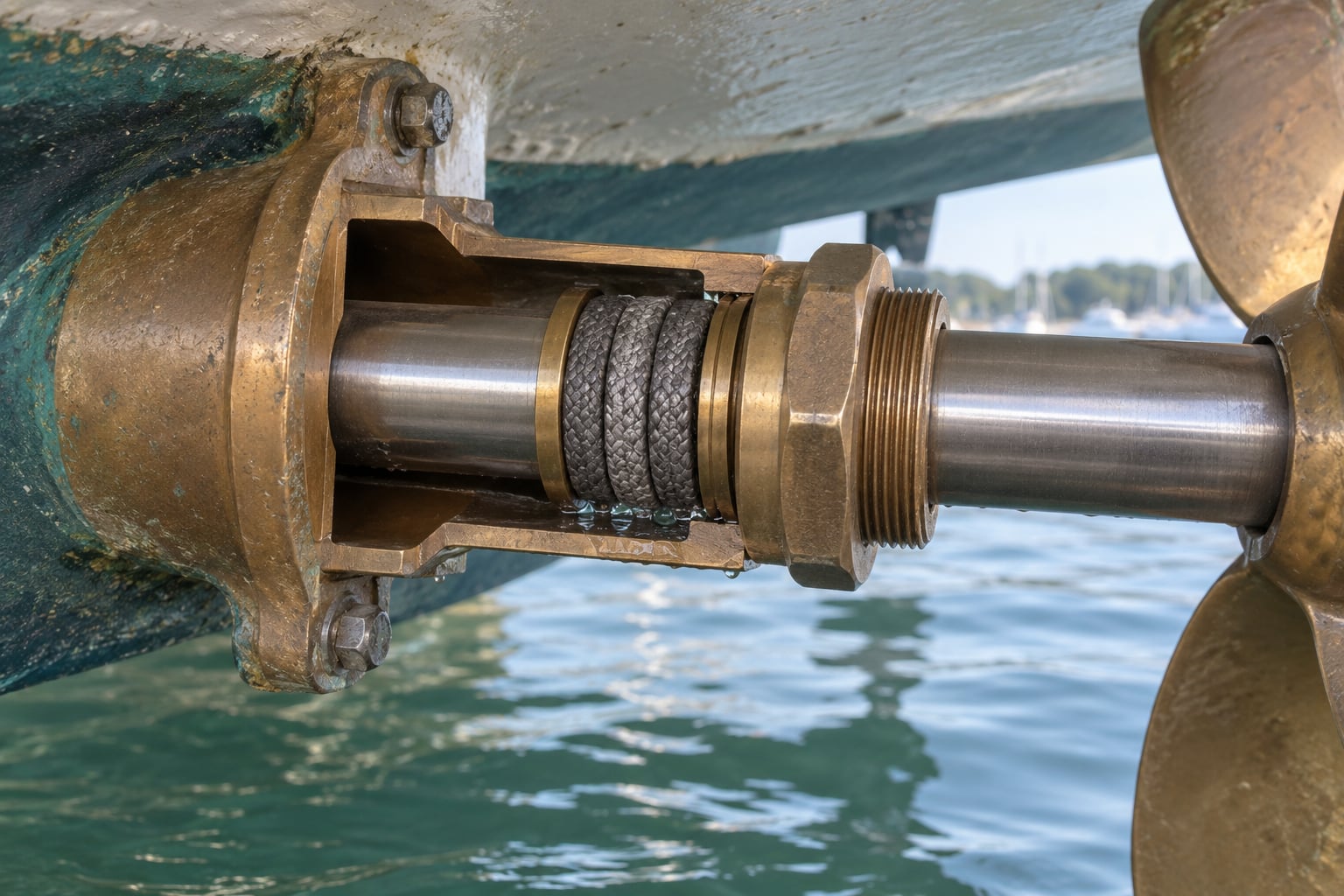
A stuffing box is a mechanical seal built into the hull around the propeller shaft. The propeller turns the shaft, the shaft passes out through the stuffing box housing, and a ring of packing material sits between the shaft and the inside wall of that housing. Tightening the gland nut compresses the packing inward until it grips the shaft hard enough to slow the water down without stopping the shaft.
In plain terms: the shaft is the moving part, the packing is the squeezable filler, and the nut is the adjustment. Nothing in the design intends a dry, metal-on-metal seal, because two hard surfaces rubbing at shaft speed generate heat fast.
On most inboard boats the assembly sits at the forward end of the stern tube, just inside or just aft of the hull, and it is supported by a cutlass bearing in the shaft log. On larger vessels the same principle is scaled up, sometimes with a shaft liner between the packing and the shaft.
How a Stuffing Box Works Step by Step
The sequence is worth following in order, because each step explains the next one.
Why a stuffing box works better with a little water
When the shaft turns, the packing and the shaft surface rub against each other. Friction between two dry surfaces builds heat quickly, and packing that gets too hot glazes, hardens and wears. A thin stream of seawater enters through the gap, wets both surfaces, and forms a lubricating film that carries the heat away.
So the water you see dripping into the bilge under way is doing a job. A sailor on the SailboatOwners forum described the effect plainly: their drip rate was around one per second with the engine running and dropped to roughly one every half a minute at rest, because a cold shaft sits still and takes up very little water.
What the packing gland nut actually controls
The gland nut sets how much packing compression exists, and compression sets how tight the gap is. Turn the nut a fraction tighter and the packing presses harder on the shaft, which slows the water and increases friction. Loosen it and more water passes through.
The same nut also sets how much torque it takes to turn the shaft. That is the useful signal an owner has: a stuffing box adjusted correctly lets the propeller turn with the same effort as it did at the dock yesterday. If it suddenly feels hard, the packing is too tight or contaminated.
Water also cools the packing and the bearing ahead of it, which is why the shaft log on many boats is supplied with raw water through a hose and clamps. On faster shafts that flow has to be generous, because the heat has to go somewhere.
What Parts Make Up a Stuffing Box?
The terminology varies between builders, so it helps to know the pieces by more than one name.
| Part | What it does |
|---|---|
| Stuffing box housing | The bronze or stainless body bolted or welded into the hull; holds the packing chamber |
| Packing gland (packing nut) | The threaded nut that compresses the packing inward against the shaft |
| Locking nut | A second nut that jams the gland nut so it cannot turn in service |
| Packing | The compressible rings, usually flax fibre, PTFE-impregnated or graphite |
| Propeller shaft | The rotating steel, bronze or stainless shaft passing through the seal |
| Stern tube and shaft log | The tube and bearing housing that carry the shaft from the engine to the propeller |
| Cutlass bearing | The sacrificial bearing in the log that supports the shaft and takes the propeller thrust |
| Cooling hose and clamps | Feeds raw water through the log to the stuffing box on many installations |
| Flange or liner | Mounting hardware, and on large shafts a liner protecting the shaft surface |
Two of these parts get confused more than the others. The packing gland is the part that does the sealing. The cutlass bearing does no sealing at all; it carries the weight and the thrust, and when it wears, the shaft drops and starts running off centre, which a stuffing box cannot compensate for.
Why Does a Stuffing Box Leak Water?
A stuffing box leaks because it is designed to. The packing is compressed against a shaft that rotates at thousands of revolutions per minute and expands as it heats up, so a hole that would be sealed at the dock opens slightly under way. The design tolerates that small flow and relies on the bilge pump or a manual pump to handle it.
How much water comes through depends on three things: shaft diameter, shaft speed, and how tightly the packing is set. A larger shaft has more surface to seal and usually runs slower, so the flow is typically modest. A fast shaft running hot and long needs more water, not less.
Leakage stops entirely once the engine is off and the shaft cools, because contraction closes the gap. If a boat leaks heavily with the engine cold and stopped, that points to something other than normal operation: packing that has hardened, a gland nut that has loosened, a shaft that has worn oval, or a packing nut that was never tightened after reassembly.
Two other causes get missed. A shaft that is out of true will chafe the packing and cut a groove in it, so the leak returns seconds after every adjustment. And air trapped in the shaft log can reduce the cooling flow, which cooks the packing until it no longer seals at all.
What Is Stuffing Box Packing Made Of?
Packing comes in a handful of materials, and the choice affects how the box behaves far more than most owners expect.
| Material | Strengths | Limitations |
|---|---|---|
| Fibre packing (flax, cotton) | Soft, forgiving, easy to install, cheap to replace, self-adjusting | Swells when wet, hardens with heat, needs periodic replacement |
| PTFE-impregnated fibre | Better chemical and heat resistance, less swelling, smoother shaft surface | Firmer to install, needs correct size, can glaze if run dry |
| PTFE yarn (Teflon-type) | Long life, resists most chemicals, very low friction | Poor at holding water back on a shaft that moves, easily installed too tight |
| Flexible graphite | Excellent high-temperature resistance, common in industry | Can contain metallic additives that corrode a shaft; warnings apply, see below |
| Mouldable packing | Meant to seal without adjustment once installed | Can soften and shed inside the housing when it overheats |
Fibre packing remains the default on most recreational boats because it is forgiving. Aboard a lot of cruising boats the packing gets replaced every haul-out, sometimes sooner in warm water, and nobody thinks about it again.
Graphite-extruded packing deserves its own caution. ABYC P-6 and shaft manufacturers have warned that graphite packing containing metallic lubricants can attack a bronze or stainless shaft through galvanic action, leaving measurable wear in a single season. One long-running test documented on MarineHowTo recorded about 0.05 inch of shaft loss with the anodes healthy and in place. Read the product data sheet before fitting it, and never assume it is interchangeable with fibre packing.
How Much Should a Stuffing Box Leak?
There is no universal number, because shaft sizes, speeds and packing materials differ widely. Boat builders publish a drip rate for a specific model, and that figure is the reference to use. In general terms, the guidance in circulation is a few drops per minute with the engine running and under way, and a slow drip or an occasional trickle while under way at cruise.
Temperature is often a better guide than counting drops. Feel or measure the housing with an infrared thermometer and compare it with the surrounding water. If the stuffing box runs more than roughly 20 degrees Fahrenheit above the water, the seal is too tight, the cooling flow is weak, or air is trapped in the log. Practitioners who log these temperatures over years describe how quickly an adjustment problem announces itself as heat.
Some practical checks:
- Watch the drip with the boat at rest for a minute or two, then again under way at cruise. A large difference is normal and comes from shaft expansion.
- Note whether the flow increases after the boat sits for a while. Extra water after a stop often means worn packing that has taken a set.
- Look at the shaft where it exits the housing. A shiny bright band is fine. A dull scored patch means the shaft is rubbing unevenly.
- Compare against the builder’s manual for the model rather than a generic chart. Manuals and experienced owners sometimes disagree on packing size, and when they do, follow the advice of someone who has run that boat.
How Do You Adjust or Replace Stuffing Box Packing?
Adjustment is a small job. Repacking is a haul-out job on most boats, and on any boat where the stuffing box sits below the waterline in a tight, enclosed space it is work for someone comfortable with the layout.
Adjusting the packing gland
With the engine off and the boat level, back the packing nut off slowly until the drip increases noticeably, then bring it down in small increments until the flow returns to the builder’s figure. Snug it by hand first, then use a wrench only to take up the remaining play. The locking nut has to be loosened before the gland nut and retightened afterwards.
Replacing the packing
The general sequence is the same nearly everywhere: secure the boat and de-energise, relieve the pressure and take the strain off the nut, loosen the locking nut and gland nut, wind the old packing out with a packing hook or extractor, inspect the shaft and the housing, cut and stagger the new rings, reinstall with even hand pressure, then snug the gland nut back down and set the drip rate.
A few details that matter more than they sound. Cut each ring with a clean square butt joint and stagger the seams around the circumference so water cannot follow one line. Pack the chamber evenly with a tool that reaches the bottom rather than pushing material into one side. And keep the replacement packing the correct size for the shaft, since undersized packing will not reach the shaft and oversized packing sets up uneven compression.
Two safety points. Repacking a stuffing box that is underwater is not a casual job; a loose nut on a boat sitting in water can open the hull faster than a pump can answer, which is why most owners do it in a yard with the boat hauled out. And if the nut will not move, work at it gradually with penetrating oil and the correct wrench rather than a cheater bar, because a rounded nut on a bronze housing is a much bigger job than the packing ever was.
Any boat whose stuffing box is in a hard-to-reach location, or where the shaft shows scoring, belongs with the boat builder, a marine surveyor or a yard technician. Follow the builder’s manual where it exists, and treat advice from a forum as a useful second opinion rather than a substitute for looking at your own installation.
What Problems Can Occur in a Stuffing Box?
Most failures trace back to heat, wear or an adjustment that was never made. The warning signs are worth knowing in advance.
- Excess leakage. More than a few drops per minute under way, or a stream at rest, usually means hardened packing, a loose gland nut, or a shaft worn out of round. If tightening it does not hold for more than a short run, the packing is spent.
- Overheating. A housing that is hot to the touch, packing that smokes or smells, or a sudden temperature jump when the boat takes a hard roll points to air trapped in the shaft log cutting off the cooling flow.
- Shaft scoring. A groove in the shaft surface can come from overtightening, from the wrong packing size, or from running with no water through the seal. Deep scoring is usually a shaft replacement, and on a large vessel it is an expensive one.
- Loose or damaged gland nut. A gland that rocks, has stripped threads or has a damaged face will not hold pressure consistently, no matter how the packing is set.
- Corrosion. Bronze housings and stainless shafts in an electrolytic pairing can develop crevice corrosion at the shaft-to-housing gap, especially where oxygen cannot reach. Anodes protect the shaft, not the fit of the packing.
- Failed cooling hose. A perished hose or a missing second clamp quietly starves the packing of water, and the symptom looks like an adjustment problem rather than a plumbing one.
Air entrapment deserves its own note. Wave action and reverse blows can push air into the shaft log, where it sits and blocks flow. When the air clears, the temperature can spike sharply in seconds. Several years of logging on MarineHowTo recorded a string of these events, and they are a strong argument for checking the flow with the boat moving in a seaway rather than only at the dock.
Because the packing box sits where the shaft leaves the hull, water entering there is easy to overlook until the bilge pump runs continuously. A float switch or a simple alarm in the bilge is worth more than most owners expect.
How a Stuffing Box Differs from a Shaft Seal
A mechanical shaft seal replaces the packing with a rotating face. Instead of fibre pressed against a shaft, a stainless steel rotor turns against a carbon or ceramic ring held in a rubber bellows, which flexes as the shaft moves. Sealing happens at the two faces rather than in a ring of rope.
| Point of comparison | Traditional stuffing box | Mechanical dripless shaft seal |
|---|---|---|
| How it seals | Compressed packing against the shaft | Two machined faces rotating against each other |
| Leakage | A few drops per minute by design | Very little to none when running |
| Routine maintenance | Repack at least once a season, often more | Bellows replaced occasionally, no packing to change |
| Break-in | None, it works immediately | Needs a controlled run-in period |
| Failure mode | Leaks, overheats, scores the shaft | Bellows perishes, seal weeps, carbon face wears |
| Sensitivity to alignment | Moderate | High; misalignment shows up fast |
| Best suited to | Older boats, low power, budget owners | New builds, high power, offshore use |
Owners upgrading to a mechanical seal need to know about one extra step. After the boat comes out of the water, air sits in the bellows and the seal will not cool. Most manufacturers specify a burping or bleeding procedure to push that air out before running, and skipping it is the most common cause of a dripless seal that fails in its first season. The manufacturer’s instructions for that specific model are the authority here, not a general rule of thumb.
For a boat that already has a serviceable stuffing box, the honest summary is that the traditional box is cheap to keep and needs constant attention, while the mechanical seal costs more up front and asks for less of your time.
Frequently Asked Questions
How often should a stuffing box drip?
With the engine running and the boat underway, a few drops per minute is normal and necessary. The water lubricates and cools the packing. A trickle at rest is also normal, because a cold shaft sits still and takes up little water. Your boat’s builder publishes the exact figure for the model, so use that as the reference.
How do you adjust a stuffing box?
Loosen the locking nut first, then back the packing gland nut slowly until the drip increases, and bring it down in small steps until the flow matches the builder’s figure. Snug by hand before using a wrench, and retighten the locking nut afterwards. If the shaft suddenly turns harder, stop and loosen it; friction is the signal you overdid it.
Why does my stuffing box drip more under way than at rest?
A running shaft expands from heat and vibrates very slightly, both of which open the gap the packing cannot fully close. Many owners have measured a rate around one drop per second underway falling to a slow trickle at rest. The same happens when a cold boat starts and the packing has taken a set from sitting.
Can I repack a stuffing box while the boat is in the water?
It is not recommended. Once the gland nut comes off, the hull is open to the sea, and most boats cannot pump faster than the sea fills them. Repack with the boat hauled out, or have a yard technician do it. On a boat that must be done in the water, expect to need a plug or a diver and treat it as a serious job.
Why did my packing nut seize and will it come off?
Corrosion between the gland nut and the housing is the usual cause, especially in salt water or on an old bronze housing. Work at it patiently: soak it with a penetrating oil, tap the wrench lightly, and use a strap wrench that fits well. Avoid cheater bars and excessive force, because a rounded nut on a bronze housing is a far bigger job than the packing.
Can I use graphite packing in my stuffing box?
Only if the manufacturer says so for your shaft material. Flexible graphite can carry metallic additives that act electrochemically against bronze or stainless shafts, and both ABYC P-6 and shaft manufacturers have warned about it. Reports describe measurable shaft wear within a single season with healthy anodes in place. Check the data sheet before fitting it.
What to Do First
Watch the drip for a minute at the dock and again under way at cruise, and feel the housing against the surrounding water. That gives you a baseline for your own boat in about five minutes, and almost every complaint later turns into a comparison against it.
If the drip is far too fast, loosen the locking nut and ease the gland nut down a fraction at a time until the rate settles back. If the rate is right but the housing is hot, check the cooling hose and its clamps before touching the packing at all. And if the packing itself is due, book the repack for haul-out rather than doing it in a hurry.