To find the center of gravity on a boat, float it level in still water and find where it balances fore and aft, then repeat the test out of the water with the hull supported on a single narrow edge and slide a known weight until it stops tipping. Read the two answers together and you have the longitudinal center of gravity in about an afternoon, with nothing more exotic than a tape measure, a known test mass, and a flat surface.
That is the honest answer, and it is more useful than the shortcut most of the internet offers. A lot of advice in circulation points at the engine mount, the lifting eye, or the fuel tank and calls that the center of gravity. It works right up until you move a battery or add a hardtop, at which point it is simply wrong.
Before you touch a tape, decide which of three numbers you actually want. Boats have a longitudinal center of gravity (fore and aft, usually written LCG), a vertical center of gravity (height above the keel, VCG or KG), and a transverse center of gravity (side to side, TCG). The flotation test gives you the first, the cradle test confirms the first, and the pendulum timing gives you the second. The third, for a symmetric hull, is the centerline.
Table of Contents
- What You Need
- Step-by-Step
- Common Mistakes
- Frequently Asked Questions
- Can I find a boat’s center of gravity from its design drawings?
- What does it mean if my boat floats higher at the bow than at the stern?
- How does moving heavy gear affect a boat’s center of gravity?
- What is the difference between the center of gravity and center of buoyancy?
- Do I need to calculate the vertical center of gravity for a small boat?
- Why does my boat list to one side during the center-of-gravity test?
- Conclusion
What You Need
None of this is expensive, and most of it you already own. The parts that are easy to skip are the documented loading condition and the test weight, and those are the parts that decide whether the number means anything.
- The design plans or the builder’s weight schedule. Not to copy, but to compare against. If your measured LCG sits 20% of the boat’s length away from the design figure, one of the two is wrong.
- A loading record. A sheet of paper listing every item aboard with its weight and its position, measured from one fixed reference point. Pick the forward perpendicular at the stem, or the transom, and use the same one for every measurement that day.
- A supported level surface or a calm test basin. For the dry test, a sawhorse or boat stand carrying a length of 4 by 4 or a hardwood dowel. For the float test, a pool, a calm lake at dawn, or a sheltered harbour with no current.
- Weighing equipment. A bathroom scale works for loose items; a platform scale or a lift with a load cell works for the boat. Accuracy of a few pounds is plenty.
- A marked movable test weight. A gallon jug of water, a stack of concrete blocks, a dive weight, or a bag of sand. Know its weight to within a pound and know exactly where its center sits when you place it.
- An inclinometer or a level. A boat inclinometer, a digital level, or a phone with a level app. Any of these reads heel well enough for a trim and list check.
- A tape measure and a plumb bob. For distances fore and aft, athwartships, and for dropping a vertical line from a point on deck to find the centerline.
- Something to write on. A calculation sheet with columns for weight, distance, and product. The moment rule is trivial arithmetic and very easy to get wrong on a knee in a boat cockpit.
Step-by-Step
Prepare the Boat and Define the Test Condition
A center of gravity is not a property of the boat. It is a property of the boat plus everything in it, in a specific arrangement. The hull alone and the hull with two crew, full fuel, and a loaded ice chest are three different boats with three different answers, and comparing them is meaningless.
So write the condition down before you measure anything. I use a line for each of these: hull and installed gear, fuel, batteries, fresh water, ground tackle, ice chest, and each person by name and estimated weight. Then choose the condition you care about. For most trailerable boats that is the loaded condition on the water with a normal crew, because that is the trim you will actually live with.
Sum the weights. That total is your displacement in pounds or kilograms once the boat is floating, and it is the denominator for every moment calculation in this article. If you have a platform scale, weigh the whole boat in this condition instead of adding up the list, and use the list only to break out the individual items.
For the dry test, set the stand on level ground and confirm it with the level before the boat goes on it. A support that is off level by a degree will bias every reading you take, and it will bias them consistently, which is the worst kind of error because it is hard to notice.
How to Find the Center of Gravity on a Boat by Flotation
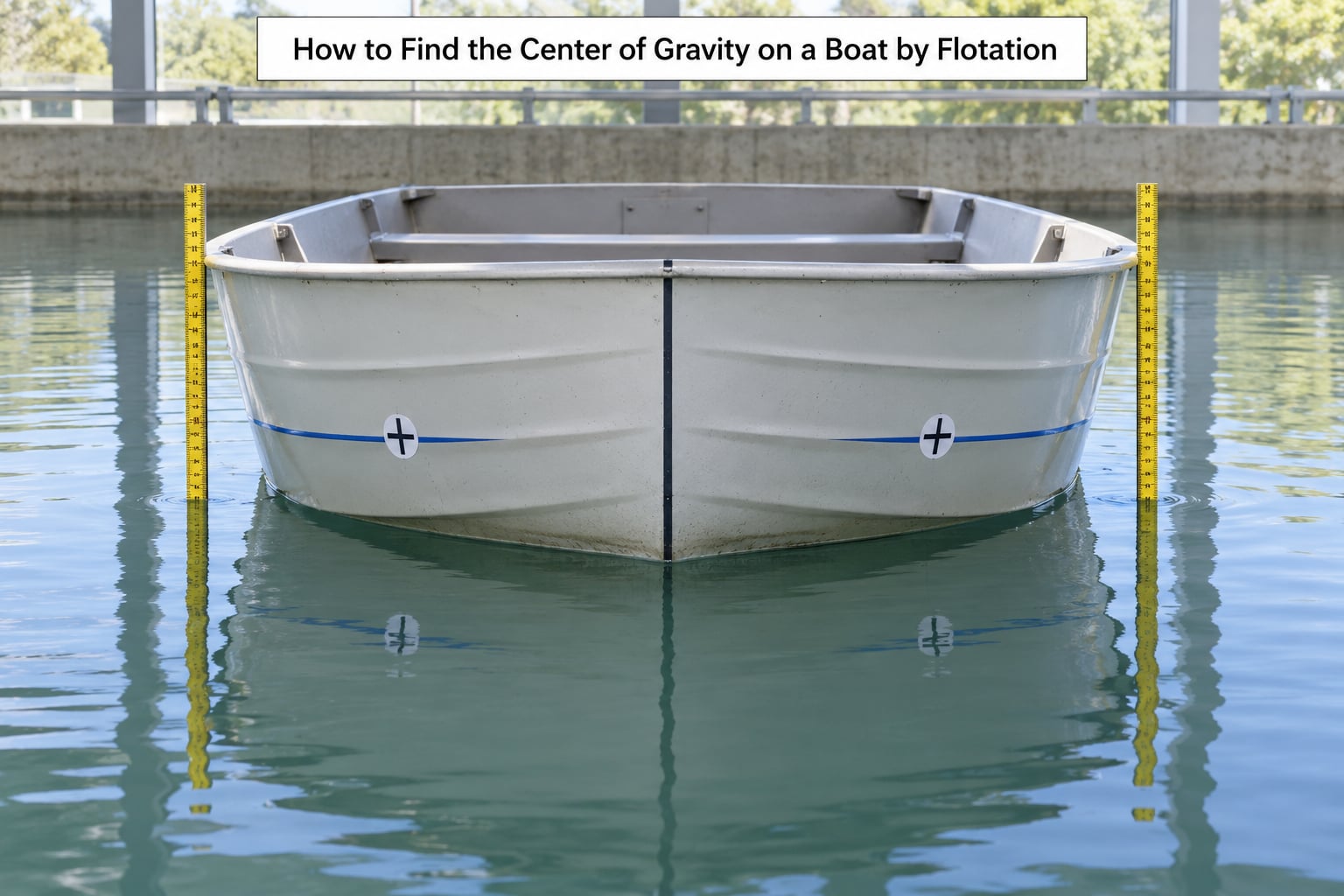
Float the boat in still water with an even keel and no wind or current on it. Mark the waterline at the stem, at midships, and at the transom on both sides, then measure the draft at each mark. If the port and starboard marks do not line up within a few millimeters, the boat is not floating even and you have a transverse problem, not a longitudinal one.
The boat floats where its longitudinal center of gravity sits directly above its longitudinal center of buoyancy, and in a level trim the center of buoyancy lies under the centroid of the waterplane. That centroid is the center of flotation. Measure it directly rather than guessing it from the hull shape.
Take the half-breadths of the waterplane at three or four equally spaced stations along the length. Treat each segment as a trapezoid, and compute the centroid as the weighted average of the segment midpoints:
Center of flotation = sum of (segment width × distance of segment midpoint from the reference) ÷ sum of segment widths
Do the arithmetic in plan view, not from the waterline stripe. A useful sanity check on a conventional hull with a fine entry is that the centroid should fall noticeably forward of midships, often around 35% to 45% of the waterline length from the bow, because the fine bow contributes almost no width.
That is your first estimate of the LCG. Now check it with a known load rather than trusting it. Place a test mass of known weight on the port side at a measured distance off the centerline, let the boat settle completely, and read the heel angle. The heeling moment is the weight times that distance. The boat must heel to port, and the amount it heels tells you whether the transverse waterplane is behaving the way the plan assumed.
Repeat on the starboard side. If the boat heels the same angle both ways, the transverse balance is sound. If the angles differ, something is loose in the bilge, or the hull is out of true, and that is a problem to fix before you read anything else off the boat.
To find the center of gravity on a boat accurately rather than approximately, the flotation test alone is not enough. It tells you where the boat wants to float, which is where the buoyancy acts, and that is only the same place as the weight when the two are in equilibrium. The cradle test below is what pins it down.
Check the Result with a Tilt Test
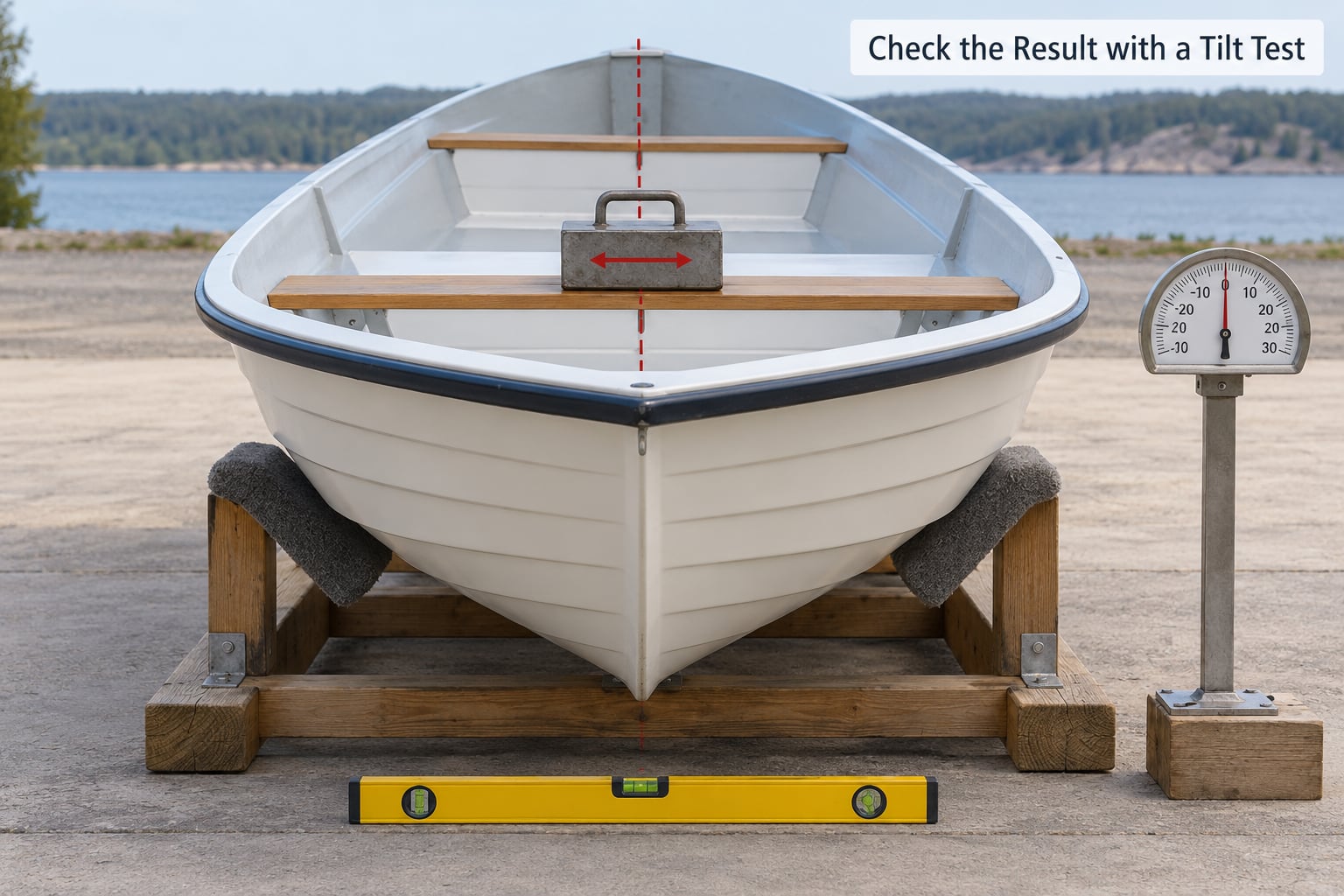
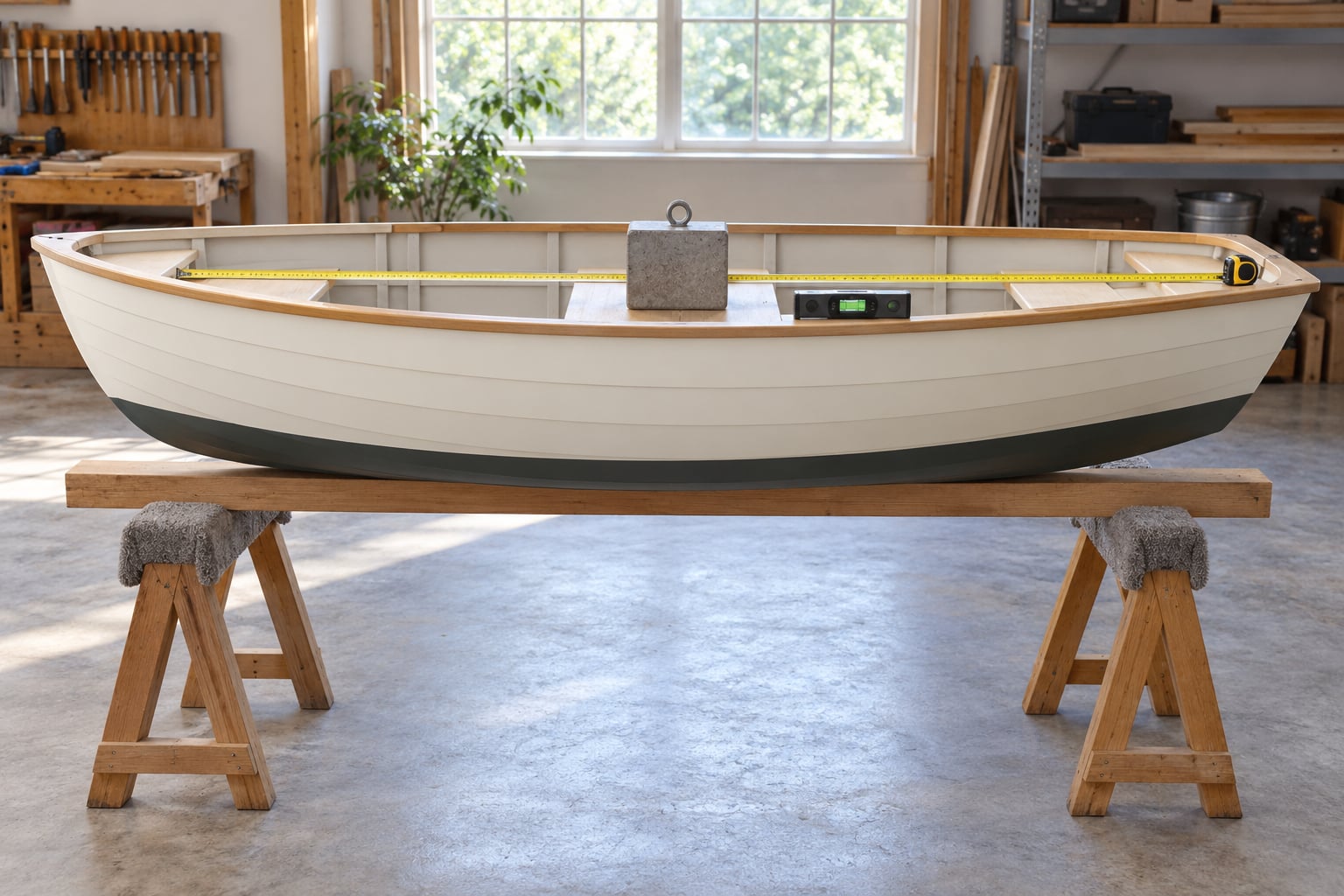
Set the boat on the stand with a single narrow edge running across its width, so the hull behaves like a see-saw. A length of 4 by 4 laid on edge, or a hardwood dowel in two padded sawhorses, does it. A wide cradle will not work because it gives the hull a base rather than a pivot, and then you are measuring the stand, not the boat.
Check the balance with the level first, using the boat’s own deck or gunwale as the reference. Then add or shift the test weight in small steps until the boat stops tipping and sits with an even keel fore and aft. The reading is the distance from your reference point to the center of the test weight, and that is the LCG in the documented loading condition.
The same figure falls out of a weight inventory, which is worth doing because it tells you what to move if the answer is wrong. Take a 19-foot trailerable boat in its loaded condition: hull and installed gear 2450 lb at 92 inches from the stem, outboard 280 lb at 18 inches, fuel 95 lb at 74 inches, battery 90 lb at 150 inches, ground tackle 40 lb at 62 inches, ice chest 45 lb at 132 inches, and two crew at 180 lb each sitting at 126 inches. Multiply each weight by its distance from the stem, add the products, and divide by the total weight of 3360 lb. The moments sum to 294750 lb-inches, giving an LCG of 87.7 inches from the stem, or 39% of a 226-inch length.
That last line is the useful one. Moving the battery from 150 inches back to 60 inches shifts the LCG to 85.3 inches and costs nothing. Adding 100 lb of lead ballast in that same spot pulls it to 84.6 inches, but you now carry 100 lb you did not have to carry, through every wave and every mile of fuel burn, to buy 0.7 inches. The arithmetic settles the argument that gets argued endlessly in the boat forums.
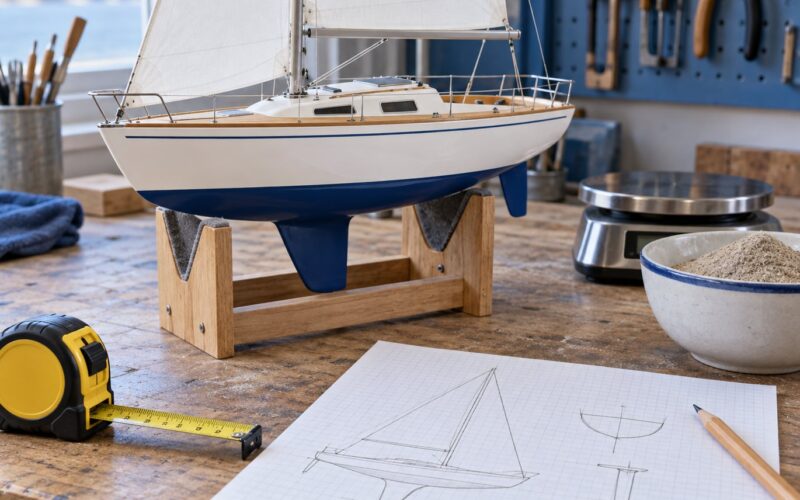
This is the method most often credited to the model boat trade, where a hull is balanced on a brass tube before the engine goes in. It scales up to a full-size boat without changing anything about the principle, and it is worth doing before hardware is permanently mounted, because a hull balanced bare will almost never be balanced after the electronics and fuel go in.
For the vertical center of gravity, use the boat as a pendulum. Support it on the same narrow edge so it can swing fore and aft, displace the bow by a small angle, release it, and time the period with a stopwatch. Average at least ten swings. For a simple pendulum,
period = 2 × pi × square root of (height of the pivot above the center of mass ÷ gravitational acceleration)
so the height of the center of mass above the pivot is gravitational acceleration multiplied by (period ÷ 2 × pi) squared. A two-second period corresponds to a center of mass about 39 inches above the pivot, and a 2.5 second period to about 61 inches. Real hulls are not perfect pendulums, water damping and internal friction cut the period short, and this needs a small swing amplitude, roughly under ten degrees, to stay in the range where the simple formula holds. Treat the result as a useful estimate rather than a survey.
For a rough comparative check instead of a timing, put a known weight low and as far to one side of the centerline as you can safely manage, and note the heel. The bigger the response, the lower the transverse center of gravity is sitting.
Now compare the cradle reading against the flotation result. If the two agree within a couple of percent of the hull length, your loading record and your arithmetic are probably sound. If they disagree badly, work through the record looking for a heavy item you forgot, which is almost always the cause, and for loose water in the bilges, which is the second most common.
Common Mistakes
Most bad center of gravity numbers come from small measurement problems rather than bad theory. Here is what goes wrong, what it does to the result, and how to get back to a clean reading.
| Mistake | What it does to the result | How to correct it |
|---|---|---|
| Testing on moving or uneven water | The heeling moment from waves and current is added to the heeling moment you are trying to measure, and the reading swings with the surface. | Use a sheltered basin or a flat calm morning. Take the reading on the gentlest cycle and repeat three times. Discard the outlier rather than averaging it in. |
| Changing the load between trials | Each trial gets a different boat. Results stop being comparable and the moment arithmetic is meaningless. | Freeze the loading condition. Photograph it. If you must move something, re-weigh and re-record before continuing. |
| Measuring from the wrong reference point | An offset of a few inches at the reference point propagates straight into the answer and shifts the reported percentage of hull length. | Pick the forward perpendicular, the transom face, or the stem and use the same one all day. Write it at the top of the sheet. |
| Averaging heel without recording the sign | Heeling to port and heeling to starboard look identical in magnitude and mean opposite errors, so a genuine list can be averaged away to zero. | Record heel as a signed number, for example minus 2.1 degrees, so port and starboard never cancel. |
| Confusing LCG, VCG, and TCG | You measure a fore-aft balance and then compare it to a published height above the keel, or to a number from a different boat entirely. | Label every result with its plane and its condition. LCG in inches from the stem, VCG in inches above the keel, TCG in inches off the centerline. |
| Loose water in the bilge | Sloshing free water shifts to the low side as the boat heels, acting like weight that is far lower and further out than anything you own. It fakes a center of gravity that does not exist. | Find and fix the leak, then pump the bilge dry and re-run the test. Add free surface to the load record as a separate line while you work. |
| Treating the result as an exact structural value | A bathroom scale and a stopwatch give you a good working figure, and treating it as a survey value invites false confidence on a real stability question. | Report it with its uncertainty, a few pounds on the total weight and a few inches on the position, and keep the loading record with the number. |
| Fixing trim by adding weight at the ends | You add displacement, add drag, and raise the fore-and-aft moment of inertia, so the boat responds more slowly to the helm for the same correction. | Move weight you already carry. Shift a battery aft, stow the ice chest low, get the ground tackle out of the bow locker, and re-measure. |
That last one is worth dwelling on, because it is the most common piece of bad advice in the forum threads on this subject. Adding weight forward or aft to correct a trim does move the center of gravity, but it also makes the boat heavier and harder to push, and it spreads the weight out, which is exactly the opposite of what you want for response. Moving the same mass the other way costs nothing and achieves more.
Field practice on sailboats and small trailerable craft converges on the same habit: weight low and close to the keel trunk, ground tackle stowed low and aft, batteries under a seat rather than on a shelf, ice chest under the dinette rather than in the cockpit. The waterline stripe on the hull and the cockpit drain are both used as crude level references in the field, and the drain doubles as a trim indicator, since water that pools in it at rest but runs clear under way means the bow is lifting.
Trailer tongue weight is worth knowing about as a sanity check rather than a measurement. A boat that is balanced correctly on its trailer sits with a sensible fraction of its weight on the tongue, and one that is tongue-heavy is usually not balanced. The pitfall is that axle position changes the reading independently of the boat, so two badly set-up trailers give two different numbers for the same perfectly balanced hull. Fix the trailer before you blame the boat.
Once you know the LCG and the VCG, the one number that tells you how the boat behaves is the metacentric height, written as GM and equal to KM minus KG, or the height of the metacenter above the keel minus the height of your center of gravity. In plainer terms it is the vertical distance between the point the boat is trying to fall about and the point the water is pushing it up from. A small displacement hull with a ballasted keel and a crew sitting low will show a large positive value and feel stiff. The same hull with the crew standing on the foredeck can show a small or negative value and feel tender and twitchy, and that is the connection most owners find useful in practice.
Frequently Asked Questions
Can I find a boat’s center of gravity from its design drawings?
Often yes, and it is worth checking first because it costs nothing. Builder weight schedules give a design longitudinal center of gravity, usually expressed as a percentage of length from the forward perpendicular, plus a vertical figure. Two cautions: the design figure assumes the specified fuel, gear, and crew, and it describes the boat as delivered, not as you have loaded it. Treat it as a baseline to compare your measurement against, not as an answer to replace one.
What does it mean if my boat floats higher at the bow than at the stern?
It means the boat is floating by the stern, so the stern is carrying more of the displacement. Usual causes are weight stowed too far forward, water in the bilge running aft, or a loading condition heavier than the design condition. Check the fuel tank and battery positions first, because those are the items owners move most often. Then pump the bilge and re-float. A transom that sits noticeably low in a light condition is a separate issue worth investigating.
How does moving heavy gear affect a boat’s center of gravity?
It moves the center of gravity by the weight of that item times the distance it travels, divided by the new total weight. In practice, a heavy item moved a long way beats a light item moved a short way, and the effect is often smaller than people expect. Moving two people forward 25 inches on a boat weighing 3500 pounds shifts the center of gravity about 2.5 inches. Moving 90 pounds of battery 40 inches shifts it roughly an inch.
What is the difference between the center of gravity and center of buoyancy?
The center of gravity is the point where all the weight of the boat and its contents acts as a single downward pull. The center of buoyancy is the point where the upward push of the water acts, and it sits at the centroid of the submerged underwater volume. A floating boat is in balance when the two are in the same vertical line, and the horizontal position where that line falls is the center of flotation.
Do I need to calculate the vertical center of gravity for a small boat?
Not always, but you should know roughly where it is. The vertical center of gravity sets how quickly the boat rolls back upright after a knockdown, and it is the reason a crew sitting low makes a tender boat feel safe. If your boat will only be operated from seated positions with gear stowed low, a weight inventory with rough heights will tell you enough. Pendulum timing in a supported cradle gives you a better figure if you want one.
Why does my boat list to one side during the center-of-gravity test?
Most often it is water moving to the low side as the hull heels, which is free surface effect rather than a real weight in the wrong place. Other causes are a hull that is out of true, a battery or fuel tank that is only partly full on one side of a centerline tank, a piece of gear hanging outboard, or a plug or through-hull that is dribbling. Pump the bilge dry and hang the gear up before you read anything into the list.
Conclusion
Start by writing down the exact loading condition, because without that record every number you take afterward is a number about a boat that does not exist. Float the boat in still water and measure the center of flotation, then set the hull on a narrow edge in a cradle and find the balance point with a known weight. Time the pendulum for a vertical estimate, compare everything against the design plans, and if the gap is large or the boat is behaving oddly in a seaway, take the loading record to a qualified naval architect before you change anything structural.