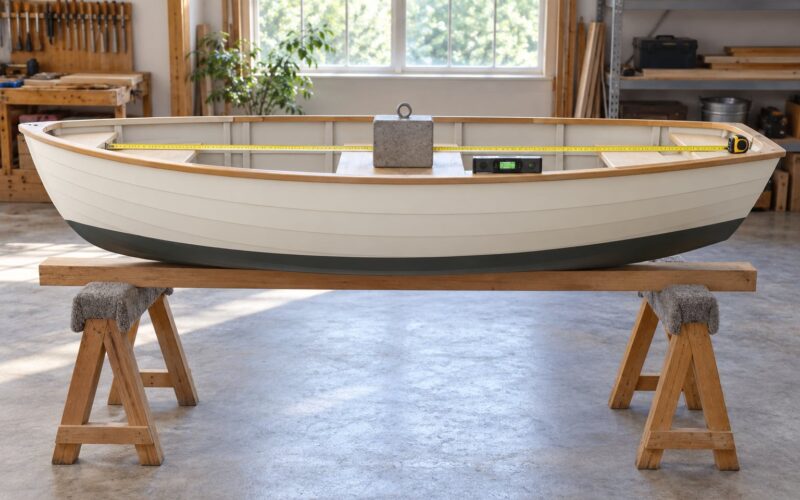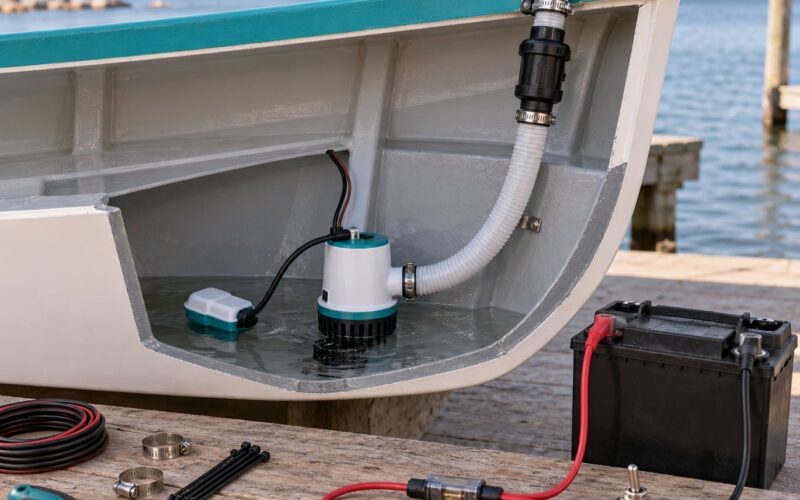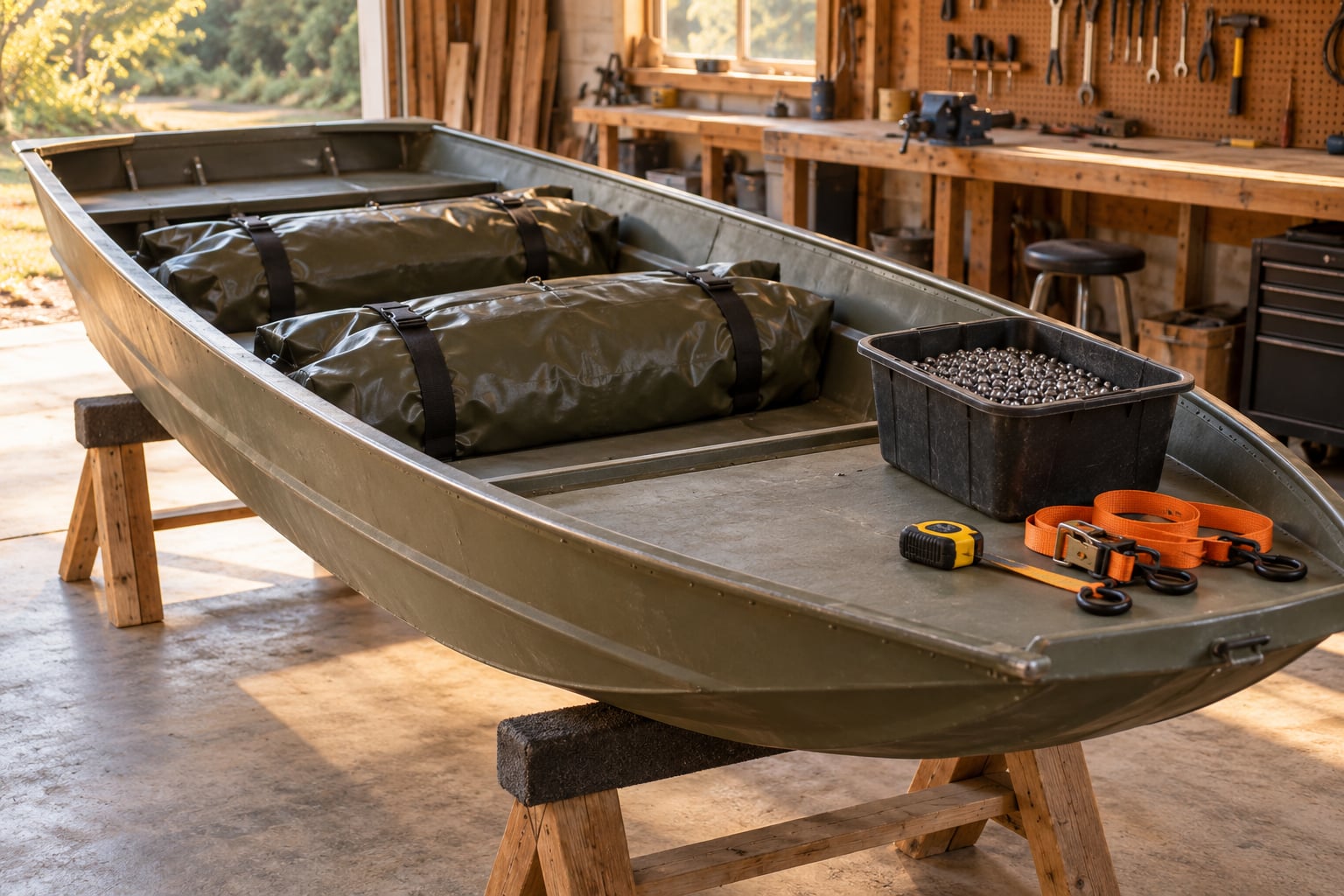
Adding ballast to a small boat means putting deadweight inside the hull, as low and as close to the centreline as you can manage, then fastening it down so it cannot move. Sand bags, bagged steel shot, lead, or a plumbed water tank all work. The material matters far less than the position, and on a trailerable craft the whole job is an afternoon with a spade and a set of straps.
People usually arrive at this after a season of the bow bouncing in a chop, or after discovering a jon boat is impossibly tippy with one person in it. Both are real problems, and ballast is a legitimate answer to both. The caution is that ballast is weight you cannot remove at the dock, and a small hull has very little margin for weight in the wrong place.
This guide covers the calculation, the materials, the installation, and the water test that tells you whether you got it right. It also covers the case against ballast, because the most common advice you will hear at a slip is that you want trim tabs instead. That advice is right some of the time, and the sections below say which is which.
Table of Contents
- What You Need
- How to Add Ballast to a Small Boat Without Compromising Safety
- Common Mistakes
- Frequently Asked Questions
- Is water suitable as permanent ballast in a small boat?
- Where should permanent ballast be placed for the best stability?
- How much ballast should I add to a small boat?
- Is lead better than steel or water ballast?
- Can too much ballast make a small boat unsafe?
- How should I test ballast placement before going offshore?
- Conclusion
What You Need
Before you buy anything, you need to know two numbers: how much the boat weighs empty, and how much it is rated to carry. Everything else follows from the gap between them.
Displacement is simply the total weight the boat floats at, and every load has to be paid for out of the plate on the hull. On a small craft the difference matters, because a jon boat that weighs 180 pounds empty might be rated for 475 pounds total. Gear, battery, fuel, cooler, motor, and people all draw from that same number before ballast does.
Hull configuration decides what ballast can even do. A flat-bottom skiff has almost no inherent stability and leans on the crew to stay upright, so low central weight is the whole game. A shallow-V skiff already carries weight in the hull and is more forgiving. A deep-V or a planing hull resists the bow driving down, which is why ballast is a blunt tool on them. A canoe or a sailing dinghy has no motor weight to hide ballast behind, so any weight you add is deadweight you row or tow.
Next, decide whether you want ballast that stays in the boat or ballast you can take out. Fixed ballast, once installed, changes the boat permanently: it adds to haul-out weight, it adds to trailer tongue weight, and it reduces freeboard forever. Portable ballast, in bags you strap down and can lift out, costs you a little effort every launch and buys you the ability to change trim by moving bags.
| Material | Typical density | Handling | Hull and corrosion risk | Removable |
|---|---|---|---|---|
| Water in a tank | 8.3 lb per US gallon | Adjustable at the dock, but needs a pump and a drain | None if the tank is sound; freezing and trapped air are the real risks | Drain it and it weighs nothing on the trailer |
| Sand, loose or bagged | About 100 lb per cubic foot | Cheap to add, shifts if left loose, dries out and pours everywhere | Abrasive if it slides; keep it in sealed bags | Yes, bag by bag |
| Steel shot, bagged | About 490 lb per cubic foot | Heavy per bag, easy to divide into increments | Rusts and leaves black dust; bag it and isolate it from the hull | Yes |
| Lead, bagged or potted | About 710 lb per cubic foot | Very dense, so small volumes give big weight | Toxic dust if it chips; it also poisons bilge water | Awkward, but possible |
| Dunnage bags filled with shot or sand | Varies with fill | The cheapest reversible option, and the one owners report using most | Depends on the fill and the bag | Yes |
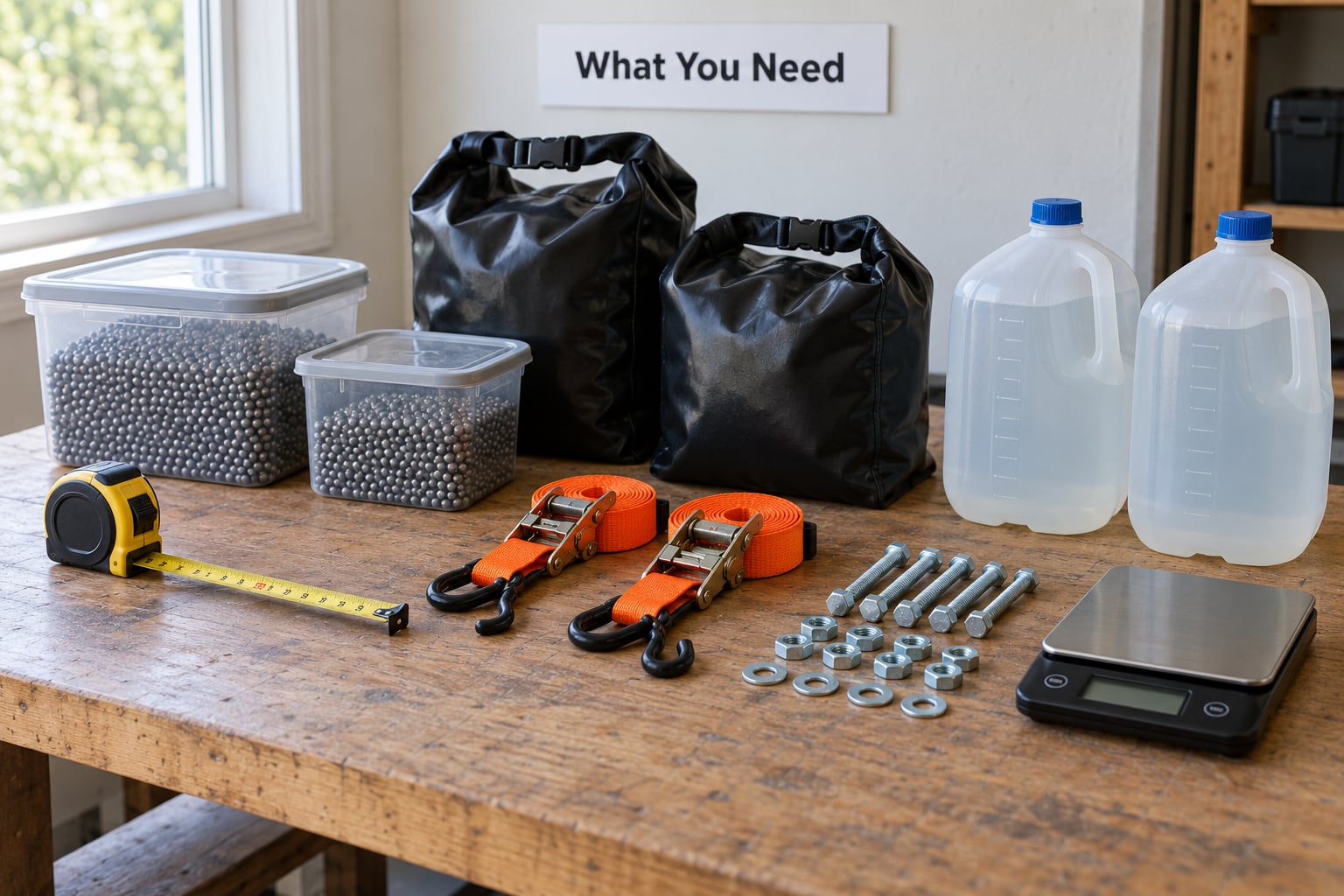
For equipment, you want a scale that reads in pounds, a tape measure, a marker for the waterline, ratchet straps or rated tie-downs, marine-grade fasteners with washers, a liner or mat for the compartment floor, and containers with lids that actually seal. If you are going with a water tank, add a pump sized to the tank and a breather line, and read the filling and draining section before you drill anything.
How to Add Ballast to a Small Boat Without Compromising Safety
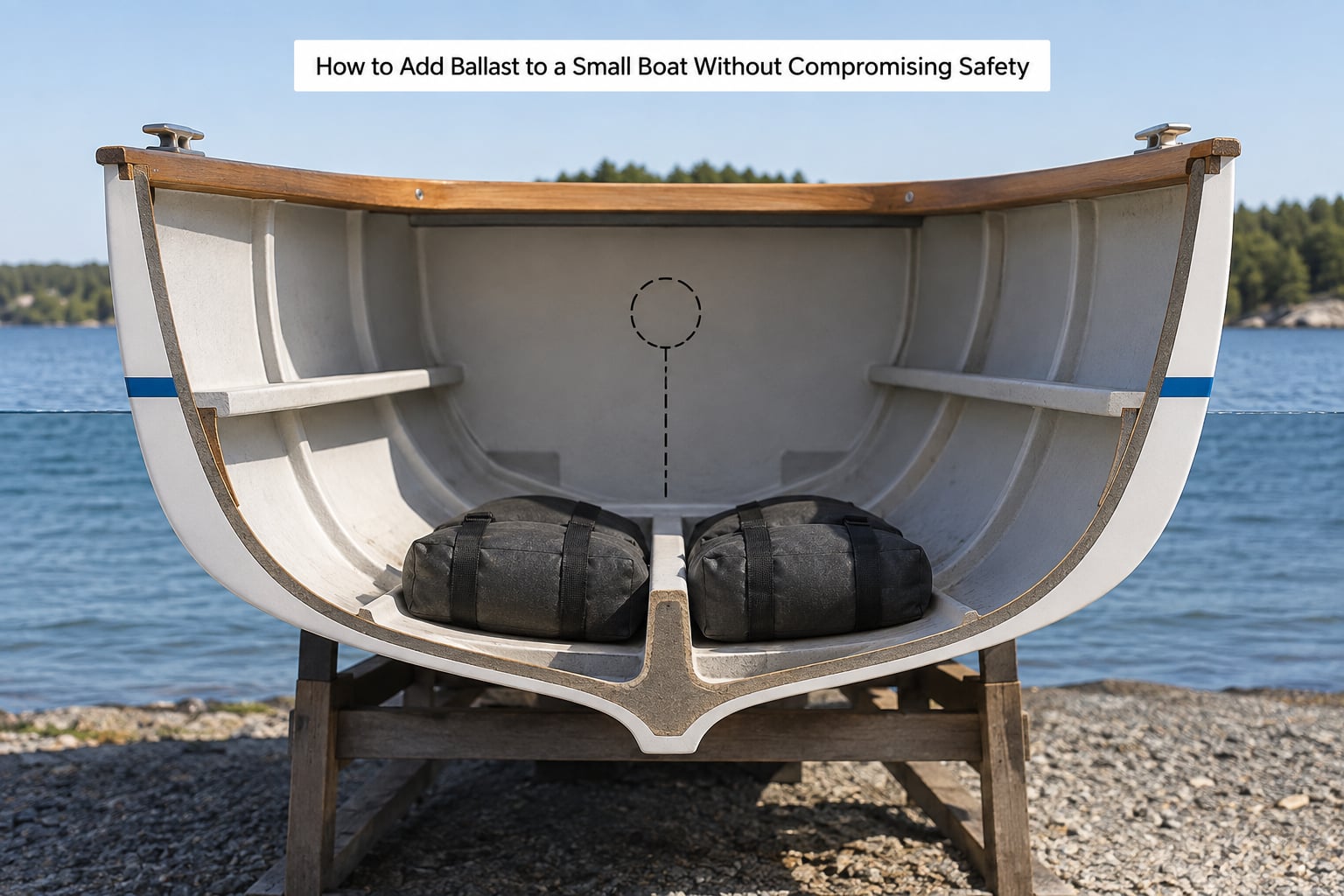
The process is: confirm the boat has the capacity for it, work out a conservative weight, put that weight as low and as central as the hull allows, fasten it to structure rather than to liner, check the boat’s attitude on land, and only then take it onto the water. Each step has a check that tells you it worked.
Confirm the Boat’s Load Capacity and Current Weight
Start at the capacity plate, not at a forum post. If your boat carries one, the maximum weight and maximum number of people printed on it are the hard ceiling, ballast included.
Boats built to US Coast Guard rules normally carry a capacity plate, though the size at which that applies depends on how a particular hull is rated and labelled, so read the plate or the build sheet rather than assuming from length alone. If there is no plate, the builder or the manufacturer can usually tell you the design load.
Then write down what is already aboard. Battery, fuel, motor, tackle, cooler, safety gear, trailer hardware, and the people in the boat all count. Add your intended ballast to that list. If the total comes within a few percent of the rating, stop, because you have left no margin for a splash of water or an extra passenger.
Two things are worth getting a second opinion on: ballast that pushes you past the plate, and anything that changes how the hull floats rather than just adding mass. A naval architect or an experienced small-craft builder can tell you in ten minutes whether your hull has the reserve depth for it. The US Coast Guard publishes A Best Practices Guide to Vessel Stability, and state agencies such as the Oregon State Marine Board publish plain-language capacity guidance, so start there rather than with opinion.
Calculate and Distribute the Ballast
A sensible first move is to add roughly 5 to 10 percent of the boat’s dry weight, low and on the centreline, then judge the result on the water.
That is a starting point, not a verdict. If you know the boat weighs 180 pounds empty, that is 9 to 18 pounds, which sounds trivial until you remember how little a small hull has to begin with. From there, iterate: add a measured increment, run the boat at a fixed cruise speed, look at the waterline, and decide whether you need more, less, or the same weight somewhere else.
There is a guideline people repeat on the water called the one third rule, and it is worth knowing even though it is not law. Roughly, no single added load should represent more than about a third of the boat’s rated capacity, and it must sit low and centred. Treat it as a conservative ceiling that keeps you inside the envelope, not as permission to load up to a third of the plate.
Placement has three axes, and each one fixes a different complaint. Along the length of the boat, weight forward pulls the bow down and kills bow lift in a chop; weight aft lifts the bow and adds steering bite and tracking at speed; weight near the middle changes the ride without changing the trim much. Across the boat, weight must sit on or very near the centreline, because a bag of shot set down to port is a permanent list and a permanent heel in a turn. Vertically, low is almost always better, because righting moment is weight times lever arm, and moving weight down increases the lever without adding any mass.
The practical default that owners on the iboats and ifish forums converge on is low, central, and split roughly evenly fore and aft, then shifted in whichever direction your specific problem points. A sandbag on the bow seat when you are solo, or a long fat sac laid across the ski locker door on a bowrider, is the cheapest validated version of that rule.
Choose a Ballast Material and Container
Choose bagged, solid ballast over loose water if you want the weight to actually do the work you are paying for.
The reason is the free surface effect. A block of lead sitting on the hull floor moves with the boat as one mass. Water in a partly filled tank sloshes to the low side as the boat rolls, and its own weight shifts toward the outside of the heel, which cancels part of the righting moment you thought you had bought. The same 100 pounds of water can deliver a fraction of the stability of 100 pounds of shot, and it gets worse the less full the tank is.
Sand is the common-sense middle. It is heavy enough to matter, cheap, and forgiving, but it must be in sealed bags, because loose sand migrates to the low corner in a seaway and then behaves exactly like the loose water you were trying to avoid.
Lead is the most compact option, which matters in a hull with no usable floor space. The forum example most often cited is 130 pounds of lead in the front compartment of a small C-Hawk skiff, chosen because it was available rather than because it was elegant. Handle it in gloves, bag it, and keep it out of the bilge water, since lead in water is a genuine hazard for whatever is in that water.
Whatever you pick, the container has to not leak, not deform, and not present a sharp edge to anyone stepping into the cockpit. A container that fails halfway through a launch puts several hundred pounds of shot loose in a boat, and loose shot underfoot is how hulls get holed. Rounded, lidded, and strapped is the standard.
Prepare and Secure the Ballast Compartment
The compartment has to be clean, dry and lined, because a leak you cannot see is a leak that will eventually show up in the wrong boat.
Clean out grit, old tackle and bilge water, dry the surface properly, and line the floor with marine ply, a mat, or a thick layer of closed-cell foam. That liner does two jobs at once: it stops shot and sand from abrading gelcoat when the load shifts, and it gives you something to strap against.
Check the structure before you load it. Look at the frames, the stringers, and the thwarts, and bolt through solid wood rather than into thin panel. Do not fasten to the hull liner, the carpet, or a livewell lid that somebody will stand on later.
Keep the space around your ballast working. Leave clear of the drain plug, the bilge pump and its float switch, any wiring, sensors, or battery connections, and anything you need to reach in a hurry. Fire extinguishers, PFDs, an anchor line, and a bailer all have to stay accessible, and a fuel tank never goes under a pile of shot.
Install the Ballast in Controlled Amounts
Add ballast in measured increments, seal the container, and strap or bolt it to structure so it cannot lift, slide, or grind.
Measure each addition rather than tipping a bucket and hoping. If you are using shot, count bags. If you are using water, use a calibrated jug and write down the volume. This is the step that makes the water test useful, because you will not know what worked otherwise.
Close the container fully, then secure it. Ratchet straps to structural points, cross-tied so they cannot slip, or threaded webbing through drilled eyes. A bag that can move half an inch under wave loading will move six inches in a wake, and the noise and the shifting of the load are the first warning you will get that it is not fastened properly.
Record each increment on tape inside the compartment or in a notebook in the helm. The goal is not just a ballasted boat but a repeatable one, where the same set-up gives the same trim next month.
Check Trim, Stability, and Freeboard on Land
Floating the boat in the driveway, or at least at the dock ramp with the drain plug out, shows you most of what you need to know before you start the motor.
Set the boat up at its intended operating load: motor, battery, fuel, and gear in place. Then look at the waterline on both sides and along the length. Is the boat level or is it down on one side? Is the bow or the stern sitting noticeably low? How much freeboard is left, meaning the vertical distance between the waterline and the gunwale?
Those three observations tell you what to change. A list means something is off the centreline, and no amount of extra weight elsewhere will fix it. A bow that is too low in a boat that is meant to run in a chop can submarine, which is a worse problem than the bow lift you were trying to cure. Too little freeboard anywhere means the boat is shipping water over the deck edge, and that is the point where added weight has stopped being ballast and started being a liability.
Also check that the added weight has not raised the centre of gravity. If you had to put weight up high because the low space was full, the boat may be more tender than before despite carrying more weight, and the fix is lower or less, not more.
Run a Controlled Water Test
Test in calm, protected water first, then work up to rougher conditions gradually, and come back to the ramp after every change.
Start in a sheltered bay with almost no chop and no planing speed. Get everyone aboard, take a photo of the waterline against a fixed reference, and note the freeboard at both ends. Add passengers, then gear, then move weight fore and aft in small steps, rechecking the waterline each time.
Watch how it behaves rather than only how it looks. Does it loll, meaning it sits over to one side and stays there? Does it roll back quickly when you step off the gunwale? Does the bow pound into a wake? Is the boat stiff and unresponsive, which usually means too much weight, or too much of it too high? Is it tender, which usually means too little weight or too much weight above the hull?
Stop and relocate or reduce the ballast if the boat is tender, excessively stiff, unstable, or unevenly loaded. A long slow test at one throttle setting and a fixed number of people is worth more than a fast run up the river, because it is repeatable. Save the open water and the offshore runs until the boat has behaved well for an entire season with the ballast in place.
Common Mistakes
Most ballast problems on small boats come down to one of seven things, and all of them announce themselves if you watch for the warning signs.
Exceeding the capacity plate. This is the one that is unsafe and often unlawful, not just inconvenient. The warning sign is freeboard visibly shrinking after the ballast goes in. The fix is to remove weight until the total sits comfortably inside the plate, and the US Coast Guard stability guide is worth reading before you do anything else.
Guessing at the weight. Bucket-by-bucket loading produces an unknown total, and an unknown total cannot be trimmed or repeated. Weigh it, or count bags and write the number down.
Loose shot or loose sand. The warning sign is noise, a shifting centre of gravity, and a scuff mark on the hull. Everything goes in sealed, closed containers, and everything gets strapped.
Putting the weight too high. If the only space left is under the console or on a seat, you have raised the centre of gravity. The boat will feel more tender than before. Move the weight down into the hull structure, or use a denser material so you can use less of it.
Creating a drainage problem. Ballast over a drain plug, a bilge pump intake, or a pump float switch means the boat cannot empty when it needs to. Keep the pump area clear and test that the pump still cycles with the boat full of gear and ballast in place.
Concentrating the weight in one spot. A single heavy bag amidships stresses the frames below it and lifts the ends. Spread the weight fore and aft, and use more, lighter bags rather than one heavy one.
Skipping the water test. The warning sign is discovering the problem on the water with passengers aboard. The test takes twenty minutes in a sheltered bay and it is the difference between a repeatable boat and a guess.
One more deserves a mention, because it is the objection you will hear most. If all you need is for the bow to sit down at speed in calm water, trim tabs do that job with no permanent weight, and on a planing hull they are the better tool. The Hull Truth consensus, bluntly stated, is that what most boats need is trim control rather than fixed weight. Ballast earns its place when the problem is stiffness at rest, a porky ride with one person aboard, spray coming over the bow in a chop, or a hull that is simply too light for its job, because tabs do none of those things.
| Problem | Ballast solves it | Trim tabs solve it |
|---|---|---|
| Bow rides up and slams in a chop | Yes, forward and low | Partly, at speed, not in slow chop |
| Spray over the bow or porky at rest | Yes | No |
| Tender with a single person aboard | Yes, low and central | No |
| Bow too high on a planing hull at cruise | Only at the cost of haul-out weight and acceleration | Yes, this is their job |
| Added weight you cannot remove | Only with portable bags | None added |
Ballast Safety and Maintenance Tips
Ballast is a maintenance item, not a one-time job, and five habits keep it from causing problems.
Keep metals off bare structure. Steel shot and lead sitting in a wet bilge will leave rust rings and black dust that you will find months later. Bag everything, use stainless fasteners, and put a mat or a sealed liner under the weight.
Inspect at the start of each season. Check that straps are tight and unfrayed, that fasteners have not worked loose, that no container has split, and that the liner has not shifted. Re-torque anything a season’s vibration worked loose.
Let water out. If you use a tank, drain it after the trip, not at the end of the season. A tank left partly full over winter invites algae, ice damage, and a nasty surprise in the spring, and it is also unnecessary weight on the trailer.
Keep removable ballast genuinely removable. If you chose bags, you should be able to pull them in a couple of minutes at the ramp, and that reversibility is what lets you answer the questions that only show up once you are out on the water.
Write down the final figure. Weight in pounds, position fore and aft, and which bags. Next season you will not have to rebuild the experiment, and anyone who takes the boat after you will know what was done and why.
Frequently Asked Questions
Is water suitable as permanent ballast in a small boat?
Yes, on a trailerable boat where haul-out weight is the problem, since a full tank adds mass to the water trial and nothing to the trailer. Water-in-water has mass but no buoyancy of its own, and a partly filled tank suffers the free surface effect, so it gives less stability than the same weight of bagged shot. It also needs a pump, a drain and a vent. The Macgregor 26 carries about 1,150 pounds of water ballast for exactly this reason.
Where should permanent ballast be placed for the best stability?
As low as the hull allows, on or very near the centreline, spread fore and aft rather than piled in one spot. Righting moment is weight times lever arm, so moving weight down increases stability without adding any mass. Weight forward pulls the bow down in a chop, weight aft adds tracking at speed, and weight to one side is simply a permanent list.
How much ballast should I add to a small boat?
Start at roughly 5 to 10 percent of the boat’s dry weight, low and central, then add more in measured increments only if the water test says you need it. The one third rule is a useful conservative ceiling, not a target, and neither figure overrides the capacity plate. On a 180 pound jon boat that starting range is only 9 to 18 pounds, which surprises people.
Is lead better than steel or water ballast?
Lead is the most compact, so it fits where nothing else will, and forum owners have run figures like 130 pounds of it in a forward compartment. It is dense, toxic if it chips, and it contaminates bilge water, so it must be bagged and isolated from the hull. Steel shot is nearly as effective, bags cleanly, and is far safer to handle. Water is the least effective per pound and the most complex.
Can too much ballast make a small boat unsafe?
Yes, in four ways: you can exceed the capacity plate, you can raise the centre of gravity and make the boat more tender, you can eat the freeboard until the boat ships water over the deck edge, and you can hold the bow low enough to submarine in a seaway. The US Coast Guard stability guide and your state marine board are the right references. Note that 46 CFR Part 170 covers inspected commercial vessels, not recreational boats.
How should I test ballast placement before going offshore?
Start in calm protected water with everyone aboard and photograph the waterline against a fixed reference. Check level side to side, note freeboard at bow and stern, and watch the boat loll, roll, or pound. Move weight in small steps and recheck each time, then work up to slightly rougher water over a season. Save offshore runs until the set-up has behaved well for months.
Conclusion
Start at the capacity plate, not at a number from a forum. Confirm how much the boat weighs empty and how much is already aboard, then work out a conservative ballast range at roughly 5 to 10 percent of dry weight, placed as low and as central as the hull allows.
Add it in measured increments, fasten every container to structure, check the waterline and freeboard on land, and only then run a slow test in calm protected water. Write down the final weight and position, and if the boat is still tender or stiff, move the ballast or take some of it out before adding more.