Boat stability is a hull’s tendency to return upright after it heels, and you can calculate it for a small craft with a tape measure, a weight list and four formulas. The short version: find how high the center of gravity sits, find how high the metacentre sits, and the distance between them is your metacentric height, or GM. A boat floats fine with a negative GM. It just does not want to come back up.
That distinction catches a lot of people out. A hull sitting level in the slip is not a stable hull, it is a floating hull, and the two are decided by where the weight ends up. Below is the method I would hand a beginner: measure the boat as it will actually be used, build a weight list, and carry one worked example all the way to a righting moment with the units showing at every line.
It takes about an hour of desk work and no design software. What you will not get is a certified stability booklet, and I will flag where that line sits.
What You Need
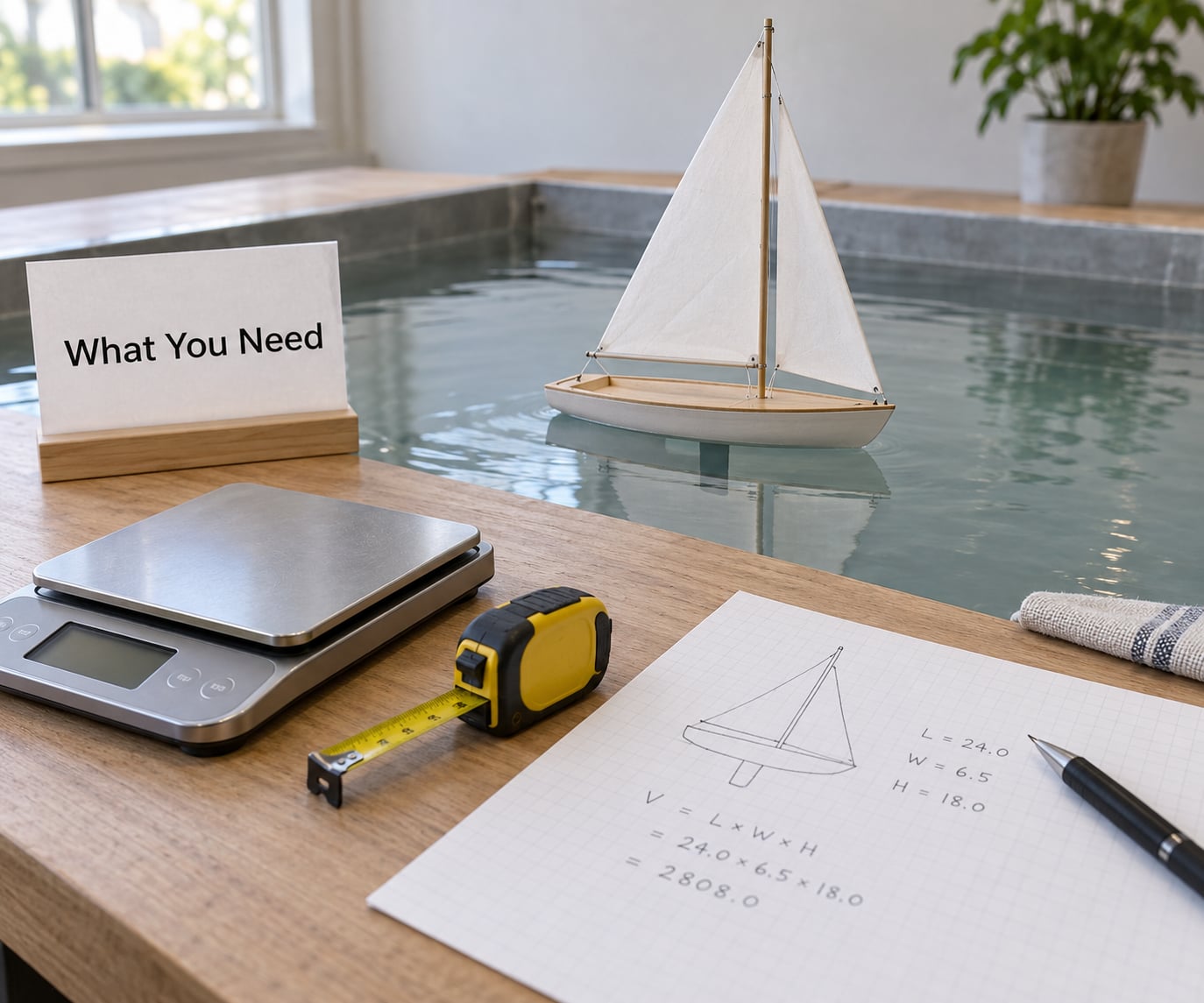
Before any arithmetic, you need the numbers below and nothing more exotic. Everything here can be measured with a tape, a bathroom scale or a set of boat scales, and a spreadsheet to hold it.
- Length overall (LOA) and length at waterline (LWL) — the underwater length is what feeds the waterplane calculation, and it is usually 5 to 15 percent shorter than the LOA you see on the brochure.
- Waterline beam (BWL) — the widest point at the load waterline, not the widest point of the hull at deck level.
- Draft (T) — how deep the keel or canoe body sits in the water, measured from the lowest point.
- Loaded displacement — the total weight of boat, people, water, fuel, gear and ballast, in kg or lb.
- A weight-by-weight inventory with a height for each item above the keel. Home builders do this down to paint and fasteners, and that level of detail is what makes the final number trustworthy.
- Water density — 1025 kg/m³ for seawater, 1000 kg/m³ for freshwater. Using the right one changes your answer by about 2.5 percent.
- Tools — tape measure, inclinometer or a plumb line and protractor, calculator, spreadsheet.
Three points carry the whole method. G is the center of gravity: the single point where all the boat’s weight is imagined to hang. B is the center of buoyancy: the geometric centre of the submerged volume, which moves as the hull heels. M is the metacentre, a geometric point above B where the tilted hull’s buoyancy acts as if it pointed straight up. When the hull heels, B slides sideways under the new waterplane and B-to-M is the offset that produces the righting force.
Here are the four formulas you will use, with everything they depend on.
| Symbol | Formula | Units | In plain English |
|---|---|---|---|
| Metacentric height | GM = KM − KG | m or ft | The distance between your weight and the boat’s pivot point. Positive is good. |
| Metacentre height | KM = KB + BM | m or ft | How high the metacentre sits above the keel. |
| Height of buoyancy | KB | m or ft | Height of the centre of the submerged volume above the keel, usually a bit over half the draft. |
| Metacentric radius | BM = I ÷ V | m or ft | The hull’s own contribution to initial stability, driven by how much waterplane it has. |
| Waterplane inertia | I ≈ Cwp × L × B³ ÷ 12 | m⁴ or ft⁴ | How much the beam resists rolling. This is the term people forget. |
| Displaced volume | V = Δ ÷ ρ | m³ or ft³ | How much water the boat pushes aside, which equals its weight in tonnes. |
| Righting arm | GZ = GM × sin θ | m or ft | Horizontal lever arm between G and B once the boat is tilted. |
| Righting moment | RM = Δ × g × GZ | N&m | The actual force turning the boat back upright. |
θ is the heel angle in degrees, Δ is displacement, and ρ is water density. Cwp is the waterplane area coefficient, typically 0.70 to 0.80 for a conventional monohull — take 0.72 if you have no other information. All eight of these feed the same idea: stability is a comparison between a number your boat invents through its shape and a number you put there by loading it.
Step-by-Step
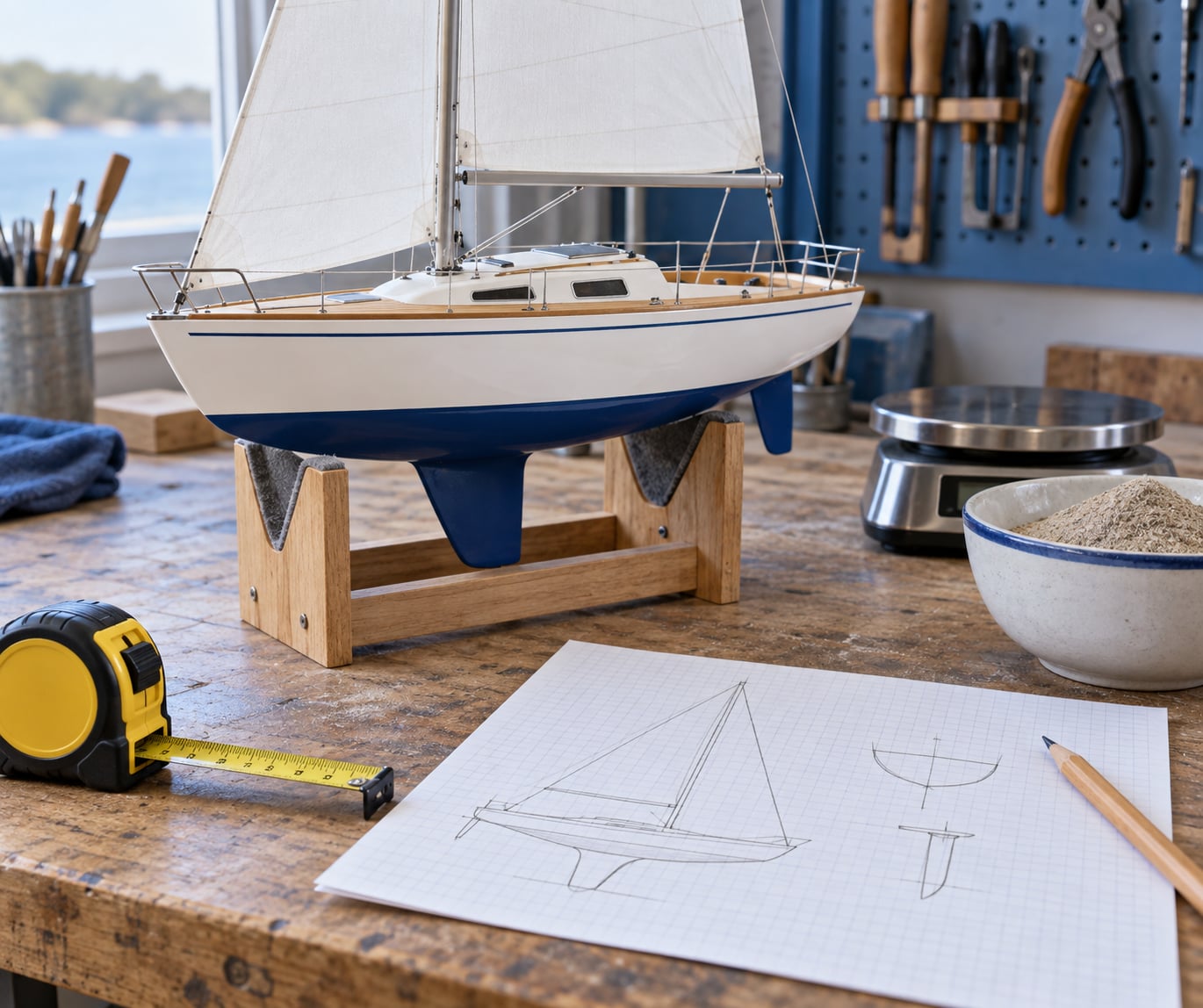
The worked example below runs on a 27-foot cruising monohull in seawater. I will keep every line, because the units are where hand calculations usually go wrong.
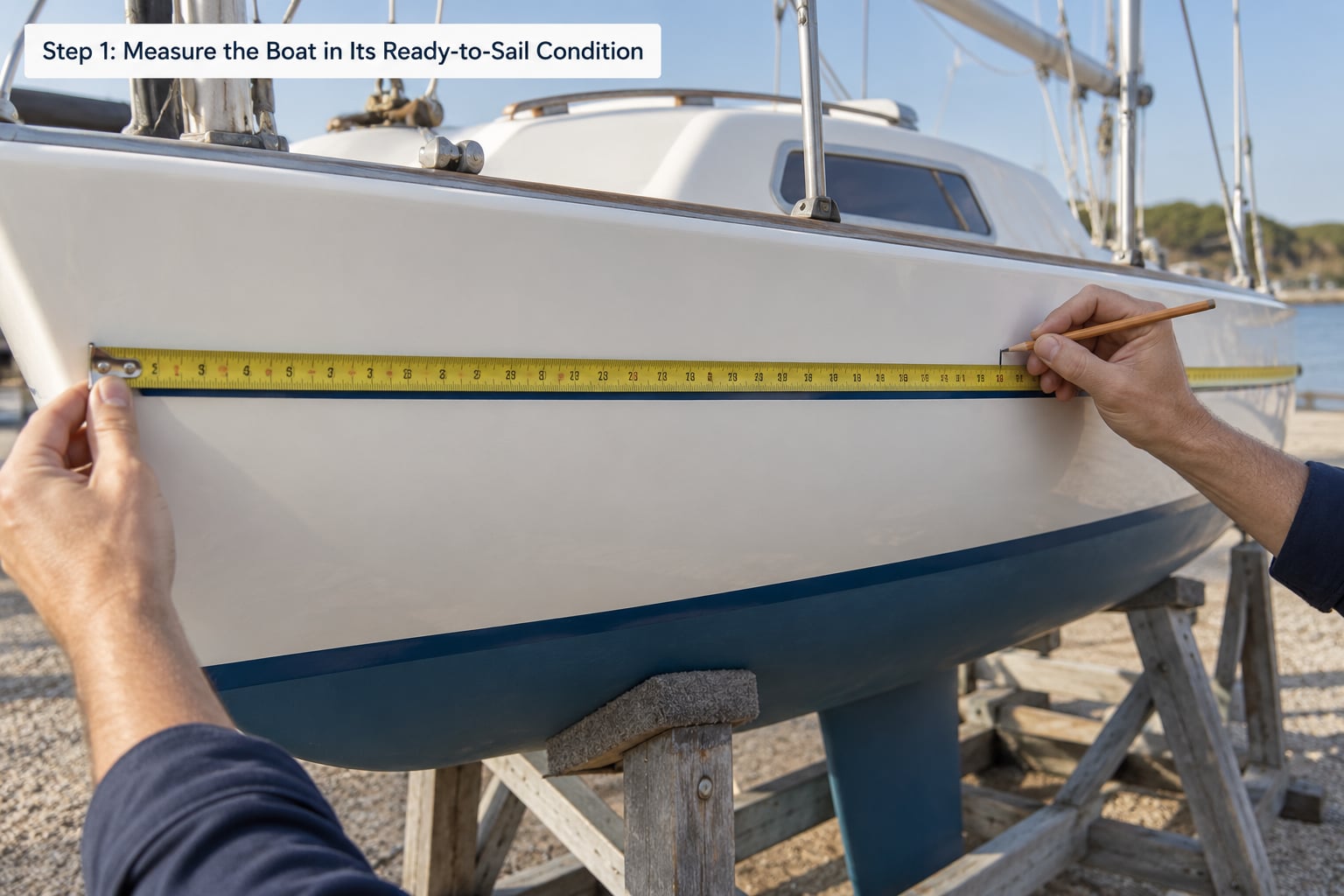
Step 1: Measure the Boat in Its Ready-to-Sail Condition
Measure with the boat loaded the way you actually sail it, because displacement and center of gravity both move when gear comes aboard. For our example: LWL 7.4 m, waterline beam 2.9 m, draft 0.55 m, loaded displacement 4500 kg.
Then write down every weight with a height above the keel. This is the step people skip, and it is the one that decides whether the rest is worth doing.
| Item | Weight (kg) | Height above keel (m) |
|---|---|---|
| Ballast keel | 1600 | 0.35 |
| Hull structure | 1150 | 0.85 |
| Rig, sails and canvas | 380 | 1.55 |
| Engine, shaft and fuel | 300 | 0.70 |
| Water in fixed tanks | 320 | 1.05 |
| Batteries | 120 | 0.55 |
| Stores and personal gear | 250 | 1.20 |
| Anchor, chain and dock lines | 180 | 0.60 |
| Galley and misc gear | 200 | 1.30 |
| Total | 4500 | — |
If you have no weights for the hull or rig, the builder’s published displacement is a starting point only. Forum regulars who build at home report that brochure figures drift, and a boat that was light in the shed is usually heavier in the water once the batteries and water are aboard.
Step 2: Estimate the Boat’s Displacement
Displaced volume comes straight from the loaded weight, because a floating boat displaces its own weight in water. Divide by the density of seawater:
V = Δ ÷ ρ = 4500 kg ÷ 1025 kg/m³ = 4.39 m³
Notice what just happened: 4.39 cubic metres of seawater weighs 4500 kg, so the boat floats. This is also the quick sanity check people on design forums use. If your hull’s underwater volume looks far smaller than your displacement implies, one of the two numbers is wrong.
There is a second route, useful when you know the hull lines but not the weight. Divide the underwater volume into slices with Simpson’s rule, sum them, and multiply by 1025 to get the weight the hull will carry at that draft. If your weight list and your hull-volume estimate disagree by more than about 10 percent, find out why before going further.
Step 3: Locate the Center of Gravity and Center of Buoyancy
KG is a weighted average, so multiply each weight by its height and divide by the total. Using the table above, the sum of weight times height is 3406.5 kg&m, giving:
KG = 3406.5 ÷ 4500 = 0.76 m above the keel
KB is easier, because buoyancy sits inside the shape of the underwater body. For a moderate midship section it runs a little over half the draft, so use a multiplier of roughly 0.53. At 0.55 m draft that gives KB = 0.53 × 0.55 = 0.29 m. Owners with a full midship section drawing can do better by finding the centroid of the submerged area directly, and for a hard-bilge cruiser with a lot of deadrise, KB lands nearer half the draft than a little over it.
Now apply the free surface correction before you move on, because this is where a real boat departs from the textbook. A partly filled tank behaves as if its water were suddenly sitting at the top of the tank, not spread through it. The shift in effective KG equals breadth × length ÷ 12. For the 320 kg tank in our example, about 0.9 m by 1.5 m, half full:
Free surface correction = 0.9 × 1.5 ÷ 12 = 0.11 m
So the effective KG becomes 0.76 + 0.11 = 0.87 m. Baffles inside the tank cut that figure sharply — a well-baffled tank reduces the correction by roughly a factor of nine, which is why builders insist on them.
Step 4: Estimate the Righting Arm and Righting Moment
Waterplane area first, then waterplane inertia, then the metacentric radius. With Cwp = 0.72:
A = 0.72 × 7.4 m × 2.9 m = 15.45 m²
I = 0.72 × 7.4 m × 2.9³ m³ ÷ 12 = 10.83 m⁴
BM = I ÷ V = 10.83 ÷ 4.39 = 2.47 m
KM = KB + BM = 0.29 + 2.47 = 2.76 m
GM = KM − KG = 2.76 − 0.87 = 1.89 m
That is the number. Nearly two metres of metacentric height on a ballasted cruising boat is healthy for initial stability, though it also means the hull will be lively rather than easy in a short steep sea. Now turn it into a force at a specific heel angle. At 20 degrees of heel:
GZ = GM × sin 20° = 1.89 × 0.342 = 0.65 m
RM = Δ × g × GZ = 4500 × 9.81 × 0.65 = 28,700 N&m (about 28.7 kN&m)
That 28.7 kN&m is the moment trying to put your boat back on an even keel at 20 degrees. Here is the honest limit: GM is derived from a small-angle assumption, and sin θ is a straight-line approximation that holds well only below roughly 10 to 15 degrees. Past that, the true GZ curve rolls over differently because the hull’s shape changes, and eventually the deck edge goes under. Treat everything above 15 degrees as indicative, not measured.
For a feel beyond the small-angle range, the natural roll period is worth knowing. It follows T = 2πk ÷ √(g × GM), where k is the radius of gyration, commonly taken as about 40 percent of the waterline beam. For this hull that lands somewhere in the two-to-three-second range — a boat that reacts quickly and settles promptly rather than rolling slowly and deeply.
Step 5: Check the Result Before Going to Sea
Read the sign of GM first. Positive means the metacentre sits above the center of gravity, the boat has a positive righting moment as soon as it heels, and it wants to come back. Zero is neutral and rarely survives real-world loading errors. Negative means the weight is effectively above the pivot, so the boat is technically stable upright but unstable once disturbed. On a conventional keelboat a negative result usually means an input is wrong, so re-check the weight list before you accept it.
Then run the check for the loading conditions you actually see: boat at anchor with everyone aboard, boat under sail with a crew on the windward rail, boat with half a tank and half the crew. Each one changes displacement, KG or free surface, and the boat you measured at the dock is not always the boat you sail.
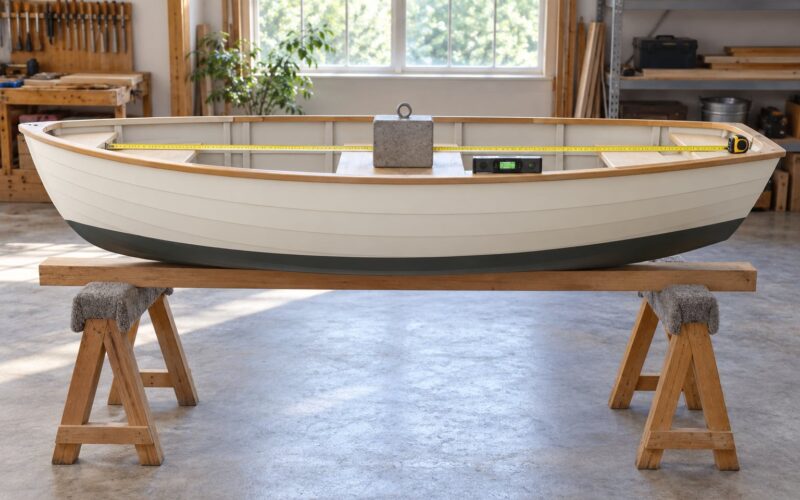
You can also measure GM directly with an inclining experiment, and on a small boat it is more honest than trusting a hand calculation. Six steps, on a flat calm day, ideally in shallow water or at a quiet berth:
- Float the boat at its normal draft with the gear aboard and mark the waterline on the hull at midships.
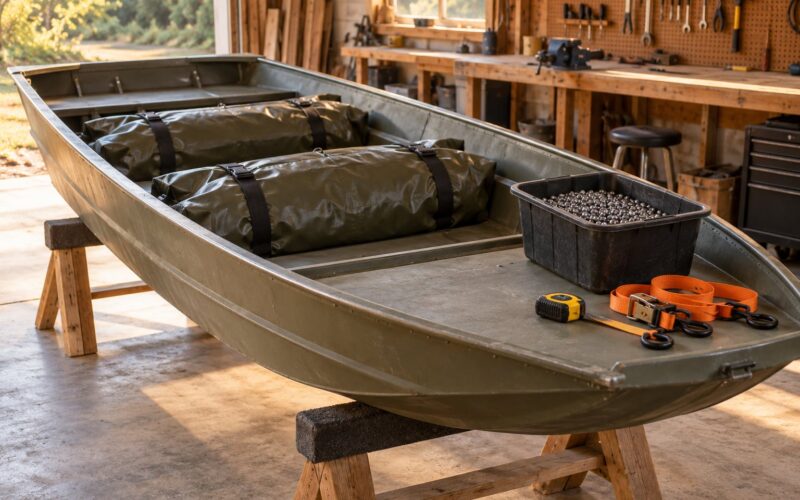
- Weigh a known shifting weight — sandbags or water containers — and note the mass, for example 100 kg.
- Park the weight on the centreline, record zero, then move it to the widest point on one side, as far outboard as the gunwale allows.
- Read the heel angle from a pendulum clinometer and write it down.
- Shift the same weight to the opposite side and read again. Divide the total swing by two for the heel caused by the shift alone.
- Calculate GM = W × d ÷ (Δ × θ), where d is the horizontal distance the weight travelled and θ is in radians.
For the 100 kg moved 1.5 m on our 4500 kg boat, a GM of 2.0 m predicts a swing of about 1.9 degrees end to end. Expect a small number, use a real clinometer rather than a bubble level, and average several trials. A phone inclinometer app is adequate if you can hold the reference surface steady.
Stop the hand calculation and get a professional involved when you are designing a hull from scratch, when the boat carries passengers for hire, when displacement is going past a regulatory threshold, or when a result sits close to zero. Naval architects, and stability booklets issued for commercial craft, are the right reference at that point. For a family boat you plan to keep for a decade, an afternoon of measurement gets you 90 percent of the way.
Common Mistakes
These are the errors that actually change the answer, in rough order of how often they happen.
Calculating the boat empty. A bare hull is not how you will use it, and on a ballasted boat the difference is dramatic. Fix: add gear, water and people before you start, and record it.
Putting weight where it is convenient instead of where it is stowed. Batteries on a cabin sole and water in a tank under the floor both sit higher than people assume. Fix: measure the actual height of the item above the keel, not the height of the locker it lives in.
Ignoring loose or shifting gear. A fuel can that slides to the low side when the boat heels is a heeling moment that grows with the heel. Fix: add lashing rails and secure lockers, then count the secured weight as part of the boat.
Using freshwater density for a boat in salt. It is a 2.5 percent error in displacement, which propagates straight into BM. Fix: use 1025 kg/m³ at sea and note which water you used.
Forgetting free surface. A half-full tank is treated as if all the water were at the top of it. In the example above that was 0.11 m of KG, which is not a rounding error. Fix: apply the breadth × length ÷ 12 correction, and fit baffles.
Believing more ballast means more stability. This is the most persistent myth on the forums. Ballast low down lowers KG and raises GM, but a ballasted hull is still mostly held up by the weight of the water it displaces. It is a much bigger effect than most people expect, which is why the ballast-to-displacement ratio on serious cruisers sits far higher than the number a beginner would guess. Move ballast low and it genuinely helps; add it on deck and you have made the boat worse.
Confusing initial stability with the whole stability story. GM describes the first few degrees only. A boat can have a healthy GM and still have poor reserve stability past 40 degrees, a low downflooding angle from a low companionway, or a range of positive stability that ends sooner than you would like. Fix: read the GZ curve if the builder publishes one, and check where the deck edge and openings go under.
Treating a hand calculation as certification. It is a screening tool. It will tell you roughly where you stand and whether a loading change helped or hurt. It will not tell you your craft is compliant, because a compliance assessment checks criteria — downflooding angles, area under the GZ curve, wind heeling — that this method never touches.
Concluding that a stiff boat is a better boat. High GM means fast, sharp motion. Many cruising sailors would rather have a tender boat that rolls slowly through a swell, and the fix for a tender boat is usually moving weight up and outboard or adding a little form stability, not chasing a bigger number. Two hulls with similar GM can feel nothing alike.
Seven factors move stability more than anything else you will change. Weight position and how high it sits. Free surface from slack tanks. Ballast quantity and where the weight is stowed. Hull form and beam, which set I and therefore BM. Draft and freeboard, which decide when the deck edge goes under. Wind and other heeling moments, which your calculation has not included at all. And loading condition, because displacement, trim and KG all shift as people, water and fuel move around.
One last sanity check that costs nothing. If your GM comes out negative, absurdly large, or close to the displacement in millimetres, you have a unit or arithmetic error somewhere. A useful range of sanity for a cruising monohull with a ballast keel is roughly 0.6 to 2.0 m; small open craft often run 1.5 to 3.0 m because their waterplanes are wide and light; narrow centreboard boats sit much lower. Landing far outside those bands means go back to the weight list.
Frequently Asked Questions
What are the formulas for calculating boat stability?
Four formulas cover most small-craft work. GM = KM – KG gives the metacentric height, the distance between your weight and the hull’s pivot. KM = KB + BM builds the metacentre height, where BM = I / V is the metacentric radius and I is the waterplane second moment. Righting arm GZ = GM sin theta, and righting moment = displacement x g x GZ. With those five, plus V = displacement / water density, you can screen any boat.
What is the formula for metacentric height?
GM = KM – KG. Both heights are measured from the keel. KM comes from the hull alone, calculated as KB + BM, where BM is the waterplane second moment of area I divided by the displaced volume V. KG comes from your boat’s weight list. A positive result means the metacentre sits above the center of gravity and the hull rights itself. The formula is valid only at small heel angles, roughly under 10 to 15 degrees.
What is the formula for calculating the righting moment?
Righting moment equals displacement times gravity times the righting arm: RM = displacement x g x GZ. GZ is the horizontal distance between the center of gravity and the center of buoyancy once the boat is tilted, and for small angles GZ = GM sin theta. In SI units with displacement in kg, you get newton-metres; divide by 9.81 to express the moment in kg-m. Multiply the moment by the heeling moment from wind or a crew shift to see which one wins.
What are the 7 factors affecting ship stability?
The seven that matter most are: how high added weight is stowed, free surface effect in slack tanks, ballast quantity and its vertical position, hull form and beam, draft and freeboard, heeling moments from wind and crew movement, and the loading condition itself as displacement and trim shift. For small boats the first three dominate, because a single tank or a stack of water cans can change KG more than the hull shape ever will.
What does negative GM mean?
A negative metacentric height means the center of gravity sits above the metacentre, so the boat has no positive restoring moment at small heel angles. It sits upright while perfectly level and tends toward a steady angle of loll once disturbed, rather than returning. On a conventional keelboat, recheck your weight list first, since a negative result usually means an input error. Genuine cases respond to lowering ballast or moving heavy items down out of the accommodation.
How do I lower the center of gravity of my boat?
Move weight down and keep it near the centreline: put water in a tank low in the hull rather than a jerrycan in a cockpit locker, stow batteries on the structural floor rather than a cabin sole, and keep heavy tools in low lockers. Adding low ballast works too, but it also raises displacement, so repeat the whole calculation afterward. A canting bulb or movable ballast shifts KG on demand, which is why cruising yachts with them can carry heavy gear high. Recheck the figure after every change.
Conclusion
Start by weighing the boat as it will actually be sailed, not as it sits in the yard. Build the weight list with real heights, find KG by weighted average, calculate KM from the waterplane, and subtract. Then repeat the whole thing for the tank that’s half empty and the crew that’s all on one side, because that second number is the one that matters on a windy day. Once you have learned how to calculate boat stability for beginners in this way, the number becomes a tool you use every time something goes aboard, and a naval architect’s booklet becomes something you can actually read rather than guess at.