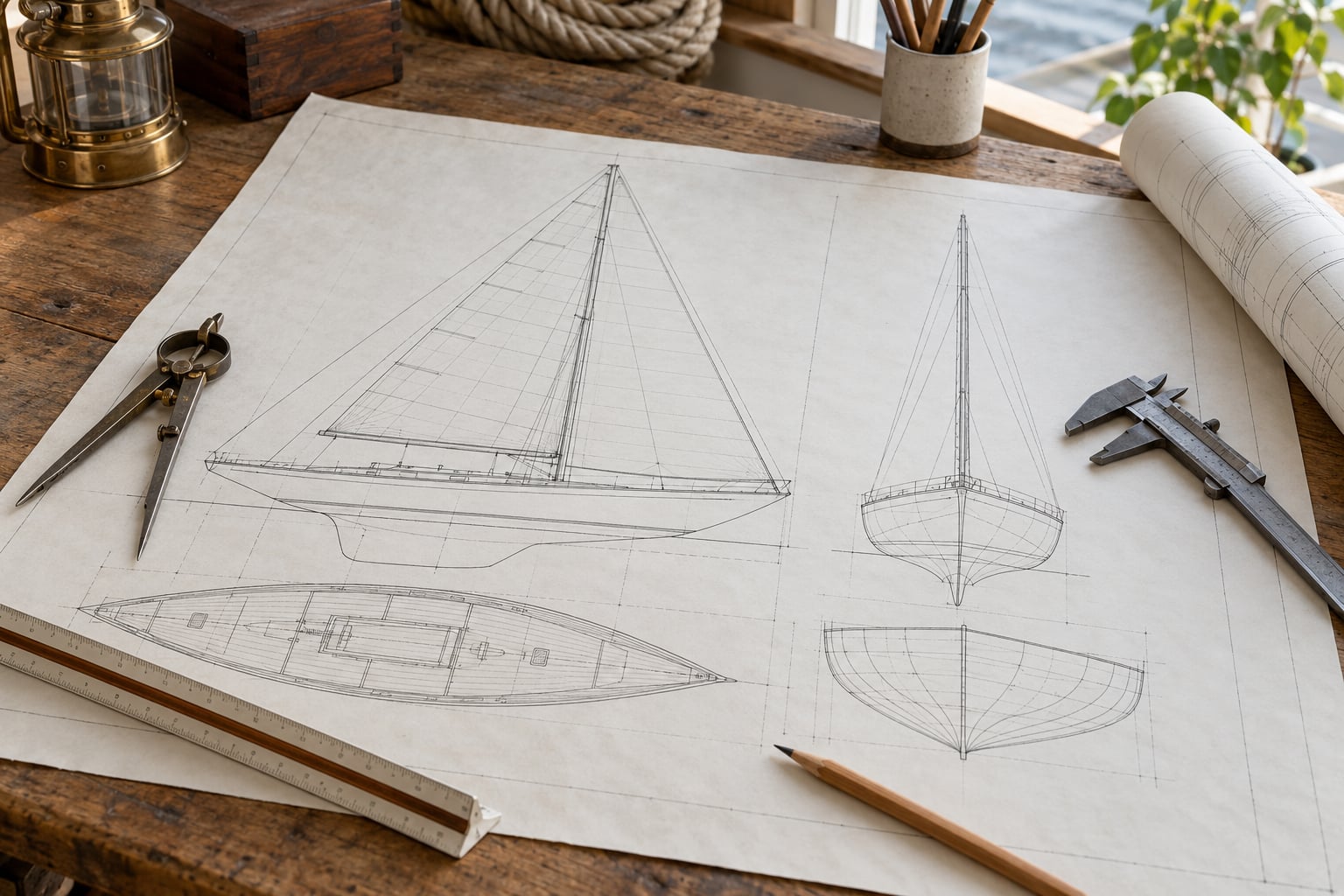
If you want to know how to read a sail plan, work through the sheet in a fixed order: title block and scale first, then the reference grid, then each sail’s outline, then the construction lines, then the dimension callouts and notes, and finally the check against the boat the plan was drawn for. A first pass takes twenty minutes on a clean production sheet. The hard part is not finding shapes, it is telling a structural line apart from a measurement aid.
The term is also used loosely, and part of the confusion is genuine. On a boat, a sail plan is the side-view drawing of the rig, the suit of sails, and the standing rigging. It is not a sail inventory, and it is not a construction pattern. Some search results use “sail plan” to mean a voyage itinerary, which is a different thing entirely.
Table of Contents
What You Need
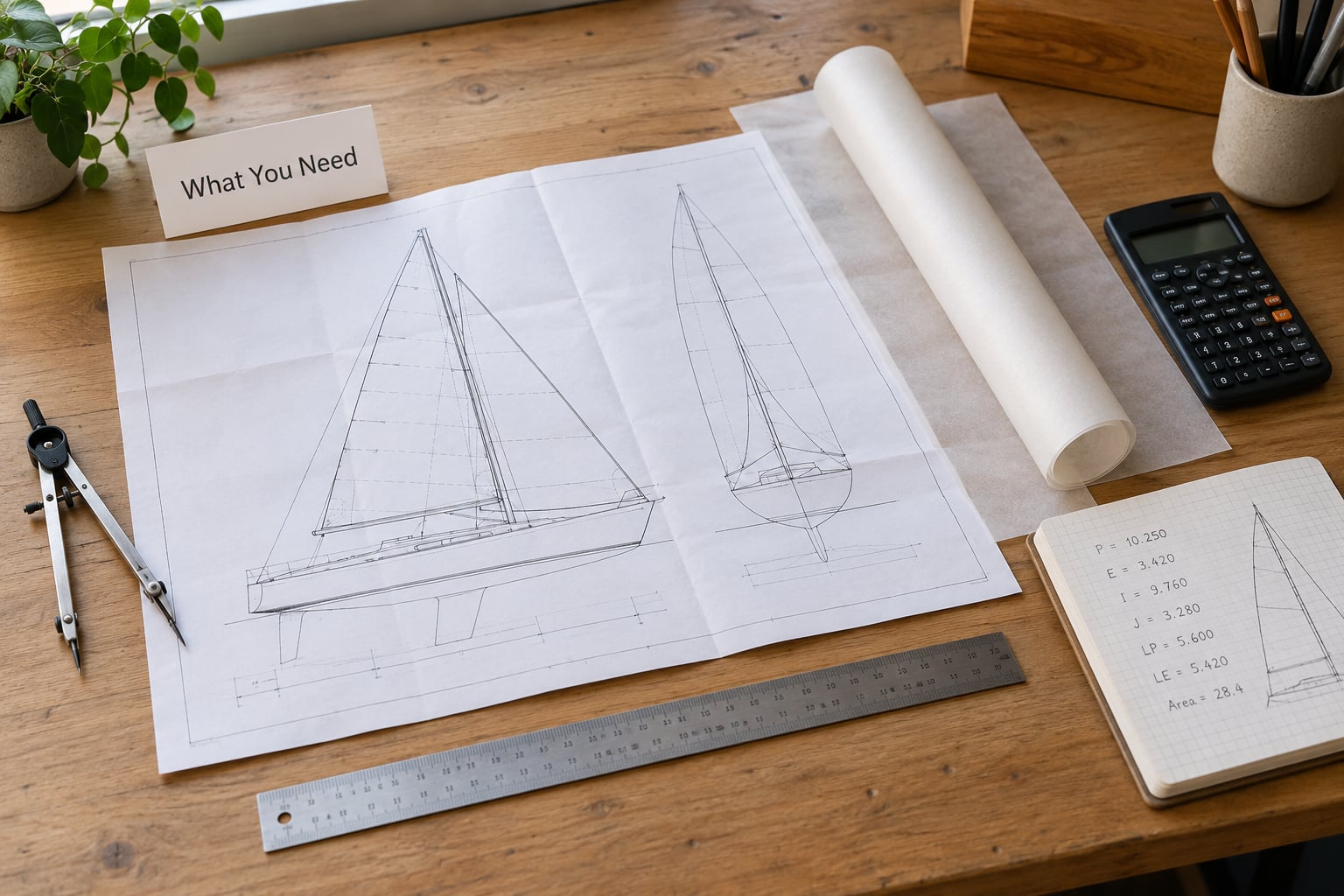
You need the sheet itself, and you need it at a size where the annotation text is readable. A sail plan is one drawing inside a larger set, and the neighbouring sheets matter. Lines plans give the hull shape, the offsets and the deck plan, which is how you check that the rig on the sail plan actually lands on the boat.
Before you interpret anything, know which document you are holding. Four similar names get used interchangeably, and picking the wrong one wastes the whole exercise.
| Document | What it shows | What you use it for |
|---|---|---|
| Sail plan | Side elevation of masts, sails, standing rigging and sail combinations | Understanding the rig, sail area and reefing arrangements |
| Sail details drawing | Panel layout, seam lines, batten pockets, corner reinforcement patches | Ordering a replacement sail or discussing construction with a loft |
| Sail specification | A written list of edge lengths, cloth weight and sail number | Quoting for a new sail without a full drawing |
| Sail inspection report | Condition findings from a surveyor, with damage and remaining life | Deciding whether a sail is repairable or end-of-life |
Complete production plan sets normally contain at least one sail plan and often two, one for the sailing rig and one for the motoring arrangement. Traditional builders went further: Atkin’s own wording for the Meridian is that the rig stands only if it is “made exactly as shown in the sail plan without additions and omissions.”
Have a ruler, a pair of dividers and a calculator within reach. A scale of 1:40 means one millimetre on the sheet equals forty millimetres on the boat, so any length you measure off the paper converts by multiplying by forty. Getting that arithmetic wrong is the single most common way to misread a plan.
Step-by-Step: How to Read a Sail Plan
1. Identify the Drawing Type and View
Start by confirming what kind of sheet you are looking at. A sail plan is a side elevation: everything is projected onto one plane, so a shroud crossing behind the mast still reads as a single straight line. If the drawing shows the boat from above with sails swung out, you are looking at a plan of sail, usually on a separate sheet.
Two other views show up often. A profile view is the sail itself seen flat, which is the sailmaker’s shape or a mould template. A construction or detail view shows one panel, one corner or a hardware fitting at larger scale, with a boundary around it. If the sail outline is cut off by a rectangle, you are not looking at a complete sail.
How to tell you got it right: every corner of every sail on a sail plan has a name attached to it. A partial view never does.
2. Read the Reference Direction and Grid
Locate the mast, the boom, and the head, tack and clew of the mainsail before anything else. The mast is the long vertical or raked line; the gooseneck is where the boom pins to it; the head sits at or near the masthead, the tack at the gooseneck, and the clew at the aft end of the boom. From those three points the sail’s three edges follow immediately.
The luff runs from the tack to the head along the mast. The leech runs from the head down to the clew, and the foot runs from the clew back to the tack along the boom. Every sail on the drawing is bounded by those three edges, and the corners are named after them.
On a headsail, the luff runs up the forestay instead. The forestay is the standing rigging line running from the masthead forward, and where it lands on deck tells you the headsail type. Check the sheet’s stated scale and its reference direction before measuring anything.
3. Trace the Sail Outline
With the corners fixed, follow the outline and note where it bulges. Roach is the outward curve of the leech above the boom. It adds area high up, and on a mainsail it is what keeps the sail driving rather than flattening off too early. A drawing that shows a high roach with a shallow foot is describing an upwind-biased shape.
The leech curve and the luff curve together describe twist, the amount the sail’s upper sections fall off to leeward relative to the lower sections. Wide twist suits downwind sailing, where a sail needs to spill; a flat leech suits close-hauled work, where you want the section to hold its shape. A broad, square clew is a cruising shape. A narrow, high-aspect clew is a racing one.
Also look at the foot. A straight foot means the sail luffs onto the boom directly. A leech-reefed or loose-footed sail, where the foot does not follow the boom, is drawn with the foot line ahead of the boom and a loose-footing allowance noted.
4. Decode Internal Construction Lines
The internal lines fall into two groups, and separating them is where most beginners go wrong. Structural lines describe how the sail is built. Everything else is a construction aid, a reference grid, or a trim guide.
Structural lines you will meet: panel or seam boundaries, which are usually drawn as straight chords across the sail; batten pockets, shown as long narrow shapes running up the leech side; reinforcement patches at the head, tack and clew, drawn as solid dark shapes; and reef points, which appear on a mainsail as short horizontal marks with tie lines at a set distance above the foot.
Construction aids: the leech and luff curve reference lines, perpendicular grid lines, station marks, telltale positions and centre-of-effort marks. If a curve is smooth and unterminated, it is almost certainly a reference, not a seam. Seams are straight across the sail; curves are drawn for reference.
Radial or vertical panel layouts also matter when you compare sail plans. A vertical cut run is common on modern laminate sails built as one piece, while a horizontal cut panel layout is the traditional cross-cut Dacron build. A roller-furling mainsail is usually cut with extra material forward, which shows as a shaded or doubled area along the luff.
5. Check Dimensions, Symbols, and Annotations
Dimension callouts give luff length, leech length and foot length, generally in millimetres or inches. When you order a replacement sail, these three figures are what the loft asks for first, along with the sail number. Leader lines run from a number to the thing it describes, and they often cross other lines, so trace them rather than assuming the nearest label belongs to the nearest shape.
The notes block is where the design intent lives. A production sheet such as the Friendship Yacht Company plan states a scale of 1:40, carries a sheet number, opens with a general-notes paragraph, and then lists the running rigging specification, naming the main halyard, mainsheet, vang and the rest. Read that list as the boat’s control inventory.
| Running rigging item | What it changes on the sail plan |
|---|---|
| Mainsheet | Mainsail foot tension, boom angle, twist at the top |
| Boom vang or kicker | Upper leech tension, so twist and draft position |
| Cunningham | Luff tension and entry angle |
| Outhaul | Draft depth, and with it draft position |
| Mainsail halyard | Hoist height, and whether the luff is on or off the halyard |
| Headsail sheets and fairlead | All four headsail elements at once, because the lead sets sheeting angle |
That mapping is worth learning before you buy hardware. As a long-running thread on forums.sailboatowners.com puts it, until you know which sail element a control moves, adjusting it is guesswork. The same logic applies to the drawing: learn the shape before you judge the boat.
Finally, check the general notes for the conditions the drawing is valid under, and check the revision block if there is one. Old plans get amended, and a superseded sheet is a common trap in secondhand documentation.
6. Compare the Plan With Its Intended Use
A technically valid plan is not automatically the right plan. The last step is asking whether the design suits the vessel and the way it will be sailed. Total sail area against displacement tells you whether the boat is under- or over-canvassed, and the ratio is the first thing a designer checks.
Read the rig proportions next. A fractional rig carries its headsail luff short of the masthead, so the headsail is smaller and the mainsail carries more of the work, and the mast can bend under backstay tension to flatten the main. A masthead rig lets the headsail overlap past the masthead, which is also the drawing rule for telling the sails apart: if the headsail luff extends aft of the masthead line on the plan, it is a genoa rather than a jib.
Now check the practical side. Does the reefing shown on the plan match what is actually fitted? Do the chainplate positions on the sail plan line up with the shrouds on the deck plan? Is the gooseneck at the height the sail was cut for?
For balance, locate the centre of effort from the area of each sail and its distance from the centre of lateral resistance. A centre of effort well forward of the centre of lateral resistance gives a boat that pulls to leeward, which is weather helm and a tiring helm on a long passage. That single comparison is the performance reason the sail plan is drawn at all.
Common Mistakes
Treating a projected view as a construction view. On a sail plan, lines cross freely because everything is flattened into one plane. A shroud passing behind the mast is not attached to it. Open the sail details drawing if you need to know what touches what.
Assuming every curved line is a seam. Seams run straight across the sail. Curved lines are luff and leech references, trim guides or centre-of-effort marks.
Ignoring the scale statement. A 1:40 sheet read as 1:20 doubles every length you derive from it, and the error is invisible until the sail arrives. Check the scale before the first measurement, not after.
Mixing millimetres and inches. Sail edge lengths are quoted in millimetres in most lofts and inches in older documentation. A 10 millimetre conversion slip on a 12 metre luff is small in itself, but it compounds with every other callout.
Expecting the plan to confirm boat compatibility. A sail plan shows the design as drawn. It does not tell you what your boat was later fitted with, and it cannot account for a replaced mast, a new forestay or a lazy jack kit added years afterwards. Cross-check against the boat.
Reading the sail number as a hull number. The number printed on the sail is issued separately from the registration number on the hull, and it is the number the scoring system uses.
Three habits catch most of these. Read the title block before the drawing, take a scale reading before any measurement, and trace every leader line before believing a number. Then compare the plan against the deck plan and the boat itself, side by side.
Frequently Asked Questions
What is a sail plan?
A sail plan is a side-view technical drawing of a sailing vessel, prepared by a naval architect, showing its sails, the spars that carry them, and the standing rigging that supports them. Production sets usually include at least one sheet, often two variants. It is not a sail inventory, a construction pattern, or a voyage itinerary, though the phrase is sometimes used for all three.
What is the difference between a sail plan and a lines plan?
A sail plan shows the rig above the deck: masts, sails, standing rigging and sail combinations. A lines plan shows the hull: offsets, sheer and deck lines, from which the hull form is laid out. Sailboat plan sets normally contain both, and the rig on the sail plan is checked against the hull on the lines plan to confirm that chainplates, mast position and gooseneck height actually land where the rig assumes.
What does a 1:40 scale on a sail plan mean?
It means one unit measured on the sheet equals forty of the same units on the boat, so a length of 300 millimetres on the drawing is 12 metres on the rig. Divide nothing and guess nothing. Confirm the printed scale before the first measurement, since every dimension you derive from the sheet depends on that one number, and note whether the callouts are given in millimetres or inches.
How do I tell a jib from a genoa on a drawing?
Compare the headsail luff with the masthead. A jib stops short of the masthead, so its luff does not reach as far aft as the mast line. A genoa overlaps, so its luff extends aft of the masthead and the clew sits well aft, often beyond the mainsail. The rule of thumb among sailors, argued over endlessly on the sailing forums, is simply that overlap past the masthead means genoa.
What do the numbers printed on my sails mean?
The sail number identifies the sail to a governing body and to the scoring system. It is issued by one of three authorities: the builder, the class association, or a national authority such as USSA or MNA. A headsail without its own number often carries the mainsail number. Alongside it you may find the class insignia near the head, the sailmaker’s stamp, the area in square metres, and a PHRF or IRC rating.
Where do I find the sail plan for my own boat?
Start with the builder’s documentation or the owner’s manual, which normally reproduce the sail plan sheet among the plan set. A class association will hold the one-design plans for association boats, and USCG or register documentation may include rig details. Charter and brokerage listings often reproduce the sheet. If none survive, a naval architect can draft a replacement from measurements taken on the boat itself.
Start at the title block, confirm the scale, and mark the three corners of the mainsail before you read anything else. From there the drawing explains itself in a fixed order, and every later question, from reefing to sail numbers to helm balance, is answered somewhere in those lines.