A sail generates lift by turning air. Curve the cloth and hold it at an angle to the wind, and the air passing around it gets pushed downward and aft. The sail’s reaction to that change in the air’s momentum is a force pointing roughly perpendicular to the apparent wind, and that force, not a shove from the breeze, is what drives a boat upwind.
Sail lift, defined plainly: the aerodynamic force produced by the pressure difference across a cambered sail held at a non-zero angle of attack to the apparent wind. It acts sideways relative to the boat’s heading, which is exactly why a keel exists.
Table of Contents
- What Does It Mean for a Sail to Generate Lift?
- How Does Airflow Create Lift Around a Sail?
- Why Does Angle of Attack Matter So Much?
- What Is Apparent Wind, and How Does It Affect Lift?
- How Does Sail Shape Change the Lift?
- How Much Lift Does a Sail Produce?
- How Do Sailors Use Lift to Propel a Boat?
- How Can You Improve Lift Without More Sail Area?
- Frequently Asked Questions
- Conclusion
What Does It Mean for a Sail to Generate Lift?
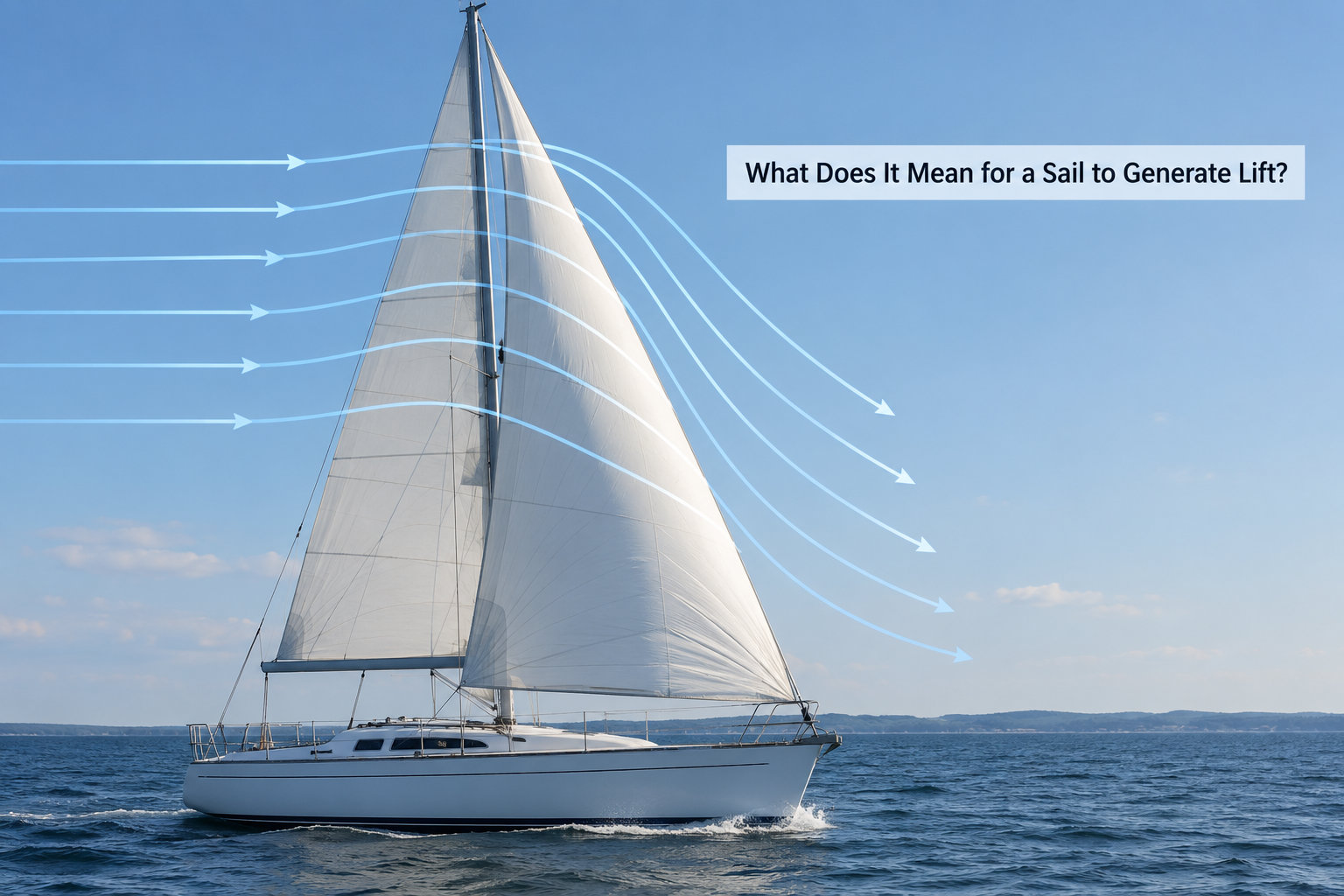
It means the sail is working as a vertical wing. Hold an airfoil-shaped sail at the right angle to the airflow and it produces a force perpendicular to that airflow, the same way a fixed-wing aircraft produces one in the horizontal plane. Rotate that wing upright and it becomes a means of moving a boat through water in a direction the wind never blew.
Two forces come out of that interaction. Lift acts perpendicular to the apparent wind, and drag acts along it, opposing motion through the air. Real sails produce both, always, and the ratio between them is what decides whether a boat is quick or merely powerful.
How a sail generates lift instead of drag
The parachute idea is the first thing to unlearn. A parachute generates its force mostly by being pushed downstream, which is drag, and drag alone cannot sail toward the wind. A cambered sail at a small angle of attack sends most of its force sideways instead, which the hull and keel can convert into forward motion.
Is sail lift the same as forward thrust?
No, and mixing up the two causes most of the confusion around this topic. Lift is defined perpendicular to the apparent wind. Driving force is the component of the total aerodynamic force that points along the boat’s heading, and it is only a fraction of the total. Sail a close-hauled course and the lift coefficient is high while the driving force is modest, because most of the force has to be cancelled sideways by the keel before any of it becomes progress.
How Does Airflow Create Lift Around a Sail?
It happens in four steps, and once you can picture them, trim stops being guesswork.
- The sail sits at an angle to the apparent wind, so the flow has to turn to get past it.
- The curved surface adds a circulation that the flow would create anyway, like the extra swirl around a cricket ball.
- Air leaving the sail moves downward and aft, so the pressure on the windward side rises and the pressure on the leeward side drops.
- That pressure difference integrates into a net force: lift perpendicular to the apparent wind, drag along it.
Flow turning is the mechanism. The sail pushes air down, and because the air’s mass and momentum have to balance, the air pushes back on the sail with equal force in the opposite direction. Newton wrote it first; the pressure-difference description is how we visualise the same event.
Equally important is what the air does not do. It does not travel two different distances around a sail and then race to catch up. Flow around a sail is not steady, and the streamlines on the two sides never meet again at the trailing edge, because the fluid moving over a lifting surface forms a circulation that reaches into the fluid ahead of and behind it.
What Bernoulli’s principle does and does not explain
Bernoulli’s principle is real and it does apply to sails: where flow speeds up, static pressure drops, and the low pressure on the leeward side of a sail is genuinely part of why lift exists. What is wrong is the equal-transit-time story that says air splits at the leading edge, takes one path over the long side and one under the short side, and meets again at the trailing edge having sped up and slowed down by the same proportion.
That version fails a simple test. A flat sheet of plywood bolted to a rail at an angle and blown from behind makes lift, and it makes plenty of it. Camber is not what causes lift; the turning of the flow and the circulation around the shape are. Threads in a fluid cannot impose a consistent speed change on it, and nothing requires the two sides to rejoin. Threads on r/sailing and on physics.stackexchange converge on exactly this point, with NASA’s own explanation of lift as the version most people find convincing.
Where the boundary layer matters: air next to the cloth is dragged along with it, forming a thin layer a few millimetres thick. Keep the flow attached and that layer stays orderly. Push the angle of attack too far and it separates, and lift stops rising.
Why Does Angle of Attack Matter So Much?
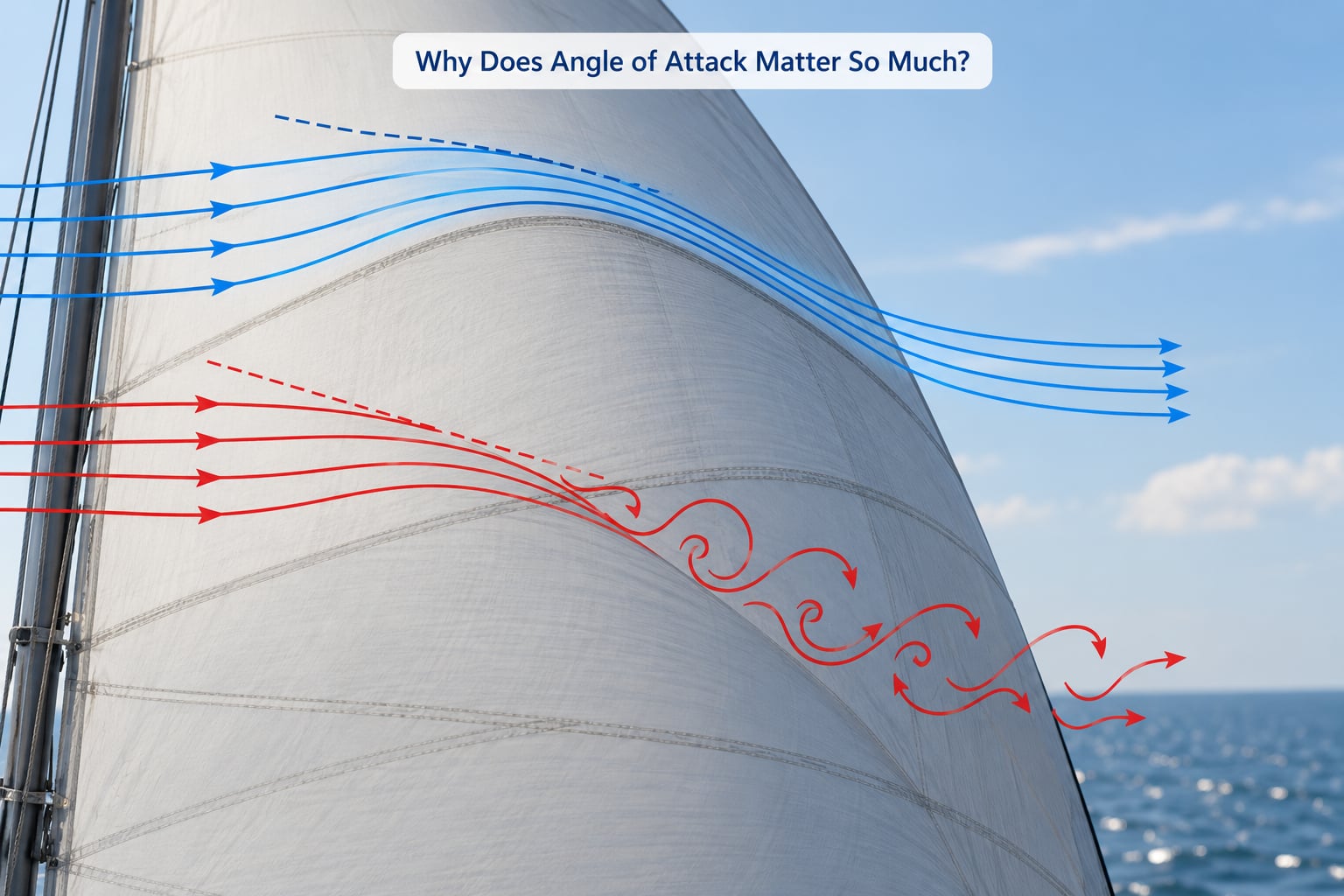
Because angle of attack is the throttle on lift. Hold the same sail at the same apparent wind and change only the angle between the sail and the flow, and the lift coefficient moves along a curve with a clear shape: rising, peaking, then falling away.
Increasing the angle of attack
Open the sail out and the windward and leeward pressures both climb, so lift rises roughly in proportion. The catch comes when the flow’s turning demands exceed what the boundary layer can sustain near the leech, and the air peels away from the cloth instead of following it. At that moment the sail luffs: the leech flutters, the telltales spin, and the lift coefficient falls even though the sail is at a steeper angle than before.
The point of maximum lift
Peak lift, usually near 15 to 20 degrees for a well-shaped sail, sits just before separation begins. This is the sail’s best-lifting angle, and the whole craft of trimming is about holding near it in the conditions you have. The optimum drifts with apparent wind and with the shape of the sail, which is why a setting that worked on the previous beat rarely stays perfect on the next one.
Stalled flow and what it feels like
Past the peak, the lift coefficient drops while the drag coefficient climbs sharply. A stalled sail feels heavy and full of nothing: the telltales stream aft, the boat stops accelerating, and the helm goes soft because the lateral force has fallen too. Sailors describe the telltales doing opposite things because luffing is a forward-edge separation while a stall begins further aft, and the two respond to different trim changes.
Upwind, the usual close-hauling angle of attack is much lower than peak-lift angle, sometimes 10 to 15 degrees, because drag matters as much as lift and the boat needs to hold an angle to the true wind. Sailing fast means flying at a lower angle; sailing in a lull means flattening and easing to catch what air there is.
What Is Apparent Wind, and How Does It Affect Lift?
Apparent wind is the wind a sail actually feels: the vector sum of true wind and the boat’s own motion through the water. Sail dead downwind and it collapses toward the true wind. Sail close-hauled and the boat’s own motion adds a headwind component, so apparent wind is stronger and further forward than what the anemometer at the masthead reads as true wind.
Here is the part that unsettles people: as the boat accelerates, its own motion subtracts from the apparent wind, so apparent wind falls. The sail then generates less lift, the boat decelerates slightly, apparent wind rises again, and the boat settles at a steady speed where driving force matches total resistance. That is why a boat with more sail does not simply keep going faster until the rig falls apart. It finds its own limit.
Apparent wind also shifts with height. Wind is faster at the masthead than at the foot of the sail, which is exactly why sails are built with twist: the angle of attack is allowed to open up as you go up the sail, so the upper sections see an angle that suits their higher air speed.
Gusts raise apparent wind briefly and a boat should pitch and accelerate through them rather than heeling hard. Steady heel means the rig is loaded beyond what the hull wants, and it steals speed as surely as it adds drag.
How Does Sail Shape Change the Lift?
Camber and draft position are the two variables a sailor can actually change under load, and twist is the one the sailmaker controls. Everything else follows from them.
Sail camber and depth
Camber is the curve of the sail’s cross-section, and its depth is usually expressed as a percentage of chord. Dellenbaugh’s figures, widely quoted in the reference literature, put maximum draft at 13 to 16 percent of chord in light air, 11 to 13 percent in medium, and 9 to 12 percent in heavy air. Deep sails carry more power at low speed; flat sails carry less and reach better once the boat is moving.
Draft position up the sail
Move the draft forward and the leading sections bite harder, which points the boat higher and pulls the centre of effort forward. Move it aft and the sail unloads early, which suits reaching. The visible sign is the telltale behaviour: lift on one side of a telltale’s stream means the flow is separating aft, and you can move draft with cunningham tension, outhaul, or leech tension.
Sail twist
Twist is the difference in angle of attack between the foot and the head of the sail. More twist opens the angle of attack up the mast, which flattens the entry and prevents an overpowered head from stalling while the foot is still driving. Less twist gives a firmer, more powerful shape that suits steady air. Raking the mast back adds twist; cunningham tension removes it.
One thing separates sails from aircraft wings, and it explains why trimming never ends. A wing is rigid and holds the shape it was designed. A sail is a membrane whose shape depends on the load it is carrying, so it flattens when eased, deepens when loaded, and changes again in a puff. The sail you trim is a snapshot of one instant of apparent wind.
How Much Lift Does a Sail Produce?
The standard relationship is L = 0.5 x rho x VA x VA x A x CL, where VA is apparent wind speed, A is sail area, rho is air density and CL is the lift coefficient. Lift scales with the square of apparent wind, which is why the last few knots of breeze matter so much more than the first few.
| Variable | What it means | What sets it on a real boat |
|---|---|---|
| rho | Air density | Altitude and temperature; barely worth thinking about for most sailing |
| VA | Apparent wind speed at the sail | True wind plus boat speed, plus wind gradient up the rig |
| A | Sail area | Rig size; mostly fixed, so trim is the lever |
| CL | Lift coefficient | Angle of attack, camber, draft position, aspect ratio, whether the flow stays attached |
A worked example for a 10 square metre cruising main in 10 knots of apparent wind. Ten knots is about 5.1 metres per second, and sea-level air density is roughly 1.225 kilograms per cubic metre. With a lift coefficient of 1.2, which is realistic for a well-trimmed cruising sail, that gives roughly 185 newtons of lift, about the weight of a 19 kg mass hanging off the rig.
Now compare that to the boat. A 300 kg cruiser displaces close to 3,000 newtons, so the sail alone could not hold it up, let alone drive it through the water. The keel supplies the rest. Actual performance also depends on how well the lift is aligned, on hull and keel resistance, and on whether the flow stays attached at all.
How Do Sailors Use Lift to Propel a Boat?
By splitting the total aerodynamic force into the part that helps and the part that hurts. If alpha is the apparent wind angle, the driving force is approximately L x sin(alpha) minus D x cos(alpha), and the lateral force is approximately L x cos(alpha) plus D x sin(alpha). Upwind, sin(alpha) is small, so lift dominates and driving force is small. Downwind, alpha approaches 180 degrees, sin(alpha) falls away and drag takes over as the engine.
| Point of sail | Apparent wind angle | Dominant force | What the sail is doing |
|---|---|---|---|
| In irons | 0 to 30 degrees | Neither; no-go zone | Luffing on both sides, boat stalls and slides sideways |
| Close-hauled | 30 to 45 degrees | Lift | Low angle of attack, high lift coefficient, foiling keel working hard |
| Beam reach | 60 to 100 degrees | Lift and drag balanced | The fastest point of sail on most boats, sails working hardest |
| Broad reach | 110 to 150 degrees | Drag rising | Eased sheets, open sail, drive from speed through the water |
| Running | 150 to 180 degrees | Drag | Spinnaker’s job changes entirely: drag area, not a lifting foil |
The no-go zone exists because of that geometry rather than a rule anyone invented. As the apparent wind angle closes toward zero, driving force falls toward zero while lateral force stays large, so the boat slides leeward faster than it moves forward. Push closer and the total force pushes backwards instead.
The keel is the other half of the answer. Its underwater foil is a wing generating hydrodynamic lift against a sideways-moving hull, which cancels most of the lateral force from the sail and turns what remains into forward drive. The price is leeway, a few degrees of sideways travel the boat never stops making. Foiling boats and iceboats do the same thing far more dramatically because their foils can generate enormous lift with almost no drag.
Heeling is the cost of that arrangement. The aerodynamic force acts well above the boat’s centre of lateral resistance, so its sideways component rolls the boat, and every degree of heel adds form drag and wetted surface. Heeling moment is the reason a stiff dinghy carries a crew on the windward rail rather than hiking alone.
How Can You Improve Lift Without More Sail Area?
You cannot add sail area to a boat you already own, but trim recovers much of what a bigger rig would have delivered. The goal is simple: keep the angle of attack near the peak of the lift curve, in the shape the current conditions want.
Trimming the sheet
Trim in until the windward telltale lifts, then back off a fraction until both stream aft. Sheet tension is the primary control of foot draft, and foot draft is the primary control of the angle of attack over most of the sail’s area. Ease in light air for depth and power; pull on in heavy air to flatten and stay clear.
Diagnosing poor airflow
Three checks in order. First the telltales: streaming aft on both sides means attached flow on the working side, fluttering means luffing, and one side lifting while the other streams means the flow has separated aft and the sail needs flattening or the draft moved forward. Second the shape: hold the leech and check whether draft sits in the forward third, which suits upwind sailing, or further aft, which suits reaching. Third the surface: salt, dirt and a slack leech all trip the boundary layer and cut lift.
If you want evidence rather than impressions, this is where instrumentation pays off. Telltales give you a continuous visual signal. An apparent-wind instrument or a pitot tube at the masthead tells you the real VA going into the equation rather than a guess. Pressure taps at several chordwise positions on the sail measure the windward-to-leeward difference directly, which is the quantity the lift equation is actually about. A strain gauge or load cell on the leech gives a second, independent read on how hard the sail is working, and on foil boats the same instrumentation on the centreboard tells you whether the underwater foil is doing its share.
For engineers, the same pressure-tap approach used in wind tunnel work on flexible membranes works on the water, with the usual added complication that a sail’s shape changes as it loads. Iceboats and land yachts push the concept to its limit, running apparent wind angles far outside what a displacement hull can hold.
Frequently Asked Questions
Is a sail a wing or a parachute?
A sail behaves as a wing. Held at an angle of attack, its curved shape turns the airflow and creates a pressure difference that produces lift perpendicular to the apparent wind. A parachute relies mostly on drag, which pushes it downstream and can only carry the boat the same way the wind is blowing. That is the fundamental difference, and it is why sails can drive a boat toward the wind.
How do sails use Bernoulli’s principle?
They use the real part of it: where air speeds up over the leeward side, static pressure drops, and that low pressure contributes to lift. They do not rely on the equal-transit-time version that claims air speeds up over the long side and rejoins the slower air at the trailing edge. Fluid cannot be forced to speed up or slow down that way, which is why a flat plate at an angle still makes lift.
Why can’t a boat sail directly into the wind?
Because of how the total aerodynamic force resolves. Head to wind, lift points sideways and driving force falls toward zero while lateral force stays large, so the boat slides sideways faster than it advances. Inside roughly 30 degrees of the true wind there is no useful driving force at all, which is the no-go zone. Tacking works because the boat makes progress across the wind while the angle closes toward it.
What is the difference between luffing and stalling?
Luffing happens at the leading edge when the angle of attack is too small; the airflow cannot follow the entry and the cloth shakes and flutters. Stalling happens at too large an angle, when flow separates aft of the peak-lift point, lift falls away and drag climbs. Practically, luffing means sheet in, stalling means flatten the sail, and telling them apart comes down to where the telltales break down.
Does a flat plate make lift if camber is not required?
Yes, and this is the cleanest proof that camber is not the cause of lift. Hold a flat sheet at an angle to the flow and it still turns air, still develops circulation, and still produces force. Camber raises the lift coefficient and lets a sail do useful work at smaller angles of attack, but the underlying mechanism is flow turning, not curvature.
Conclusion
A sail generates lift because its curved shape, held at an angle of attack to the apparent wind, turns the airflow downward and aft, and the resulting pressure difference pushes the cloth perpendicular to that wind. The keel cancels most of the sideways part so what is left drives the boat forward.
Start on the water by watching three things at once: where the apparent wind is coming from, whether the sail is holding its shape, and what the telltales are doing. Make one small trim change at a time and you will find the peak of the lift curve yourself, without needing a single instrument.