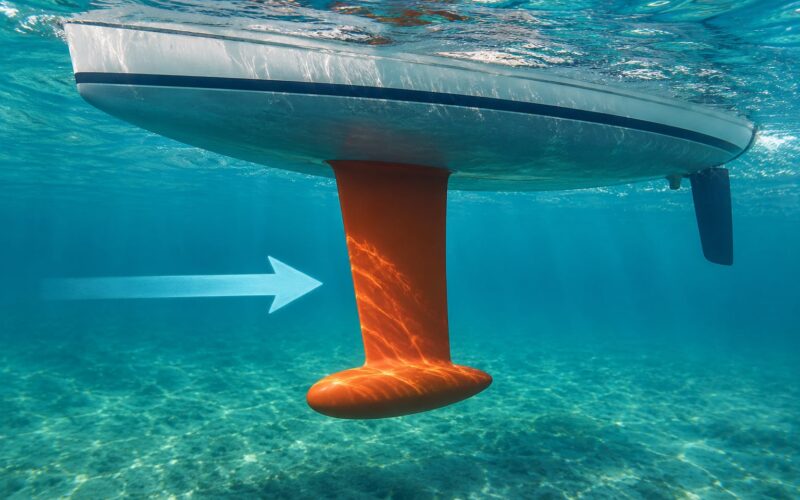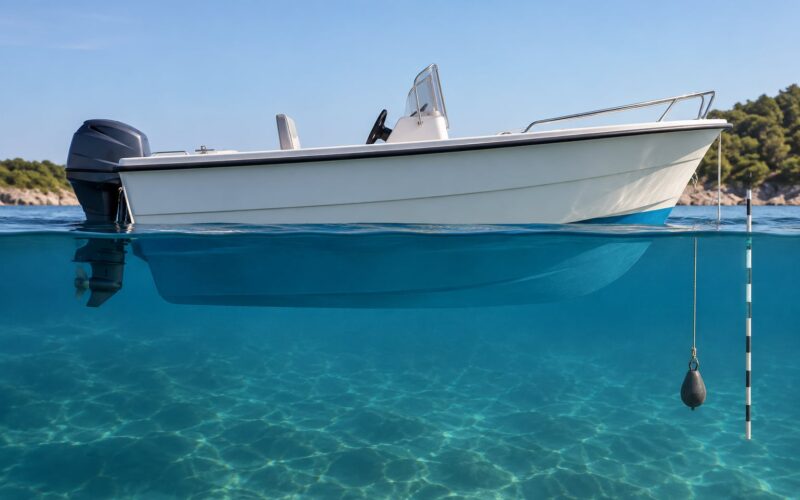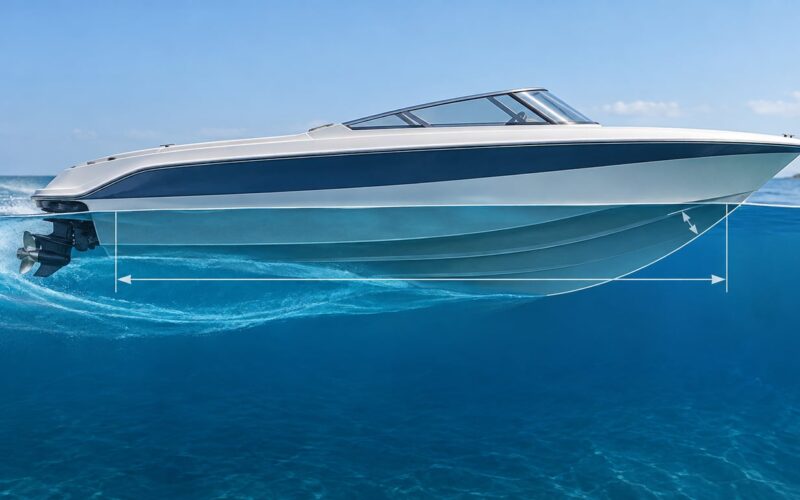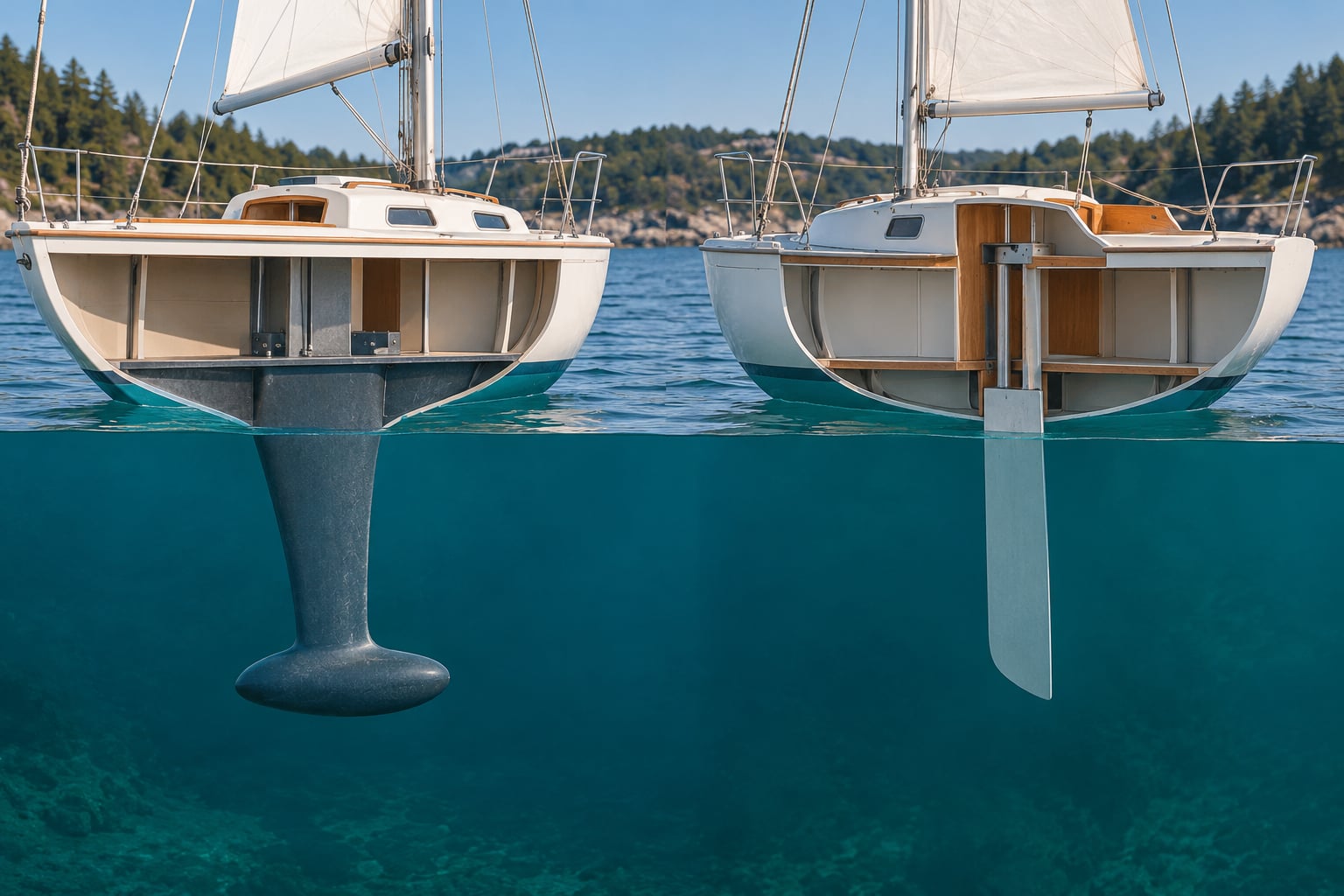
The difference is what the appendage carries. A keel is bonded to the hull and full of metal ballast, so it stays in the water and supplies both sideways resistance and righting moment. A centerboard is a light foil that drops into a trunk and can be raised, giving up most of that stability to gain shallow water and transport options.
Those keel vs centerboard differences run through everything a sailor notices on the water: how hard the boat heels in a gust, whether it points upwind in a lull, whether you can sit on a mudflat at low tide, and whether the boat lives on a trailer or in a berth with a crane beside it. Get the pairing wrong and you notice it as a boat that feels uncomfortable, sluggish, or simply unable to reach the anchorage you wanted.
Table of Contents
- Keel vs Centerboard Differences at a Glance
- How Keels and Centerboards Create Side Force
- Stability, Ballast, and Initial Response
- Performance in Wind, Waves, and Current
- Draft, Shallow Water, and Boat Access
- Construction, Maintenance, and Adjustability
- Which Should You Choose?
- Frequently Asked Questions
- Conclusion
Keel vs Centerboard Differences at a Glance
The table below sets a fixed ballast keel against a retractable centerboard across the factors that matter most to owners. Read it as a set of trade-offs rather than a scorecard, because a boat that is wrong for your water is wrong no matter how good its other numbers look.
| Factor | Fixed ballast keel | Retractable centerboard |
|---|---|---|
| Carries ballast | Yes, metal in the foil itself | No, the board is light |
| Initial stability | High, low permanent ballast | Lower, most ballast sits high |
| Righting moment | Large and always present | Modest, and falls away when raised |
| Sideways resistance | Strong, constant area | Strong only while the board is down |
| Draft | Deep, fixed at launch | Shoal draft with the board up |
| Shallow water access | Poor, aground risk in shoals | Good, plus tidal drying out |
| Installation and retrofit | Harder, structural, build-time job | Simpler and retrofittable, but the trunk is a weak point |
| Trailering over land | Not possible without a crane | Simple, routine, cheap |
| Upwind pointing | Depends on foil span and draft | Very good with the board fully down |
| Motion in a seaway | Slower, damped, comfortable | Quick, livelier, drier ride |
| Maintenance load | Fouling and corrosion of one part | All of that plus pivots and trunk seals |
| Cost of moving and storing | Travel lift, crane or forklift every move | A trailer, a ramp and a car park |
How Keels and Centerboards Create Side Force
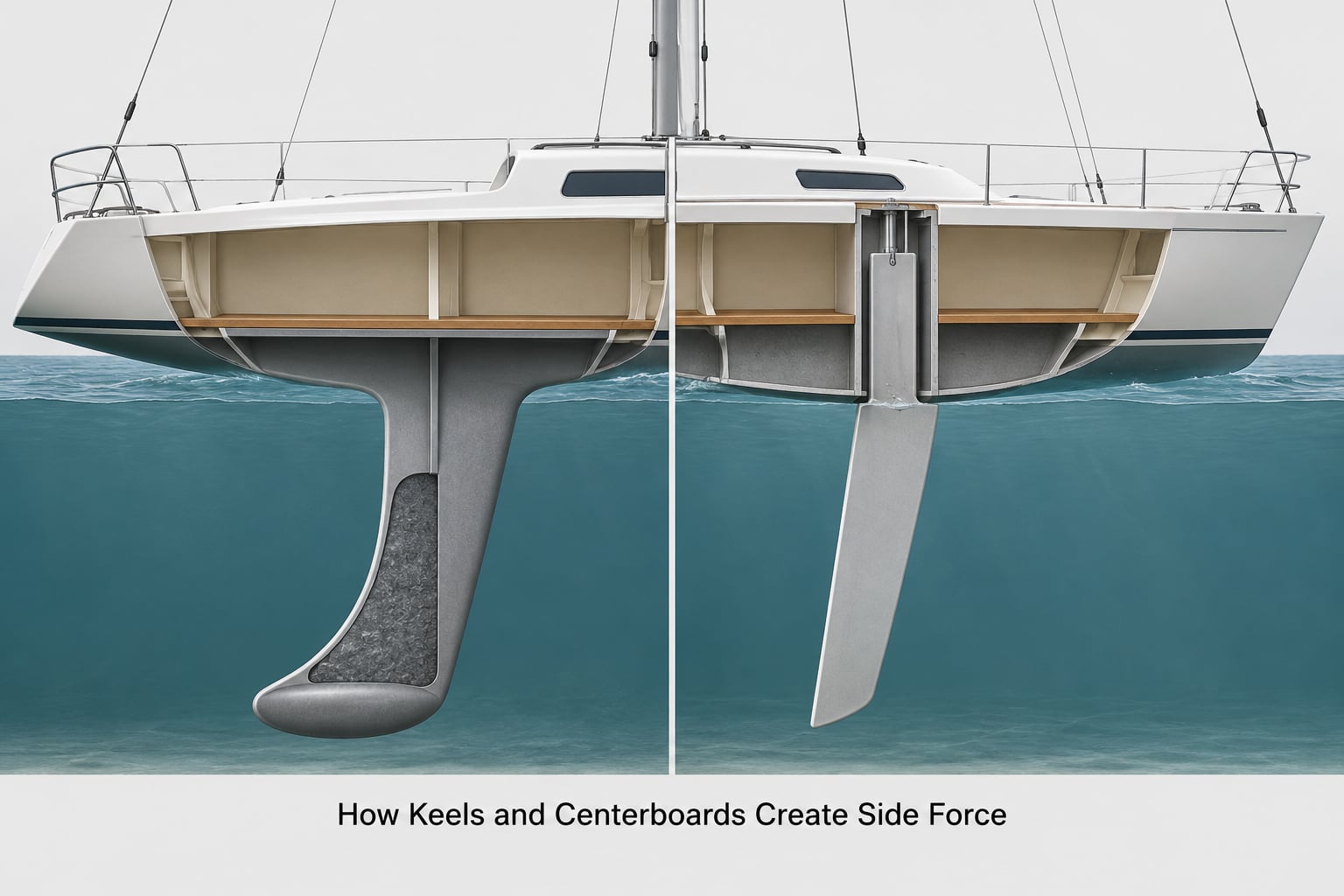
Wind on a sail pushes the boat sideways. Whatever stops that sideways push is a foil working underwater, and both a keel and a centerboard do it the same way: the foil meets the water at a small angle of attack and generates lift sideways, cancelling most of the wind’s force.
The quantity that matters is the angle between the boat’s path through the water and its heading, called leeway. A short, shallow foil has to work harder and slips more, so leeway climbs. A deeper foil with more span has less leeway at the same speed, which is why deep-draft boats generally sail faster close-hauled in steady air.
Wetted surface and drag
A fixed keel is always in the water, so its wetted surface is always creating drag. A raised centerboard stops creating any at all, and a lot of small boats sail noticeably faster over a sandy patch or in a light breeze with the board up. That is a real gain and also the reason people describe board-up boats as “slower” in open water: the total wetted area has grown for the whole sail.
A trunk is a hole, not an appendage
One piece of jargon causes endless confusion. The centerboard trunk is the housing in the hull that the board slides through; it is a slot, not a foil. The foil is the board itself. That distinction explains why above-waterline the board can come out completely for transport or storage while a keel can never come out at all.
Two jobs, or only one
The cleanest framing comes from a CruisersForum thread that gets quoted often on this site: a regular keel does two things, reducing leeway and increasing righting moment through its own weight, while a centerboard mostly does the first. Once you accept that split, most of the handling differences stop being mysterious. A boat on a board is a foil with a hull attached; a boat on a ballast keel is a ballast stability device that happens to also generate lift.
Stability, Ballast, and Initial Response
What keeps a sailboat from tipping over is ballast placed low, and that is the whole of the keel vs centerboard differences in one sentence. A typical production cruiser carries roughly a quarter to a third of its displacement as ballast, and on a keelboat the large share of that sits at the bottom of a foil with a long lever arm.
When the boat heels, that weight tries to fall back to the low side. The bigger the weight and the lower it sits, the harder it pulls, and the hull designer’s job is to balance that huge restoring force against a hull that would otherwise fall over on its own. Raising a board does not touch the righting force from the permanent ballast in the hull, but it removes the foil’s contribution entirely.
Initial response and roll damping
Initial stability describes how the boat stands up as it first heels. A ballast keel tends to stand up promptly because the weight is already in the right place, which is why keelboats feel settled rather than nervous. A board boat rolls more freely and leans into a wave before it recovers, and it carries more of its ballast high in the hull, so it responds more slowly to being pushed over.
Roll damping tells the same story from the other side. Water moving around a deep, narrow keel resists the motion, and a large keel turns the boat into something close to a long pendulum that resists rolling hard. A shallow board does not, so the boat rolls more, which is why light-displacement centerboard cruisers feel lively in a way a full-keel cruiser never does.
Performance in Wind, Waves, and Current
Leeway, tracking, and helm feel separate cleanly by appendage in steady conditions and blend together in waves. Here is where each one wins and where each one costs you.
- Upwind pointing. A long, deep foil gives less leeway and lets a boat drive higher. Many centerboard boats point extremely well with the board fully down, which is why owners are reluctant to raise it in open water even when the water is shallow.
- Light air. Wetted surface dominates here. With the board up, a shallow-draft boat carries less of the hull around and often accelerates better, though the advantage shrinks once the hull-form differences are accounted for.
- Tracking and directional stability. A full keel resists yaw and keeps a heading for hours, the quality CruisersForum owners describe as tracking well while maneuvering like a barge. A board plus spade rudder turns instantly and points where you ask, at the cost of holding a line unattended.
- Helm feel. Short, narrow foils with light mass feel lively and responsive. Deep keels carry more load and can feel heavy, especially with a large rudder directly behind them.
- Motion offshore. This is the strongest argument for fixed ballast. A deep keel damps roll and pitch, so a passage feels flatter. SailingAnarchy posters describe the upwind difference with a board down as huge, and the same owners usually say the same boat is unpleasant in a big seaway with the board up.
Why the keel vs centerboard differences shrink in light air
Drag scales with the square of speed, and lift-generating effort matters most when you are working hard against the wind. At low speed the board-up boat looks excellent; once you are powered up and leaning on the rail, the low-leeway advantage of a properly sized foil comes back quickly. That is why experienced cruisers treat board position as a condition of the day rather than a fixed habit.
What grounding does to a keel versus a centerboard
A keel that touches bottom drags a long, heavy, blunt object across the hull and can punch a hole in it, stop the boat dead, or snap a rudder hung below the hull. A hinged board often swings up and back as it hits, taking the hit on the leading edge instead of the hull. That is a genuine safety advantage, and it is one of the quieter reasons coastal sailors like boards. Removable boards have their own failure mode, since a drop-down board can shear at its pin.
Draft, Shallow Water, and Boat Access
Draft is where the choice stops being theoretical. A keel sets your draft once and forever, measured from the lowest point of the ballast, while a centerboard lets you choose between a working draft with the board down and a much shoal draft with it up.
Shoal draft opens specific geography: a bar at the mouth of an estuary, a coral or sand flat you can cross only near high water, an inland lake with a posted limit, a mooring in a shallow bay. It also changes where you can go in bad weather, since you can always run for shelter in shallow water rather than being committed to deep water offshore.
Drying out and beaching follow from the same fact. A boat with a raised board settles upright on a tidal flat, which is how thousands of small cruisers spend every winter without a marina. A fixed keel cannot do this; it lies over on her side, and owners of shallow-draft full keels still hit the limit of how far the tide goes.
Transport is the other half. A trailerable boat launches in ten minutes at a ramp you can reach from a car park. A keelboat needs a travel lift, a crane, or a forklift every time it moves, and that cost is the single biggest difference in day-to-day ownership between the two. The maintenance side says the same thing from a different angle: more moving parts means more to inspect.
Construction, Maintenance, and Adjustability
Structurally, a fixed keel is the harder job for the builder. The hull must carry the ballast through a root fairing, and the joint has to survive the entire load in a seaway. A board only loads the trunk, which is why boards are retrofittable and why a hull built for one is not automatically a hull built for the other.
Movable appendages add a maintenance category that does not exist on a keelboat. A survey of a swinging or lifting appendage looks at the pivot bolts, the pennant or wire that holds it up, the hydraulic system and its hoses, the stops, the trunk seal, and the case. Anything left in salt water for a decade deserves those same six checks, and corrosion in a pivot is the failure owners regret most.
Fouling applies to both, but a keel with a fairing and a bulb collects less growth than an exposed board, and a deep keel keeps the surface below the reach of most light. On a shallow board in warm water you will be cleaning it more often, and that work is one reason charter and delivery captains keep the board down only when they have to.
Why a raised weighted swing keel feels tender
Some boats use the term swing keel for a weighted keel on a pivot, and those are not centerboards at all. WoodenBoat writers make the point plainly: a swing keel with any meaningful ballast component is felt as lower stability with the board up, because the weight that was providing the righting moment has moved up into the hull or into a lifting wire. MacGregor owners have been re-labelling their swing keels as centerboards after reading the manual, which is exactly the confusion this sentence is meant to end.
Which Should You Choose?
Match the appendage to the water and the storage, not to the boat’s looks. Each case below has a clear answer.
- Offshore and bluewater cruising. Choose a fixed ballast keel. It damps roll, holds a heading, and survives a knockdown with the stability already aboard.
- Performance sailing and racing. Choose a fin keel or a cantilever fin. Minimal wetted surface and low drag matter more than shallow access.
- Small dinghies and daysailers. Choose a centerboard or daggerboard. It is lighter, simpler, and gives the boat a shape that can be stored on a roof rack.
- Shallow coastal and island hopping. Choose a centerboard. Beaching at low tide and anchoring in a bay too shallow for a keel is the whole point.
- Inland lakes, rivers, and intracoastal routes. Choose a shoal-draft centerboard and learn the posted limits.
- Transportable and seasonal-storage boats. Choose a centerboard. It removes the launch equipment cost entirely.
- Boats used on a multihull as a companionway tender. Choose a centerboard or daggerboard, since a keel makes the tender hard to hoist and nearly impossible to beach.
- Small marine robotics and survey workboats. Choose a shallow, protected appendage, or none at all. Work in shallow survey areas and near structures where a long keel is a liability, and where a boarding crew needs to step ashore safely.
The compromise that keeps coming up among owners, including on Reddit’s sailing forum, is a shallow three-quarter keel with a drop-down board, which is stable with the board extended and free when it is retracted. For coastal cruising, that hybrid is often the most practical answer of all.
Frequently Asked Questions
Is a centerboard safer than a keel?
It depends on the failure you are comparing. In shallow or unfamiliar water a centerboard is safer, because a hinged board often swings up as it touches and the hull clears, while a fixed keel can dig in and hole the hull. Offshore in heavy weather a ballast keel is safer, because it keeps its righting moment and its roll damping in place. Many coastal cruisers combine both advantages with a shallow keel and a drop-down board.
Do centerboards make a boat faster than fixed keels?
With the board down, a centerboard boat points well upwind and is competitive with any keel of similar span and depth. With the board up in light air, it can sail faster because the wetted surface is smaller. In steady breeze the keel usually wins on boat speed and tracking. The honest summary is that the board changes what the boat can reach rather than making it inherently faster.
Can a keelboat sail in shallow water?
Only if it is a shallow-draft design and you respect the tide. A full keel gives up some shallow water access in exchange for a stable, well-damped ride, and a fin keel gives up a great deal more. A keelboat can usually reach a shallow anchorage at high water and leave at high water, but it cannot dry out on a tidal flat the way a raised-board boat does. Always check the charted depth against your keel draft plus the tide.
Which appendage is better for a small sailboat?
For most small sailboats the centerboard wins, because it gives a much wider range of draft, stores easily, and costs nothing to launch. It also lets you beach the boat, which is how many of them are stored. A weighted swing keel is a different animal: it behaves like a small ballast keel with the board down and feels noticeably tender with the board up, so treat it as a keel for stability purposes.
Can a centerboard be removed or raised when not sailing?
It depends on the design. Removable boards come out completely for transport and storage, which is the normal arrangement on trailerable cruisers. Enclosed boards slide up into the trunk and can often be pulled out after the boat is lifted out of the water. Hinged or swinging boards stay with the boat but rotate clear of the hull. Any board should be raised before aground in water you did not expect to be shallow.
How much does a centerboard or keel affect boat cost?
It changes ownership cost more than purchase price. A centerboard boat can be trailered, so it avoids a travel lift or crane, marina fees sized by draft, and winter storage on a cradle. A keelboat pays those costs every season. A hydraulic lifting keel sits between the two, adding purchase cost and a maintenance line item, and it still needs a deep-water berth or a lift to be moved.
Conclusion
The keel vs centerboard differences come down to one exchange: permanent ballast buys you stability and damped motion, and a retractable board pays for shallow water and easy handling with that stability. Match the appendage to the depth you actually sail, the way the boat will be stored, and how hard you expect it to be heeled before anything else.
Start by measuring what you have: your charted minimum depth plus tide against your current draft, and how often the boat needs to move. That answer usually settles the choice on its own.