LiFePO4 (lithium iron phosphate) wins on almost every number that matters in a marine project: usable capacity, weight, cycle life, charging time and maintenance. Lead-acid still wins on purchase cost, fault tolerance and simplicity, so it stays the sensible choice for a coastal day-sailer or a start bank. Everything in between depends on your load and your charger.
The decision for lifepo4 vs lead acid for marine projects comes down to one question: how much usable energy can you carry, and how long do you want it to last without being replaced? Rated amp-hours on a datasheet are marketing. What you actually get on the bank is a different number, and it is that number which sets the size of everything else — the charger, the solar array, the mounting tray, the vessel’s ballast.
I’ve read enough refit threads and battery datasheets to know where the marketing stops. What follows covers the eight criteria that matter, the charger settings nobody publishes, and the two places people wreck an otherwise good installation. Updated for 2026.
Table of Contents
- LiFePO4 vs Lead Acid for Marine Projects at a Glance
- Usable Capacity and Battery Sizing
- Weight and Vessel Space
- LiFePO4 vs Lead Acid: Lifespan and Charging
- Safety, Corrosion, and Moisture Exposure
- Cold-Weather and Wet-Environment Performance
- Cost and Total Ownership
- How to Choose LiFePO4 or Lead Acid for a Marine Project
- Which Should You Choose?
- Frequently Asked Questions
- Conclusion
LiFePO4 vs Lead Acid for Marine Projects at a Glance
| Criterion | LiFePO4 | Flooded lead-acid | AGM / gel |
|---|---|---|---|
| Usable depth of discharge | 90-100% | ~50% | 50-80% |
| Discharge curve | Flat, then a sharp cliff | Sags from the first amp | Sags early, holds mid-range |
| Cycle life to 80% capacity | 2,000-8,000 cycles | 200-500 cycles | 300-800 cycles |
| Calendar life | 10-15 years typical | 3-5 years | 4-7 years |
| Weight for 10 kWh usable | ~220-260 lb (100-118 kg) | ~900-1,100 lb (410-500 kg) | ~700-900 lb (320-410 kg) |
| Specific energy | 90-160 Wh/kg | 30-50 Wh/kg | 35-60 Wh/kg |
| Charge acceptance | Fast, accepts partial top-ups | Slow, dislikes partial charging | Moderate |
| Charge temperature floor | 0°C/32°F without heating, with cutoffs | Works to well below freezing | Works below freezing |
| Maintenance | None | Water every few months, vented | None, but sealed |
| Gassing on charge | Negligible | Hydrogen, needs ventilation | Minimal |
| Failure mode risk | BMS cutoff, cell imbalance | Sulfation, plate shedding, spills | Sulfation, early capacity loss |
| Upfront cost relative | 3-7x lead-acid | Baseline | 1.5-2x flooded |
| Cost per usable kWh over life | Lower after roughly year two | Highest long-run | High long-run |
| Best fit | House banks, robotics, propulsion, liveaboard | Start banks, low-demand coastal boats | Start banks, tight compartments |
The short version: LiFePO4 for anything that moves, runs long, gets charged by solar, or needs to be light. Lead-acid for a boat that mostly sits, mostly starts, and whose owner would rather not think about chargers.
Usable Capacity and Battery Sizing
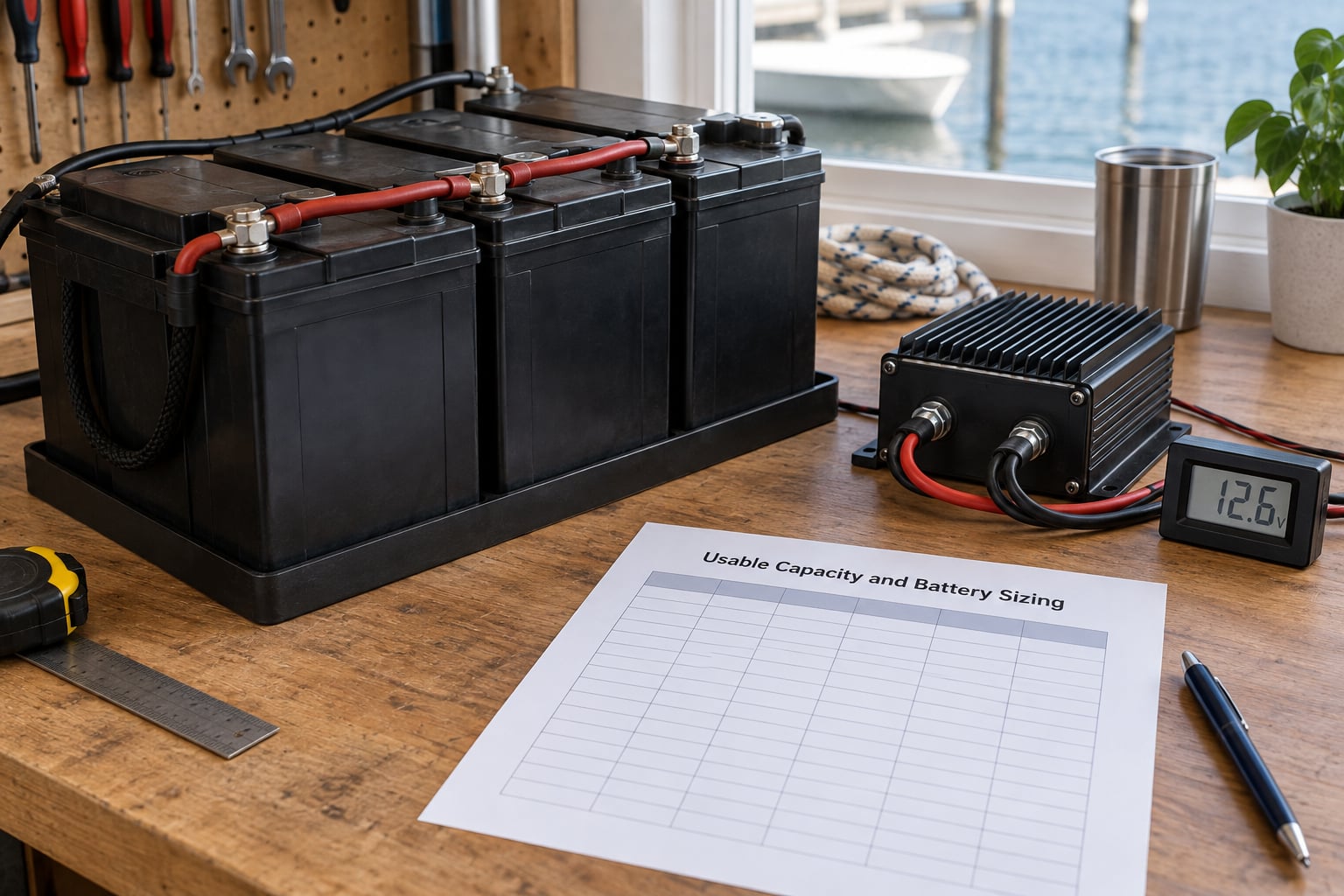
Why rated amp-hours are not usable amp-hours
A 100 Ah flooded battery does not give you 100 Ah. Lead sulfate builds up on every discharge and the voltage sags hard as you pull current, so usable capacity drops to roughly half of rated. AGM stretches that to maybe 50-80%, and gel sits between the two depending on age.
LiFePO4 gives back about 90-100% of rated capacity, and it holds a nearly flat voltage plateau until the bank is nearly empty, then drops off a cliff. That flat plateau is a real advantage for an electric outboard or a trolling motor: the motor sees the same voltage for the whole run rather than browning out early.
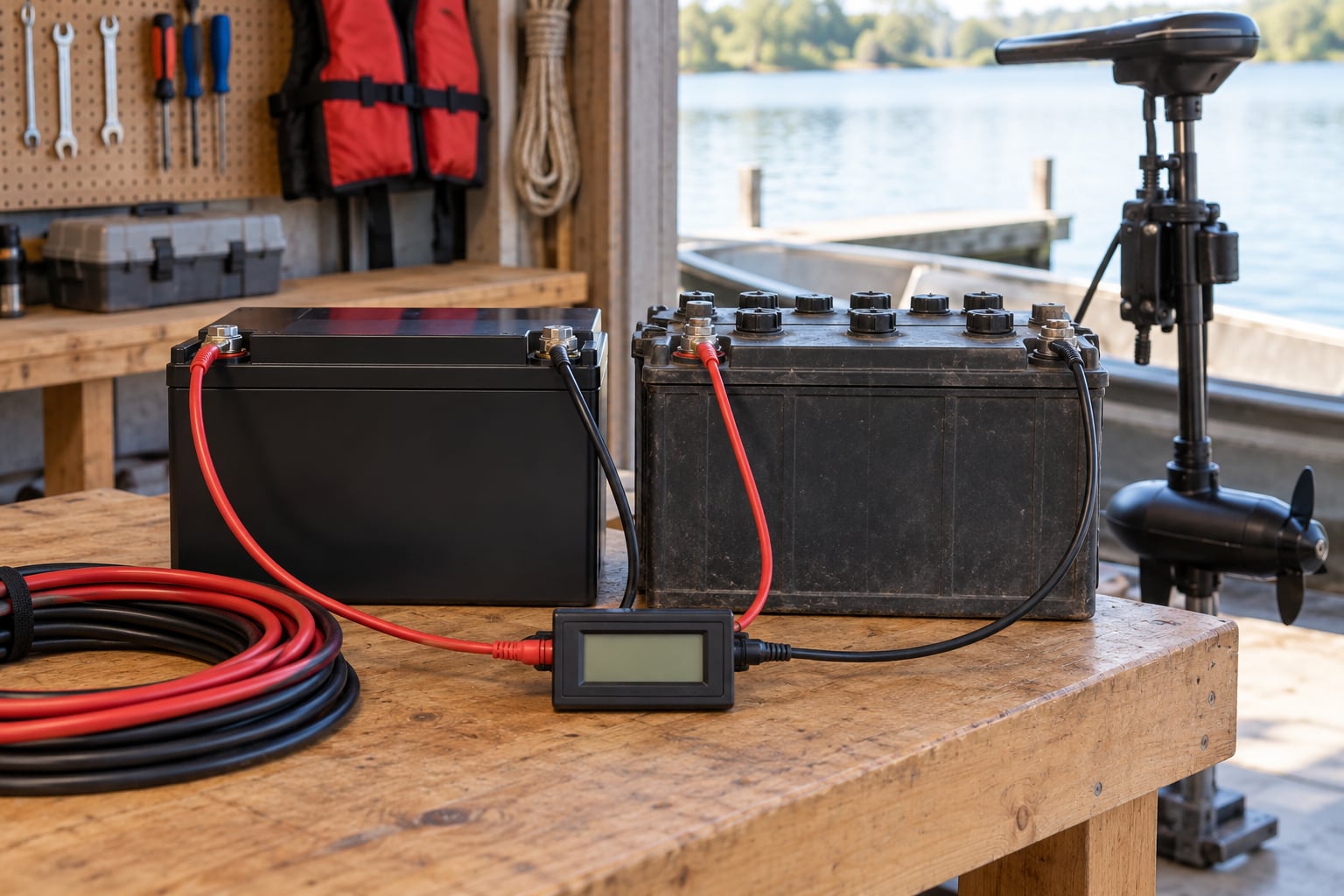
One quirk catches everyone out. A LiFePO4 battery sitting at 13.4V reads as “nearly full” on a voltmeter even when it is only around half charged, because the resting voltage is so high and so flat. If you judge state of charge by voltage alone, you will call a half-empty bank full. Use a coulomb counter or the manufacturer’s Bluetooth telemetry instead.
How to size either chemistry without guessing
Start from loads, not batteries. List every load and its average and peak current, add an inverter surge factor if you are running an inverter, and multiply by your runtime in hours. That gives you required watt-hours. Divide by the inverter’s nominal voltage for amp-hours.
Then divide by the usable depth of discharge for the chemistry: 0.90 for LiFePO4, 0.50 for flooded, 0.60 for AGM as a conservative figure. A 40 ft cruiser running a 12V refrigeration load, electronics and lighting for 24 hours after a full night might land near 500 Wh, which is about 50 Ah at 12V. Sized properly, that is a 60 Ah LiFePO4 bank or a 100 Ah flooded bank.
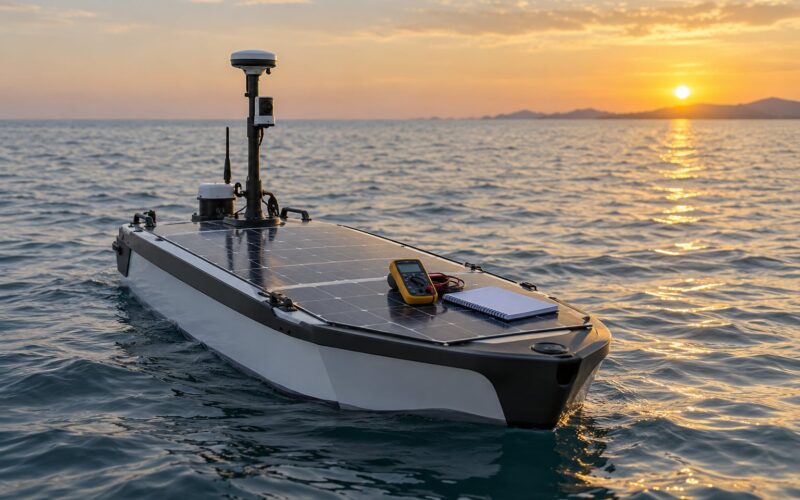
For a small ocean drone or a sensor float running a 2W electronics payload for a week, the arithmetic is simpler but the rule is identical: multiply watts by hours, divide by voltage and by usable DoD. Many makers skip the DoD step, buy a bank twice the size they need, and then wonder why the robot is heavy.
Add roughly 20-30% headroom for degradation and for the days you cannot recharge. That margin is cheaper than a second battery tray.
Weight and Vessel Space
This is where the two chemistries separate fastest. A 10 kWh LiFePO4 pack weighs roughly 220-260 lb (100-118 kg). The same 10 kWh in flooded lead-acid weighs around 900-1,100 lb (410-500 kg), and in AGM around 700-900 lb (320-410 kg).
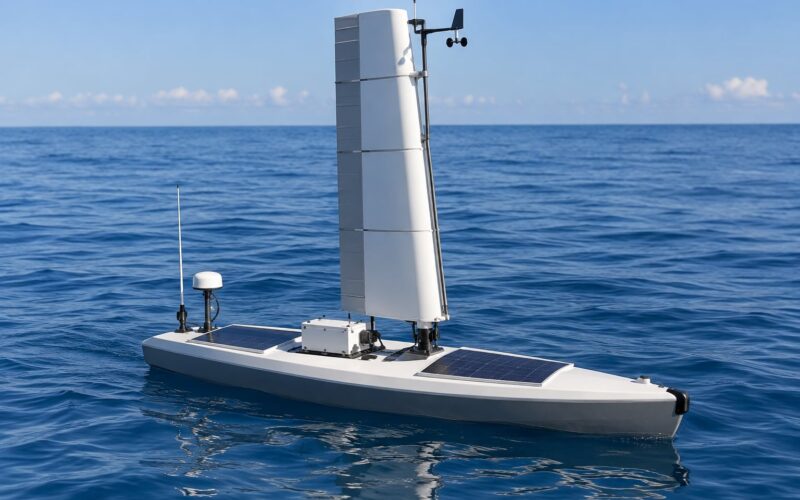
For a small autonomous surface craft or kayak-class drone, that difference decides whether the vessel floats at all. One sailboat conversion comparison puts the usable energy for a given charge at roughly 40% higher on LiFePO4 than on sealed lead-acid, because you no longer have to carry the capacity you can’t use.
Mounting is the part people underestimate. A bank that weighs a quarter as much still weighs hundreds of pounds, so it needs a proper tray, straps rated for the load, and fasteners that will not let go in a seaway. Lead-acid is heavier but its mass sits lower and is easier to secure with plain steel brackets.
Removing dead weight also moves your centre of gravity. On a small boat, lowering the centre of gravity improves stability, which is usually worth more than the range gain you were chasing.
LiFePO4 vs Lead Acid: Lifespan and Charging
What “lead-acid” actually covers
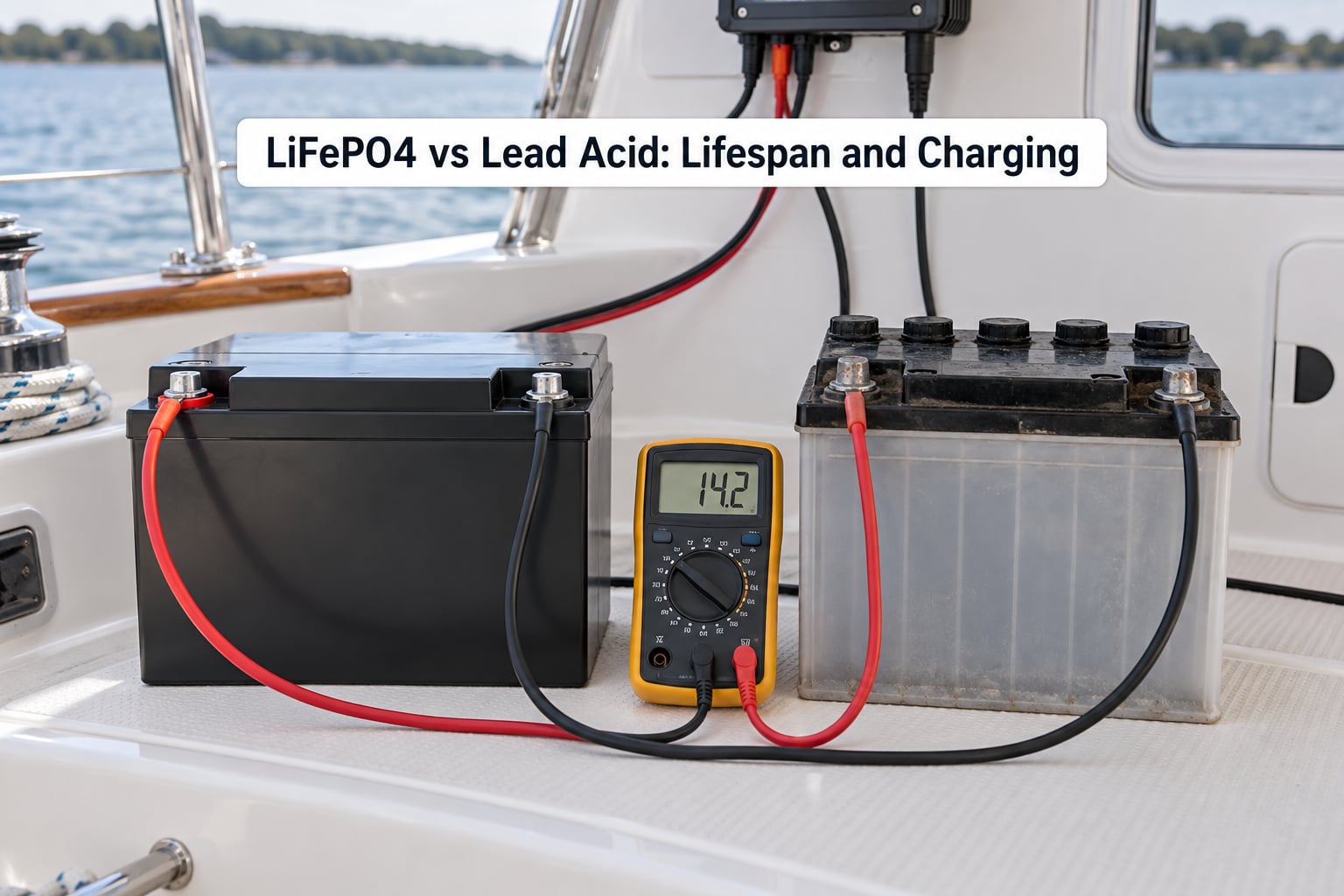
Most comparisons pretend lead-acid is one chemistry. It is three, and they behave differently enough to change the answer. Flooded batteries need water, vent hydrogen and tolerate deep discharge reasonably but sulfate quickly. AGM is sealed, needs no watering, and holds a better discharge curve than flooded. Gel has the deepest discharge tolerance of the three but is sensitive to overcharge and heat, so it needs a lower, regulated charge profile.
AGM is flooded’s replacement in most modern refits, and it is the fair comparison point against LiFePO4, not the cheap flooded battery in the bargain bin.
Cycle life and what it costs you
A quality flooded marine battery manages a few hundred full cycles before capacity falls off. AGM and gel land in the few-hundred range too, depending on how deeply you cycle them. LiFePO4 is routinely rated from 2,000 to 8,000 cycles depending on how hard you push it, with calendar life of 10-15 years against roughly 3-5 for flooded.
That gap changes the maintenance schedule, not just the bill. On CruisersForum the most repeated comment from owners who switched is about getting out of the lazarette every few months with a watering can. On SailingAnarchy the counterweight is more common: lithium is more expensive and more complex, and lead is more fault tolerant. Both are right, and the deciding factor is usually duty cycle.
Charger settings that actually matter
Getting the charge profile right is where most lithium installations fail. A charger with a fixed lead-acid absorption stage will push a LiFePO4 bank past its cell limit, and an undersized charger will leave the bank chronically undercharged. Both problems show up as a battery that stops filling around 13.2V and never reaches a usable state of charge.
Here are the numbers people argue about on the forums:
| Setting (12V bank) | LiFePO4 | Flooded | AGM |
|---|---|---|---|
| Bulk / absorption | 14.4-14.6V, or skipped entirely | 14.4-14.8V | 14.4-14.7V |
| Float | 13.4-13.6V | 13.2-13.4V | 13.6-13.8V |
| Standby / equalise | 13.4V, equalise off | 13.2V, equalise monthly | 13.6V, equalise per maker |
| Cell charge cut-off | 3.60-3.65V per cell | 2.45V per cell | 2.40-2.45V per cell |
Many inverter/chargers let you disable the absorption stage entirely and let the bank charge on bulk then float, which several owners report working well for LiFePO4 house banks. The critical requirement either way is charger output sized to the bank — roughly a tenth of bank capacity in amps for a healthy charge, plus whatever the largest DC load demands at the same time.
LiFePO4 also accepts partial charging without the penalty lead-acid suffers. Topping up for twenty minutes on a solar day still puts useful energy in, which matters enormously on a boat where sun is the only charger you have.
Safety, Corrosion, and Moisture Exposure
Lead-acid gasses. Charging a flooded bank produces hydrogen, which is why boats carry overboard vents and why flooded installations need a tray that catches acid and a compartment that breathes. Lithium iron phosphate produces negligible gas on charge, so a sealed lithium bank can go in a compartment where a flooded one would not be allowed.
On thermal behaviour, LiFePO4 is the more forgiving chemistry. Lead-acid cells get hot under high charge current and thermal runaway is a real concern with badly vented compartments; lithium cells fail differently, usually through an internal short, and the integrated BMS is designed to disconnect before that happens. Neither is fireproof, and neither should be installed without thinking about where it sits.
The genuine lithium risks on a boat are practical rather than exotic: BMS cutoffs that leave you dead at anchor, cells that go out of balance when you parallel batteries without per-battery fusing or matched setpoints, and no-name units with no published warranty and no answer when you call. The most common complaint on r/boating and r/liveaboard is not chemistry at all, it’s support — unresponsive reps in other time zones, weeks of back and forth, and replacements that never arrive.
Look for ABYC compliance, UL 1642 or UL 2054 certification, UN38.3 transport certification, a stated IP rating, and a warranty you would actually be able to claim. Then secure the tray properly and fit a proper breaker, not an inline fuse taped to the cable.
Cold-Weather and Wet-Environment Performance
Cold is the one place lead-acid still behaves. A flooded battery discharges happily below freezing, and charging in the cold is unremarkable. LiFePO4 is different: charge acceptance collapses near freezing, and charging a lithium cell below about 0°C/32°F risks plating lithium metal inside the cell, which permanently damages it.
Below roughly minus 20°C, capacity loss on lithium becomes severe, with figures around 50-60% of rated capacity cited in the cold-temperature literature. Many quality banks include a low-temperature charging cutoff that simply refuses to charge rather than letting you do damage. Several models now offer internal self-heating plates that bring the pack up to a safe charging temperature first.
If your project winters over, that cutoff is a feature, not a fault. It means the bank survives until you can charge it properly instead of quietly degrading. A heated battery box, a thermostatic heater on the compartment, or simply not charging below the cutoff all work.
For moored or winter-stored vessels, the practical procedure is to leave a maintenance charger connected in a temperature-controlled compartment and check the bank periodically rather than letting it sit at partial charge. Salt spray is a bigger everyday enemy than cold for both chemistries, so rinse terminals, keep bus bars clean, and coat exposed hardware.
Cost and Total Ownership
Upfront, LiFePO4 costs roughly three to seven times a comparable lead-acid bank, and buyers routinely report paying about three times AGM. That multiple is the source of most of the hesitation, and it is also the least interesting number.
The useful numbers are cost per usable watt-hour and cost per cycle. Because lithium gives back 90-100% of rated capacity where flooded gives about half, and because it survives thousands of cycles instead of hundreds, the cost per cycle collapses. A lead-acid bank that needs replacing three times in ten years, plus the labour, the terminal work, the watering and the downtime, changes the arithmetic entirely by year two.
Cost per installed kilowatt tells a similar story for propulsion. When you convert a sailboat to electric, the battery bill stops being a rounding error and becomes a large share of the project, and usable energy per dollar moves the total noticeably.
Where lithium loses on cost is when the boat is idle. A bank that sits at 50% state of charge for two years will age faster than one cycled regularly, and a low-demand coastal cruiser will not amortise lithium before the boat changes hands. That is the honest case for lead-acid, and it is the one most vendor pages leave out.
How to Choose LiFePO4 or Lead Acid for a Marine Project
Work through these in order rather than starting with chemistry.
- Set the weight budget. Work out how many pounds the vessel can carry as battery before payload or trim is affected. If the answer rules out the lead-acid bank you calculated, that settles it.
- List continuous and peak loads. Include inverter surge, thruster, winch and any electric propulsion motor. Peak current drives battery and cable sizing, not just daily energy.
- Calculate required usable watt-hours. Loads times hours, plus 20-30% headroom.
- Count your charging opportunities. Solar-only, occasional shore power, or regular marina charging changes everything. Frequent partial charges favour lithium.
- Check cold exposure. If the bank will sit below freezing or charge in winter, budget for a heated compartment or accept the cutoff.
- Check the space and mounting. Lithium is smaller but needs a secure tray and strain relief; flooded needs a vented, acid-catching tray.
- Be honest about maintenance capability. If nobody will ever top up water, flooded is a ticking clock regardless of how good it looks new.
- Compare total cost over the vessel’s real life, not the invoice. Include chargers, fusing, tray hardware, replacement cycles and labour.
- Decide the start bank separately. A very common and sensible architecture is a lithium house bank plus an isolated lead-acid start bank charged through an automatic charging relay or dual charging controller.
- Never parallelize lead-acid and LiFePO4 on the same bank. This is the single most repeated warning across the sailing forums. Their charge acceptance and absorption behaviour differ enough that the lead cells drag the lithium into an overcharge or the lithium undercharges the whole bank. Replace the whole bank at once, or keep them electrically isolated.
Which Should You Choose?
For weight-sensitive autonomous robots, ocean drones and anything electric-propelled, LiFePO4 is not a preference. The mass saving changes the vessel’s design.
For fixed ocean sensor installations and moorings with limited charging opportunity, LiFePO4 also comes out ahead, since solar top-ups work better and there is no water to add in a sealed housing.
For tenders, small workboats and low-demand coastal day-sailers, lead-acid remains entirely reasonable. A SailingAnarchy consensus thread on new builds put it plainly: lithium is more expensive and more complex while lead is more fault tolerant, so for coastal cruising with minimal demand, go lead.
For liveaboards and boats with heavy house loads, LiFePO4 pays back fastest, largely because the cycling is constant and the maintenance burden disappears.
For a first prototype or a budget test rig, flooded or AGM is the sensible starting point. You learn the electrical system before you commit to a battery chemistry you cannot easily re-sell.
For projects with unreliable shore power, LiFePO4 wins on usable capacity and partial-charge tolerance. Just verify the charging equipment matches before you commit.
A word on terminology, since it comes up constantly: Li-ion is the umbrella term and NMC is the common automotive subtype. LiFePO4 is a different lithium chemistry with a flatter curve, longer life, better thermal stability and a higher minimum cell voltage, which is why it suits stationary marine work rather than weight-critical vehicles.
Frequently Asked Questions
Can I mix lithium and lead acid batteries in the same bank?
No. Their charge curves and absorption behaviour differ enough that the lead cells either overcharge the lithium pack or drag the whole bank down. Replace the entire bank at once, or keep them electrically separate with a charging relay. This is the most repeated warning on the sailing forums, and it is also the easiest mistake to make when replacing batteries one at a time.
Which type of battery is better for a boat, AGM or lithium?
AGM is the right choice for a start bank, a low-demand day-sailer or a boat that will sit unused for long stretches. LiFePO4 is better for a house bank, liveaboard power, trolling motor use or electric propulsion, because it gives back 90-100% of rated capacity, cycles thousands of times and needs no maintenance. Your charging equipment has to match whichever you pick.
What should I set my float voltage to?
For a 12V LiFePO4 bank, float around 13.4-13.6V and bulk around 14.4-14.6V, or skip absorption entirely if your charger allows it. Flooded wants 13.2-13.4V float and AGM 13.6-13.8V. Never equalise a lithium bank, and check the manufacturer’s figures, since the cell charge cut-off is 3.60-3.65V per cell.
How cold is too cold for a lithium battery?
Below about 0°C/32°F, charging a LiFePO4 cell can plate lithium metal and permanently damage it, so quality banks cut off charging rather than let it happen. Discharging in the cold is far less harmful, though capacity can fall to roughly half below minus 20°C. Self-heating packs or a thermostatic battery compartment solve charging in winter.
What are some common problems with LiFePO4 batteries?
The usual complaints are BMS cutoffs that leave the bank dead, cells falling out of balance when paralleled without per-battery fusing, chargers with fixed lead-acid absorption stages that overcharge the pack, and packs that stop filling around 13.2V because the charger is undersized. Poor after-sales support on no-name units is the other big one. Buying certified cells with published voltage settings avoids most of it.
How long do lithium boat batteries last?
With matched charging and no chronic undercharge, a quality LiFePO4 marine bank commonly gives 10-15 years of service and can be rated for 2,000-8,000 cycles depending on depth of discharge. Flooded lead-acid typically manages 3-5 years and a few hundred cycles in real marine use. Calendar life matters as much as cycles: leaving a bank partly charged accelerates ageing in both chemistries.
Conclusion
Default to LiFePO4 for any marine project where weight matters, cycling is regular, or charging is sporadic. Default to lead-acid when the boat mostly sits, the demand is small, and simplicity matters more than range.
Before you buy anything, calculate four numbers: required usable watt-hours from your load list, your continuous and peak current draw, the weight you can afford to carry, and where the charging will actually come from. Those four figures answer the chemistry question on their own. Match the charger to the bank, keep lithium and lead-acid electrically separate, and the rest is detail.