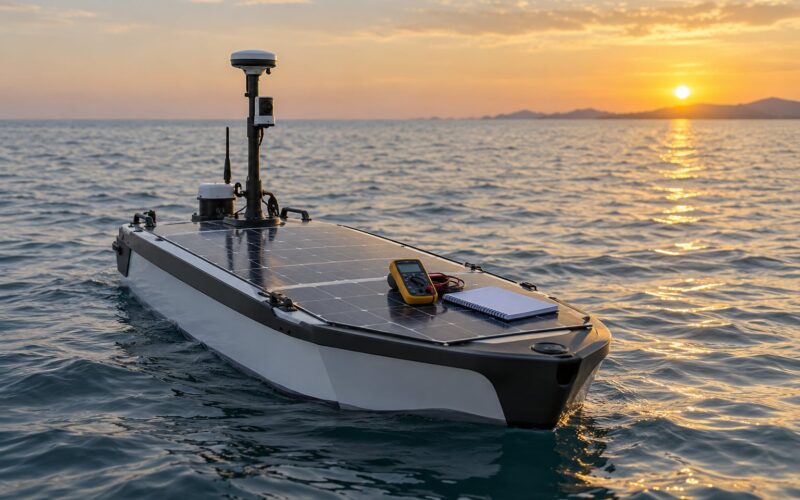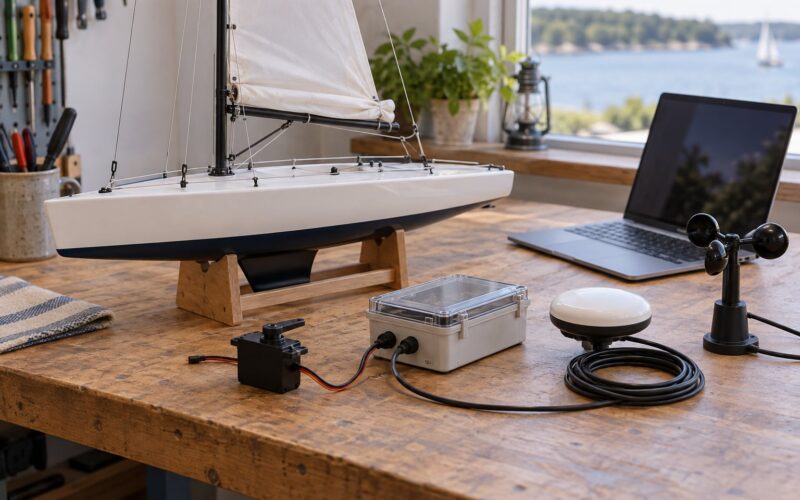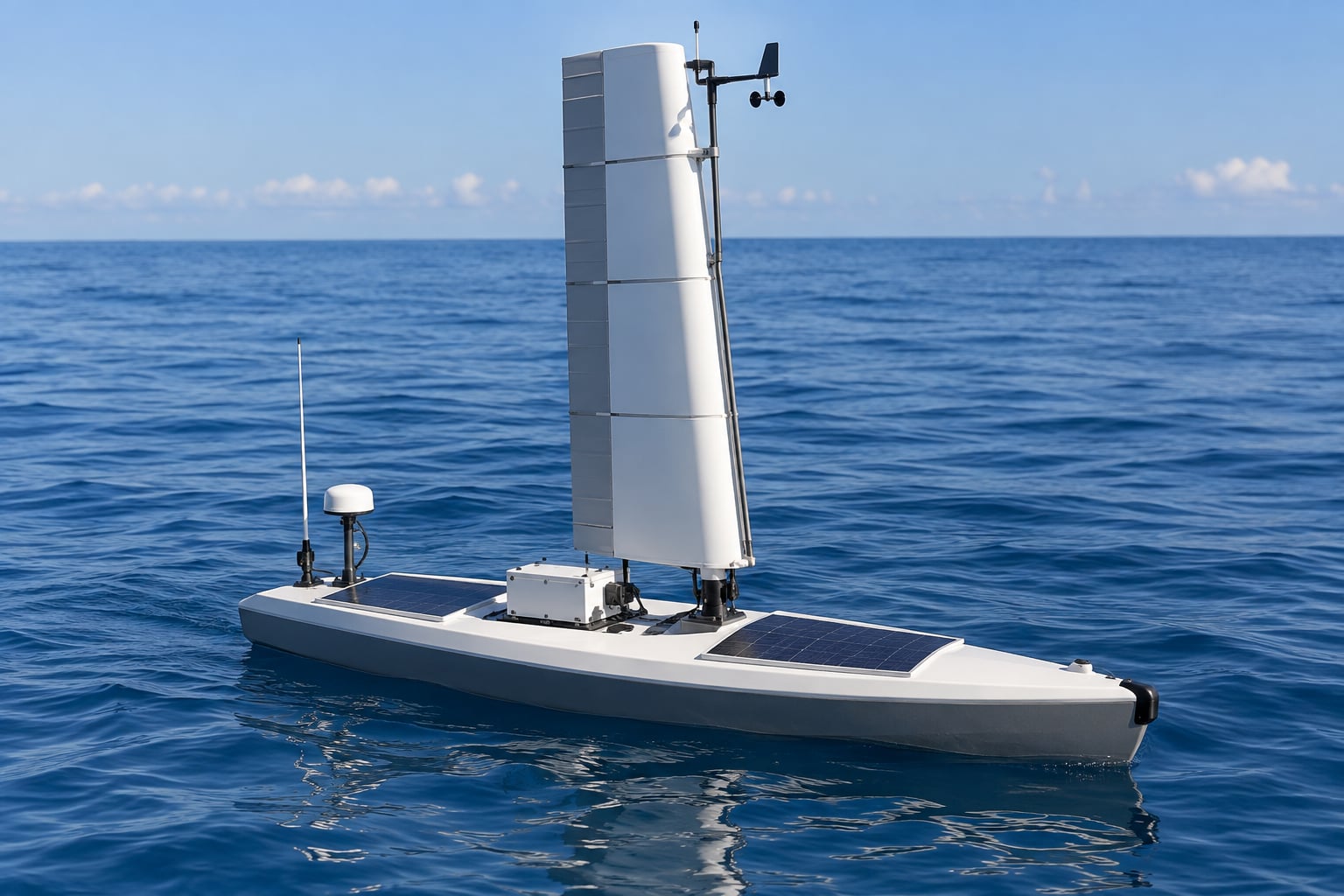
An autonomous sailboat is an uncrewed sailing vessel that steers itself. Sensors report where it is and what the wind is doing, an onboard computer decides which heading to sail, electric actuators move the rudder and trim the sail, and solar panels keep the whole thing powered. Nobody on board makes those decisions.
What makes this interesting is that sailing is genuinely hard to automate. The wind shifts, the current pushes sideways, other vessels appear without warning, and occasionally there is no wind at all. A self-driving car deals with a road that stays put. A robot sailboat has to manage a moving, sometimes hostile environment while its power supply and attention span both run out. That is how autonomous sailboats work, and it comes down to a control loop that repeats several times a minute for months.
This explainer is aimed at people who know sailing but not robotics: marine engineers, oceanography students, makers and curious technically-minded sailors. It is current as of 2026 — worth saying, because most explanations still circulating online were written around 2016 and describe hardware and control schemes that have moved on.
Table of Contents
- What Is an Autonomous Sailboat?
- The Main Systems on an Autonomous Sailboat
- How Autonomous Sailboats Work as a Complete System
- How Autonomous Sailboats Work Without a Joystick
- How the Boat Knows Where It Is and Which Way It Is Going
- How Wind Sensors Guide Steering and Sail Control
- How Autonomous Sailboats Choose a Route
- How the Sails, Rudder, and Autopilot Move the Boat
- How Collision Avoidance and Traffic Rules Are Handled
- How an Autonomous Sailboat Communicates with Operators
- How Power, Weather, and Failures Affect Operations
- How Autonomous Sailboats Are Built and Tested Safely
- Frequently Asked Questions
- Do autonomous sailboats need artificial intelligence?
- Can an autonomous sailboat operate without GPS?
- Are autonomous sailboats safe when people are aboard?
- How long can an autonomous sailboat sail without charging?
- Can autonomous sailboats use solar power for long voyages?
- What is the difference between an autopilot and a fully autonomous sailing robot?
- Conclusion
What Is an Autonomous Sailboat?
An autonomous sailboat is a vessel that sails, steers, and makes collision-avoidance decisions with no crew aboard. It carries a navigation computer, a sensor suite, powered steering and sail actuators, a power system, and a radio link to a shore operator. Its control software runs the whole loop: sense, decide, actuate, verify, repeat.
That is the only definition that matters, because “autonomous” is used loosely. The term is also abbreviated ASV (autonomous surface vehicle) or USV (unmanned surface vessel), which are used interchangeably. Sailing robots are sometimes called sail drones or sailing robots.
Not all of them are equal. It helps to grade them on a ladder:
- Remote-steered. A crewed boat on a radio link. The human decides everything; the boat has no autonomy at all. Useful for testing hardware.
- Supervised. The boat steers and sails to waypoints on its own, but a shore operator approves or overrides manoeuvres, especially anything involving other vessels. This is where most commercial platforms actually sit today, and it is a meaningful gap between the marketing term and the real behaviour.
- Autonomous on open water. The boat handles wind, route, tacking and routine traffic without a human in the loop. Humans are notified, not consulted.
- Collision-rule compliant. The boat treats the COLREG rules — the international regulations governing collision avoidance at sea, written for human watchkeepers — as constraints its planner must satisfy, including giving way under Rule 14 when another vessel is on its starboard bow.
Most uncrewed sailing platforms live at level two or three. A handful of research vessels demonstrate level three. Very few claim level four, because the rules were written for people and machine reasoning about them is genuinely difficult.
The Main Systems on an Autonomous Sailboat
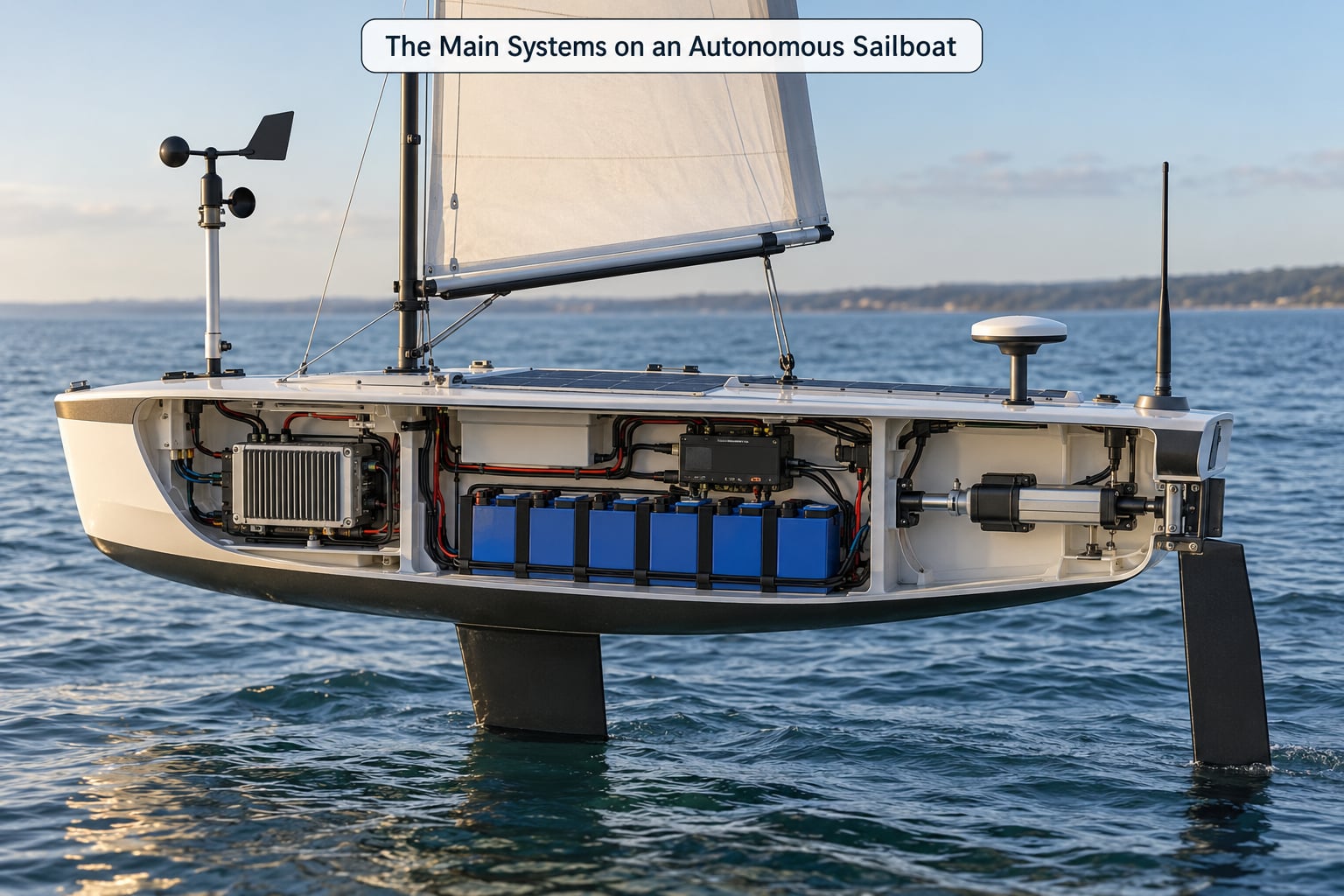
Every platform arranges these differently, but the parts fall into a handful of families, and if a system is missing from this list it is worth asking how the boat survives without it.
Navigation computer
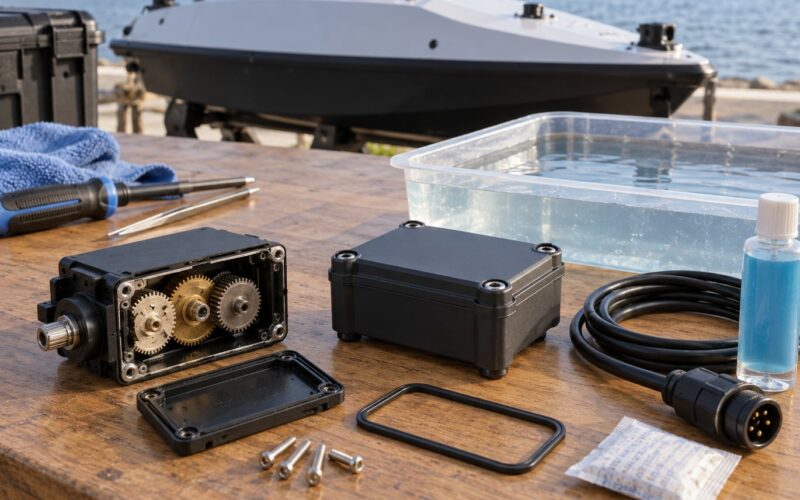
A watertight sealed box, usually a small single-board computer running Linux, running the control software and logging everything it decides. It may be backed by a second independent computer so a crash or a software fault does not end the mission.
Wind instruments
An anemometer and a wind vane — the same hardware a crewed boat carries to read apparent wind. On an uncrewed boat this replaces the human looking at telltales and feeling the wind on their face.
Position and motion sensors
A GPS receiver for position, an electronic compass for heading, and an inertial measurement unit giving roll, pitch and yaw rate. The inertial unit also bridges the gaps when the GPS drops out.
Traffic sensors
A listen-only AIS receiver picks up the radio transmissions of vessels fitted with AIS, which is most commercial traffic over a certain size. Radar or a camera is occasionally added for vessels that do not transmit.
Steering and sail actuation
A marine autopilot with a rudder actuator, plus a winch or servo that sheets the sail. Some rigs trim themselves passively and need no motor at all for the sail.
Communications
A satellite modem for open-ocean work, with cellular and Wi-Fi used opportunistically when the boat is near shore.
Power system
Solar panels, a lithium iron phosphate house bank, voltage regulators, and often a small electric thruster reserved for emergencies. The sail supplies propulsion; solar and batteries supply everything else.
Independent safety hardware
Watch circles, a geofence, kill switches, and often a beacon or strobe. This hardware is deliberately independent of the main computer so a software fault does not take it with it.
Taken together, the parts map onto a simple table, and the last column is the one worth memorising, because it is what an operator actually has to reason about at three in the morning:
| Subsystem | Typical component | Its job in the loop | What goes wrong |
|---|---|---|---|
| Position | GPS receiver | Fixes the boat on the chart | Multipath error, antenna shadowed by a battery stack |
| Attitude and motion | Electronic compass, IMU | Heading, roll, pitch, and dead reckoning between fixes | Magnetometer disturbed by the hull, slow inertial drift |
| Wind | Anemometer and wind vane | Apparent wind angle, which sets the whole sailing strategy | Salt and biofilm on the vane, broken heater in freezing air |
| Speed through water | Paddlewheel, electromagnetic or ultrasonic log | Separates leeway from real progress | Foaming, weed, near-zero flow at low speed |
| Traffic | Listen-only AIS, sometimes radar or cameras | Builds the picture avoidance is planned against | Non-transmitting craft, wrong or stale targets |
| Compute | Watertight single-board computer, often a redundant pair | Runs the decision cycle and logs it | Water ingress, filesystem corruption, unhandled software fault |
| Steering | Autopilot with electric rudder actuator | Turns the commanded heading into motion | Jammed gearbox, air in the hydraulic or mechanical line |
| Rig | Rigid wing with counterweight, or self-trimming soft sail | Converts wind into drive without needing a crew | Delamination, a stuck sheet, asymmetric loading in a gust |
| Power | Solar array, lithium iron phosphate bank, regulators | Runs everything that is not propulsion | Cell degradation, shadowed panels, a week of cloud |
| Propulsion reserve | Small electric thruster | Escapes irons, holds station in a calm | Empty battery in exactly the situation it was saved for |
| Communications | Satellite modem, with cellular and Wi-Fi near shore | Reports state, receives retasked missions | Antenna buried in spray, modem hang requiring a reset |
How Autonomous Sailboats Work as a Complete System
The cleanest way to understand it is as a loop with four stages: sense, decide, actuate, verify. Understanding how autonomous sailboats work means following that loop, because every subsystem exists to serve one of those four stages and every failure can be traced to one of them.
Sense is where GPS, wind, compass and inertial readings arrive, each with a timestamp and a quality flag. Decide is where the software fuses those raw readings into a best estimate of where the boat is, works out which heading is best given the wind, and commits to it. Actuate is where the helm and rig are commanded, with the commands ramped rather than slammed so the boat and its actuators are not shocked. Verify is the part most explanations skip: the boat checks whether the manoeuvre did what was intended.
That verification step is what turns a sequence of commands into a control system. If the boat is asked to turn thirty degrees and, after ten seconds, its estimated heading has barely moved, the software has learned something useful. It might increase rudder demand, check whether the wind is on the wrong side, look for a fouled actuator, or fall back to a safer state. Either way, without that check it would simply issue the same command forever and never notice the difference between a boat that is working and a boat that is stuck.
The loop also runs at two speeds. A fast inner loop keeps heading on target and sail angle correct, refreshing several times a second. A slow outer loop decides the route, checks the weather forecast, watches the power budget and handles traffic. Separating them matters, because a route decision every ten minutes and a rudder command every 200 milliseconds should not be written as the same piece of code.
How Autonomous Sailboats Work Without a Joystick
There is no joystick and no helm to grab, so the decision-making has to be written as a repeating cycle of explicit steps. The structure is more like an airliner’s flight management system than a video game: states, rules, and predictable behaviour when things go wrong.
- Read every sensor and mark each reading as good, suspect or missing.
- Estimate the boat’s position, heading, speed through the water, speed over the ground, and leeway.
- Compare the estimate against the planned route and the traffic picture.
- Choose a manoeuvre and a target heading, within what the wind and the state of the rig allow.
- Command the helm and the rig, with rate limits so nothing moves faster than the mechanics can take.
- Check the result, log the whole cycle, and adjust or escalate if the result was not the expected one.
So where does AI come in? Mostly in three places: fusing noisy sensor data into a clean state estimate, learning to spot targets and predict their courses from radar or camera imagery, and learning the trade-offs between tacking now or waiting for a better wind window. The steering itself is usually not an AI problem at all. Course keeping is a well-understood control problem, and most boats solve it with a proportional controller that nudges the rudder proportionally to the heading error.
The distinction matters when something goes wrong. A deterministic rule either fires or it does not, and you can read the rule and predict the outcome. A learned model can behave sensibly on data it has seen and strangely on data it has not, and you cannot always say in advance which case you are in. Experienced teams tend to put machine learning where the failure mode is graceful — target classification, forecast refinement — and keep the safety-critical decisions in rules a human wrote and can audit.
How the Boat Knows Where It Is and Which Way It Is Going
Positioning is less exotic than it sounds, and it starts with a plain question: where is this boat, right now, expressed in a coordinate system everyone else also uses? The answer is latitude and longitude on the WGS84 reference ellipsoid, with an altitude and a timestamp. The position is then converted to local east-north coordinates, because nothing a boat does is more natural than heading north or east.
Heading comes from the electronic compass, but a magnetometer alone is a poor instrument near a steel hull and a large battery bank. So the compass is corrected against GPS course over ground, and then the whole estimate is checked by an inertial measurement unit, which measures angular rate and acceleration and integrates them into a position that drifts slowly. The three disagree constantly, and the software’s job is to weigh them: GPS is precise but occasionally wrong or missing, the compass is absolute but noisy, the inertial unit is smooth but drifts. Fusing all three gives a better answer than any of them alone.
That matters more than it sounds, because GPS multipath error is real near cliffs and in heavy weather, and a straight line drawn to a position that jumped fifty metres sideways is a course the boat will physically follow. A filter that notices the jump and leans on the inertial unit instead prevents a very bad day.
Speed is reported in two ways, and the boat needs both. Speed through the water comes from a paddlewheel, electromagnetic or ultrasonic sensor. Speed over the ground comes from the GPS. The difference between them is leeway — the sideways drift caused by the wind pushing the hull. A sailing robot cannot avoid leeway the way a powered vessel can, so its helm has to correct for it, and it can only do that because it can measure it.
When GPS quality degrades, the honest options are limited. The boat can coast on its inertial solution, which is good for minutes and poor for hours. It can fall back to a radio beacon or to terrain matching. Or it can treat the loss as a fault and revert to a safe state, which in practice means reefing, steering a search pattern, and telling the shore. The last option is what well-designed systems actually do, and it is a reminder that the interesting failure mode is rarely the sensor dying cleanly.
How Wind Sensors Guide Steering and Sail Control
Wind is the hardest thing on the boat to measure and the most important. The boat feels the apparent wind — the wind as it arrives at the hull after the boat’s own motion has added to it. This is exactly what a wind vane on any sailboat reports, and it is not the same as the true wind a sailor talks about. A boat sailing at six knots sees apparent wind shifted forward by its own speed, which is why a wind vane sits well forward and high, and why apparent wind angle, not compass heading, is what a sailing algorithm actually steers on.
From apparent wind angle the software derives a target angle off the wind, usually somewhere between 120 and 150 degrees. The choice is a real trade-off. Close-hauled is fast but produces high loads on the rig; running downwind is easy but slow. One published sailing robot chose different target angles for different apparent wind angles, using a tighter, faster angle in stronger wind and easing off when the air went light, which is the same reasoning a racing skipper applies without noticing.
Some of the sailing vocabulary is worth stating plainly, because the control logic is easier to follow once you know what the boat is doing. In the no-go zone, roughly within 40 degrees of the wind, a soft sail simply flutters — it is luffing, and the boat cannot drive. Caught there head to wind, the boat is in irons, the rudder does nothing because water is not flowing past it, and only a backing sail or a thruster can get it moving again. A gybe is the other end of the range: crossing the stern, which a rigid wing does easily and a boom would otherwise let a boom slam across. Between those extremes the boat bears away or tacks, and the software chooses when by watching the wind window — the range of headings it can safely point at right now.
The one thing the boat never does is steer on the wind reading alone. Wind measurements are always combined with position, heading and the boat’s own motion, because a wind sensor alone cannot tell the boat whether it is being blown backwards, pinned, or reading a gust. Any explanation that reduces this to “it follows the wind” has skipped the interesting half.
How Autonomous Sailboats Choose a Route
A route is a list of waypoints, and following it looks simple until you realise that the shortest line between two points is frequently the worst one. A straight line to a waypoint dead downwind may sit at 90 degrees to the wind, where the boat makes almost no headway, or inside the no-go zone where it cannot move at all.
How autonomous sailboats work on the water comes down to two errors computed continuously. Cross-track error is how far the boat is from the straight line joining the current and next waypoint, measured sideways. Along-track error is how far ahead or behind it is on that line. A line-following controller compares the desired course with the measured course and turns to reduce the difference, which is the entire mechanism of a normal autopilot, applied automatically.
The second layer is wind-aware routing. A route planner takes the forecast wind and builds a cost for each candidate heading: distance, expected speed made good, how long the tack takes, and how much power the manoeuvre costs. It then picks the cheapest option, which frequently means sailing further but faster. This is the same logic a delivery driver uses when a road closure makes the short route a bad route, and it is the layer that lets a wind-aware robot hold a schedule in a way a pure autopilot cannot.
Chart data and depth sounder readings add hard constraints. Routes are laid over navigable water with a safety margin, and in shallow areas the boat slows down, re-plans around shoals, or turns to hold station. Waypoints are also how the shore retasks a mission: send new points, and the boat sails to the next one on the list without any special handling.
How the Sails, Rudder, and Autopilot Move the Boat
The autopilot is the least exotic part of the system, and it is worth starting there, because it answers a question people often ask: yes, a sailboat can have an autopilot, and for decades it has. It reads a compass heading, compares it to the target, and drives the rudder to close the gap. An autonomous sailboat uses the same device with the target written by software instead of by a helm hand.
The rudder itself is moved by an electric actuator, usually a brushless DC motor with a worm gear, and it is deliberately slow. A 22-metre boat has tens of thousands of newton-metres of sail load behind that rudder, and slamming it across produces roll, noise and fatigue. The command is therefore ramped, rate-limited, and often filtered, and the actuator reports its own position back so the software knows whether the rudder is where it was asked to be or merely where it is trying to get to.
Sails are handled in two quite different ways. A self-trimming sail needs no motor at all: the geometry of the rig means it sets itself as the apparent wind changes, which removes an entire class of failure. The rig on the best-known ocean-going sail drones goes further and uses a rigid carbon-fibre wing that behaves like an aerofoil, held at a constant angle by a counterweight forward of the sail and fine-tuned by a small trailing tab that corrects the wing’s angle far faster than a crew could pull a rope. A motor that fights the sail continuously is a waste of power, and the sail is only forced back to the correct angle if a gust or a wave disturbs it.
That last point is the design lesson practitioners keep returning to: reduce the force at its source rather than fight it with an actuator. Builders working on rigid self-trimming wings on student and hobby platforms reach the same conclusion independently — balance the wing about its centre of effort and the loads the hardware has to handle drop, rather than spending a motor’s worth of energy continuously cancelling them.
Self-trimming does not remove all the energy questions. There is real discussion among builders about what happens when an actuator does have to hold a position against a moving load, and the honest answer is that stalling against a setpoint pulls current and dissipates the energy as heat, while being genuinely back-driven by the rig allows some of it to be returned to the battery. In practice, on a small rig, the recoverable amount is small enough that the difference rarely decides the design. It matters more on a large, heavily loaded wing than on a model.
Where sails are soft, a servo or winch sheets them in, and the winch needs anti-jamming logic because a sail that jams under load is a fault that stops the boat. Two-line sheeting, where the control line pulls the boom out and lets it in depending on wind direction, removes the need to decide which way to wind it — one more decision the software would otherwise have to get right at the worst possible moment.
How Collision Avoidance and Traffic Rules Are Handled
Collision avoidance is the hardest problem in autonomous sailing, and it is a planning problem rather than a driving problem. Following a route and avoiding another vessel are not the same task: the first is arithmetic, the second is a matter of interpreting intentions, which the world does not make easy. Two vessels can follow identical collision-avoiding paths and still converge, because the sea gives no lanes.
Detection relies mostly on AIS. A listen-only receiver picks up the position, course, speed and navigation status of vessels that transmit it, and that data is accurate, cheap and free of interpretation problems. It also comes with a hard limit: not every vessel transmits. Fishing boats without AIS, small craft, and vessels with a failed transponder are invisible to that channel alone, which is why serious platforms add radar or cameras to cover targets the radio network misses.
From there it becomes look-ahead reasoning. The software computes the closest point of approach and the time to it for every tracked contact, builds a candidate manoeuvre, then replans the route around the new course rather than simply steering around a point. Replanning matters because a collision manoeuvre that takes the boat into shoal water or into the wind is not a solution.
Then there are the COLREG rules, and these are the ones a machine has to reason about. Rule 14 says a vessel gives way when another is on her starboard bow; Rule 15 says keep clear of a head-on situation; Rule 18 gives stand-on vessels their own obligations. These are human-authored conventions about mutual intent, and a machine has to infer intent from a track that may itself be uncertain. Where the other vessel is a human who does not know a robot is there, or is ignoring it, the safe move is to be conservative early rather than correct later.
Uncertainty is the honest limit. AIS gives a position, not a thought. A vessel transmitting a course of 180 degrees at eight knots may be fishing, may be lost, or may be about to turn. Most operators handle this by keeping a human in the loop for anything close, which is why supervised autonomy, with an operator approving manoeuvres in a shoreside app, remains the normal operating mode. It is less elegant and considerably more honest than claiming full compliance.
A quick way to judge a vessel’s claim is to ask what happens when an AIS target simply vanishes from the plot. A system that assumes every contact is a well-behaved, transmitting, rule-following vessel will eventually sail into a decision it cannot make. A system that keeps a dead-reckoned track for a disappeared contact, widens its safety margin and slows down when the geometry stops being clear has actually thought about the problem. It is worth remembering that a robot here is at a structural disadvantage: a person on a crewed boat can signal, hail, negotiate and infer in a way no machine on a mid-ocean mission can.
How an Autonomous Sailboat Communicates with Operators
A boat that sails for months has to be supervised without being flown by hand, and that requires deciding carefully how much data crosses the ocean. Satellite bandwidth is small and expensive, so the boat compresses aggressively and sends position, heading, speed, wind, battery state, and any anomalies on a short interval, with full logs stored locally and downloaded on return or when a cell connection becomes available. One documented sailing robot reported its routine state in packets of roughly 150 bytes, which tells you the order of magnitude a design like this aims for.
Satellite is the only option in true open ocean, and it also brings the usual failure modes: a mast-mounted antenna needs a clear horizon, heavy weather can degrade the link for hours, and the modem itself is a single point of failure on a vessel with no crew to reset it. Most designs therefore treat the link as interruptible. Losing communications should never stop the boat, and the safe behaviour on losing the link is to carry on with the mission plan, not to stop and wait.
Command and control usually works in one direction far more than the other. Uplinking a status report is easy; sending a new mission or an emergency command is different, because the link may be down when it matters most. For that reason, shore teams send tasks that the boat will execute when it next has connectivity, and critical safety actions — a geofence breach, a battery reaching its reserve level, a weather window closing — are handled onboard without asking permission.
What the operator still does by hand is smaller than people expect: approving a collision-avoidance manoeuvre, deciding when to reef for a forecast gale, and making the call to abandon a mission and bring the boat home. Monitoring is the other half. A dashboard worth watching shows wind against expectation, battery trend, the last few contacts on AIS, and whether the boat is still making the progress the plan assumed. A quiet boat is not always a healthy boat.
How Power, Weather, and Failures Affect Operations
The most common public misreading is that a sail drone runs on wind. The sail provides propulsion and almost nothing else. Every electronic system on board is powered by solar panels charging a lithium iron phosphate bank, and that budget is the real constraint on every mission. One published small sailing robot reported an average draw around half an amp-hour per hour with four 35-watt panels topping it up, and roughly 80 hours of operation from a full bank without sun. A bigger boat carrying a dozen instruments runs a much larger budget, but the ratio is the same: electronics and payload dominate, and the sail is simply the cheapest propulsion available.
Everything the boat does competes for the same bank. This is why the power system, not the rig, tends to set the mission’s practical limits. Solar output collapses under cloud and in heavy weather, and a boat that has spent a week in bad conditions arrives at the next sunny patch already in deficit. Good designs therefore refuse to spend reserve power on anything optional, and treat propulsion manoeuvres as an expense to be budgeted. The small electric thruster is the classic case — an emergency tool, sized to escape irons and hold a boat in place, deliberately not used for routine work.
Now the failure case most explanations skip: what happens when the wind dies. A boat in irons has no water flowing past its rudder, so steering commands do nothing, and a soft sail luffing in the no-go zone simply flutters while the boat drifts backwards. What the software does depends on how it is built, and the sensible sequence is recognisable. Detect the stall by checking progress over ground against expected progress. Reduce sail to stop flogging and stop the loads that come with a boat stalled head to wind. If the boat has steerage, back the sail or run a sternway manoeuvre to build flow, then resume. If it does not, deploy the thruster for a controlled push off. If neither works, drift, log it, report it, and wait — because a boat in irons is inconvenient, not sinking, and burning power trying to fix an unfixable problem is how a long mission ends early.
Weather sets hard limits. Most operators will not send a small autonomous boat into a forecast hurricane, and there is a size below which heavy weather is simply out of scope. A sub-10-metre hull is not going to survive being laid flat in a serious gale, and the software’s job in those conditions is to avoid getting there rather than to cope once it has.
Other failures get less attention but end missions. Salt water gets into connectors and slowly corrodes them, so watertight enclosures and conformal coatings do more for reliability than any software feature. Biofouling grows on a hull and a wind sensor, adding drag and corrupting readings over weeks, which is why long missions periodically clean or replace them. A GPS antenna shadowed by a full battery stack, a compass sitting too close to a steel hull, a mooring line lost in a harbour entrance — each of these has ended more autonomous voyages than any clever algorithm ever broke.
How Autonomous Sailboats Are Built and Tested Safely
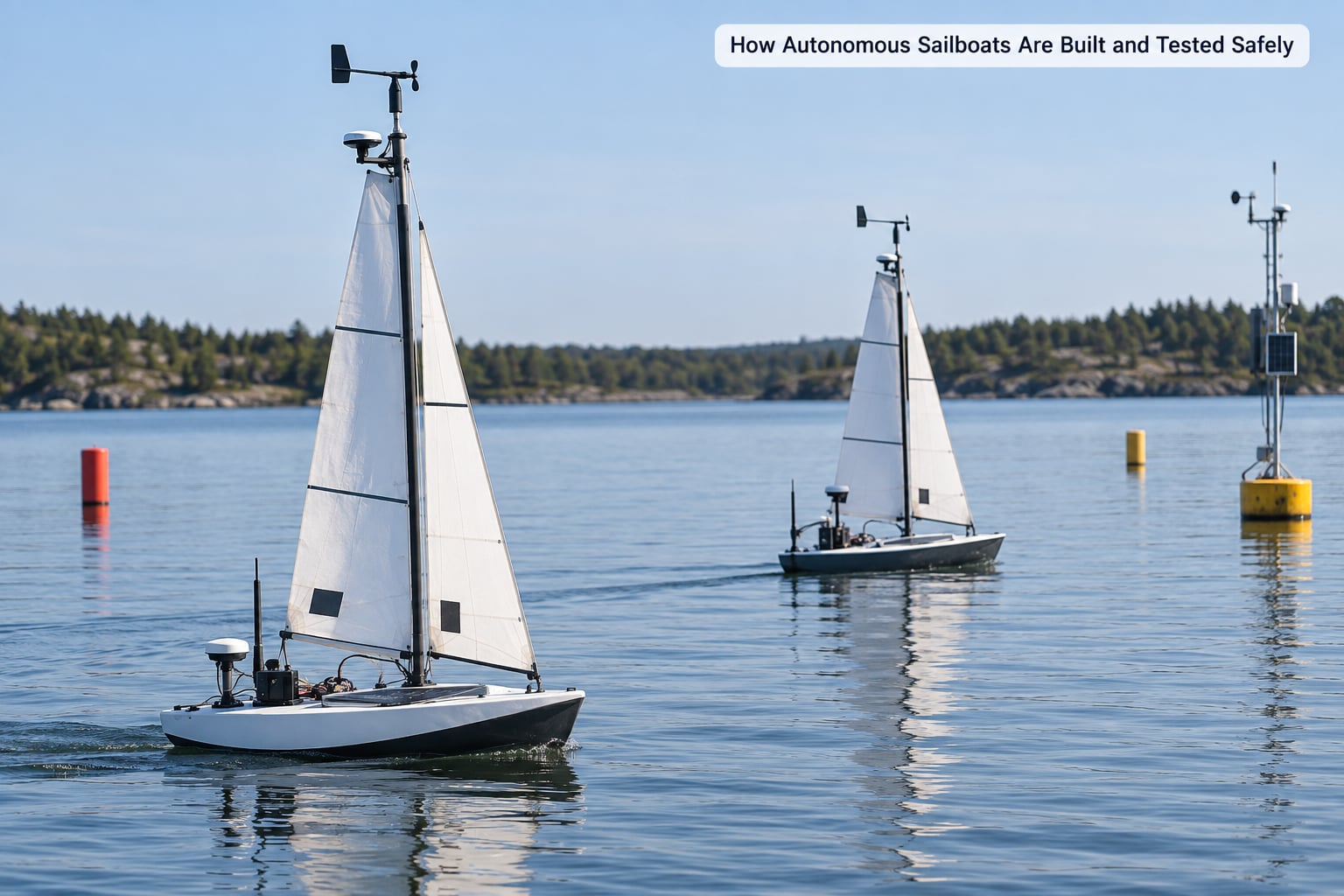
Nobody sane starts an autonomous boat by putting it in the open ocean. The sequence is progressive, and each stage has a specific question it answers.
- Simulation. Sail dynamics first, then a virtual world with wind, current and traffic. The control software is developed and stress-tested against scenarios that would be dangerous to reproduce, including sensor dropouts and a total loss of wind. The fidelity problem is that simulated wind is a model of wind, and a sim that gets the physics subtly wrong gives false confidence.
- Bench testing. Actuators, sensors and the full control loop exercised on a stand with no water involved, including deliberate fault injection.
- Controlled freshwater trials. A short closed course, where every manoeuvre can be observed from the bank and recovered instantly. This is where rigging and righting moment are proven, and where a capsize is a five-minute problem rather than a lost boat.
- Short coastal routes. Cellular coverage, a support boat in attendance, and a route back to a slipway in under an hour.
- Short offshore passages. The first real test of the satellite link, of wave handling, and of whether the power budget survives contact with conditions.
- Long missions. Only once everything above has worked, usually with conservative software and conservative weather windows.
Safety hardware is designed to work when the main computer does not. A geofence in the software is a convenience; a geofence enforced in hardware, or a physical kill switch in an accessible place, is a safety system. Two independent computers able to take over from each other cost little and remove an entire class of failure. A strobe and a beacon cost almost nothing and answer the only question that matters after a loss of position.
Recovery is the part that deserves the most planning, and the part with the least published writing. A six-to-twelve-month mission assumes a boat will eventually be somewhere inconvenient when something breaks. Tugging is usually cheaper and safer than sailing home under power, which is why tugs, not rescue boats, do most of the work. Teams that have done this long enough plan the retrieval before the launch, not after the failure.
The environmental side is real too. Small autonomous vessels are cheap to lose and easy to deploy near reefs, marine parks and shipping lanes, so good practice includes charting avoidance areas, keeping clear of whale and seabird habitat, and reporting position to authorities so the boat is not mistaken for debris or a hazard to navigation.
If you are starting a build yourself, the sensible order is: a hull with a proven design, a keel with enough righting moment for the size, sensors before actuators, a simulator before a boat, and a lake before an ocean. The robotics side is the easy half to get wrong and the hard half to get right.
Frequently Asked Questions
Do autonomous sailboats need artificial intelligence?
Not for the core job. Steering, route following and wind-window decisions are usually handled by deterministic rules and standard control algorithms, because predictable behaviour is worth more than clever behaviour on a boat nobody is aboard. Machine learning tends to appear at the edges, fusing noisy sensor data, classifying targets in radar and camera imagery, and refining weather forecasts. Keeping safety-critical decisions in auditable rules is a deliberate design choice, not a technical limitation.
Can an autonomous sailboat operate without GPS?
Only for a limited time and with degraded accuracy. An inertial measurement unit can carry the boat through a short outage, but it drifts continuously and cannot be trusted for long. Beyond that, the sensible options are a radio beacon, terrain matching, or treating the loss as a fault and reverting to a safe state: reef, hold a search pattern, and tell the shore. A boat that needs GPS to steer is normal, but one that cannot decide what to do without it is a design problem.
Are autonomous sailboats safe when people are aboard?
Passenger operations are a different problem from research missions, and most uncrewed platforms are not designed for it. The hazards are specific: a powered winch, a moving rig, an unattended helm on a boat with no crew to grab it, and a control system that has never been tested with a human in the path of its actuators. Legitimate passenger use needs a certified control system, a crewed watch keeping discipline, and an emergency stop that a human can reach, not a commercial research boat repainted.
How long can an autonomous sailboat sail without charging?
It depends entirely on what is running and how much sun there is. A documented small sailing robot reported roughly 80 hours of operation from a full bank with no solar input, drawing about half an amp-hour per hour. A larger platform carrying a dozen instruments draws far more, and a week of cloud can leave it in deficit. The number that matters is not the battery capacity but the worst-case stretch of cloudy days the design assumes, because that is what ends missions.
Can autonomous sailboats use solar power for long voyages?
Yes, and that is the point. Solar arrays feeding a lithium iron phosphate house bank run the electronics, the communications and the sensors, while the sail handles propulsion. It is why these platforms can work for months: the sun is free and does not stop. The constraint is not generation but budget. Every extra instrument, every satellite minute and every thruster nudge comes out of the same bank, and the boat is a solar-powered computer that happens to have a sail attached.
What is the difference between an autopilot and a fully autonomous sailing robot?
An autopilot holds a heading. You set the course, the wind is already doing the sailing, and a human chooses when to tack, reef, or head home. A fully autonomous sailing robot also decides those things: it picks routes, chooses tacks based on the wind window, monitors weather and power, handles traffic, and reports back. The autopilot is the hardware and one control loop inside the robot. Building one without the other is a common way for student projects to stall, because steering to a heading proves very little about a boat that has to survive a month alone.
Conclusion
The whole system reduces to one loop, repeated for months: sense, decide, actuate, monitor, recover. Sensors describe where the boat is and what the air is doing, software picks a heading that respects both the route and the wind, actuators move the helm and the rig, and the boat checks whether the manoeuvre worked before trying the next one. Everything else is engineering around that loop.
If you want to understand it further, watch a real one operate rather than reading another description. There are documented open-water test programmes, university projects and maker threads where the raw detail is far more useful than a press release, including the design arguments about rigs, keel ballast and how much of the autonomy is really the shore operator wearing a boat-shaped hat.
And if you are building one, start in a simulator, then a lake with a support boat, then a short coastal loop with cellular backup. Do not start with a transocean. The loop is simple enough to reason about and hard enough that the ocean will find whichever part of it you skipped.