An energy budget is a 24-hour inventory of everything your boat consumes, built up load by load and expressed in watt-hours or kilowatt-hours per day, then converted to amp-hours if you want a 12 V number. Work through the nine steps below and the budget tells you the battery capacity, the charging power and the reserve margin your installation actually needs.
Two budgets matter, not one. The DC budget covers lights, electronics, refrigeration, pumps and any inverter loads, and for a small boat it usually lands somewhere between 15 Ah per day for the smallest trailerable craft and 150 Ah per day for a 25 to 35 foot cruiser. The propulsion budget covers the energy in the fuel you burn getting the hull through water. You size them separately and then check they agree.
This is for boats under 24 m, so ABYC E13 for DC electrical systems and ISO 13297 for domestic electrical installations both apply to anything you build from these numbers. Electrical work on a boat is not a good place to improvise; have a marine electrician sign off on the final design.
Table of Contents
- What You Need
- Step-by-Step
- 1. Define the Boat’s Operating Profile
- 2. Build a Load Schedule
- 3. Calculate Average and Peak Demand
- 4. Estimate Energy Consumption for Each Activity
- 5. Add Conversion and Peaking Allowances
- 6. Size Usable and Nameplate Battery Capacity
- 7. Verify Peak Current and Charging Capacity
- 8. Validate the Budget With a Measured Trial
- 9. Review the Energy Budget for Worst-Case Use
- Common Mistakes
- Frequently Asked Questions
- Conclusion: Build the Budget From Measured Loads
What You Need
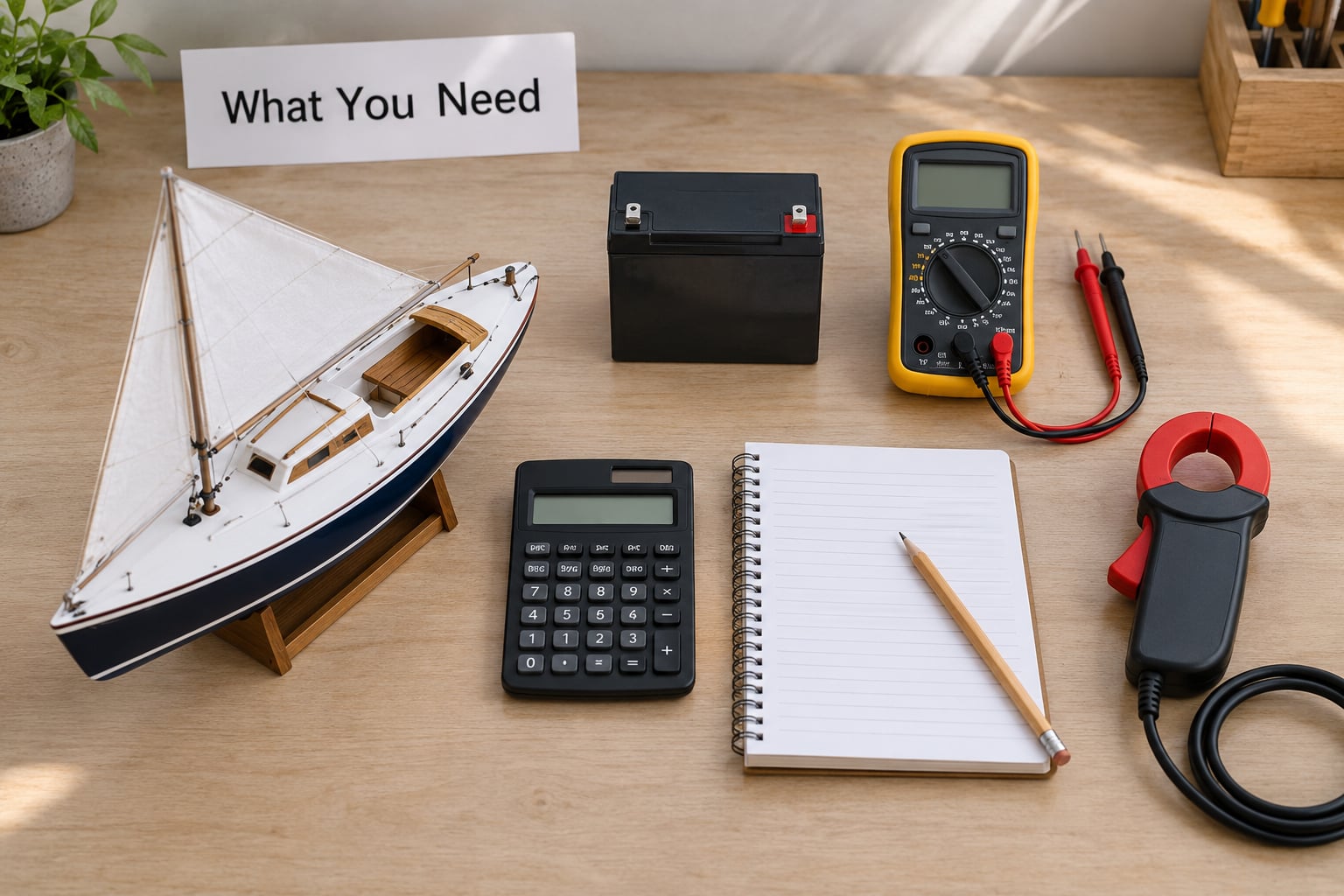
Gather these before you touch a number. Without them the budget is guesswork with a decimal point in it.
- Vessel data: length overall, displacement, hull type and construction, and whether you have an outboard, inboard diesel, or electric outboard. Hull speed and displacement drive the propulsion half of the budget.
- Electrical architecture: nominal system voltage, bank configuration, whether an inverter is fitted and its rating, and the charge controller or alternator regulator in use.
- Device data: the nameplate wattage or rated current for every load, plus the manufacturer’s duty cycle for anything that cycles rather than runs continuously.
- Test equipment: a clamp meter or inline ammeter, a multimeter for voltage, and ideally a battery monitor with a shunt so the numbers are measured rather than assumed.
- Operating assumptions: trip length, hours at anchor versus hours under way, crew number, and how many days you want to run without a full recharge.
- Manufacturer guidance: the battery datasheet for usable depth of discharge and charge acceptance, and the solar controller’s true-point and efficiency data. Nameplate wattage is an optimistic upper bound, not a promise.
Step-by-Step
1. Define the Boat’s Operating Profile
Set the boundary before you count anything, because the answer changes completely with the use case. Write down the vessel type, powertrain, system voltage, typical trip duration, and the reserve you want to hold at all times.
Then decide what the budget covers: sailing, motoring, anchoring, or mixed operation. Most small boats need two profiles, not one. A day at anchor with a refrigerator cycling and a passage with autopilot, radar and steaming lights are entirely different energy profiles, and a single averaged number hides both.
How you tell it worked: someone can read your profile and describe a plausible day on the water without asking a clarifying question.
2. Build a Load Schedule
Create a table with one row per device and the columns: device, rated power in watts, measured current in amps, duty cycle, operating voltage, and expected hours per day. Include the loads people forget, because they are where the budget leaks.
Standing loads are the ones that never switch off. A shunt monitor, a stereo, a phone charger plugged into a socket and an inverter idling at near-zero draw all accumulate quietly. Switched loads are the ones you control, and they are the only ones you can honestly reduce later.
Where a device is rated in amps rather than watts, convert it first: watts equals volts times amps. Then multiply rated power by duty cycle to get average power, and average power by hours of use to get daily watt-hours.
How you tell it worked: the table has a row for every breaker on the panel, not just the loads you remember using.
3. Calculate Average and Peak Demand
Average demand is what drains the bank over a day. Peak current is what sizes the cables, the fuse, the controller and the alternator, and the two are not the same number.
Watts equals volts times amps, and amps equals watts divided by volts. So a 120 W device on a 12 V system pulls 10 A, and the identical device on a 24 V system pulls 5 A. Average power is rated power multiplied by duty cycle: a 60 W anchor light running 12 hours a night averages 30 W. Peak current matters for anything with a compressor, a pump or a motor, because those draw far more at start than at steady state.
How you tell it worked: every row carries both a watt figure and an amp figure, so no later step has to guess which unit it is holding.
4. Estimate Energy Consumption for Each Activity
Multiply average power by realistic activity durations, then total the results. Keep the activities separate, because the durations are what differ.
For motoring, add the electronics, lighting and any DC loads that stay live while the engine runs. For sailing, add instruments, wind instruments, autopilot, nav lights and the interior lights you actually leave on. For anchoring, add refrigeration compressor cycles, cabin and nav lights, a monitor or two, and shore-side charging equipment if you have it. Add your communications and autonomous systems as their own line, since a satellite modem or an autopilot that never sleeps is easy to underestimate.
Work in watt-hours per day and divide by the system voltage to get amp-hours per day at 12 V. Keep both figures, because watt-hours is the honest unit and amp-hours is the one that will be sitting in your head when you look at a battery datasheet.
How you tell it worked: you can point at the row that dominated the total and explain why it deserves to dominate it.
5. Add Conversion and Peaking Allowances
Your loads are measured at the device. The battery sees more, because every conversion step loses something. Apply the factors once each, in order, and do not stack them twice.
- Motor controller and inverter losses: budget roughly 10 to 15 percent combined for a controller, and a similar figure for an inverter including its idle draw.
- Voltage taper: once a bank is charged, the charging voltage falls and less current flows in, so late-stage charging is always slower than the arithmetic suggests.
- Battery chemistry: the Peukert effect means a heavily discharged lead-acid bank accepts noticeably less than its amp-hour label implies at low charge rates. Higher charge rates also stress a small bank.
- Ageing and temperature: budget for capacity that has already faded, and remember a cold bank accepts less charge in usable time than a warm one.
How you tell it worked: you can name the factor behind every percentage you applied, and no factor appears twice in the chain.
6. Size Usable and Nameplate Battery Capacity
Now convert energy into a bank. Usable capacity is nameplate capacity multiplied by the depth of discharge you are willing to use in normal operation: roughly 50 percent for lead-acid in a real installation, and 80 to 90 percent for LiFePO4 with a good battery management system.
Multiply the daily amp-hour figure by the number of days of autonomy you want between full charge cycles, add your reserve as a percentage of that total, then divide by your usable depth of discharge. So 60 Ah per day across two days gives 120 Ah; with a 20 percent reserve that is 144 Ah usable, and at 50 percent depth of discharge you need about 288 Ah of nameplate capacity.
Convert to kilowatt-hours to sanity-check the weight before you commit, because on a small boat this is usually where the budget tells you something uncomfortable. A 400 Ah bank at 24 V is 10 kWh, which is roughly the same energy as a 2000 Ah lead-acid bank at 12 V and about a thousand pounds of it. If the number the budget produces is heavier than the boat can sensibly carry, the correct response is a shorter load list, not a bigger bank.
7. Verify Peak Current and Charging Capacity
Check that motors, inverters and simultaneous loads stay within the battery, the wiring, the controller and the fuse ratings, then confirm the charger can put the energy back in the time you have.
Charging arithmetic is simple enough to do in your head. A 400 W panel derated to about 75 percent gives 300 W, which is 25 A at 12 V and therefore 25 Ah in an ideal hour. Four hours is the theoretical figure; allow 6 to 10 hours in practice once you account for absorption taper, wiring losses and charge acceptance. That gap between ideal and real is where most disappointed owners live.
For the engine alternator, 14.4 V at 1 A is 14.4 W, and at about 50 percent efficiency that works out to roughly 0.04 horsepower per amp of output, so a 90 A alternator costs about 4 HP to drive. Oversize the alternator and derate it through the regulator rather than hunting for an exact match. A half hour of engine running recovers most of a normal charge, and 30 to 45 minutes beyond that buys surprisingly little, because the charging curve, not the alternator size, is the limit.
How you tell it worked: your charge power multiplied by the hours you can realistically charge exceeds the daily energy figure with margin to spare.
8. Validate the Budget With a Measured Trial
A calculated budget is a hypothesis. Log voltage, current, conditions, distance or time run, and the capacity recovered afterward, and you will find out where the model was wrong.
Install a shunt monitor before the first long trip and record amp-hours per day for at least a month of representative use. Compare the measured daily figure against the calculated one. When the two diverge, work out which assumption caused it rather than simply scaling everything until they match, because a single wrong duration is usually hiding a real design decision.
How you tell it worked: your measured Ah per day sits within about 15 percent of the calculated figure, and if it does not, you know which line item is responsible.
9. Review the Energy Budget for Worst-Case Use
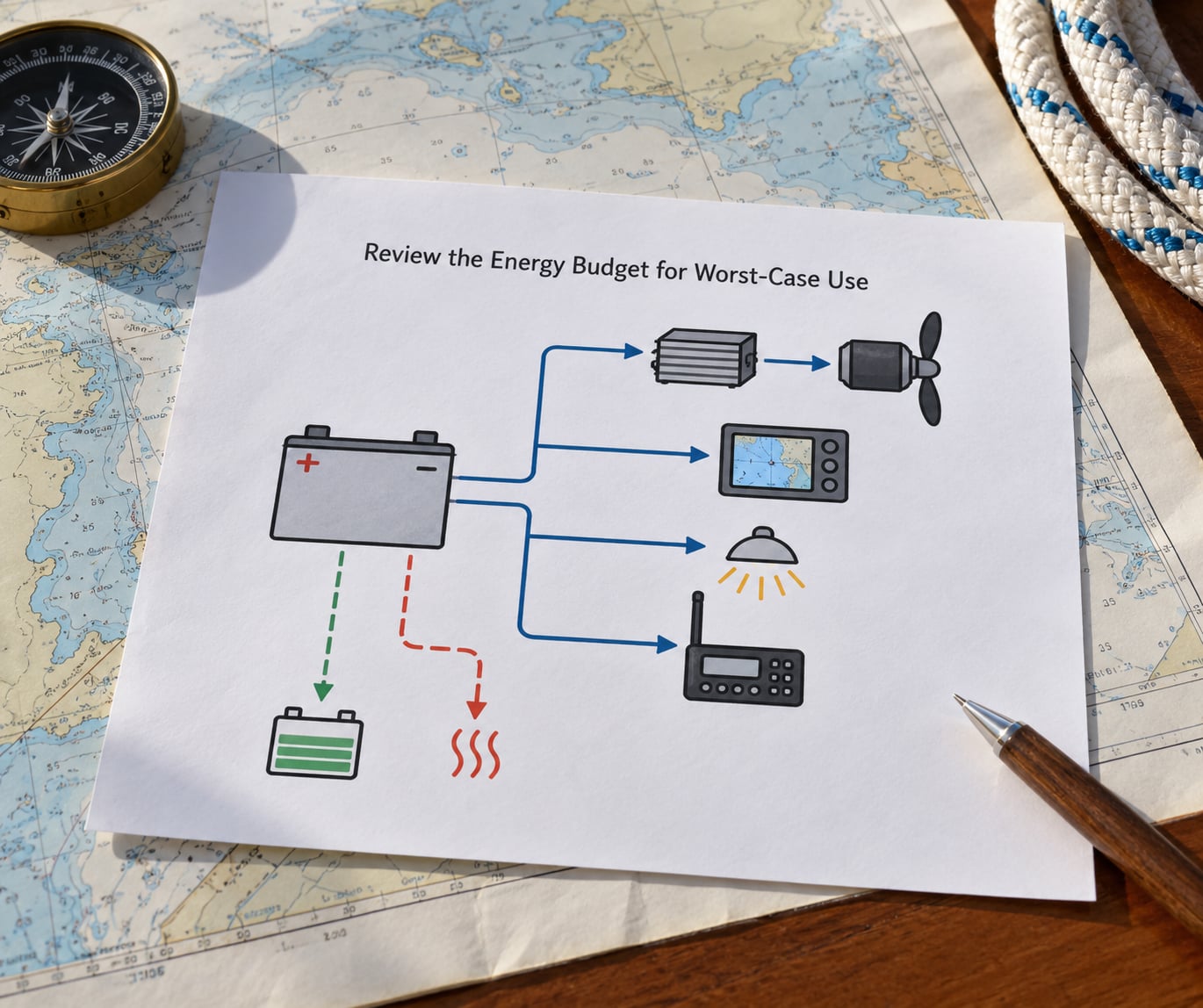
The average day is not the day that strands you. Stress the budget against adverse wind, detours, heavier seas, an equipment failure, an unexpectedly heavy hotel load, an aged bank and an interrupted charging window.
The easiest failure to miss is shading. A 370 W array that produces an excellent 1.33 kWh per day at anchor can fall well short on a beam reach with the main up, because sails block the sun for the hours when you most want the panels working. One owner of a 640 W array mounted across lifelines, hardtop and bimini reported 190 Ah on a clear Caribbean day and 150 Ah on a showery one, and now runs the engine an hour every second day. Real numbers like that are worth more than any nameplate figure.
Set the worst-case rule before you leave: no sun for N consecutive days, and the bank must still hold the reserve. For a high-latitude winter passage, extend N considerably. This is the calculation that turns an average-day budget into a design you can trust.
How you tell it worked: you can state your final usable-energy figure and the conditions it survives.
Common Mistakes
These five account for most of the budgets that go wrong, and each has a straightforward fix.
Using nameplate draw as continuous consumption. A refrigerator rated at 55 W does not draw 55 W all day; the compressor cycles. Multiply by the duty cycle, and if the manufacturer does not publish one, measure the bank draw over a full day instead of guessing.
Ignoring simultaneous loads. Budgeting each device as if it ran alone understates the total and badly understates peak current. Add up everything running at once during your heaviest realistic moment, then size the cables and inverter for that figure.
Applying one duration to every activity. Two hours of nav lights on a passage is not two hours of nav lights at anchor. Build a separate duration for each activity, and treat the compressor-heavy overnight case as its own line.
Failing to separate usable from nameplate capacity. A 500 Ah bank is not a 500 Ah budget. Usable is nameplate times your depth of discharge limit, and the difference is large enough that skipping it strands you.
Sizing from nominal rather than measured charging power. A 400 W panel is not 400 W into your bank. Use the derated figure, and remember that late-stage absorption is slow.
On top of the arithmetic, one hidden load deserves its own warning. A 1200 W heating element on a 36 V bus draws over 30 A, and a 280 Ah bank would be flat in about six hours before any other device is switched on. Inverter-driven heating is where small-boat budgets quietly explode, and it is worth deciding early whether it is part of the boat’s energy plan at all.
The cheapest energy on any boat is the load you deleted. Convert interior lighting to LEDs, right-size the inverter rather than running a 3000 W unit for a 200 W kettle, and switch off standing loads that only need to be awake occasionally. Every amp-hour removed reduces the bank, the solar and the weight all at once.
Frequently Asked Questions
How big should the battery be for a small boat?
Work it backwards from your measured daily load rather than picking a number from a chart. Multiply daily amp-hours by your desired autonomy days, add a 20 percent reserve, then divide by your usable depth of discharge, roughly 50 percent for lead-acid or 80 to 90 percent for LiFePO4. Convert the result to kilowatt-hours and check the weight before buying anything.
Should I calculate motor power separately from house loads?
Yes, always keep them as separate budgets. A propulsion load is measured in kilowatts while underway and is supplied by fuel or a large traction bank, while house loads are measured in watt-hours per day and come from the house bank. Mixing them produces a number that sizes neither. Calculate propulsion as energy per nautical mile and house loads as energy per day, then check that both fit the boat.
Is a 12-volt or 48-volt system better for a small boat?
For most boats under 35 feet, 12 V or 24 V is the sensible choice, because a 48 V bank needs heavier cable, a more capable charge controller and a battery management system, and it removes your redundancy if a cell fails. Higher voltage pays off in cable weight and efficiency, but on a small boat that saving is usually smaller than the added complexity. Match the voltage to the largest single load you want to run.
How accurate is a calculated electric boat range?
A calculated range is accurate to within about 20 to 30 percent before you measure, provided your duty cycles and activity durations are realistic. The main sources of error are shading from sails on passage, an assumed rather than measured refrigeration duty cycle, and optimistic peak sun hours. Log actual amp-hours per day for a month and you will have a figure you can trust far more than any spreadsheet output.
How much battery reserve should a small boat carry?
Hold 20 to 30 percent of nameplate capacity in reserve as a floor, and size the bank so you never plan to use it. Add autonomy for the longest stretch of no sun you actually expect, which in a winter high-latitude passage can be several days. If your usable budget arrives at zero reserve on an ordinary day, the bank is undersized no matter how good the arithmetic was.
Conclusion: Build the Budget From Measured Loads
Here is the sequence that works. List every load, measure the currents rather than trusting labels, calculate the real energy for each activity, then add conversion losses and a reserve, and size the bank from usable capacity rather than nameplate.
Then validate it on the water with a shunt monitor for a month, revise the assumptions that proved wrong, and check the worst case: no sun, an aged bank and a failed device all at once. If the bank the budget demands is heavier than your boat should carry, the budget has already told you the answer, and the answer is to cut loads, not to add capacity.