Galvanic corrosion eats small boats faster than most owners expect, and it usually starts long before anything looks broken. To prevent galvanic corrosion on a small boat you have to break one of three conditions: stop dissimilar metals from touching electrically, keep seawater or damp salt spray out of the gap between them, and give the least noble metal a sacrificial anode that corrodes instead of your hull. On a 16 ft skiff or jon boat that is a few hours of work a season.
Galvanic corrosion is an electrochemical process. Two different metals sit in electrical contact, water bridges the gap between them, and the less noble metal — usually aluminum — dissolves while the more noble one, usually 316 stainless steel or bronze, stays intact.
Small boats accelerate all of it. The metals are packed within inches of each other, the aluminum is thin, and the anode-to-cathode surface area ratio is brutal. A single stainless bolt head on a big panel is a large cathode working against a tiny amount of anodic aluminum, and that combination pits metal instead of staining it.
One r/sailing owner documented the classic version of this: chalky white oxide blooming at the forward end of an aluminum boom where it met stainless gooseneck hardware. No anode was anywhere near that fitting, and none would have helped. Above the waterline hardware needs isolation, not cathodic protection.
Table of Contents
What You Need
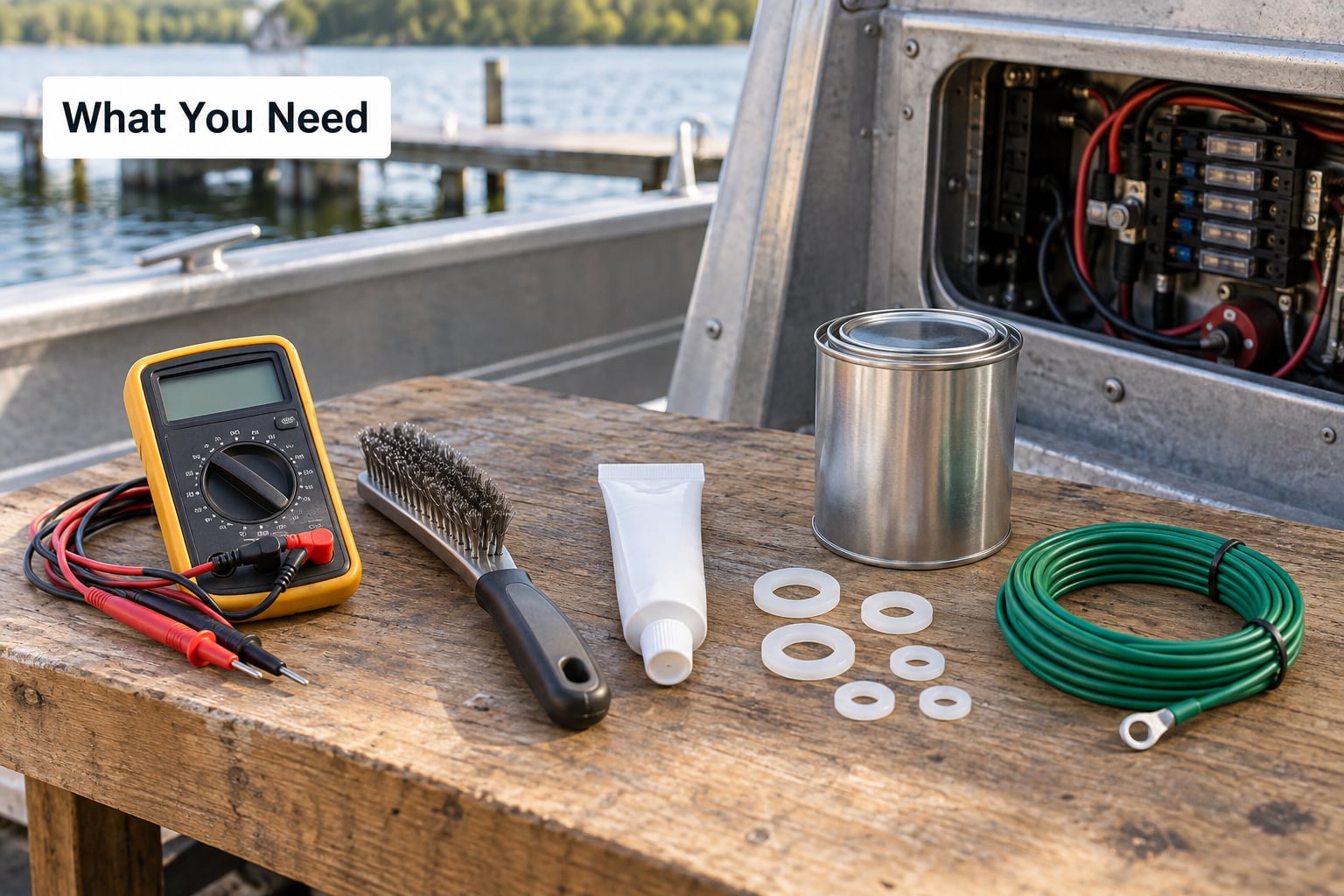
None of this is specialty gear. Most owners already own half of it.
- Multimeter that reads DC millivolts and ohms. This is the single most useful tool for finding leakage paths and bad bonding.
- Stainless bristle wire brush, Scotch-Brite pads, isopropyl alcohol, and white vinegar for etching oxide off bare metal.
- PTFE dielectric paste such as Tef-Gel for isolating dissimilar metals at fasteners.
- Nylon or Delrin washers and flanged bushings, plus G10 (GPO3) sheet cut to fit tight spots.
- Marine-grade fasteners — 316 stainless, silicon bronze, or the fastener already recommended by the hull or engine manufacturer.
- Sacrificial anodes matched to your water type: zinc, aluminum, or magnesium.
- Corrosion inhibitor and sealant — a corrosion inhibitor spray for storage, silicone or polysulfide sealant for penetrators, and heat-shrink butt splices for wiring repairs.
- Bonding hardware — marine-grade lugs, ring terminals, and tinned copper wire so you can bond underwater metals to a hull anode.
- Fresh water, a blower or rag, and a drip tray for the washdown routine.
- Your boat’s records: wiring diagram, material inventory, and a pencil sketch of every metal you can find.
- Gloves, eye protection, and a non-slip mat. Work in a ventilated area and disconnect power before you touch a conductor.
Step-by-Step
Map Every Metal That Can Touch Seawater
Start by writing down what is on the boat, not what you remember being on the boat. Most small boats accumulate hardware over years of owner changes, and the corrosion almost always traces back to something nobody wrote down. If you have never made that list, that is the first hour of work in any attempt to prevent galvanic corrosion on a small boat, and skipping it is why the same fitting keeps eating metal.
Build the list in four passes: hull and structural metal, running gear, the electrical system, and every add-on. An aluminum hull owner should expect aluminum hull panels and stringers, 316 stainless bolts and rivets, a bronze or aluminum propeller, a steel or aluminum shaft and rudder stock, zinc or aluminum anodes, copper cable and bonding wire, lead-acid battery cases and terminals, an aluminum or cast-iron outdrive lower unit, stainless drain plugs, and any trailer hardware that touches the hull while it sits.
Pay attention to concealed pairs. The cleat bolts under a backing plate, the rudder stock passing through a bearing, the bronze propeller on an aluminum shaft, a stainless hose clamp on an aluminum seacock, and the copper in a wire that terminates at a stainless terminal post are all doing the same thing quietly.
Observable result: you have a list where every entry is a metal, a location, and whether it sits in or near seawater. Anything you cannot identify yet stays on the list as a to-do.
Find and Control Electrical Leakage Paths
Galvanic corrosion needs four things at once: two dissimilar metals, electrical contact between them, and an electrolyte. Anodes remove one requirement. Everything else on this list attacks the other two.
Three electrical situations cause most of the damage. First, the classic hull and propeller pair doing nothing but sitting in salt water — anodes and bonding fix that. Second, the hull acting as an unintended electrical conductor, where a damaged wire, a chafed cable, or a bilge pump wired directly to the battery block lets DC current leave the circuit through bare aluminum. Third, shore power, where the marina’s ground path connects your hull to somebody else’s hull or to a steel sheet-pile wall, and a galvanic isolator or isolation transformer breaks that path.
Start with a visual and meter pass rather than a parts cannon. With the shore power unplugged and batteries disconnected, check continuity between bonding points with an ohmmeter. ABYC guidance treats 1 ohm as the ceiling for bonding resistance; a reading near zero means two metals you thought were isolated are wired together. Then reconnect batteries and measure DC volts between the hull and each battery terminal with everything switched off — that reading should be low. Sustained half a volt or more means a live leakage path, usually a light, a pump, or a charger ground loop.
Do not modify protected wiring blindly. If your measurements point into a shore power or battery circuit you do not understand, that is the point to bring in a marine electrician rather than rewire a safety circuit on a boat on a trailer ramp.
A more serious version of the same problem is stray current corrosion, and it behaves nothing like galvanic. Look at the table below to tell the mechanisms apart before you buy a part.
| Corrosion type | What it looks like | Typical speed | What stops it |
|---|---|---|---|
| Galvanic | Localized attack around one fitting, white chalky oxide on aluminum | Weeks to one season | Sacrificial anodes, bonding, isolation of dissimilar metals |
| Stray current | Rapid, concentrated attack along a wire path, often near a light or pump | Days to weeks | Repair the circuit, galvanic isolator, fuse the circuit properly |
| Crevice | Attack under a washer, seal, or overlapping plate with a tight gap | Months to years | Break the crevice, seal it, keep it clean |
| Pit | Small deep holes in otherwise smooth aluminum | Months to years | Coating, isolation of dissimilar metals, removing the cathodic area |
| Dezincification | Perforated brass or bronze plumbing parts that look like swiss cheese | Years | Use DZR brass or silicon bronze instead of plain brass |
Observable result: you have either a healthy bonding system or a specific circuit named as the leak, plus a meter reading recorded for comparison later.
Choose Compatible Metals and Fasteners
Dissimilar metal pairs are ranked on the galvanic series, from most active to most noble. Magnesium, zinc, aluminum alloys, mild steel, cast iron, lead, tin, brass and bronze, 304 stainless, 316 stainless, and titanium near the end. Any two metals in that list that touch while wet will find an anode and a cathode; the question is only how fast the less noble one disappears.
A practical threshold helps. More than about 200 mV of potential difference is where dissimilar-metal corrosion becomes a genuine risk in a wet compartment, and 6061 aluminum against 316 stainless is far past it — well over 700 mV. Small separations of that size are why a single bolt can outpace a whole anode, and why choosing compatible metals matters as much as adding anodes when you prevent galvanic corrosion on a small boat.
Choose the anode material for the water the boat actually sits in, not for the boat you wish you had.
| Anode material | Salt water | Brackish or mixed | Fresh water | Watch for |
|---|---|---|---|---|
| Zinc | Correct choice | Marginal | Passivates quickly | Legacy zinc can contain cadmium; it also passivate in low-salinity water |
| Aluminum | Correct choice | Correct choice | Works, but capacity is limited | Best all-rounder for boats that move between salt and brackish |
| Magnesium | Do not use | Do not use | Correct choice | Overprotection in salt water can generate hydrogen and strip protective coatings |
Replace anodes at roughly 50% erosion, not on a calendar. That matters more on a small boat than a big one, because a small hull has very little sacrificial metal to give, so anodes can look nearly intact and still stop working. Keep them bare — no paint, no sealant, no corrosion inhibitor spray on the anode surface, because the whole point is that it should dissolve.
Where you cannot avoid a mixed pair, break the electrical contact instead of choosing a cleverer alloy. Anodes only protect metals they are electrically bonded to and within roughly seven times their own length, and a hull anode does nothing at all for deck hardware, rails, or a roller furler drum.
| Isolation method | Best used for | Limit |
|---|---|---|
| Nylon or Delrin washer under the bolt head | Isolating a stainless bolt head from an aluminum rail or hull | Needs a matching flanged bushing on the far side or the bolt can still pinch through |
| G10 / GPO3 sheet | Structural shims and insulating pads in tight structural gaps | Must be cut to fit without leaving a crevice that traps salt |
| PTFE dielectric paste (Tef-Gel) | Threaded fasteners, screw fasteners, and anything you cannot shim | Must be reapplied at every removal or refit |
| Anodized or powder-coated hardware | Long-term isolation on rails, brackets, and fittings | Damaged coating exposes bare metal; inspect for chips |
| Matching hardware | Anywhere replacement is practical | Not always possible with proprietary engine and steering parts |
Observable result: every mixed-metal joint in your list now has a barrier material or a plan to replace one part, and your anodes match your water.
Protect Surfaces and Reassemble the System
Cleaning is what makes the protection last. Salt is hygroscopic, so a dry-looking fitting on a warm day can still be holding a damp salt crust that keeps the electrolyte present all season.
Wash the boat down with fresh water after every outing in salt or brackish water, starting with the hull bottom, hardware, and any area that sat under a dock or in a slip. Dry it properly afterward with a blower or absorbent rag rather than leaving it to the sun, then apply a corrosion inhibitor to bare metal, fasteners, and the engine’s external surfaces before storage.
On existing corrosion, etch the oxide off with white vinegar or a mild acid spray, scrub with a long-bristle wire brush, and repeat until the metal stops coming back grey. Forum owners fixing seized hardware report this combination works, but they also say it takes several passes and patience. Once the metal is clean and dry, coat it with an epoxy barrier coat or the paint system the hull uses.
Reassembly order matters. Clean the mating surfaces, apply PTFE dielectric paste to any dissimilar-metal fastener, refit with nylon washers and bushings in the right positions, tighten to the fastener maker’s specification rather than by feel, and apply sealant to cable penetrators and seacocks as they go in.
Put the sacrificial anodes back last and leave their surfaces clean. Then reinstall covers, restore every bonding connection, and confirm nothing is left open, loose, or freshly bare where it was not before.
Recheck the anode rate before closing out. An owner on r/sailing was burning through a zinc every month in a marina until a galvanic isolator went in — that consumption rate is a symptom of an electrical leak, not of anodes failing, and more anodes will not fix it. A millivolt hull-potential reading against a silver/silver chloride reference electrode is the professional check; readings should be no less than about -200 mV for protection.
Observable result: the boat is reassembled, covers are back on, bonding is restored, and you have a written date and anode-erosion note for the next inspection.
Common Mistakes
These are the errors that undo good work, and most of them are repeated advice floating around online.
Using graphite anti-seize on marine fasteners. Graphite plus chloride salt is a paste-grade electrolyte, and it accelerates pitting under the fastener instead of preventing it. Fix: use PTFE dielectric paste or a corrosion inhibitor rated for the application, and clean old graphite off threads before reassembly. Maintenance tip: keep a tube of dielectric paste in the glove box so the correct compound is always on hand.
Coating anodes with paint, sealant, or inhibitor. A sealed anode cannot corrode, so it stops protecting anything. Fix: strip any coating and replace the anode. Maintenance tip: mark the install date on the anode strap with a paint pen so you know when it went in.
Assuming hull anodes protect deck hardware. They do not. An anode on the hull has no effect on rails, tower brackets, outriggers, or a furler drum above the waterline. Fix: isolate those joints with washers, bushings, and dielectric paste. Maintenance tip: check those joints each spring and after any hardware removal.
Running household or automotive batteries. Batteries must be sealed marine type with tinned or marine-rated terminals, and they belong in a tray where they cannot move or flood. Fix: replace them and secure the leads. Maintenance tip: check terminal corrosion and cable chafe every time you open the compartment.
Leaving damaged or chafed wiring in service. A chafed wire touching bare aluminum turns the hull into a current path and burns metal fast. Fix: repair or replace the conductor and route it away from sharp edges and bilge water. Maintenance tip: keep wiring above the bilge pump base and out of the wettest part of the compartment.
Leaving the boat on pressure-treated trailer bunks. The copper preservatives in pressure-treated wood are a known aggressive anode against aluminum, and a boat that sits that way on a wet trailer ramp is quietly dissolving. Fix: use bunks with an isolating pad or a plastic wear surface, and keep the trailer dry. Maintenance tip: check bunks and rollers every season for crushed padding and direct contact.
Ignoring binding fasteners and blistering paint. Paint bubbling around a bolt head and a bolt that will not turn are the early stage of the same disease. Fix: remove, etch, isolate, and replace with matched hardware. Maintenance tip: run a finger along every hull fastener head once a season and look for chalky residue.
Frequently Asked Questions
How can I stop galvanic corrosion?
Break one of three conditions that cause galvanic corrosion on a small boat: stop dissimilar metals from touching electrically, keep seawater or damp salt spray out of the gap, or supply a sacrificial anode. That means fitting the right anode for your water type, bonding underwater metals to it, isolating mixed-metal fasteners with nylon washers and PTFE dielectric paste, fixing stray current paths with a galvanic isolator when needed, and washing the boat down with fresh water after every outing.
Will anti-seize stop galvanic corrosion?
Only the correct kind. PTFE dielectric paste such as Tef-Gel isolates dissimilar metals and prevents the circuit, so it does stop galvanic corrosion at that joint. Graphite anti-seize does the opposite: graphite mixed with chloride salt forms a conductive paste that accelerates pitting under the fastener head. Match the compound to the metals, and clean the threads before every reassembly.
Which anode should I use for salt water?
For salt water, a zinc anode or an aluminum alloy anode both work, and aluminum is the usual choice today because older zinc alloys can contain cadmium. Pick aluminum for a boat that also runs brackish water, since it performs in both. Magnesium is wrong for salt water, where it overprotects the hull, can generate hydrogen, and may strip protective coatings. Replace anodes at about half their original thickness.
Can you use stainless steel bolts in an aluminum boat?
Yes, but never bare. 316 stainless against 6061 aluminum carries a potential difference well above the roughly 200 mV where galvanic risk becomes real, so the joint needs isolating. Put a nylon or Delrin washer under the bolt head, a matching flanged bushing on the far side, and PTFE dielectric paste on the threads. Alternatively use matching aluminum hardware or a coated fastener where the part allows it.
Do hull anodes protect deck hardware?
No. A hull anode only protects metals electrically bonded to it and within roughly seven times its own length underwater. Rails, tower brackets, outriggers, cleats, and roller furler drums sit outside that reach, which is why chalky white oxide appears at a stainless gooseneck on an aluminum boom even on a well-anoded boat. Those joints need washers, bushings, and dielectric paste rather than cathodic protection.
Is a galvanic isolator necessary for a small boat?
Only if the boat takes shore power. A galvanic isolator blocks the DC path through the shore ground that connects your hull to a neighbouring boat or a steel sheet-pile wall. On a small trailer boat you plug in and unplug at a ramp, it is usually unnecessary. If your anodes disappear in a matter of weeks while plugged in, that is a strong signal the isolator or the wiring is the real problem.
Conclusion
Start with the map. Write down every metal on the boat and where it meets another metal, then fix the single highest-risk dissimilar pair — usually a stainless bolt or bracket sitting directly on an aluminum panel — with a nylon washer, a bushing, and PTFE dielectric paste.
Then confirm the electrical side is quiet: bonding resistance under 1 ohm, no sustained voltage between hull and battery when everything is off, and correct anodes for the water the boat actually sits in, replaced at half erosion and never coated. A fresh water washdown after each outing keeps the electrolyte out of the picture, and a twenty-minute walk-through of the hardware once a season catches what a hull anode never could.
If a meter keeps showing a live path into a shore power or battery circuit you do not fully understand, stop there and call a marine electrician. Preventing galvanic corrosion on a small boat is mostly inventory and routine; the moment you are guessing at protected wiring, the cheap fix stops being cheap.