Hull shape affects boat speed because it sets how much water the hull must push aside, how much of the hull stays wet, and whether the bottom can generate lift to climb out of the water. A long, narrow, fine-ended hull meets less resistance than a short, wide, bluff one, while a flat or shallow-V aft section lets a planing hull rise onto plane and shed drag fast. Nothing else you change buys that much.
The rest of this guide breaks that down into the variables you actually control: waterline length, displacement, deadrise, wetted surface, trim and the balance between drag and stability. It is written for designers and builders, but the same reasoning explains why a particular boat is quick or sluggish in the water.
Table of Contents
- How Hull Shape Affects Boat Speed
- What Hull Characteristics Create Resistance?
- How Does Displacement Hull Shape Change Speed?
- How Does Hull Shape Affect Planing Speed?
- What Is the Difference Between Round-Bilge, Hard-Chine, and Catamaran Hulls?
- How Do Waterline Shape and Hull Length Influence Hull Speed?
- How Should Trim, Deadrise, and Weight Be Set for Speed?
- How Can Boat Designers Test and Improve Hull Speed?
- Frequently Asked Questions
- Conclusion
How Hull Shape Affects Boat Speed
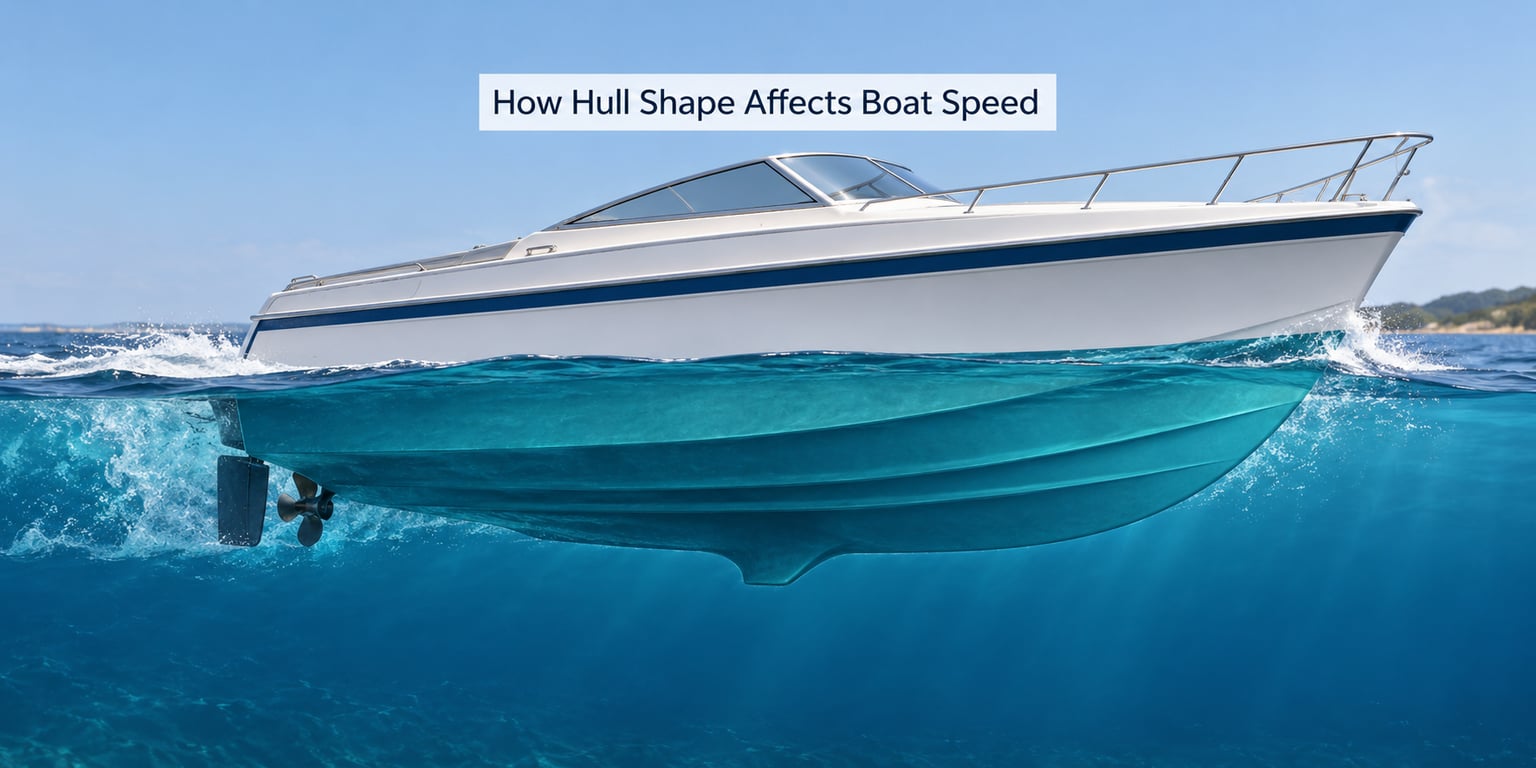
Every hull shape sits somewhere on one axis: how much of the boat’s weight is carried by buoyancy pushing up, and how much by water flowing past the bottom and being pushed down. Displacement boats live entirely on buoyancy. Planing boats shift from buoyancy to hydrodynamic lift at speed, and that handover is where most of the acceleration comes from.
Seven variables decide the outcome, and they trade against each other:
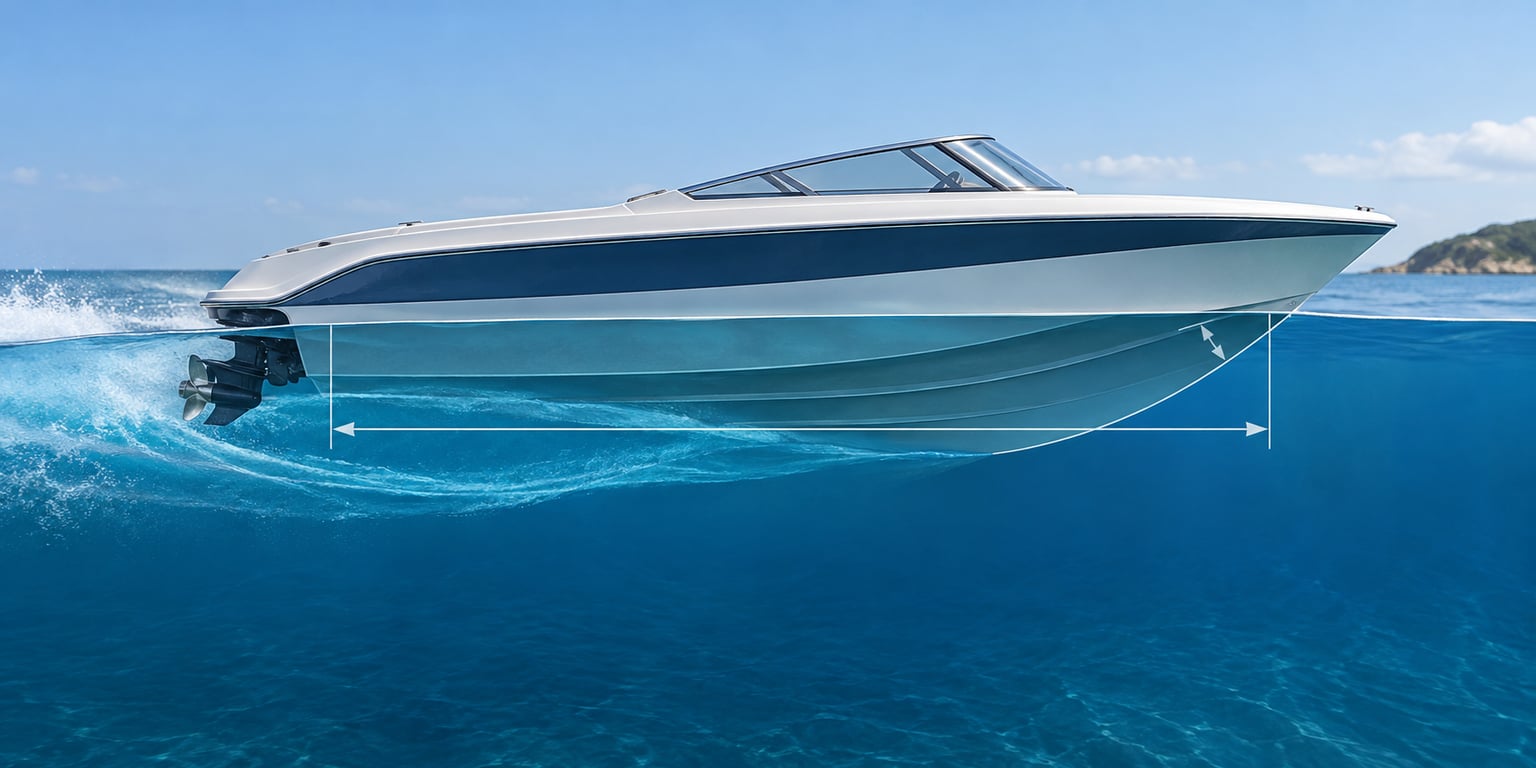
- Waterline length (LWL) — the length of the hull sitting in the water, not the length you buy.
- Wave-making resistance — energy spent pushing the bow and stern wave trains along.
- Wetted surface area — the skin the water rubs against, which grows the boat’s skin friction.
- Deadrise — the V angle between the bottom panels, usually quoted at the transom.
- Draft and displacement — how deep the hull sits and how much water it has to move.
- Trim — bow-up or stern-down attitude, which sets how much wetted length is left in the water.
- Form drag — the bluntness of the entry and the shape of the sections above the waterline.
The useful way to read any hull is against those seven. A beautiful bow means nothing if the aft sections are fat, because the aft sections set wetted area and trim.
What Hull Characteristics Create Resistance?
Total resistance splits into four parts, and hull shape changes all four at once.
- Skin friction — the rubbing of water along the wetted surface. It scales with area and roughly with the square of speed.
- Form drag — the pressure drag of pushing a body of a given shape through water. A blunt section costs far more than a fine one.
- Wave-making resistance — energy lost to the divergent bow wave and the transverse wave train running back along the hull.
- Induced drag — energy lost to side force, mainly leeway when a sailing hull crabs sideways.
Skin friction dominates at low speed and wave-making resistance dominates at high speed. Marchaj’s towing-tank figures, reported by Sailzing, put skin friction at roughly 80% of total drag at 3 knots but only about 40% at 6 knots. That is why hull smoothness matters on a slow boat and barely matters on a fast one: the same figures show a clean bottom gains about 0.27 knots over a fouled one at 4 knots, and only about 0.14 knots at 6 knots.
Shape determines the balance like this:
| Hull form | Wave-making | Wetted area | Rough water | Speed character |
|---|---|---|---|---|
| Fine entry, narrow | Low | Low | Punishing, wet | Fast for displacement; needs skill |
| Broad beam | High | High | Stable and dry | Slow; carries comfort |
| Deep V | Moderate | Moderate | Soft, forgiving | Smooth planing, needs power |
| Modified V | Moderate | Moderate | Good all-round | Plans without slamming |
| Flat hard-chine | Moderate-high | High when light | Hard, noisy | Plans early, rough in chop |
| Rounded fine ends | Very low | Very low | Wet and tender | Leads at low speed; slams in waves |
| Catamaran | Low per hull | Low, but two hulls | Fast, bridging | High speed, more drag above ~18 knots |
Narrow beats wide because wave-making resistance rises steeply with beam-to-length ratio. A catamaran beats a monohull because each slender hull makes a small wave train, but only while it stays light enough that each hull is wetted along its length.
How Does Displacement Hull Shape Change Speed?
A displacement hull never leaves the water. It moves at a speed set by wave-making resistance, and its entire design goal is to reduce that one thing.
Three levers do most of the work. A high length-to-beam ratio keeps the wave train shallow. Fine entry and run angles mean the water closes smoothly behind the hull instead of tearing away in a big wake. And a low prismatic coefficient — the ratio of the hull’s volume to a box of the same length, beam and draft — means fine ends that taper rather than a full, slab-sided middle.
Because the wave train’s steepness sets resistance, speed is limited by length. That relationship is why a 30-foot waterline boat outruns a 20-footer with the same horsepower, and it is the whole basis of the hull speed formula below.
Deadrise works differently in displacement mode. A round bilge with a fair curve generates far less form drag than a hard V at the same displacement, which is why cruising hulls tend to look rounded from the aft sections forward. Draft matters too: a deeper hull carries more displacement with less wetted area, and more payload below the waterline adds drag without adding waterline length.
How Does Hull Shape Affect Planing Speed?
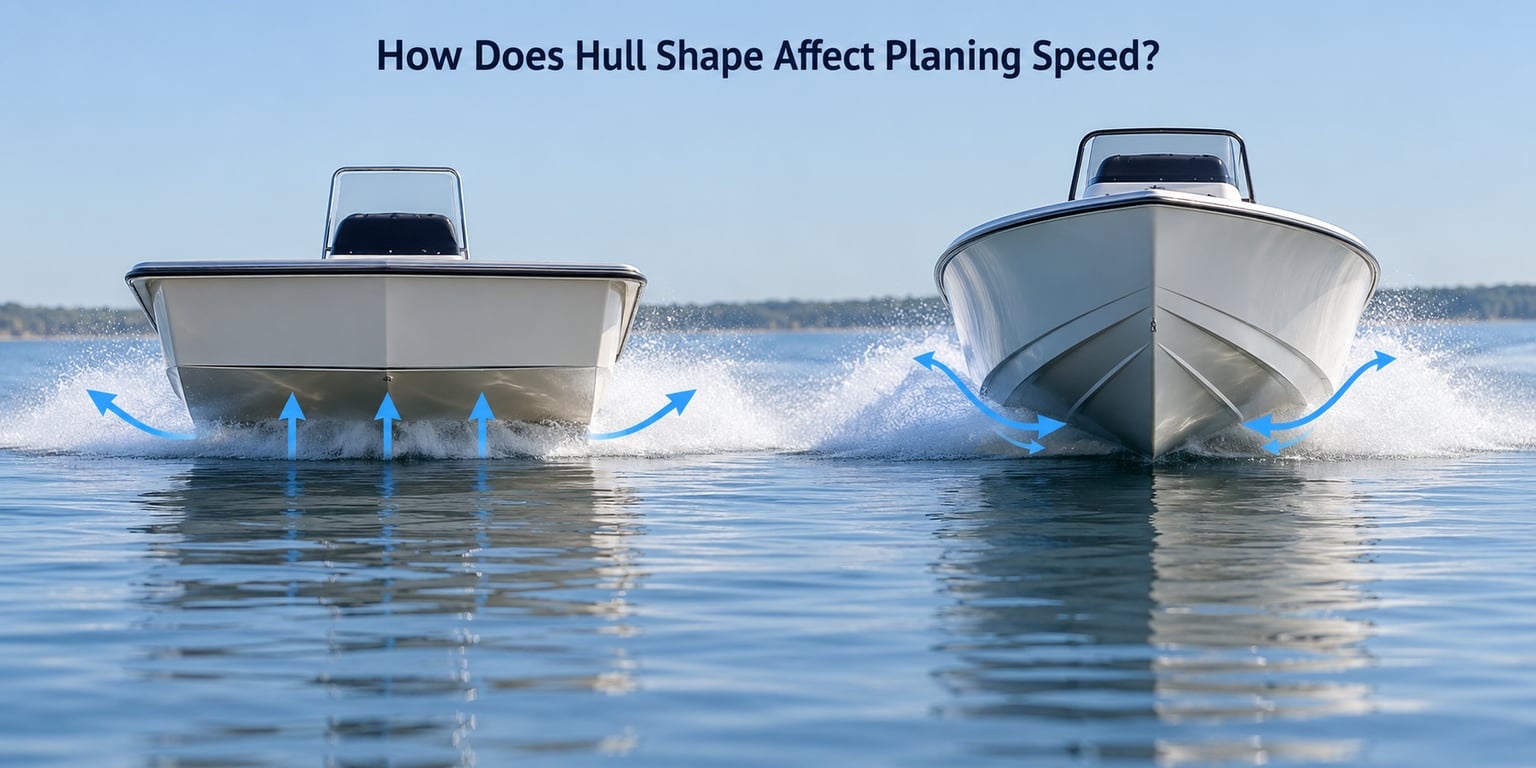
Planing speed is set by how much lift the bottom can generate at a given speed, and lift is a function of deadrise, wetted length and trim.
The sequence always runs the same way. In displacement mode the boat pushes water with its whole wetted length. As speed builds, the bow rises because the bottom pressure near the bow drops as the section emerges, and the wetted length shortens toward the stern. Lift then grows faster than drag and the hull climbs onto plane, leaving only the aft sections wet. From that point on, drag stays nearly flat while power demand climbs with the cube of speed.
That transition is governed by a Froude number. Where Fn = V / sqrt(gL), displacement boats sit below about 0.30, semi-displacement craft run roughly 0.30 to 0.40, and full planing starts near 0.40 to 0.45. A 6.1-metre waterline length with Fn = 0.4 gives about 3.1 metres per second, which is about 6 knots.
Deadrise sets how hard that transition is. Shallow deadrise carries load with low drag and planes early, then slams. Deep V gives a softer ride, deflects spray and holds lift in chop, but needs more power to plane and carries more wetted area at rest. Modified-V hulls split the difference with moderate deadrise aft and more forward.
Bottom contour decides what happens once the boat is on plane. Hard chines bite and throw spray sideways, which is stable and fast in flat water. A rounded bottom develops lift more gently and rolls more. Stepped hulls shorten the wetted length further by having the aft sections sit above the water.
Two failure modes come straight back to hull shape. Porpoising happens when wetted length drops too fast and the stern loses grip, usually on a light hull with flat sections trimmed too high. Bow-down runs happen when trim is wrong for the deadrise and the bow digs in instead of lifting.
What Is the Difference Between Round-Bilge, Hard-Chine, and Catamaran Hulls?
No design is universally fastest. Speed comes down to displacement, length, wetted surface, number of hulls and the sea state you actually run in.
Round-bilge monohulls have the lowest form drag and the smoothest ride at low speed. They are the natural choice for long passages where efficiency per gallon matters more than arrival time.
Hard-chine monohulls put a defined edge on the bottom so lift is predictable and spray throws clear of the hull. They plane at lower power and tolerate a light load, but they punish a light boat in a short steep sea with a hard, noisy ride. Dock and forum discussion on BoatDesign.net and TheHullTruth makes the same point repeatedly: displacement hulls are built to part the water and never reach planing speeds, and planing hulls spend their lives below the threshold far more often than buyers expect.
Catamarans split displacement across two slender hulls, each generating a small wave train. That gives a huge advantage up to moderate speed, plus a wide platform. Above roughly 18 knots the wetted surface of two hulls catches up and the monohull often wins back the advantage, depending heavily on loading.
How Do Waterline Shape and Hull Length Influence Hull Speed?
Hull speed is the speed at which the divergent bow wave roughly matches the waterline length, which is the point where the hull is dragging the biggest wave train it is geometrically able to make.
Hull speed (knots) = 1.34 × √(LWL in feet), or 2.43 × √(LWL in metres). The constant is not dimensionless and published sources range from 1.34 to 1.51, so treat the result as an engineering estimate. From first principles the same relationship is v = √(gL / 2π).
| LWL (ft) | LWL (m) | Hull speed (knots) | mph | km/h |
|---|---|---|---|---|
| 10 | 3.0 | 4.2 | 4.9 | 7.9 |
| 16 | 4.9 | 5.4 | 6.2 | 9.9 |
| 20 | 6.1 | 6.0 | 6.9 | 11.1 |
| 24 | 7.3 | 6.6 | 7.5 | 12.1 |
| 30 | 9.1 | 7.3 | 8.4 | 13.6 |
| 40 | 12.2 | 8.5 | 9.7 | 15.7 |
| 50 | 15.2 | 9.5 | 10.9 | 17.5 |
| 60 | 18.3 | 10.4 | 11.9 | 19.2 |
Hull speed is a drag cliff, not a wall. Modern naval architects mostly work in Froude number or speed/length ratio instead, because both capture the physics without implying a barrier. Wave-making resistance climbs slowly to about Fr 0.35, then steeply to a peak near Fr 0.50.
A boat exceeds its nominal hull speed legitimately when the ends are fine enough that the hull no longer has to drag a full-length wave train. Wave-piercing hulls and slender multihulls do this by design, often running 50% or more above the formula. Buoyancy is what really sets displacement, so sizing starts with the weight: at Fr 0.35 a hull needs roughly 350 newtons of buoyancy for every kilogram of displacement, and at Fr 0.45 roughly 450 newtons.
One practical warning: buyers apply the formula to length overall and get a badly wrong number. Measure the waterline at the loaded condition, not the LOA on the brochure.
How Should Trim, Deadrise, and Weight Be Set for Speed?
Trim is the cheapest speed lever most boats have. At the right trim angle the boat carries its weight on the aft sections, wetted length is at its shortest and resistance is at its minimum.
For calm water and cruising, set an even keel at rest, let the boat settle naturally and adjust the tabs until the wetted length is visibly shortest. For tow-sports and watersports boats, a slightly stern-down attitude with light tabs gets the bow up sooner and cuts wetted length hard.
Payload distribution matters as much as payload weight. Weight in the bow lifts the stern clear and pushes wetted length forward, costing speed. Weight aft buries the running surface and increases drag. Keep heavy items low and near the longitudinal centre, and re-check trim after a full fuel load rather than when the tanks are empty.
The honest trade-off: the trim and deadrise that give maximum top speed are usually the worst choice for rough-water control. Designers pick a middle point and accept a few percent of top speed to keep the boat manageable in a seaway. Owners who want both generally keep tabs and a hull weighting kit instead of re-shaping anything.
How Can Boat Designers Test and Improve Hull Speed?
Speed work goes wrong when several variables move at once. Keep the process repeatable.
- Define the target first. Specify the speed, the payload and the sea state. A 25-knot planing boat in a chop and a 7-knot cruising boat in calm water are different designs entirely.
- Fix displacement and length before comparing shapes. Two hulls at different weights are not comparable.
- Work in Froude number. It keeps you honest about whether the change is real or just a different boat size.
- Use tank tests or CFD where you have them. Series resistance testing separates skin friction from wave-making, which field trials never will.
- Measure in the field with care. Log GPS speed over ground along a fixed course, note the sea state, and record trim and wetted length each run.
- Vary one thing at a time. Change tabs, then deadrise, then loading, then the propeller, and log each result separately.
- Leave the propeller last. Retuning a propeller to compensate for a draggy hull only hides the problem and costs efficiency.
The field test that catches the most: measure wetted length from the transom to the first point where the hull leaves the water, at several speeds. A hull that should have shortened its wetted surface but has not is usually trimmed wrong or carrying too much weight aft.
Frequently Asked Questions
Why does a longer boat go faster?
Because hull speed scales with the square root of waterline length. A 40-foot waterline hull reaches about 8.5 knots under the formula while a 20-footer reaches about 6. The bow wave a long hull makes is stretched over more length, so it stays flatter and costs less energy to push along. That is also why length overall is a poor guide: measure the waterline.
What is the formula for calculating the hull speed of a displacement hull?
Hull speed in knots equals 1.34 times the square root of the waterline length in feet, or 2.43 times the square root of the waterline length in metres. The constant is not dimensionless and sources range from 1.34 to 1.51, so treat the answer as an estimate. From first principles the same relationship is v = sqrt(gL / 2pi).
What are the three main types of hulls?
Displacement, semi-displacement and planing. A displacement hull lives entirely on buoyancy and is speed-limited by wave-making resistance, typically up to a Froude number near 0.30. A semi-displacement hull is a long narrow displacement hull tuned to plane lightly. A planing hull generates hydrodynamic lift at speed, climbing onto plane so its wetted surface shrinks and drag drops sharply.
What is the most efficient hull shape for displacement boats?
A long, narrow hull with fine entry and run angles and a low prismatic coefficient, so the water closes smoothly behind it instead of tearing away in a big wake. A rounded canoe body carries displacement efficiently and has low form drag. The efficiency gain comes from reducing wave-making resistance, so length-to-beam ratio matters more than any single curve in the sections.
Do planing hulls have a hull speed?
Yes, in the sense that the formula still predicts where wave-making resistance becomes dominant, but it is far less useful there. Planing boats are normally designed to run well past it, because once they are on plane the wetted length collapses and resistance stops rising with the wave train. Below the planing threshold they behave like displacement boats, and forum discussion on BoatDesign.net makes the point that hull speed is not the moment a boat switches modes.
What is the best hull design for speed on water?
There is no single answer, because the answer depends on displacement, length, wetted surface, hull count and sea state. A fine-ended slender hull leads at low speed. A hard-chine or shallow-V planing hull leads once it is up and on plane. A catamaran leads in moderate conditions and loses ground above roughly 18 knots. Offshore passage, calm inland cruising and racing each reward a different hull.
Conclusion
Start by deciding what the boat actually does: displacement, semi-displacement or planing, and in what sea state. Then balance waterline length, displacement, deadrise, wetted surface and trim against each other, and stop judging speed from how a hull looks on paper. A boat is fast when the right amount of hull is in the water, at the right attitude, for the right conditions.
Everything after that is refinement: tab settings, loading, propeller choice, bottom condition. None of the tooling available in 2026 has changed the underlying physics, so a hull that was slow for structural reasons is still slow, and the shape decisions made at the start of a build are the ones that set the ceiling.