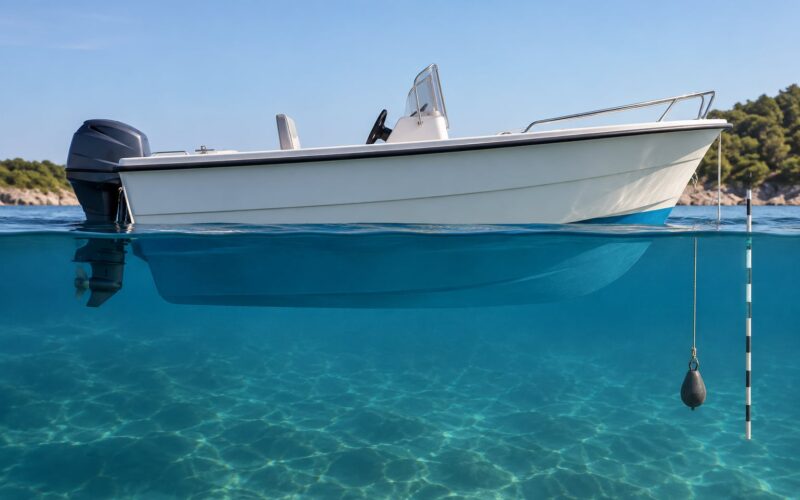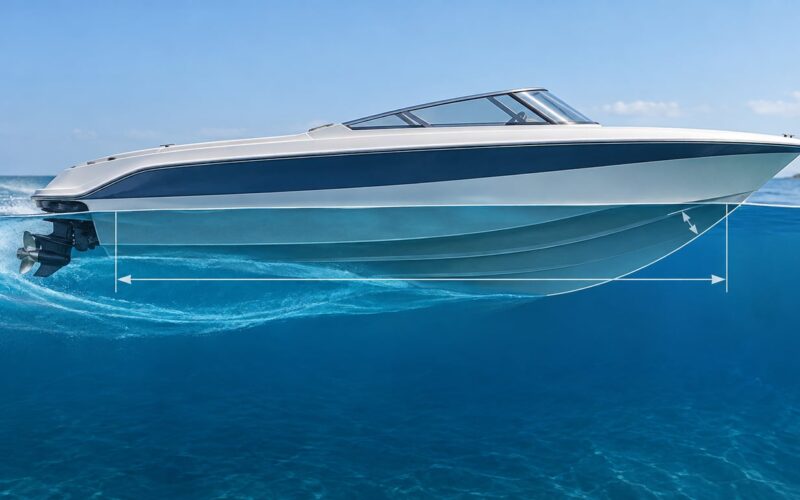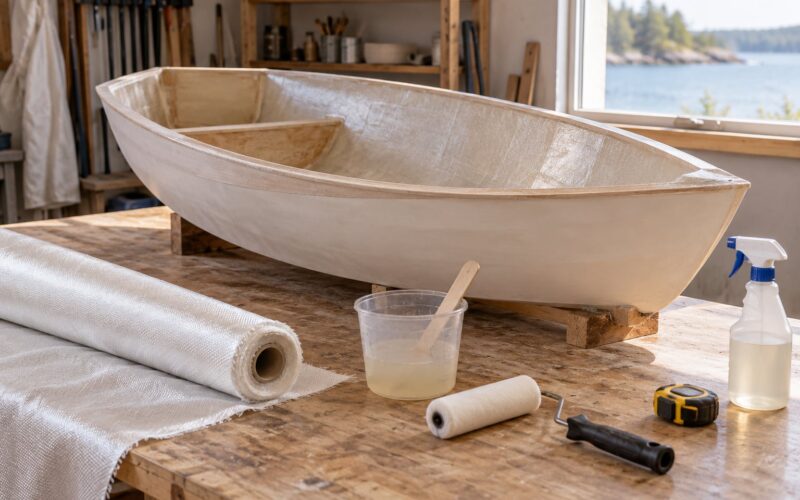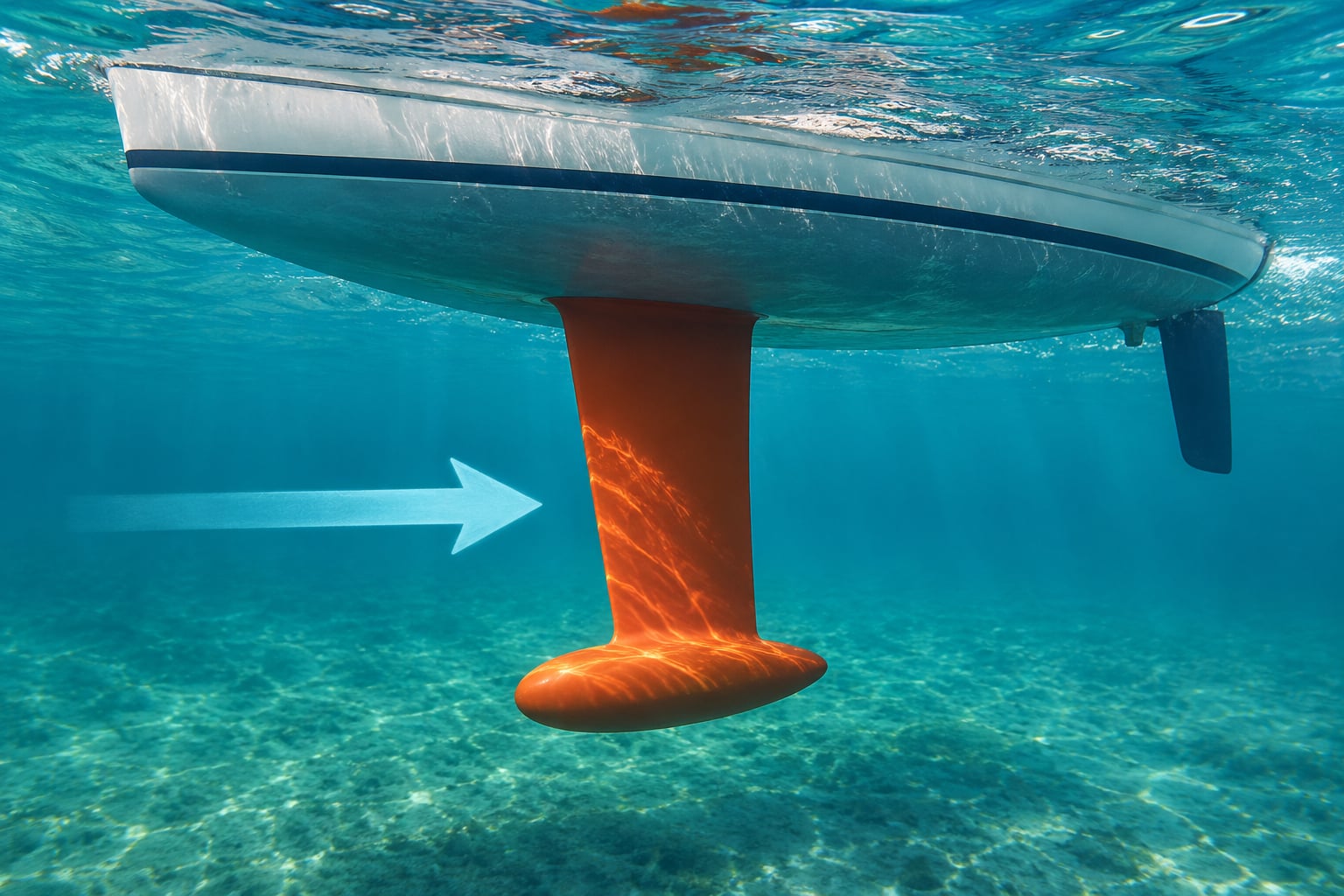
A keel is the structural spine of a boat: a beam or fin running fore and aft along the bottom of the hull, usually on the centreline, that carries weight low, resists sideways motion, and lets the rudder do its job. Straight answer to what is a keel and what does it do: it balances three forces at once, buoyancy from below, ballast from the keel itself, and the sideways push of wind and water.
One quick word of disambiguation, because the word pulls in several directions. “To keel over” means to tip or capsize, “keel” is a bone in a bird’s chest, and a ship’s keel is also the structural backbone that ties the hull together. Everything below is about the boat.
Table of Contents
- What Is a Keel and What Does It Do?
- How a Keel Creates Stability and Controls Sideways Motion
- What Is a Keel and What Does It Do on Different Types of Boats?
- How Keel Shape and Size Affect Performance
- Keels in Marine Robots and Ocean Technology
- Common Keel Problems and Design Mistakes
- Frequently Asked Questions
- The Short Version
What Is a Keel and What Does It Do?
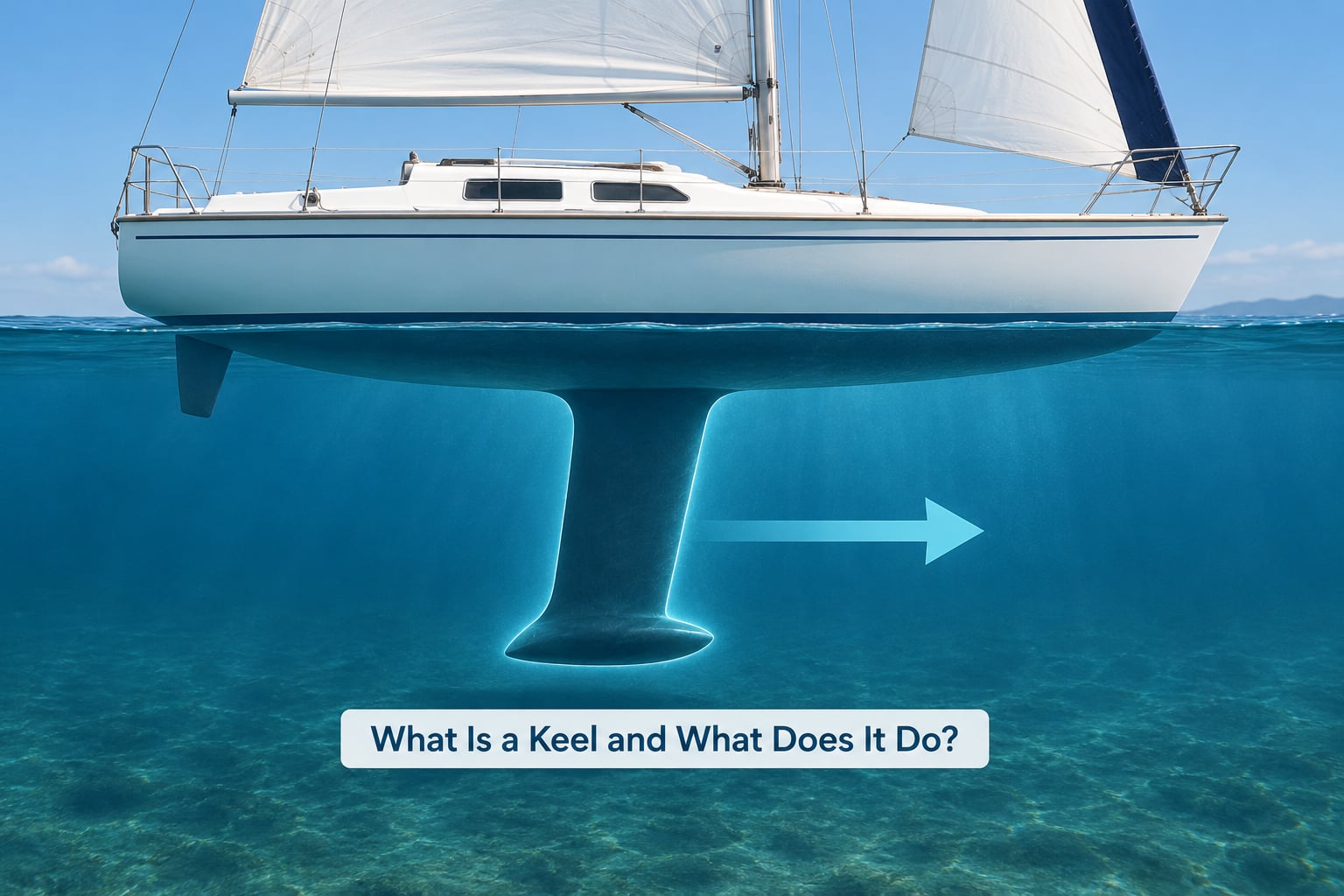
A keel is a longitudinal structural member running along the centreline of a boat’s hull, extending below the hull for ballast and lateral resistance. It stops the boat sliding sideways, keeps the boat upright, and holds the weight that decides how the hull behaves in a sea.
Here is the short version people are usually after. What does a keel do? Five things, and they are all connected:
- It carries ballast. Most of a cruising boat’s ballast is the weight of its keel, packed into the bottom of the fin or into a bulb at the bottom of the fin.
- It resists sideways force. Water pressing against the keel’s side area pushes back, so the boat tracks instead of slipping sideways.
- It lowers the centre of gravity. Weight low in the hull makes the boat want to sit upright rather than lie on its side.
- It holds the rudder in working water. A rudder only steers when there is moving water around it, and the keel is what creates that flow.
- It sets draft. How deep the keel reaches decides which water you can navigate at all.
| Keel role | Force it works against | What goes wrong when it is missing or badly designed |
|---|---|---|
| Ballast reservoir | Gravity acting on the hull’s own weight | The boat floats high, pitches wildly, and carries its weight in the wrong place |
| Lateral plane | Wind and current pushing the hull sideways | The boat makes leeway, sails in a straight line but not where you aimed, and the rudder stalls |
| Righting lever | Heeling moment from wind and waves | Excessive heel, an open-angle fleet, and eventually a capsize |
| Flow generator | Rudder needing water to bite on | Steering goes vague exactly when you need it most |
| Structural backbone | Hull flex and wave impact | The bottom of the hull works, flexes, and develops cracks and soft spots |
That last row is the one people forget. On older boats and on many powerboats the keel is also the spine of the hull, the member that ties bow to stern and stiffens the bottom. You can see the same word doing double duty: a ballast fin and a structural beam.
How a Keel Creates Stability and Controls Sideways Motion
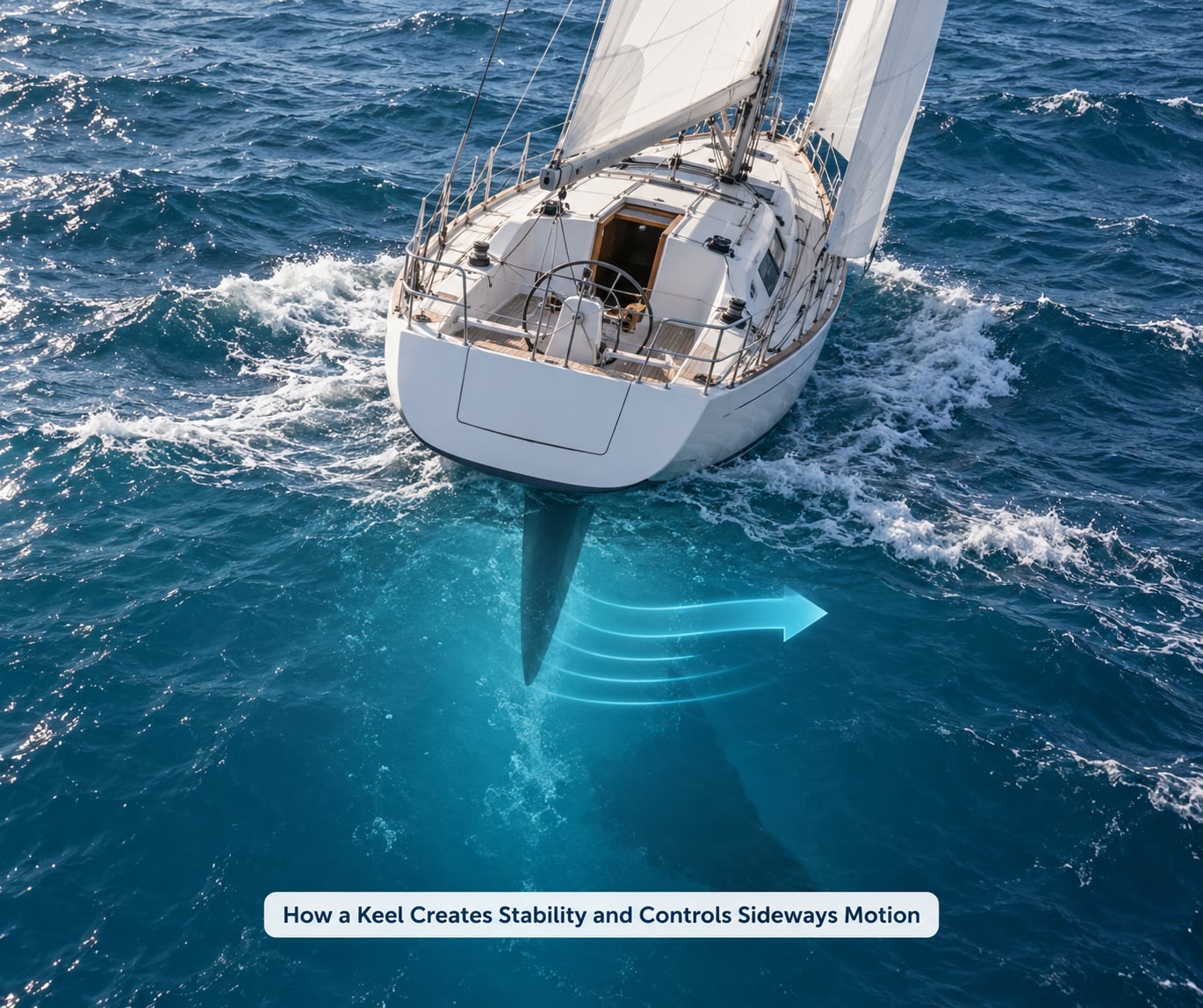
Stability and steering come from the same physics. Move a boat sideways through the water and water has to go somewhere; it flows around the hull and around whatever sticks out below it. The keel is the biggest thing sticking out below it, so it gets most of that push.
How side force is actually created
When a boat heels or sails at an angle to its heading, water flows past the keel at an angle. Because the keel is set at an angle to that flow, it behaves like a wing underwater: pressure builds on one side and drops on the other, and the net result is a sideways force called lateral resistance.
A decent analogy is a hand held flat in a current. Angle it and the water pushes back; hold it edge-on and it slips past with almost nothing. A keel works the same way, which is why the angle and shape of its foil section matter so much.
The size of that force depends on how much underwater area the keel exposes and how fast the water is moving past it, which is why a boat going slowly has almost no steering no matter how good its keel is. Leeway, the sideways drift caused by wind, is the symptom of too little of that force, and the cure is always more lateral area, more depth, or both.
How the keel and rudder work as a pair
A keelboat needs both members to steer properly, and that pairing is a big part of the answer to what is a keel and what does it do in practice. The keel supplies the sideways resistance, and the rudder supplies the turn. With a keel and nothing else, the boat tracks in a straight line but cannot be aimed. With a rudder and no keel, the rudder spins in nearly still water and the boat spins with it.
This is why keel shape and rudder type are really a single decision. A skeg-hung rudder below a long keel is efficient but limits how sharply the boat can turn. A spade rudder behind a separate fin turns tightly and tracks less. Twin rudders spread the steering load and reduce the flex that spoils a large single rudder. Nobody gets all three qualities at once, and owners on cruising forums usually settle for the compromise they can live with.
One thing worth clearing up, because owners argue about it in the wrong direction: on some boats the fin exists mainly to hold a bulb in place rather than to generate lift itself. That bulb still does the lateral work. Either way the answer is the same, the side force comes from the underwater shape.
Why ballast helps the boat stay upright
A boat floats because water pushes it up. It wants to lie on its side because wind pushes the rig sideways. The keel’s job is to make the first force act further away from the second.
When the boat heels, the weight in the keel tries to fall straight down while the hull has moved to one side, so the keel ends up lower and to leeward. That creates a moment that pushes the boat back upright. Multiply the ballast weight by the horizontal distance it sits from the centreline and you get the righting moment.
Move the keel lower and that arm gets longer, so the righting moment grows. Move it further aft and the boat stops wanting to round up into the wind. That is the whole argument designers have over keel position, and it never resolves, because both directions cost something.
Initial stability versus reserve stability
Initial stability is how stiffly the boat stands back up in light conditions, and it mostly comes from hull shape and beam. Reserve stability is what happens when something has already gone wrong: a gust, a wave, a full boat. That is the keel’s job.
A boat can have plenty of initial stability and almost no reserve stability. Tender, beamy dinghies feel stiff and lively at first and then fall over if you get them on the wrong side of a wave. A ballasted keelboat feels flat and slightly dull when upright and then keeps sailing when nothing else would.
What Is a Keel and What Does It Do on Different Types of Boats?
The function never changes, but the shape changes a lot depending on what the boat has to do. A shallow-draft estuary boat and an offshore passage boat want opposite things from the same member.
Fixed keels on keelboats and sailboats
A fixed keel is permanently bonded or bolted to the hull. It does the simplest job with the fewest parts, which is why most cruising sailboats and keelboats use one. Nothing moves, so nothing wears out, and you can put the maximum possible weight in the lowest possible place.
Attached keels on motorboats and multihulls
On powerboats the same idea appears as a deadrise keel or a strake running along the V of the hull. It stiffens the bottom, carries some weight low, and helps the hull plane. On multihulls the equivalent is a centreboard or daggerboard dropped between hulls, because a catamaran has one hull to carry stability and no obvious place to hang a keel.
Pivoting keels, lifting keels and daggerboards
A pivoting keel swings up to reduce draft in shallow water, and a lifting keel retracts into the hull entirely. Both trade some structure and some stiffness for access to shoal water and drying moorings. On many production boats the mechanism is hydraulic, and the pivot bearings become a maintenance item of their own.
A daggerboard is the simplest movable version: a thin blade that slides straight down through a case in the hull and stops about halfway. It costs less to build than a pivoting keel and gives up some stiffness and some ballast depth.
Centreboards and the keelboat versus dinghy question
A centreboard does the same job as a keel in a much smaller hull. Dinghies and small keelboats of the same length feel completely different because one holds its weight in a low, fixed foil and the other holds it in a wide, shallow, movable plank in a slot.
| Arrangement | Draft | Stability and tracking | Best fit |
|---|---|---|---|
| Fixed deep fin keel | Deep | Strongest righting moment and course keeping, most drag | Offshore cruising and passage-making |
| Shallow fixed or stub keel | Shallow | Less ballast, softer ride, more leeway | Coastal and estuary work |
| Lifting or pivoting keel | Adjustable | Depends on deployed position; mechanism adds weight | Moorings, drying harbours, variable depth |
| Daggerboard | Moderate | Good planing, less reserve stability than ballasted | Small keelboats and open boats |
| Centreboard | Shallow to moderate | Wide flexible blade, tracks moderately, heels more | Dinghies, dayboats, shallow cruisers |
| Bilge or twin keels | Moderate | Ballast spread wide; stiff, upright, hard to refloat when aground | Multihulls and boats that sail in shallow water |
| Skeg with rudder hung below | Shallow | Some lateral area from the rudder alone, long-keel feel | Budget cruisers and traditional hulls |
| Powerboat deadrise keel or strake | Shallow | Structural stiffness and planing trim rather than righting moment | Planing and displacement powerboats |
How Keel Shape and Size Affect Performance
Once you accept that a keel is a wing and a weight holder, the design variables get easy to reason about. Each one buys you something and costs you something else.
Depth and ballast
Deeper means more righting moment, more tracking, more control in rough water and more drag. That trade is the central bargain of keel design and every designer takes it differently. Ballast density matters too, because it decides how much weight you can cram into a small volume.
| Ballast material | Density (approx.) | What that means in practice |
|---|---|---|
| Lead | 11,300 kg/m³ | Most ballast weight in the smallest volume; small fins, softer motion, and a soft non-dinging material under the hull |
| Cast iron | 7,000 kg/m³ | Same weight needs a noticeably bigger fin, more drag and more wetted surface, and it rusts |
| Steel | 7,850 kg/m³ | Structurally stiff and weldable, common as the fin itself with lead in a bulb |
| Composite (lead or steel in epoxy) | Varies by fill | Light, stiff and corrosion free, but needs careful layup and inspection |
That density difference explains why an iron keel looks chunky next to a lead one carrying the same weight. Owners are often surprised by it, but it is just arithmetic: roughly 60 percent more volume for the same ballast.
Chord, span and foil section
Chord is how long the keel is front to back, span is how tall it is, and the pair of them set aspect ratio. A short span with a long chord is a stubby, stiff, draggy shape. A tall, narrow fin has less wetted surface and less drag but needs a stiffer structure to stop it flexing.
Foil section is the cross-section shape, the equivalent of an aircraft wing profile. Symmetric sections make sense when the boat sails both ways equally; asymmetric sections produce more lift one way and drag the other. Modern designs use foil sections inspired by aircraft practice, and the fillet where the fin meets the hull matters as much as the section.
Bulbs, skegs and drag
A bulb at the bottom of a fin carries the weight without adding much height, which lets the fin above be longer and narrower for the same draft. It converts a short fat keel into a long thin one. Owners on cruising forums often describe fin keels as feeling flighty upwind, which is usually the result of a section working too near its stall angle when heeled.
Deep long keels carry more wetted surface than a shorter fin with the same stability, so they sail straighter and slower. Shallow keels go faster and point worse. There is no setting that wins all of it.
Keels in Marine Robots and Ocean Technology
Everything above transfers directly to unmanned surface vessels and ocean drones, which is where this site spends most of its time. A robot boat has no crew to correct a bad heading, so directional stability matters even more than it does on a sailing yacht.
On a typical autonomous surface vessel the keel is smaller and does a narrower job: it supplies hydrodynamic lateral resistance so the vessel holds a heading without constantly steering. That saves battery, and battery is the constraint that decides how long the mission lasts.
Why heading stability costs a robot power
Every correction a surface vessel makes with its thrusters costs energy, and a vehicle holding a survey line makes small corrections constantly. A keel that resists sideways drift quietly holds the heading, so the autopilot spends its power on forward motion instead. On a long endurance mission that difference decides whether the vessel finishes its line or comes back to recharge.
Current changes the arithmetic. A fixed keel sized for calm water is not enough in a tidal race, and the usual fix is more lateral area, which is also more drag. Robot designers work the same trade as yacht designers, with a smaller budget for compromise.
- Passive keels are fixed foils or deadweights. They cost nothing to run, need no power, and cannot fail mechanically in the water.
- Active foils are controllable surfaces that change angle. Racers deploy them to recover the lateral resistance given up by a canting keel fin.
- Canting keels swing the ballast to leeward to reduce heel. On a yacht that means more drive; on a robot it means sensor accuracy and less weathercocking.
- Shallow operation matters more for robots than for boats, since survey areas are often shoal and the vessel may ground. A shallow or lifting keel keeps the craft recoverable.
- Sensor isolation benefits from a stiffer, better-faired keel, because a flexing fin adds its own motion on top of what the sensor is trying to measure.
Designers working in this field describe the passive keel and the active foil as a straight choice. Passive costs nothing in power and gives up precise heading control; active takes power, adds a failure mode, and buys back control that matters more for a survey line than for a day’s sailing.
Common Keel Problems and Design Mistakes
Most keel trouble falls into a few repeatable patterns, and most of them show up long before something fails.
The keel is undersized for the ballast it carries
A fin that is too small for its bulb flexes under load. Flexing costs energy, adds noise, and eventually cracks the joint or the tab at the top of the fin. Vibration that appears at one specific heel angle is a classic sign of this, and it also means the section is working too close to its stall angle.
Poor attachment to the hull
How the keel is fixed to the hull decides whether it is a structural member or a bolt-on fitting. Steel plate and composite keels are bonded into a hull with a wide, faired tab; older iron and lead keels often hang on bolts. Owners on sailing forums treat keel bolts as the scariest thing on the boat, and the recurring complaint is practical: they reach for a torque wrench and find they do not have a socket big enough, which is a good reason to check the size before you need it.
A quick look for cracks radiating from the tab fairing, movement when the boat is lifted or loaded, and weeping or staining under the joint will tell you far more than a paint inspection will.
Grounding and snagging
Ballast in the bottom of the fin helps absorb a knock, but a wing or twin keel makes a boat much harder to refloat once it is aground, because it digs in. Owners also report wing and twin keels catching mooring lines and fishing gear, and note how awkward they are to get antifouling into the gaps between twins.
Corrosion on iron and steel
Cast iron and steel fittings corrode from both sides: from the antifouling layer through the metal, and from galvanic action between dissimilar metals. Coating damage under the waterline often starts at the leading edge and the fillet, the two places where paint takes the least hold. Sacrificial anodes and intact coatings do most of the work here.
Excessive depth for the water
This is a design mistake rather than a fault, but it causes grounding more than anything else. Buying a deep-draft boat for a shallow tidal estuary is a decision that shows up as a ruined tide and a very expensive afternoon.
What the failure news has changed
Keel loss is rare but memorable, and a handful of recent offshore incidents have made owners check their keel bolts who never did before. The useful response is not panic and it is not swapping the keel for a heavier one. It is knowing how your boat behaves if the worst happens, and confirming that whatever partial foil the designer fitted into the hull is still attached and sound.
Several designs keep a small stub keel or a shallow centreplate for exactly that reason. It will not save a boat, but it keeps the rudder in water and stops a 30 percent displacement from becoming an unstable raft.
What a sensible inspection covers
Look at the fairing where the keel meets the hull and run your hand along it for soft spots or lifting edges. Check the antifouling around the leading edge and the fillet. Confirm the keel bolts are present and the right size for a torque check, and note the last time anyone did it. On a lifting keel, check the pivot pins and the locking mechanism rather than assuming a closed cover means a safe one.
Frequently Asked Questions
What is a keel on a boat used for?
A keel carries most of a boat’s weight low in the hull, resists sideways force so the boat tracks instead of sliding, and gives the rudder flowing water to work in. That combination lowers the centre of gravity, reduces heel, and keeps the boat pointing where the helm asks it to point.
What is the difference between a full keel and a fin keel?
A full or long keel runs much of the boat’s length and usually holds the ballast at the bottom of a deep slab. It gives a strong righting moment and excellent course keeping at the cost of more wetted surface and drag. A fin keel is a shorter, narrower shape with a separate bulb, which sails faster and points less.
What is the difference between a keel and a centreboard?
Both resist sideways motion, but a keel is a fixed structural member built into or bolted to the hull, usually carrying dense ballast. A centreboard is a wide, shallow blade in a slot that drops down when needed. A keelboat with a deep ballast keel feels stiff and safe; a similar-sized dinghy with a centreboard feels livelier and quicker.
Do all boats have a keel?
No. Kayaks, inflatables, flat-bottom skiffs and many planing powerboats rely on hull shape and wide beams instead of a deep fin. Small dinghies often use a centreboard rather than a keel. Boats that do carry weight low in a dedicated member generally use one for ballast and direction control rather than simply for stiffness.
What is a keelson?
A keelson is a heavy timber or metal beam laid on top of the keel, above the floor timbers, that adds stiffness to the hull. It sits above and parallel to the keel, not below the hull. In older wooden construction it could carry significant weight, while in modern boats the structural work usually passes through a fabricated keel and separate engine keelson.
What happens if a keel fails on a boat?
Losing a fixed keel removes most of the ballast, so the boat rises, becomes tender, and loses tracking. Many keelboats carry a small stub or daggerboard for exactly this reason, since a partial foil keeps the rudder working and the hull from becoming unmanageable. Any suspected damage should be inspected ashore rather than on a passage.
The Short Version
A keel is weight carried low and a wing held in moving water. It decides how much a boat resists heeling, how straight it sails, how fast it goes, and how much water it needs under it.
If you are still working out what is a keel and what does it do on your own boat, start with two numbers: the draft, and whether the keel is fixed, lifting or centreboard. Then look at the fairing where the keel meets the hull. That single check has caught more problems than any other on a survey.