If you are weighing arduino vs raspberry pi for boat projects, the short version is this: an Arduino-class board wins on timing, power and unattended reliability, while a Raspberry Pi wins on networking, storage and running the marine software everyone actually uses, like Signal K and OpenPlotter. Most working boat systems run both, with the microcontroller handling the hardware and the Pi handling everything you want to look at.
I have watched this exact debate play out on sailing forums for years, and the honest answer has not really changed. What has changed is that the third option, an ESP32, quietly became the best choice for a lot of small sensor nodes. Updated for 2026, here is how the three compare once you put them in a salty, vibrating, sun-baked compartment with a 12 volt bus and no way to reach it for a week.
Table of Contents
- Arduino vs Raspberry Pi for Boat Projects at a Glance
- What Is the Difference Between Arduino and Raspberry Pi?
- Which Platform Is Better for Real-Time Boat Control?
- Which Platform Is Better for Sensors and Data Logging?
- Which Platform Is Better for Networking and Remote Access?
- Which Platform Uses Less Power and Starts Faster?
- How Do Marine Conditions Change the Decision?
- Arduino vs Raspberry Pi for Common Boat-Project Uses
- Can Arduino and Raspberry Pi Work Together on a Boat?
- Which Should You Choose?
- Frequently Asked Questions
- Why use Raspberry Pi instead of Arduino on a boat?
- Can a Raspberry Pi do everything an Arduino can on a boat project?
- Which is better for a beginner building a boat monitoring system?
- Is Arduino basically C++?
- What is the difference between NMEA 0183 and NMEA 2000 support?
- How do you protect an Arduino or Raspberry Pi from saltwater corrosion?
- Conclusion: Start With the Boat’s Control Requirements
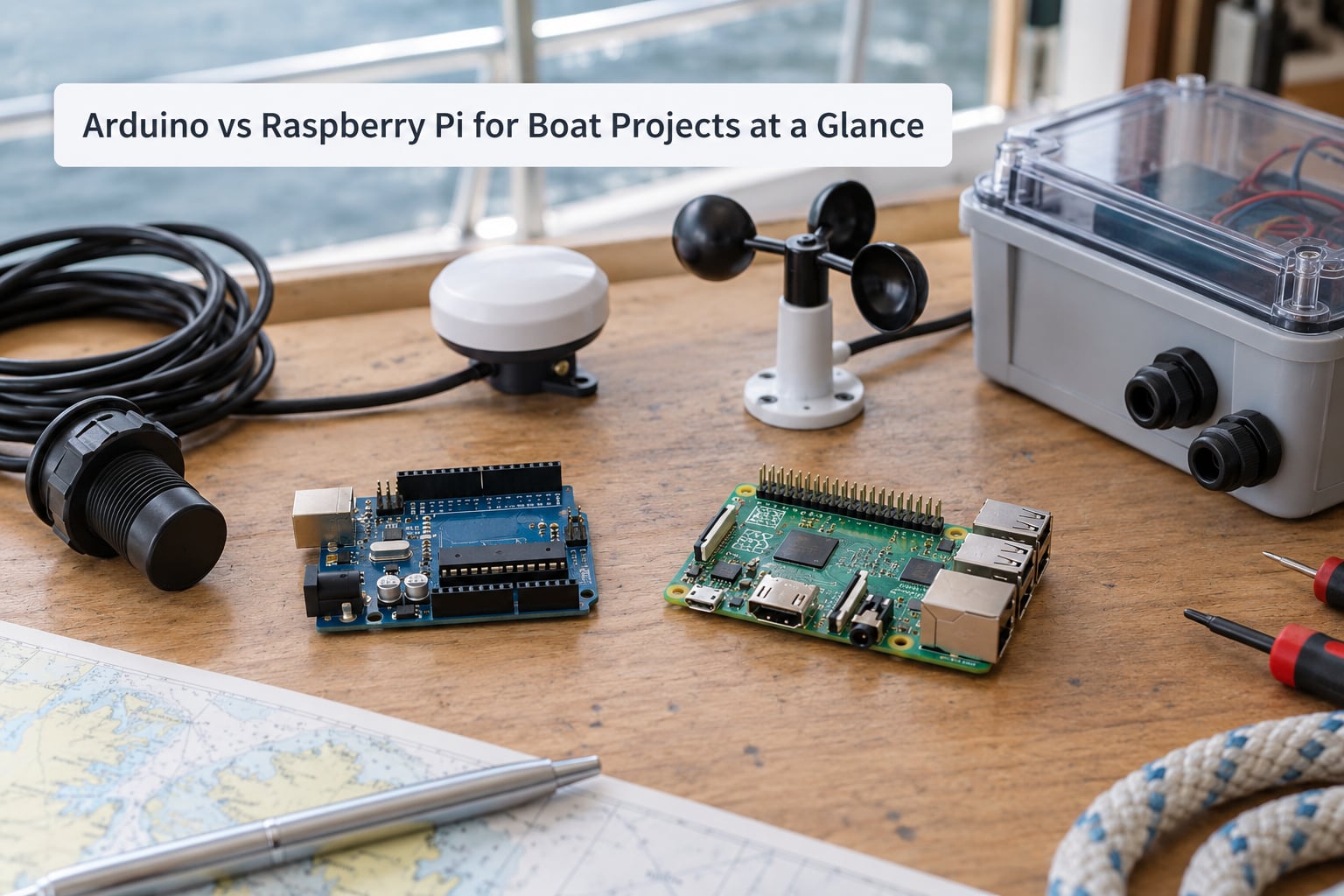
Arduino vs Raspberry Pi for Boat Projects at a Glance
| Criterion | Arduino (and ESP-class boards) | Raspberry Pi |
|---|---|---|
| Architecture | Microcontroller, runs one firmware loop | Single-board computer running Linux |
| Typical language | C++ via the Arduino IDE, or MicroPython | Python, Node.js, C, shell, anything in the repos |
| I/O timing | Deterministic, microsecond resolution | Best case milliseconds, scheduler-dependent |
| Boot time | Milliseconds | Tens of seconds to a usable login |
| GPIO logic | 5V on most classic boards, 3.3V on newer ones | 3.3V only, not 5V tolerant |
| Analog inputs | Built in on most boards | None on the 40-pin header, needs an ADC HAT |
| Serial buses | I2C, SPI, UART, 1-Wire, CAN on some models | All of those via USB adapters or HATs |
| Storage | None, firmware is in flash | microSD card, USB SSD, or NVMe |
| Wireless | None on a bare Uno, built in on ESP boards | WiFi and Bluetooth standard, Ethernet on full-size models |
| Power draw | Milliamps active, microamps in deep sleep | A few watts under load, more with a display attached |
| After a power cut | Running again in milliseconds | Boots from scratch, needs healthy storage |
| Marine protocols | NMEA 0183 easy, NMEA 2000 via ESP32 CAN | NMEA gateways, Signal K, OpenCPN, OpenPlotter |
| Best fit | Real-time control, battery-powered sensor nodes | Dashboards, chartplotters, data logging, remote access |
Read that table as a job description rather than a scoreboard. The Arduino column is a worker who starts instantly, never crashes, and draws almost nothing. The Pi column is an office manager with excellent software and a terrible startup delay.
What Is the Difference Between Arduino and Raspberry Pi?
An Arduino is a microcontroller: a single chip with CPU, memory and I/O on one board, running a single compiled program in a loop. It does one job and it does it at exactly the intervals you told it to, whether or not anything else on the boat wants attention.
A Raspberry Pi is a single-board computer. It boots a full Linux operating system, mounts storage, runs services, opens a browser and can be remotely logged into over the network. That flexibility is the point, and so is the trade-off: Linux schedules work by priority, so timing is never guaranteed.
The practical consequence on a boat is more specific than “one is better”. An Arduino reading an engine temperature sensor gives you a steady stream of clean numbers whether the boat is moving, anchored or running an automatic software update on the Pi two metres away. A Pi gives you charts, logs, alerts and a Signal K delta server that the whole open-source marine ecosystem plugs into.
Neither board is a marine-grade instrument. Both are hobby hardware, and that matters more below than anywhere else in this guide.
Which Platform Is Better for Real-Time Boat Control?
The Arduino wins real-time control, and the gap is not subtle. Pulse-width modulation on a microcontroller is a hardware peripheral that steps at a fixed rate, so servo pulses and solenoid valves land within microseconds of when you asked. On Linux, the same output depends on how busy the scheduler is.
That gap shows up in three places. A rudder or throttle actuator needs clean, repeatable pulse trains. An encoder counting propeller or wheel revolutions needs consistent sampling or your speed calculation drifts. A bilge or high-water float needs a decision, not a retry loop that a background process can stall.
On forum.arduino.cc, the advice in the widely linked guidance thread is blunt about the split: the Pi is a small PC that is poor at precise timing, while an Arduino is good at it. The same thread describes the standard fix, passing data from a low-power node to a Pi that runs the web interface. That arrangement is still the pattern most builders land on.
Here is the safety boundary I would draw without hesitation. A hobby single-board computer should not be the sole path for steering, engine shutdown, fire suppression or anything that keeps a boat from sinking. Wire those to proper marine hardware with a real fail-safe, and treat the Arduino or Pi as monitoring and convenience on top of it.
Which Platform Is Better for Sensors and Data Logging?
The Arduino wins at reading sensors, the Pi wins at storing what you read. Most Arduino boards have analog-to-digital converters built in, while a Pi’s 40-pin header has no analog inputs at all and needs an ADC HAT that fits awkwardly beside a USB socket in a wet locker.
Digital buses are where it gets murkier. I2C, SPI, UART and 1-Wire are trivially available on a microcontroller and need an adapter on a Pi. NMEA 2000 is the interesting case: it is CAN bus, and the documented route on hobby hardware is an ESP32 running the ttlappalainen NMEA 2000 library, which uses the chip’s built-in CAN controller and WiFi together.
That is why the ESP32 keeps coming up. An ESP32 has analog inputs, 3.3V logic, built-in WiFi and Bluetooth, a CAN controller, and a deep sleep mode that drops the current draw to microamps. Open-source boat projects document exactly this pattern: wireless wind sensors, an ESP8266 at 12V and 50 mA sending NMEA 0183 over serial and TCP, and 30-plus builds of that same design.
For logging, a Pi wins because it has storage and a filesystem. Signal K can record every data point to disk or a database, and you can pull the file when you get back to a marina. Firmware on a microcontroller records by accident, in whatever internal buffer happened to be full, which is fine for a trend line and useless for a proper log.
Which Platform Is Better for Networking and Remote Access?
The Raspberry Pi wins networking and it is not close. WiFi, Bluetooth and Ethernet are standard, and on a full-size model you get a wired connection for a helm-mounted box. A bare Arduino Uno has no radio of any kind, which is why network-capable ESP boards have taken over the sensor-node role.
What a Pi buys you is the entire remote-monitoring stack. Signal K is a JSON-based delta server that the open-source marine world has standardised on, OpenPlotter is a ready-made image that bundles it with charting, and Node-RED gives you a web dashboard on your phone at anchor. Add an LTE modem and the boat reports home when it is out of WiFi range.
Forums are full of people doing exactly this. Users on r/sailing describe combining an ESP node for reading sensors with a Pi running the webserver, and a second Pi Zero is a common way to split a separate Signal K server away from the main unit. One liveaboarder described keeping a spare board in a Faraday cage in case the original gets fried, which tells you more about their reliability anxiety than any spec sheet does.
The catch is maintenance. Someone on forum.arduino.cc described watching a Linux box download large automatic software updates until it ran out of disk space on an unattended device. That failure mode does not exist on a microcontroller, and it is a real argument for locking down a marine install.
Which Platform Uses Less Power and Starts Faster?
The Arduino uses far less power and starts instantly, and on a boat at anchor those are the two numbers that decide whether your project survives between solar charges.
A microcontroller in deep sleep measures in microamps. The wind sensor build documented on open-boat-projects.org runs an ESP8266 from the 12 volt bus at 50 mA, and an engine monitor in the same collection draws around 80 mA. Those are self-reported project figures rather than bench measurements, but the order of magnitude is right: a sensor node that sleeps between readings can sit on a small solar budget for weeks.
A Pi draws watts, not milliamps, and a Pi driving a screen draws more. Forum advice for chartplotters generally points at a Pi 4 or Pi 5 with a GUI, which is a power decision as much as a performance one. Some builders have moved the other way and drive a cheap Android head unit instead, partly because it idles around half a watt, leaving the Pi purely as a headless server.
Boot time matters more than people expect. A monitoring node that is reporting ten seconds after power returns is a different product from one that takes a minute to boot, and geofencing, remote wake and unattended logging all depend on how fast your system is alive again.
How Do Marine Conditions Change the Decision?
Marine conditions are what turn this from a spec-sheet comparison into a real decision, and no generic Arduino-versus-Pi article touches them. Salt, condensation, vibration and heat punish both platforms in different ways.
Salt and corrosion. Saltwater and salt-laden air attack connectors, headers and any exposed copper faster than people expect. Conformal coating on a bare board buys real time, but it is cheaper to use a board with headers you can replug and keep everything inside a sealed enclosure with a desiccant pack.
Condensation. A sealed compartment in a warm climate drops moisture every night. A box that is watertight against spray can still fill with condensation, and the fix is venting, a desiccant, and heat generated by the electronics itself. A Pi running at a few watts is actually useful here, since its own warmth keeps the enclosure above the dew point.
Vibration and storage. Constant engine vibration is what kills SD cards, and forum threads about liveaboards dwell on filesystem failure with no way to reach the boat. Mitigations exist: a read-only root filesystem, logs written to an SSD instead of the card, or a remote-controlled power cycle so a hung system can be rebooted from shore.
Heat and the 12 volt bus. An engine compartment is the worst place for a computer and the worst place for a bare board too. Power feeds on a boat bus see reverse polarity from a reversed battery clamp, and cranking transients far exceed what a USB charger or a buck converter expects. Fusing the 12 volt tap and using a regulator with proper transient suppression is not optional.
One practical note for anyone driving pumps or relays: as a reply on forums.raspberrypi.com put it, neither a Pi nor an Arduino GPIO can drive a relay directly, and both need a transistor or driver IC. The same goes for solenoids, which want flyback protection.
Arduino vs Raspberry Pi for Common Boat-Project Uses
Most boat projects land on one of these six, and the platform choice follows the job more than the spec sheet does.
Wind sensor replacing a Windex
An ESP32 or ESP8266 with an ultrasonic wind sensor, reporting NMEA 0183 over serial and WiFi. The documented builds run around 50 mA from 12V and send updates once or twice a second. A Pi is unnecessary unless you want the data in a chartplotter.
Engine and coolant monitoring
A microcontroller reading thermocouples and sending NMEA 0183 to a Pi running OpenPlotter is the classic pattern. A complete engine monitor has been documented with under a small shopping list of parts, sitting in a waterproof case in the engine compartment, and no display of its own.
Tank levels and bilge sensing
Ultrasonic or capacitive tank sensors and float switches are slow, cheap digital I/O, which is microcontroller work. The alerts are a Pi job. Split it and both parts stay simple.
Chartplotter and head unit
Here the Pi takes over entirely. OpenCPN on a Pi with a touchscreen is a working chartplotter, and forum recommendations for a usable one point at a Pi 4 or Pi 5 with a GUI. Expect to spend real watts while it is on.
Autopilot interface
Open-source autopilot work runs on a Pi, with the low-level motor control handed to a separate motor controller board. Hobby hardware should sit alongside a real autopilot, never in front of it.
Camera, vision and remote telemetry
Anything processing images, video or a Node-RED dashboard over LTE is a Pi job from the start. A microcontroller cannot do it, and adding one only adds a hop.
| Project | Platform that fits | Why |
|---|---|---|
| Wireless wind sensor | ESP8266 or ESP32 | Low power, WiFi, NMEA 0183, small |
| Engine monitor | Microcontroller to Pi | Node reads sensors, Pi displays and logs |
| 10 inch chartplotter | Raspberry Pi | OpenCPN needs Linux and a display |
| Radio remote for an autopilot | Arduino-class board | Radio encoding, tiny, always on |
| NMEA 2000 gateway | ESP32 with CAN, or a Pi | Built-in CAN controller plus WiFi |
| Energy system controller | Pi with a CAN HAT | Multiple buses plus history and alarms |
Can Arduino and Raspberry Pi Work Together on a Boat?
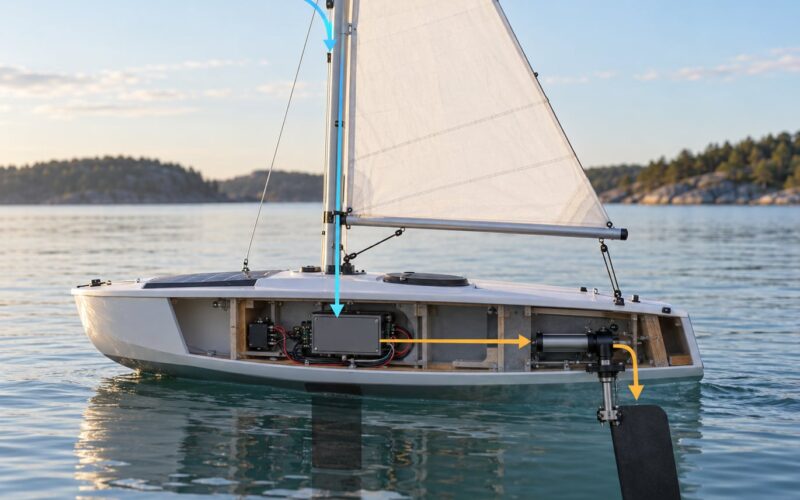
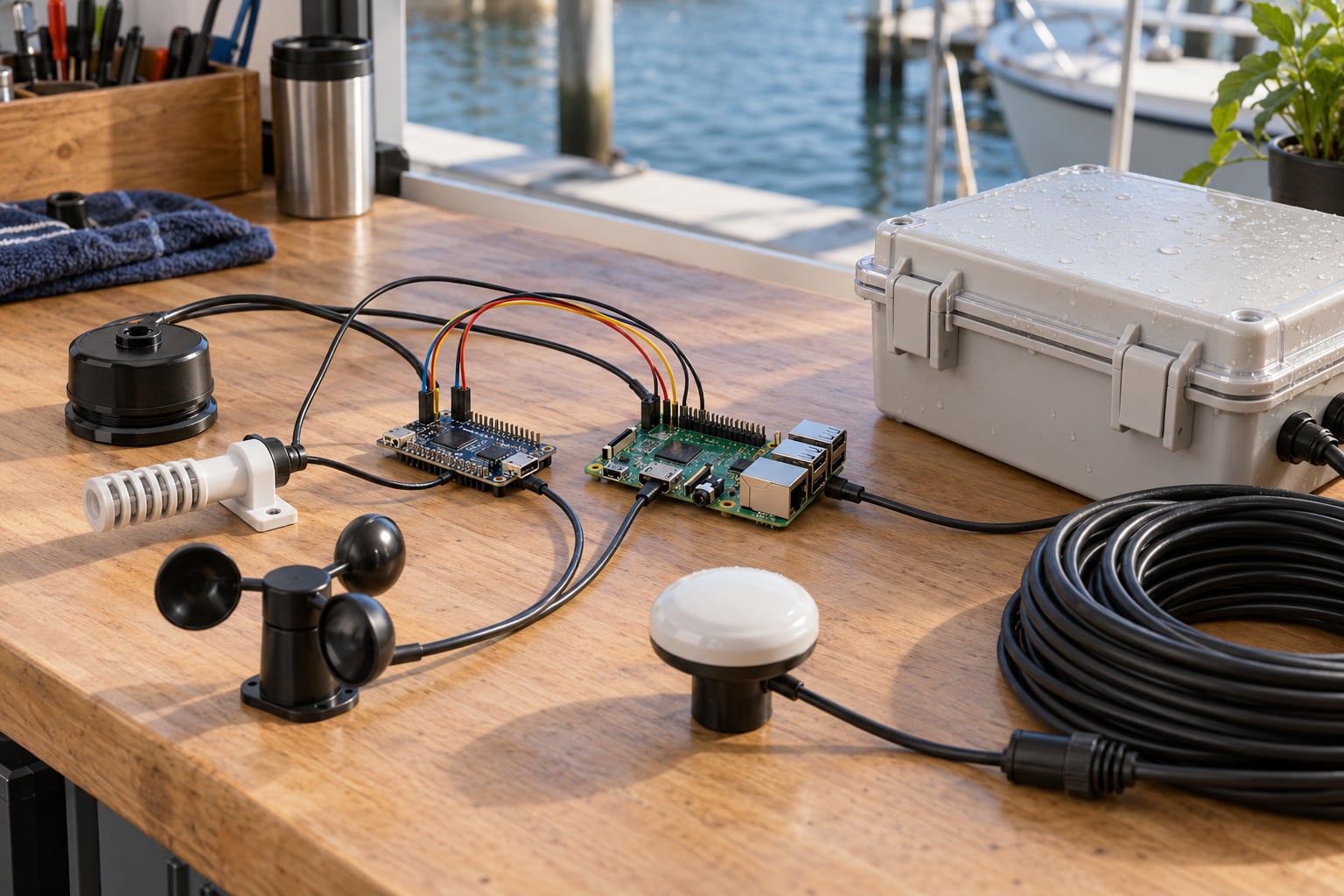
Yes, and this is the standard boat architecture. The microcontroller owns the hardware: sensors, relays, encoders, actuator pulses, and the watchdog that keeps everything honest. The Pi owns everything above it: Signal K, OpenPlotter, Node-RED dashboards, logging, internet access and remote alerts.
The handoff between them is deliberately boring. Send serial data from the node to the Pi over USB, UART or a differential RS-485 link, framed as NMEA 0183 sentences if you want to stay inside the marine ecosystem, or as MQTT over WiFi if the node is remote and the data is less critical. A geofence alert or a bilge float does not need to be instant, and a sensor node on the mast should send data over radio rather than run a cable through the shrouds.
Two integration details trip up nearly everyone. First, the voltage levels: most classic Arduinos run 5V logic, the Pi’s GPIO is 3.3V and not 5V tolerant, as noted repeatedly on allaboutcircuits. Use a level shifter or wire the Arduino pin through a divider, and never feed 5V into a Pi GPIO pin. Second, the relay question from earlier, which applies to both sides of the link.
Give the node its own watchdog timer and give the Pi a hardware watchdog or an external relay that cuts its power. The goal is a system that recovers from a hang without anyone sailing out to it.
Which Should You Choose?
Choose an Arduino or ESP-class board when the job is timing-critical, battery-constrained, or has to keep working untouched for weeks. That covers wind sensors, engine monitors, tank level sensing, bilge switches, actuator control and any NMEA 2000 node.
Choose a Raspberry Pi when you need a screen, storage, networking or the marine software ecosystem. That covers chartplotters, Signal K servers, Node-RED dashboards, logging, LTE reporting and anything that has to be comfortable to configure from a phone.
Choose both when the boat has more than one job on it, which is most boats. The sensor node stays small, cheap and boring while the Pi does the thinking.
Choose an ESP32 when the node needs CAN, WiFi and low power in one package, which is a lot of what a modern standalone NMEA 2000 sensor actually is. It is the answer most comparison articles skip, and on a power budget it is frequently the right one.
And keep steering, bilge, fire and engine shutdown functions off hobby hardware entirely, or at minimum never on a single path.
Frequently Asked Questions
Why use Raspberry Pi instead of Arduino on a boat?
You use a Raspberry Pi when the job is about information rather than timing: a chartplotter display, a Signal K or OpenPlotter server, data logging to storage, or remote access over WiFi or LTE. Linux gives you networking, a filesystem and a huge library ecosystem, none of which exist on a microcontroller. The Pi still cannot guarantee microsecond I/O timing, so it should not drive steering or actuator pulses directly.
Can a Raspberry Pi do everything an Arduino can on a boat project?
Nearly, but not quite. A Pi can drive relays, read sensors and run a dashboard, so a single-board solution is possible for a simple install. What it cannot match is deterministic timing and instant restart, and it has no built-in analog inputs. A project that only counts a tank level and sends a text alert can live on a Pi alone; one that drives an actuator or must recover from a power cut with no network should use a microcontroller.
Which is better for a beginner building a boat monitoring system?
An Arduino-class board is easier to begin with, because one sketch does everything and there is no operating system to maintain or recover. Start by reading one sensor and printing to a serial monitor. Add a Raspberry Pi later, once you have a working node and want charts, logs or phone alerts. Beginners coming from a Raspberry Pi background usually find the Arduino learning curve gentler than the reverse.
Is Arduino basically C++?
Yes, with a layer of convenience on top. Firmware is compiled C++, run through an IDE that hides library paths, board definitions and the upload step, and that is why sample code for a sensor usually compiles on the first try. Newer boards also run MicroPython, so the language is not a hard requirement any more. On a Raspberry Pi you can use Python, C, Node.js or whatever fits the job, which is a large part of the platform difference.
What is the difference between NMEA 0183 and NMEA 2000 support?
NMEA 0183 is simple serial text, sent over RS-232 or RS-485 at 4800 baud, and both platforms handle it easily. NMEA 2000 is a CAN bus network using differential signalling, which is harder to tap into without a gateway. On hobby hardware the documented route is an ESP32 with the ttlappalainen NMEA 2000 library, or a Pi with a CAN HAT, either one feeding Signal K on the Pi.
How do you protect an Arduino or Raspberry Pi from saltwater corrosion?
Enclose the board, do not coat the connectors. A sealed enclosure with a desiccant pack, cable glands instead of open holes, and connectors you can unplug for inspection will protect it far better than any bare board. Add conformal coating on the board if you are hand-wiring it, and check the IP rating before you trust a box in a cockpit. Keep at least one spare board aboard, since a failure offshore is otherwise a boat-side problem.
Conclusion: Start With the Boat’s Control Requirements
Decide what the hardware has to do before you pick the hardware. Anything that pulses, counts or has to be awake and answering a millisecond after power returns belongs on an Arduino or ESP32. Anything that stores, displays, networks or alerts belongs on a Raspberry Pi. Boats that do both get both, wired together over serial or radio.
On the Arduino vs Raspberry Pi for boat projects question specifically, the microcontroller is the boat’s nervous system and the Pi is its bridge to the shore. Build the nervous system first, prove it works in a bucket on the dock, then give it something to talk to.