You pick a battery for a solar powered boat by working backwards from the energy your boat actually uses, not forward from a catalogue. List every load in watts, multiply by hours per day to get watt-hours, divide by your system voltage for amp-hours, then divide by your safe depth of discharge and multiply by your days of autonomy. Everything else — chemistry, voltage, weight, protection — follows from that number.
The whole process takes an evening of paperwork and one weekend of testing. Skip the load audit and you end up with a bank that is either too small to finish a passage or so heavy it ruins the boat’s handling.
Table of Contents
- What You Need: How to Pick a Battery for a Solar Powered Boat
- Step-by-Step
- Frequently Asked Questions
- How do I know what battery I need for my boat?
- What type of battery is best for solar power?
- What size solar panel do I need to charge a marine battery?
- Can I use a car battery for starting a boat?
- Do I need a separate starting battery when solar is the main charging source?
- Is it safe to put a lithium battery on a boat?
- Conclusion
What You Need: How to Pick a Battery for a Solar Powered Boat
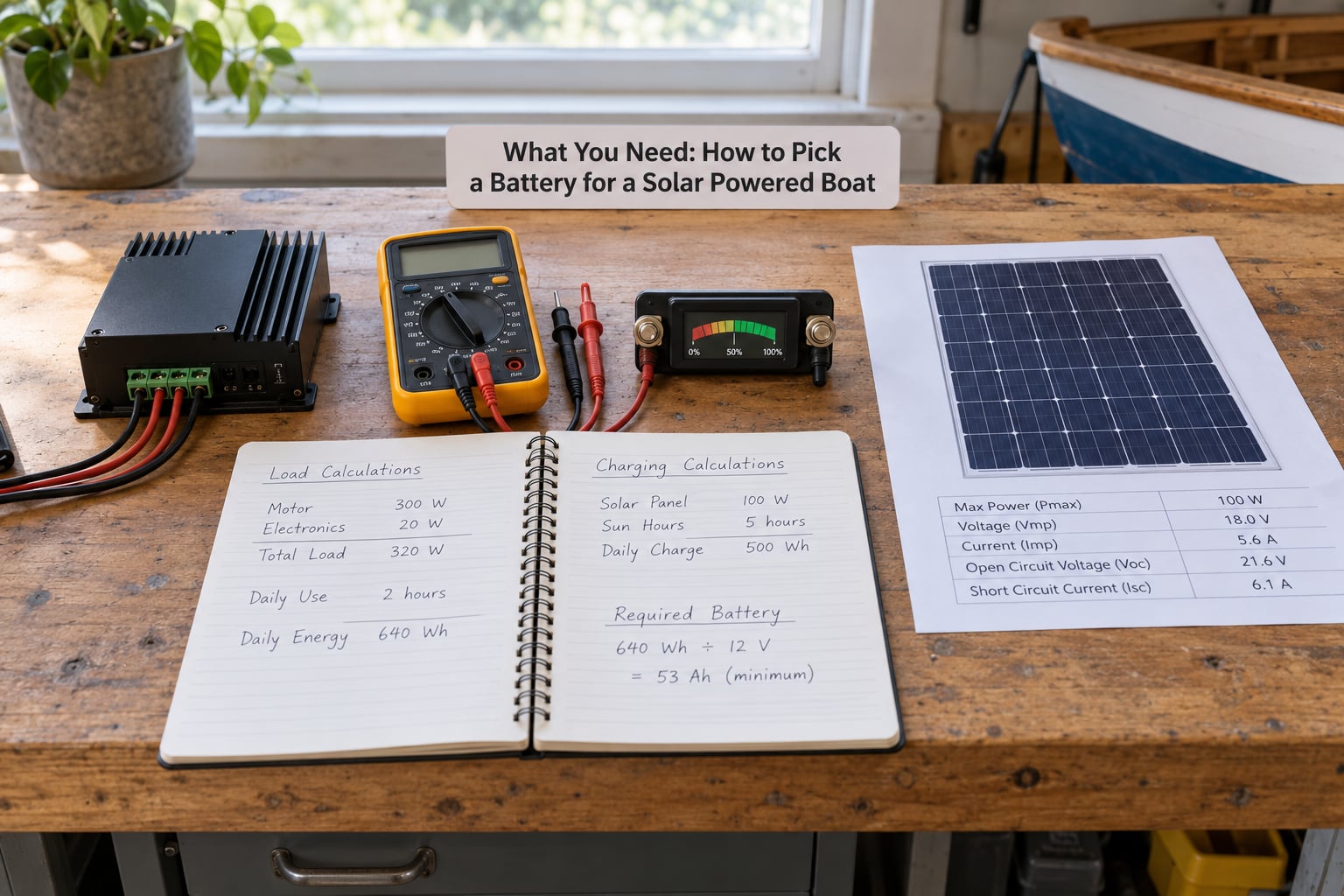
Gather the following before you look at a single battery. Without them, any recommendation is guesswork.
- Average loads: the running wattage of electronics, lighting, sensors, communications, refrigeration, and any inverter-fed AC load.
- Peak loads: the highest current a device can draw, especially motor startup and compressor start.
- Motor specifications: rated current, surge current, and the controller’s voltage window.
- Solar panel output: nameplate watts, and the real peak-sun hours your cruising latitude gets.
- Usable capacity rules: the depth of discharge your chosen chemistry tolerates day after day.
- Weight budget: how many kilograms of battery your displacement and freeboard can absorb without shifting the centre of gravity aft.
- Runtime target: hours per day and the number of sunless days the boat must carry alone.
- Charging equipment: the charge controller, alternator rating, and any shore charger you plan to carry.
- Marine environment: salt spray or freshwater, freezing winters, summer heat, vibration, and where the battery box sits.
Nominal capacity and usable capacity are not the same number, and the gap is where most sizing mistakes happen. A 200 Ah lead-acid bank gives you roughly 100 Ah you can use without shortening its life. A 200 Ah LiFePO4 bank gives closer to 160 Ah. A charge controller with low headroom, warm cells, and long cable runs take a further bite. Design on the usable figure, not the label.
Step-by-Step
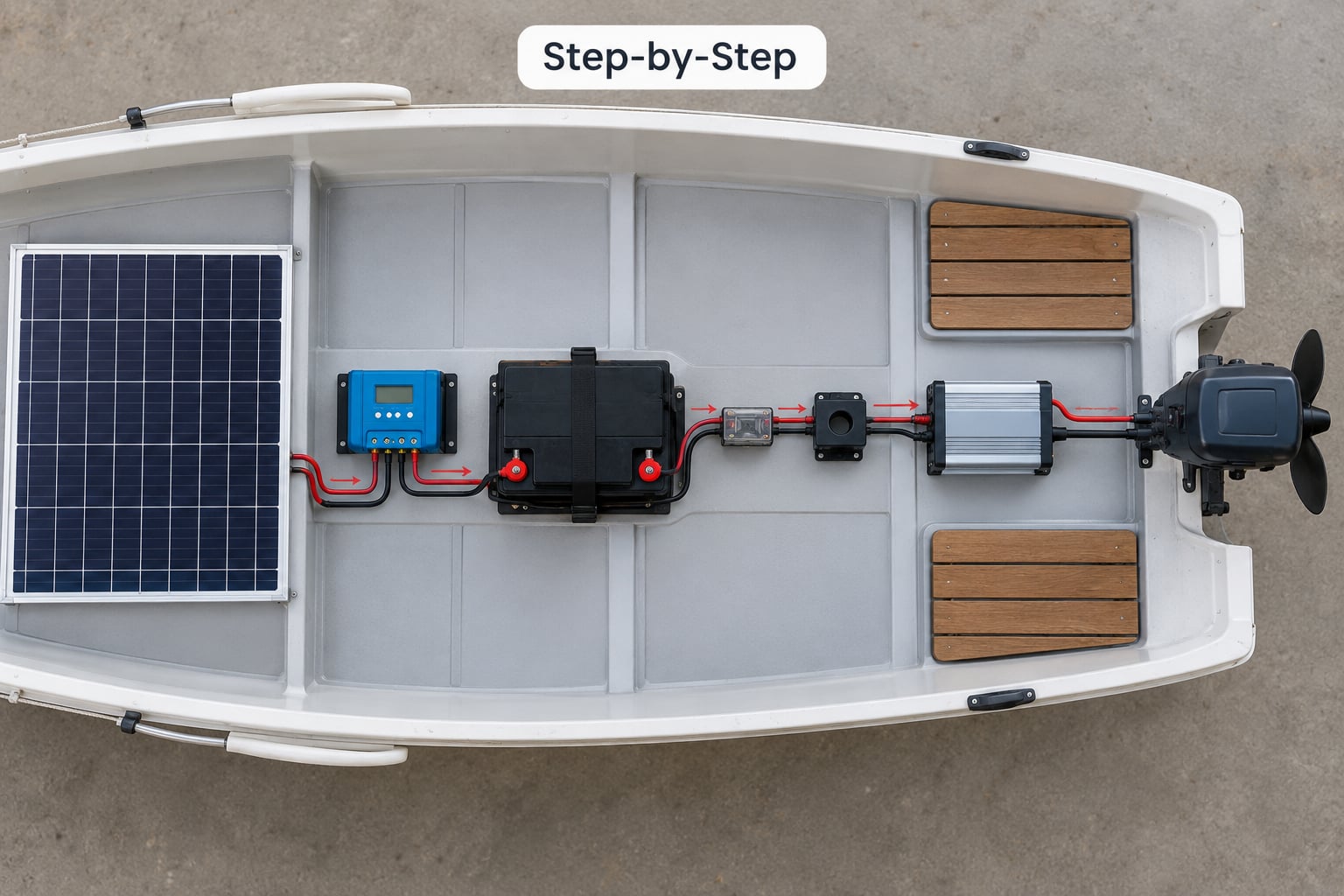
Six steps, each with a result you can check. Stop and fix a step before moving on, because every later number depends on it.
How to Pick a Battery for a Solar Powered Boat by Calculating Load
Build a load table. For each device, write the running watts, the hours it runs per day, and the watt-hours. Then sum.
| Load | Watts | Hours/day | Wh/day |
|---|---|---|---|
| Navigation electronics | 5 | 24 | 120 |
| Cabin and deck lighting | 8 | 4 | 32 |
| Refrigeration (average draw) | 25 | 8 | 200 |
| Instrument and radio charging | 15 | 3 | 45 |
| Cabin blower | 12 | 2 | 24 |
| Phone and laptop charging | 20 | 2 | 40 |
| Daily total | — | — | 461 |
That is a small 27-foot sailboat on a summer weekend, roughly 460 Wh per day. On a 12 V bank, divide by 12 to get about 38 Ah per day. Now add the peak: a motor or compressor can pull three to five times its running current for a second or two, and a 200 W compressor starting on a weak bank will trip its low-voltage cutoff. Size the bank so peak current still holds voltage above cutoff for the seconds it takes the device to start.
Three numbers turn 38 Ah per day into a real capacity: a depth-of-discharge allowance of 0.5 for lead-acid or 0.8 for LiFePO4, and a days-of-autonomy figure. A weekend cruiser with a reliable alternator can carry two days; a solar-only passage boat needs five or more. For lead-acid, 38 × 3 ÷ 0.5 = 228 Ah, so a 230 Ah bank or three Group 31s in parallel. For LiFePO4, 38 × 3 ÷ 0.8 = 143 Ah, so two 100 Ah cells in parallel, or three if you want margin for a cloudy week.
For a trolling motor the same table collapses into one line: runtime in hours = usable Ah ÷ motor amps. A 100 Ah LiFePO4 at 80% usable running a motor at 20 A gives about four hours; the same battery at 10 A gives roughly eight. Owners on r/boating report a budget 100 Ah LiFePO4 easily running a 45 lb thrust Minn Kota for a full day, which fits — the motor’s actual draw, not its thrust rating, decides the runtime.
Match Battery Capacity to Solar Charging Time
A bank can only be as large as your array can refill. Divide the daily watt-hour demand by your realistic peak-sun hours, add controller and wiring losses, and you get the minimum array wattage.
Using the 460 Wh example: at 3 usable peak-sun hours a day and 75% controller efficiency, 460 ÷ (3 × 0.75) ≈ 205 W. Round that up to a 200 to 400 W array depending on latitude and how often you expect grey skies. At 4 peak-sun hours the same demand needs about 155 W. Trawler Forum cruisers report a useful real-world anchor: 2,720 W of installed panel producing roughly 10 kWh on a good day, about 3.7 kWh per kilowatt, which is the honest number to plan against rather than nameplate watts.
Shading, angle, soiling, and long hot days near the equator can all cut a realistic figure by 20 to 40%. A dock with a mast in the way at 10 AM is not a solar resource. Match the charge controller’s rated current to the array, not the other way round: a 400 W array wants a controller that can pass at least 15 A at 12 V, and a controller that clips current is wasted panel.
Compare Battery Chemistry, Voltage, and Capacity
Lead-acid, AGM, gel, and LiFePO4 all work. They differ most in usable depth of discharge, weight per watt-hour, cold charging, and how much care they need.
| Chemistry | Usable depth of discharge | Specific energy | Cycle life | Maintenance |
|---|---|---|---|---|
| Flooded lead-acid | About 50% | 30-40 Wh/kg | 300-500 cycles | Water checks, venting, terminal care |
| AGM | About 50% | 30-40 Wh/kg | 400-700 cycles | Sealed, still needs clean terminals |
| Gel | About 50% | 30-40 Wh/kg | 500-900 cycles | Sealed, sensitive to overcharge |
| LiFePO4 | About 80% | 90-140 Wh/kg | 2,000-5,000 cycles | Sealed, BMS handles balancing |
That usable-depth column is why a 200 Ah LiFePO4 bank does the work of a 320 Ah lead-acid bank at a third of the weight. On a 13-foot boat where every kilogram counts, that is the whole argument. On a displacement cruiser with space to spare and budget pressure, AGM is a reasonable compromise.
Charging setpoints are where lithium systems get hurt. A quality charger or controller should push about 14.4 to 14.6 V into a 12 V LiFePO4 bank for absorption and settle around 13.4 to 13.6 V in float. Lithium does not need equalisation, and equalising a lithium bank at 15.5 V is a way to cook it. Lead-acid wants its full 14.4 V absorption and 13.6 V float, and a charger that never reaches 13.5 V will quietly undercharge an AGM bank — a leading cause of early failures. Below freezing, most LiFePO4 banks refuse a charge unless they have self-heating.
System voltage has to match the motor, the controller, and the inverter as one system. Most small boats run 12 V, 24 V starts to show up on larger cruising boats and halves the current for the same power, and 48 V appears on serious electric builds mainly because 48 V alternators, inverters, and DC-DC converters are off the shelf. ABYC’s E-11 covers DC systems up to 60 V, with E-31 addressing high-voltage propulsion; Trawler Forum discussion of residential 300 to 660 V banks on boats centres on exactly that limit. Group case sizes are physical: Group 24, 27, and 31 describe footprint, and a Group 27 simply holds more amp-hours than a Group 24 in the same slot count.
Check Weight, Protection, and Marine Conditions
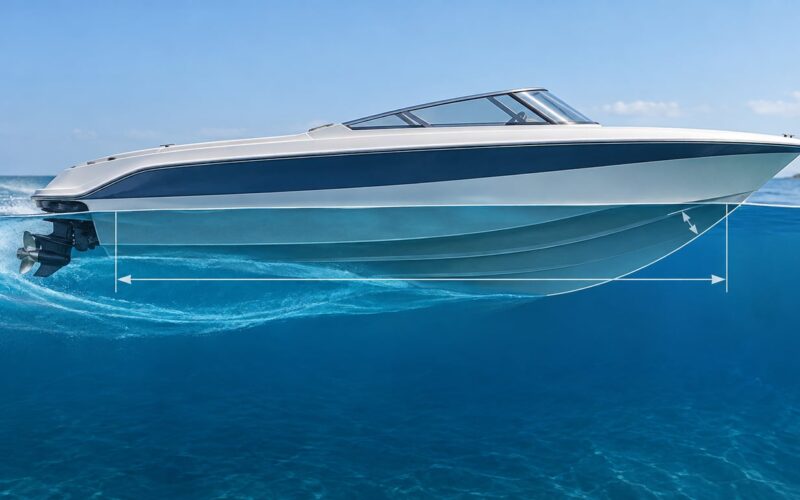
Batteries are the densest and heaviest thing you will install. Put 60 kg low and aft on a small hull and the boat handles badly, soffles in a chop, and loses freeboard. Place the bank low and near the centreline, inside a compartment that keeps it out of the sun, and recheck stability after installation rather than before.
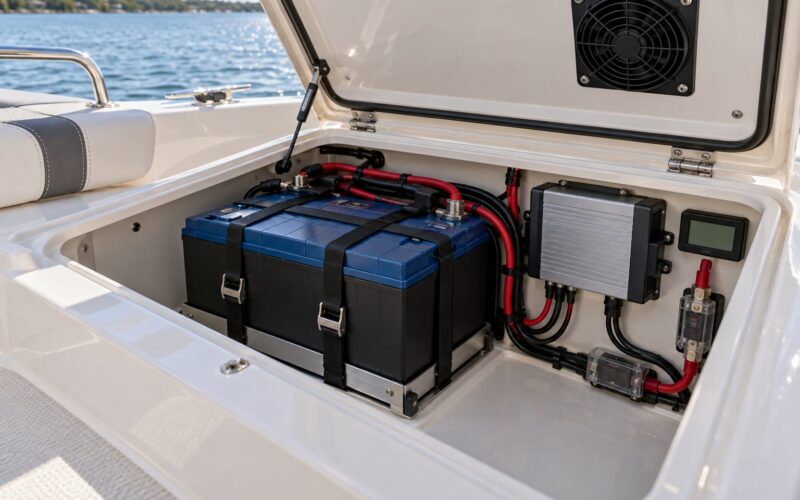
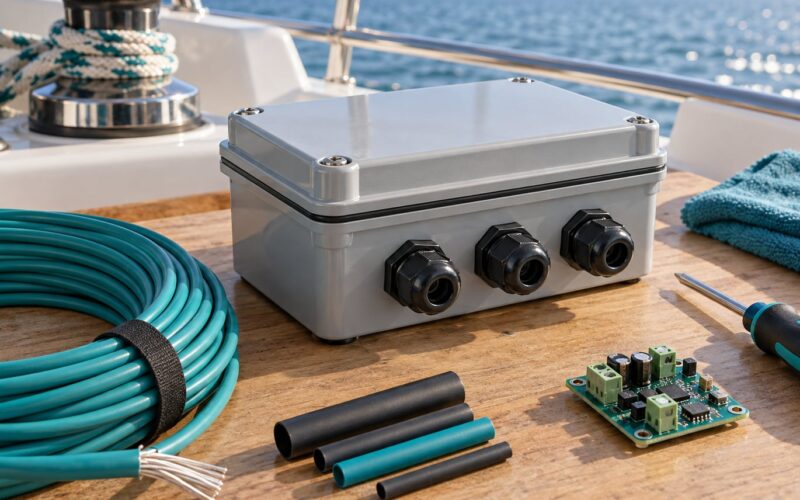
Marine conditions are more abrasive than most buyers expect. Salt spray attacks terminals and bus bars, constant vibration works loose connections, and water ingress kills a cell faster than any chemistry choice. Ask for a sealed case with an IP67 or better enclosure rating, corrosion-resistant terminals, and a tray that contains any release. Never rely on a battery box alone for containment: flooded cells need a controlled path for gas, and a LiFePO4 bank needs a battery management system with overcharge, over-discharge, over-temperature, and short-circuit protection.
Wiring is where cheap systems fail. Use marine-grade cable, size it from the length of the run rather than the nameplate current, fuse each battery at the terminal within a few centimetres, install a disconnect that is reachable from outside the compartment, and torque the terminals to the manufacturer’s figure. A short circuit on an unattended boat is a fire, and the fuse is the only thing standing between a fault and a hull.
Validate the Battery Before Building
Test before you commit. A full charge acceptance test confirms the bank takes energy in: charge to the manufacturer’s absorption voltage, hold it, then measure the resting voltage after twelve hours — a healthy 12 V LiFePO4 bank rests near 13.2 to 13.6 V, a healthy AGM near 12.6 to 12.8 V.
Next, watch it under load. Start the largest motor and log the voltage at the bank and at the motor terminals while the controller is running; a healthy system may sag 0.5 to 1.0 V across the run, more if the cable is undersized. Then verify the behaviour that matters most: does the low-voltage cutoff open cleanly and reconnect when charge returns, or does it cut out erratically under load? Erratic cutouts usually mean an undersized bank, not a faulty battery.
Run the boat for a full day and log the state of charge at the same clock times. Compare the measured depletion against your load table. If the bank drains faster than predicted, the error is nearly always in the load audit or in idle loads you forgot — a bilge pump cycling on a failed float switch can quietly add 100 Wh a day. Correct the numbers and resize before the boat goes anywhere.
Common Mistakes
- Choosing by watt-hours alone. Watt-hours say nothing about surge current or weight. Add the peak load and the chemistry’s usable depth.
- Ignoring peak motor current. Startup current trips low-voltage cutoffs on banks that size fine on paper.
- Using an array that cannot refill the bank. A 200 Ah bank behind 50 W of panel falls further behind every day.
- Underestimating usable capacity. Designing to 50% on a lithium bank wastes half the money; designing to 80% on flooded lead-acid kills it.
- Ignoring weight and centre of gravity. The bank that fits the budget may not fit the hull.
- Mismatched chemistry or voltage. A 24 V bank with a 12 V controller, or lead-acid equalisation on lithium, causes real damage.
- Omitting fuses and disconnects. A short on an unattended boat has no second chance.
- Undersized cable. Voltage drop under load starves the motor and makes a bank look faulty.
- Charging lithium below freezing. Without a self-heating BMS the cells will not accept charge, and some will be damaged.
- Testing without protection. Break a lead loose during a test with no fuse and no gloves and you have a serious burn or a spark in a fuel locker.
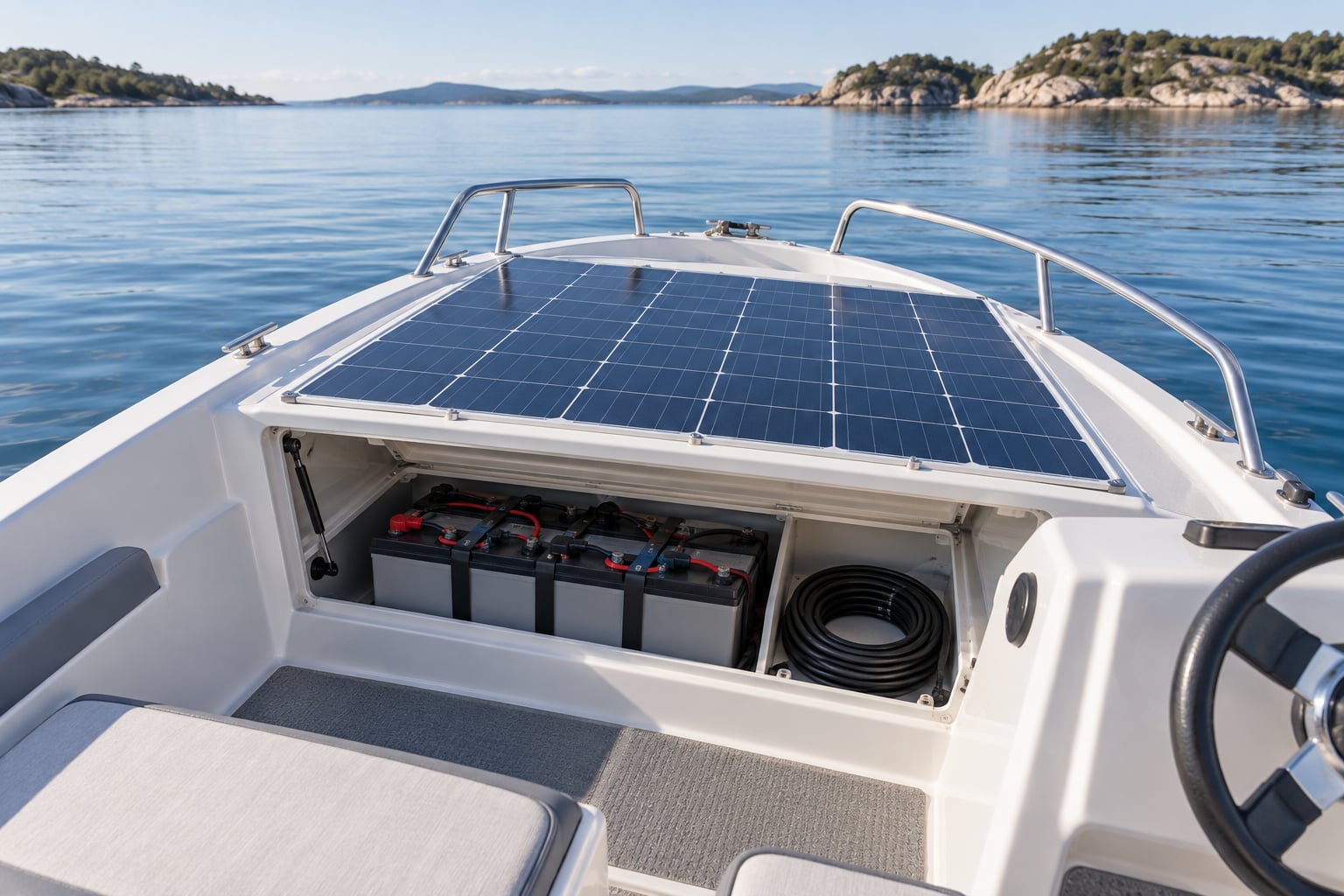
Two practical tips. Route solar to the house bank and keep the engine start battery separate, because a house bank drained to nothing will not crank an engine reliably — r/boating owners describe solar on the cranking battery as trickle charge, useful for topping up but not a substitute for a full charge. And for off-season storage with no shore power, a small panel sized to deliver at least a trickle, a controller with a storage or periodic refresh function, and monthly voltage checks will do more for battery life than any battery choice.
Frequently Asked Questions
How do I know what battery I need for my boat?
List every load in watts, multiply by hours per day, and sum the watt-hours. Divide by your system voltage for amp-hours per day, then divide by the safe depth of discharge for the chemistry and multiply by your days of autonomy. For 12 V lead-acid use 0.5, for lithium iron phosphate use 0.8. Add a reserve for cloudy weather and you have your bank size.
What type of battery is best for solar power?
Lithium iron phosphate is the current default for a solar boat bank: roughly 80% usable capacity, two to three times the cycle life of lead-acid, and about a third of the weight for the same usable energy. Lead-acid remains a sensible budget choice where weight is not a constraint and budget matters more. Gel and AGM sit between the two, sealed and tidy but limited to about 50% depth of discharge.
What size solar panel do I need to charge a marine battery?
Divide your daily watt-hour demand by your realistic peak-sun hours, then add 20 to 30% for controller and wiring losses. A boat drawing 460 Wh per day at three usable peak-sun hours needs about 205 W, so a 200 to 400 W array is the practical range. Shading, panel angle, and grey-day frequency push the number up. Panel nameplate watts are not guaranteed energy.
Can I use a car battery for starting a boat?
A car battery will crank most marine engines, but it is the wrong tool. Car batteries use thin lead plates built for a brief high-current burst, not for deep discharge, so repeated house loads ruin them quickly. For house or solar duty choose a deep-cycle or lithium iron phosphate bank. If you do fit a car battery as a starter, keep it separate from the house bank with a charge isolator.
Do I need a separate starting battery when solar is the main charging source?
On most boats, yes. A deep-cycle house bank accepts charge slowly and recovers poorly after a deep discharge, so it may not crank an engine reliably even when it reads full. Keep the engine start battery separate and let solar, the alternator, and a charge isolator handle it. On an electric-propulsion boat with no engine, that whole question disappears.
Is it safe to put a lithium battery on a boat?
It is, when the system is built for it. Choose a bank with a battery management system covering overcharge, over-discharge, temperature, and short circuit, mount it in a contained tray, vent the compartment for any gas, fuse it at the terminal, and give it a disconnect reachable from outside. Do not charge lithium below freezing unless the BMS has a self-heating function, and confirm the installer follows the battery and charge controller manufacturer limits.
Conclusion
Start tonight with a load table. Add up the watt-hours, divide by your system voltage, divide by a realistic depth of discharge, and multiply by the number of sunless days you want to survive. That single number tells you the bank size, and your panel output tells you whether the bank can be refilled.
Everything after that is refinement: pick the chemistry that fits your weight budget and your climate, match the voltage across motor, controller, and inverter, and treat the battery manufacturer’s charging limits as hard boundaries rather than suggestions.