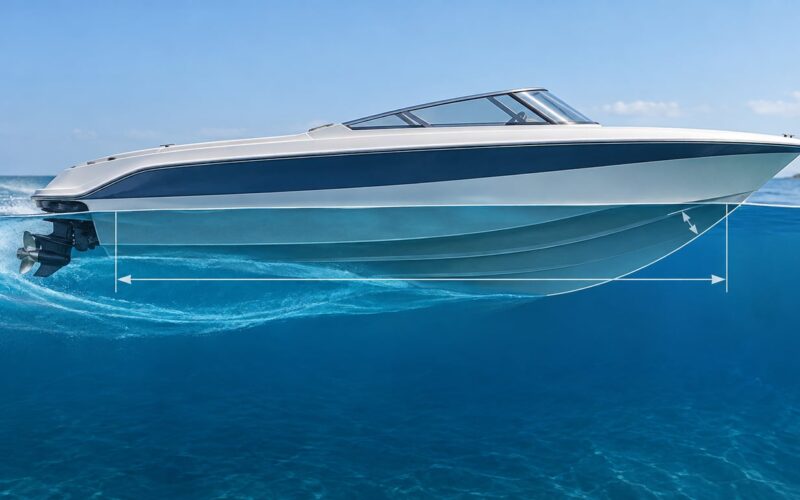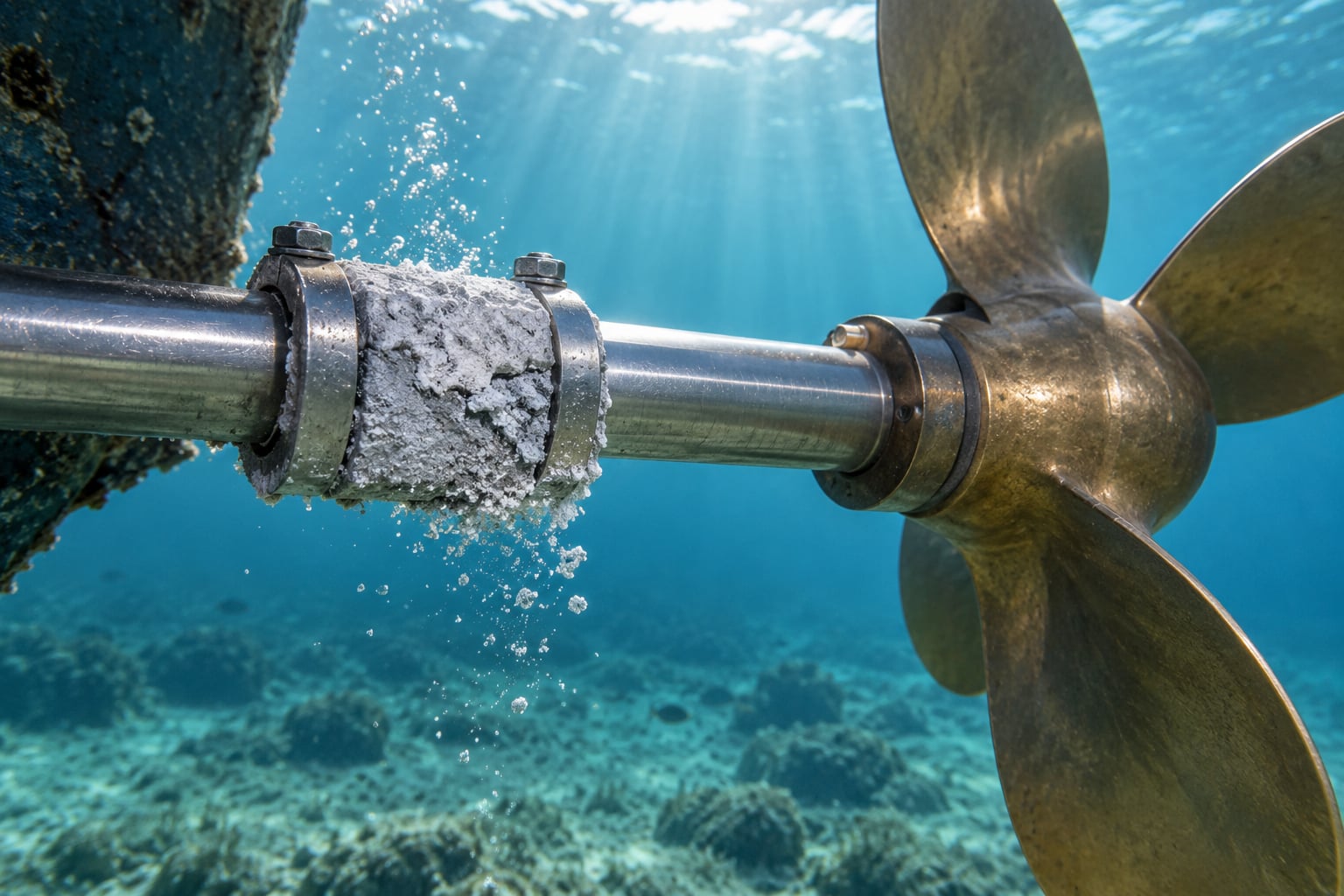
A sacrificial anode is a chunk of metal that corrodes on purpose so the metal you care about does not. Bolted to a steel hull, propeller shaft or buried pipeline and sitting in the same water or soil, it forms a galvanic cell: the more reactive anode dissolves, releases electrons into the steel, and holds that steel at a negative potential where iron corrosion cannot start.
The part most people miss is that the protection is entirely passive. There is no power supply, no controller and no monitoring. The anode eats itself at whatever rate the environment demands, and your job is simply to notice before it runs out. That is the whole mechanism, and the rest of this guide is about the chemistry behind it, the materials involved, and how to tell whether yours is still working.
Table of Contents
- What Is a Sacrificial Anode and What Does It Do?
- How Sacrificial Anodes Work: The Electrochemistry Step by Step
- Why the Connection and Wetted Surface Matter
- Zinc, Aluminum, Magnesium, and Other Anode Materials
- Where Sacrificial Anodes Are Used on Boats and Marine Equipment
- How to Tell When an Anode Has Done Its Job
- How Often Sacrificial Anodes Need Replacement
- Installation and Electrical Safety Considerations
- Can Sacrificial Anodes Stop All Marine Corrosion?
- Frequently Asked Questions
- Do sacrificial anodes protect the entire boat?
- Why is my sacrificial anode corroding but the propeller is not?
- Is a magnesium anode always better than zinc or aluminum?
- How often should sacrificial anodes be inspected or replaced?
- Can sacrificial anodes prevent rust inside a boat?
- What happens if a sacrificial anode is wired incorrectly?
- Conclusion
What Is a Sacrificial Anode and What Does It Do?
A sacrificial anode, also called a galvanic anode, is a block, rod or plate of metal deliberately more reactive than the steel it is attached to. It corrodes in place of that steel. Common shapes include the flat zinc bars bolted along a propeller shaft, the hexagonal plugs screwed into an outdrive, and the segmented collars clamped around a buried pipeline.
The protected metal is always ferrous — iron or steel. Magnesium, aluminium and zinc anodes are worthless on their own; their entire purpose is to sit electrically connected to something made of iron and become the more noble partner in the circuit.
The formal name for the effect is cathodic protection. Forcing the structure to act as the cathode, where oxygen reduction happens instead of metal dissolution, is far more reliable than trying to keep corrosion away with coatings alone. Paint fails; an anode keeps working after the paint is gone.
How Sacrificial Anodes Work: The Electrochemistry Step by Step
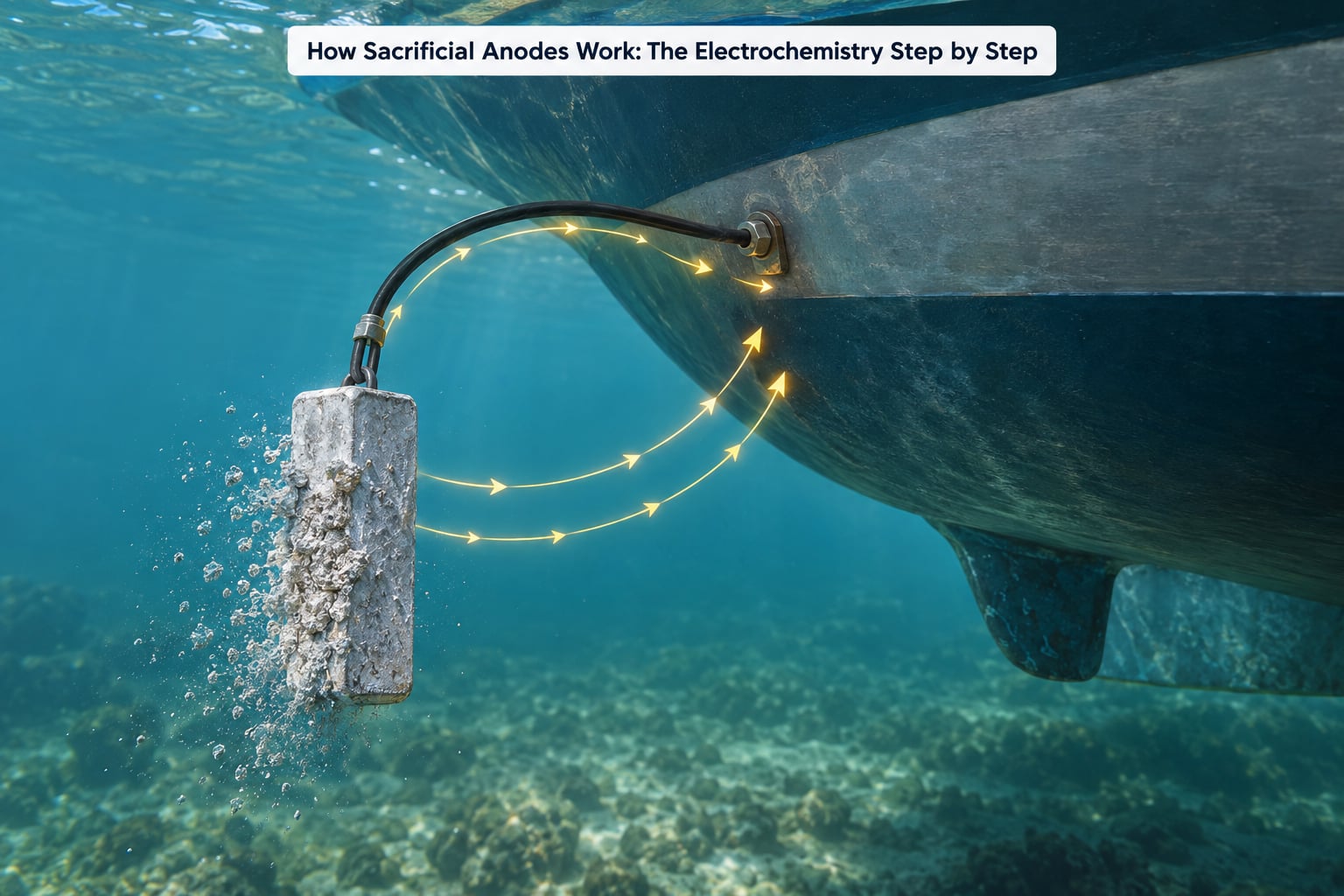
Everything reduces to two metals with different electrochemical potentials sharing one electrolyte. In seawater that electrolyte is obvious. In buried pipelines it is damp soil, and in a domestic water heater it is the hot water itself.
The sequence runs like this:
- A galvanic cell forms. The anode and the steel are electrically bonded and both sit in the same electrolyte, completing a circuit through metal, water and back again.
- The potential difference drives current. Magnesium sits near -2.37 V and iron near -0.44 V against the standard hydrogen electrode, a gap of roughly 1.9 V that pushes electrons one way only.
- The anode oxidises and dissolves. Metal atoms at the anode lose electrons, enter the water as positive ions, and physically leave the block. The anode is now measurably smaller.
- The steel is driven cathodic. Those electrons flow into the steel and neutralise the anodic reaction there, so instead of iron dissolving, dissolved oxygen is reduced and the surface stays intact.
Two separate paths have to stay open for any of that to happen. The electron path is metal: a bolt, a wire, a clamp or a stud. The ion path is fluid: seawater, freshwater or moist soil connecting the surfaces. Break either one and the cell is open, which is why a bolted-on block in a dry bilge protects nothing at all.
Because the anode dissolves, the process self-regulates. Current demand rises when the water is warmer or more conductive, the anode supplies more, and protection stays roughly constant until the metal is gone.
How Sacrificial Anodes Work in Salt Water
Seawater is close to an ideal electrolyte. Its conductivity is high, its chloride content keeps anodic reactions active, and it never lets a surface sit in the stagnant, low-oxygen state that quietly kills a buried anode.
On a boat the division of roles is clean. The anode is deliberately expendable metal. The hull, shaft and propeller are cathodes held at a negative potential. Salt water carries positive ions away from the anode and supplies the dissolved oxygen that gets reduced at the steel.
Warm brackish water is the nastiest case. Conductivity is still high enough to drive the cell, but there is less dissolved oxygen than in open ocean, so anodes can be consumed in a single season rather than over a year.
Why the Connection and Wetted Surface Matter
The most common reason an anode does nothing is not the wrong alloy. It is that the circuit is broken. An anode needs a low-resistance metallic path to the structure and a continuous liquid path to the same structure.
Paint and fouling are the usual culprits. An anode accidentally coated in antifoul, or a shaft anodes clamped onto where the coating carries all the way through the contact patch, is electrically isolated from the steel. Biofouling on the anode face plays the same role: the working area shrinks and consumption slows to a trickle.
Trapped air works against you too. An anode sealed inside a dry plastic tube, or mounted where a pocket of air isolates it from the surrounding water, has no ion pathway. This is the single most misunderstood point on the whole subject, and it explains a lot of frustration in boat forums: an anode that looks untouched after a season is usually not disabled, it is disconnected.
Isolation from other dissimilar hardware matters for a different reason. An aluminium outdrive bolted straight to a steel shaft with no galvanic isolator creates its own cell, and that cell steals most of the available current. Adding a sacrificial anode to the pair is not a fix; it just changes which piece gets eaten. Fix the bonding first.
Zinc, Aluminum, Magnesium, and Other Anode Materials
Three materials do almost all the work. Magnesium offers the biggest driving voltage, aluminium offers far more capacity per kilogram, and zinc sits in between as the traditional marine choice. Magnesium is not automatically the best answer — it is the most aggressive, and that aggressiveness causes its own problems.
| Material | Typical alloy | Potential vs SHE | Capacity | Best environment | Main limitation |
|---|---|---|---|---|---|
| Magnesium | AZ31 or AZ63 alloy | about -2.37 V | Low; heavy per amp-hour | High-resistivity soil, low-conductivity freshwater, tank interiors | Overprotection can drive hydrogen into steel and disbond coatings |
| Aluminium | KA90 aluminium-zinc-tin | about -1.1 V | High, around 2000 Ah/kg | Seawater, offshore structures, large surfaces | Passivates below roughly 1446 ppm chloride, so it dies in fresh water |
| Zinc | Zinc-aluminium-copper | about -0.76 V | Moderate, around 780 Ah/kg | Saltwater boats, hulls, shafts, propellers, rudders | Low driving voltage means it stalls in high-resistivity or poorly conductive water |
Two behaviours explain most real-world failures. Aluminium forms a thin, adherent oxide film; in water with less than about 1446 ppm chloride that film seals the surface and consumption nearly stops, which is why an aluminium anode in a lake can look brand new after two summers. Zinc does something similar in water that is too cold or too fresh to carry enough current.
Magnesium is the opposite failure. Its driving voltage is so high that it keeps pushing current past the point the steel needs, generating hydrogen at the surface and stripping protective coatings off the structure. In buried pipelines, where the anode is buried alongside rather than touching the pipe, engineers deliberately use high-resistance backfill to throttle the current.
Where Sacrificial Anodes Are Used on Boats and Marine Equipment
On a typical shaft-driven boat, anodes bolt to the exposed section between the stuffing box and the propeller. Two zinc bars are common practice, positioned so they are fully wetted at rest and fully submerged under way. Many builders mould a sacrificial anode into the propeller hub itself, which protects the shaft, the hub and the fasteners in one part.
Outboards and stern drives take threaded plugs on the gearcase and lower unit. Sailboats commonly use a zinc anode on the rudder stock and one on the keel shoe, because the prop is often feathering or lifting clear of the water most of the time and needs no help.
Then there is the seawater-cooled side of things. Exhaust manifolds, heat exchangers and cooling passages in marine engines and generators corrode from the inside where nobody looks, and a small anode in the cooling circuit is the standard defence.
Offshore and moored equipment follows the same logic at larger scale. Platform legs, risers, wellheads and storage tank interiors all carry sacrificial anodes sized to the seawater flow around them. Protective anodes are also fitted to subsea structures such as pipeline pig receivers and monopile foundations.
That last category matters for anyone building or deploying ocean hardware. A moored sensor buoy, an AUV or an ROV sitting on the seabed is a small steel island surrounded by seawater, with dissimilar metals, connectors and a mooring chain in the same water. Adding sacrificial anodes to the frame and the mooring chain is inexpensive protection against exactly the failure that ruins a deployment: a corroded pin or connector that lets water in.
How to Tell When an Anode Has Done Its Job
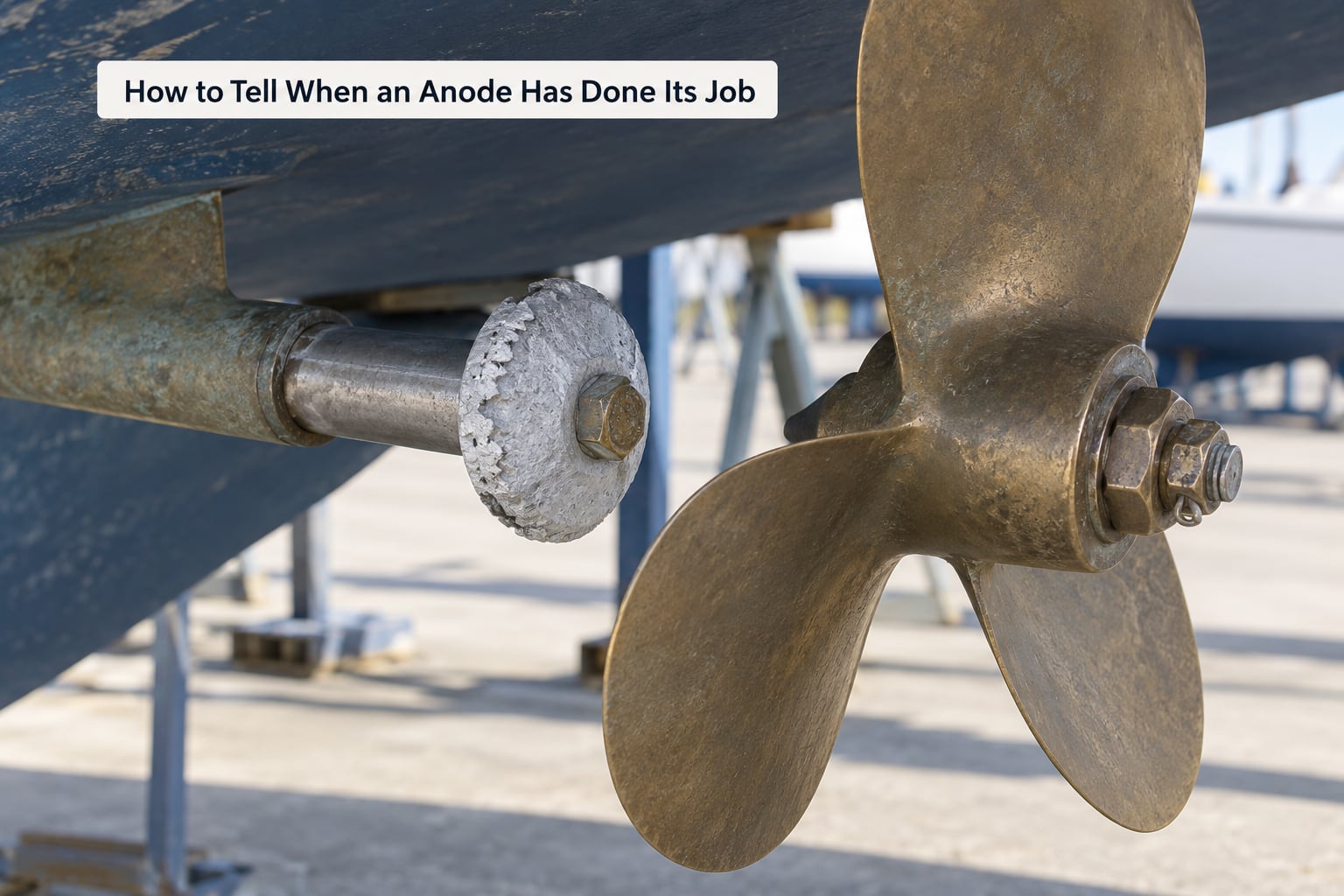
A working anode does not vanish. It erodes slowly and unevenly, usually from the outer edges and corners inward, and the faces where it bolts to the structure stay recognisably intact.
The field rule most owners use is to replace at roughly 50 percent consumed. That is deliberately conservative. Once half the mass is gone, the remaining area has shrunk, the current distribution across the surface changes, and you have little margin left if the boat sits unattended for a month.
Look for four things during inspection:
- Loss of the original shape. A new zinc bar has square edges. A half-consumed one looks like a slowly melted block with a waisted middle.
- A bare, bright attachment face. When the coating or passivation layer has been eaten back to raw metal around the bolt, the anode is well past its useful life.
- Rust stains on the structure. Orange-brown weeping around the bolt pad means corrosion has started on the steel itself, which should not happen while the anode is doing its job.
- Uneven wear with the structure still pitting. Partial protection points to undersizing or a coating holiday, not to a healthy anode.
A sudden drop between inspections is worth investigating rather than just replacing. Heavy protective growth, an exposed attachment area, or an anode on the wrong side of a strut where water flow starves it all point to consumption being pulled onto a small remaining surface.
Check anodes in the cradle when the boat is out, and always with the propeller shaft turned so you can see the full face. Divers inspecting anodes underwater should treat any exposed attachment hardware as a pinch and shear hazard, and should confirm the boat is isolated from shore power before working near any bonded equipment.
How Often Sacrificial Anodes Need Replacement
There is no universal interval. It depends on how much bare metal is exposed, how conductive the water is, and how long the boat sits between checks. Treat these as starting points for a boat in ordinary service rather than guarantees.
| Situation | Typical check interval | Watch for |
|---|---|---|
| Boat kept in salt water, used regularly | Every 6 to 12 months | Fast edge rounding in warm months |
| Boat in salt water, lightly used or stored | Twice a year | Anode intact but structure staining at the mount |
| Boat in fresh water only | Annual | Zinc barely consumed; consider switching material |
| Warm brackish or estuary water | Every 3 to 6 months | Single-season consumption; anodes may need doubling up |
| Buried pipeline or seabed structure | Per operator survey schedule | Localised attack near the anode itself |
| Moored sensor buoy or AUV mooring | Each deployment turnaround | Chain and connector wear at the attachment points |
The factors that speed consumption up are consistent: higher salinity, higher water temperature, more exposed bare metal, faster vessel speed creating turbulence and aeration, and a large difference in surface area between anode and structure. Coatings work in the same direction, since a well-coated hull with an over-large anode keeps the current near the anode and consumes it locally.
The most-cited number in boat-owner threads is simply that anodes are cheap compared with a propeller or a shaft. That framing is correct, and it is why the field rule is to err toward replacing early rather than stretching the interval.
Installation and Electrical Safety Considerations
Installing a sacrificial anode is simple, but the sequence matters. Follow the boat builder’s or equipment manufacturer’s instructions for the anode position and fastener torque, since those details are specific to the hardware.
- Clean the contact surface. Scrape or grind the steel under the anode to bright metal, and do it again if the surface is pitted.
- Bond directly. Bolt the anode to bare steel, or use the supplied wire and lug where the design calls for a remote connection. Confirm continuity with a multimeter if the connection is hidden.
- Keep the ion pathway open. Leave every wetted face exposed, and never paint or antifoul the anode.
- Install fasteners last. Replace the original bolts, never reuse zinc fasteners, and torque them to spec so the pad stays in contact as the anode erodes.
- Place for even distribution. Position the anode so current spreads over the structure rather than concentrating at one edge.
On electrical safety, a sacrificial anode is not an electrical device and carries no meaningful voltage on a boat. The real hazards are adjacent. Bonding a zinc anode directly to an aluminium outdrive keeps the drive as the anode and accelerates it, so galvanic isolators exist for a reason. Isolators work by preventing the unwanted current path; adding a sacrificial anode to solve an isolation problem is treating the symptom.
Handle spent anodes sensibly. Zinc and aluminium are mild in bulk but not to leave in an enclosed bilge or near galvanic couples in a wheelhouse, where stray fragments can become their own small cells. Magnesium in particular reacts with water and produces hydrogen, so keep it away from standing water and follow the supplier’s handling notes. A magnesium anode landing on a rusty steel deck can throw hot sparks, a thermite reaction that has burned holes in decks.
Can Sacrificial Anodes Stop All Marine Corrosion?
No. Cathodic protection handles general corrosion on a well-connected, well-exposed surface and does it well. It does nothing about several other mechanisms that attack boats and marine structures.
Crevice corrosion and pitting occur in shielded gaps where the anodic surface is not large enough to supply the demand, which is why anodes can look healthy while a coating holiday underneath still pits.
Stray-current corrosion comes from a nearby DC source, shore power earth leakage or an improperly wired system, and can be far more aggressive than galvanic corrosion. Anodes can also shield a structure from stray currents without removing the hazard.
Mechanical damage — abrasion from a trailer, grounding, a dragged chain or a grounding strike — removes metal no anode can put back. Coating failure under a shrinking anode leaves an unprotected patch. Corrosion fatigue and stress-corrosion cracking act on loaded components where the anodic surface area is tiny relative to the load.
Galvanic isolators, proper coatings, sound electrical bonding and regular physical inspection remain the supporting cast. The anode is the cheapest layer, not the only one.
Frequently Asked Questions
Do sacrificial anodes protect the entire boat?
No. An anode only protects metal that is electrically connected to it and sits in the same water, so it covers the shaft, prop and nearby hull rather than the whole boat. Paint, isolated fittings and crevices stay unprotected. Cover the rest with sound coatings and a galvanic isolator to break unwanted current paths.
Why is my sacrificial anode corroding but the propeller is not?
That is the system working, provided the prop is connected. The prop is the cathodic member held at a negative potential, so iron corrosion cannot start on it. Most metals are nobler than the anode, so bronze, aluminium and steel all sit on the protected side. Persistent attack on a prop usually points to a bad bond or a missing isolation, not to a weak anode.
Is a magnesium anode always better than zinc or aluminum?
No. Magnesium has the highest driving voltage, around -2.37 V, which makes it useful in high-resistivity soil and low-conductivity fresh water where zinc stalls. In seawater that extra force causes overprotection, generating hydrogen at the steel surface and stripping protective coatings. Aluminium has higher capacity but passivates below about 1446 ppm chloride. Match the material to the water and the structure.
How often should sacrificial anodes be inspected or replaced?
Boat anodes in salt water are usually checked at least annually, and every six months in warm brackish water or after heavy use. Replace at roughly 50 percent consumption rather than waiting until the block is a wafer, since the remaining area shrinks and current distribution worsens. The widely used field rule from boat owners is simple: if the shape has changed noticeably, change the anode.
Can sacrificial anodes prevent rust inside a boat?
Only inside sealed tanks holding an electrolyte, where the anode is submerged and bonded, such as a hot water storage tank. A dry bilge or an enclosed engine space has no ion pathway, so a bolted-on anode does nothing there. Rust above the waterline is a ventilation and coating problem instead. For below-waterline corrosion on the outside, use anodes mounted on the structure.
What happens if a sacrificial anode is wired incorrectly?
A loose, corroded or painted connection opens the circuit, and the anode stops protecting anything while looking perfectly normal. The usual cause is an oxide film or leftover coating under the bolt pad, so clean to bright metal and confirm continuity with a multimeter. Wiring the anode straight to an aluminium outdrive instead of the steel structure simply makes the outdrive the sacrificial part.
Conclusion
Do three things. Work out what ferrous metal each anode is meant to protect and confirm it is still electrically bonded to it. Check consumption at every haul-out and swap the anode out at roughly half its original mass rather than when it looks finished. Then match the material to the water around it, so magnesium does not overprotect your hull and aluminium does not quietly passivate in fresh water.
Keep the anode wetted, unpainted and uncoated. Almost every mystery failure in the field traces back to one of those three conditions being broken.