Hull displacement is the weight of a boat, and by Archimedes’ principle it is exactly equal to the weight of the water the submerged hull pushes aside. That single relationship explains why a loaded workboat sits deeper than the same hull empty, why a heavy cruiser is steady in a seaway, and why no hull can outrun its own mass. Once you know a boat’s displacement you can predict its draft, its realistic top speed, how much it can carry and how it will behave when you load it up.
Most confusion on this topic comes from one word doing two jobs. Displacement is a weight, measured in pounds, kilograms or tonnes, and never in litres or cubic metres. The volume of water pushed aside is a different measurement, and conflating the two is how people end up arguing past each other on forums. This guide sorts the two out, works through a real number, and shows where displacement sits alongside the other figures on a spec sheet.
Table of Contents
- What Is Hull Displacement?
- How Is Hull Displacement Measured?
- What Is the Difference Between Displacement and Volume?
- Why Does Hull Displacement Matter for Boats?
- How Much Displacement Does a Boat Need?
- How Do Displacement, Tonnage, and Draft Relate?
- What Happens When a Boat Is Overloaded?
- Frequently Asked Questions
- What is hull displacement in simple terms?
- How do I calculate the displacement of a boat?
- Is displacement measured in pounds, kilograms, litres, or cubic metres?
- What is the difference between displacement tonnage and volume tonnage?
- How much weight can a boat carry based on displacement?
- Does a lightweight boat always have better displacement?
- Conclusion
What Is Hull Displacement?
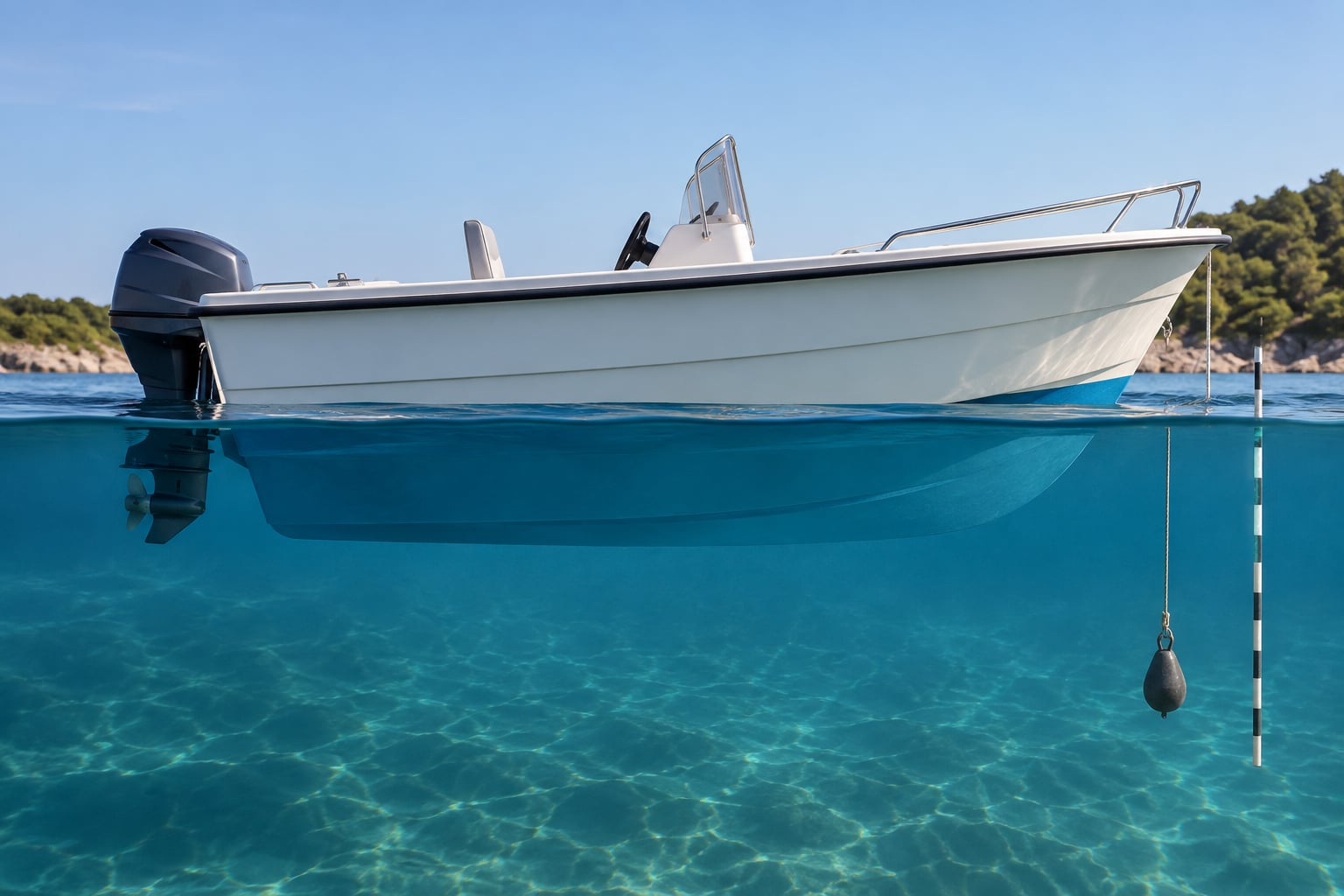
Hull displacement is the total weight of a boat, and by Archimedes’ principle it is exactly equal to the weight of the water the submerged part of the hull displaces. A 4,000 kg boat floating in seawater pushes aside 4,000 kg of water, which occupies roughly 3.9 cubic metres of underwater volume. The boat settles at the depth where the water it moves aside weighs exactly as much as the boat does.
Buoyancy is the upward force a fluid pushes back on a submerged body. Archimedes’ principle states that this force equals the weight of the fluid displaced, which means a floating vessel is always in balance: the water pushes up with the force of the volume it has moved aside, and that force cancels the vessel’s weight at exactly one draft.
Load a crate into the boat and the total weight rises, so the hull must move more water to balance, so it sinks deeper. Take the weight out and it rises. Hull shape changes nothing about that rule. As one experienced builder put it on a design forum, a hull displaces only what it weighs, so if you add weight to a box barge it simply sits deeper.
One rule of thumb carries most of the weight of this article: a hull displaces exactly what it weighs, no matter what shape the hull is. Shape only changes how much underwater volume that weight requires, and therefore how deep the boat floats and how much resistance it makes at speed.
Displacement is never a single number attached to a boat. It is always tied to a stated loading condition, so a spec sheet figure means very little until you know whether it is light, loaded or at full load.
- Lightship displacement is the weight of the bare vessel with its hull, structure, machinery, permanent equipment and permanent ballast, but no fuel, no water and no people.
- Deadweight is everything you can load on top: fuel, fresh water, provisions, crew, passengers, stores, tools and cargo.
- Loaded or full-load displacement is the sum of the two, and it is the figure that matters for draft, stability and speed.
Two vessels with the same hull can carry very different numbers, which is why a boat quoted at 3,000 kg light might float deeper than a smaller hull quoted at 3,200 kg light once both are fully loaded.
How Is Hull Displacement Measured?
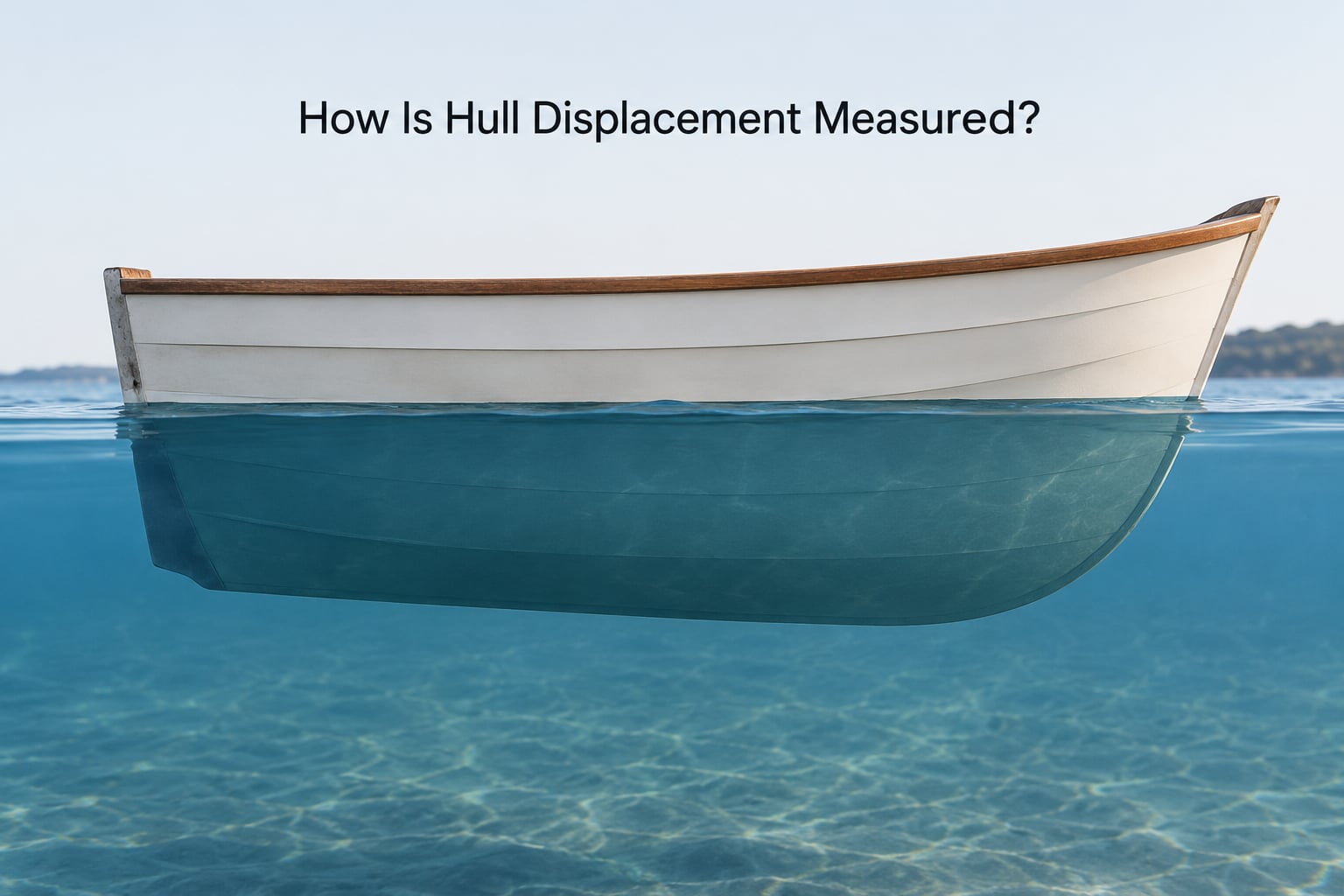
Hull displacement is measured by weighing the boat, not by measuring the hull, and the calculation is a conversion rather than a measurement. The formula is simple enough to do in your head once you know the two numbers it needs.
Displacement volume equals displacement weight divided by water density. Using seawater at 1,025 kilograms per cubic metre and fresh water at 1,000 kilograms per cubic metre, a 4,000 kg vessel displaces about 3.90 cubic metres in salt water and 4.00 cubic metres in fresh water.
Worked backwards, if you know the underwater volume in cubic metres, multiply by the water density to get the weight. Multiply by 1.025 in the ocean, by 1.000 on a lake or river.
Here is a realistic example for a 30 foot (9.1 m) express cruiser, using typical figures for a boat of that size and type rather than any one manufacturer’s published numbers. Assume the water is seawater at 1,025 kilograms per cubic metre throughout.
- Start with lightship displacement. A 30 foot express cruiser commonly carries roughly 3,900 kg of hull, structure, engines and permanent gear.
- Add deadweight. Two people, a week of provisions, 200 litres of diesel, 100 litres of water and the safety and deck equipment come to about 1,700 kg all told.
- Add them together. Loaded displacement is 3,900 kg plus 1,700 kg, giving 5,600 kg, which is 5.6 tonnes or about 12,350 pounds.
- Convert to displaced volume. 5,600 divided by 1,025 gives 5.46 cubic metres of underwater volume at rest.
- Check it against the waterline length. A displacement of 5.6 tonnes on a hull with a 28 foot (8.5 m) waterline gives a displacement-to-length figure that sits in the normal band for a cruiser of this size, which is a useful sanity check that the weights add up.
Multiply that volume by the seawater density again and you are back where you started, which is the whole point: the two numbers describe the same thing from opposite directions, and only one of them is a weight.
The practical measurement methods differ by boat type. For anything with a published spec sheet or a builder’s model data, the displacement comes from the design hydrostatics: the naval architect computes the immersed volume at each draft from the hull form, and the mass curve that results gives displacement against draft directly. Small craft are far simpler, because the capacity plate on the transom carries both a maximum gross or hull weight and a maximum person count, and a careful owner can weigh the boat, subtract known equipment and work back to a usable figure. Trailerable boats are usually weighed on a scale at the trailer manufacturer or at a weigh station, with the trailer and gear accounted for separately.
Why the Measure You Quote Matters When Comparing Hull Displacement
Unit confusion is the single most common error on this topic, and it is easy to make without noticing. A 5,600 kg boat does not displace 5,600 litres, and a boat quoted in pounds has not been quoted in pounds of water. A lot of forum argument dissolves once people write the number with its measure attached.
Converting between the systems is straightforward. One tonne is 1,000 kilograms, roughly 2,205 pounds. Ten tonnes is 10,000 kilograms or about 22,050 pounds. In volume, one cubic metre is about 35.3 cubic feet, and 4,000 kilograms of seawater occupies roughly 3.9 cubic metres, or about 138 cubic feet. If a builder lists displacement in one system and a reviewer quotes it in another, convert before comparing, because the apparent difference is usually a unit artefact rather than a real one.
Two rules keep this honest. Always state the water density assumption alongside the number, because a figure quoted for fresh water and a figure quoted for salt water for the same boat are genuinely different. And always state the loading condition, because light displacement and full-load displacement for the same boat can differ by 40 percent or more.
What Is the Difference Between Displacement and Volume?
Displacement is the weight of the vessel, while displacement volume is the amount of water pushed aside, and they are related by the density of the water. Mixing the two is the most common misreading on a spec sheet, so it is worth being precise about which is which.
Three different volumes get confused in boat literature. The enclosed volume is all the space inside the moulded hull up to the top of the deck, whether or not any of it is underwater. The immersed or submerged volume is only the part below the waterline, and that is the volume responsible for buoyancy. The displaced volume is the same underwater volume expressed as a liquid measurement, which is why it changes with water density while the enclosed volume never does.
| Measurement | What it is | What it is measured in | What it does not tell you |
|---|---|---|---|
| Displacement (weight) | The mass of the vessel in a stated loading condition | Tonnes, kilograms, pounds | How deep the hull sits, or how fast it can go |
| Displacement volume | The underwater volume of the hull, expressed as water | Cubic metres, cubic feet, litres | How much the vessel weighs on its own |
| Enclosed volume | All space inside the moulded hull to the deck | Cubic metres, cubic feet | Whether the boat is loaded or empty |
| Reserve buoyancy | The buoyant volume above the waterline, held in reserve | Cubic metres, percentage of total | How much weight the boat can safely add |
The reserve buoyancy line is the one most readers have never seen explained. Any hull has more enclosed volume than it is currently using, and that spare volume is what keeps a boat afloat when a wave buries the deck or when somebody puts a rock through the bottom. A planing hull at rest uses a small share of its enclosed volume, because most of the hull is lifted clear of the water, which is why such boats carry a lot of reserve. A full displacement cruising hull runs much deeper and uses a far larger share.
None of these three numbers is a substitute for the others, and a boat listing three of them is giving you three different facts. Displacement tells you the mass. Displaced volume tells you how much water the hull is standing in. Enclosed volume tells you how much space the designer had to work with, and it feeds the regulatory tonnage figures covered later in this guide.
Why Does Hull Displacement Matter for Boats?
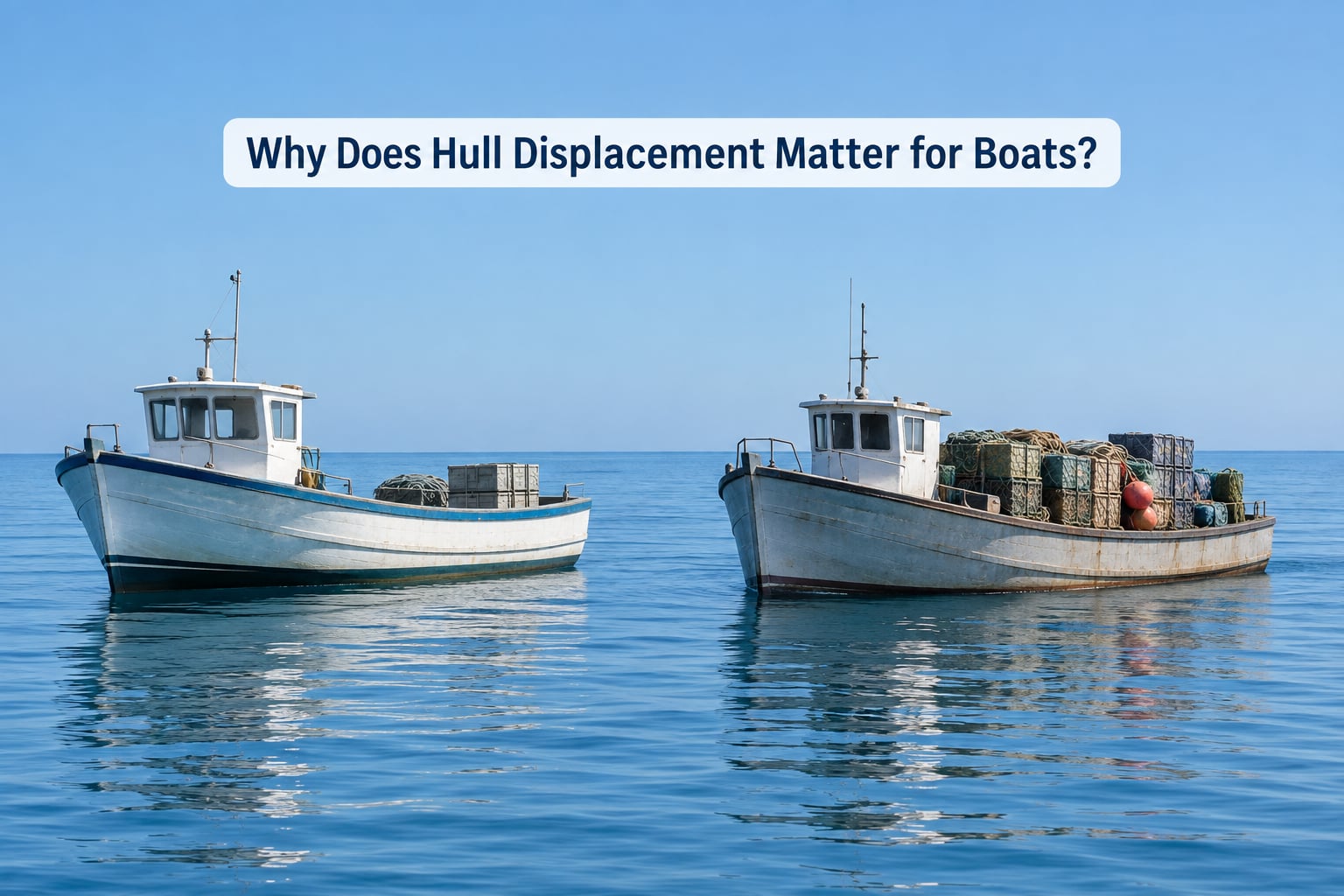
Displacement matters because almost every performance number a boat produces follows from the mass the hull has to carry. Six consequences follow directly from that mass, and each one is measurable.
1. It sets your realistic top speed
A displacement hull cannot be pushed arbitrarily fast. As speed rises, the bow and stern waves it generates grow steeper, and at a certain point they dominate the resistance until more power adds almost no speed. The practical limit is close to a hull speed of 1.34 times the square root of the waterline length in feet, in knots.
For a 28 foot (8.5 m) waterline, that is 1.34 times the square root of 28, which comes to about 7 knots or 13 km/h. Most full displacement cruisers cruise in the 6 to 7 knot range, and long-legged racers with fine hulls push a little past it. A planing hull ignores this limit entirely, which is the entire point of its shape, but pays for it with far higher fuel consumption per mile.
2. It sets your acceleration and stopping distance
Moving 12 tonnes takes roughly four times the energy of moving 3 tonnes at the same speed. Heavier boats therefore start slower, carry more momentum when they do reach speed, and take longer and further to stop. In a sailboat, an extra half tonne of lead in the keel is a deliberate trade: it slows the boat down but stiffens it up and stops it heaving.
3. It drives fuel burn and range
Resistance grows steeply with speed, and every increment of mass adds more. A typical 12 metre motor yacht running at 25 knots might burn around 150 litres an hour, roughly 6 litres per nautical mile. A 10 metre displacement sailboat motoring at 7 knots might use about 12 litres an hour, closer to 1.7 litres per mile. The planing boat is four times faster and burns three to four times as much per mile, which is exactly why long-range passage making is done at displacement speeds.
4. It determines draft and freeboard
Draft is the depth of hull below the waterline, and it is the most visible symptom of displacement. A heavier hull sits deeper, eats into its freeboard, and needs a deeper berth, a taller bridge clearance and a shallower operating area. The same 5,600 kg cruiser would sit about 1 centimetre deeper in fresh water than in salt, which sounds trivial until your boat is already drawing close to a channel’s allowed depth.
5. It governs stability, though weight is not the whole story
More mass low in the hull raises the centre of gravity relative to the water and generally makes a boat stiffer and more settled in a seaway. A displacement hull also moves through wave crests slowly, so it absorbs less punishment than a light planing hull doing the same trip. But displacement on its own does not make a boat stable. A very heavy narrow boat with its weight piled high will be tender and uncomfortable, and beam, weight distribution and the position of the centre of gravity matter more than the headline number. Practitioners argue about this constantly, and the honest answer is that a well-shaped light boat and a badly proportioned heavy one can each disappoint.
6. It bounds how much you can load on board
Payload capacity is the difference between lightship displacement and full-load displacement, and it is a design figure rather than a suggestion. Once you close that gap you are no longer within the conditions the naval architect tested, and you are running on reserve buoyancy that was never meant to be spent. Weight also raises the centre of gravity when it goes in the cockpit rather than low in the bilge, which costs you the freeboard and the stiffness you just gained.
For a cruising sailboat, ballast is often 25 to 50 percent of displacement, and that ratio tells you how much of the boat’s mass is deliberately low down. For a planing motor yacht the figure is much lower, commonly 10 to 25 percent, because the hull shape is doing the work instead of the lead. Treat those as indicative ranges for cruising craft rather than rules, since the useful number depends entirely on hull form.
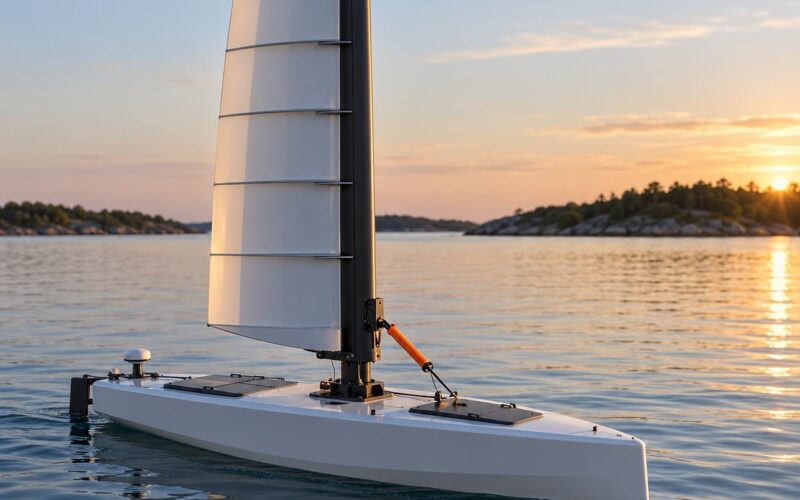
For autonomous platforms the same trade-off appears in a sharper form. A sensor buoy, an ROV or an ocean cleanup vessel carries its payload, batteries and buoyancy foam in one hull, and every kilogram added to the electronics is a kilogram that has to be carried through the water. A workboat designed around payload-versus-endurance is making exactly the same displacement calculation a yacht designer makes, with less tolerance for getting it wrong.
How Much Displacement Does a Boat Need?
The right displacement for a boat is the sum of five things: the hull itself, the machinery and permanent systems, the payload, the reserve buoyancy you want to keep in hand, and the margin for the conditions you will actually operate in. Estimate each one and add them up. That total is the displacement your design needs, and everything else about the boat follows from it.
- Hull weight. This is the single largest line item and the hardest to guess. Aluminium and composite hulls are lighter than steel or timber, and a deep-V planing hull weighs far more per metre than a fine displacement hull of the same length. If you have no builder data, the safest route is to ask the builder or the naval architect for the lightship figure, and it should be on the spec sheet or in the model data.
- Machinery and systems. Engines, gearbox, generator, batteries, solar, wiring, watertight bulkheads, heating and the electrical panel all sit in the displacement total. A boat with a large generator for hotel loads carries a lot more than an otherwise similar boat without one.
- Payload and consumables. People, water, fuel, provisions, tools, safety gear, spares and the scientific payload on a survey boat. Decide how long the boat will be away from a dock and size the tanks for that, not for the shortest possible trip.
- Reserve buoyancy. Decide how much spare volume you want above the waterline. Workboats and ocean-going craft need more reserve than a day boat, because a full displacement hull already runs with a high fraction of its volume submerged.
- An operating margin. Add 10 to 15 percent for the weight you will add after launch and forget to record, which on a converted or equipped boat is not a rounding error.
Once you have the total, the displacement-to-length ratio gives you a fast check. Divide displacement in tonnes by length overall in metres. Recreational craft run from roughly 0.2 for a light trailerable boat up towards 1.0 for a heavy displacement cruiser, with planing motor yachts clustering in the middle. A figure far above the band for the boat type you are designing usually means the estimate is wrong or the boat is over-equipped.
For small craft the same method still works with much smaller numbers. A 90 kg rowing shell needs a hull that will float that shell plus a rower, a pair of oars and a sensible margin, and the same arithmetic describes it exactly. Scale does not change the physics, only the tolerances you work to.
How Do Displacement, Tonnage, and Draft Relate?
Displacement, tonnage and draft all describe the same vessel from three different angles, but only two of them are weights. Confusing them is the second most common error on this topic after mixing weight and volume.
Draft is the easiest to connect to displacement because you can measure it. As weight goes up, the hull settles deeper along a curve set by its waterplane area, which is the underwater surface area at the waterline. A wide boat has a large waterplane and gains draft slowly as weight is added. A narrow boat has a small waterplane and gains draft quickly, which is why long waterline length and moderate beam usually mean a boat that tolerates heavy loading well.
Gross tonnage and net tonnage come from the International Maritime Organization’s convention on tonnage measurement. They are based on enclosed volume, they are dimensionless rather than weights, and they exist for regulatory and fee purposes. A vessel rated at 500 gross tonnage does not weigh 500 tonnes, and treating the two numbers as interchangeable is how a spec sheet ends up misleading a reader completely.
| Figure | What it measures | Unit | Typical use |
|---|---|---|---|
| Displacement | Weight of the vessel in a stated condition | Tonnes or pounds | Loading, draft, speed, stability |
| Displacement tonnage | The same weight expressed in tonnes | Tonnes | Traditional shipkeeping language |
| Gross tonnage (GT) | Enclosed volume under the IMO convention | No unit, dimensionless | Registration, fees, charter accounting |
| Net tonnage (NT) | Usable enclosed volume under the IMO convention | No unit, dimensionless | Freight and capacity comparison |
| Draft | Depth of hull below the waterline | Metres, feet, inches | Bridge clearance, berth depth, grounding |
For the technically inclined reader, the table that ties all of this together is the hydrostatic curve set, sometimes shortened to the hydrostatics. A naval architect plots displacement against draft, and alongside it centre of buoyancy, centre of gravity, metacentric height and waterplane area. Every loading question about a boat is answered by reading a position off those curves, which is why a serious design is never signed off on weight estimates alone.
Ballast to displacement ratio is the other number worth knowing, since it appears often in questions from sailors. It expresses the weight of ballast as a percentage of the vessel’s displacement, and for cruising sailboats it commonly falls between 25 and 50 percent, depending on how much the hull form is expected to carry. A high ratio means a stiff, motion-comforting boat that needs effort to power up; a low ratio means a responsive boat that will feel tender once the wind gets up. Treat those as typical ranges, not standards.
What Happens When a Boat Is Overloaded?
An overloaded boat is one whose displacement has moved past the condition its design was approved for, and the effects show up in a predictable order. The first thing to go is freeboard, because added weight pushes the hull deeper and eats the gap between the waterline and the deck edge.
From there the problems compound. Low freeboard means waves reach the deck, which means water comes aboard, which means more weight. Weight stowed high in the cockpit or on the foredeck raises the centre of gravity, so the boat becomes tender, rolls further and recovers more slowly, and the energy it needs to right itself increases sharply as the stability margin shrinks. Steering suffers next, because a deeper-immersed rudder works differently and the extra drag slows the boat through turns.
Structurally, the loads go up everywhere. Deck fittings, cleats, toe rails, handholds and the guardrails are all sized for a specific working load, and weight carried above the sheerline puts a bending moment into the hull that the original scantlings were never asked to handle. Add weight low in the hull and you gain some of that back, which is why a stowage plan matters more than most owners expect.
Performance suffers quietly. More wetted surface, more drag, higher fuel consumption for the same passage and slower acceleration out of a turn. If the boat is carrying more than her freeboard allows, she is also carrying less reserve buoyancy than the designer intended, which removes the margin that protects you in a heavy sea.
There are warning signs worth watching. A noticeably lower freeboard than you remember. A set of marks or a waterline stain on the hull showing the boat has been running lower. Water sitting in the cockpit after a passage. Deck gear that has started to look close to the water. A listing that returns to normal only after you move weight around. Any of those is a reason to redistribute the load low and forward of amidships where possible, and to reconsider the trip.
Frequently Asked Questions
What is hull displacement in simple terms?
Hull displacement is the weight of a boat, which equals the weight of the water the submerged hull pushes aside. A 4,000 kg boat displaces 4,000 kg of seawater, which fills roughly 3.9 cubic metres of underwater space. The hull settles at the depth where the water it moves weighs exactly as much as the boat does.
How do I calculate the displacement of a boat?
Take the boat’s weight in a stated loading condition and divide by the water density. In seawater, displacement volume in cubic metres equals weight in kilograms divided by 1,025. So a 5,600 kg cruiser displaces about 5.46 cubic metres of water at rest. If the weight is unknown, weigh the boat on a scale and add up fuel, water, gear and people.
Is displacement measured in pounds, kilograms, litres, or cubic metres?
Displacement is a weight, so it is measured in pounds, kilograms or tonnes. Litres and cubic metres measure volume, which is the water pushed aside, not the boat. Convert between them with the water density: about 1,025 kg per cubic metre in seawater and 1,000 kg per cubic metre in fresh water. One tonne is 1,000 kg, or roughly 2,205 pounds.
What is the difference between displacement tonnage and volume tonnage?
Displacement tonnage is simply the vessel’s weight expressed in tonnes, a real force that tells you draft, load capacity and speed potential. Volume tonnage, which includes gross and net tonnage, comes from the IMO convention and measures enclosed volume inside the hull. It has no unit and is not a weight, so a vessel rated at 500 gross tonnage does not weigh 500 tonnes.
How much weight can a boat carry based on displacement?
Usable capacity is the gap between lightship displacement and the full-load displacement the designer approved. On a 30 foot cruiser with a 3,900 kg lightship figure, the deadweight allowance is typically around 1,700 kg for people, fuel, water, provisions and gear. Load low in the hull, watch your freeboard, and treat the number as a design limit rather than a target.
Does a lightweight boat always have better displacement?
Not necessarily. A light boat is easier to push and accelerates better, but a heavier hull with its weight low sits deeper, moves more slowly through waves and holds its course more calmly. What matters is the ratio of displacement to waterline length, the position of the centre of gravity and how much of the hull is underwater at rest.
Conclusion
Hull displacement is the weight of a boat, and it is exactly equal to the weight of the water its submerged hull pushes aside. Everything practical follows from that one fact: how deep the boat floats, how much it can carry, how fast it can realistically go, how it behaves in a seaway and how much fuel it burns getting there. It is a weight, not a volume, and it is always quoted for a stated loading condition in a stated type of water.
Before you compare two boats, work out the loaded displacement for each one and check the ratio of that figure to waterline length. Before you load a boat, add up what is going aboard and compare it with the gap between lightship and full-load displacement, keeping the weight low. Before you design a small craft, a survey platform or a work vessel, do the same sum from the other direction, starting with the hull and building outwards, so you know how much payload the design can honestly carry before the batteries and the sensor stack are chosen. The physics is old and reliable, and it is the shortest route to sensible answers.