Use 316 stainless (A4) for anything that sees salt water, spray, or a permanently humid marine atmosphere, and use 304 (A2) only where the part stays dry and sheltered. The two grades look identical on the shelf, cost a similar amount of money, and both get sold as marine hardware, which is exactly why so much of it fails in the first season.
Most of the difference comes down to one alloying element. Adding 2 to 3% molybdenum to 316 changes how the passive surface film behaves when chloride ions attack it, and that single change is worth more than any other variable in a boat build.
Everything below is written for people who have to make the call: boat owners replacing seized hardware, fabricators welding instrument cases, and teams specifying sensor housings and fasteners for ocean robots.
Table of Contents
- 316 vs 304 Stainless for Marine Use at a Glance
- What Is the Difference Between 304 and 316 Stainless Steel?
- How Does Marine Saltwater Affect Stainless Steel?
- Where Is 304 Stainless Steel Still a Reasonable Choice?
- Where Does 316 Stainless Steel Make Sense for Marine Equipment?
- What About Welding, Machining, and Fabrication?
- How Do Cost and Availability Compare?
- Which Should You Choose?
- Frequently Asked Questions
- Conclusion
316 vs 304 Stainless for Marine Use at a Glance
| Criterion | 304 stainless (A2) | 316 stainless (A4) |
|---|---|---|
| Chromium | 18 to 20% | 16 to 18% |
| Nickel | 8 to 10.5% | 10 to 14% |
| Molybdenum | None | 2 to 3% |
| Maximum carbon | 0.08% (0.03% in 304L) | 0.08% (0.03% in 316L) |
| PREN | About 18 | About 24 |
| Behaviour in sea water | Pits quickly in standing or splashed salt water | Much slower to pit, but not immune, especially in crevices |
| Magnetism | Non-magnetic when annealed, slightly magnetic after cold work | Same behaviour, so a magnet tells you little |
| Tea staining on deck fittings | Common, looks like surface rust | Noticeably less, still not stain free |
| Welded fabrication | Fine, use 304L for weld decay resistance | Use 316L and ER308L filler, then passivate |
| Material cost | Lower | Premium, driven by molybdenum and nickel |
| Best fit | Dry interior, sheltered lockers, non-splash zones | Splash zone, deck hardware, sensors, below waterline |
PREN, the pitting resistance equivalent number, is a weighted formula that combines chromium, molybdenum and nitrogen into one figure. Anything near 18 will struggle in chlorinated water. Roughly 24 buys you far more margin, and about 35 is where duplex stainless starts.
What Is the Difference Between 304 and 316 Stainless Steel?
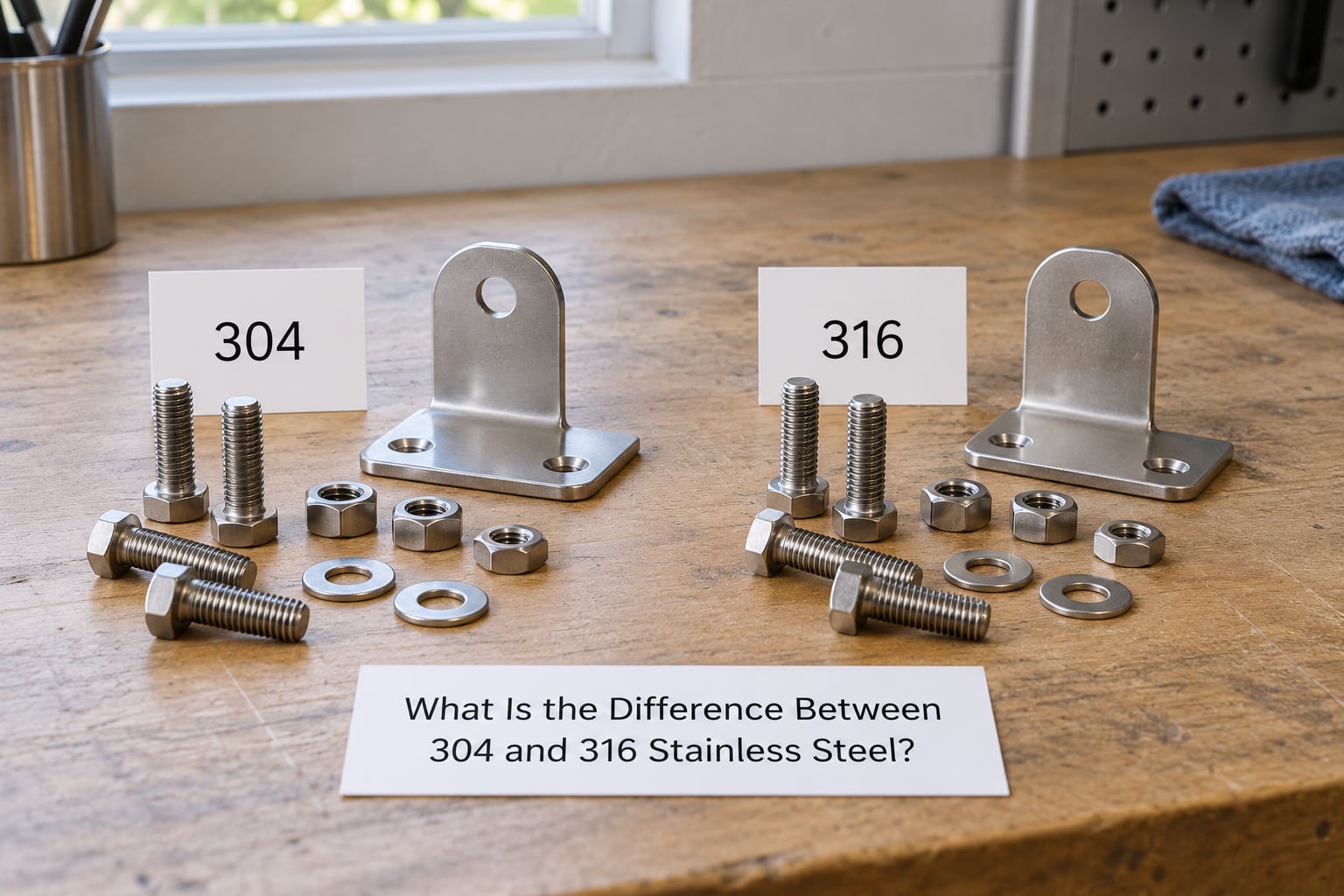
Both grades are austenitic stainless steels. They share the same basic structure, the same formability, and the same welded finish once passivated. The gap between them is chemistry, and the chemistry difference is small enough that most suppliers do not think about it until a part is already corroding.
Molybdenum is the deciding addition
304 contains roughly 18 to 20% chromium, 8 to 10.5% nickel, and no molybdenum at all. 316 trades a little chromium for 2 to 3% molybdenum and picks up a little more nickel. That molybdenum content is the whole reason 316 outperforms 304 in salt water.
Here is the mechanism in plain language. Stainless steel resists corrosion because chromium forms a self-healing oxide film only a few nanometres thick. In aerated fresh water that film rebuilds as fast as it is damaged, so nothing happens. Chloride ions, which seawater carries in abundance, punch through that film faster than it repairs. Molybdenum stabilises the film and slows that breakdown. 304 has nothing to slow it with.
What PREN actually tells you
PREN is calculated as percent chromium, plus 3.3 times percent molybdenum, plus 16 times percent nitrogen. Run the numbers on 304 and you land near 18. Run them on 316 and you get about 24. Every point of PREN roughly corresponds to an order of magnitude change in pitting resistance in laboratory chloride conditions, which is why a 6-point gap matters so much in the field.
Where 316L fits in
316L is 316 with carbon held at 0.03% instead of 0.08%. That small change matters if you weld the part, because standard 316 can form chromium carbide deposits along the weld heat affected zone, and those depleted zones go into service as a ready-made corrosion path. For anything you fabricate, specify 316L and an ER308L filler. The finished weld then behaves close to the parent metal after passivation.
How Does Marine Saltwater Affect Stainless Steel?
Salt water does not attack stainless the way water attacks carbon steel. There is no flaking orange rust and the part does not visibly weaken over months. What chlorides actually do is find small defects in the passive film and drill tiny holes into the surface. Those holes are pits, and pits are where the failure lives.
| Failure mode | What it looks like | Why 316 does better |
|---|---|---|
| Pitting corrosion | Small deep craters, often around a scratch or a mounting hole | Molybdenum slows film breakdown, so pits start later and grow slower |
| Crevice corrosion | Attack hidden under a washer, a gasket, a lap joint or a bolt head | Tighter margin against the oxygen-depleted salt water that sits in crevices |
| Galvanic coupling | The less noble metal corrodes at the joint, often the aluminium or carbon steel side | 316 sits slightly more noble than 304, so it protects coupled alloys a little better |
| Tea staining | Uniform brown discolouration on exposed fittings, no structural loss | 316 resists the free-iron surface deposit that causes the stain |
| Weld decay | Corrosion running along the heat affected zone beside a weld | Only if you used 316L and passivated; ordinary 316 welded work stays vulnerable |
Why warm and stagnant water is the hard case
Cold, moving, well aerated sea water is actually the friendliest condition for austenitic stainless. Warm water that sits still in a bilge, a livewell, or a heat exchanger shell is the worst. Higher temperature speeds the chemical reactions, oxygen depletion in the stagnant pocket removes the repassivation trigger, and sulphides from decay add to the attack. Practitioners on welding forums raise this constantly because it is where 316 hardware still surprises people.
Biofouling and surface condition decide a lot
A smooth, passivated, electropolished surface sheds biofilm and keeps oxygen flowing. A surface scarred by grinding, welding spatter, or a careless wire brush traps salt, holds moisture, and creates the micro-environment where crevice corrosion starts. Two parts of the same grade can behave completely differently depending on how they were finished.
Why 316 hardware still corrodes sometimes
Grade is one variable among several, and it is not always the deciding one. A bolt through an unsealed aluminium hull without isolation creates a galvanic cell no grade can rescue. An undisturbed washer face, a bend radius, a thread runout, and a clean passivation bath all matter as much as the alloy. Purchasers on sailing forums generally find that seized fasteners are almost always a joint design problem first and a grade problem second.
Where Is 304 Stainless Steel Still a Reasonable Choice?
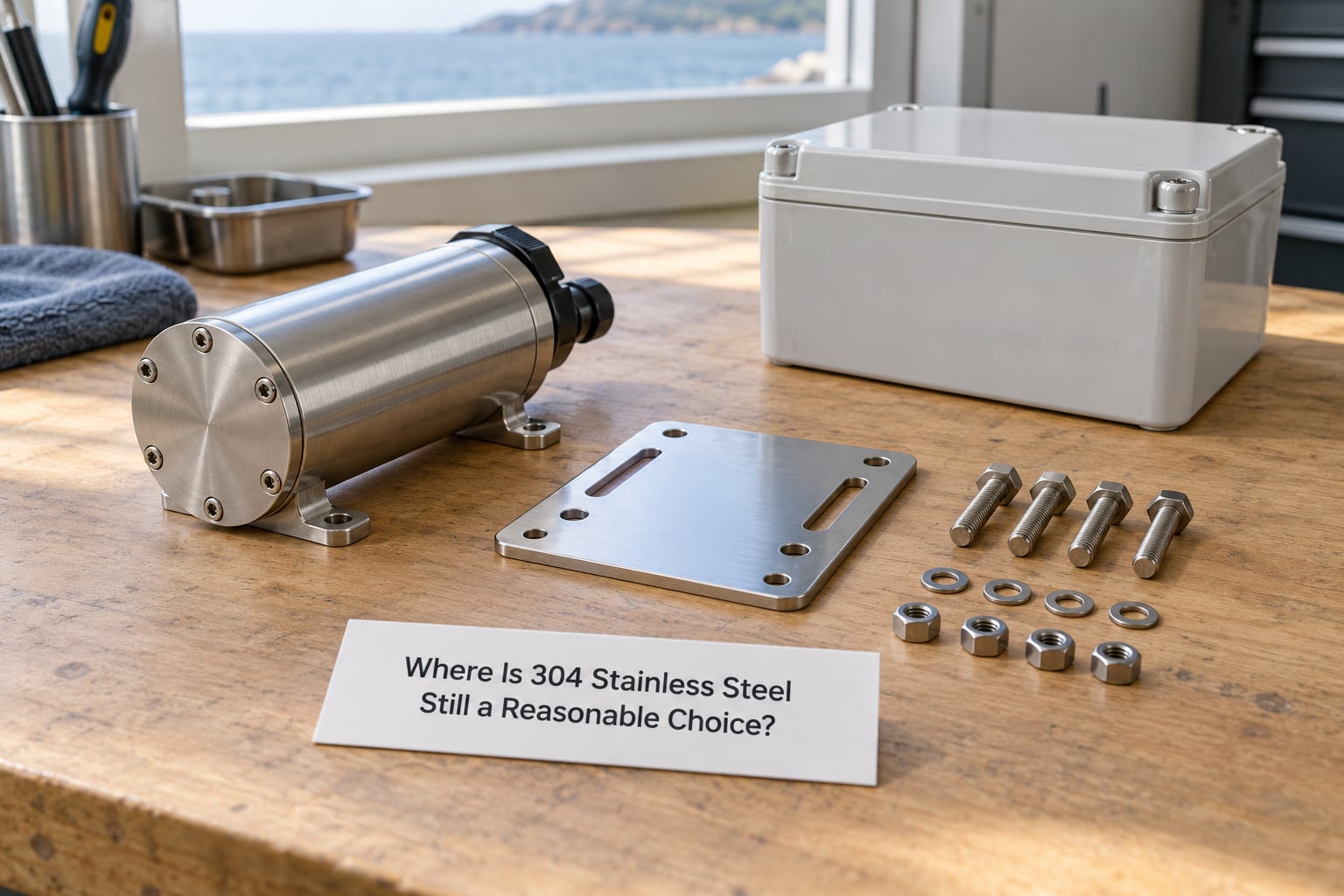
Flat out, 304 is not good enough for a splash zone or anything below the waterline. Engineers on eng-tips say it plainly: 304 does not cut it in a marine environment even under good conditions. But calling 304 useless on a boat throws away a lot of perfectly good engineering, because a surprising share of marine hardware never gets wet in the first place.
The dry zones where 304 holds up fine
- Cabin and saloon interiors. Interior joinery brackets, cabinet hinges, and trim fasteners sit in a dry interior and can stay 304 indefinitely.
- Inside lockers and sealed cabinets. If salt spray never reaches them, 304 works and the lower material cost is real.
- Protected non-splash deck zones. Under a dodger, inside a sprayhood, or beneath a lifting arm where water runs off, 304 has years of life in practice.
- Freshwater systems and tanks. Potable water lines, bilge pumps on the freshwater side, and non-salt plumbing have no chloride load at all.
- Covered moorings and enclosed storage. A trailered boat, or a boat stored under a full cover in a saltwater yard, sees far less salt than one left on a hardstanding in summer.
- Inboard engine internals and non-marine hardware. Anything on a shielded sub-assembly, such as a spare sensor inside a sealed junction box, can be 304.
The honest caveat
Even in a dry zone, salt migrates. Salt-laden dampness gets carried into lockers on sails, gloves, and bilge water, and it lingers for months. That is why most boat builders I talk to default to A4 anywhere outside the saloon, even in places where 304 would technically survive. The material saving on a few dozen small fasteners rarely pays for the one that seizes.
Where Does 316 Stainless Steel Make Sense for Marine Equipment?
316 earns its place wherever chlorides can reach the part, and it is the default choice for the majority of exposed marine hardware. It is not exotic, it is widely available in every common product form, and the premium is modest compared with the cost of a part you have to cut out of a hull to replace.
- Deck hardware. Cleats, padeyes, bow rollers, ring bolts, and stanchion bases all take salt spray from any direction and 316 keeps its finish.
- Exposed fasteners. Bolts, screws, and hinges on a splash zone or above the waterline are the classic A4 application. Replace seized A2 fasteners with A4 and the problem usually ends.
- Below-waterline and immersed parts. Through-hull fittings, seacocks, strainers, impellers, and propeller shaft hardware sit in continuously chlorinated water. 316 is the minimum sensible grade here.
- Sensor and instrument housings. Marine sensor bodies, mounting brackets, and protective cages see salt spray at the surface and condensation below it. 316 or 316L keeps the seal and the signal path stable.
- Ocean robot hardware. Float sections, anode frames, skid rails, and pressure housings all need a grade that tolerates both immersion and the biofouling that follows weeks in the water.
- Piping and heat exchange. Seawater piping, cooling jackets, and exhaust components see warm chlorinated flow, which is the condition austenitic stainless handles least comfortably.
- Coastal railings and dock hardware. Public railings and dock fittings get de-icing salt in winter, a concentrated chloride source that will punish 304.
What to do when 316 is not enough
For continuous immersion with regular service, or for hot chlorinated process streams, austenitic grades run out of margin. Duplex 2205 sits near PREN 35 with roughly twice the strength of 316 at similar thickness, and super duplex goes further still. These are offshore and desalination choices rather than boat choices, mostly because of welding procedure requirements and higher alloy cost, but they are the honest answer to the question of what professionals specify when a part lives in salt water permanently.
What About Welding, Machining, and Fabrication?
Fabrication is where the grade choice quietly doubles, because the weld can be worse than the parent material you paid to upgrade. A few practical rules cover most cases.
Use 316L for anything you weld
Standard 316 heated into the 800 to 1400 degree Fahrenheit sensitization range lets chromium tie up with carbon at grain boundaries, leaving those boundaries chromium poor and open to corrosion. Welding 316L, or using 316 parent metal with ER308L filler and a controlled heat input, largely avoids it. Fabricators on welding forums describe the symptom as weld decay: a joint that looks fine when it goes in and starts weeping a year later.
Passivate after welding
A fresh weld carries an oxide layer and heat tint that must come off. Pickling followed by a proper passivation process, referenced to ASTM A967 or the equivalent standard, restores the chromium-rich film. Skip it and the welded area becomes the first thing to pit, no matter how good the alloy is.
Keep carbon steel off the surface
Grinding with a wheel used on carbon steel, or brushing with a contaminated wire brush, drives free iron onto the stainless surface. That deposit rusts, and the resulting tea staining gets blamed on the grade. Dedicated stainless tools, dedicated grinding discs, and a rinse before passivation are cheap habits that prevent most of the cosmetic complaints on fittings.
Forming and machining notes
Both grades work harden quickly and gum up cutting tools, so use sharp tooling and steady feed rather than trying to plough through. Forming 304 needs a little less force than 316, which is one of the reasons fabricators sometimes reach for it. Specify a 2B annealed finish for general sheet work and a No. 4 or electropolished finish where appearance and cleanability matter, since the smoother the surface, the longer the passive film survives.
How Do Cost and Availability Compare?
316 costs more per unit than 304, and the premium comes almost entirely from the molybdenum and nickel content. There are no fixed prices to quote here, since the figure moves with alloy prices, part form, finish, and quantity, and any number written down today will be wrong by next quarter. Check current pricing for the specific part you are specifying.
Material cost is the smaller half of the decision
Compare the premium on a fastener against what it costs to get a seized bolt out. If the bolt passes through an aluminium or composite hull, extraction can mean cutting a plug, drying the core, and doing the job twice. The same logic applies to a deck fitting that leaves brown streaks down a varnished transom. On parts that are hard to reach, hard to remove, or expensive in labour to replace, 316 pays back quickly. On a hidden bracket inside a locker, it may never pay back at all, which is why a blanket rule for the whole boat wastes money.
Availability is about form and finish
Both grades are easy to find as sheet, bar, tube, fasteners, and sheet fasteners. 316L is common in sheet and tube but thinner in a wide range of finished fittings, so lead times stretch for specialty castings. Duplex is a different world, often on a supplier order basis. When availability matters, specify the standard number rather than the marketing word.
Marine grade is not a certification
Nothing regulates the phrase marine grade. It can mean anything from 304 to a certified super duplex part, and it appears on plenty of packaging containing A2 hardware. Ask for the standard instead: ASTM A240 for sheet and plate, EN 1.4301 for 304, EN 1.4401 for 316, EN 1.4404 for 316L, or the fastener equivalent ISO 3506-1 with A2 and A4 designations. Ask whether a mill certificate is available, and where the part is safety critical, require one.
Which Should You Choose?
Three questions decide the grade, and if you answer them in order you will not go wrong. First, can salt water touch this part, either directly, through spray, or through carried damp? If yes, use 316. Second, will you weld it? If yes, use 316L with ER308L filler and passivate afterwards. Third, does it sit immersed continuously, or in warm chlorinated flow? If yes, look at duplex 2205 rather than stopping at 316.
| Zone or duty | Grade to specify |
|---|---|
| Cabin interior, dry joinery, sealed cabinets | 304 acceptable |
| Sheltered non-splash deck hardware under covers | 304 acceptable, 316 preferred |
| Splash zone: exposed deck fittings, stanchions, padeyes | 316 (A4) |
| Sensor housings, instrument cases, brackets, cable glands | 316 or 316L |
| Above-waterline fasteners and hinges | 316 (A4) |
| Below waterline, seacocks, through-hulls, shaft hardware | 316 minimum, duplex for permanent immersion |
| Welded custom components | 316L, ER308L filler, post-weld passivation |
| Freshwater and non-salt plumbing | 304 acceptable |
How to check what you already have
Fasteners are marked with a grade code on the head, and A2 means 304 while A4 means 316. Metric and inch markings will also tell you whether the part was made to the metric or inch standard, which tells you which market supplied it. The magnet test is widely repeated and widely misunderstood: both 304 and 316 are non-magnetic in the annealed condition, and either can pick up magnetism from cold working or from being near a workbench steel surface. A magnet that grabs a bolt proves very little. For anything that matters, take the part to a supplier with a handheld alloy analyser, or fit it and re-check in a season.
How to write the specification
Put the grade number and the standard on the drawing, not a marketing phrase. Write 316 stainless to ASTM A240 or EN 1.4404 for sheet, specify A4 to ISO 3506-1 for fasteners, state the surface finish, and add the passivation requirement. Add isolation washers where the part touches aluminium or carbon steel. That five-line specification prevents nearly every failure I see described on the forums.
Frequently Asked Questions
Is 304 stainless ok for marine use?
304 is acceptable in dry, sheltered, non-splash zones such as cabin interiors, sealed lockers, freshwater systems and hardware under a full spray cover. It is not acceptable for the splash zone, exposed deck fittings, anything below the waterline, or any part that sees salt spray directly. Most builders default to 316 outside the saloon because salt migrates further than people expect.
What is the best stainless steel for marine use?
316 stainless steel, marked A4 on fasteners, is the standard answer for exposed marine work because its 2 to 3% molybdenum content resists chloride pitting far better than 304. For permanently immersed or hot chlorinated service, duplex 2205 is the professional answer. Match the grade to the exposure zone rather than defaulting every part to the same alloy.
Will 304 stainless rust in saltwater?
304 does not develop the flaking orange rust that carbon steel produces. What it develops is pitting, small deep craters that attack the surface, plus brown tea staining on exposed fittings that looks identical to rust and often gets mistaken for it. That staining is cosmetic and can be removed, but the pitting under a washer or in a crevice is real corrosion that can seize the part.
Which is better, 304 or 316 stainless steel bolts?
For bolts in salt water, on a splash zone, or below the waterline, choose 316, which is designated A4. Choose 304 or A2 only for dry interior fittings. Check the head markings before you buy, since hardware sold as marine grade is very often A2. Where a 316 bolt passes into aluminium or carbon steel, add an isolating washer to stop galvanic attack on the softer metal.
Does stainless steel need galvanic isolation in a boat build?
Yes, whenever stainless meets aluminium, carbon steel, or bronze and salt water can reach the joint. The two metals form a cell and the less noble one corrodes, which is how aluminium gets eaten away around a through-hull fitting. Nylon or PTFE isolating washers and bushings break the electrical path. Isolation protects the coupling; upgrading 304 to 316 does not, because the galvanic problem is about dissimilar metals, not about alloy quality.
How do I specify stainless steel for an ocean robot?
Specify 316 or 316L for housings, frames, skids, and fasteners, and duplex 2205 for anything permanently immersed or in a warm chlorinated flow. State the standard number rather than the words marine grade, request a mill certificate, and add a passivation requirement for welded parts. Separate dissimilar metals with isolating hardware so the robot is not quietly eating its own frame.
Conclusion
Start by walking the boat with a notepad and sorting every stainless part into dry, splash exposed, or immersed. Everything in the first pile can be 304. Move everything in the other two piles to 316, use 316L and passivation on anything you weld yourself, and add isolating washers wherever the new hardware passes through aluminium or composite.
Then check the head markings on what you are replacing. If it says A2 and it belongs below the waterline, you have found the reason it seized.