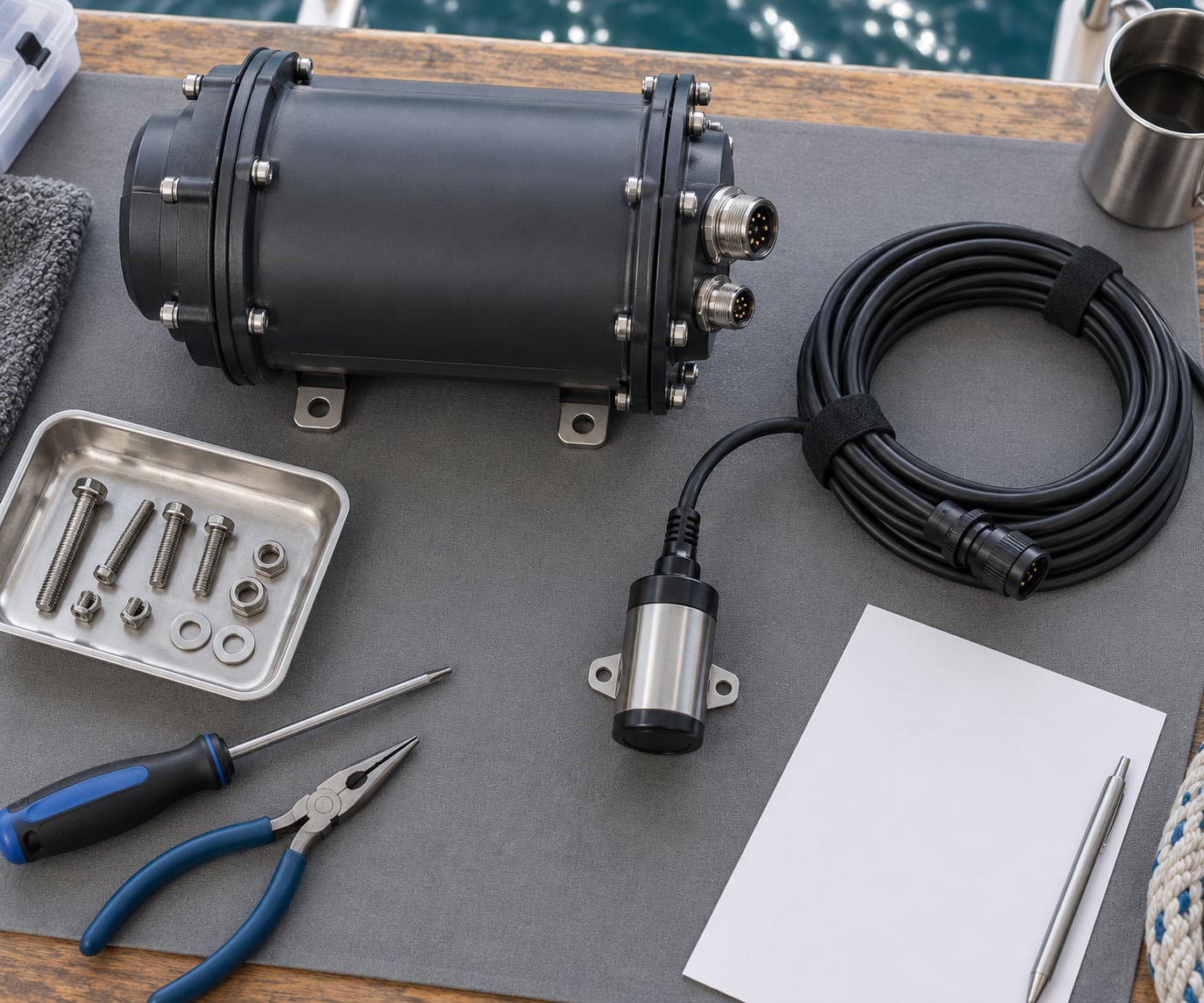
How to source parts for a marine project comes down to three things: know the environment every component has to survive, build a bill of materials that ranks parts by failure impact, then route each category to the channel that reliably supplies it. Get that order wrong and you inherit corrosion, water ingress, and a part nobody can cross-reference in two years.
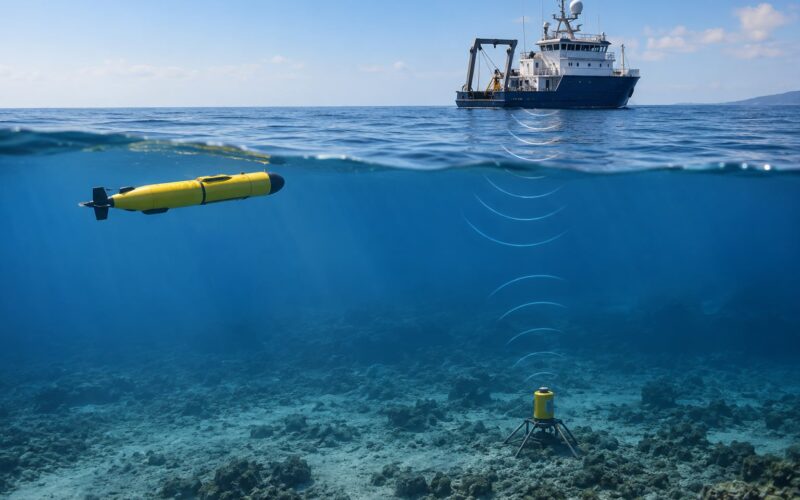
This guide covers boat builds and refits, but the same discipline applies to ocean robots, drifting buoys, mooring hardware, sensor pods, and tidal test rigs. Those projects have a harder sourcing problem than a boat, because there is no chandlery around the corner and no mechanic who already knows the part.
Table of Contents
- What You Need Before You Order Anything
- Step-by-Step
- How to Source Parts for a Marine Project by Defining the Environment
- Create a Bill of Materials With Risk Priorities
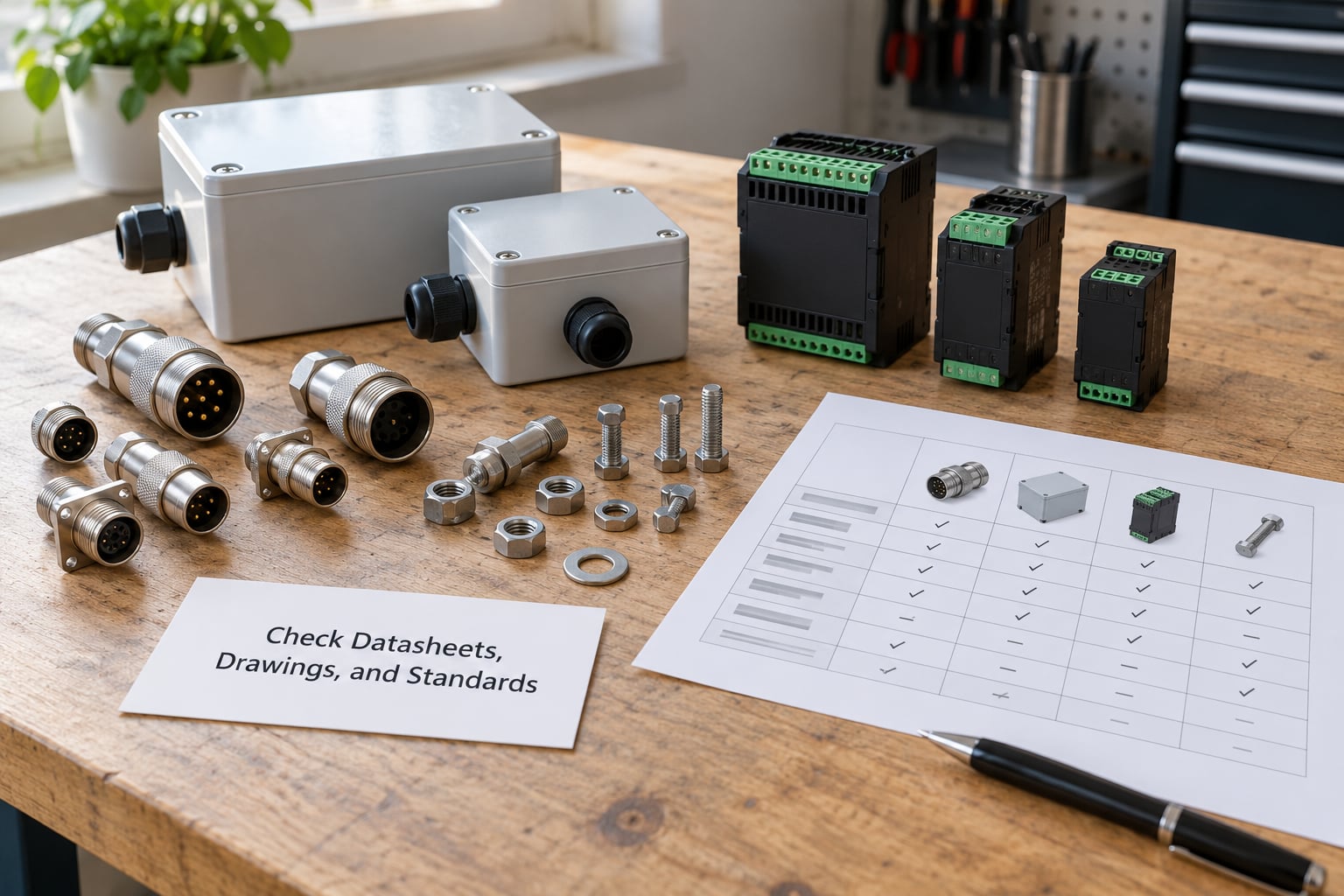
- Check Datasheets, Drawings, and Standards
- Evaluate Marine and Industrial Suppliers
- Design for Substitutions and Obsolescence
- Validate Before Ordering in Volume
- Place, Receive, and Trace the Order
- Common Mistakes
- Frequently Asked Questions
- Where should I buy parts for a marine robot or ocean sensor?
- How do I choose components that will not corrode in seawater?
- Can I substitute an electronic part if the manufacturer part number changes?
- What documentation should I keep when ordering marine-project parts?
- Should I order samples before buying components in bulk?
- How do I source hard-to-find or obsolete parts without buying counterfeits?
What You Need Before You Order Anything
Most sourcing mistakes trace back to a thin requirements document. Before a single purchase order exists, assemble these seven things.
- Environment profile. Immersion depth and pressure at that depth, temperature range, vibration and shock levels, UV exposure, humidity, and which metals will be electrically connected in the same seawater.
- Subsystem inventory. Every assembly with its function, so nothing structural, electrical, or sensing gets ordered as an afterthought.
- Technical documents. CAD or frame drawings, wiring diagrams, datasheets, interface specifications, and any standard references your design is built around.
- Compliance constraints. Applicable standards and class requirements, plus the rules that apply to your operating area.
- Target quantities. Build quantity, prototype quantity, and the spare ratio you intend to carry.
- Budget ceiling. What you can spend per subsystem and how much contingency you accept.
- Supplier criteria. Traceability, returns, minimum order quantity, counterfeit screening, and who handles warranty claims.
The environment profile is the item people skip, and it is the one that decides everything else. A connector rated for a splash zone and a connector rated for continuous submersion are different products with different part numbers, even when the listing photo looks identical.
Step-by-Step
How to Source Parts for a Marine Project by Defining the Environment
Write the deployment conditions as pass/fail limits, not adjectives. “Seawater tolerant” tells you nothing; “continuous immersion to 30 meters, -2 to 50 degrees C, 5 g vibration” tells you what to buy.
Translate those conditions into per-component limits: pressure rating for anything below the waterline, temperature derating for electronics in an unventilated housing, corrosion material choices, UV stability for anything above deck, and a galvanic compatibility list. Dissimilar metals in direct contact accelerate each other, so pair 316 stainless with compatible fasteners or isolate them.
Also record expected service life and duty cycle. A part rated for intermittent duty will not survive continuous operation, and continuous-duty parts cost more.
You have it right when every critical component carries a documented environmental limit matching its intended deployment, and any component without one is flagged for evaluation before it enters the bill of materials.
Create a Bill of Materials With Risk Priorities
Turn the design into a structured BOM with one row per line item: manufacturer part number, description, quantity, unit cost, lifecycle status, failure impact, approved alternates, and a sourcing risk rating.
Sort the sheet by failure impact, not by price. A $4 fastener that falls off and sinks a thruster matters more than a $400 display module. Mark every line that has a single source, is flagged end-of-life, or sits on backorder — those are the ones that will stop your build.
Keep part numbers and revisions locked into the sheet rather than left in your head or in an email thread. When the engineer and the purchaser hold the same revision, sourcing stops being an argument.
You have it right when procurement and engineering work from the same revision, and you can name every single-source or obsolete line item in the build without opening a second file.
Check Datasheets, Drawings, and Standards
Pull the manufacturer datasheet for every critical line and read the ratings, not the marketing. For electrical parts, confirm voltage, current, tolerance, and derating. For pressure-housing parts, confirm depth rating and what that rating assumes about media density and temperature.
Check material compatibility against whatever the part contacts: seawater, fuel, sealant, cleaning chemicals. Verify ingress protection ratings against the actual exposure zone, and confirm connector sealing method — potted, conformal coated, or a rated IP enclosure. Any of these can be verified by measurement or datasheet and should never be taken on faith from a listing title.
Check mechanical details too: dimensions, tolerances, mounting hole patterns, and whether the specified revision matches the revision you are quoting. For anything on a data bus, confirm the interface specification so you are not mixing protocols by accident.
You have it right when no critical requirement in the BOM comes from a marketplace listing or a seller description.
Evaluate Marine and Industrial Suppliers
Five channels cover almost everything, and each one fails differently.
Authorized distributors carry genuine parts with full traceability and manufacturer warranty. You pay a margin for that certainty, and minimum order quantities can be awkward when you need one connector.
Marine specialists and chandleries know the environment. They will tell you which part fits your hull, and they carry consumables you will need on launch day. Their reach is usually regional, and pricing reflects the service.
Industrial and electronics distributors are strong on connectors, sensors, passives, and enclosures, with excellent datasheet libraries and honest lifecycle data. Ask specifically about environmental ratings rather than assuming a catalog part is sealed.
Marketplaces offer the widest selection and the weakest verification. Seller history, return terms, and whether the listing includes a real datasheet tell you more than the photos do.
Direct from the manufacturer gives the best documentation and the worst convenience for small quantities. Some will sell a single unit; most will not.
Salvage and used channels work for hardware, fasteners, propellers, and instrument housings where you can inspect before committing. Avoid them for anything you cannot test: sealed pressure housings, safety gear, and unknown-lot electronics.
Compare each candidate on traceability, accuracy of on-hand inventory, minimum order quantity, lead time, warranty handling, counterfeit screening, and returns. Ask a supplier to confirm in writing what they will do when a line arrives damaged or wrong.
You have it right when every selected supplier can produce traceable documentation and a realistic fulfillment plan in writing, and at least one backup exists per critical line.
Design for Substitutions and Obsolescence
Assume something will change. Manufacturers revise parts, end production lines, and requalify materials without warning, and a one-off marine build has no purchasing department watching those notices for you.
Qualify alternates before you need them. Check footprint and interface compatibility, then check what is not physical: firmware drivers, register maps, configuration files, and calibration constants. A drop-in replacement that needs different driver support is not a drop-in replacement.
Track lifecycle status for every critical line and set a review point. When a part is single-sourced and nearing end-of-life, treat a last-time-buy as a decision with a date attached, not something to think about later.
You have it right when every critical component has a qualified alternate, or a written mitigation and an accepted risk, with someone named to own it.
Validate Before Ordering in Volume
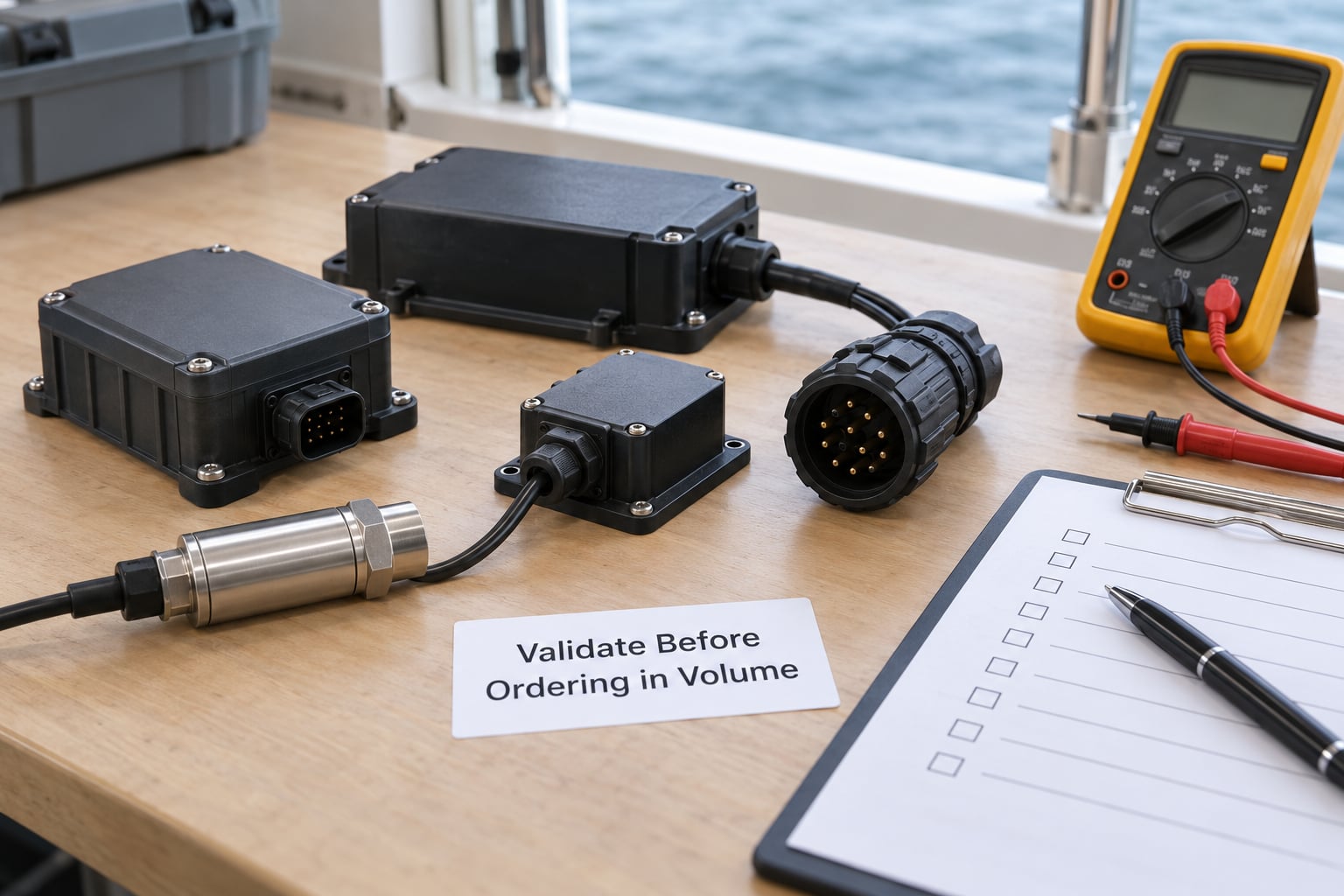
Order samples first, always. For a one-off build this is the cheapest insurance in the whole process.
On receipt, inspect for damage, correct part number and revision, and markings that match the documentation. Run electrical tests on the bench: supply current draw, signal output across the expected range, and any communication handshake the device uses. Verify material and coating by inspection, weight, or magnet test where the datasheet claims a specific alloy.
For anything pressure-exposed, do an ingress or pressure check rather than trusting the rating alone. For anything mechanical, confirm the fit against the drawing with the actual mating hardware.
Burn in electronics under load for a while before you seal an enclosure. Sealing a marginal part hides the failure until it is underwater, and then it is too late.
Capture the test results with the sample. Those records become your baseline for comparing production deliveries against.
You have it right when prototype parts meet the same specifications and mechanical interfaces the production order assumes, and you hold written evidence of the checks.
Place, Receive, and Trace the Order
Issue the purchase order with manufacturer part numbers and revisions spelled out, not descriptions. “Corrosion-resistant M8 fastener, A4-80” is a negotiation; a part number is a commitment.
At receiving, log serial and lot codes against the purchase order, check the packing against the manifest, photograph any shipping damage before opening the carton, and file claims inside the carrier’s window. Inspect a percentage of delivered units, more for parts you did not sample.
Store everything dry, clean, labeled, and organized by category. Sealed electronics still corrode in a damp bilge, and adhesives and sealants have shelf lives that matter more than most people assume.
Keep the record central: supplier, part number, lot, purchase record, inspection result, and which assembly the part went into. That chain is what makes a warranty claim, a failure analysis, or a rebuild six months from launch possible at all.
You have it right when you can pick any delivered part and trace it in both directions, from supplier and lot forward to the installed assembly and back to the inspection record.
Common Mistakes
Sorting by price first. The cheapest source is often the one that cannot tell you the lot, the revision, or the return terms. Rank suppliers by traceability and fit, then by landed cost.
Ignoring pressure and corrosion ratings. A housing rated for a splash zone will not survive submersion. Check the actual exposure, not the marketing tier.
Buying without traceability. If the seller cannot supply a lot code or an authorized-distributor chain, assume you will never know what you installed. This is the point where counterfeits and unmarked gray-market stock enter a build.
Skipping sample validation. One sample per critical line costs a fraction of a field failure and tells you whether the datasheet describes your build.
Treating substitutes as equivalent. Replacements change pinouts, firmware support, and calibration. Verify the interface, not just the fit.
Ordering volume with no storage or shelf-life plan. Sealants, adhesives, batteries, and some lubricants degrade on a shelf. Buy to your real maintenance schedule.
Mixing dissimilar metals in one seawater circuit. Galvanic couples eat the less noble metal. Match metals or isolate them.
Trusting unbranded marketplace listings. Request the datasheet. A seller who cannot produce one is selling a guess.
Frequently Asked Questions
Where should I buy parts for a marine robot or ocean sensor?
Split by category. Industrial distributors are best for connectors, enclosures, sensors, and passives, since they publish lifecycle data and datasheets. Marine specialists are best for hardware, fasteners, wire, and anything exposed to corrosion. The manufacturer is worth contacting for custom or revision-controlled electronics. Marketplaces only for parts you can verify against a datasheet or test on arrival. For a remote deployment, local availability is worth more than small savings, because a failed part is usually a whole deployment.
How do I choose components that will not corrode in seawater?
Match the material to the job, then verify it in writing. 316 stainless steel and nickel-plated brass handle saltwater well; vinyl-coated and zinc-plated steel do not belong below the waterline. For electronics, use sealed or potted housings with a documented ingress rating matched to the exposure zone. Mix dissimilar metals sparingly, isolate them with insulators where you must, and add cathodic protection on exposed metal structures. Re-inspect fittings after the first season in service.
Can I substitute an electronic part if the manufacturer part number changes?
Often, but never by assumption. Check footprint, pinout, supply voltage, current draw, and interface compatibility first, then check what is not physical: firmware drivers, register maps, configuration files, and calibration constants. Rebuild and retest the subsystem around the new part rather than trusting a bench power-up. Record the substitution in your bill of materials with the date and the reason, so the next person does not reverse-engineer your decision.
What documentation should I keep when ordering marine-project parts?
Keep the datasheet and drawing revision for every critical line, the purchase order, the supplier confirmation of authenticity and traceability, received lot or serial codes, your incoming inspection result, and where the part ended up in the assembly. Add any deviation, substitution, or approved alternates with the date and reason. Store it in one central place tied to the build, not in a folder of screenshots. That record is what makes warranty claims and failure analysis possible later.
Should I order samples before buying components in bulk?
Yes, for every critical line. One sample per part costs a small fraction of a single field failure and tells you whether the datasheet matches your build. On the sample, check markings and revision, run electrical tests across the expected range, verify the material, and do an ingress or pressure check if the part is exposed to water. Burn electronics under load before sealing anything. What you learn on the sample is your baseline for inspecting the production delivery.
How do I source hard-to-find or obsolete parts without buying counterfeits?
Go through authorized distributors first and ask them to cross-reference the obsolete number, since they often hold the successor part or know its lifecycle date. If you must buy the original, require dated photographs of the markings, a lot or date code, and the packaging, and buy from a seller with a long, verifiable history and a return policy. Test before installing. Never mix no-name parts into a safety-critical or pressure-critical assembly, and never power up an unmarked component without a full test.
Document the operating environment first, because every other sourcing decision depends on it. Then build a risk-ranked bill of materials, and qualify both a primary and a backup supplier before you commit to volume. Learn how to source parts for a marine project once, with the records in place, and the second build goes faster than the first.