To make a boat safe for remote operation you need three things before it ever leaves the dock: a written operating envelope, an emergency stop that works with every other system switched off, and a staged test plan that starts on land. Everything else — fail-safe behavior, command links, weather limits, geofencing — is built on top of those. This guide walks through the workflow in the order it actually needs doing, and as of 2026 the rules of thumb haven’t changed much: conservative limits, independent stops, supervised trials.
This is written for small research and survey craft, marine robotics prototypes and hobby-scale autonomous boats. Commercial vessels follow class and flag-state processes on top of this, and you should talk to a licensed marine surveyor and your insurer before going further.
Table of Contents
- What You Need
- How to Make a Boat Safe for Remote Operation: Step-by-Step
- 1. Define the operating limits and emergency actions
- 2. Inspect the hull, propulsion, steering, and electrical systems
- 3. Design independent remote controls and fail-safe stops
- 4. Harden the control, navigation, and sensor installation
- 5. Establish reliable command and telemetry links
- 6. Plan for weather, collision risk, and onboard failure
- 7. Test on land, in sheltered water, and progressively farther out
- 8. Brief, log, and review every remote operation
- Common Mistakes
- Frequently Asked Questions
- How much radio range does a remotely operated boat need?
- Do autonomous boats need a person onboard?
- What is the most important boat remote-control safety system?
- Can I operate a boat remotely without cellular service?
- How often should a remote-control marine system be inspected?
- What should happen when the boat loses its GPS signal?
- Conclusion
What You Need
Vessel documentation comes first. You want general arrangements, lines plan, wiring diagrams, a hydrostatic curve and a systems list that shows where power enters and where it goes. If those don’t exist, draw them before you add anything.
Then the people. Name one person as remote operator and one as safety observer, and write down who has authority to abort. For early trials, an observer riding onboard changes the risk picture more than any single piece of electronics.
Safety equipment: life jackets for everyone aboard, a throw line, a fire extinguisher rated for the battery chemistry, a first aid kit, a bilge pump and a manual scoop, flares or a signal mirror, and a horn. For lithium battery work, a dedicated bucket of dry sand and a thermal runaway bag.
Control hardware means a physical mode switch that clearly separates manual, remote and autonomous, a latching emergency stop button wired directly into the propulsion power path, and a way to isolate propulsion power without powering down the electronics that report the fault.
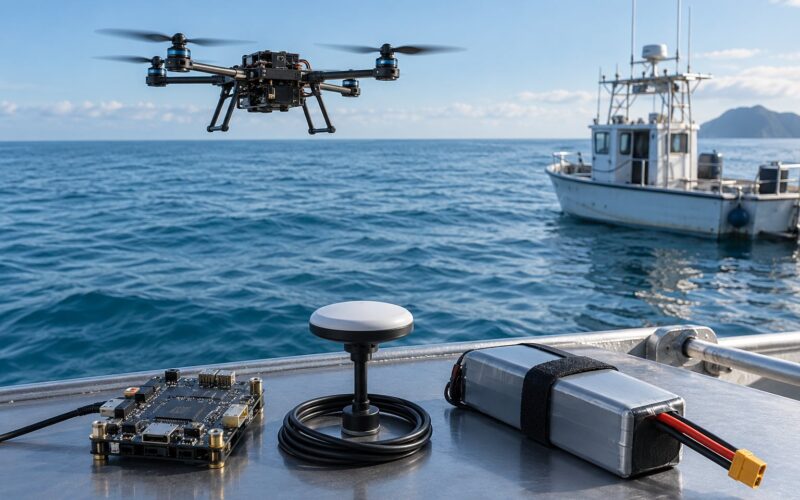
Communications: a primary command link, a second link on a different band or provider, and a monitoring path that only carries telemetry. Antenna hardware that is actually rated for the bands you intend to use, mounted clear of the motors.
Navigation and instruments: GNSS receiver with its antenna in a clear position, compass, a depth sounder or echo sounder if you’re working near anything shallow, and a battery monitor on each bank. A second independent position source — visual bearing, radar, or a second receiver — is worth the money.
Power reserves sized with the reserve rule: enough energy to return to a known safe point at cruise with 30 percent still on the cells. Test environment: a bench with a multimeter and a current clamp, a pool or pond, sheltered water, and a marked test zone with a shoreline safety station.
How to Make a Boat Safe for Remote Operation: Step-by-Step
1. Define the operating limits and emergency actions
Write the operating envelope down before you energize anything. One page is enough: allowed waters, maximum distance from shore, maximum speed, maximum wind and wave limits, maximum hours of unattended operation, and the conditions that mean abort immediately.
Same page: what the boat does when each thing fails. Link lost, GNSS fix lost, position uncertain, battery below reserve, water ingress, geofence breach, telemetry loss, and manual override engaged. Each entry gets a resulting vessel state — motor stop, return to last waypoint, return to shore, or hold position.
You’re done when a second person who was not in the design conversation can read the page and say out loud what the boat does at each failure. If they can’t, the envelope isn’t written yet.
2. Inspect the hull, propulsion, steering, and electrical systems
Start with the structure. Look for soft spots, working cracks, delamination, loose fasteners and drained through-hulls left open. Check watertightness by running the boat in shallow water with everything closed and watching for anything that moves faster than it should.
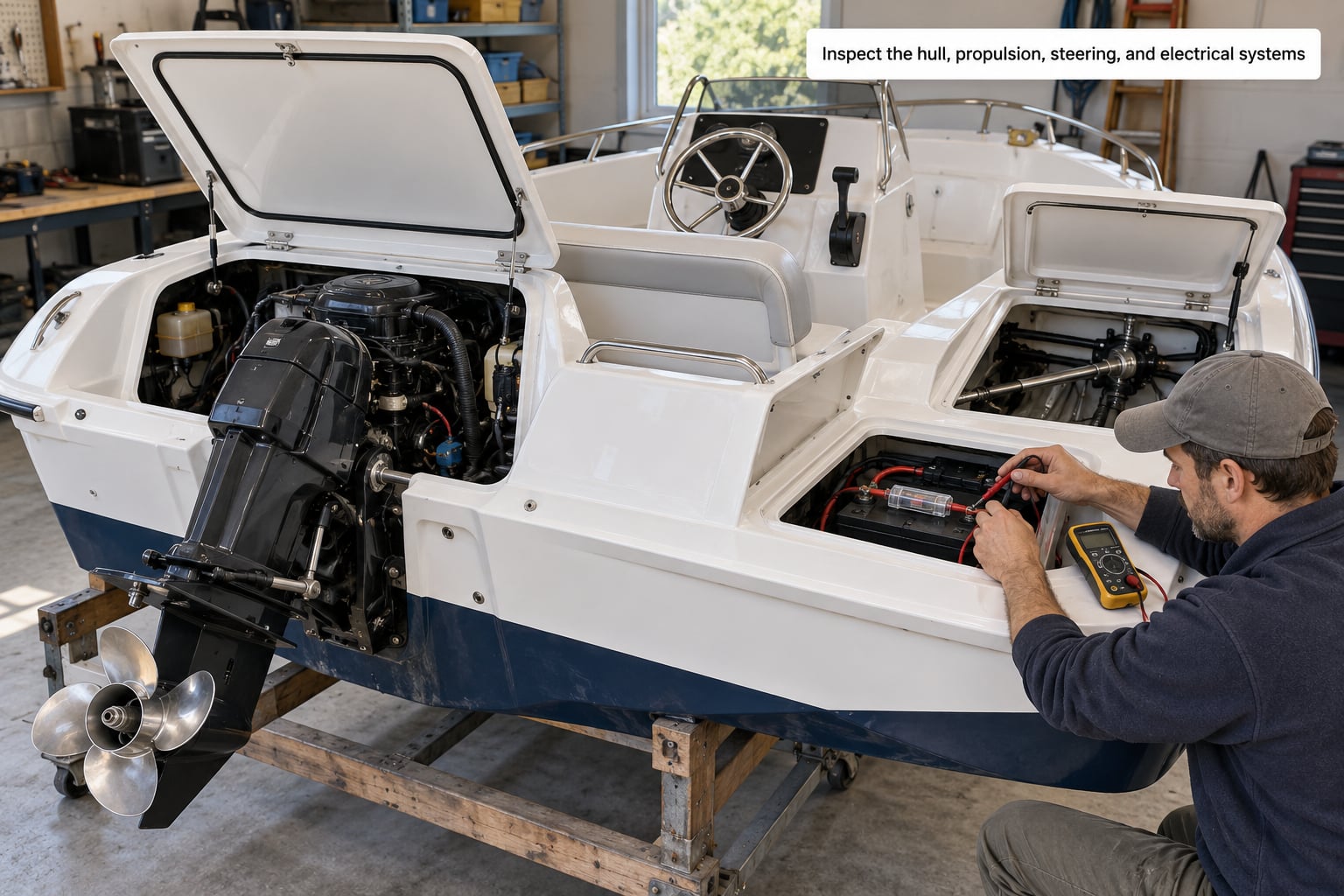
Then propulsion and steering. Spin the shaft by hand before energizing and note any binding or roughness. Confirm the propeller is clear and correctly oriented, that the steering actuator has full travel in both directions without hitting the stops, and that the rudder or jet nozzle reaches full deflection.
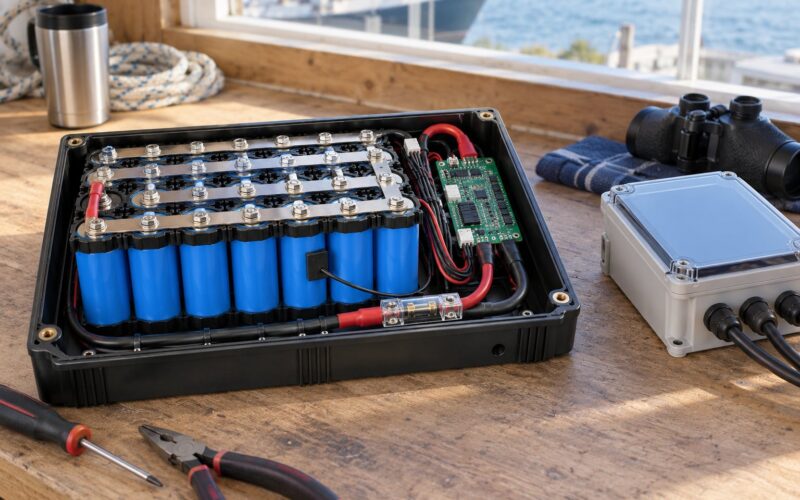
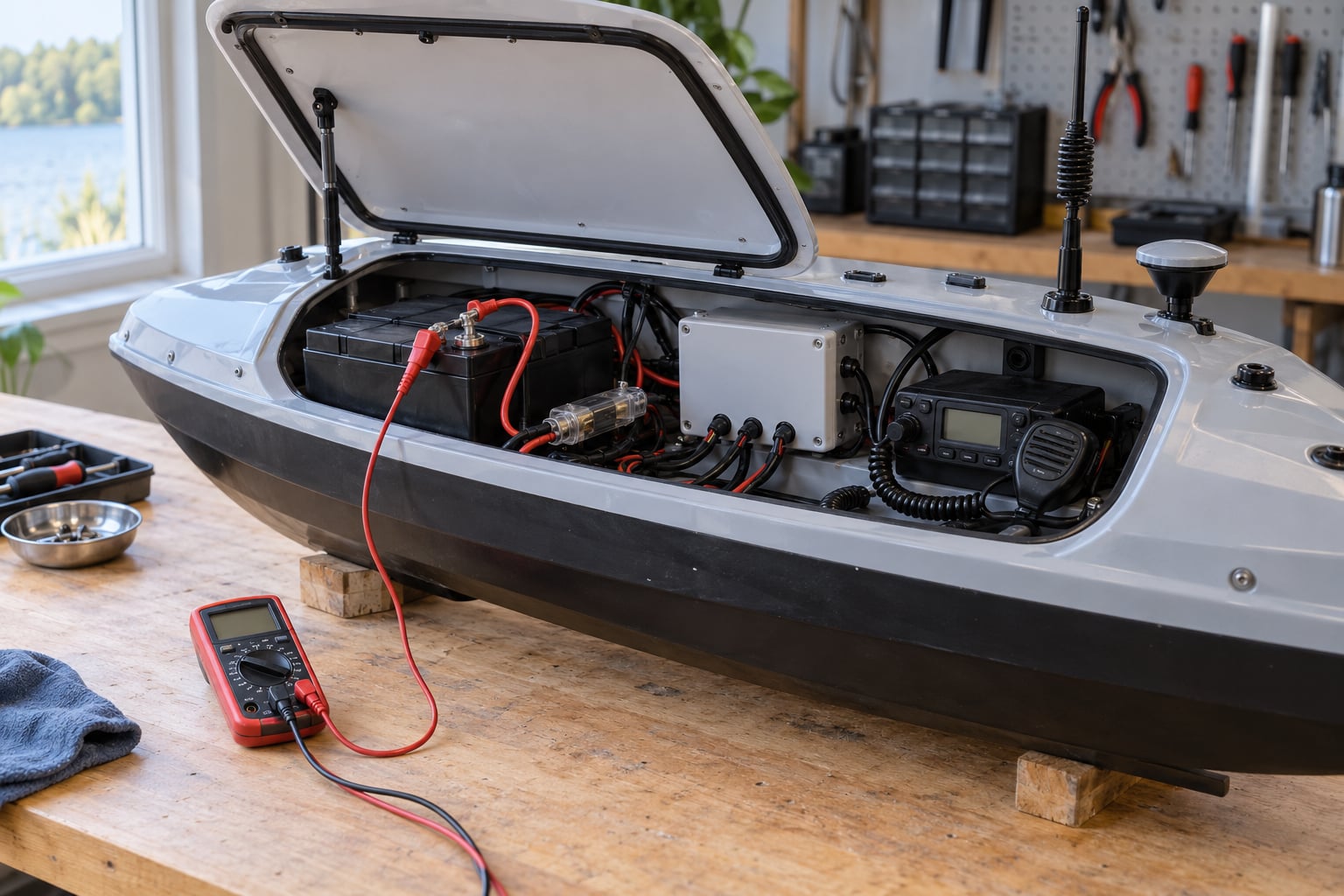
Electrical inspection is where most problems hide. Measure each battery bank’s voltage at rest and under load, compare banks, and check every fuse is the right rating and seated. Pull every connector and look for corrosion, backed-out pins and mismatched pairs. Verify charging is isolated between banks and that the shore-power path cannot backfeed the electronics.
You know the checks passed when you have a signed sheet: rest voltage per bank, insulation resistance, fuse ratings, torque marks on battery terminals, and a photoset of the compartment before the electronics go in.
3. Design independent remote controls and fail-safe stops
The core rule is that the emergency stop must work when nothing else works. Wire it so that pressing it removes energy from propulsion regardless of what the autopilot, the remote link or the onboard computer believes. A software command to stop is not an emergency stop.
Give manual control priority. Put a physical mode switch in reach of the helm, and make the transition one-way and deliberate: you can’t jump from autonomous to remote mid-crossing without a confirmed key switch. On any command timeout, the neutral and motor-stop commands must be the default state, and any unrecognized packet must be treated as no command at all.
Add a watchdog that de-energizes propulsion if telemetry updates stop arriving, then bench-test the whole chain. Cut the transmitter, pull the antenna, power-cycle the modem and jam the link in turn; each time, propulsion should stop within the timeout you wrote in the envelope. A mechanical latching stop, clearly labeled, sits in easy reach and needs deliberate reset.
4. Harden the control, navigation, and sensor installation
Mount electronics so they can be inspected. Enclosures need strain relief on every cable, glands rated for the environment, and enough free air where heat matters. Vibration is the enemy of solder joints and connectors; secure anything that isn’t bolted or bonded, and keep cable runs away from sharp edges and hot surfaces.
Position is everything for the GNSS antenna. Put it as high and as unobstructed as you can, away from the VHF antenna and any wiring carrying switching current. Give the compass its own clear spot away from steel, high-current cable and ferrous hardware, then recheck alignment after the refit.
Put disconnects where you can reach them with the boat in the water, not in a locker that fills. Add redundant sensing where the decision matters: two position sources, two temperature measurements on each critical bay, and float switches on more than one level in a compartment you care about.
5. Establish reliable command and telemetry links
Treat the command link and the telemetry link as two different products. Command needs predictable low latency and a predictable failure. Telemetry needs to get through eventually and tell you honestly how old the data is. Conflating them is how people end up unable to control a boat because a video stream stalled.
Do a link budget before buying the expensive antenna: transmit power, antenna gain, cable loss, receiver sensitivity, terrain and sea state. Then run a real range test at low power, in line of sight, at the boat’s typical heading, in the worst sea state you plan to operate in. Log packet delivery ratio and round-trip latency at each increment of distance, because the cliff edge is much closer than the maximum range suggests.
Ship an independent second link, ideally on a different band and a different network. Marinas and coastal cellular are fine close in and useless a few miles out; satellite works past the horizon but brings latency and clear-sky problems. Test the behavior when the link degrades rather than when it dies: the boat should degrade to its documented fallback, and telemetry should report the state rather than quietly showing stale numbers.
6. Plan for weather, collision risk, and onboard failure
Set weather thresholds conservatively and enforce them with a rule, not a feeling. Check the forecast for the whole operation window, not the launch hour, and set an abort time rather than an abort condition where you can. A boat that turns back early looks cautious; a boat that decides at the worst moment looks like a boat that has lost its nerve.
Collision avoidance has a hard limit. Radar or a camera can find a target, but classifying a small boat, a log and a bird differently takes practice and light. Treat detection as an alarm that prompts a human decision, and set the geofence as the real boundary: hard limits on position, plus a standoff around hazards and around other boats’ working areas.
Plan for the failures nobody wants to think about. Propulsion loss mid-crossing, steering jam, GNSS fix lost entirely, communications gone with the boat still moving, or an engine room taking water. Each one needs a pre-decided response and, where possible, a mechanical means of limiting damage — redundant bilge pumps on independent power, a way to close a fuel or battery isolation from outside, and enough reserve energy to hold station while you organize a recovery.
7. Test on land, in sheltered water, and progressively farther out
Run the entire control chain on land with the prop removed or the drive disconnected: full throttle and rudder range, mode transitions, timeouts, emergency stop, and the failure list from the envelope. Keep a stopwatch on every timeout. Then move to a pool or pond and verify the same behaviors with a person aboard.
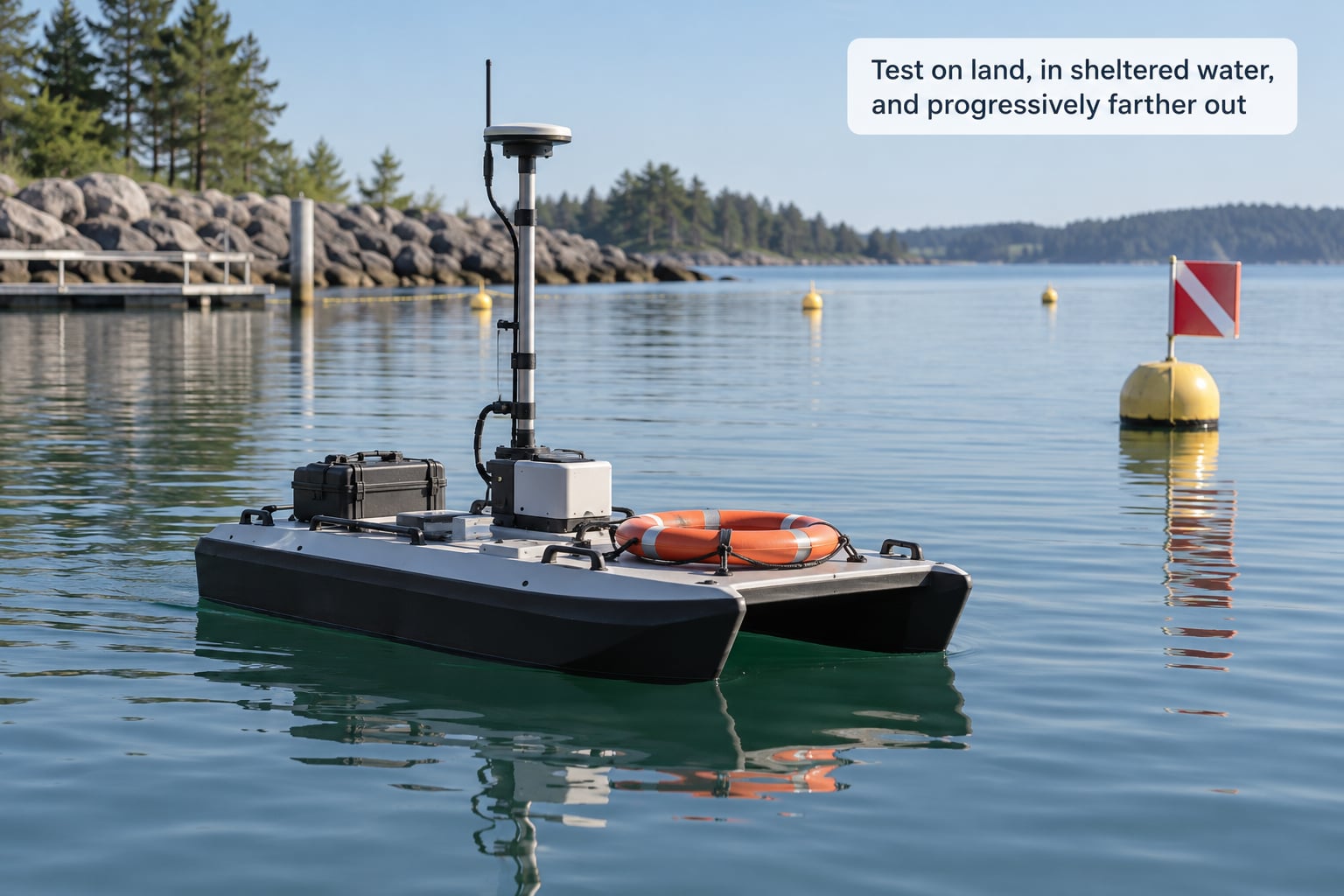
Next comes attended sheltered water, still inside the marked test zone, with a shore-based station and a safety observer aboard. Simulate link loss deliberately, once for each failure mode, and confirm the boat does what the envelope says. Expand range in steps, doubling each time, and do not skip a step because the last one went well.
Sign off on written criteria: all envelope behaviors demonstrated, no unresolved faults logged, operator and observer both able to describe the abort procedure, and a recovery drill completed within the planned response time. Until every box is checked, the boat is a supervised trial platform, not a remote operation.
8. Brief, log, and review every remote operation
Pre-deployment briefings take five minutes and prevent most incidents. Who is operating, who is watching, what the abort criteria are today, what the weather looks like, and where the recovery assets are.
Keep an operating log: date, duration, route, weather, commands sent, faults, link quality, battery consumed, and anything that felt wrong. Log anomalies even when nothing went wrong, because the pattern is what you catch later.
After each run, pull the telemetry and review it fresh rather than trusting the live dashboard. Over time, retire equipment that fails repeatedly, revise the envelope when conditions change, and re-brief when a procedure changes. Safety here is a maintenance habit, not a commissioning certificate.
Common Mistakes
Treating GNSS as the only position source. One receiver with no cross-check is one failure away from a wrong answer. Add a second receiver or a radar/visual bearing, and compare them continuously.
Mounting antennas near motors, steel or high-current wiring. Motors and switchmode supplies are noise sources; a noisy antenna produces intermittent errors that look exactly like software bugs. Move the antenna and re-test before touching code.
Skipping fresh water testing. Pool and pond runs catch leaking seals, loose connectors and inverted polarity in minutes, and salt water hides them until the run is over.
Omitting a physical stop. If the only way to stop the boat is a command through software and radio, you have no emergency stop. Install a hardwired latching stop that works with the electronics dead.
Relying on a single radio link. One provider, one band, one antenna. Carry a second link on a different band and network, and rehearse the fallback before you need it.
Launching without an onboard observer. Distance makes small problems invisible. Ride along through the early range steps even when telemetry looks perfect.
Ignoring battery degradation. Capacity and internal resistance both drift with cycles and with age, so a reserve calculated on new cells is fiction. Re-measure capacity periodically and size your reserve from measured, not nominal, numbers.
Frequently Asked Questions
How much radio range does a remotely operated boat need?
Enough to cover your operating area with a real margin, not the maximum the datasheet promises. Decide your furthest working distance, add the distance to your recovery point, then add a factor for sea state and obstructions. Test at low power in line of sight and log where delivery ratio actually drops. Keep a second link on a different band, because range failure is rarely gradual.
Do autonomous boats need a person onboard?
It depends on the vessel, the waters and the rules that apply to it, and for small craft local requirements usually come first. For research and survey prototypes, most teams keep an observer aboard during early trials and only reduce crew later with a written risk assessment. Commercial autonomous operation is governed by flag-state and class requirements, so check both before reducing the crew.
What is the most important boat remote-control safety system?
The independent emergency stop. It should remove power from propulsion through a hardwired path that works with the autopilot, the link and the onboard computer all failed or disabled, and it should be reachable from the helm and from the shore station. A software stop command is a convenience. A hardwired stop that needs a deliberate reset is a safety function.
Can I operate a boat remotely without cellular service?
Yes, if you plan for it deliberately. Command and telemetry links need not rely on cellular: an ISM radio handles short-range line-of-sight work, and satellite service covers beyond-horizon distances with added latency and clear-sky interruptions. The important part is the failure behavior. Your envelope must state what the boat does when every link degrades, and the test plan must exercise that case before it happens for real.
How often should a remote-control marine system be inspected?
Inspect before every operation, and schedule deeper checks on a cycle rather than on a repair trigger. Before each run, check the emergency stop, mode switch, link quality, battery state, fluid levels and free surfaces. On a longer interval, pull connectors, look for corrosion and water ingress, re-measure battery capacity and re-verify each documented failure behavior. Keep the results in the operating log.
What should happen when the boat loses its GPS signal?
Decide this in the operating envelope, before it happens, because the wrong default is a boat that keeps driving on a stale fix. A common approach is to stop propulsion, hold station for a short period while the receiver recovers, and return to a known safe point if the fix does not return. The boat should also alert the operator, since a lost fix often means degraded surroundings or interference.
Conclusion
Making a boat safe for remote operation is mostly written discipline: an envelope with hard numbers, a stop that works when everything else doesn’t, redundancy where a single failure strands the vessel, and testing that expands range only after the current step is proven.
Start with three things this week. Write the one-page operating envelope with an explicit response for every failure mode. Install and bench-test a hardwired emergency stop. Then run a supervised trial in sheltered water with an observer aboard and link loss simulated on purpose. Everything beyond that is scale, not novelty.