Choosing a propeller for a small electric boat comes down to three numbers written on the hub: diameter, pitch and blade count. Get the diameter right and your prop fits the hull and the skeg; get the pitch wrong and the motor boggs down at cruise or spins to its controller limit while the boat barely moves. Because an electric motor has no redline, makes full torque from a standstill and is usually limited by its controller rather than by revs, the familiar gas-engine rules of thumb only half apply.
Here is the method I use, and it has nothing to do with buying a bigger motor. Gather your numbers, work down the seven steps below, and you will land on a propeller that stays inside both the mechanical and the electrical limits of your system. It takes about an hour of measuring and arithmetic, and the only real difficulty is finding a clean stretch of water to test on.
If you picked up a scratch-built test platform or a field boat rather than a conventional hull, the same sequence works, though the thrust target usually matters more than the top speed.
Table of Contents
- What You Need
- Step-by-Step
- Common Mistakes
- Frequently Asked Questions
- How do I know what size propeller I need?
- Will a bigger propeller drain more battery on an electric boat?
- Does propeller pitch matter the same way on an electric outboard as on a gas engine?
- What size propeller should I use in shallow water?
- Can I change the propeller on my electric outboard safely?
- Will a four-blade prop reduce cavitation?
- Conclusion
What You Need
Every sizing decision downstream depends on these numbers, so collect them before you look at a single propeller. Most of them are on the boat’s plate, in the motor manual, or measurable in a few minutes with a tape.
- Loaded weight: hull, motor, battery bank, fuel or water, passengers and gear. Empty displacement alone understates the load by a wide margin.
- Hull type and length: displacement, flat-bottom skiff, jon boat, pontoon, dinghy or planing hull. This decides whether you need planing speed or steady low-speed thrust.
- Motor details: rated power in watts or kilowatts, voltage, rated and maximum shaft RPM, and whether there is a reduction gear and what its ratio is.
- Controller limits: maximum current in amps, any speed or RPM limiter in the controller settings, and whether the throttle is a simple pot or a bus with a data protocol that reports RPM.
- Battery budget: bank voltage and amp-hours. This is the number that turns a speed target into a range target.
- Clearance measurements: transom height, skeg height, rudder and shaft geometry, and the distance from the hull bottom to the cavitation plate with the motor in its normal trim position.
- Operating conditions: where you run, how much weed and debris is in it, how much current and wind you fight, and how long a trip you actually take.
Step-by-Step
Define the Boat’s Load and Operating Conditions
Start from the loaded weight, not the boat’s dry weight. A 16 ft jon boat that weighs 250 lb empty can easily reach 900 lb with a battery bank, a person and fishing gear, and that difference changes the thrust requirement by a third or more.
Then decide what the boat is optimised for. A skiff or planing hull wants to get on plane and stay there. A jon boat, tender or sailboat auxiliary mostly needs torque at low speed for steering and docking. A weed-choked lake launch needs pitch low enough not to windmill through vegetation. If you cannot decide, you are probably looking at a medium-pitch propeller with a moderate diameter, which is the safe default for small craft.
Set a Target Speed and Thrust Requirement
Translate the speed you want into a thrust figure, then check the boat can actually deliver it. For slow craft, plan on roughly 10 to 15 percent of the loaded weight in pounds of static thrust; a 900 lb jon boat with a 120 lb thrust rating has comfortable margin for wind and current. Planing hulls need less static thrust but a lot more top-end power, and they need a hull that will lift.
Work out the power side with the standard conversion: one horsepower is about 746 watts, so a 2 kW motor is roughly 2.7 hp. A small electric outboard in that class typically turns between 1,000 and 2,000 shaft RPM after its reduction gear. Multiply power by the hull’s speed coefficient to get the watts needed at your target speed, then add a margin for wind, chop and payload.
Choose the Right Propeller Diameter
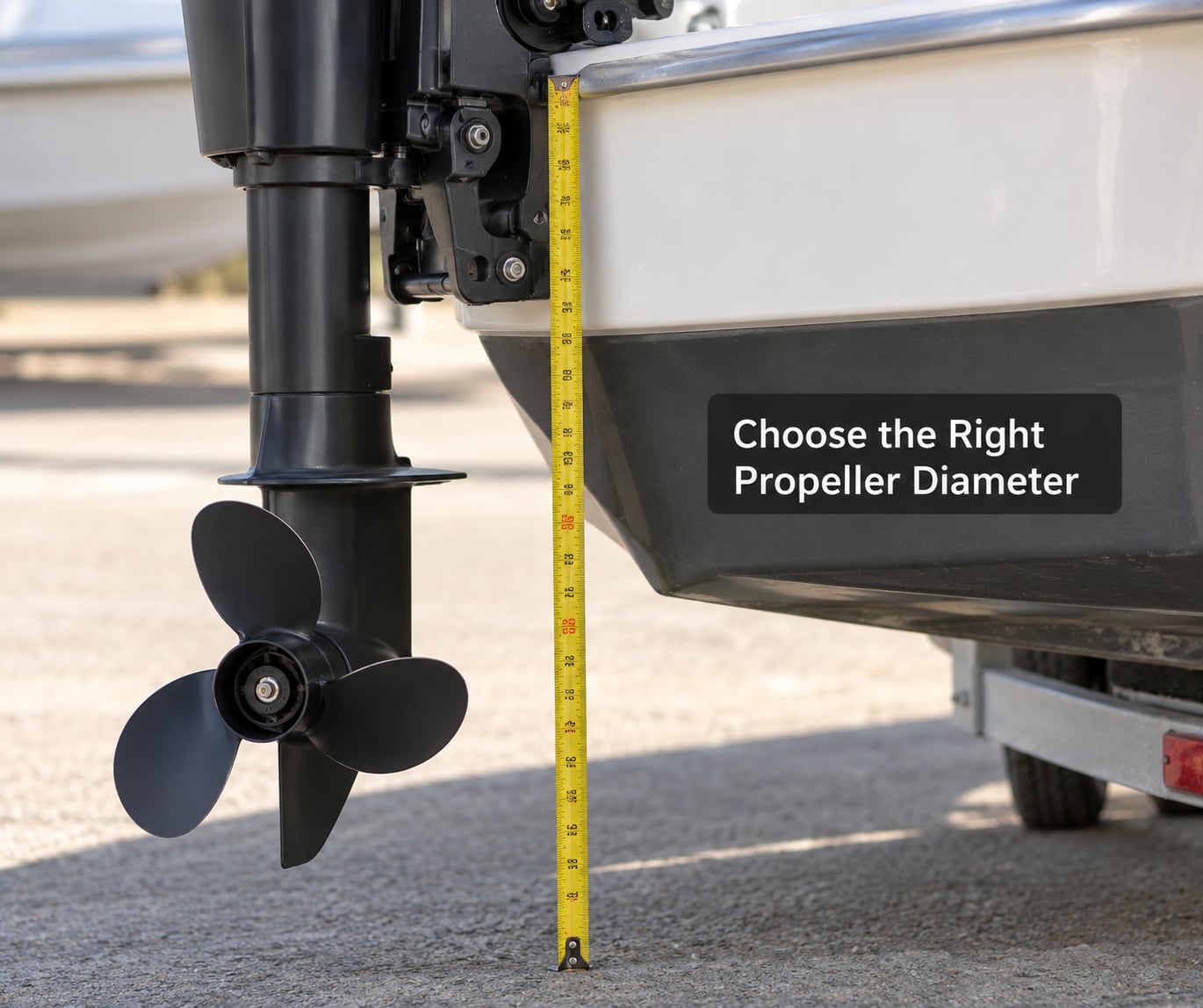
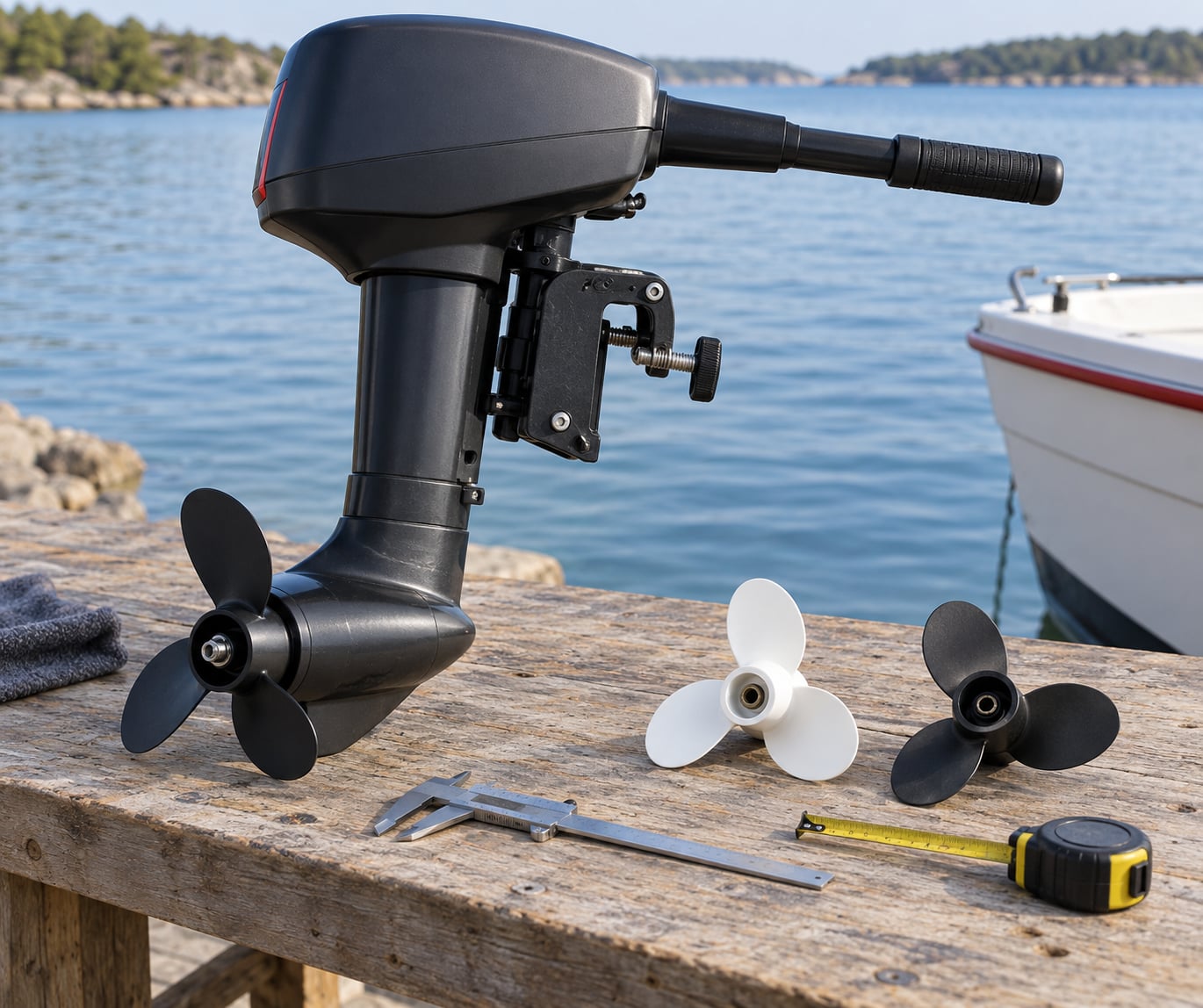
Diameter is the most intuitive of the three numbers, and it sets both thrust and shaft speed. A larger diameter moves more water per revolution, so it produces more thrust at lower RPM and queter running. A smaller diameter spins faster to move the same water, which is faster but louder and harder on the motor. You also cannot choose diameter freely: the prop has to clear the skeg, the rudder, the hull and the bottom paint at full lock.
Measure from the prop’s tip down to the lowest fixed point underneath the motor, then subtract the safe clearance your hull needs over rocks and sandbars. On a small electric outboard with no skeg at all, the cavitation plate becomes your limiting surface, and that is the number that dictates your maximum diameter.
Diameter also scales shaft speed inversely at a fixed boat speed. Swapping a 9-inch prop for a 10-inch prop of the same pitch drops shaft RPM by roughly ten percent for the same water speed. That is the single easiest way to quiet down a screaming electric motor.
Select a Pitch That Matches the Motor
Pitch is the distance the blade would advance in one revolution if it were a screw, and it is written right after the diameter: a 9×19 prop is 9 inches across with 19 inches of pitch. Low pitch means more thrust and slower speed; high pitch means more speed and much more load on the motor.
Electric motors invert the usual instinct to add pitch for more speed. They make their rated torque at low RPM and hold speed only as long as the prop load allows, so too much pitch does not give you more speed. It drags the motor down, forces the controller into current limit, converts your battery energy into heat and, on a thermal-limited controller, into shutdown. If you have never worked through how to choose a propeller for a small electric boat before, stay in the middle of the manufacturer’s range and move in steps of one or two inches of pitch, not six.
Pitch ratio, written as P/D, is a useful sanity check. Values around 0.9 to 1.3 are common on small displacement and semi-displacement craft, while planing hulls often run higher ratios to reach their hull speed. A very low ratio on a fast boat wastes thrust; a very high ratio on a slow boat makes it work for nothing.
| Diameter x pitch | Typical fit | How it behaves |
|---|---|---|
| 9 x 12 to 9 x 15 | Dinghy, tender, very shallow | Easy acceleration, low top speed, clears anything |
| 9 x 17 to 9 x 19 | Jon boat, small skiff, fishing | Workhorse choice for 2 to 3 kW motors |
| 10 x 17 to 10 x 20 | Larger jon boat, loaded pontoon | More thrust per rev, needs clearance and torque |
| 7 x 25 and higher pitch | Light planing skiff | Faster, needs hull to plane and motor torque |
Decide How Many Blades You Need
Two blades are the most efficient option per unit of thrust and the cheapest to buy, but they load the shaft harder in pulses and are fussier about cavitation at high RPM. Three blades are the usual compromise on small electric outboards: smoother power delivery, more thrust from the same diameter, and a much quieter run because the blade passes the hull less violently. Four blades add more blade area for the same diameter and further reduce vibration and cavitation, at the cost of efficiency and top speed.
For most small electric boats, two or three is the whole decision. Choose four only when cavitation is a persistent problem or when you want a very smooth, slow-speed trolling setup. Electric motors are quiet enough that blade-pass noise becomes the loudest thing on the boat, which nudges the choice toward three blades more often than it does with a gas outboard.
Check Material, Hub, and Shaft Compatibility
Aluminum is the default for electric outboards: light, cheap, and it bends rather than snaps if you hit something. Polymer props are also light and will not corrode, which makes them a good match for salt water or a boat that sits in a trailer. Stainless steel lasts longest and holds its pitch under the highest loads, but the added mass can hurt acceleration on a small craft, and galvanic corrosion between dissimilar metals in the water is worth watching.
The mechanical fit is where most cross-brand swaps fail. Props bolt to a hub set, and hub set numbers are manufacturer-specific, so a prop from a different electric outboard brand usually needs an adaptor kit rather than a set of bolts. Verify the shaft diameter, whether it is keyed or splined, the thread pattern, the hub set number, the rotation direction and whether the boat takes thrust forward or astern. A prop turned the wrong way will pull the boat backwards, which feels like a dead motor until you look at the rotation marking.
Test and Refine the Propeller Choice
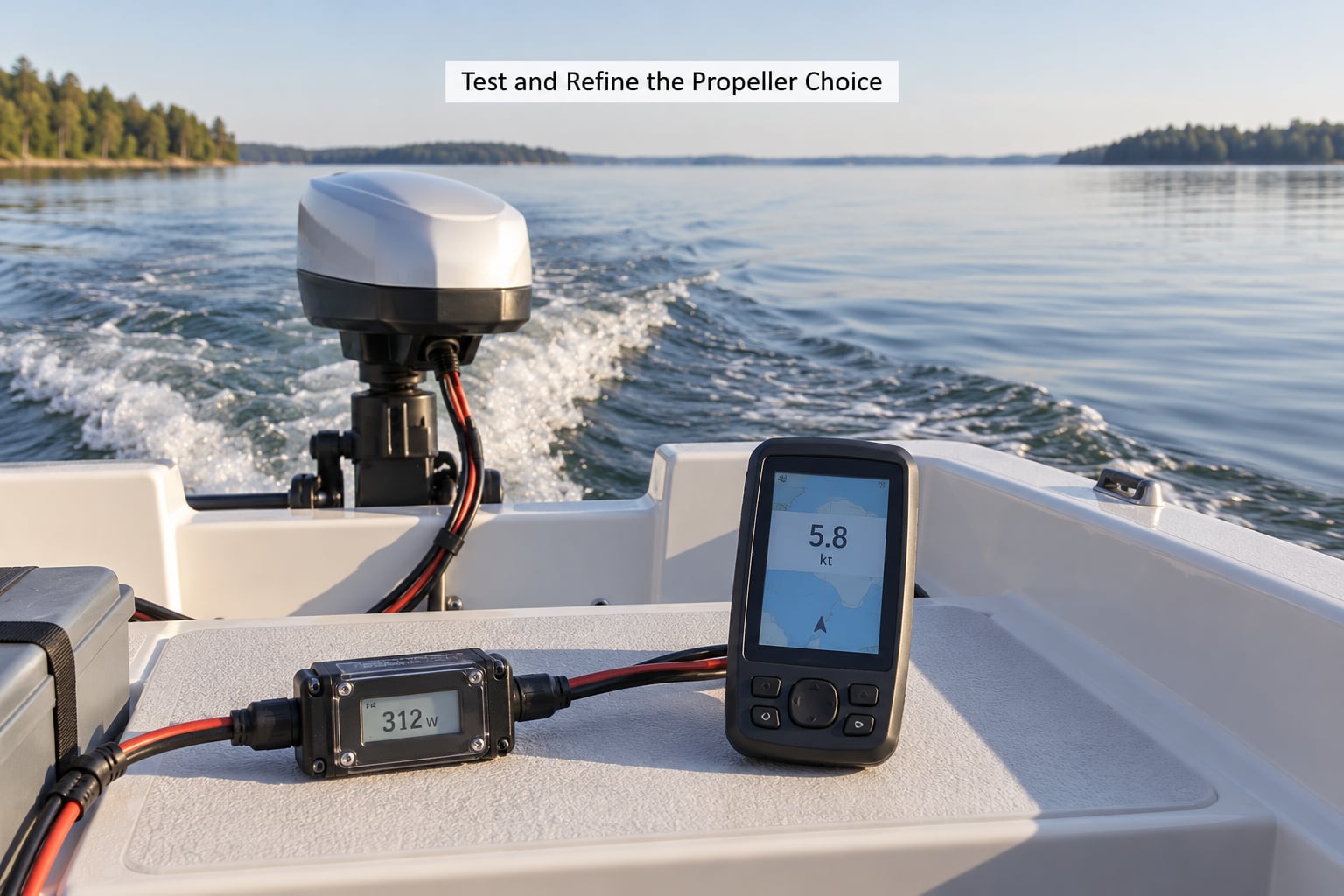
Test on a calm day, in flat water, at the throttle position you expect to cruise at. Record motor RPM if your controller reports it, GPS speed over a measured distance, and current draw at that throttle. Those three numbers taken with the stock propeller are your baseline, and without a baseline every later comparison is guesswork.
Then swap one variable at a time. If RPM sits well below the motor’s rated speed but current draw is high, the prop is pitched too high; drop one or two inches of pitch. If RPM is pinned at the controller limit while speed is disappointing, the prop is too large or too low in pitch; increase diameter or pitch by a small step. If you hear cavitation at cruise, go down in pitch or up in diameter before you change anything else. Keep a spare prop and a spare shaft in the boat, because both get lost in lakes regularly.
Safety note: remove the propeller before any work on the shaft, confirm the prop is positively retained by the tab washer and nut or the retaining hardware your motor specifies, and stay clear of a loose prop under power. Follow the motor manufacturer’s torque and retention instructions rather than general practice.
Common Mistakes
Most disappointing electric boat performance is a propeller problem, not a motor problem. These are the mistakes I see most often, with the correction for each.
- Guessing diameter by eye. People eyeball the gap between prop and hull instead of measuring to the skeg, rudder and cavitation plate. Measure from the prop tip to the lowest point underneath the motor at full steering lock, then subtract your grounding clearance.
- Adding pitch when speed is low. A higher pitch usually means more load and more heat, not more speed. Drop pitch by one or two inches first and re-measure.
- Ignoring the controller limit. If your controller caps current or speed, the motor can never make the power the propeller asks for. Check the current limit setting before you buy a propeller intended to use more power.
- Fitting a hub set that does not match. Bolts that almost fit will not seal, and an adapter kit from a different brand may not be rated for the shaft. Confirm the hub set number and shaft diameter before ordering.
- Overloading the battery. A propeller that demands more than the motor’s continuous rating pushes the bank into its C-rate limit, which shortens range and stresses the cells. Size for continuous draw, not peak.
- Comparing props under different conditions. A prop that felt slow with three people and a full tank of gas tells you nothing about the same prop with two people on a flat lake. Normalise the load before you judge.
- Using a planing prop on a displacement hull. High-ratio props on jon boats and dinghies waste battery at low speed. Match the prop type to the hull type, not to the motor’s top-end claim.
Frequently Asked Questions
How do I know what size propeller I need?
You cannot know from the boat length alone. You need loaded weight, hull type, motor power, motor and controller RPM limits, shaft and hub dimensions, and clearance to the skeg and cavitation plate. Use those inputs to pick a diameter that fits the available space, then choose the lowest pitch that still lets the motor reach its rated RPM at your target speed. Measure before and after you change anything.
Will a bigger propeller drain more battery on an electric boat?
Not automatically. A larger diameter at lower RPM often uses less energy for the same boat speed, because the motor works in its efficient range instead of spinning hard. A larger pitch, by contrast, loads the motor harder and pushes current draw up, cutting range. Compare watts per mile at a fixed GPS speed rather than judging by propeller size, and stay inside the controller’s continuous current limit.
Does propeller pitch matter the same way on an electric outboard as on a gas engine?
Not quite. A gas engine has to stay inside a rev range, so pitch is often tuned to hit peak power. An electric motor makes strong torque from a standstill and is usually limited by current and controller settings, not by a redline. That makes excessive pitch more damaging and less useful: the motor bogs, draws maximum current and gives you no extra speed. Start near the middle of the maker’s range.
What size propeller should I use in shallow water?
Diameter and clearance decide this, not pitch. Measure from the prop tip to the lowest fixed point under the motor, which on a small electric outboard is usually the cavitation plate or a short skeg, and keep enough clearance to pass over sandbars and rocks. Low pitch helps you power through weed, but a short-pitched prop still needs room to turn. Many makers publish a maximum propeller size for their transom height, and that limit is a hard ceiling.
Can I change the propeller on my electric outboard safely?
Yes, and it is the cheapest performance change you can make. Confirm the hub set number, shaft diameter, thread pattern and rotation direction match, fit any required adapter kit, and torque the retaining hardware to the manufacturer’s specification. If the shaft is splined, replace the prop rather than resizing the shaft. Always remove the prop before working on the shaft and never run a boat with a loose or untorqued prop.
Will a four-blade prop reduce cavitation?
Four blades give more blade area for the same diameter and smooth the power pulses, so they usually reduce cavitation and vibration compared with two blades. They cost some top speed and efficiency because each blade carries less load in cleaner water. For most small electric boats, fixing cavitation is better done by lowering pitch or increasing diameter. Three blades are usually the better first move, with four blades for very smooth slow-speed running.
Conclusion
Write down the loaded weight, motor rating, controller limits and your measured clearance first. From there, pick the largest diameter that fits the space, choose a mid-range pitch that lets the motor reach its rated RPM at your target speed, and start with two or three blades. Test it at cruise with a GPS and a current meter, then change one variable at a time. Most boats that feel slow or hot are running the wrong propeller, and fixing that costs less than a replacement motor and an afternoon of work.