You can measure boat speed without GPS by timing the boat over a known distance with a stopwatch, or by using an instrument that senses the water itself — a chip log, pitot tube, paddle wheel, electromagnetic log or ultrasonic sensor. The stopwatch method takes five minutes and no hardware; the instruments give you a continuous speed through the water reading all trip.
That last part matters. A stopwatch run between two buoys gives you speed over the ground, and current and wind will be baked into the number. Every mechanical or electronic log measures speed through the water, which is the figure you actually want when you are checking hull performance, judging trolling speed, or working somewhere satellites don’t reach.
Both belong in your toolkit. Here is how to decide which one fits your boat, then how to get a reading you can trust.
Table of Contents
- What You Need
- Step-by-Step: How to Measure Boat Speed Without GPS
- Tips for Reliable Non-GPS Boat Speed Readings
- Frequently Asked Questions
- What is the simplest way to measure boat speed without GPS?
- What is the difference between speed through water and speed over ground?
- Can I measure speed with my phone?
- Which non-GPS speedometer is most accurate?
- Does current make a non-GPS speed reading wrong?
- How do I calibrate a boat speedometer without GPS?
- Conclusion
What You Need
Everything below comes out of a hardware store, a chart table, or your own boat’s existing gear.
- A measured reference distance. Two charted marks, a pair of range buoys, or two fixed shoreline objects whose separation you have measured. A nautical mile is 1852 metres, or one minute of latitude on the chart.
- A timing device. A stopwatch, or a phone used strictly as a stopwatch. Turn on a screen-off timer so a stray unlock doesn’t stop the clock mid-run.
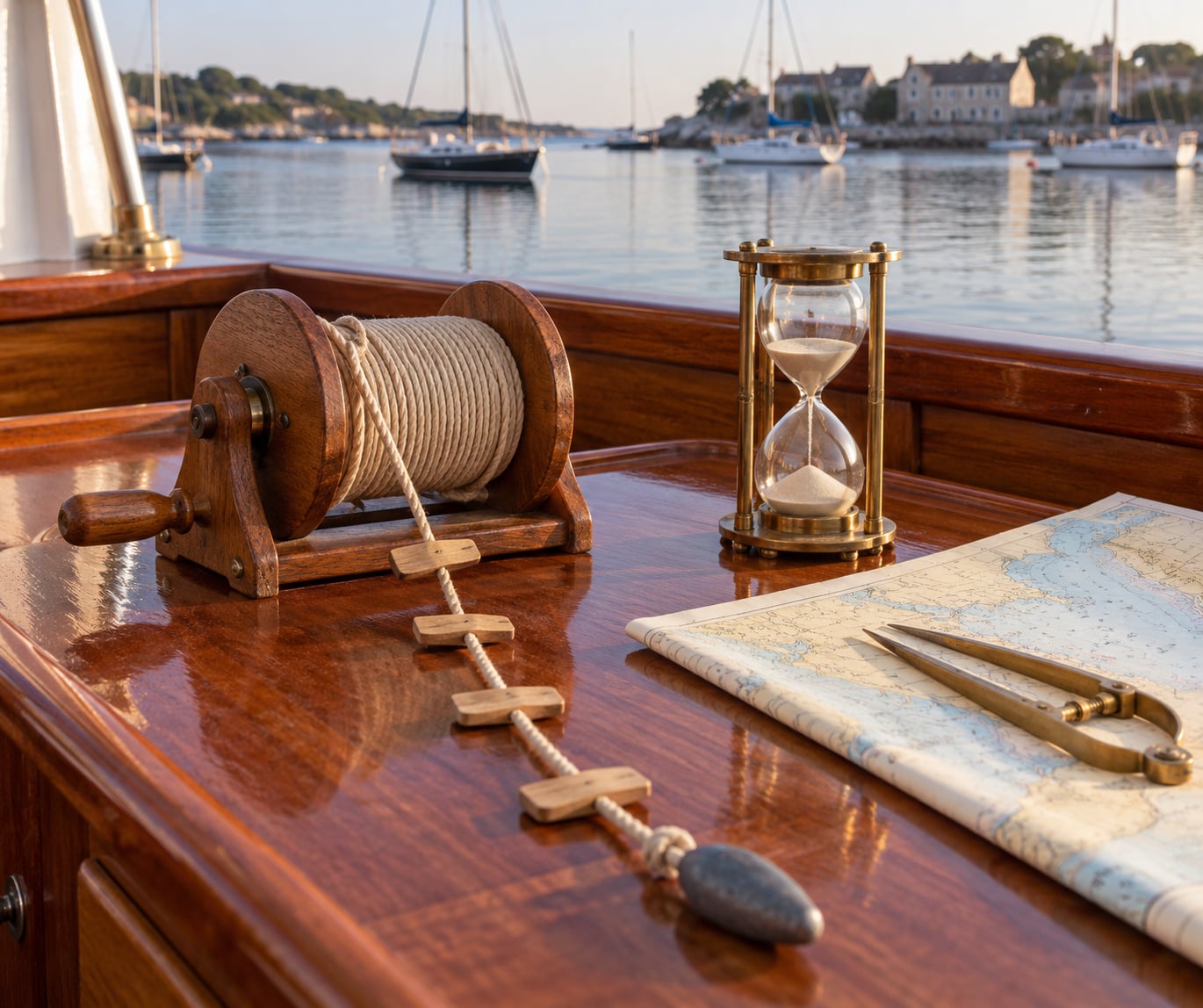
- A sensor, if you want continuous readings. A chip log and sand-glass, a pitometer log, a paddle wheel or turbine, an electromagnetic log, or an ultrasonic transit-time sensor. Model boats and small tenders often use a counting cup or streamer instead.
- Waterproof electrical parts. Marine-rated wire, heat-shrink, an adhesive-lined hull gland, and a fuse close to the battery. Anything you route through the hull gets this treatment.
- Basic hand tools. Screwdriver set, drill and hole saw for a through-hull fit, cable ties, and a sharp utility knife.
- A way to record runs. A notebook or a spreadsheet. You want timestamps and conditions, not just the number on the dial.
Step-by-Step: How to Measure Boat Speed Without GPS
Choose a Non-GPS Speed Measurement Method
Pick the method that matches how you’ll use the reading, not just how accurate you want it to be. A fishing boat that needs a trolling-speed check needs a through-hull paddle wheel. A race boat needs the stopwatch or an ultrasonic sensor because those read steady at planing speeds where a paddle wheel slips.
| Method | What it measures | Typical accuracy | Power | Install effort | Best for |
|---|---|---|---|---|---|
| Stopwatch over a measured distance | Speed over ground | 2-5% with care | None | None | Any boat, one-off checks, race timing |
| Chip log and sand-glass | Speed through water | 3-8% | None | Low, needs practice | Traditional vessels, dead reckoning, no power |
| Pitot-tube or pitometer log | Speed through water | 3-5% | None for the mechanical original | Moderate, needs a straight run | Powerboats under about 25 knots |
| Paddle wheel or turbine | Speed through water | 2-5% when clean | 12V typically | Through-hull or over-hull fitting | Cruisers, trolling, engine checks |
| Electromagnetic log | Speed through water | 1-2% | 12/24V | High, needs a calibrated install | Larger yachts and commercial craft |
| Ultrasonic transit-time sensor | Speed through water | Under 1% | 12V | Moderate, two transducers aligned | High-speed boats, performance work |
| Doppler acoustic device | Speed through water, or over ground if bottom-locked | 2-5% | Varies | Varies | Underwater vehicles, lifeboats, no-fixed-instrument work |
One table, one decision. If you only need a number today, use the stopwatch. If you need the number every time you leave the dock, install a log.
Prepare the Boat and Test Area
Find the mounting location before you drill anything. A through-hull paddle wheel wants clean water ahead of the strut, forward of the prop and clear of the wake, with the correct hole size and a backing nut on the inside. A pitot tube needs a straight run with no through-hulls, sea chests or lifting eyes in the boundary layer ahead of it.
Choose flat water and light air. A following sea at 20 knots will load and unload a paddle wheel alternately, and the reading will wander even though the boat is steady. In a crosswind, the boat makes leeway and the water moving past the hull is no longer the water you are pointing at.
For a stopwatch run, measure your baseline first. Two large fixed objects beat two small buoys, because a small mark is easy to cross at the wrong angle. Note the wind, the sea state, and whether the tide is running before you start.
Install and Calibrate the Selected Sensor
Mount the sensor where the manufacturer’s diagram says, then sanity-check that placement against reality. Paddle wheels read low when they are aerated by surface turbulence, which happens if the boat is planing, pitching hard, or fitted too high on the hull. They also read low when fouled with weed or slime, so keep the tip in clean water and give the boat a good shake after every outing.
Pitot tubes read low when mounted in disturbed air, which is why you want them ahead of any bow fitting and well below the deck where spray hits. Ultrasonic sensors need both transducers aligned fore and aft, clear of any step or wake, and the hull needs filling with the correct sealant before it goes in the water.
Calibrate against something independent. The classic method is a measured mile: pick two surveyed marks a nautical mile apart on a straight bearing, run at a steady throttle, and time the transit. Run it three times in both directions and average. The current cancels between an inbound and an outbound leg, which is the whole reason for running both ways.
Adjust the instrument’s calibration factor until the readout matches your averaged measured-mile figure, then leave it alone until conditions change.
Take Measurements and Calculate Speed
The math is short. Speed equals distance divided by time. For the stopwatch method, measure your course in nautical miles and time the run in seconds, then convert: speed in knots = (distance in nautical miles × 3600) ÷ elapsed seconds.
A worked example. You run a one-nautical-mile course in 5 minutes and 12 seconds, which is 312 seconds. 3600 ÷ 312 = 11.5 knots. Run it back the other way in 5 minutes and 6 seconds, or 306 seconds, and 3600 ÷ 306 = 11.8 knots. Average the two and you have about 11.6 knots through the water with the current largely cancelled.
Keep the timing honest: start on the mark clearing the bow, stop when the same mark reaches the stern or abeam, and be consistent about which point you use every run. Alternate engines and add a second person’s timing when you can. Three good runs averaged will beat one run you felt good about.
With a sensor fitted, the sensor does the division and the display does the conversion. Your job shifts to logging: record speed at a fixed engine setting, a fixed throttle angle and a fixed time after settling onto plane, so you can compare numbers between trips.
Validate the Reading Against a Known Reference
Validation is where most mistakes surface, so check every reading against something else. A stopwatch run and a pitot or paddle wheel reading on the same straight leg should agree within a few percent. If they don’t, one of them is fouled, aerated or being read from the wrong side of a bend.
Use hull speed as a free independent check. The classic formula is hull speed in knots = 1.3 × the square root of the waterline length in feet. A boat with a 20-foot waterline should do about 1.3 × 4.47 = 5.8 knots. If your instrument claims 22 knots on a hull that is only displacing at that speed, the instrument is wrong, not the boat.
Account for the environment when comparing numbers. Current adds or subtracts from your speed over ground, and in a river it can reach several knots. Wind matters enormously for a sailboat and barely at all for a powerboat on a straight reach. Sea state adds noise to any mechanical sensor. When the two readings disagree in a known current, the through-water instrument is usually the right one.
Common Mistakes
Most bad non-GPS readings come from the same handful of errors.
- Sensor placed in disturbed water. Move it ahead of the wake, below the prop wash, and clear of any turbulence source. Fix: relocate, then re-run the measured mile.
- Air bubbles in the sensor. Blowing through an ultrasonic head or a partially drained pitot line gives a wild reading. Fix: fill and bleed the unit until it holds steady at rest.
- Poor zeroing. A sensor that reads 0.4 knots with the boat stopped will read high all trip. Fix: zero it in clean, still water before every session.
- Timing the wrong mark. Starting when the buoy is abeam rather than at the bow adds a few percent every time. Fix: pick one reference point and never change it.
- Guessing the distance. Eyeballing “about a mile” ruins the calculation. Fix: use charted marks, a survey range, or measure with a wheel or GPS once and write the number down for later.
- Ignoring current. A one-way run in a 2-knot ebb reads fast or slow depending on direction. Fix: run both directions and average.
- Line stretch on a chip log. A log-line that has been wet and dried will read long, so the vessel appears fast. Fix: re-mark the line against a measured distance every season.
Tips for Reliable Non-GPS Boat Speed Readings
A sensor is a maintenance item, not a set-and-forget instrument. Clean a paddle wheel and an ultrasonic head every few trips, and more often in weed. Look for slime, eel grass and biofilm, and check that the impeller spins freely by hand with the power off.
Log every session. A column for speed, engine setting, time, wind, sea state and tide is enough to catch a drift in accuracy long before you notice it on the gauge. Repeat runs in the same conditions; if your logged figure moves 10% between trips in the same conditions, the sensor is fouling or the calibration is off.
Verify the electrical side twice a year: battery terminals clean and tight, connector coated, and the fuse still the right rating. Moisture in a through-hull gland is the fastest way to turn a good sensor into a liability.
Cross-check with a second method on purpose, not by accident. A pitometer log and a paddle wheel will disagree when one of them is fouling, and that disagreement is useful information. If you want a genuinely independent test, compare against the stopwatch run on a measured course at least once a season.
Frequently Asked Questions
What is the simplest way to measure boat speed without GPS?
Time the boat over a measured distance with a stopwatch. Mark two fixed points, hold a steady throttle, start the clock as the near mark passes your bow and stop it as the far mark reaches the same point. Speed in knots equals distance in nautical miles multiplied by 3600, divided by elapsed seconds. Run it both directions and average out the current. No hardware, no power, about five minutes.
What is the difference between speed through water and speed over ground?
Speed through water is how fast the hull is moving relative to the water it sits in, and it is what every non-GPS instrument reports. Speed over ground is how fast the boat moves across the earth, which a satellite receiver derives from position fixes. Wind, current and leeway separate the two. When you are trolling or judging hull performance, through-water speed is the figure that matters.
Can I measure speed with my phone?
Yes, as a stopwatch and as a rough independent estimate. Time a run over a distance you have already measured and do the division yourself, which is genuinely non-GPS even though the phone has a receiver. Accelerometer apps that report speed need GPS ground speed to calibrate, so they do not serve a no-signal run. Video frame counting between two fixed marks is another option, but it is a stopwatch in disguise.
Which non-GPS speedometer is most accurate?
Among through-water instruments, ultrasonic transit-time sensors are usually the most accurate, commonly under 1% when properly installed, and they hold up at planing speeds. Electromagnetic logs come next at roughly 1-2%, but they are expensive and demand a calibrated installation. Pitot and paddle wheel instruments sit around 3-5% when clean and well mounted. Accuracy depends far more on installation quality than on the instrument brand.
Does current make a non-GPS speed reading wrong?
It depends which reading you have. Current has no effect on speed through water, because the sensor measures the water moving past the hull. It does change speed over ground, so a stopwatch run in a two-knot ebb tide reads low going with the current and high against it. If you only have one direction of stopwatch runs, the figure carries that error. Timing both directions and averaging removes most of it.
How do I calibrate a boat speedometer without GPS?
Use a measured mile. Pick two surveyed marks a nautical mile apart on a straight bearing, run at a steady throttle after letting the boat settle, and time the transit. Repeat three times outbound and three times inbound, then average the pair of directions so current cancels. Adjust the instrument’s calibration factor until it matches that figure, and re-check whenever fouling or a hull change could have shifted the calibration.
Conclusion
Start with the stopwatch. Measure a distance between two fixed marks, time a steady run in both directions, average them, and divide distance by time. That gives you a real speed figure in ten minutes with nothing to install and nothing to power.
If you want a number every time you get under way, pick a through-water log that suits the hull — a paddle wheel for cruising and trolling, an ultrasonic sensor for a fast boat, a pitometer for a simple powerboat under about 25 knots. Calibrate it against a measured mile, keep the sensor clean, and check your work against the hull-speed formula before you trust it.
One honest caveat: none of these replace GPS for navigation, because they report how fast you are moving through water, not where you are. Pair them, and the pair covers conditions where either one alone would leave you guessing.