Short answer: you can cut, sand and lay up carbon fiber safely, and the method is simple — stop the dust at the source with wet cutting or local extraction, then wear a proper particulate respirator, eye protection and gloves as your second layer. Carbon fiber is a reinforcement made of graphite filaments roughly 5-7 microns thick, bundled into cloth or sheet and bonded with epoxy to form what the industry calls CFRP. The dust it produces is solid fragments, not a gas, and it is small enough to reach deep into the lungs.
Updated for 2026, this guide walks through the whole job: what to wear, how to set up the bench, how to cut and sand without filling the room with black dust, how to handle resin without getting sensitized, and what to do with the waste. Classifications and product formulations change, so treat the safety data sheet that ships with your specific material as the final word over anything written here.
Table of Contents
- What You Need
- Step-by-Step: How to Work With Carbon Fiber Safely
- Common Mistakes
- Cutting with no local extraction
- Using compressed air or a blower to clean the bench
- Using a standard shop vacuum on carbon dust
- Wearing damaged or the wrong gloves
- Sanding or routing across the laminate with a belt sander
- Storing offcuts loosely or leaving dust to accumulate
- Skipping the SDS because the product looks harmless
- Frequently Asked Questions
- Is it safe to breathe in carbon fiber dust?
- Are carbon fiber particles carcinogenic?
- Do I need a respirator to cut carbon fiber?
- Can I use a household shop vacuum to collect carbon dust?
- Does wet cutting and wet drilling really reduce carbon fiber dust?
- How do you clean carbon fiber dust off your hands, and what about splinters?
- Conclusion
What You Need
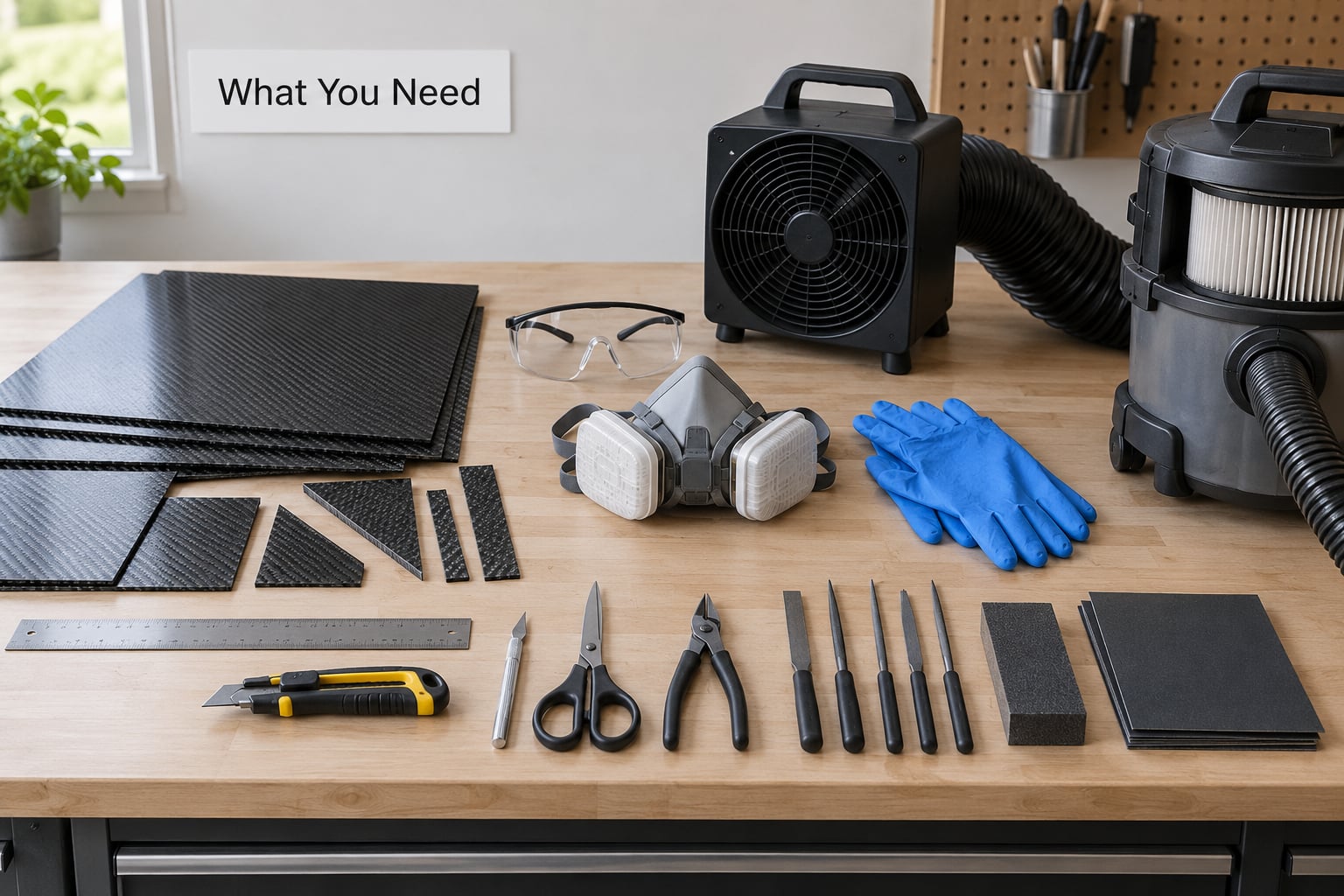
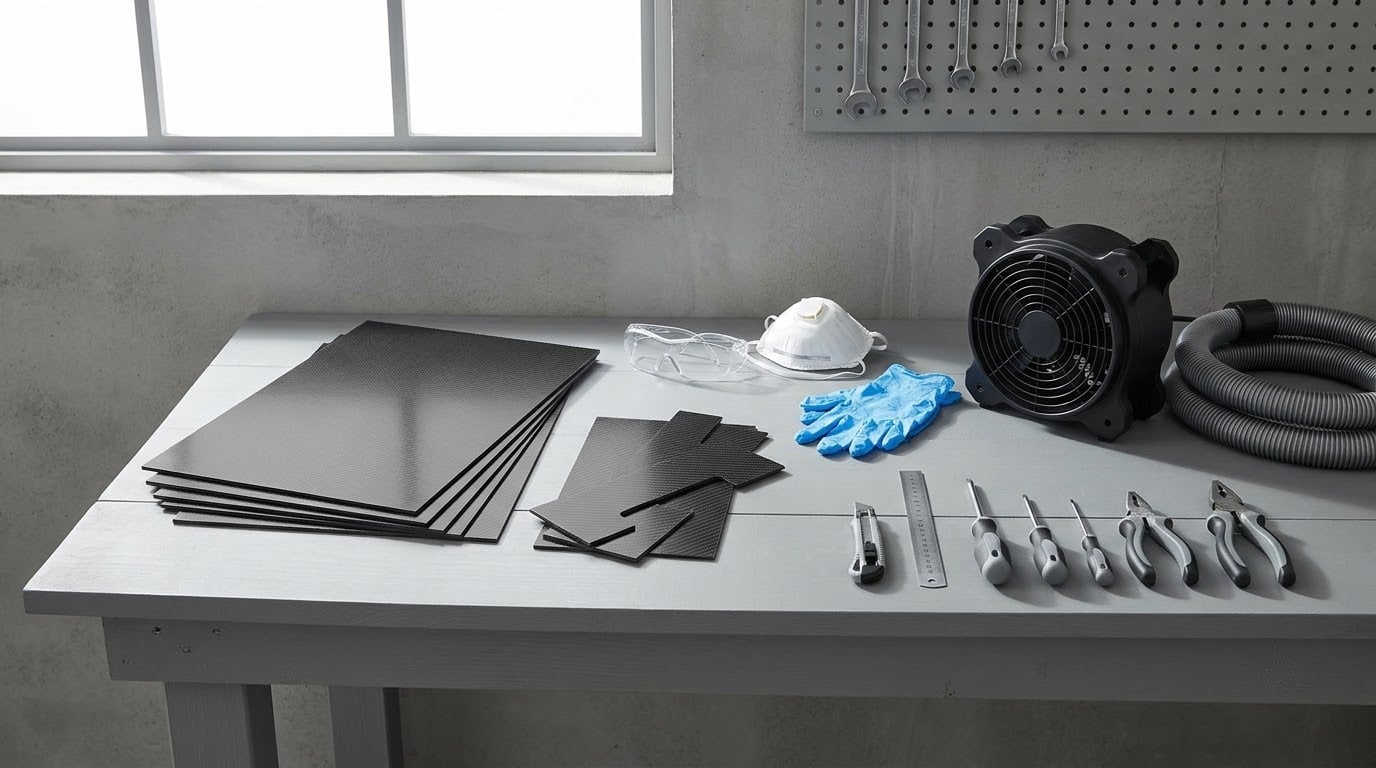
The equipment list for carbon work is short and mostly cheap. The expensive mistake is buying a good respirator and then cutting dry material in a closed room, because PPE is the last layer, not the first.
Respiratory protection
For any task that makes airborne dust — cutting, drilling, sanding, routing, trimming — use a NIOSH-approved particulate respirator. An N95 handles light trimming and low-dust cleanup; a P100 is the sensible default for sanding, routing and CNC work because it filters finer particles at a higher efficiency.
Fit testing matters more than the class printed on the box. A disposable folding mask that gaps at the cheeks delivers a fraction of its rated protection, and users on woodworking forums report throat pain that lingers for days after sanding in a loose-fitting N95.
Chemical vapor is a different problem and needs a different filter. An activated carbon cartridge or a supplied particulate plus vapor (PHE/PV) cartridge covers epoxy vapors during resin work and spray application. A plain particulate filter does nothing for vapors, and that mix-up is the most common respirator error I see.
Eye, hand and body protection
- Safety goggles for cutting, drilling and sanding. A face shield is useful on top when routing or grinding, since carbon dust is pitch black and shows up instantly in the eye.
- Nitrile gloves for handling wet laminate, resin and uncured cloth. Bare hands pick up fibers that behave like tiny splinters.
- Long sleeves or a coverall for sanding and routing. Carbon dust works its way into cuffs and onto forearms where you then scratch.
- Hearing protection whenever a router, grinder or table saw is running.
Ventilation and dust control
A respirator handles what reaches your face. Only capture at the source handles what leaves the tool. For most home shops that means a combination of wet methods, a vacuum with a genuinely fine filter, and moving filtered air away from your breathing zone.
- Wet cutting and wet drilling — a bottle, a squeeze bottle or a misting nozzle keeps fiber dust from becoming airborne at all. Water-fed cutting is exactly what composite manufacturers use for the same reason.
- A vacuum with a fine filter connected directly to a sanding drum, router shroud or drill hole. Standard shop vac filters are designed for wood chips, not for 5-micron fibers, and they exhaust fine dust back into the room.
- A portable exhaust fan set to pull air from the bench area toward a window or an open doorway — air moving away from you, never across your face.
- A folding downdraft or filtered enclosure for sanding sessions, or simply working outside on a dry day, which beats most improvised indoor arrangements.
Tools and workspace controls
Keep a cutting mat and a clean sacrificial surface under the work, a dust collection point within arm’s reach, sealed bags or a lidded bin for offcuts, a brush and vacuum for cleanup, and a dedicated pair of nitrile gloves kept away from your phone and your tools.
The task-to-PPE matrix
Print this one or screenshot it, because it maps protection to the actual task in front of you rather than to a generic workshop. Most safety advice tells you to wear a mask; this tells you which mask, and what else has to be running at the same time.
| Task | Required PPE | Ventilation and dust control | Wet method usable? | Waste handling |
|---|---|---|---|---|
| Cutting sheet with a saw or knife | Goggles, N95 or P100, nitrile gloves | Exhaust fan away from face | Yes — wet saw | Sealed offcut bin |
| Drilling or countersinking | Goggles, P100, gloves, hearing protection | Vacuum hose on the hole or wet drilling | Yes | Filter vacuum canister |
| Sanding a cured laminate | Goggles, P100, sleeves or coverall | Vacuum shroud plus fan | Wet sanding where the adhesive allows | Filter canister, sealed |
| Routing or CNC machining | Goggles, P100, hearing protection, coverall | Shrouded router or spindle extraction | Coolant flood where compatible | Wet-trapped chips or filtered drum |
| Hand layup with epoxy | Nitrile gloves, goggles, sleeves | General ventilation, no respirator needed for low vapour work | Not applicable | Cured part or hazardous resin waste rules |
| Spraying resin, primer or clear coat | Full-face or half-face respirator with organic vapor cartridge, goggles, chemical-resistant gloves | Mandatory extraction or outdoor spray | Not applicable | Follow the coating SDS for disposal |
| Clean-up | N95 minimum, gloves | Fan running | Damp wipe first | Sealed double bagging |
Step-by-Step: How to Work With Carbon Fiber Safely
1. Prepare the Workspace and Check the Material
Start by identifying what you actually have, because the hazards differ. Dry cloth and prepreg off the roll shed loose fiber. A cured CFRP part is inert until you disturb it with a tool. A tube with a gel coat behaves differently again from a machined plate.
Read the safety data sheet before the material is opened. Section 2 gives hazard classification, Section 4 covers first aid, Section 7 handling and storage, Section 8 exposure controls and PPE, Section 11 toxicity. Supplier SDS wording is consistent enough to be recognizable — carbon fiber suppliers typically list may cause mechanical irritation of the mouth, nose and throat, along with eye and skin irritation in initially exposed individuals.
Next, control the room. Close the door to the rest of the house, open a window on the far wall, position your exhaust fan so it draws from the bench toward that window, and lay a clean sheet or cutting mat over the bench. Move anything you do not want covered in fine black dust — laptops, keyboards, coffee mugs — out of the room first.
Safety check: before any tool starts, you should be able to point to the air moving away from your face, the vacuum or wet supply within reach, and the sealed bin waiting under the offcut end of the material.
2. Use the Right Personal Protective Equipment
PPE protects you when the engineering controls are imperfect. It does not replace them, and a well-fitted respirator in a cloud of dust is a last resort, not a plan.
Do a positive seal check every time you put a respirator on: cover the filter area and inhale gently. If air leaks around the edge, the seal is not there and the rating means nothing. Users report pulling respirators down to scratch an itch or talk on the phone mid-task; that single break undoes the protection more effectively than a slightly wrong filter class.
For skin, gloves matter most during layup and cleanup rather than cutting. Nitrile is the right default because uncured epoxy will soak through thin cotton. Change gloves between resin work and sanding, and never take resin-soaked gloves off with bare fingers pulling at the cuff — peel them off inside out and wash your hands straight away.
Safety check: before the first cut, seal-test the respirator, confirm goggles are on, sleeves are down, and the gloves you are wearing suit the task in front of you.
3. Cut Carbon Fiber Safely and Without Creating Sharp Edges
Cutting is the moment dust becomes airborne and edges become sharp. The safest carbon cut is a wet one with a guarded blade and a supported workpiece.
Support the material on both sides of the cut line so it cannot pinch the blade or flex into the guard. A sheet bridging a gap will kick back or splinter, and a sharp graphite splinter in a hand is a genuine problem rather than a joke. Clamp to a flat surface, keep your fingers well back from the line of the cut, and let the tool do the work at a moderate feed rate.
Use wet cutting wherever the material allows it: a wet saw with a coolant line, a misting nozzle, or a spray bottle and a slow cut. Wet carbon produces a residue on the bench rather than airborne dust, and the same water-fed approach is what manufacturers use for exactly this reason.
Finish every edge. Grind or sand the cut line to blunt exposed filaments, because an unfinished carbon edge leaves fibers standing up like fish hooks waiting to embed in skin. A scraper or 180-grit paper over the edge takes seconds and removes a real injury path.
For curved parts and tubes, route with a dust shroud or cut with a fine-toothed blade at low speed and heavy lubrication. Avoid cutting dry carbon with a high-speed abrasive wheel indoors; that is the fastest way to fill a room with fine black dust and a poor reason to reach for the shop vac.
Safety check: stop and look at the cut. If dust is drifting visibly, or you can see fiber fuzz standing proud of the edge, your control is not working yet — fix extraction or add water before continuing.
4. Drill, Sand, and Machine with Controlled Dust
Drilling carbon is less forgiving than drilling metal. The material is abrasive, it can chip and split, and drill bits heat up fast enough to generate dust and smoke.
Wet drilling is the straightforward answer. A sponge soaked in water on the panel, a misting bottle, or a pump sprayer keeps dust down and cools the bit at the same time. Back the panel with a sacrificial wooden block so the bit cannot punch through and splinter the exit face, and clamp the work so it cannot spin when the bit grabs.
Sanding is the biggest dust generator in the whole process. A random-orbit sander throws more airborne dust than a router does. Put the vacuum hose directly on the sanding pad or work inside a shroud, use a filtered canister rather than a standard one, and keep a P100 on your face. Never sand across the laminate with a belt sander — it will gouge the fibers and turn a cleanup job into a removal job.
Wet sanding works on cured parts with a stable matrix, but it needs the abrasive to be water-compatible and it produces slurry rather than dust, which still has to be contained. Test a hidden corner first, because some epoxies are moisture-sensitive and a wet belt will soften the surface.
For routing and CNC work, shroud the spindle or use a vacuum adapter, feed slowly, and let the chip evacuate. Composite dust is lighter than wood dust and travels; a shop vacuum whose exhaust vents back into the room makes the problem worse while feeling like you are cleaning.
Safety check: run the tool for ten seconds, stop, and look at the surfaces around the bench. Dust on horizontal surfaces ten feet away means the extraction is not capturing and needs a shroud, a wet supply, or a move outdoors before you go further.
5. Join, Seal, and Finish Carbon Fiber Safely
Adhesives and coatings are where the formal hazard classifications live. Carbon fiber dust is generally treated as an irritant — a carbon manufacturer representative stated on a professional forum that the scientific community does not class carbon fibre particles as carcinogenic or as a hazardous substance, while still warning against inhaling them. Epoxy resin, by contrast, appears on the EU harmonised list of hazardous substances and is a recognized skin sensitizer, which is the point forum users keep raising and hobbyist guides keep skipping.
Read the resin SDS before mixing. Work in a ventilated area, measure accurately rather than by eye, and wear nitrile gloves and eye protection. Some hardeners are amine-cured and can burn skin and eye tissue on contact; sensitization, once it happens, is permanent and shows up as a rash that starts weeks after the exposure.
Watch the exotherm. Thick masses of epoxy generate their own heat as they cure, and a pot or a heavily reinforced part can climb past the flash point of the resin if you leave it sitting in a pile. Cure in a controlled, ventilated space with the part on a heat-tolerant surface, follow the published cure schedule, and never accelerate a cure with an improvised heat source you have not cleared.
Spray work is a different category again. Aerosolized epoxy, primer and clear coat require a respirator with an organic vapor cartridge and mandatory extraction or outdoor application. Follow the coating’s own SDS for cure times, overspray control and disposal, and skip any shortcut the manufacturer did not write down.
Keep carbon from getting hot enough to decompose. Burned resin produces acrid fumes, and overheating a laminate can give off smoke that is far more irritating than the dust you have been careful about all day.
Safety check: read the can or the tub before the timer starts. You should be able to name the required glove material, the required respirator cartridge, the required cure time and the required ventilation for the exact product in front of you.
6. Clean Up and Store the Work Area
Cleanup is where most of the exposure happens, because the bench gets cleaned fast at the end of a session and carefully at the start of the next one.
Dampen surfaces first. A barely damp rag or a mist of water turns settled dust back into a manageable residue instead of lifting it into the air. Then wipe, then vacuum with a filtered unit, working from the far end of the bench toward the fan so you are not standing in the disturbed zone.
Never use compressed air or a blower. It does not remove dust, it redistributes it, and it drives fine particles into the room and into your breathing zone. This is the single most common mistake in small workshops and it is worth repeating: a shop vacuum without a fine filter exhausts most of what it collects.
Handle your clothing as contaminated. Shake dust out outdoors rather than in the garage, and launder work clothing separately. Wash hands and forearms with soap and a stiff brush — the embedded fragments that people describe as stuck in the skin do come out with soap and a brush, not by scrubbing harder with soap alone.
Contain waste properly. Dust goes into a sealed canister or a double-bagged tied sack; offcuts go into a lidded bin or a closed container. Do not leave loose carbon cloth draped over a bench, where it sheds fiber every time someone brushes past.
Store material flat, dry and covered, off the floor and away from solvents. Carbon fiber is electrically conductive, so keep it away from exposed elements, and ground your setup if you are working near mains-powered equipment with loose fiber in the air.
Safety check: leave the room and come back. No visible dust on horizontal surfaces, nothing drifting in the light from the window, and the bin closed.
Common Mistakes
Most carbon injuries and most carbon dust clouds trace back to one of these.
Cutting with no local extraction
A garage door open across the lot is not extraction. Fiber dust settles on everything within a few meters and stays there until it is disturbed. Fix: an exhaust fan pulling toward an opening, or move the job outside, before the first cut rather than after you notice the haze.
Using compressed air or a blower to clean the bench
This moves dust rather than removing it and puts you directly in the cloud. Fix: dampen, wipe, then vacuum with a fine filter. No shortcuts back to the air gun.
Using a standard shop vacuum on carbon dust
Wood-rated filters are not fine enough for 5-micron fibers and can exhaust the load right back out. Fix: a HEPA-rated or fine-filter unit, emptied outdoors, with the canister handled as contaminated waste.
Wearing damaged or the wrong gloves
Holes at the fingertips, or thin cotton that resin soaks straight through, are decoration rather than protection. Fix: nitrile gloves, inspected, changed between resin work and sanding.
Sanding or routing across the laminate with a belt sander
It cuts fibers, lifts the matrix and multiplies the dust. Fix: random-orbit with a shroud for flattening, hand sanding for edges, and a spot of patience where it matters.
Storing offcuts loosely or leaving dust to accumulate
Loose cloth on a bench keeps releasing fiber for weeks. Fix: lidded bin for offcuts, sealed bags for dust, and a wipe-down at the end of every session.
Skipping the SDS because the product looks harmless
The carbon looks like black cloth and the resin looks like honey. The hazard information lives in Section 2 and Section 8 of the sheet, and it takes two minutes to read. Fix: read it before the first mix, and again whenever you change product.
Frequently Asked Questions
Is it safe to breathe in carbon fiber dust?
No, and you cannot see the fraction that matters. Carbon fiber dust is solid graphite fragments, and the finest particles are small enough to reach the lower lungs. Supplier safety data sheets list mechanical irritation of the mouth, nose and throat. Keep dust from becoming airborne with wet cutting or a filtered vacuum, then use a P100 as your backstop. Occasional dust exposure is a very different situation from years of it.
Are carbon fiber particles carcinogenic?
Carbon fiber dust is generally classified as an irritant, not a carcinogen. A carbon manufacturer representative stated publicly that the scientific community does not class carbon fibre particles as carcinogenic or as a hazardous substance, while still advising against inhaling them. The component that usually carries the formal hazardous classification is the epoxy resin, which is a known skin sensitizer. Classifications can be revised, so check the SDS for the specific material you are holding.
Do I need a respirator to cut carbon fiber?
Yes, for any dry operation that produces dust. An N95 suits light trimming and general cleanup; a P100 is the better default for sanding, routing, drilling and CNC work. Fit is the part people get wrong, so seal-test each time by covering the filter and inhaling gently. Remember that a particulate filter does nothing for epoxy vapors, which need an activated carbon or particulate plus vapor cartridge.
Can I use a household shop vacuum to collect carbon dust?
Usually not, unless it has a HEPA-rated or fine filter. Standard wood-shop filters are built for chips and sawdust and will exhaust finer particles back into the room, which gives you a clean-looking bench and a contaminated shop. A shrouded sander or router connected to a fine-filter unit works well. Empty the canister outdoors, seal it, and treat it as contaminated waste.
Does wet cutting and wet drilling really reduce carbon fiber dust?
It does, and it is the primary control rather than a fallback. A wet saw, a misting nozzle or a pump sprayer keeps fiber dust from lifting at all, turning what would be airborne dust into a residue you can wipe up. Water-fed cutting is standard practice in composite manufacturing for the same reason. Wet sanding works on many cured laminates too, though it needs a water-compatible abrasive and a corner test first.
How do you clean carbon fiber dust off your hands, and what about splinters?
Wash with soap and use a stiff brush, working at the fingertips and under the nails where the fragments settle. Dry wiping or solvents make it worse by driving fragments into the skin. If a fragment stays embedded, treat it as a splinter: clean the area, use tweezers on a shallow one, and see a clinician for anything deep or in an eye. Persistent symptoms after a dusty session are worth a doctor’s call too.
Conclusion
If you take one action from this guide, make it the first one: set up capture before the first cut. Wet methods and a filtered vacuum close the source, a P100 and goggles handle what escapes, and everything else on the list is refinement.
The order to remember is eliminate, contain, protect, clean. Eliminate the dust with water or a shroud, contain what remains with extraction, protect your face and hands, then clean the bench wet and bag the waste. Work through the matrix table task by task, and follow the safety data sheet that ships with your specific fiber and resin, because those classifications change as formulations do.