How carbon fiber is used in boat building comes down to one idea: a hull that is stiff without being heavy. Carbon fiber reinforced polymer (CFRP) is not a sheet of solid material. It is thousands of stiff carbon filaments bundled into tows, woven or aligned into sheets, and locked together by a polymer resin. Boats made from it use that composite as a skin over a lightweight core, so stiffness comes from the fibers and the shape comes from the mold. Whether that is worth doing depends almost entirely on what you are building and what loads it has to carry.
Table of Contents
- Why Boat Builders Use Carbon Fiber
- How Carbon Fiber Is Used in Boat Building
- Carbon Fiber Cloth, Composite, and Core Materials
- How Different Boat Parts Are Built
- Choosing Fabric, Resin, and Core for the Job
- Weight Savings, Stiffness, and Performance
- Fabrication, Bonding, and Quality Control
- Repairs, Recommissioning, and Damage Assessment
- Safety, Durability, and Common Design Mistakes
- Frequently Asked Questions
- Conclusion: Start With the Loading Requirements
Why Boat Builders Use Carbon Fiber
Boat builders reach for carbon fiber because of its stiffness-to-weight ratio, not because it is strong in the abstract. A carbon laminate puts roughly 230 to 250 GPa of tensile modulus into a material with a density near 1.76 g/cm3, which is about a quarter the density of concrete.
The useful part is the combination. A hull made from carbon can be measurably lighter and much stiffer than the same hull in fiberglass, and it will not rust, rot, or lose strength from salt water the way metals do. It also holds a molded shape tightly, so panels and appendages stay dimensionally stable over years.
But the material alone does not make a boat lighter, faster, or safer. A sloppy hand layup with a heavy resin content can weigh more than a decent fiberglass laminate while being far more brittle. What you actually buy with carbon is the ability to place material exactly where the load runs, and to leave it out everywhere else.
How Carbon Fiber Is Used in Boat Building
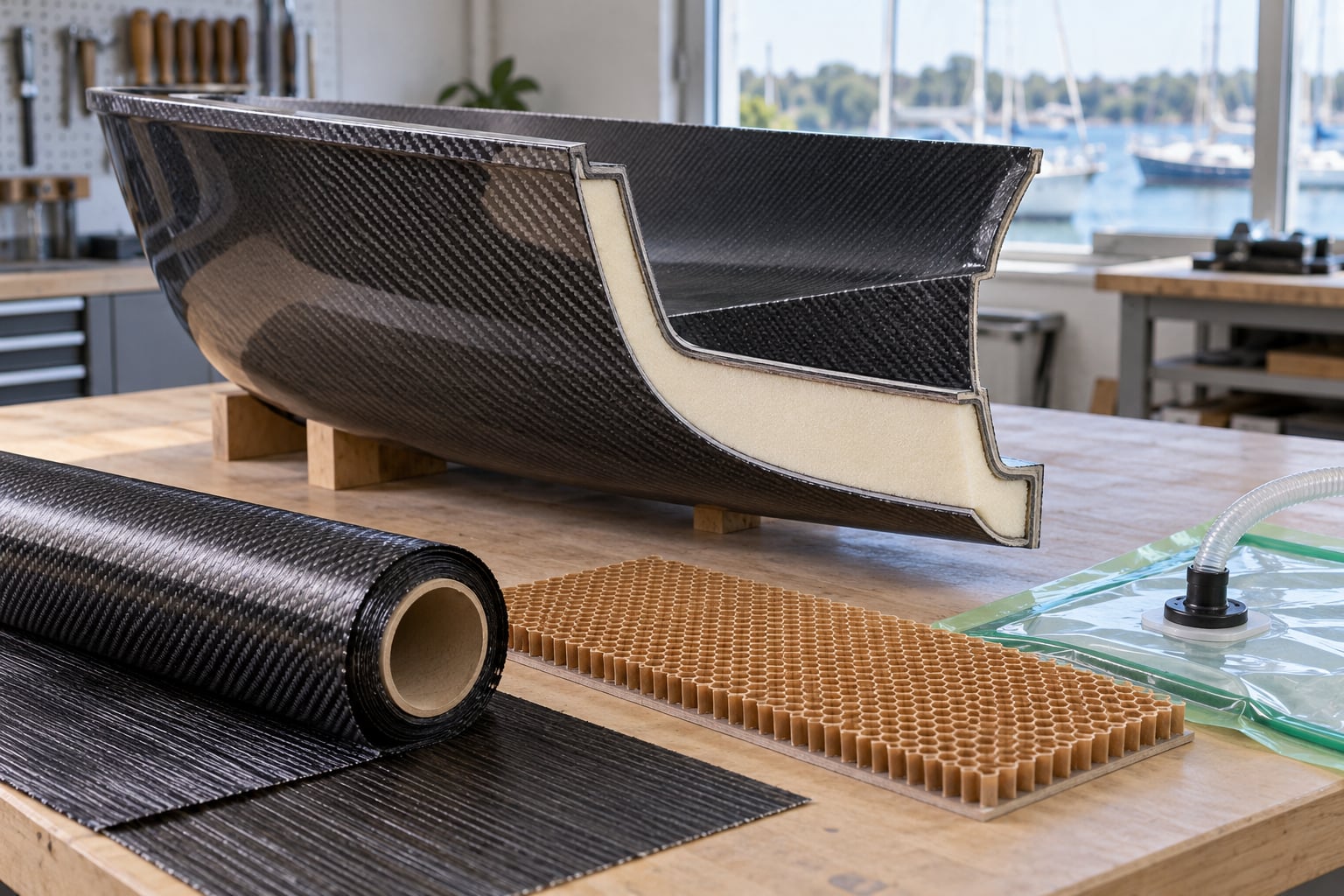
Carbon fiber is rarely the whole boat. It is used on the parts where stiffness, low mass, or corrosion resistance pay for themselves, and it is often used as one skin of a sandwich panel rather than as a solid structure.
| Part of the boat | How the material is used | Why carbon is chosen there |
|---|---|---|
| Hull shell | Carbon skins bonded to a foam core, molded or bagged | Maximum stiffness at minimum displacement, which turns directly into speed or range |
| Deck and cabin shell | Cored sandwich with carbon outer skins | Low mass high above the waterline, where weight costs righting moment and heeling |
| Bulkheads and floors | Cored panels, often with extra plies in high-stress corners | Panel stiffness without the mass of a solid laminate |
| Frames and stiffeners | Unidirectional cloth or pultruded profiles inside the hull | Carries bending and torsional loads along a known direction |
| Masts, booms, spars | Tow or unidirectional tube construction | Very high longitudinal stiffness at a fraction of the mass of aluminum |
| Rudders, tillers, keels, centerboards | Molded or cored carbon blades, sometimes over a foam core | Moves a heavy control surface without adding top weight |
| Foil sections and daggerboards | Bagged or infused shells with unidirectional skins | Thin, aerofoil-shaped sections that hold their form under load |
| Sponsons, braces, outriggers | Tube or channel laminates bonded to the hull | Bracing that adds stiffness where the structure needs it |
| Hardware and sensor mounts | Local doubler plates of thick cloth | Spreads a point load into the laminate so fasteners do not pull through |
Racing sailboats and A-class catamarans are the obvious examples, but so are rowing shells, high-speed powerboats, and the instrumented hulls used in ocean robotics, where every gram saved goes into endurance rather than top speed.
Carbon Fiber Cloth, Composite, and Core Materials
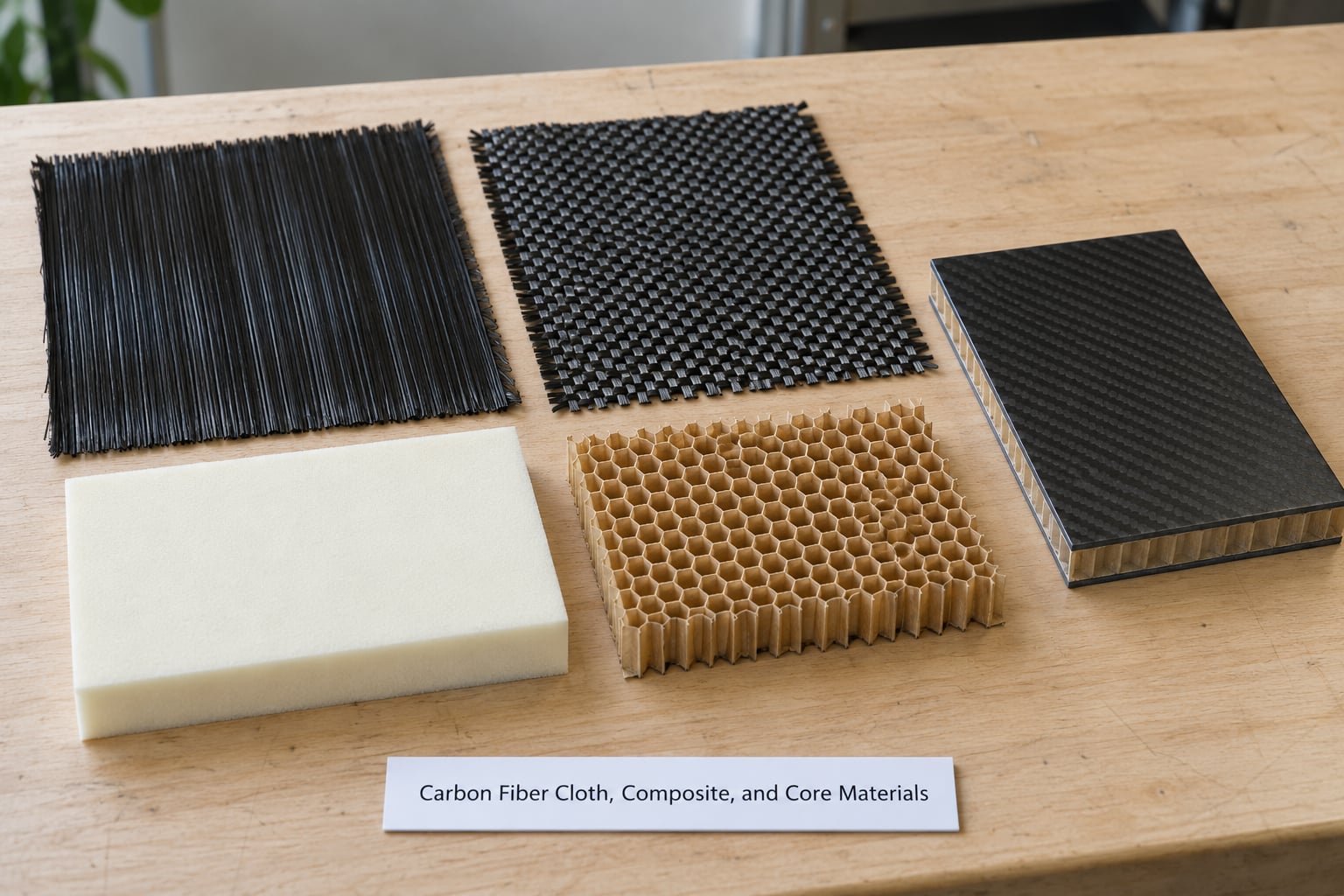
Carbon fiber arrives in three main reinforcement forms, and the choice sets how the laminate behaves under load. Woven cloth, usually described by tow count and areal weight such as 3K 240 g/m2, drapes well and is easy to handle, but it splits the strength between warp and weft. Unidirectional tape and tow put nearly all of the fiber in one direction, which is exactly what a bending load or a spar wants, and it drapes poorly. Chopped strand mat gives up strength for a surface that looks smooth, and it is rarely used where structure matters.
None of that fiber does anything until resin binds it. The matrix is what transfers shear between plies, holds the shape, and decides how the part handles water, heat, and impact. Epoxy is the usual choice for boats because of adhesion and low shrinkage. Vinyl ester and polyester are cheaper and were the norm for production hulls, and each has its own water and temperature limits.
| Core material | Strengths | Tradeoffs |
|---|---|---|
| PVC or polyurethane foam | Light, buoyant, bonds well, machines easily | Soft, can dent, must be sealed at cut edges |
| Balsa or plywood | Stiff for its weight, absorbs resin, forgiving on tooling | Heavier and absorbs moisture if not sealed |
| Aluminum honeycomb | Very high stiffness per unit thickness, extremely light | Expensive, needs special tooling, edge protection is critical |
| Solid laminate | No bonded interfaces, strong in compression | Heaviest option, most material to place |
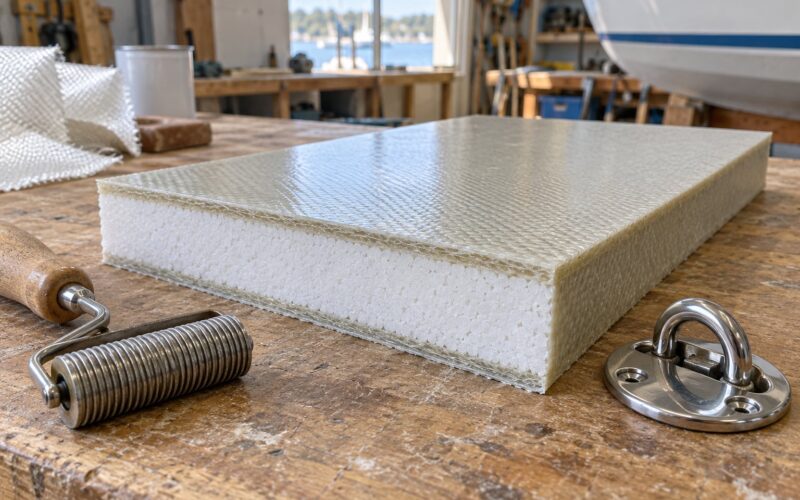
The core does most of the work of separating the skins far enough apart to make the panel behave like an I-beam. That is why a thin sandwich panel can be stiffer than a solid plate of the same weight, and why builders talk about panel stiffness rather than fiber strength when sizing decks and hulls.
How Different Boat Parts Are Built
Different parts get different construction methods, and the difference is mostly about shape, size, and how much pressure the part has to survive during cure.
Non-structural panels such as instrument lids, seat pans, and locker fronts are the simplest case. They are cut, laid up wet, or better, bagged to cut voids, then trimmed. Cored hulls and decks go further, because the core has to survive the vacuum or the press while the skins bond to it, and that is where gel-coat-on-nothing construction usually falls apart.
Load-bearing frames are built differently again. They are typically wet laid in a closed mold or pultruded, then bonded into a hull that is still wet so the frame and the skin become one structure rather than two glued surfaces. A secondary bond to a fully cured hull is weaker than the original layup and is treated as a structural joint wherever it carries load.
Control surfaces such as rudders and tillers are usually cored, bagged, and then machined or sanded to final shape. Bonded joints in these parts matter more than they look: a rudder that is heavy enough to snap in half on a dock strike is a real failure mode that comes up constantly in builder discussions.
Choosing Fabric, Resin, and Core for the Job
Match the reinforcement to the direction of the load and the resin to the environment and the process. Bending loads call for unidirectional plies aligned with the span. Torsion calls for off-axis and quasi-isotropic plies so the part is not soft in one direction. Abrasion and impact exposure call for extra skins, and often for a tougher skin material where the composite is not the structural core.
Temperature matters as much as force. A part near an engine bay or in a sun-exposed hull sees more thermal cycling than most people expect, and a resin that softens or hydrolyzes under those conditions will outlast nothing. This is where vinyl ester and polyester earn their place over epoxy in some production hulls.
Use certified systems and follow the layup the manufacturer specified. The failure that shows up later usually traces back to an adhesive or epoxy that was never validated with that fiber sizing, or to a laminate schedule someone adjusted on the shop floor without recalculating anything.
Weight Savings, Stiffness, and Performance
The weight case for carbon depends on the comparison you make. Against a good fiberglass laminate built with the same core and the same discipline, the saving is real but modest. Against a heavy production glass hull, the gap is large. One builder working in an all-carbon build put it at around 20 percent of hull weight with a comparable glass build, while multiplying stiffness by two or three, which is roughly the range many composites designers quote.
| Property | Carbon fiber composite | Fiberglass laminate | Aluminum |
|---|---|---|---|
| Density | About 1.5 to 1.6 g/cm3 finished | About 1.5 to 1.9 g/cm3 finished | About 2.7 g/cm3 |
| Stiffness for the same weight | Highest of the three | Moderate | High, but heavy for the job |
| Corrosion in salt water | None in the composite itself, but reactive with aluminum | None | Galvanic pitting at dissimilar fittings |
| Impact tolerance | Low, brittle, damages internally | Moderate, forgiving | Dents, rarely cracks |
| Repair in the field | Difficult, specialist work | Well understood, easy | Riveted and bolted, easy |
| Material and tooling cost | Highest | Low | Medium |
| Best fit | Racing, foils, spars, instrumented hulls | Production hulls, repairs, utility craft | Trailers, fishing boats, work craft |
Aluminum is the one people forget, and it is often the right answer. A trailer or a workboat that lives in a marina for ten years has nothing to gain from a lighter laminate and plenty to lose from impact brittleness.
Fabrication, Bonding, and Quality Control
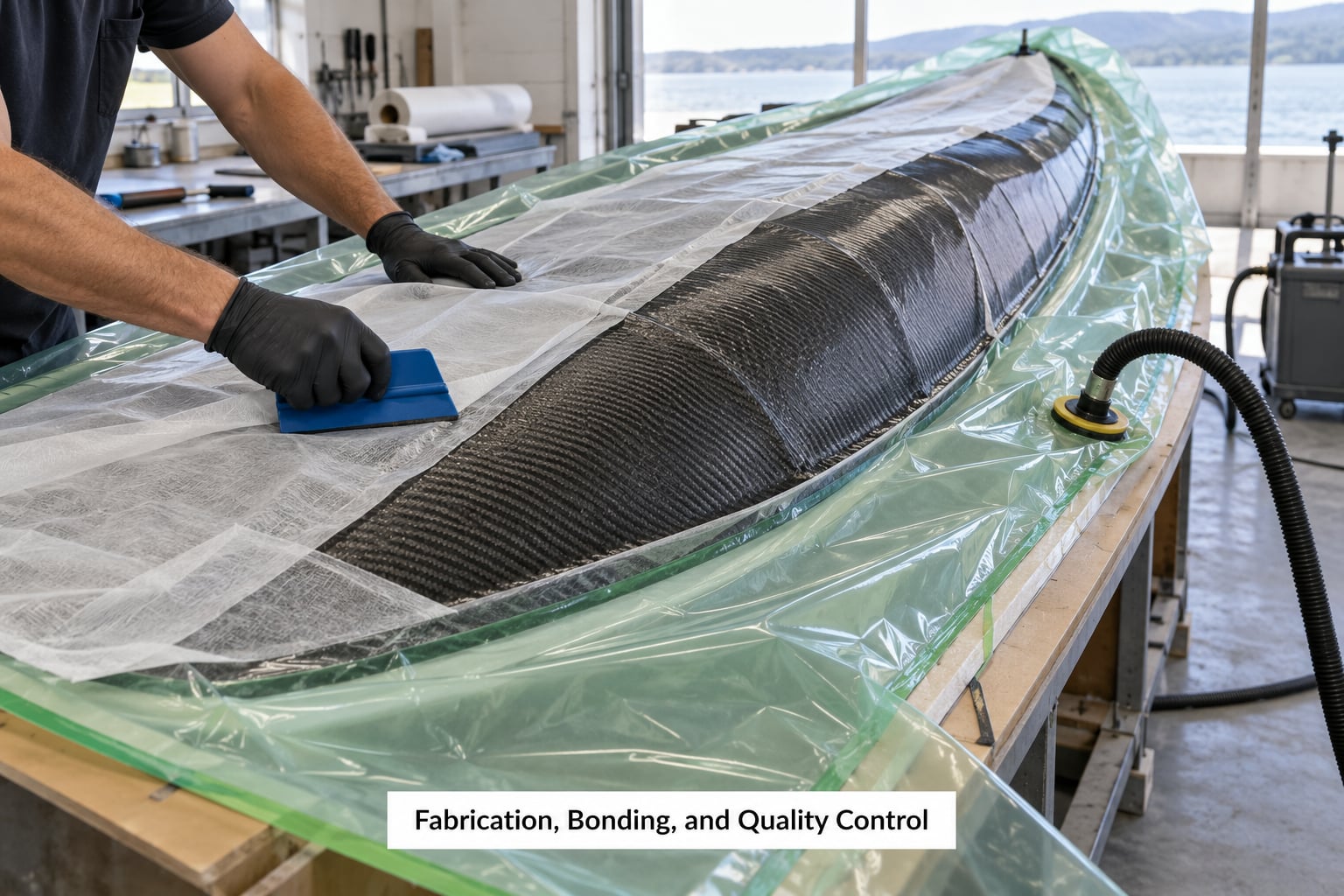
A carbon hull runs through a fixed sequence, whether it is one part in a home shop or a run in a factory. Design and laminate schedule first, then tooling, then release agent, then ply cutting, then core placement, then layup, then resin, then cure, then trimming and finishing. Each step assumes the previous one was done properly.
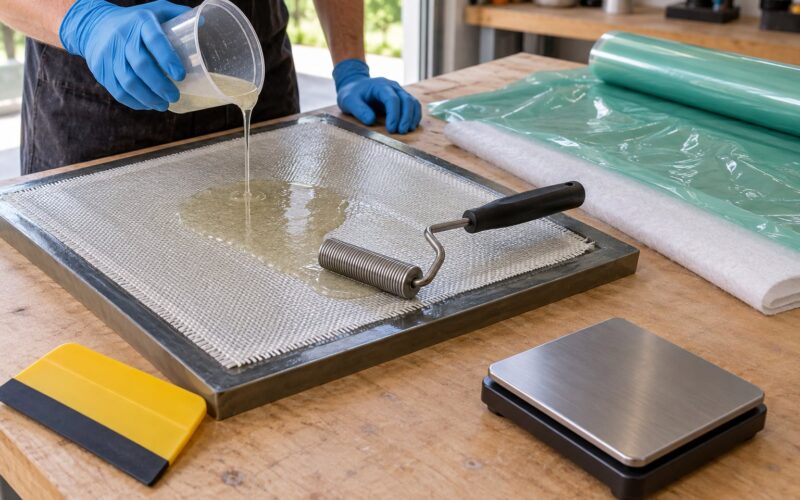
Tooling decides the finish. A polished mold with a good release coating gives a surface that needs very little fairing. Layup method decides the weight. Wet layup by hand gives roughly half the laminate by weight as resin, vacuum bagging pushes the resin content down, and resin infusion moves liquid resin through a dry stack under vacuum so the fiber is wetted and compacted without roller work.
Carbon is stiff enough that it will not follow compound contours on its own. Builders on SwayLocks make the point bluntly: carbon over a fin box or a compound rail has to be bagged, because hand pressure alone will not press it into the mold.
Quality control is where most weight savings are won or lost. Voids and pinholes come from trapped air, a dry spot means resin never reached that patch, and both are invisible until you tap the part or cut into it. Vacuum bags holding pressure for the whole cure, peel ply to guarantee a clean bond for secondary work, and resin bleed-off at the edges are what separate a good laminate from a heavy one.
Repairs, Recommissioning, and Damage Assessment
Start by deciding whether the damage is cosmetic or structural. A scratch through the topcoat that does not go through the fibers is a fairing and refinishing job. A crack that follows a ply line, a soft area under the skin, or a part that flexes under hand pressure is a structural problem, and the honest answer is that a carbon boat is repaired properly by a marine composite technician rather than by a patch kit.
Typical repair work means removing the damaged material back to sound laminate, scarfing the edges to a long taper so the patch blends in, preparing the surface for bonding, and adding plies aligned with the original load direction. Moisture that got in through a breach needs to come out first, because bonding to a wet core produces a repair that fails later.
There are cases where replacement wins. Anything safety-critical that has taken a hard impact, or a part near a high-energy foil or a motor mount, is a replace-it decision more often than not.
Safety, Durability, and Common Design Mistakes
Carbon fiber is a pleasant material to work with and a demanding one to finish safely. Cutting and grinding produces a fine dust that is a respiratory hazard, so extraction and a proper respirator are not optional. Epoxy and polyester resins can cause sensitization on repeated skin contact, and solvents need ventilation. Resin-rich rags can self-heat and start a fire if left in a pile, which is why they belong in a sealed metal container outdoors.
On the boat, durability is mostly a detailing problem. The fiber itself is stable and does not corrode. The resin matrix degrades with ultraviolet exposure and moisture, so topcoats and UV-stable clear films matter, and edges where the core is exposed need sealing so water cannot track into the sandwich.
Carbon is also electrically conductive and reacts with aluminum. Isolating washers, sealed isolators, and a deliberate hardware design are what keep a carbon hull from pitting around every fitting. The most common design mistakes I see are reinforcement laid in the wrong direction for the load, resin saved at the expense of compaction, sharp core edges left unsealed, and hardware fitted straight into a thin skin without a doubler.
Frequently Asked Questions
Is carbon fiber good for boat building?
Yes, on hulls where stiffness-to-weight drives the design, such as racing sailboats, A-class catamarans, performance cruisers, high-speed powerboats, and lightweight rowing shells. It is not a general upgrade for small cruising or utility hulls, where the material cost rarely pays back. The gain comes from the laminate schedule, not from the raw fiber, so a well-built carbon hull and a careless one can differ by hundreds of grams.
How does carbon fiber compare with fiberglass and aluminum in a hull?
Carbon composite is far stiffer and lighter for a given weight, and it does not corrode. Fiberglass is cheaper, far easier to repair, and more forgiving of a bad layup. Aluminum is heavier than either composite but tolerates impact well and is easy to work on. Most cruising and work boats are better served by fiberglass or aluminum; racing and foiled craft are where carbon earns its place.
How much weight can carbon fiber save on a boat?
Against a well-built fiberglass laminate of the same shape and core, the saving is commonly in the region of 15 to 25 percent of structural weight, with a much larger stiffness gain. Against a heavy production glass hull the gap widens. Builders doing all-carbon work report winning around 20 percent of hull weight while multiplying stiffness by two or three, though resin content and core choice move the number a lot.
Can a damaged carbon fiber boat part be repaired?
Often, yes, if the damage is limited and the repair is done properly. Structural repairs mean removing damage back to sound laminate, scarfing the edges to a long taper, and bonding new plies in the original load direction, after confirming the core and any moisture are sound. Safety-critical parts that have taken a hard impact are better replaced, and that work belongs with a qualified marine composite technician.
Do you need to vacuum bag a carbon fiber hull?
For anything structural, generally yes. Hand wet layup leaves a lot of trapped air and excess resin, and carbon is stiff enough that it will not press into compound contours by hand. Vacuum bagging or resin infusion compacts the laminate, cuts resin content, and holds the part against the mold while it cures. Simple flat panels can be wet laid by hand, but hulls, decks and foils are bagged or infused.
Conclusion: Start With the Loading Requirements
Decide the loads, the environment, the allowable weight, the manufacturing method, and the repair strategy before you decide on carbon fiber. If the part is not stiffness-driven, or if a knock in a marina would end the trip, fiberglass or aluminum is the smarter build. If the part carries real bending or torsion loads at minimum mass, a cored carbon laminate designed for its load direction is hard to argue with.
For primary structure, get a qualified naval architect or composite specialist involved before the first ply is cut. It costs less than a hull that flexes too much, or a fitting that pits the metalwork around it.