To estimate range for an electric boat, divide your usable battery energy by the energy the boat burns per nautical mile at your cruising speed. The master formula is: Range (nautical miles) = (usable kWh x drivetrain efficiency) / (kW required / speed in knots). Most estimates go wrong because they use peak power, ignore depth of discharge, or quote a speed the boat never holds.
The deeper issue is speed. Power needed to push a hull through water climbs roughly with the cube of speed, while range is energy divided by power, so range falls even faster than speed rises. Doubling your cruise speed can cut your range by three-quarters or more. That is why a manufacturer’s top-speed range figure tells you very little about what you will actually get on a day trip.
What follows is the method I use for this calculation: gather the inputs, work through seven steps, then validate the answer with a logged run on your own boat. It takes about an hour of desk work plus one short trip.
Table of Contents
- What You Need
- Step-by-Step
- Common Mistakes When You Estimate Range for an Electric Boat
- Frequently Asked Questions
- How far can an electric boat go on one charge?
- How long will a 100Ah battery run a 55lb trolling motor?
- Why is my real range lower than the calculated or claimed range?
- Does a bigger battery bank always give more range?
- How do I measure the real amp draw on a trip?
- Should boat batteries stay plugged in while the boat is not in use?
- Conclusion
What You Need
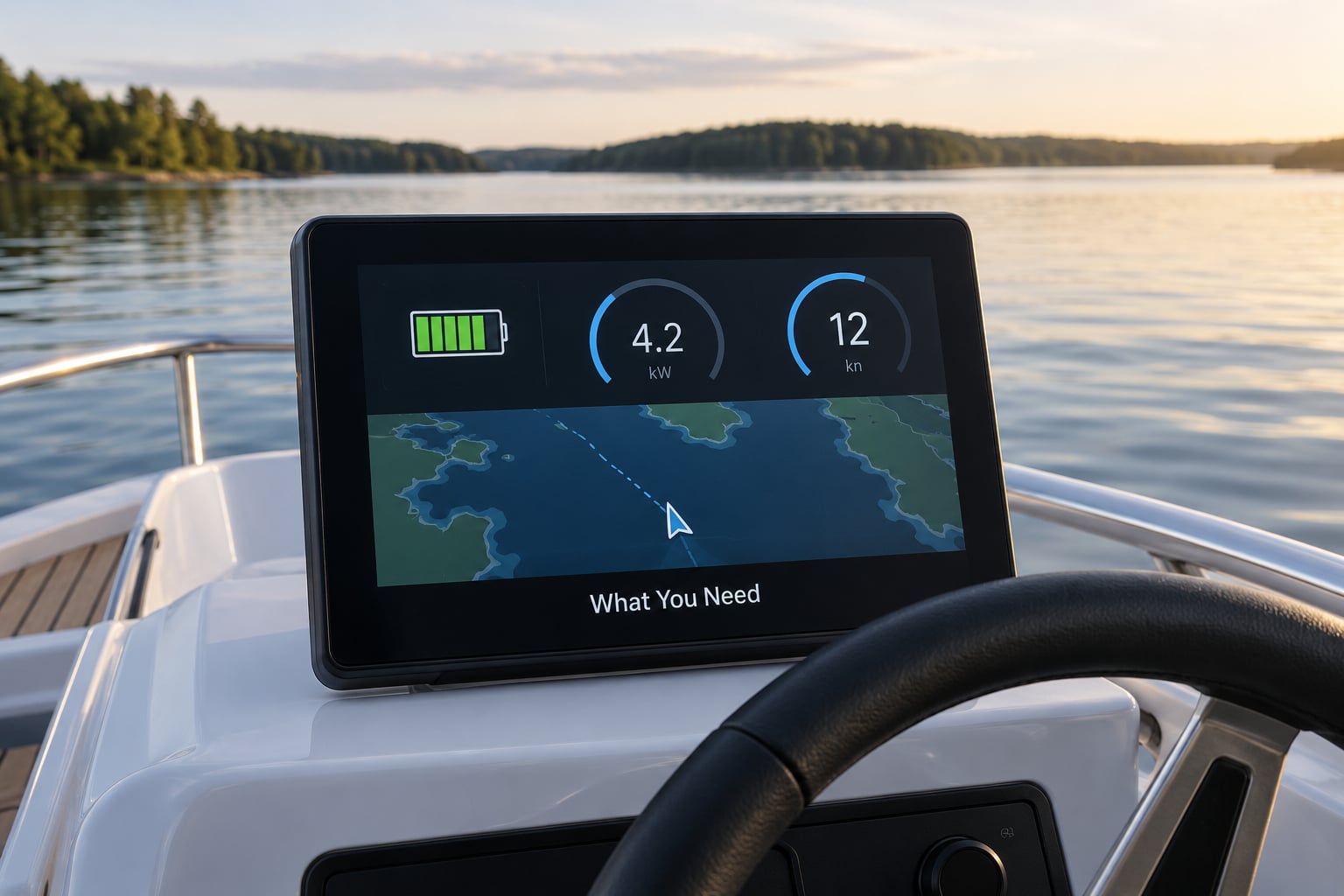
You need five groups of information, and only the first two are hard. Have these ready before you touch a calculator.
- Battery bank data: nominal voltage, amp-hour capacity, chemistry, age in seasons, and the discharge cutoff your battery management system or charger uses.
- Drivetrain data: motor and controller ratings, propeller size and pitch, and whether your controller reports live amp draw or power.
- Hull data: overall length, loaded displacement in pounds including battery weight, hull type (displacement, semi-displacement, planing), and the cruising speed you actually intend to hold.
- Route data: expected headwind and following wind, tidal or river current set, wave state, water temperature, and how far you must travel from the last charging point.
- Instrumentation, if you have it: a battery monitor with a shunt, a coulomb counter, or a GPS log that records speed over ground.
If you do not know your loaded displacement, weigh the boat dry, add the battery bank and gear, and add passengers and fuel. Owners often do this step once and are surprised, which is a good sign.
Step-by-Step
1. Define the boat’s usable battery energy
Start from nominal nameplate energy, then subtract what you cannot safely use. Battery capacity in kilowatt-hours is simply nominal volts times amp-hours, divided by 1,000.
Usable kWh = total kWh x depth of discharge x state of health
Depth of discharge varies sharply by chemistry, and this is where most calculators over-promise. Plan on roughly 50% for flooded lead-acid, 50 to 80% for AGM depending on age and charge state, and 80 to 90% for lithium iron phosphate banks, then apply a further 10 to 20% for age and cold. State of health means the capacity the bank still holds now, not what it held new.
Worked: a 48V 200Ah lithium iron phosphate bank holds 48 x 200 / 1,000 = 9.6 kWh. At 90% depth of discharge and 92% state of health, usable energy is 9.6 x 0.9 x 0.92 = 7.95 kWh. A lead-acid bank of the same nominal size would give you roughly 4.3 kWh. That gap is exactly why lithium conversions often triple a hull’s practical range, not add a few miles to it.
Voltage is not a substitute for this. Across the useful part of the discharge curve the pack voltage barely moves, so a bank sitting at 13.4V can be nearly flat. If you have no coulomb counter, buy one before you trust any range figure.
2. Estimate motor and system power draw
You need electrical input power at your cruise speed, not the motor’s headline rating. A controller rated for 30 kW peak tells you nothing about the 4 kW your boat draws at 4 knots.
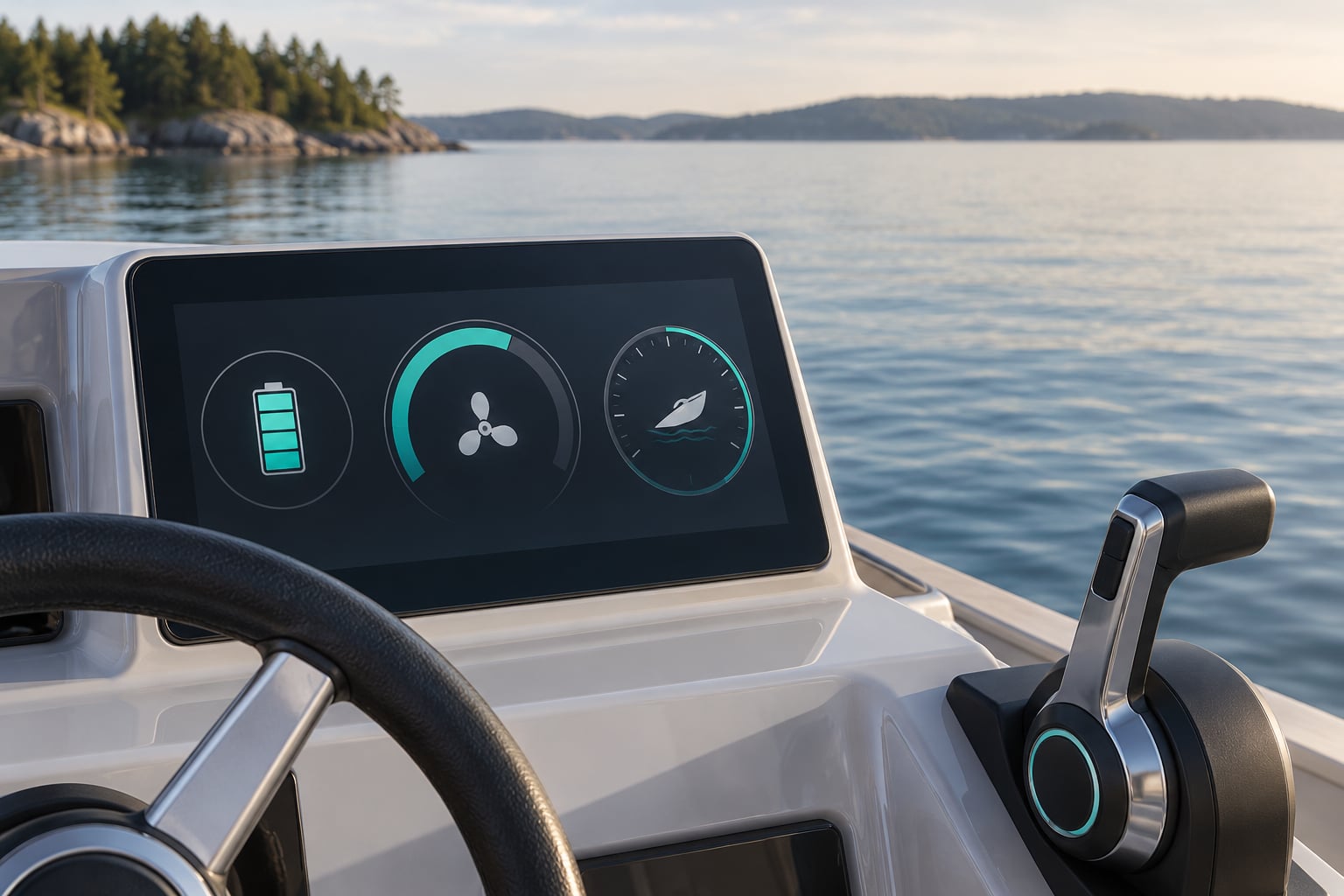
Three ways to get a real number, best first. Your battery monitor or shunt gives live amps at the pack, so multiply amps by pack volts and divide by 1,000 for kilowatts. Second, run the boat at your intended cruise speed on flat water with no wind and read the controller’s live power figure. Third, estimate from displacement with the displacement rule below.
For displacement and semi-displacement hulls, a workable rough rule for mechanical power at the propeller is: kW = (loaded displacement in pounds x speed in knots cubed) / 60,000. A 1,200-pound skiff at 5 knots comes to 2.5 kW. Treat that as accurate to within roughly a third and confirm it against a logged run.
Then divide by drivetrain efficiency to get battery-side power. A healthy lithium system with a modern controller runs about 80 to 85% from pack to propeller, so 2.5 kW at the prop means roughly 3.1 kW from the bank. Older controllers and lead-acid banks under heavy load sit nearer 70%.
3. Choose a realistic cruising speed
Pick the speed you will actually hold for most of the trip, not your top speed and not the speed the brochure used. For a displacement hull, useful speed ends around 1.34 times the square root of the hull length in feet, so a 16-foot waterline hull is near 5.3 knots before resistance climbs steeply.
Here is what the cube law does to one 1,200-pound skiff, with electrical input shown at 80% drivetrain efficiency:
| Speed (knots) | Power at propeller (kW) | Power from bank (kW) | Energy per nautical mile (kWh) |
|---|---|---|---|
| 3 | 0.5 | 0.7 | 0.23 |
| 4 | 1.3 | 1.6 | 0.40 |
| 5 | 2.5 | 3.1 | 0.63 |
| 6 | 4.3 | 5.4 | 0.90 |
| 8 | 10.2 | 12.8 | 1.60 |
| 10 | 20.0 | 25.0 | 2.50 |
Read the last column twice. Going from 5 to 8 knots is a 60% speed increase and costs you two and a half times the energy per mile.
4. Calculate range under expected conditions
Now the master formula applies cleanly, because you have already converted to energy per distance.
Range (nautical miles) = usable kWh / energy per nautical mile
Equivalently, if you are still holding kilowatts rather than kWh per mile: Range = (usable kWh x drivetrain efficiency) / (kW required / speed in knots).
Full worked example on the skiff above. Usable energy 7.95 kWh, cruising 5 knots, drawing 3.1 kW from the bank. Energy per mile is 3.1 / 5 = 0.62 kWh, so range is 7.95 / 0.62 = 12.8 nautical miles, which is about 14.7 statute miles.
Here is the same boat against three usable battery sizes, before any weather or reserve correction.
| Cruise speed | 5 kWh usable | 10 kWh usable | 20 kWh usable |
|---|---|---|---|
| 3 knots | 21.9 nm (25 mi) | 43.8 nm (50 mi) | 87.6 nm (101 mi) |
| 4 knots | 12.5 nm (14 mi) | 25.0 nm (29 mi) | 50.0 nm (58 mi) |
| 5 knots | 8.0 nm (9 mi) | 16.0 nm (18 mi) | 31.9 nm (37 mi) |
| 6 knots | 5.6 nm (6 mi) | 11.1 nm (13 mi) | 22.2 nm (26 mi) |
| 8 knots | 3.1 nm (4 mi) | 6.3 nm (7 mi) | 12.5 nm (14 mi) |
| 10 knots | 2.0 nm (2 mi) | 4.0 nm (5 mi) | 8.0 nm (9 mi) |
A nautical mile is 1,852 metres, about 1.15 statute miles, and a knot is a nautical mile per hour. Mixing miles per hour into a knots-based calculation is the single most common arithmetic error here, and it flatters your range by about 15%.
Then adjust for conditions, rather than assuming calm water. A headwind of 10 to 15 knots across your track can add 20 to 40% to energy per mile, and a beam sea adds more than a following sea. A 1 to 2 knot tidal set against you costs roughly 10 to 20% at low cruise speeds and a much larger share at high speed, because you are fighting total resistance across the whole cubic term. Cold water is denser and costs a few percent; cold batteries cost more, since lithium charging and output both suffer below freezing and lead-acid capacity drops sharply. Passengers, gear, and a wet hull add weight and wetted surface.
House loads sit on top of everything. A 1,000W inverter running four hours uses 4 kWh, which on this skiff is more than 6 nautical miles of cruising at 5 knots. Add fridges, electronics, and lighting to whatever your boat draws and subtract it before you plan.
One more correction people miss: added battery mass. Every extra 100 pounds of pack raises drag, so the range you gained from the extra capacity is not quite what you bought. On a heavy displacement hull the extra kWh still wins comfortably; on a marginal planing boat near hull speed the weight penalty can eat a meaningful share of the gain.
5. Add a safety reserve
Size the reserve by risk and trip length, not by habit. For a short hop on a lake with charging nearby, 10% is reasonable. For a coastal passage with tide, current, and no charging for six hours, 25 to 30% is the minimum I would plan with.
The reserve covers detours, traffic, a slower leg than planned, battery ageing between now and next season, and the auxiliary loads you underestimated. Cruising boats arriving back on 5% state of charge is how the forum horror stories start.
6. Validate the estimate with a controlled run
One real trip turns a paper estimate into a calibrated number. Start at 100% charge, note the exact time, hold your target cruise speed, and log distance by GPS along with the bank monitor’s cumulative amp-hours or kWh. Record the state of charge when you stop, then compare.
The correction factor is simply: measured range divided by predicted range. Multiply future estimates by that factor and update as the boat ages or conditions change. Keep wind, sea state, and whether you were running electronics in the log, because a factor averaged over different weather is useless.
Where you do not have a monitor, a GPS log plus start and end voltage still teaches you something, though the honest version of this is that voltage-based state-of-charge reading on a small bank is guesswork. Owners who log amp draw with a shunt to calibrate a hand calculation, or who compare the same hull before and after a lithium conversion, consistently find measured numbers landing below the published figure once wind and current are in the mix. Expect your correction factor to land somewhere between 0.7 and 0.9.
7. Plan the route from usable range
Turn the number into a plan, not a headline. Set your turn-around point at no more than 60% of your reserved range, so the last leg runs with the reserve intact and you still have margin for a slow crossing.
Work the tide table so the outbound leg rides the flood and the return rides the ebb. Where a set is running across your track, budget the distance the set will carry you sideways, not just the along-track distance. Treat channels, bridges, and restricted waters as fixed obstacles that do not move with the tide.
Finally, check charging time at the far end. A 10 kWh pack on a 0.5C charger at 48V needs a 20A output and takes about 11 hours from empty, longer in cold weather with lead-acid. If your turnaround is under six hours, you need a faster charger or a shorter leg. The capacity-versus-power confusion bites here too: a lithium bank can hold half the amp-hours of a flooded bank of similar physical size and still deliver far more usable power, so sizing purely on amp-hours hides the real difference.
Common Mistakes When You Estimate Range for an Electric Boat
Using nominal capacity instead of usable capacity. The number on the label is not the energy you get, and the gap is largest on lead-acid.
Estimating from top speed or peak horsepower. Range at hull speed is a fraction of range at cruise speed. On the table above, going from 5 to 10 knots cuts usable distance by three quarters.
Treating zero state of charge as a normal endpoint. It is an emergency threshold, and lead-acid at zero is permanently damaged.
Ignoring auxiliary loads. Inverters, fridges, and electronics are pure loss for propulsion purposes, and a 1,000W inverter costs real miles.
Skipping environmental corrections. Headwind, current, and waves are why electric range always looks generous on paper, and every one of them erodes a figure you planned around.
Trusting a manufacturer’s headline figure. A quoted range usually assumes light winds, calm water, a light boat, and a fresh pack. Ask what speed and conditions produced it, then redo the arithmetic for yours.
Comparing knots to miles per hour, or nautical miles to statute miles. It inflates range by about 15% and it is easy to miss in a table.
Frequently Asked Questions
How far can an electric boat go on one charge?
It depends on usable energy and cruise speed more than on motor size. A skiff with 8 kWh usable cruising at 5 knots and drawing 0.62 kWh per nautical mile gets roughly 13 nautical miles. The same boat at 10 knots gets about 3. Small displacement craft with trolling motors commonly run 10 to 20 miles per charge; planing hulls under way cover far less.
How long will a 100Ah battery run a 55lb trolling motor?
Use the shortcut: runtime hours = (amp-hours x discharge limit) / current draw. For a 100Ah flooded lead-acid battery at 50% usable and a 20A draw, that is 50 / 20 = 2.5 hours. At 4 mph you cover about 10 statute miles, or 8.7 nautical miles. Switch to 100Ah lithium and 90% usable, and the same motor gives you 4.5 hours and roughly 18 statute miles.
Why is my real range lower than the calculated or claimed range?
Four things usually explain it: you planned on calm water and met wind or current, your usable depth of discharge was lower than assumed, the bank has lost capacity with age, and the boat was carrying more weight than the estimate. Manufacturer figures also tend to quote an optimistic cruise speed, where drag is lower. Log a trip and multiply future estimates by your measured-to-predicted ratio to correct for your boat.
Does a bigger battery bank always give more range?
Usually yes, but less than proportionally, because the extra mass raises drag. A heavier boat needs more power at every speed, so each additional kWh you add produces slightly less distance than the previous one. On displacement hulls the added energy still wins comfortably. On a marginal planing boat sitting near hull speed, the weight penalty can eat a real share of the gain.
How do I measure the real amp draw on a trip?
Install a battery monitor with a shunt on the negative cable, or use a coulomb counter, then read amps and pack voltage. Multiply them and divide by 1,000 to get kilowatts while you hold your target speed. Log cumulative amp-hours or kWh against a GPS track from full charge, and you get a measured kWh per nautical mile for your exact boat and conditions.
Should boat batteries stay plugged in while the boat is not in use?
For lithium, a smart charger left on is fine and is the best way to keep the bank full, since lithium holds a full charge without damage. Lead-acid wants a maintenance float rather than a bulk charge every cycle, since constant absorption accelerates sulfation. In either case, a charger sized around a quarter of the amp-hour rating charges a 200Ah bank in roughly a day without stressing it.
Conclusion
Start with two numbers and nothing else: the usable kilowatt-hours in your bank, and the power your boat actually pulls at the speed you intend to cruise. Divide, apply a reserve sized to your route, and you have a defensible range figure for planning.
Then close the loop with one short logged trip at cruise speed, comparing measured energy per nautical mile against your prediction. That single ratio tells you more about your boat than any brochure figure, and it takes an afternoon to get.
Keep the discipline of planning to 60% of reserved range and re-checking as the boat ages. Electric boats do not have a fuel stop, so the estimate is what stands between you and a long tow.