How failsafe systems work on drones comes down to one idea: the flight controller watches for a fault it cannot fly through, and when it finds one it takes the aircraft out of your hands and runs a recovery you chose in advance. The receiver monitors the control signal continuously. If nothing valid arrives for longer than a configured timeout, usually a fraction of a second, the link is declared dead and the controller lands the drone in place, hovers it, drops it, or climbs and flies home.
Everything in that chain gets decided on the ground, before launch. Nothing about it is improvised in the air, which is exactly why a failsafe can save an aircraft at the moment a pilot is least able to help.
That matters more for marine work than most people expect. A boat is a moving launch point, salt water eats connectors, and the horizon swallows your radio link sooner than it swallows anything else. Guide readers who build or run ocean robots will find the same core logic as a quadcopter, with different numbers and fewer landing options.
Table of Contents
- What Is a Drone Failsafe System?
- How Failsafe Systems Work on Drones
- What Happens When a Drone Loses Its Radio Link?
- How Do Low-Battery and Power Failsafes Protect a Drone?
- How Do GPS and Navigation Failsafes Work?
- How Do Attitude and Motor Failsafes Stabilize a Drone?
- How Do Marine Drones Make Failsafe Decisions at Sea?
- What Is the Difference Between Failsafe, Auto-Return, and Emergency Landing?
- How Can You Test a Drone’s Failsafe System Safely?
- Frequently Asked Questions
- Conclusion
What Is a Drone Failsafe System?
A drone failsafe is an automated safety routine the flight controller runs when it detects a fault it cannot recover from under pilot control, most often the loss of the control link. Instead of continuing to fly blind, the aircraft lands where it is, holds a hover, releases its payload, or climbs to a set altitude and returns to its home point before disarming.
That is different from ordinary autopilot behaviour. A level or position hold mode is a flight mode you chose to fly in, and the drone is doing exactly what you asked. A failsafe is the controller overriding your intent because the conditions for your intent no longer exist.
Failsafes are also not the same thing as obstacle avoidance. Avoidance sensors try to keep the aircraft from hitting things while it flies normally. A failsafe runs when normal flying has already stopped being possible, and it matters most when the link, the battery or a sensor has already started to go.
Any aircraft flown beyond visual line of sight, over water, over people, around structures or as a paid operation needs this logic to hold up. On an ocean robotics platform, where a lost vehicle also means lost weeks of field work, it matters even more.
How Failsafe Systems Work on Drones
Every failsafe on any platform follows the same six-step chain: detect the fault, confirm it, classify how serious it is, pick a response, fly that response, and record what happened. The hardware differs between a small FPV quad and an autonomous surface vessel, but the logic underneath is identical.
Step one: detect a fault
Detection is continuous and happens at the lowest level. The receiver counts valid control frames. A battery monitor watches cell voltage under load. The GNSS receiver reports satellites used and fix quality. Inertial sensors cross-check attitude. Each of these is a separate detector, and most of them vote before anything is declared.
Step two: confirm the fault with a guard period
No system reacts to a single bad sample. Every failsafe has a guard time, a timeout threshold, before it acts. Consumer platforms commonly use a couple of seconds; flight stacks built for racing quads use fractions of a second because a racing pilot would rather crash than hover. Short guard time means a fast rescue and a fast loss of control when interference is momentary. Longer guard time gives a fade the chance to recover, at the cost of a longer window where the aircraft is flying on stale commands.
Step three: classify the severity
The controller decides whether this is a hint, a degraded state or an emergency. A GNSS position that jumped a few metres is a hint, corrected in the background. Losing GNSS while the link is fine is degraded, so the aircraft holds attitude and altitude and waits for a fix. Losing the link entirely is an emergency, because nothing else will come.
Step four and five: select and execute a response
The chosen action runs as a normal flight mode with safety rules layered on top. Sanity checks guard the whole manoeuvre: if speed, heading or position become physically impossible, the controller aborts the rescue rather than flying confidently in the wrong direction.
| State | What the drone is doing | Typical response |
|---|---|---|
| Normal | All sensors agree and the link is healthy | Fly as commanded, log telemetry, arm failsafes to stand by |
| Degraded | One input is weak, drifting or inconsistent | Switch to a second navigation source, hold attitude, warn the operator, keep flying |
| Warning | A reserve threshold is crossed, such as low battery | Announce it, start the countdown to return, keep the aircraft controllable |
| Emergency | The control link is dead, or the aircraft is unrecoverable | Run the configured action: hover, land, drop or return to the home point |
| Terminal | Power or propulsion is failing and no response will complete | Descent, buoyancy or a controlled ditch, then disarm and transmit a final beacon |
The table is worth reading twice, because the last row is where most beginners have never thought. A failsafe that needs power and a failsafe that triggers because power is failing are not the same system, and a controller that has lost motor authority cannot climb to a safe altitude no matter how well it is programmed.
What Happens When a Drone Loses Its Radio Link?
When a drone loses its radio link, the receiver stops receiving valid frames, the guard time expires, and the flight controller runs the action you configured for loss of link. On most platforms that means a short hover first, then return to the home point, then descent and disarm.
The hover stage exists for a good reason. Radio fades are usually brief: you pass behind a ridge, duck through a doorway, or clip a concrete wall, and the link comes straight back. Giving the link a couple of seconds to return avoids sending an aircraft home over perfectly good terrain every time it passes behind a rock.
After the hover, most systems climb to a failsafe return altitude before heading home, so the return path clears whatever was blocking the link in the first place. Climb first is safer near tall structures and worse near a ceiling, a canopy or a hillside, which is why the altitude is configurable rather than fixed.
Which action you pick should follow from where the aircraft is. Over open water, land in place is often the right answer, because a water impact loses less than a flight back into a cliff face. Over a forest, land in place is usually a tree. Near people, the shortest possible flight home matters more than the tidiest one.
Pilots report the same pattern repeatedly in forums: a strong-looking link that still produced a return to home. The usual cause is not the link. It is a battery threshold, a telemetry drop or a loose connector, and the difference is visible in the flight log if the aircraft managed to log one. Loss of telemetry at the exact moment of link loss is common, which is precisely when you most want it.
How Do Low-Battery and Power Failsafes Protect a Drone?
Low-battery failsafes work by watching cell voltage under load and, on some platforms, total current draw. When the pack crosses a warning threshold the aircraft announces it and reserves enough energy for one more flight. When it crosses the action threshold, the controller commits to a return or a landing rather than waiting to see how bad it gets.
Two thresholds matter. The first is a warning, which exists to inform you while you still have options. The second is the action threshold, which is usually set well above empty on purpose, because a drone that returns to a dead pack on the tarmac has already crashed.
Battery failsafes fail for predictable reasons. Strong headwind on the return leg burns more current than the outbound leg did. A payload that was light at launch is heavy on the way back. Cold cells sag under load, so the reading that triggered the warning looks healthy again once the aircraft is unloaded. And a pack that has been through a hundred cycles holds less than the same pack new, at the same nominal capacity reading.
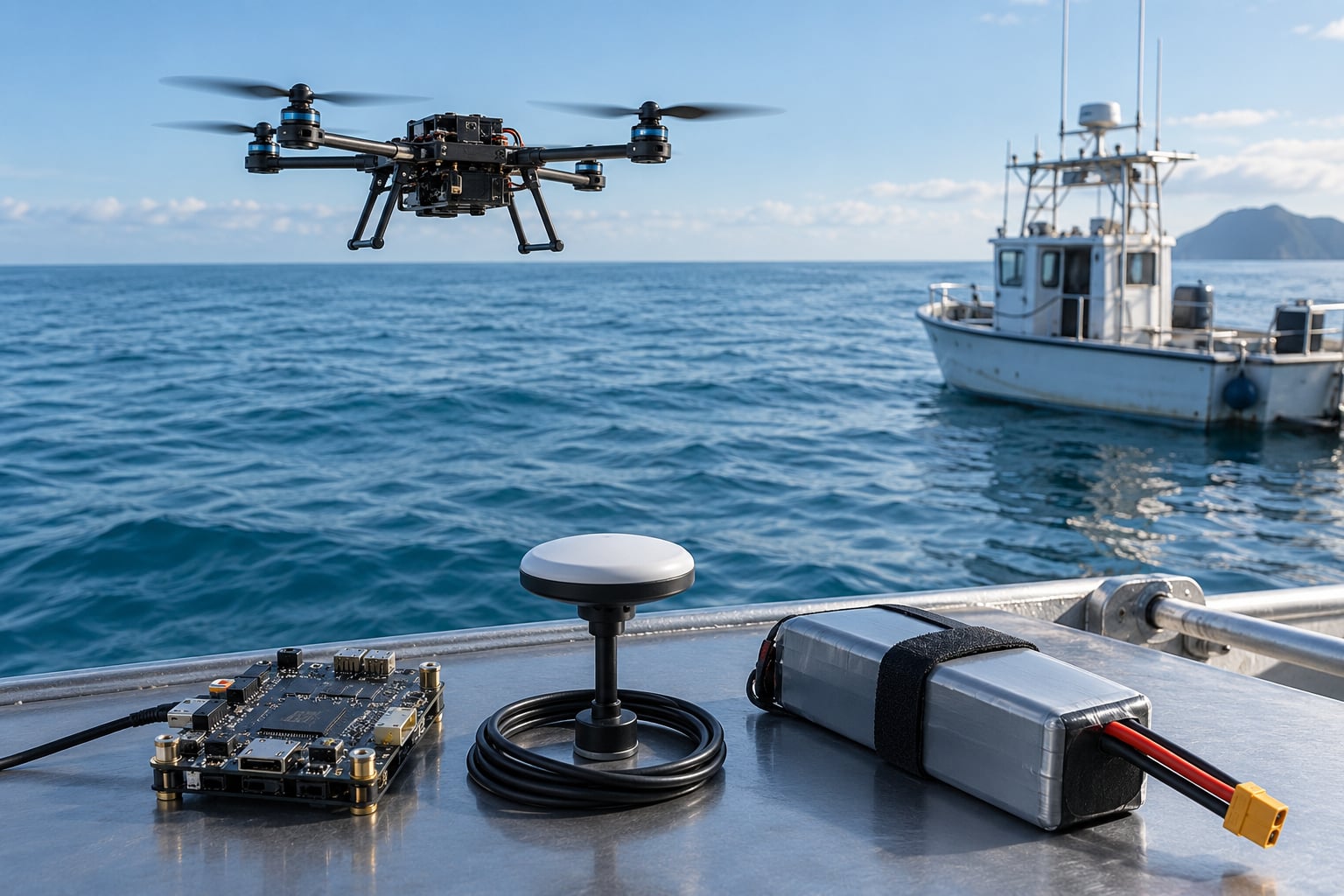
Marine operations add a fourth factor. A drone that returns to a boat is landing on a moving, wet, pitching target, so the sensible reserve is larger than it would be over a field. Many marine pilots keep a conservative rule of being back on deck with roughly a third of the pack unused, and they treat anything lower as the signal to stop launching.
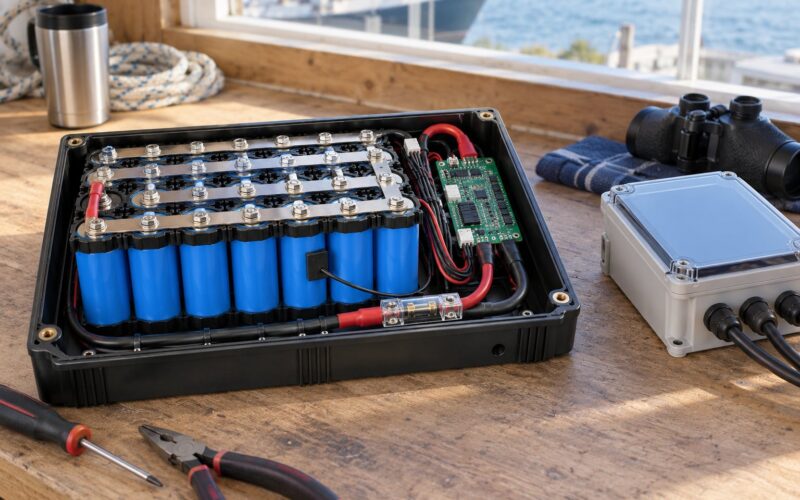
One more case to plan for: what happens when the failsafe itself loses power. Controllers built for safety-critical work hold enough reserve to log the event, transmit a final position and fire a beacon after the main pack collapses. A hobby quad usually does not, and a marine vehicle that sinks silently teaches you very little afterwards.
How Do GPS and Navigation Failsafes Work?
GPS and GNSS failsafes work by checking whether the position solution is trustworthy before the aircraft is allowed to act on it. Satellites used, fix quality and the disagreement between the receiver and the inertial estimate all feed that judgement, and a temporary correction is treated very differently from a total loss of position information.
A jump of a couple of metres from multipath is a temporary error. The controller smooths it, prefers the inertial estimate for a few seconds, and keeps flying the mission. A drop below the minimum satellite count is different: the controller holds attitude and altitude, which it can do from onboard sensors alone, and flags that it has lost position.
Geofencing sits on the same system. When the aircraft approaches a boundary, some platforms warn, some push it back, and some command a return. The enforcement strength varies widely, and in most cases it depends on position data being good, which means a geofence is only as trustworthy as the fix underneath it.
Compass problems deserve their own line because they cause the worst outcomes. Magnetic interference from a steel structure, a motor or a boat’s electronics can make the aircraft believe it is pointing somewhere else. A rescue flown on a bad heading is a rescue flown confidently in the wrong direction at speed, which is why most systems sanity-check the compass against inertial and GNSS data and prefer the sensors that agree.
Navigation-source switching is the mechanism behind all of this. The aircraft holds a list of sources, in order of trust: GNSS with magnetometer, GNSS alone, inertial estimate, optical flow, or a station keeping position from a tether or an acoustic modem. When the top source fails it moves down the list, and only when the list runs out does a real failsafe fire.
For marine and offshore work, the honest version is that position is never guaranteed. GNSS over water is often cleaner than it is in cities, but horizon masking near a platform, salt fog, jamming and interference from ship radar all degrade it. Systems designed for that environment either carry a second position source or plan their recovery around the assumption that the fix will be bad at some point.
How Do Attitude and Motor Failsafes Stabilize a Drone?
Attitude and motor failsafes work by cross-checking the aircraft’s own sensors against each other and against the physical response of the vehicle, then correcting small errors automatically and escalating large ones into a defined recovery.
The gyroscope measures rotation rate, the accelerometer measures the gravity vector, and the magnetometer measures heading. The controller fuses them into an attitude estimate. If any one of them disagrees sharply with the other two for more than a moment, the outlier is discounted, which is how a single noisy sensor is prevented from taking down a healthy aircraft.
The job here is stabilization rather than recovery. A drone that is tipping recovers on its own every second it flies, using the same estimator, and the pilot would never know it happened. Failsafe logic only engages when the error is large enough to matter, such as an attitude estimate that diverges from reality, or a motor that has stopped responding.
Motor-status checks are the less mature half of this. Flight controllers can see current draw, and a failing motor or a shed propeller shows up as a change in it. What happens next depends entirely on the platform. A capable controller redistributes thrust to the remaining motors and commands a controlled descent. A basic one does nothing except fly badly until it lands.
Propulsion failure is the hardest case in the whole topic, and it is worth being honest about the maturity gap. Published research on quadrotor control allocation under rotor loss goes back well over a decade, and the demo videos that show a quad continuing to fly after losing a propeller are real. Turning that into something dependable enough to fly over water or over people is a different engineering problem, and most hobby and consumer platforms have not attempted it.
How Do Marine Drones Make Failsafe Decisions at Sea?
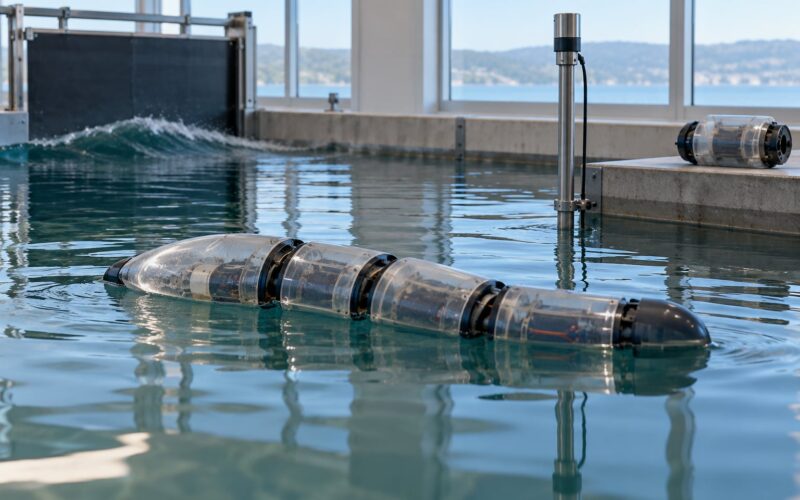
Marine drones make failsafe decisions at sea under worse conditions than almost any land operation: salt water, constant motion, a moving reference point and a radio link that dies at a shorter distance than it does on land.
Corrosion and moisture are the unglamorous part. Connectors, pressure housings and seals all get worse with time, and a corroded connector produces exactly the intermittent signal loss that triggers a failsafe, which means a fouled connector can cost you an aircraft rather than being noticed. Sealed housings and connector inspections are failsafe preparation.
Wave motion changes the maths. A drone sitting on a pitching deck has no stable home point to return to, and the launch point may be 50 metres away by the time it is overhead. Fixed-wing and surface platforms handle this with a moving home reference that follows the vessel; multirotors on a deck are usually recovered by sight instead.
Landing sites are the other difference. On a field, the failsafe can put an aircraft anywhere flat. At sea the options are a deck, a net, a crane, the water or a buoy. That is why marine designs favour a different default: stop, stay, float and be found, rather than fly a long way back on a battery that may already be sagging.
Weather exposure and horizon masking mean recovery ranges are short and conditions are rarely ideal. The failures that actually happen offshore are the boring ones: a battery that looked fine on the charger, a link that degrades with spray on the antenna, a vehicle that returns to a point that has drifted.
What Is the Difference Between Failsafe, Auto-Return, and Emergency Landing?
Failsafe, auto-return and emergency landing are three different response levels. Failsafe is the safety logic that decides to act, auto-return is the most common action it chooses, and emergency landing is what happens when the aircraft is out of options.
| Response | Trigger | What the aircraft does | Typical outcome |
|---|---|---|---|
| Failsafe | Any configured fault the pilot cannot clear: link loss, low battery, lost position, geofence breach | Declares the fault, waits out the guard time, then selects an action | A defined, logged behaviour instead of an improvised one |
| Auto-return | The failsafe was triggered and return home is the selected action | Hovers, climbs to a set altitude, flies to the home point, descends, lands, disarms | Most aircraft recover; some land tens of metres from the launch point |
| Emergency landing | Position is unusable, the aircraft is over populated ground, or there is no energy left to return | Descends immediately or holds a hover for a limited time, then comes down under control | A controlled impact or ditch rather than a flyaway |
The confusion between these three causes real problems. A pilot who thinks return home is a failsafe assumes the aircraft will always come back, and configures it badly without noticing. A pilot who thinks a failsafe is a landing feature configures it to drop and is surprised when the payload releases mid-flight.
Smart return and failsafe return are the same distinction seen from the pilot’s seat. A smart return is one you asked for: press the button, the aircraft climbs and goes home on a path you set. A failsafe return is the aircraft deciding on its own that it must go home. They share a routine and can share a configuration, and only one of them is happening because something went wrong.
One detail worth knowing: during a return the pilot often still has control. Stick inputs remain live on most platforms, and there is usually a way to abort an automated landing. That is useful and it is also a trap, because a pilot who fights the routine at the wrong moment can turn a working rescue into a crash.
How Can You Test a Drone’s Failsafe System Safely?
You can test a drone’s failsafe system safely by triggering the fault deliberately, on the ground or over open ground, without ever turning the radio off at altitude. The procedure matters more than the settings, and the goal is to watch the routine, not to fly the aircraft.
Start with documentation. Read the flight controller manual section on failsafe before changing anything, and note the guard time, the selected action, the return altitude and the battery thresholds that are currently set. Most manuals are terse, and writing the four values down is what makes the next steps an actual test rather than a guess.
Then check the aircraft on the bench. Confirm the receiver is bound, confirm the link-quality indicator reads healthy while you move the aircraft around, and confirm the home point and compass heading are correct before anything leaves the ground. A wrong home direction makes every later test meaningless.
For the actual test, use an auxiliary switch or the flight controller’s simulated failsafe command if it has one. Both simulate link loss without touching the radio, which is the safe version of the procedure. Turning the transmitter off while the aircraft is airborne works, but it also removes your ability to recover it if something else goes wrong.
Test one trigger at a time, in a clear area with no people, no trees and no traffic, and give yourself a generous altitude limit and a full battery. Watch what the aircraft does, note how long each stage takes, and check whether it climbs before it turns and whether it disarms after landing.
Record the telemetry. Note the trigger time, the distance out, the altitude, the duration of the return and the battery consumed. Forum pilots trust this kind of number more than any reassurance, and it is the only way to know whether your return altitude is actually high enough to clear the obstacle you are worried about.
Finish by restoring the configuration. Save the original values, restore them, and re-run a normal flight to confirm nothing changed. Then write down what you measured, because the next thing you will want to know is where the aircraft landed, and an 18-metre landing error on one platform and a two-metre error on another are both normal and both worth recording.
Frequently Asked Questions
What is failsafe in drones?
Failsafe is an automated safety routine the flight controller runs when it detects a fault it cannot recover from under pilot control, usually loss of the radio link. Instead of flying blind, the aircraft lands in place, hovers, releases its payload, or climbs and returns to the home point. Every action is chosen on the ground before launch.
Does drone failsafe work without GPS?
Partly. With no position fix, the aircraft can still hold attitude and altitude using its gyroscopes and accelerometers, so hover and land-in-place failsafes still work well. Return to home does not, because there is no home to return to. That is why some platforms fall back to descending in place instead of attempting a navigation-based rescue.
Can a drone failsafe recover from a motor or propeller failure?
On capable platforms, sometimes. Flight controllers can spot abnormal current draw on a motor, redistribute thrust to the others and command a controlled descent, and published research has demonstrated quadrotors staying airborne after a rotor loss. Most hobby and consumer drones have no such logic, so a motor failure ends in a descent that is uncontrolled rather than planned.
How do I test my drone’s failsafe safely?
Use an auxiliary switch or the flight controller’s simulated failsafe command instead of switching the radio off mid-flight. Read the manual first, note the guard time, action, return altitude and battery thresholds, then fly in a clear area with no people or obstacles and test one trigger at a time. Record the times, distances and battery used, then restore your original settings.
Why did my drone go into failsafe when the signal looked strong?
The link is only one of several triggers. Low battery under load, a dropped telemetry feed, a GNSS jump, a compass error and a loose receiver connector all produce the same behaviour. Check the flight log if one exists, because the record usually names the trigger. Losing telemetry at the exact moment of the link drop is common and makes this harder to diagnose than it should be.
Should I rely on return to home as a normal landing method?
Treat it as a backup rather than a flight mode. Control engineers borrow a two-level alarm analogy from pressure vessels: the first level warns you, the second takes over. Flights spent in the band between those two levels is where accidents come from, because the routine gets treated as a normal mode and everyone stops watching the link. Learn to land manually and treat the automated return as insurance.
Conclusion
A drone failsafe is an automated safety routine the flight controller runs when it detects a fault it cannot recover from, such as a lost control link. It lands the aircraft in place, hovers it, drops it, or sends it back to the home point, and every one of those choices was made on the ground before you launched.
So before flying near people, structures or open water, do one thing: find out which triggers your aircraft supports, what it does by default for each one, and how to test them without losing the aircraft. Note the guard time, the return altitude and the battery thresholds in writing, run the test in a clear area, and record what happens.
Then treat the whole system as the last layer rather than the plan. The failsafe is the reason a routine radio fade is an inconvenience instead of a lost vehicle. It is not a substitute for watching your link, your battery and your surroundings.