If you want to know how to find a marine robotics internship, the honest answer is that job boards are the weakest tool you have. Marine robotics is a small field where most roles are filled through university labs, small ocean-technology companies with no HR department, student teams, and research vessel programs, so the search is a targeted outreach project rather than a keyword search. Most students who succeed spend three months building proof of skill and a list of targets, then apply six to nine months before the season they want.
I work around boats and open-source marine hardware, and I have watched capable students get passed over for lack of evidence while less capable students got interviews purely because they showed up with a specific, working project and a clear reason for contacting that particular team. That is the whole game. Here is the process I would hand a student starting from zero.
Table of Contents
- What You Need to Find a Marine Robotics Internship
- Step-by-Step: Land a Marine Robotics Internship
- Step 1: Know How to Find a Marine Robotics Internship
- Step 2: Search the Right Labs, Companies, and Programs
- Step 3: Build Proof That You Can Work on Marine Robotics
- Step 4: Network Before a Role Is Advertised
- Step 5: Tailor Each Application to the Team
- Step 6: Follow Up and Improve Your Odds
- Common Mistakes
- Frequently Asked Questions
- When should I start looking for a marine robotics internship?
- Do I need a marine engineering degree to get one?
- How can I get a marine robotics internship with limited experience?
- How much knowledge of sailing robots or ocean drones do I need?
- What should I do if there are no marine robotics internships listed?
- Conclusion
What You Need to Find a Marine Robotics Internship
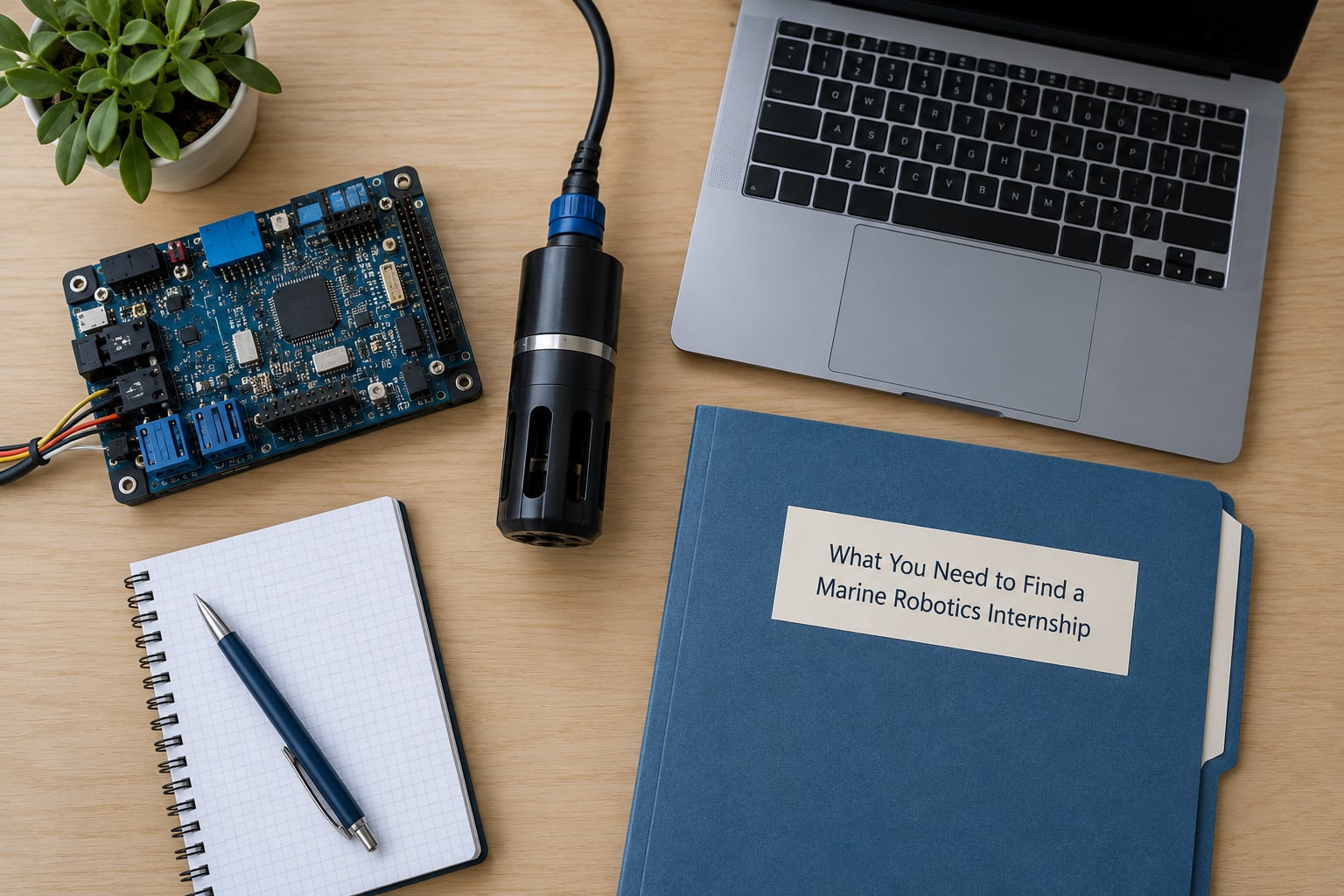
You need six things in place before you send a single application. Most students have two of them and spend a semester applying anyway.
A focused role map. Write down the two or three job titles you would actually accept. “Robotics intern” is too wide; “autonomy software intern for an AUV team” is searchable.
An updated resume that leads with hardware. Marine teams read for systems you have touched, tests you have run, and failures you diagnosed. Coursework fills the bottom third, not the top.
A portfolio or public code. A GitHub repository, a short write-up, a video of a vehicle surfacing, or a documented tank test. Anything a stranger can open without asking you for a login.
A record of coursework and projects. Transcripts, a current GPA if it helps, class projects, and any lab or club membership you can document.
A tracking sheet. One row per organization: name, contact, role, date applied, date you heard back, notes. Searching without this turns into starting over every month.
A working network. Even three people who will answer a question. Mentors and professors are the most useful asset in this field.
Step-by-Step: Land a Marine Robotics Internship
Step 1: Know How to Find a Marine Robotics Internship
Start by narrowing the discipline, because the vehicle class decides almost everything downstream. An AUV (autonomous underwater vehicle) team cares about navigation, state estimation and autonomy software. An ROV (remotely operated vehicle) team cares about tethered power, video, manipulators and operator reliability. An ASV or USV team cares about wind, waves, solar budget and above-water sensing.
Then translate that into job titles you can search: robotics intern, marine autonomy intern, ocean sensor engineering intern, subsea systems intern, field test engineer intern, or ocean technology engineering intern. Success looks like a written list of twenty organizations with a named role attached to each one.
Step 2: Search the Right Labs, Companies, and Programs
Five channels hire marine robotics interns, and only one of them is a job board. University laboratories and marine institutes post on their own pages and through your campus research office. Ocean technology startups and AUV or ROV manufacturers post on their career pages, often without an HR contact. Government and nonprofit agencies recruit through their own trainee programs. Student teams and marine robotics competitions recruit members constantly. Vessel-based programs take students at sea.
Verify before you invest: confirm the posting is current, check the eligibility rules about work authorization and minimum standing, and see whether the team names a specific project you would contribute to. A listing that says “assist with marine robotics research” with no project detail usually means summer help with data entry. Ask before you apply, not after.
Step 3: Build Proof That You Can Work on Marine Robotics
One finished project beats four half-finished ones. A small surface craft that held a heading across a pond, a pooled underwater vehicle that surfaced on command, a simulated mission in Gazebo or Isaac, or a logged and graphed dataset from a mooring all count.
Each project page should answer four questions in plain language: what problem you were solving, what you personally built or wrote, how you tested it, and what the result was. Include numbers, hours on the water, depth reached, missions flown, error margins. If your school has no marine program, a robotics club or an adjacent engineering group is a workable starting point, and starting one yourself is a strong signal in an application.
Step 4: Network Before a Role Is Advertised
Most marine openings are filled by referral before they are posted. Low-pressure outreach works: email a graduate student working on vehicles you have actually read about, a professor whose lab matches your interests, or an engineer who spoke at an ocean technology event. Reference students on r/ComputerEngineering also say plainly that lab or club membership is the perceived prerequisite, and they are right.
Keep the message short: who you are in one line, one specific thing you built, one question that shows you read their work, and a request for fifteen minutes. Aim for a five percent reply rate; anything above that means your targeting is good. Follow up once after ten days, then stop.
Step 5: Tailor Each Application to the Team
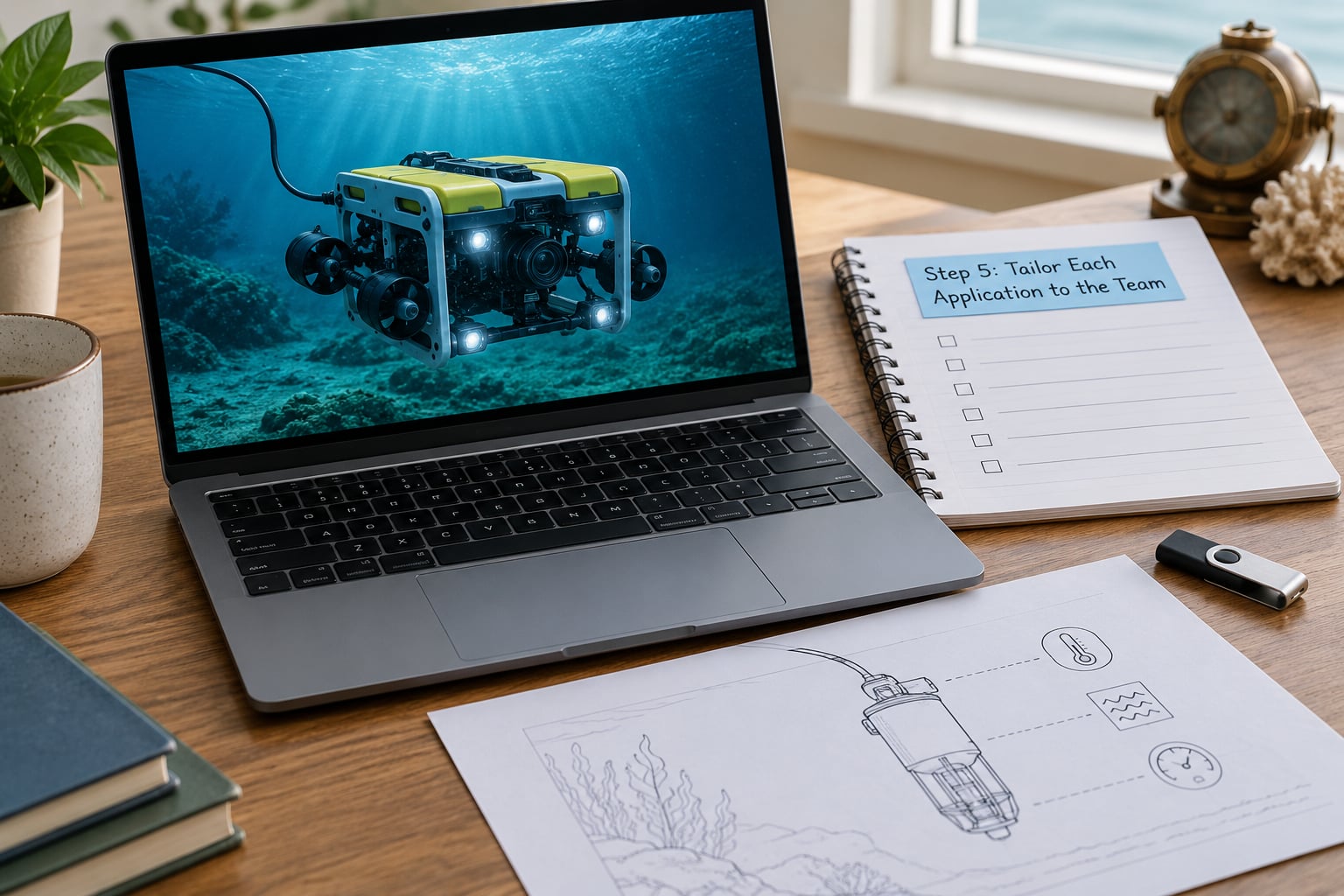
Match the resume, the project narrative, the cover email and the portfolio to that organization’s current mission. If a lab publishes on underwater navigation, your project write-up should lead with your state estimation work, not your CAD file.
Map every requirement in the posting to a piece of evidence. Where a line asks for embedded experience, point to the specific board you soldered. Success is simple: a reader can find the answer to each requirement in under thirty seconds, and the application addresses a problem the team actually has rather than restating your resume.
Step 6: Follow Up and Improve Your Odds
Send a confirmation email the same day naming the role, your availability window and one line about why you fit. Prepare for technical questions on control loops, sensor failure modes, what happens when a DVL drops out mid-mission, and what your safety plan was on the last deployment. Expect behavioral questions about a time something broke and what you did next.
Follow up about ten days after the stated decision date, once, briefly. Log rejections with the reason, the stage you reached, and what evidence was missing, because the same posting often reopens. Track replies, referrals, interviews and offers as your real success metric; treat a silent application as a targeting problem, not a verdict on you.
Common Mistakes
Searching only the exact title. Fix: search by employer category and vehicle type, not by job title. “AUV” and “subsea” pull up roles titled engineer or research assistant.
Applying with no marine evidence. Fix: complete one hardware project that has been in water, however small, before your next application round.
Mass-emailing founders. Fix: send five targeted messages a week instead of fifty generic ones, and route cold outreach to graduate students and postdocs who have time to reply.
Ignoring adjacent employers. Fix: include hydrographic survey contractors, offshore energy operators, aquaculture monitoring teams and marine electronics makers. They are overlooked and they hire.
Treating silence as final. Fix: send one polite follow-up, then move on. A quarter of field-season postings stay open after the first cohort is filled.
On balance, keep coursework moving while you build the project, network weekly rather than in a panic before deadlines, and apply on a schedule. Two focused hours a week beats a weekend of applications that all say the same thing.
Frequently Asked Questions
When should I start looking for a marine robotics internship?
Start nine months before the season you want. Summer field-season roles often close six to nine months ahead because teams hire crew before the water warms up, while winter and spring engineering internships follow the normal academic recruiting calendar. Begin building the project and the contact list six months before you apply, so you have something specific to send.
Do I need a marine engineering degree to get one?
No. Mechanical, electrical, computer, ocean and marine engineering all qualify, and so do marine biology and oceanography students on the technical track. Employers care far more about what you have built and tested than about the name on your degree. If your background is biology or geology, lean toward sensor work, data analysis, mission planning or field operations, where your coursework is an advantage.
How can I get a marine robotics internship with limited experience?
Target places that expect beginners: university labs, small startups that need hands, student teams and vessel-based programs. Build one documented project with real numbers, then volunteer for field support work such as deployments, data logging and maintenance. Many interns are hired as general technical support first and grow into autonomy or hardware work over the summer.
How much knowledge of sailing robots or ocean drones do I need?
Enough to hold an informed conversation. Learn what AUV, ROV, ASV, USV and HOV stand for, what each one is used for, and the basic failure modes of underwater navigation, including why acoustics replace GPS below the surface. That is usually a weekend of reading plus one vehicle video. Hiring managers would rather see honest curiosity than a confident bluff.
What should I do if there are no marine robotics internships listed?
Treat it as normal, because most marine robotics internships never reach a mainstream job board. Build your own target list from university marine labs, ocean technology startups, agencies and research vessel programs, then contact teams directly with project evidence. Check whether an organization has a team but no advertised role, and ask whether they take interns. Reply to a posted role that mentions a team rather than a job title.
Conclusion
Knowing how to find a marine robotics internship comes down to three actions you can finish this week. Open a spreadsheet and list twenty laboratories, companies or programs that work on vehicles, sensors or ocean data. Pick five active projects among them and read what each team publishes. Then send one message to one team, referencing something specific they built and attaching one piece of evidence that you built too. Repeat weekly, and the search stops being mysterious.