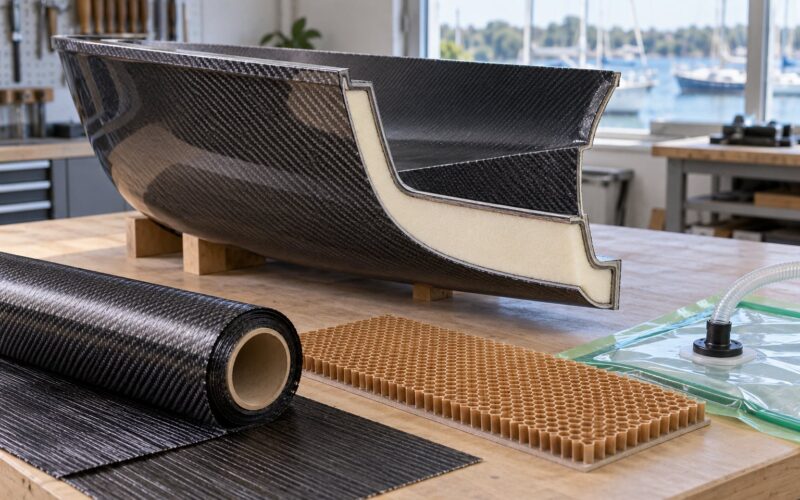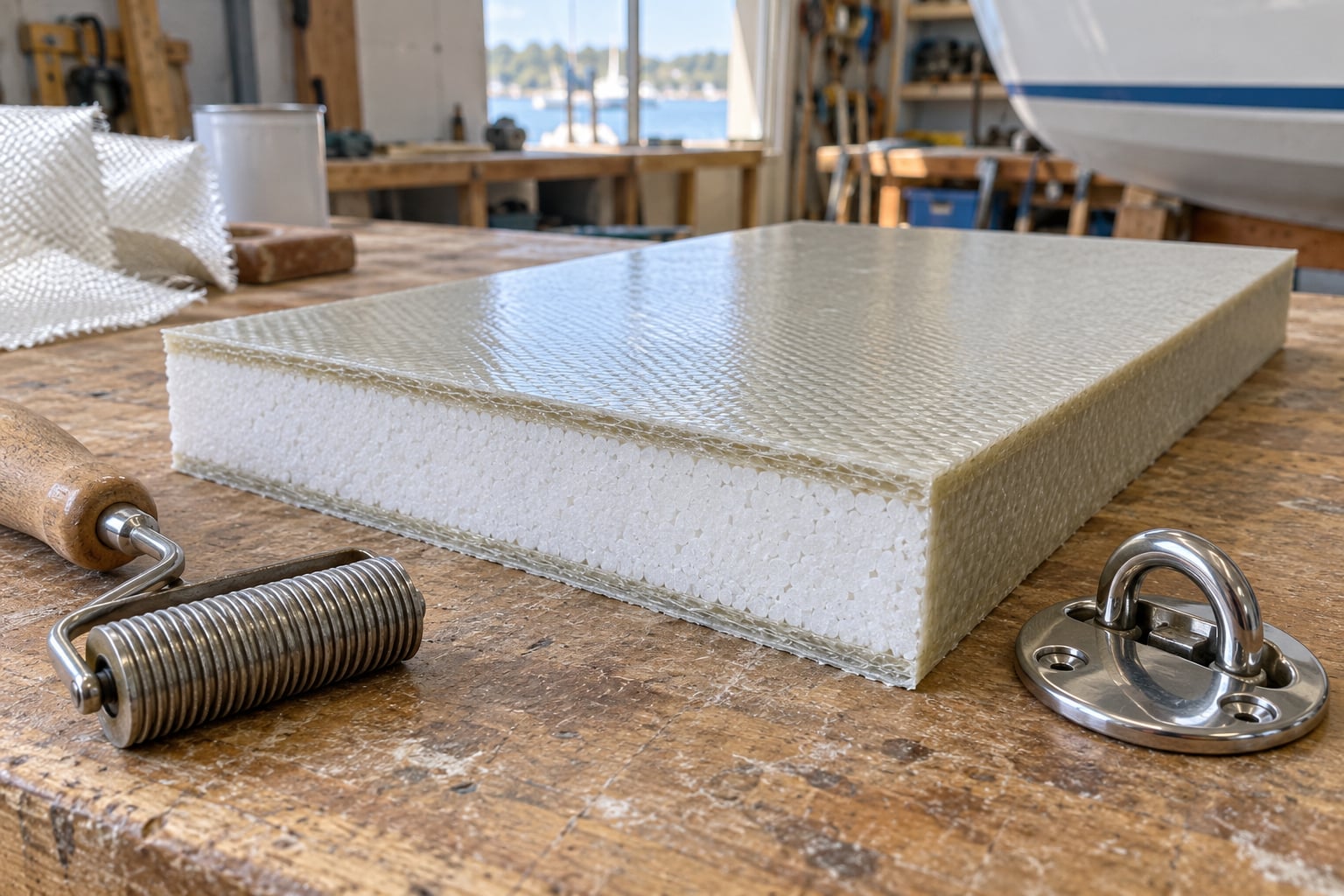
A foam core sandwich panel gets its strength from splitting the job in two. Two stiff outer skins carry the bending load, one in tension and one in compression, while a thick, lightweight core holds them apart and carries the shear between them. That arrangement works like an I-beam turned on its side, and it is why a panel can be far stiffer than a solid sheet of the same weight.
Below is what the layers actually do, which core and skin materials suit marine work, how the panels get built, and where they fail. If you are laying up a hull, deck or cabin top this year, the load path matters more than any brand name on the foam.
Table of Contents
- What Is a Foam Core Sandwich Panel?
- How Foam Core Sandwich Panels Work
- What Are the Main Foam Core Types?
- Why Are Foam Core Panels Stiff but Lightweight?
- How Do the Skins, Core, and Adhesive Share Loads?
- What Affects Foam Core Panel Performance?
- How Are Foam Core Sandwich Panels Made?
- Where Are Foam Core Panels Useful in Marine Construction?
- What Are the Common Failure Modes?
- How Do You Choose the Right Foam Core Panel?
- Frequently Asked Questions
- Conclusion
What Is a Foam Core Sandwich Panel?
A foam core sandwich panel is a three-layer composite built in the order skin, adhesive, core, adhesive, skin. The core is thick and light, usually 10 mm to 100 mm. The skins are thin relative to the core, usually 0.5 mm to 3 mm of laminate or a sheet of plywood, aluminum or steel.
That last point separates a structural panel from foam board. Foam board is a single extruded sheet, thick in its own right, used for printing, insulation and packaging. It has no separate skins and it is not designed to span. A structural foam core sandwich panel puts its material where it resists bending, which is a completely different thing.
Is there a difference between foam core and foam board?
Yes, and it is a big one. Foam board is one homogeneous sheet of extruded polystyrene, typically 3 mm to 50 mm thick, sold by the square metre for mounting photos and adding light insulation. Foam core is the thick interior layer of a sandwich panel, usually a closed-cell structural foam with a much higher compressive strength, bonded to two stiff facings on either side. Board has no skins and no bond line, so it cannot carry a bending load across a span.
How Foam Core Sandwich Panels Work
Here is how foam core sandwich panels work in plain terms: the skins do the bending, the core does the shear and the spacing, and the adhesive line does the transfer. Every failure you will ever see on a foam core panel comes from breaking one of those three jobs.
- The load lands on a skin. A wave, a footstep or a bolted fitting presses on the outer facing.
- The skin spreads it into tension and compression. Bending puts one skin in compression and the other in tension, because the panel flexes like a beam across its span.
- The adhesive transfers that force inward. The bond line is what makes the two skins behave as one section instead of two separate sheets that slide past each other.
- The core takes the shear. Transverse shear is the sliding force between the top and bottom of the panel. The core resists it across the thickness.
- The core holds the skins apart. That separation is the whole trick: material moved away from the middle of the panel keeps doing useful work as the panel bends.
- The core also braces the skins against buckling. A thin skin on its own wrinkles under compression at a fraction of the load. The core props it up at every point along the panel.
Notice what the core does not do. It contributes almost nothing to bending strength, because most of the material sits near the neutral axis where stress is close to zero. It buys stiffness, spacing, shear capacity and buckling resistance for very little weight.
What Are the Main Foam Core Types?
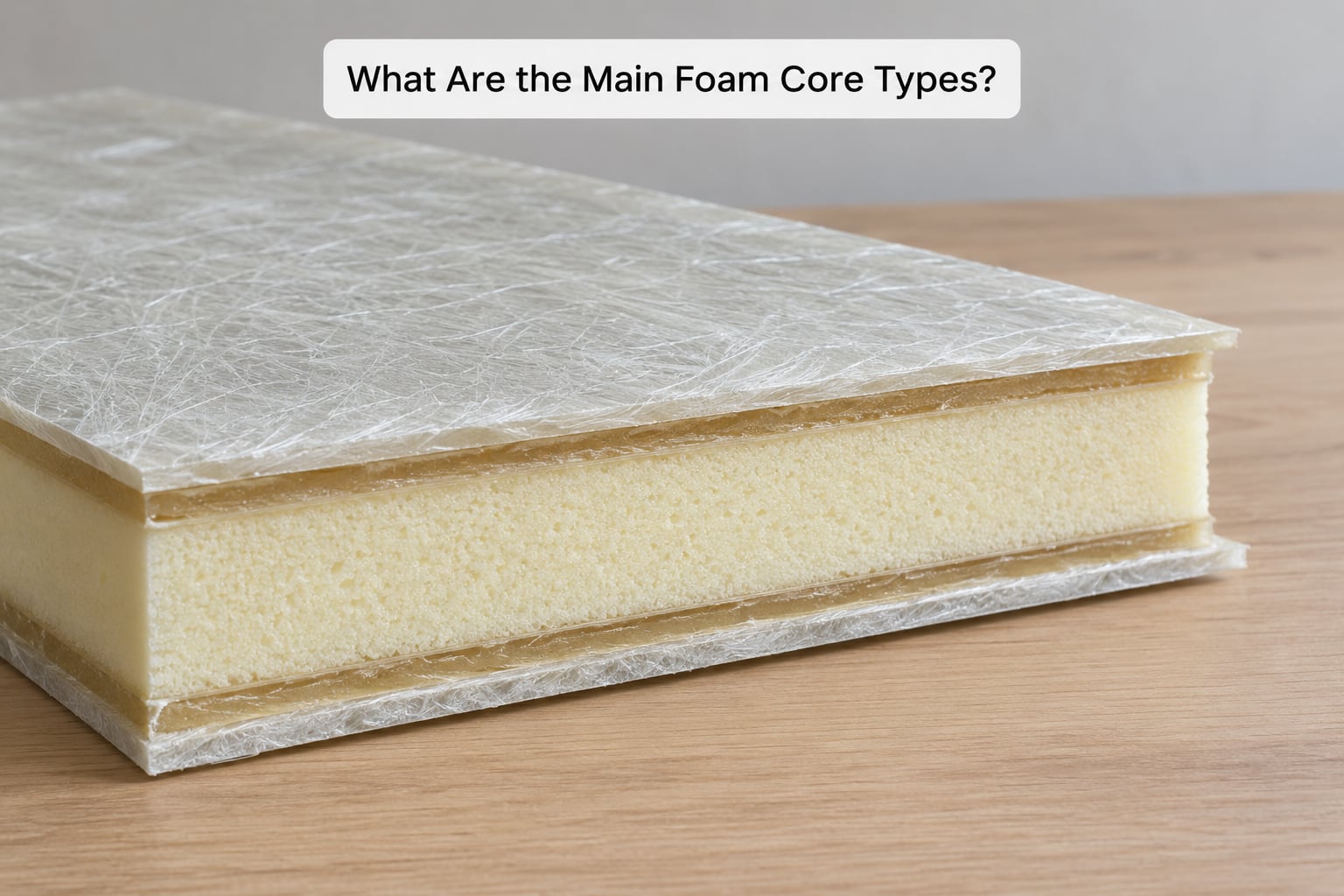
The core you pick decides how much compression the panel survives, how it behaves when it gets wet, and how much work the bond line has to do. These are the ones you will actually meet in boat building and light composite work.
| Core | Typical use in a boat | Moisture behaviour | What it asks of the bond |
|---|---|---|---|
| PVC foam (Divinycell and similar) | Decks, cabin tops, bulkheads, rudders, instrument pods | Closed cell, does not absorb water, edges still need sealing | Demanding. The skin must be abraded off and the surface wetted before bonding or peel strength drops. |
| Polyurethane foam | Molded shapes, limited flat panel work | Closed cell, dimensionally stable | Good wet-out if the cell skin is broken first |
| XPS (extruded polystyrene) | Non-structural decks, hatches, floatation blocks, prototypes | Low absorption but wicks along cut edges, and it degrades in fuel and solvent | Awkward. Solvents in resin attack it, so use a non-solvent system. |
| EPS (expanded polystyrene) | Cheap non-structural cores and floatation | Wicks readily and softens in contact with resin solvents | Poor with polyester or vinyl ester. Epoxy is safer but still needs care. |
| PET foam | Hulls, decks and vanes where low water absorption matters | Very low absorption, good freeze and thaw behaviour | Good, but the bonding window is narrower than most people expect |
| Polypropylene honeycomb | Flat decks and non-contiguous panels in series-built craft | Does not absorb water at all | Undemanding, but the cell walls crush easily under point loads |
| Balsa wood | Race hulls and thin laminate stacks | Absorbs readily unless sealed, and it must be sealed | Needs a sealing face, and end grain soaks glue |
What is foam core board made of?
Foam core board is made by blowing a polymer with a gas and holding the bubbles in a matrix. Extruded polystyrene and XPS push the foam through a die. Expanded polystyrene expands loose beads in a mould. Closed-cell structural foams such as PVC, PET and polyurethane are chemically blown so the cells are closed and the material survives compression. That closed structure is why a structural foam holds its thickness under load and why it barely drinks water.
Why Are Foam Core Panels Stiff but Lightweight?
Bending stiffness depends mostly on how far the load-carrying material sits from the middle of the section. Stack your material up near the neutral axis and it contributes almost nothing. Spread it out to the outer faces and every gram counts twice, because it works over a longer lever arm.
Think of a deep I-beam versus a flat bar of the same weight. The I-beam is far harder to bend. A foam core sandwich panel is that idea in flat form, which is why core thickness is the first lever you pull.
There is an important nuance for anyone doing arithmetic on a panel. Stiffness scales with the cube of depth, so doubling core thickness is roughly an eightfold gain in bending stiffness for the same skins. Strength is different: it scales much more gently, and total panel strength is usually set by the skin material and the bond line rather than by the core.
That split explains a lot of puzzling results. Thickening the core on an already stiff panel buys very little extra strength and adds weight. Putting more glass in the skins barely moves the stiffness at all, but it does raise strength and adds mass. Pick the lever that matches the load case you actually have.
How Do the Skins, Core, and Adhesive Share Loads?
Each layer owns a specific job, and each has a matching failure signature.
Tension and compression are the skins’ problem. They run at the outer fibres, furthest from the neutral axis, and they are the reason the panel does not snap. If a skin is too thin, it reaches its strain limit before the core ever notices.
Transverse shear belongs to the core. When the panel bends, adjacent layers want to slide past one another. The core resists that sliding force across its full thickness, and a low-density or crushed core is where shear failure starts.
Peel is the adhesive’s hardest job. Peel concentrates force in a very small area at the edge of the bond, and it is what opens a crack when someone levers against a panel edge or a fitting pulls at an angle. A bond line that is strong in shear and weak in peel will look fine until something pulls at a corner.
Punchure and point loads are the core’s weakness. A cleat, a deck fitting or a rod holder concentrates force into a few square centimetres. Low-density foam crushes there long before the panel flexes, and a crushed core cannot recover.
Impact is a skin question. A hard landing bends the skin back past its limit and cracks the outer gelcoat or laminate. Foam underneath limits how far the skin can bend, which is why a thin skin over a dense core takes a hit differently from the same skin over a soft one.
Change any one layer to something weak and the load path reroutes. A weak core makes the panel a flexible membrane with no shear capacity. A weak bond turns the panel back into two separate sheets. A weak skin makes the whole section buckle in compression before it ever reaches full strength.
What Affects Foam Core Panel Performance?
Panel behaviour is set by a handful of variables, and it helps to know which ones move the needle.
- Core thickness drives bending stiffness. It is the strongest single lever for a flat panel spanning a distance.
- Skin thickness and material modulus drive strength and impact resistance. Stiff skins such as carbon or aluminum let you reduce their thickness.
- Core density decides compressive strength, shear capacity and how much point load the panel survives under a fitting.
- Cell structure matters. Closed-cell foam holds water out and keeps thickness; open-cell foam crushes and soaks.
- Adhesive compatibility decides whether the bond holds at all. Some resin systems dissolve the foam skin, and a wet-out surface that never cures makes a weak panel that tests fine.
- Fibre orientation sets the direction of strength. Unidirectional cloth along the span is efficient; random mat in both directions is tougher but heavier.
- Span and support spacing set the load case. Doubling the unsupported span increases bending stress sharply.
- Moisture and temperature change core properties and adhesive cure. Chilled panel and resin cure slowly and stay weak longer.
- Workmanship decides more than material choice does. Voids, resin-starved areas and missed surface preparation all remove strength silently.
How Are Foam Core Sandwich Panels Made?
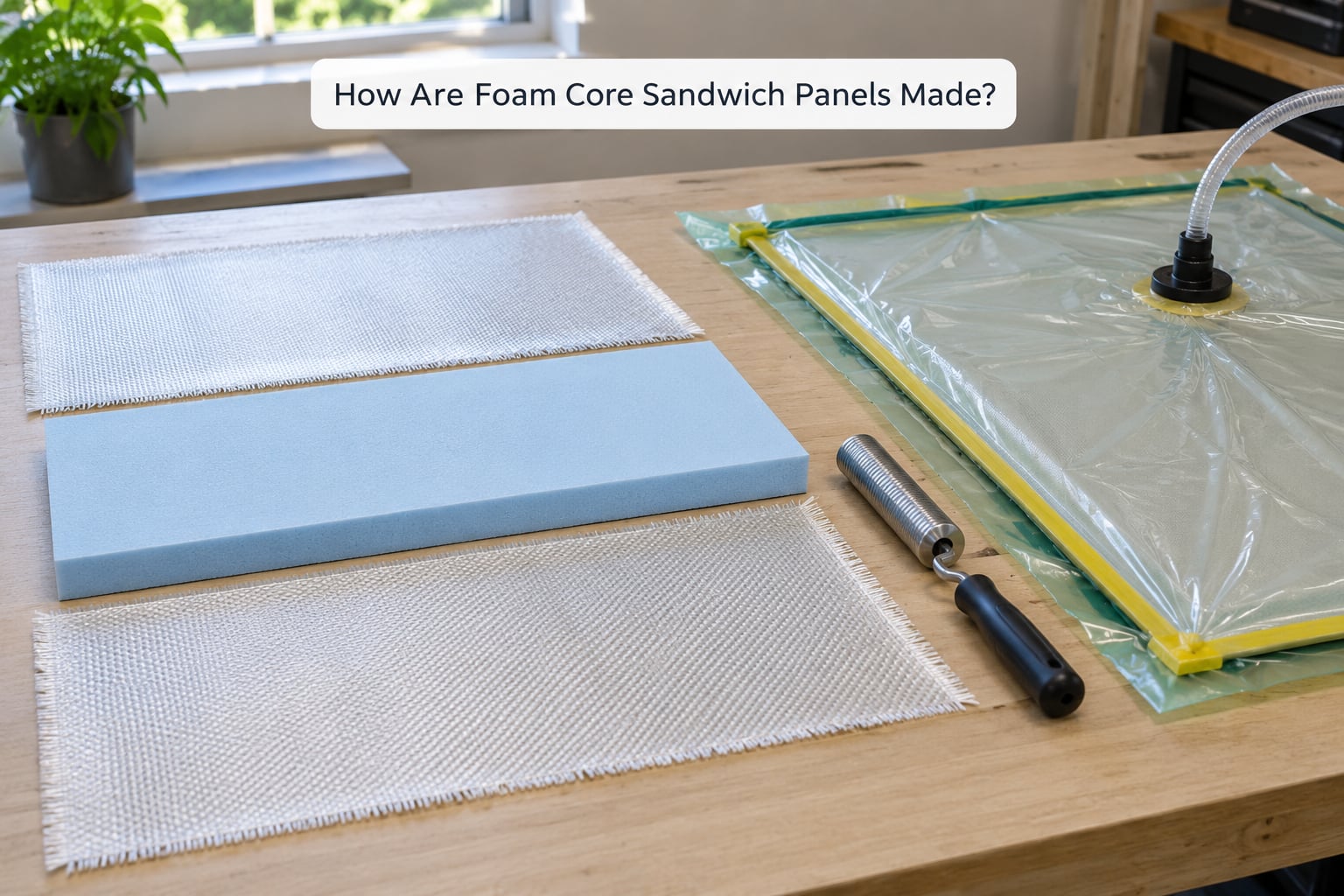
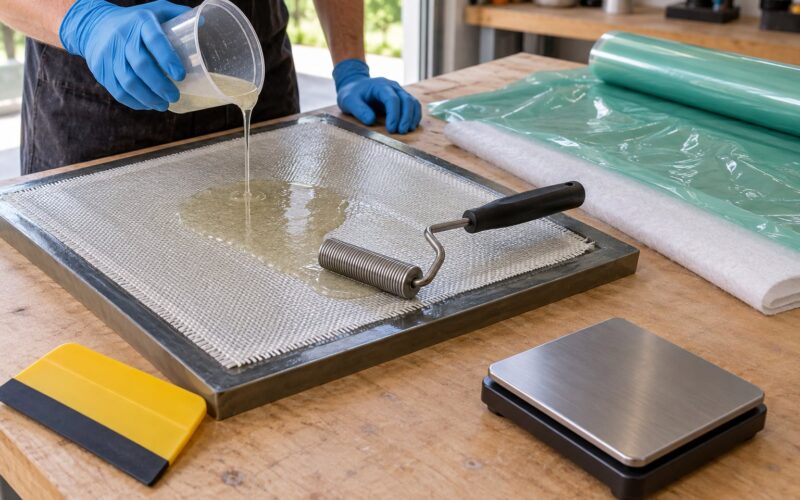
The build sequence is short but unforgiving. Wet lay-up over foam is genuinely a lot of labour and mess, which is why some builders rule it out for a one-off and use bonded skins instead.
- Prepare the skins. Cut oversize and sand the faces to be bonded. Clean and dry everything, including the back of the laminate where it may have been in contact with release film.
- Condition the core. Abrade the foam surface lightly to cut through the fused cell skin, wipe the dust off, and let it dry. Skipping this step is the most common cause of peel failure on PVC and PET cores.
- Wax the mould surface where needed so the finished panel releases cleanly.
- Lay the first skin and get it properly wet out with no dry patches or trapped air.
- Add the core with the abrasive side facing the laminate, then apply the second skin. Fillet the edges so the skins meet the core at more than ninety degrees instead of a knife edge.
- Control pressure with a vacuum bag or a weighted caul. Enough pressure to consolidate the laminate, not so much that resin is squeezed out or the core is crushed.
- Cure fully before trimming. Trim the panel square and seal every cut edge, because foam cores wick along exposed edges.
On safety: work with resin and solvents in a ventilated space, wear eye protection and chemical-resistant gloves, cover your skin, and follow the data sheet for your chosen system. Vacuum bags need a check valve or a filter when you use an amine-cured epoxy. Cut foam with a clean blade outdoors or with good extraction, and treat the dust as a respiratory irritant.
Where Are Foam Core Panels Useful in Marine Construction?
Boat work is where foam core panels make the most sense, because every kilogram saved translates into speed and range.
Decks and cabin tops are the classic application. They span between beams, they are walked on, and they take a lot of point load from hardware. They need a denser core and a thicker skin than people expect.
Bulkheads and interior partitions are straightforward: flat, lightly loaded, and often removable. A thinner core works here, and coring the whole panel keeps weight down in exactly the place where it matters most for a small boat’s handling.
Small boat hulls and kayak-style craft use sandwich throughout, with local solid laminate at the keel, stem and transom where concentrated loads land.
Hatches, lids and removable panels suit a sandwich build because the panel can be light, stiff and easy to seal at the edges.
Rudders, hydrofoil elements and control surfaces need a dense core and continuous skins, because these parts run in water and carry cyclic loads with no second chance.
Separate the non-structural uses from the primary ones. Deck padding, storage lids, buoyancy blocks and instrument covers are not carrying the boat. A keel, a garboard or a structural deck beam is. One site expects a certified design approach; the other expects a sensible weekend build.
Water is the marine-specific risk. Even closed-cell cores take on weight through cut edges and through repeated wet and dry cycles. A panel that stays dry and stays sealed behaves very differently from one that has spent a season with an unsealed edge in the bilge.
What Are the Common Failure Modes?
Most foam core panel failures show up in one of a small number of ways.
Skin wrinkling and print-through happens when the skin shrinks more than the core during cure, or when the laminate is too thin for the core surface. Keep skins at a sensible minimum thickness and control exotherm on thick lay-ups.
Core crushing comes from point loads. A deck fitting, a clamp or a ratchet strap concentrated on a low-density core will dent it permanently. Use a doubler block of denser material under hardware.
Debonding and delamination along the bond line usually trace back to an un-abraded core surface, a contaminated laminate face, or an adhesive that did not match the core chemistry.
Voids and resin-starved areas appear as whitish patches or hollow-sounding spots under the skin. They come from poor wet-out, trapped air or insufficient resin flow.
Core saturation and edge water tracking start at an unsealed cut edge and travel along the core. Sealing edges with a compatible filler or a layer of glass is cheap insurance.
Face sheet buckling under compression means the skin is too thin, the core is not bracing it, or the panel is carrying a bending load it was not sized for.
Edge damage from handling or from a fitting levering against the panel edge causes peel. Fillet or trim the edges and guard exposed ones.
Impact damage cracks the skin and can crush the core underneath without any visible sign on the surface.
Joint failure at fasteners shows up when bolts bear directly on foam. Use washers, through-bolts or inserts that spread the load across a larger area.
A tap test along the panel finds voids and delamination quickly. Sound dull and hollow means suspect; sharp and even means sound. Check edges of finished panels with a pry test on an offcut before you commit a part to the boat.
How Do You Choose the Right Foam Core Panel?
Work through these in order and the answer usually becomes obvious.
Define the load case first. A walking deck, a hatch lid and a hull panel have almost nothing in common. Note whether the panel is loaded in bending, in compression, or in puncture.
Measure the span and the supports. Stiffness needs go as the cube of the unsupported distance, so the spacing of your stringers or frames matters more than most people expect.
Set the environment. Wet and freeze-thaw exposure pushes you toward closed-cell cores with sealed edges. A dry interior bulkhead gives you more freedom, and often a cheaper core.
Fix the skin material next. It decides the panel’s strength per unit thickness and what adhesive you can use.
Then pick the core by density for point loads and shear, and by thickness for bending stiffness. Do not specify thickness before you have looked at span.
Check adhesive compatibility last, but check it before anything else gets cut, because it can rule out the core you wanted.
Build a test panel. A small offcut with your exact skins, core and adhesive will tell you more in an afternoon than an afternoon of theory. Tap it, load it at a fitting, and only then laminate the real part.
For anything carrying the boat or its crew, size the panel through a proper design process rather than by copying someone else’s coring schedule.
Frequently Asked Questions
What are the disadvantages of foam core sandwich panels?
Sandwich panels have predictable limits. Fasteners bear on foam and crush it without spreaders. Cut edges wick water unless sealed. Point loads dent low-density cores, and a crushed core does not recover. Large flat panels are awkward to repair in the field, and stiff skins over a soft core ring hollow under a tap. None of that rules them out, but it does set the limits.
Can you use XPS or EPS foam in a boat?
Both work on non-structural parts, and neither suits a primary hull or deck. EPS wicks water along cut edges and softens when polyester or vinyl ester solvents touch it. XPS absorbs less but still wicks at the edges, and many resin systems attack it. If you use either, seal every edge, keep it clear of the fuel tank area, and epoxy is the safer adhesive.
What is the lifespan of sandwich panels?
Longevity follows the weakest layer, and it is usually the core or the bond rather than the skins. Sealed panels in a protected interior can last for decades. Unsealed edges, repeated wet and dry cycles, ultraviolet exposure of polyester resin and creep under permanent load all shorten service life. Foam core sandwich panels built for protected interior use typically give long service with intact edges; marine panels need their edges sealed and inspected.
What is a polyurethane sandwich panel?
It is a sandwich panel whose core is rigid polyurethane foam, usually made by injecting liquid components into a closed mould. The result is an integral, well-bonded panel where the foam fills the space between two skins. In building work the common version is a metal or composite skin with a polyurethane core, valued for thermal insulation. Marine builders usually meet polyurethane foam as a molded core rather than a flat structural panel material.
Do I need to seal the edges of a foam core panel?
Yes, and it is the cheapest insurance in the build. A cut edge exposes open cells that wick water along the panel, which is how a core that started dry ends up heavy and soft. Seal edges with a compatible filler or a strip of glass and resin, then sand flush. Inspect sealed edges each season, especially around fasteners and anywhere two panels meet.
Are foam core sandwich panels waterproof?
The panel itself can be, as long as the core never gets wet. Closed-cell foams such as PVC and PET absorb very little water, but most sandwich panels leak at the edges, through fastener holes and around fittings rather than through the faces. Cut edges are the weak point and should be sealed with a compatible filler or glass. A saturated core loses stiffness, adds weight and is very hard to dry out completely.
Conclusion
Foam core sandwich panels work because they put stiff material at the outside where bending stress lives, and cheap light material in the middle where it costs nothing to sit near the neutral axis. The skins carry tension and compression, the core carries shear and holds the skins apart, and the bond line transfers everything between them.
Start by writing down your load case, your span, the environment and your weight budget. Pick the skin material, then a core whose density suits the point loads, then a thickness that fixes the span. Check adhesive compatibility before cutting anything, laminate a small test panel, tap it, and only then build the real part.