A flexible hull moves through water by deforming while it travels. Water pressure pushes on the wetted skin, the water alongside has to be accelerated along with the hull, and a compliant structure absorbs part of that force by bending rather than resisting it. That shape change rewrites the wake, and the new wake pushes back on the hull.
Hydroelasticity is simply the name for that two-way conversation between a deformable structure and the fluid around it. The field was formalised by Bishop and Price in the 1970s, and it exists because neither side can be solved alone: change the stiffness and you change the flow, change the flow and you change the loads.
This matters most to makers of small autonomous craft, sailing robots and ocean-monitoring drones, because a compliant hull behaves well in one speed range and badly in another. Below I walk through the sequence, the forces, the wave response and the build decisions.
Table of Contents
- What Is a Flexible Hull and Why Does Its Shape Matter?
- How Flexible Hulls Move Through Water
- The Forces Acting on a Flexible Hull
- What Happens in Waves and Current
- How Material Flexibility Controls the Motion
- How Engineers Test Flexible-Hull Movement
- Design Trade-Offs for Marine Robots and Sailing Hulls
- Frequently Asked Questions
What Is a Flexible Hull and Why Does Its Shape Matter?
A flexible hull is a hull built as a segmented or hinged structure whose skin and frame are deliberately compliant, so it bends and twists slightly under load instead of behaving as one rigid shell.
A rigid hull carries its shape by stiffness alone. Change the load and the shape barely moves; the extra force goes straight into bending the frame and, ultimately, into the structure failing. A flexible hull absorbs part of the same force by changing shape, then returns to its original geometry when the load goes away.
Compliance can come from several places. An inflatable skin on an articulated frame gives large, distributed movement. Segmented panels with fabric or composite joints give controlled movement concentrated at known points. A single-thickness shell gives uncontrolled-by-design movement that concentrates wherever the shell happens to be flattest.
That last point is the one builders on boatdesign.net keep rediscovering. One summary of single-thickness fibreglass panels: the hull flexes where the flatter sections are, because a flat panel has almost no curvature to stiffen it. Planned compliance and accidental compliance look similar on the beach and behave completely differently at sea.
Shape matters because the shape is what the water pushes on. Every change to the wetted outline changes the pressure distribution, the skin friction and the wake. For a rigid hull that relationship is one-way: shape creates flow. For a flexible hull it runs both directions.
How Flexible Hulls Move Through Water
Direct answer: buoyancy sets where the hull floats, added mass dominates the first moments of any change in motion, structural flex redistributes the load, and the reshaped body then settles into a steady bend or twist matched to speed and sea state.
How flexible hulls move through water, step by step
- First contact. When a hull enters or meets a wave face, the local pressure rises almost instantly over the wetted patch. The exact pressure history depends on entry angle and shape, not just size.
- Added mass takes the first hit. The water immediately next to the hull has to be pushed aside and accelerated too. This added mass is often comparable to the hull’s own mass, so the initial inertial load is far larger than weight alone would suggest.
- The joints take a share. On a flexible hull that force spreads across the segments. Each joint deflects a little, so the hull develops a temporary curve or twist instead of one catastrophic local load.
- Shape changes the flow. A bent hull no longer presents the same outline. The wake changes, the pressure field shifts, and the load distribution moves with it.
- The new load feeds back. The changed flow pushes on the already-deformed shape. That is the hydroelastic loop, and it is why a flexible hull cannot be analysed by fixing the shape and solving the flow afterwards.
- Damping bleeds the energy off. Material hysteresis, joint friction and skin damping dissipate the oscillation, so the hull settles rather than ringing.
- Steady travel. Under way in steady seas, the hull reaches a repeatable bend matched to speed, loading and trim. Waves then add an oscillation on top of that steady baseline.
The hydroelastic number
Engineers summarise the competition between structure and fluid with a ratio usually called the hydroelastic number: structural natural frequency compared against the timescale of the hydrodynamic loading. When the structure is stiff and fast relative to the forcing, it behaves almost like a rigid body. When it is soft and slow, the shape change dominates.
The useful part is that the crossover is speed dependent. The same compliant structure can soften an impact at one speed and amplify it at another. Water-entry experiments on flexible wedges show exactly this reversal, and researchers who separate stiffness from damping find that damping widens the range of speeds where flexibility helps instead of merely shifting it.
That is the practical rule for a small craft: a flexible hull is not fast, and it is not slow. It is fast in a band you have to find.
The Forces Acting on a Flexible Hull
Every hull is an argument between a handful of forces. For a flexible hull the argument is never finished, because the shape keeps changing while the forces act.
| Force | Direction | Effect on a flexible hull |
|---|---|---|
| Buoyancy | Upward, set by displaced volume | Holds the hull at its floating position and shifts as the shape or immersion changes |
| Gravity | Downward, through the centre of gravity | Sets trim; moves relative to buoyancy as segments flex and as ballast shifts |
| Added mass reaction | Along the direction of acceleration | The dominant term during any start, stop or turn; scaled by how much water is dragged along |
| Form drag | Opposite the direction of travel | Grows when the hull deforms into a blunter shape at speed |
| Skin friction | Along the surface, opposing relative motion | Changes continuously as the skin stretches and its surface texture shifts |
| Lift and side force | Perpendicular to flow, varies with attitude | Changes as the hull bends, so steering response is not constant with speed |
| Wave and current forces | Direction set by the wave slope | Drive heave, roll, pitch and yaw, and drive structural deformation at the same time |
| Propulsion | Forward at the drive point | Applied below or behind the centre of lateral resistance gives steering; applied above it gives roll and heel |
Hydrodynamics, in one sentence, is the study of how moving fluids exert forces on bodies; a hydrodynamic effect is just the result of that flow acting on something, such as lift on a foil or drag on a skin.
Buoyancy and gravity are steady and slow. Added mass is fast and appears only when the hull accelerates. Everything in between depends on the instantaneous shape, which is why flexible-hull motion is time-dependent rather than a steady-state calculation.
What Happens in Waves and Current
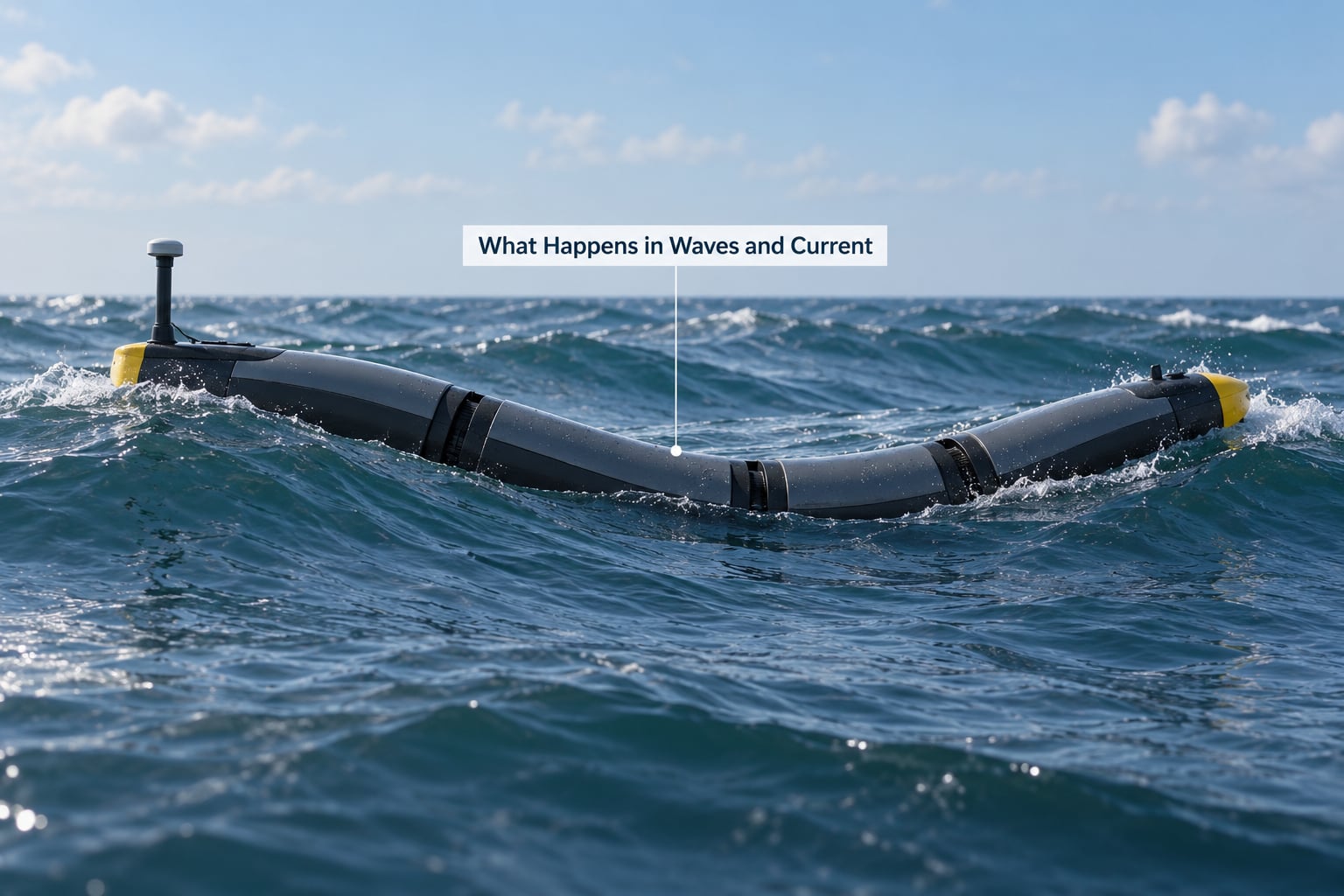
In waves a flexible hull does four things at once: it heaves up and down, it rolls, pitches and yaws, and it deforms internally. The internal deformation is the part rigid-hull theory leaves out.
Two frequencies matter more than wave height. One is the natural frequency of the hull as a structural system; the other is the frequency at which the hull meets the waves, which depends on speed and heading. When the two approach each other, the hull accumulates motion instead of shedding it, and small waves produce large responses.
Resonance is not the only reason a flexible hull behaves oddly. The water alongside must be accelerated with the hull, so the effective mass in the water is much larger than the mass on the beach. That inertia damps nothing by itself; it just makes the hull slower to start and slower to stop.
Phase lag is the other effect. A compliant hull does not track the water surface exactly. It reaches its extreme a fraction of a wave behind, sometimes reduces the peak, and sometimes overshoots and rebounds. Whether the response stays inside the envelope you designed for depends on stiffness and damping working together.
Curents add a steady offset on top of this. A following current raises apparent speed and therefore loads the hull harder; a head current does the opposite. Add wave-induced drag at low speed and the hull can stall, pitch into the wave face and slam.
How Material Flexibility Controls the Motion
Stiffness and damping are two different levers, and builders who confuse them end up over-engineering. Stiffness decides the shape at a given load. Damping decides how long the hull rings after that load changes.
| Lever | What it controls | What it costs | Reach for it when |
|---|---|---|---|
| Stiffness | Magnitude of bending and twisting under load | More frame mass or higher internal pressure, which cuts payload | The steady shape is wrong at your working speed |
| Damping | Decay rate of the hull’s own oscillation | Joint friction, viscoelastic layers, heavier hardware | The shape is right but the motion is lively |
| Segment count | Whether movement is smooth or stepped | More joints, each one a wear site and a stress riser | Wave following is the goal and the sea state is moderate |
| Pressure | Membrane tension in an inflatable skin | A pump, a regulator and more failure modes | You want large distributed stiffness without adding mass |
Soft construction gives large deformation and small peak loads. It also rebounds, wallows and takes an impact set that never fully leaves. Semi-rigid construction, usually a stiffened thin shell, gives moderate movement with a smaller memory of every wave.
Segmented construction gives the most control, because each joint is a deliberate decision point. The cost sits at the joints: fatigue concentrates there, seams chafe, and any rigid fitting bonded across a joint becomes a crack starter.
Two failure behaviours show up again and again in builder discussion. A panel that takes a permanent set after repeated loading quietly changes the hull’s waterline behaviour. And a joint that has absorbed water, growth or repair compound can stiffen enough to turn the flexible hull into a rigid one with heavy, dead sections.
How Engineers Test Flexible-Hull Movement
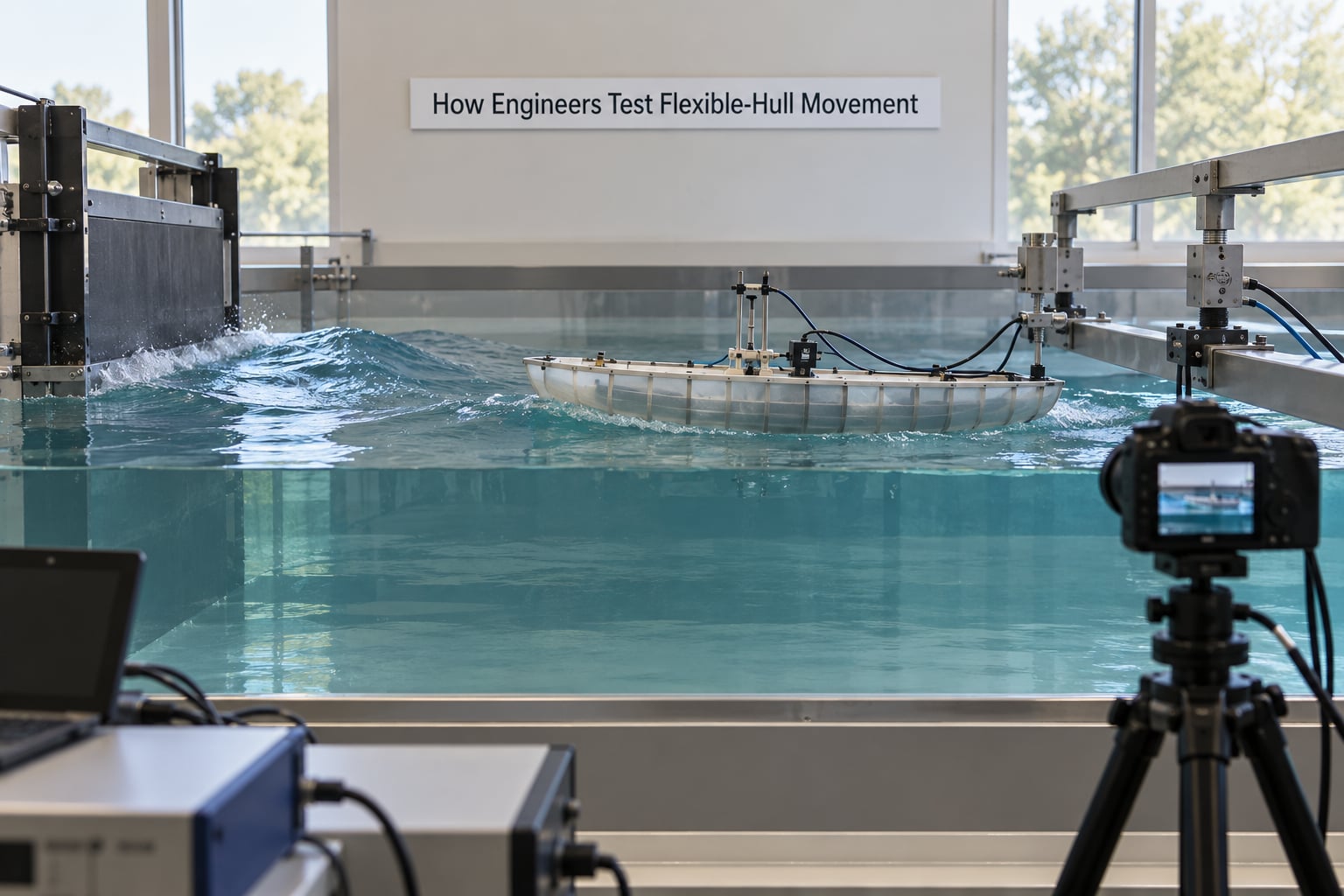
Nobody gets flexible-hull behaviour right on paper alone, because the interesting behaviour happens at timescales too short to reason about in advance. Testing is the answer.
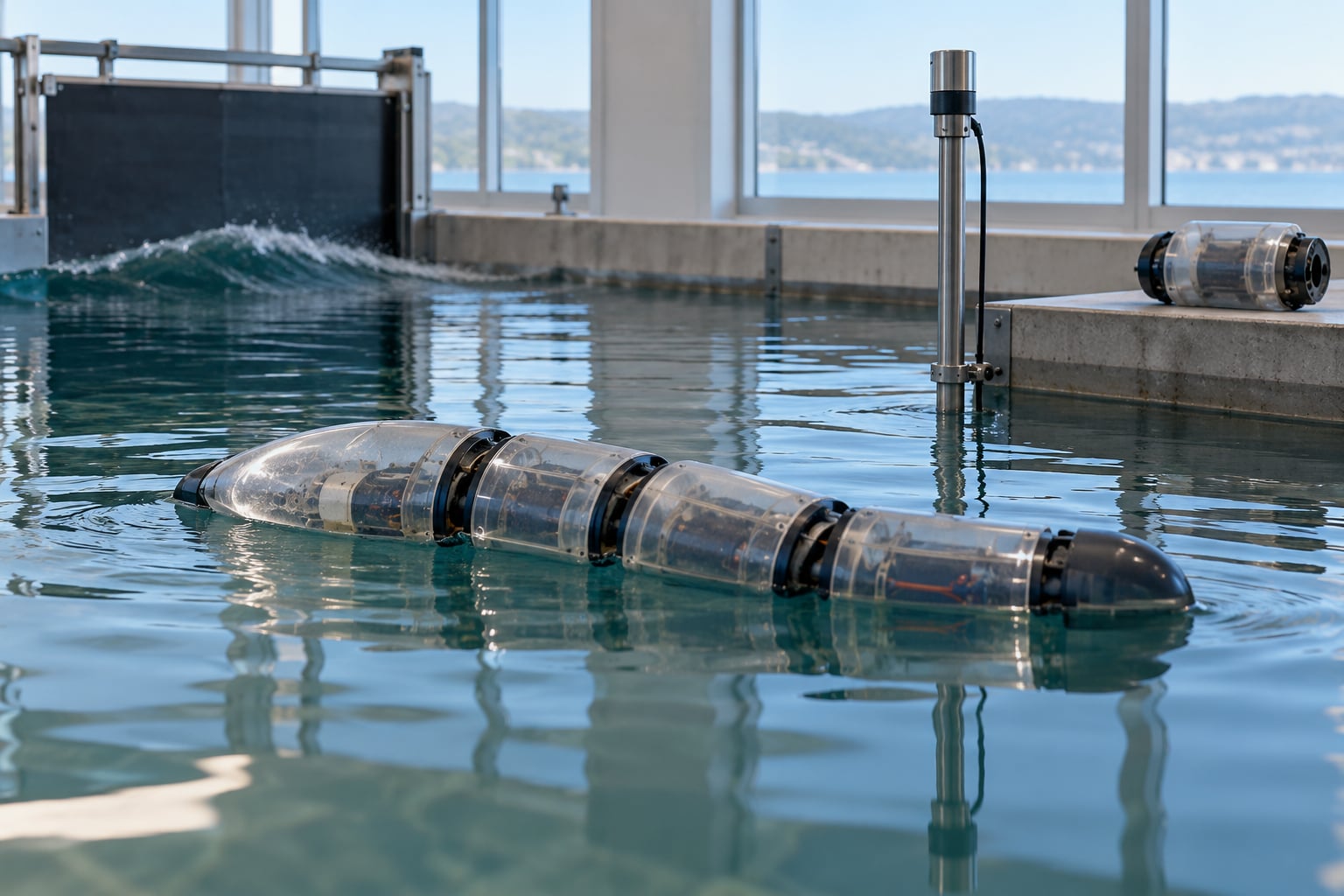
Tank testing with a wave paddle gives repeatable, controlled conditions at a fraction of field cost. You set one wave height and one frequency, hold speed constant, and watch. Because the sea never repeats itself, a repeatable test is the only way to tell a real effect from a story.
Towing tests cover steady travel. Run the hull at a fixed speed with a load cell on the tow line and you get resistance directly. Compare a range of speeds with the segments at different stiffness settings and the speed-dependent reversal becomes visible rather than theoretical.
Wave-basin trials add the piece a tank cannot easily give: an irregular sea. That is where phase lag and resonance show up, and where the difference between a hull that looks calm and one that is actually calm is made obvious.
Instrumentation does the rest. Pressure taps along the skin give the instantaneous distribution that theory only predicts. Strain gauges at the joints give deflection directly. An IMU log aligned to video gives heave, roll, pitch and yaw against the wave field. Flow visualisation with dye or foam streak lines makes wake changes visible without a single expensive sensor.
Always run a rigid control hull of comparable size in the same tank. Without it you have numbers; with it you have an argument.
One caution from the builder side: hull flex moves instruments. A sensor aligned on the beach can be pointed somewhere else entirely after an hour at sea, so alignment belongs in the test plan, not just the build plan.
Design Trade-Offs for Marine Robots and Sailing Hulls
Every flexible-hull decision is a trade between hydrodynamic efficiency, structural survival and control authority. The interesting choices sit between those three.
Hull thickness and frame layout set where the flex concentrates. Flat panels, unsupported corners and the gap between a fitting and the skin it is bonded to are all places the compliance gathers. Spreading a stiffener along the load path rather than concentrating it at a point costs a little weight and removes most of the cracking.
Ballast placement sets the relationship between the centre of gravity and the centre of buoyancy. Water and sand ballast keep a small robot’s trim adjustable without a heavy fixed keel, but moving mass slows every correction and increases added mass when it shifts.
Propulsion and rudder placement decide whether a compliant hull is controllable at all. A drive point below the hull line gives the usual differential-steering behaviour. Moving the control surface forward, so the hull bends as it turns, is what lets a fish-like hull hold an upwind heading without tacking, at the cost of response that changes character with speed.
The hull type still decides where flexibility fits best.
| Hull type | How it moves | Where flexibility fits |
|---|---|---|
| Displacement | Pushes a large volume of water aside; speed follows displacement | Comfort in a seaway; little efficiency gain from shaping |
| Semi-displacement | Part plane, part displace; sensitive to loading | Absorbing slam; the compromise is the point of the type |
| Planing | Lifts onto the surface and reduces wetted area | Little room; added mass and flex work against lift |
| Multihull | Two or more slender bodies sharing the load | Natural fit: each demihull is already an isolated compliant body |
The downsides of the semi-displacement approach are the reason it is a compromise: it carries weight it does not need at low speed and is unforgiving of being loaded past its design point. Flexible hulls inherit that behaviour exactly, plus a new one, because immersion changes shift the pressure field the joints live in.
For ocean monitoring and cleanup work, the priority is usually energy per day rather than top speed. That favours a hull sized to its own drag rather than to a target speed, which in turn gives the joints room to work inside a band rather than at a limit.
Frequently Asked Questions
Do flexible hulls reduce drag?
Sometimes, and the effect is speed dependent. A hull that conforms gently to a wave face presents a smoother outline and removes sharp discontinuities such as a separate keel or rudder junction, which are real turbulence sources. Builders also cite a delayed transition from laminar to turbulent flow in a flexible skin. None of that guarantees lower resistance at every speed: a hull that deforms into a blunter shape under load increases form drag instead.
Why does a flexible hull wobble or oscillate in waves?
Usually because the hull’s structural natural frequency is close to the frequency at which it meets the waves. Each encounter feeds energy into the same motion, so response grows wave by wave until damping balances input. Added mass makes it worse by slowing the start and stop of every movement. The fixes are damping, a stiffness change, or changing speed and heading so the two frequencies separate.
How much hull stiffness do I actually need?
Enough that the steady shape at your working speed and load is the shape you designed. Too stiff wastes weight and payload; too soft lets the hull deform into a blunter, draggier outline and increases the added mass it drags. Tune against a test rather than a rule: tow the hull at several speeds with one joint deliberately softer, and watch where resistance turns upward.
Is a flexible hull faster than a rigid hull?
Not in general. A compliant hull usually pays a small efficiency penalty in exchange for lower peak loads, better wave riding and payload protection, which is the trade that matters for long-endurance craft. There is a speed band where a given stiffness helps rather than hurts, and it moves with sea state and loading, so the answer has to be found by testing at your own speeds.
What is hydroelasticity in simple terms?
Hydroelasticity is the interaction between a deformable structure and the water around it, where the shape change and the flow change each other. It was formalised by Bishop and Price in the 1970s. The practical consequence is that you cannot analyse a flexible hull by fixing its shape and solving the water separately, because the moment the hull moves, the loads move with it.
How do you measure how much a hull is flexing?
Strain gauges at the joints give deflection directly, pressure taps along the skin give the instantaneous load distribution, and an IMU logged against video gives heave, roll, pitch and yaw against the wave field. Dye or foam streak lines show wake changes for almost no cost. Run the same sequence at several speeds, because the answer changes with speed.
Start by towing, not by theorising. Measure resistance at a spread of speeds with one joint set soft and one set stiff, and you will find your own speed band faster than any rule of thumb. Everything else on this page, the damping, the ballast, the control surface, follows from what that test tells you.
This article was written for 2026.