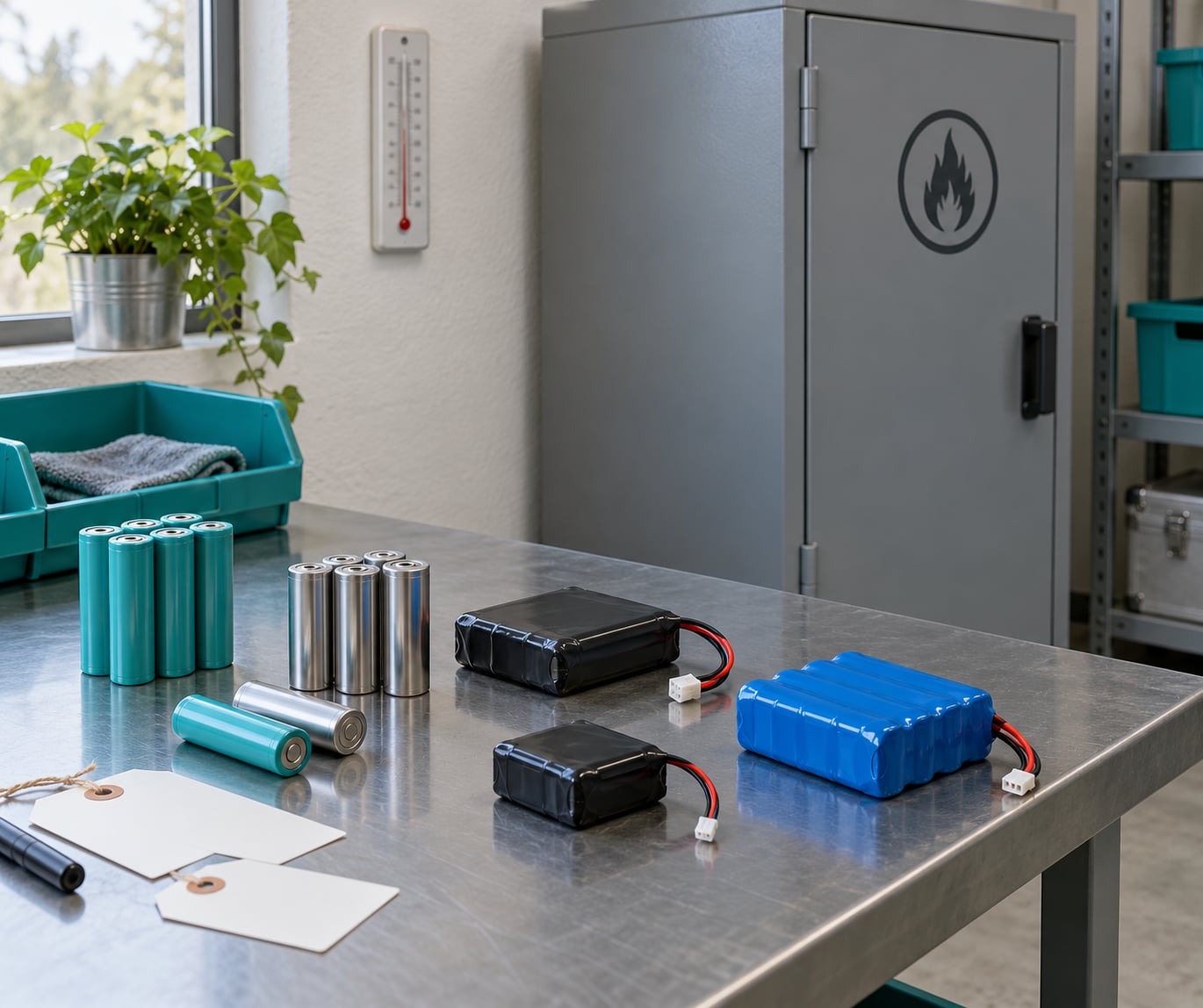
Lithium batteries are safest when stored in a cool, dry, ventilated interior space, at roughly 40-50% charge, upright in a nonconductive container, away from heat, direct sunlight and anything that burns.
Keep them off the floor, keep the terminals covered, and check on them every few weeks. If a pack is damaged, swollen or leaking, don’t store it at all.
Getting those basics right is most of the battle, and how to store lithium batteries safely comes down to temperature, charge level, terminal protection and the container you pick. A lithium-ion cell stores its energy in a flammable electrolyte, and when that chemistry goes wrong it does not behave like a kettle that switches itself off. The failure mode is called thermal runaway: an internal short drives temperature and pressure upward on their own, the cell vents flammable gas, and once it starts, ordinary extinguishers can’t finish it.
That deserves a fair amount of context rather than panic. UL Solutions logged 550 lithium-ion battery incidents in the United States in 2024, with 126 injuries and 14 deaths. Billions of cells are in use every day and properly stored cells are overwhelmingly uneventful, but storage is exactly where risk concentrates, because a cell can sit for months quietly absorbing heat with nobody watching.
The advice below pulls the storage numbers from manufacturer datasheets, the National Fire Protection Association, UL Solutions, and the 2024 amendments to the International Fire Code. Where a datasheet and a general rule disagree, the datasheet wins.
The short version:
- Temperature: 50-77°F (10-25°C) is the target band. Below -13°F (-25°C) and above 149°F (65°C) is where cells start taking real damage.
- Humidity and air: dry, and with enough ventilation that a venting cell never collects gas in a sealed space.
- Charge level: 40-50% for months-long storage; at or below 30% where a code-compliant storage area requires it.
- Position: upright, single layer, terminals covered, nothing metal touching the case or contacts.
- Location: an interior closet, cabinet or conditioned utility room, not an attic, garage, shed, boat deck or vehicle.
- Paperwork: a label with the chemistry, date stored and charge level. It makes the monthly inspection ten seconds instead of ten minutes.
Table of Contents
- What You Need
- Step-by-Step
- Step 1: Identify the Battery Chemistry and Storage Instructions
- Step 2: Check the Battery for Damage or Abnormal Behavior
- Step 3: Set the Correct Charge Level for Storing Lithium Batteries Safely
- Step 4: Protect Terminals and Prevent Short Circuits
- Step 5: Choose a Suitable Storage Container
- Step 6: Control Temperature, Humidity and Sunlight
- Step 7: Store Batteries Separately and Label Them
- Step 8: Inspect Stored Batteries on a Schedule
- Step 9: Bring Batteries Back Into Service Safely
- How to Store Lithium Batteries Safely: Common Mistakes and Fixes
- Frequently Asked Questions
- What is the safest way to store lithium batteries for long-term use?
- Should lithium batteries be stored fully charged or partially charged?
- Can lithium batteries be stored in a refrigerator?
- Is it safe to store lithium batteries in a car, boat, or garage?
- What should you do if a stored lithium battery is swollen or leaking?
- How should damaged or recalled lithium batteries be disposed of?
- Conclusion
What You Need
None of this is specialized equipment. Gather it before you start so you’re not hunting for tape with a battery in your hand.
- The manufacturer’s storage specification. The datasheet for the pack or the device that holds it. This is the single most useful item on the list and the one most people skip.
- A nonconductive case or the original packaging, which on a power tool or laptop battery is usually a fitted plastic tray with a terminal cover.
- A fire-resistant cabinet or containment box if you’re storing more than a few small cells, an e-bike pack, a power tool bank, or anything with a lithium battery energy storage system inside it.
- Terminal caps or electrical tape for bare cells and packs with exposed contacts.
- A permanent marker and label stock for chemistry, date and charge level.
- A thermometer or a temperature data logger if the location isn’t obviously climate-controlled. Cheap USB loggers record a season of data in one trip.
- A dry, interior spot with a shelf you can see. Visibility is what makes the inspection routine in Step 8 actually happen.
Skip the fire-resistant cabinet if you’re storing two laptop batteries. Don’t skip it if you’re storing a single 500 Wh e-bike pack, because pack size drives both the energy released and the difficulty of containing it.
Step-by-Step
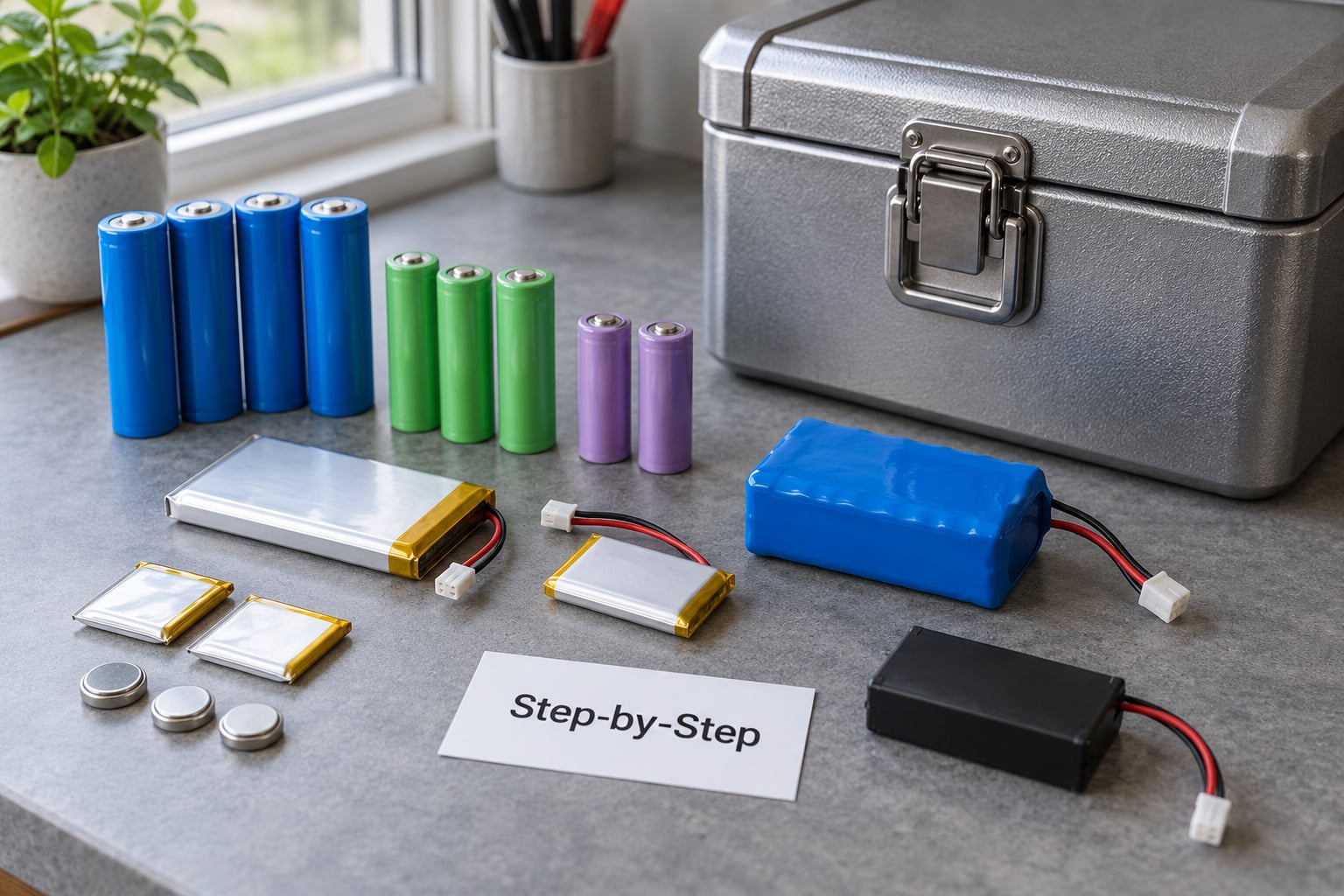
Work through these in order. Steps 1 and 2 are the ones that decide whether a battery belongs in storage at all, and they take about two minutes.
Step 1: Identify the Battery Chemistry and Storage Instructions
Lithium-ion (LiCoO2 and NMC) is what most phones, laptops, power tools and e-bike packs use. Lithium polymer (LiPo) is a pouch-format lithium-ion cell that is more mechanically fragile, which matters most on an aircraft or in a trailer where things get shaken.
Lithium iron phosphate (LiFePO4) tolerates heat better and has a much longer calendar life. Primary lithium cells — the non-rechargeable ones in sensors, meters and marine beacons — have no state of charge to worry about and mostly care about temperature and humidity.
So read the label before you apply any general rule, including the general rules in this guide. Model it, look for a datasheet, and note three things: the storage temperature range, the recommended storage charge, and the maximum storage duration. If the pack is still inside a device, the device manual is the authority; if you can no longer identify the maker or model, treat it as the more conservative chemistry and store it at the cooler end of the band.
Step 2: Check the Battery for Damage or Abnormal Behavior
Do this under good light and look at what the cell is telling you. Swelling is the obvious one — a soft, pillowed or slightly rounded case that no longer sits flat, often visible as a laptop lid that won’t close.
Leaking electrolyte leaves a sticky, faintly oily film, usually with a sharp solvent smell. White, green or crusty deposits around the terminals mean corrosion. Look for dents, crushed corners, a torn or lifted wrapper on a pouch cell, or a seam that has separated.
Also ask whether it behaved badly before you put it away: an unexpected swell while charging, a charger that refused to finish, an unusually warm pack, a hiss, or a device that dropped battery far faster than it used to.
A battery that fails any of these checks does not go on a storage shelf. Move it to a hard-surface location away from combustibles and get it to a collection point, following the guidance in the FAQ at the end. Storing a damaged cell is the single most consequential mistake on this list.
Step 3: Set the Correct Charge Level for Storing Lithium Batteries Safely
There isn’t one magic number, which is why this rule gets repeated badly online. For a rechargeable cell going into storage for more than a few weeks, 40-50% state of charge is the usual recommendation.
A fully charged cell holds more energy, runs hotter in a runaway event, and ages faster at high voltage. A fully discharged one is worse in a different way: copper in the current collector can dissolve into the electrolyte and plate as dendrites across the separator, and those metal whiskers eventually create the internal short you were trying to avoid.
Some environments require the opposite end of the range. The 2024 amendments to the International Fire Code grant relief from certain storage requirements when the state of charge is 30% or less, which is why you may see facilities holding cells at 30% or lower. Code-compliant storage prioritizes the fire code over calendar life, and that’s a rational trade.
Primary lithium cells don’t take a charge at all, so this step applies only to rechargeable packs. And if you can charge to a specific figure only by guessing, staying at or below 30% is the conservative choice — it costs you a little capacity, and capacity is replaceable.
Step 4: Protect Terminals and Prevent Short Circuits
An unprotected terminal is the most direct route to a problem. A loose coin, a key on a workbench, a binder clip, a battery-powered tool hanging above a shelf, or one bare cell touching another can produce a short that develops into a full thermal runaway in seconds, and a cell that shorts while surrounded by combustibles burns the room rather than the cell.
Three habits cover almost all of it. Fit a terminal cap or wrap each exposed contact with electrical tape, pressing it down so it stays put. Keep cells in their original fitted packaging when you have it — the tray is molded to keep contacts apart and off the case. And never store loose cells in a shared bin or drawer; give each one its own compartment, or keep them in the pack they came in.
FAA guidance for crews carrying spare batteries in the field points at the same control: individual protection for each cell, kept apart from anything conductive. It’s a small habit that removes the most mechanical failure mode there is.
Step 5: Choose a Suitable Storage Container
The right container does three jobs: it stops metal touching metal, it keeps a venting cell from building pressure in a sealed space, and it limits how fast a fire can spread if something goes wrong. Different options trade off against each other, and no option does everything.
| Container | Fire resistance | Ventilation | Good for |
|---|---|---|---|
| Original plastic tray or clamshell | None — melts in a fire | Full | One laptop or tool battery |
| Nonconductive plastic tote with a lid | Low, but keeps contact and spread | Leave the lid loose or off | Several small cells, labeled |
| Metal ammo can with gasket | Contains sparks and flame well | Poor — not designed to vent | Dry indoor use, spares and tools |
| Fire-resistant cabinet with fusible link | Designed to contain a runaway event | Vented or filtered | E-bike packs, tool banks, BESS, anything large |
| Fire-resistant bag or sleeve | Rated for a short high-temperature event only | Full | Transport and temporary handling, not permanent storage |
| 5-gallon bucket with drilled vent holes | Low | Poor unless modified | Bulk dry storage of sealed cells only |
Two cautions on the table. Community consensus is that most small fire bags are rated to contain a brief very-high-temperature event, not a sustained battery fire, so don’t treat one as a storage cabinet. And don’t seal a damaged or actively venting cell in a rigid airtight container — pressure builds with nowhere to go. A damaged battery wants isolation and a disposal route, not a lid.
Step 6: Control Temperature, Humidity and Sunlight
Temperature is the variable that actually decides how long a stored cell lasts. Here are the numbers, and where each one comes from.
| Threshold | Value | What it means |
|---|---|---|
| Recommended storage band | 50-77°F (10-25°C) | Where calendar aging slows down most |
| Upper damage threshold | 149°F (65°C) | Above this, cells accelerate degradation and risk venting |
| Lower damage threshold | -13°F (-25°C) | Below this, charging is not permitted and plating damage can occur |
| Storage state of charge | 40-50% | Balance of usable capacity against stored energy and cycle life |
| Code-compliant storage SOC | 30% or less | Threshold used for storage-requirement relief in the 2024 IFC amendments |
| Inspection interval | Every few weeks, monthly while stored | Catches swelling, corrosion and self-discharge before they matter |
Humidity matters less than most guides imply, but standing moisture corrodes terminals, and corrosion is a short circuit waiting to happen. Keep cells off concrete floors, off uninsulated metal shelving, and away from any point where water gets in. Ventilation isn’t about the battery; it’s about you. Storage areas should have enough air movement that a vented cell disperses its gas instead of collecting it in a closet.
Sunlight is a heat source with extra persistence, and a south-facing window or a greenhouse wall can push a shelf past the upper threshold on a still afternoon. Keep storage out of direct sun even if the room reads cool.
Step 7: Store Batteries Separately and Label Them
Separate means physically separate: different shelves, different containers, ideally different rooms from anything flammable. Lithium-ion batteries stored shoulder to shoulder with gas cylinders, paint, solvents, fuel or a paper pile have no margin at all. Keep them away from heat sources and ignition points — a furnace, a water heater, a welding bay, a boiler, a smoking area.
Don’t mix chemistries in one container, and don’t store a charged pack next to a charger that is plugged in. Plugged-in chargers in standby draw small current, and the one failure you don’t want is a charger you forgot about for a year.
Label each container with the chemistry, the date stored, the charge level, and a contact name if the batteries belong to work equipment. A month-old battery you can identify at a glance is a battery you can keep correctly; an anonymous cell in a bin is one you’ll avoid checking.
Step 8: Inspect Stored Batteries on a Schedule
Yes, lithium batteries go bad from sitting, gradually, and this is where managing that actually happens. A quality cell stored cool, dry and near 40-50% holds usable capacity well past a year. But calendar aging is real: capacity falls whether or not you cycle the pack, and a cell held at 100% or at 0% degrades considerably faster than one held in the middle.
Set a monthly reminder. Each check takes a minute and covers five things: room temperature still inside the band, no new swelling or distortion, no leakage or corrosion, no smell, and the charge level. On a pack with a fuel gauge or a battery health readout, read the actual state of charge and top back up to no more than 30% if it has drifted below that. For anything without a readout, top up every three to four months to the recommended storage charge rather than guessing monthly.
Stop and isolate a battery immediately if it’s warm to the touch without having been charged, hissing, swollen, wet, or showing any of those symptoms that were absent at the last check. A slow leak that gets isolated costs you one battery. The same leak discovered after eight months in an unventilated cupboard can cost you the cupboard.
Step 9: Bring Batteries Back Into Service Safely
Coming out of storage is uneventful if you do it in order. Inspect first, against the same five checks, and reconnect the pack with the correct connector, confirming the polarity twice before you power anything up.
Then charge it with the manufacturer’s charger, on a hard non-combustible surface, with the cell or pack kept away from paper, fabric, bedding and other combustibles.
A soft surface such as a sofa or a bed is the classic mistake, because it blocks the heat that a runaway cell needs to dissipate. Set your device’s charge limit to 80% for daily use and follow the same rule for the first few cycles.
Expect the first charge after long storage to take longer and the pack to feel warmer than usual, particularly below freezing. Never charge a lithium-ion battery below its freezing point; bring it to room temperature first and give it time to equalize. A pack that feels unusually hot while charging, bulges, or hisses is an immediate stop — disconnect it if it’s safe to reach, move people and pets away, and follow the emergency steps in the Common Mistakes section below.
If you have any doubt about a battery’s condition after two years of storage, the cheapest path is to let a recycling or collection facility assess it rather than putting it back into service.
How to Store Lithium Batteries Safely: Common Mistakes and Fixes
Storing a damaged, swollen or leaking battery. This is the error with real consequences. Isolate it on a hard noncombustible surface away from anything flammable, do not puncture or compress it, and move it to a proper collection point. If it is hot or hissing, do not handle it — clear the area and let emergency responders deal with it.
Leaving a pack at full charge for months. High voltage ages a cell faster than anything else you do to it. Bring it to 40-50% before it goes on the shelf.
Leaving a pack empty. Deep discharge invites copper plating and the internal shorts that follow. Keep the floor of your storage charge somewhere above zero.
Using the garage, attic, shed or vehicle. This is the question forums ask most, and the honest answer is that unheated spaces are the wrong place for anything stored for months. An attached garage in summer routinely exceeds 149°F (65°C) in the back corner, and a cold one drops below -13°F (-25°C) in winter. The same logic applies to a boat’s open deck or equipment locker, an RV bay and a car trunk — all of them swing with the weather, and all of them are inside a metal shell in summer. Store indoors, or in a location where you have actually measured the temperature range across a full year.
Treating a fire-resistant bag as a storage cabinet. These are made for transport and short-term handling. The rating covers a brief high-temperature event, not a sustained battery fire.
Charging on a soft or combustible surface, or leaving a charger connected indefinitely. Use a hard surface and unplug when the charge finishes. Unplugged at 80% rather than left at 100% is the simplest risk reduction available.
Using the wrong charger. A charger that pushes more voltage or current than the pack was designed for is an overcharge waiting to happen. Use the charger the device shipped with, or one explicitly rated for it.
Blocking vents and packing cells tight. Airflow matters for you as much as for the cell. Leave headroom above cells in a container and leave lids loose on plastic totes.
Throwing batteries in household trash or recycling. Never. Damaged and recalled batteries in particular need a certified collection route, and local rules vary by country and state.
If you remember only one thing from this guide, remember that manufacturer instructions override everything here. A datasheet that says 15-35°C is a different battery from one that says 50-77°F, and the datasheet is correct for that pack.
Frequently Asked Questions
What is the safest way to store lithium batteries for long-term use?
Store them in a cool, dry, ventilated interior space between 50 and 77F (10 to 25C), at 40-50% charge, upright in a nonconductive or fire-resistant container, with terminals capped or taped and nothing conductive touching them. Keep them away from heat, direct sunlight and combustible material, and inspect monthly. For large packs such as e-bike or power tool batteries, use a fire-resistant cabinet rather than a plastic tote.
Should lithium batteries be stored fully charged or partially charged?
Partially charged, at 40-50% for typical long-term storage. A full cell holds more energy, runs hotter if something goes wrong, and ages faster at high voltage. A fully discharged cell can suffer copper plating across the separator, which sets up the internal short you were trying to avoid. Some fire-code-compliant facilities store at 30% or below, because the 2024 International Fire Code amendments grant storage relief at that level.
Can lithium batteries be stored in a refrigerator?
Not recommended for home storage. A refrigerator is not a dry, stable environment, condensation forms on cold surfaces, and the compartment warms unevenly. Storage in a household fridge risks moisture on terminals and corrosion, which is a reliable path to a short. If a manufacturer or safety body specifically instructs refrigerated storage for a specific cell, follow that instruction exactly, including the required packaging and desiccant.
Is it safe to store lithium batteries in a car, boat, or garage?
For anything stored more than a few days, generally no. Unheated garages, sheds, attics, vehicle trunks and boat equipment lockers routinely exceed the 149F (65C) upper damage threshold in summer and can fall below -13F (-25C) in winter. An interior closet or conditioned utility room is safer. If an outbuilding is your only option, measure the temperature range across a full year with a data logger before you commit to it.
What should you do if a stored lithium battery is swollen or leaking?
Do not puncture, crush or compress it, and do not put it back on a charger. Move people and pets away, keep it away from combustibles, and do not handle a cell that is hot or hissing. Take a cool, merely swollen pack to a household hazardous waste or battery collection facility. A hot, hissing or actively venting cell is an emergency: clear the area, evacuate, and call emergency services, telling them it is a lithium-ion battery.
How should damaged or recalled lithium batteries be disposed of?
Never in household trash or curbside recycling. Take them to a household hazardous waste facility, a retailer take-back point, or a certified battery recycling and collection site, and tape the terminals before transport. For a recalled pack, follow the recall notice rather than general advice, since the manufacturer usually supplies a specific shipping container. Rules differ by country, state and battery type, so check your local hazardous waste authority.
Conclusion
Start with the five things that matter: identify the chemistry, check the pack for swelling or damage, store at the manufacturer’s recommended charge level in the 40-50% range, cover the terminals, and put it in a cool, dry, ventilated interior spot away from anything combustible. Label the container, check it monthly, and use a fire-resistant cabinet for the big packs. Everything else on this page is detail underneath those five.
Last reviewed October 2026. Numeric thresholds reflect UL Solutions incident data for 2024, NFPA consumer lithium-ion guidance, the 2024 International Fire Code amendments on state of charge, FAA guidance on protecting spare battery terminals, and manufacturer datasheets for storage temperature and charge. Manufacturer instructions override all of it.