A student ocean robotics competition is a season-long engineering program in which a team of students designs, builds, tests and pilots a vehicle that works in water, usually a remotely operated vehicle (ROV), to complete mission tasks modeled on real subsea industry and research work. Understanding how student ocean robotics competitions work comes down to one repeating annual cycle: an organization publishes a new mission scenario and rulebook, teams register, build and pool-test a vehicle against those specific tasks, get scored at a qualifier on mission performance plus engineering and communication plus safety, and the top teams earn an invitation to an international championship.
This page walks that whole cycle end to end, from reading the announcement to writing up what happened. Rules change every season, so treat the numbers here as the shape of the process rather than a rulebook for 2026.
Table of Contents
- What Is a Student Ocean Robotics Competition?
- Why These Competitions Matter for Students
- How Student Ocean Robotics Competitions Work from Start to Finish
- The Announcement Phase
- The Challenge and Task Design
- The Team Proposal or Design Review
- Building an Ocean-Ready Robot
- What Happens During Pool and Field Testing?
- How Competitions Are Judged
- Safety, Ethics, and Environmental Responsibility
- Awards and What They Measure
- What Makes a Strong Student Team?
- How to Prepare for Your First Competition
- Frequently Asked Questions
- Conclusion: Start with the Rules, Then Build for Evidence
What Is a Student Ocean Robotics Competition?
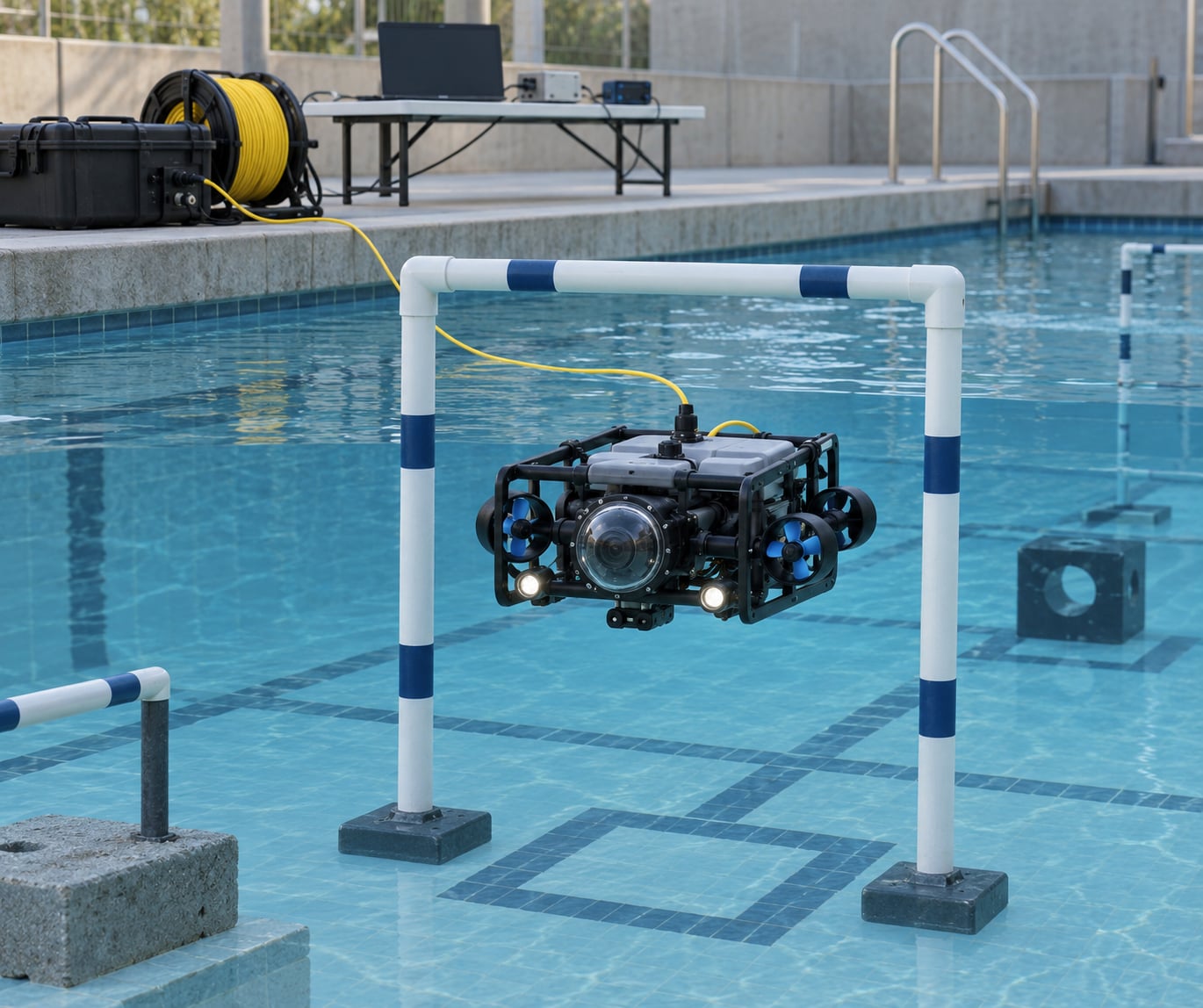
An ROV competition is an event where student teams pilot a tethered underwater vehicle through a course of mission-based tasks and present the work behind it to judges. The word “competition” undersells it. Most of the scoring sits with documentation, engineering explanation and safety, not with finishing first.
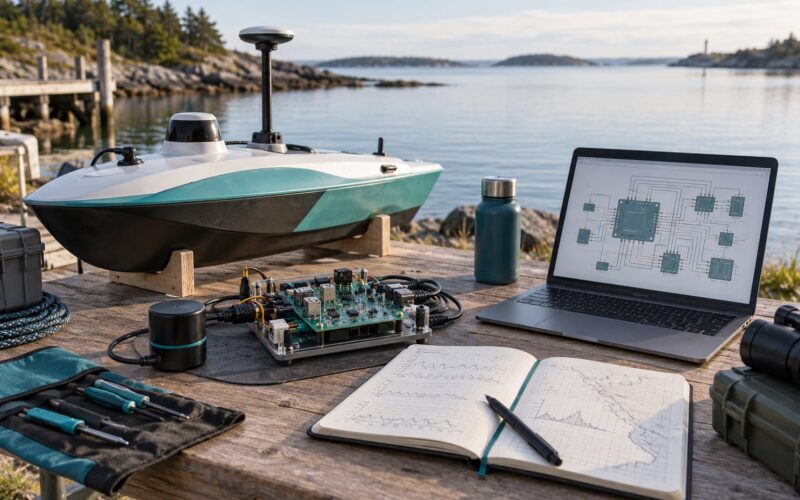
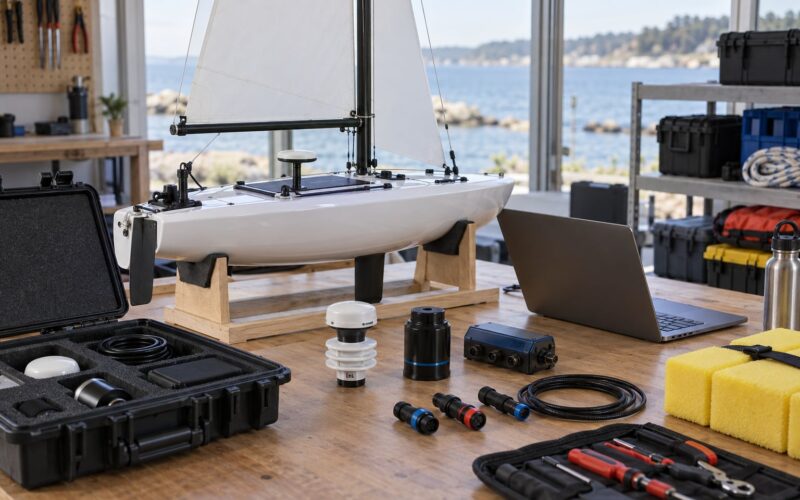
The vehicles fall into three families. An ROV is piloted from the surface by a human holding a control box, so a tether connects pilot and vehicle. An autonomous underwater vehicle (AUV) has no tether and runs its own navigation code from waypoints or a preloaded mission. An autonomous surface vehicle (ASV) does the same job on the water’s surface, which makes it the easiest starting point for a brand-new team.
Events also differ by age group, vehicle type and mission. Some run in a classroom pool over a single day with a themed obstacle course. Others run across a season with written reports, an oral presentation and a final international round. Age bands commonly run middle school, high school, community college, university and adult categories.
Why These Competitions Matter for Students
The reason these events exist is the practice, not the trophy. A season forces students through the whole engineering loop: read a requirement, size a system, choose materials, find out that it leaks, fix it, and prove the fix worked.
They also practice skills that sit outside the workshop. Teams write technical reports, present to adults who will interrupt with questions, budget parts, run a safety briefing, and keep a build log that somebody else has to read. Communication counts in these competitions, which is unusual for an engineering event and deliberate.
Environmental literacy comes along for free when the missions concern real water problems. Careers follow too: marine technology, offshore energy, naval and defense contracting, survey work and research vessels all hire people who know how to make something survive a wet environment.
One more framing helps. A failed mission run on the day is normal engineering, and the teams that treat it that way are the ones that improve fastest.
The teams that benefit most are rarely the ones with the newest equipment. A three-year-old vehicle with a trimmed hull, a pilot who has flown the course fifty times, and a notebook full of timed runs will beat a shiny first-week build every week of the season.
How Student Ocean Robotics Competitions Work from Start to Finish
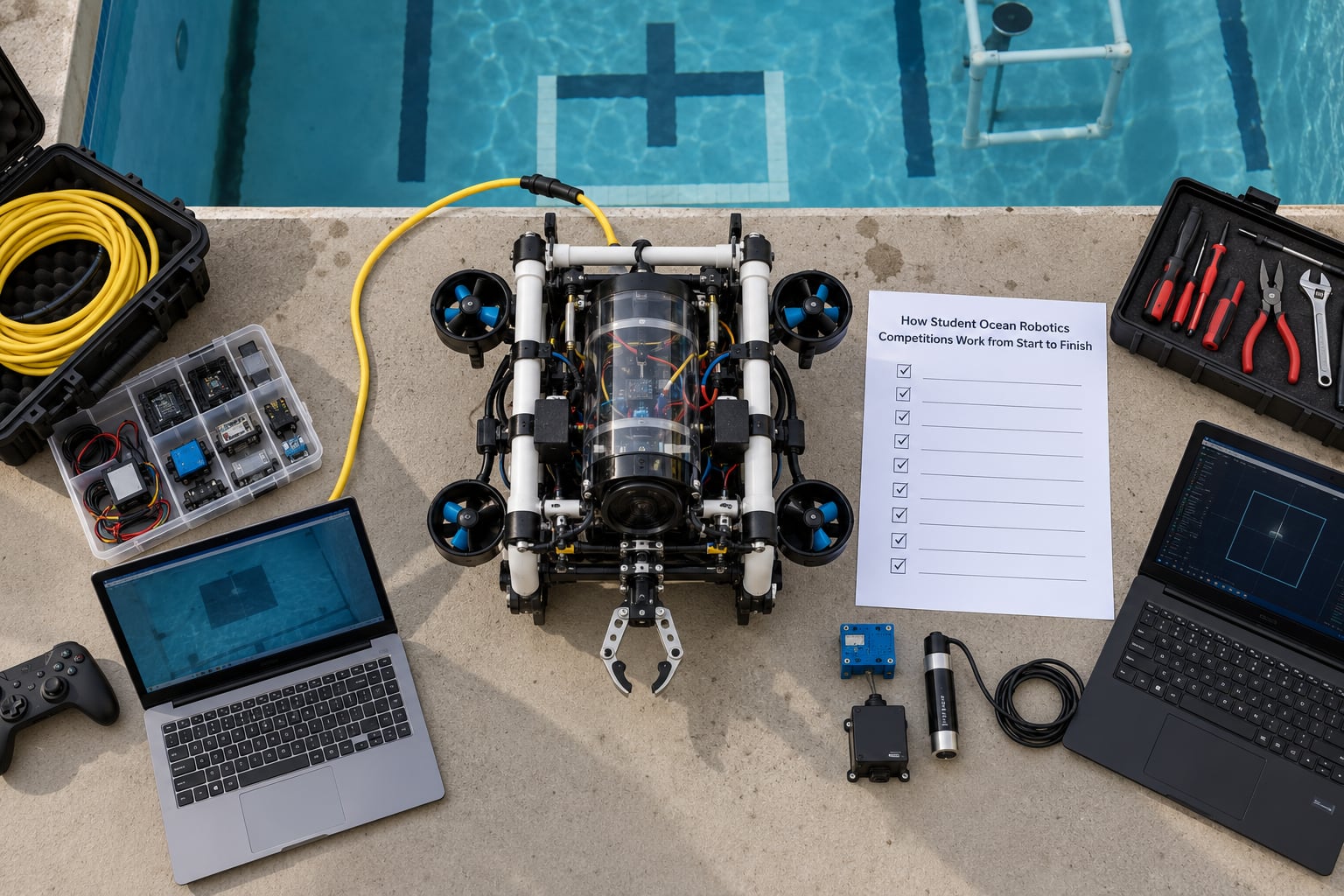
The full lifecycle runs about seven phases, and the same seven phases show up whether the event is a regional qualifier, a national contest or a university competition.
1. Team formation
Students join or get recruited, a coach or mentor signs on, and the group splits into subteams. Mechanical, electrical, software and documentation are the usual four. University clubs often run a lighter schedule with general meetings on a weekday and longer work sessions at the weekend.
2. Announcement
The organizer publishes the season theme, the rulebook, the task list, class definitions, size and power limits, safety rules, deliverables and the calendar. This is the single most important document of the year, because every design decision downstream flows from the tasks it names.
3. Concept and proposal
The team interprets the mission, sketches a system concept, picks a build route, and in many programs presents that to judges or organizers before building. Feedback here saves a season. A rejected concept at the design stage is cheap; the same mistake discovered in the pool is not.
4. Build and bench test
Fabrication, wiring, sealing, control software, and dry-run testing on a bench. Buoyancy gets checked before anything touches water, and the team dry-fits every sealed housing.
5. Pool and field testing
Mission rehearsals in progressively harder conditions. Sensor calibration, autonomy runs if applicable, environmental checks, and a written log of what broke and why. This phase takes longer than most first-time teams budget for.
6. Qualifier or championship
The team registers every member, attends the event, runs the mission, presents the engineering, and displays the vehicle. Scoring follows the published rubric.
7. Awards and advancement
Results are posted, awards are handed out, and the top eligible teams in each class receive invitations to the next level. Many championship events are invitation-only rather than open registration, so placing at a qualifier matters.
The Announcement Phase
Organizers publish the challenge and everything that governs it: eligibility by age and class, operating limits such as vehicle dimensions, weight, power budget and tether length, safety requirements, required deliverables, the season calendar, the scoring criteria and the resources available to teams.
Eligibility and advancement rules are worth reading twice. Some programs are school-sponsored only, some accept independent clubs and community organizations, and some require that a parent or legal guardian register any member under 18 before the deadline. That one rule is the most common cause of a team arriving with an incomplete roster.
What teams should verify before committing
Confirm the vehicle class and its size limit, then confirm the vehicle type the class actually uses. Check whether scored tasks require a tether, a manipulator, a camera or an autonomous mode. Check the power source restrictions, because some programs cap battery chemistry or cell count. Check the deliverables list and its deadlines, and check whether the world or international round is by invitation only.
Also confirm what mentors may do. Several programs limit how much hands-on build work an adult can do, and a mentor who quietly builds half the vehicle can disqualify a team.
Then confirm where the event actually happens and who can travel there. Venues rotate year to year, travel and housing for an international round are real line items, and some programs cover them for the top-placing teams while leaving lower places to self-fund.
The Challenge and Task Design
Most missions come from a theme tied to real ocean work: infrastructure inspection, search and rescue support, aquaculture, offshore energy monitoring, debris and water quality sampling. The theme changes each season and the whole vehicle plan follows it.
Task formats recur. Navigation tasks ask a team to follow a course and hold position inside a tolerance. Object detection tasks require finding and identifying a target, often with a camera stream the judges watch. Station keeping asks the vehicle to hold a spot inside a marked zone while currents push it around. Data collection tasks require the vehicle to reach a location, sample or measure, and bring the data home. Manipulator tasks test a gripper or arm on a latched object. Route completion tasks chain several of these with time limits. Autonomy tasks score how well the vehicle performs without a pilot, and resilience tasks deliberately make the environment harder to see whether the team built for it.
The same task can test very different skills depending on the class. A middle school task might be a simple pass through a hoop on a tether, while an advanced class version adds a payload pickup, a time bonus and a written report. The task does not change much. The scoring depth does.
The Team Proposal or Design Review
A proposal review, where a program asks for one, puts the team in front of judges before fabrication. Teams typically present their reading of the mission, the system concept and vehicle platform, the sensing and navigation approach, the safety plan, a build schedule, a budget, a test strategy and enough prior evidence to show the concept is feasible.
A short pilot, a buoyancy calculation and one timed pool lap carry more weight than a slide deck. Judges have seen plenty of decks.
| Reviewer question | What strong evidence looks like |
|---|---|
| Do you understand the scored tasks? | Each task listed with the mechanism you will use and the points you expect |
| Is the vehicle platform viable? | Drawn dimensions, thruster count, buoyancy estimate, power budget |
| How will it stay dry? | Sealing method per housing, connector type, leak test procedure |
| How will you navigate? | Pilot technique for tethered, waypoint plan for autonomous |
| What is your safety plan? | Pre-launch checklist, recovery procedure, power isolation step |
| Can you finish in time? | Milestones per month with a contingency if a part arrives late |
| What will it cost? | Line items with a contingency, plus how you will cover a shortfall |
| How will you test? | Test ladder from bench to full mission with pass criteria |
Building an Ocean-Ready Robot
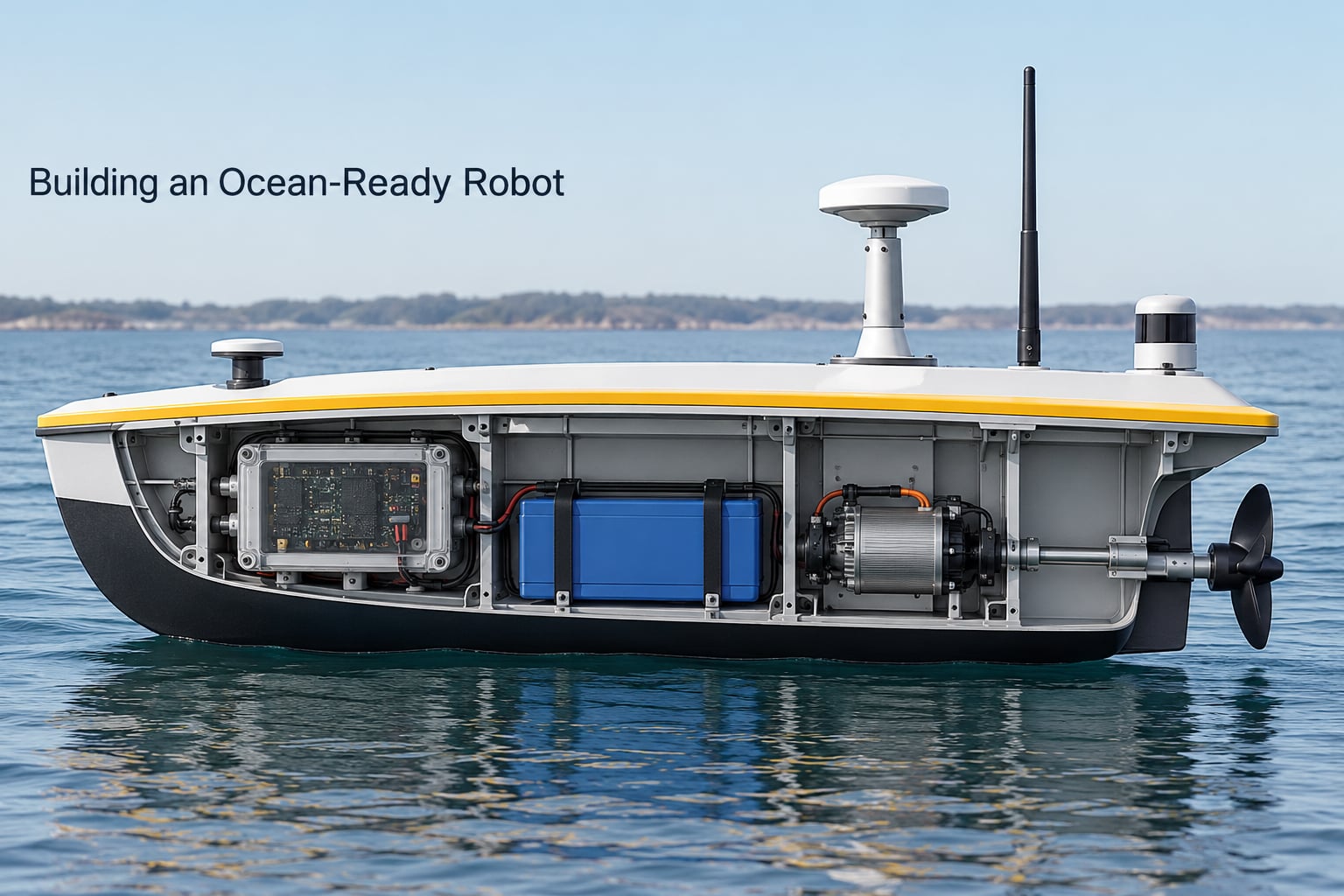
Water and electronics do not negotiate, so the build sequence matters. Hull first, then waterproofing, then everything electrical, then the systems that depend on all three.
Hull selection decides the vehicle’s personality. A commercial frame gets you a working baseline fast. A purpose-built hull gives you control over volume, weight distribution and thruster placement. Buoyancy follows: a vehicle that floats too high noses over and exposes thrusters, and one that sinks is hard to recover. Teams trim with foam or ballast until the vehicle sits neutral at rest.
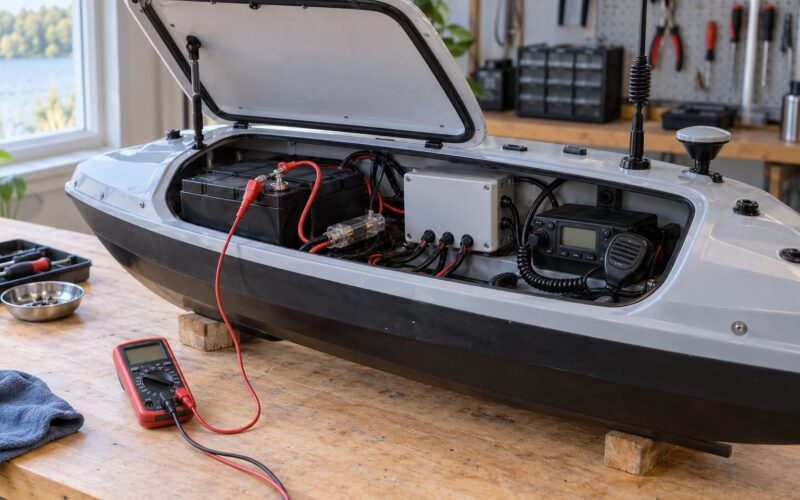
Waterproofing is a materials problem before it is a technique problem. Sealed housings, potted joints, conformal-coated boards and connectors rated for wet use all appear on competitive vehicles. Every housing gets a leak test under pressure before assembly, and a bench soak afterward.
Actuation and power come next. Thrusters get chosen to match the hull rather than the other way around, and mismatched thrusters cause the handling problems that pilots fight hardest. Power budgeting is arithmetic: compute draw, motors at duty cycle, camera, lights, margin for brownouts.
Computation, communication and navigation follow. For tethered vehicles the control box holds the pilot interface and the umbilical carries power and video. For autonomous vehicles you need a reliable inertial or acoustic position fix and a control loop that converges instead of oscillating.
Sensing is where missions get won or lost. A forward camera is close to mandatory. Range sensing, temperature, and whatever the theme demands come next, mounted where they can actually see the task. Payload integration means the manipulator or sensor has to reach the task geometry without shifting the center of gravity.
Two properties get skipped and should not. Define fail-safe behavior: what the vehicle does on signal loss, low battery or a tether snag. And design for maintainability. On competition day, a housing that opens in four minutes with common tools saves a run; one sealed with marine epoxy does not.
What Happens During Pool and Field Testing?
Testing is the part that separates teams that place from teams that show up. Most teams do more of it than they planned and most first-year teams do less.
The pattern that works is a ladder. Static bench checks first: electronics powered dry, thrusters at low power, control inputs verified in the correct direction. Then float tests with no mission. Then slow controlled runs with a tether handler. Then full-speed mission rehearsals with the task props set up exactly as they will be on the day. Then runs in worse conditions, since competition water is never as clear as the pool at your school.
Sensor calibration happens between stages, not at the end. A camera tilt that looks fine from the deck changes the moment you are on your knees at pool level.
Every session produces data, and the log is what turns a session into progress.
| Test type | Failure evidence it reveals |
|---|---|
| Dry power-on | Wiring errors, reversed connectors, brownouts under load |
| Pressure or soak test | Slow leaks in housings, connectors, and potted joints |
| Trim and buoyancy test | Freeboard errors, nose-over, poor thruster immersion |
| Thruster response test | Mismatched or undersized motors, thrust asymmetry |
| Control box check | Axis confusion, dead inputs, gain settings that feel wrong to the pilot |
| Tether handling run | Tangling, snag points, insufficient slack handling |
| Autonomy dry run | Waypoint logic errors, sensor offsets, sensor fusion drift |
| Full mission rehearsal | Task timing, pilot stamina, unlogged assumptions about the course |
| Visibility reduction test | Failure in murk or low light that the pool hid |
| Endurance run | Battery capacity assumptions, heat build-up in sealed housings |
Retest after every fix. A change to buoyancy or thruster trim shifts handling, and handling shifts everything downstream.
How Competitions Are Judged
Most rubrics divide into four buckets, and teams that know the weighting build differently. Mission performance carries the points for completing scored tasks, with time bonuses. Engineering and communication carries the points for the technical report, the oral presentation and the quality of the design explanation. Safety carries deductions rather than additions in many programs. A collaborative task adds a small scored element, often done by mixed teams or by reassigning operators mid-course.
How student ocean robotics competitions score a failed run matters more than most first-time teams expect. A single mission score is one number out of a total, and a run that fails cleanly often still earns partial task points. Engineering, communication and safety points are scored independently of whether the vehicle performed, so a documented failure usually outscores a silent one.
| Scored category | What it rewards | How teams earn it |
|---|---|---|
| Mission or product demo | Actually finishing the mission tasks | Fast, repeatable runs; practiced pilots; props set up as in the rules |
| Engineering | Design quality and evidence | Test logs, failure analysis, CAD, clear budget and schedule |
| Communication | Explaining it to judges | Short answers, no filler, a team that finishes on time |
| Safety | Compliance, no penalties | Briefing, tether handling, power isolation, clean pool behavior |
| Collaborative task | Operating under a constraint | Pre-assigned roles, practiced handovers |
| Marketing or display | Explaining the idea to a non-technical audience | A plain board, a demo someone can touch |
One detail catches new teams: several programs present teams as start-up companies, with a sales-style pitch alongside the engineering pitch. That is not decoration. It is scored.
A failed run is not automatically poor performance. It becomes poor performance when the team has no evidence to offer afterward.
Safety, Ethics, and Environmental Responsibility
Water plus batteries plus a moving propeller is the combination people worry about, and every program treats it seriously. Pre-launch checks are standard: harness and tether secured, thrusters clear of hands, power isolated until the pilot is ready, and a person watching the tether at all times.
Operator supervision is non-negotiable. Every ROV run has a designated pilot and a tether handler, and nobody handles a thruster while the vehicle is powered. Emergency recovery is practiced, not improvised: a failed vehicle surfaces on its own or gets recovered by its retrieval line, and teams know both methods before they need one.
Programs also publish weather and water limits. Wind, current and lightning rules decide whether an outdoor run happens at all, and the go or no-go call belongs to organizers, not to a team with a season’s work invested.
Human overrides are required for anything autonomous, so a person can always take control. And waterproofing is a safety system as much as a performance one.
Environmental responsibility gets less attention but matters in open water. Deployed equipment that is lost must be recovered or reported so it does not become a hazard, and teams follow wildlife-disturbance rules such as keeping clear of nesting sites and marine mammals. Data privacy applies too: if a vehicle carries cameras in places where people or sensitive infrastructure appear, teams need rules about what is recorded and what gets shared.
Responsible disposal at season’s end closes the loop. Batteries and electronics go to proper recycling rather than a bin, and the vehicle’s materials should not end up in a creek.
Awards and What They Measure
Placing first overall is the least interesting award on the sheet. Programs typically split recognition into overall performance, engineering design, best autonomous run, best data or sensor payload, most innovative design, best technical documentation, best presentation, and best teamwork or mentoring.
That split matters for planning. A team with a strong mission run and weak documentation can target the engineering or documentation award deliberately, and a team with a modest vehicle but an excellent report has a real shot. Multiple awards going to different teams is normal, not a sign the judging was soft.
What Makes a Strong Student Team?
The evidence is specific and it is visible in how a team works, not in what it owns.
Defined roles mean everyone knows their lane: pilot, tether handler, mechanical lead, electrical lead, software, documentation. Shared engineering notes mean the knowledge survives a week when the one person who understood the wiring is absent. Repeatable tests mean the team can run the same course three times and get comparable results.
Transparent failure analysis is the marker that separates strong teams from lucky ones. When something breaks, the log says what broke, the hypothesis, the fix and the retest result. Version control on drawings and code stops a working configuration from being quietly overwritten.
Documentation gets written as you go rather than the week before the event. Collaboration stays respectful when the build gets hard, which it always does. And the build schedule is realistic: teams that finish early can iterate, while teams that plan to finish at the deadline spend the final week debugging instead of testing.
How to Prepare for Your First Competition
Start with mentor support. One engineer who can show up most weeks is worth more than five who cannot, and the best recruits are the parents of teammates, a local marine shop, a nearby university club or an alumnus. Set the mentor’s boundary early, in writing, so nobody is uncertain later.
Read the rules twice and write a one-page summary of the scored tasks. Underline every requirement with a number attached, because numbers are points. Build a proof of concept that proves the hardest physical thing, usually buoyancy or a single thruster, before committing to a full platform.
Choose a low-risk architecture. Tethered and piloted wins for a first season; autonomy is a second-season problem. Use a kit if a kit gets you to a working pilot, and go custom when the tasks require a mechanism the kit cannot do. Kits are not penalized for being kits, but they cannot score points on tasks they cannot physically attempt.
Keep a test log from day one. Practice the presentation with a mentor who asks hostile questions, and rehearse the pilot under time pressure. Plan contingencies: a spare part, a fallback prop, a second pilot. And budget honestly, since realistic first-season totals range widely depending on travel distance and how much the team builds itself.
Logistics beat hardware most of the time. Pool access is the unglamorous blocker that derails more first seasons than any technical problem, so line up water early. Registration has deadlines, waivers must be signed, and anyone under 18 is registered by a parent or legal guardian.
Finally, decide what success looks like before the season starts. A first-year objective of flying the whole course once, cleanly, is worth more than a stretch target of winning a task nobody has ever completed.
Frequently Asked Questions
What is the SeaPerch competition?
SeaPerch is a student ROV challenge built around a themed obstacle course in a pool. Teams design and build a vehicle, then pilot it through hoops, gates and handling tasks, with some seasons adding a land-based component such as a technical paper or presentation. The program is run through registered regionals, and the International SeaPerch Challenge at the top is invitation-only for teams that place well at their regional.
What does MATE ROV stand for?
MATE stands for Marine Advanced Technology Education. The MATE ROV Competition is an international engineering challenge in which teams are given a limited time window to pilot their remotely operated vehicles through a series of mission-based tasks. Teams are organized into classes, from SCOUT for beginners through NAVIGATOR, RANGER, PIONEER and EXPLORER, with the top three classes eligible to advance to the World Championship.
How is an underwater robot competition judged?
Judging usually splits into four buckets: mission performance for completing scored tasks, engineering and communication for the technical report and oral presentation, safety compliance which often works as deductions, and a collaborative task. Mission runs can carry time bonuses, and a partial task usually still earns partial points. Because the report and presentation are scored separately, a failed run can still produce a strong overall result if the documentation is solid.
Do robotics competitions look good on college applications?
They help when the application can point at specifics. Admissions readers want to see that you designed, tested, failed at something, diagnosed the cause and shipped a fix, then explained it under questioning. A season of pool testing and a written report gives you that story in a way a short-term project usually does not. Teams that keep logs and stay involved across several seasons have a stronger record than one-off entries.
What is the most prestigious robotics competition?
Within ocean and underwater robotics specifically, the MATE World Championship, the International SeaPerch Challenge and RoboSub are the events most teams treat as the top of the ladder, followed by RobotX and RoboBoat at the research level. There is no single global ranking, and prestige depends on your program. Land-based events like FRC are more widely recognized by the public but test different skills.
Conclusion: Start with the Rules, Then Build for Evidence
A student ocean robotics competition runs on one repeating cycle: read the announcement, interpret the scored tasks, propose a vehicle, build and waterproof it, test it in a ladder that ends at the real course, then get scored on mission performance, engineering, communication and safety. Everything else, including whether you win, follows from how well you did those steps.
If you are about to start, do three things this week. Download the current rulebook and write a one-page summary of every scored task with the points attached. Confirm the class limits, the age eligibility and who must sign the registration. Then pick one hard physical thing, usually buoyancy or a single thruster, and test it in a pool before you commit to a vehicle.
Rules shift every season, so confirm anything specific to 2026 against the current published documents before you build against it.