What the Coast Guard requires for small vessels comes down to a short list of federally mandated items that scale with your boat’s length: a U.S. Coast Guard-approved wearable life jacket for every person aboard, a throwable flotation device on boats 16 feet and over, a fire extinguisher, a sound-producing device, visual distress signals on coastal and Great Lakes waters, and navigation lights for night operation. On top of that sit registration, a capacity plate, and a set of operating rules. This guide walks through each one and shows you how to confirm the version that applies to your hull.
Requirements are current as of October 2026, and they do change. The engine cut-off switch rule landed in 2021 and the marine fire extinguisher rating rule in 2022, so plenty of boats on the water today predate the rules that now apply to them. Where this article and an official source disagree, the official source wins.
Table of Contents
- What the Coast Guard Requirements Cover
- Which Coast Guard Rules Apply to Your Boat?
- Registration and Boat Documentation
- Required Safety Equipment for Small Vessels
- Life Jackets, Capacity, and Passenger Safety
- Navigation Lights, Sound Signals, and Distress Equipment
- Fire Extinguishers and Marine Sanitation
- Rules for Leaving the Dock
- Float Plans, Emergency Readiness, and Coast Guard Assistance
- Boat Inspection, Policing, and Proof of Compliance
- Federal Rules Are Not the Only Rules
- A Practical Compliance Checklist
- Frequently Asked Questions
- Does the Coast Guard require every small boat to be registered?
- What documents should I carry when operating a small vessel?
- Is a state boating license or safety course required everywhere in the U.S.?
- Do I need Coast Guard documentation for a recreational boat?
- Can I operate a small vessel without a float plan?
- Where can I verify the current requirements for my boat and waterway?
- Conclusion
What the Coast Guard Requirements Cover
The Coast Guard sets three separate layers of requirements, and most confusion comes from mixing them up. Equipment requirements tell you what must physically be aboard. Documentation requirements tell you what papers prove the boat is legal and what it can carry. Operating requirements tell you how you must behave once underway, from speed to lookout to radio discipline.
Four variables decide which rules apply to your boat. Length sets the equipment group. Propulsion matters, because the engine cut-off switch rule keys off planing hulls specifically. Service decides whether you are treated as recreational or commercial, and that distinction is much larger than most owners assume. Operating area decides whether you are on federally controlled waters or inside a state system with its own additions.
One more variable catches people by surprise: a passenger for hire. The moment you accept money to carry someone else on your boat, the recreational rulebook largely stops applying.
Which Coast Guard Rules Apply to Your Boat?
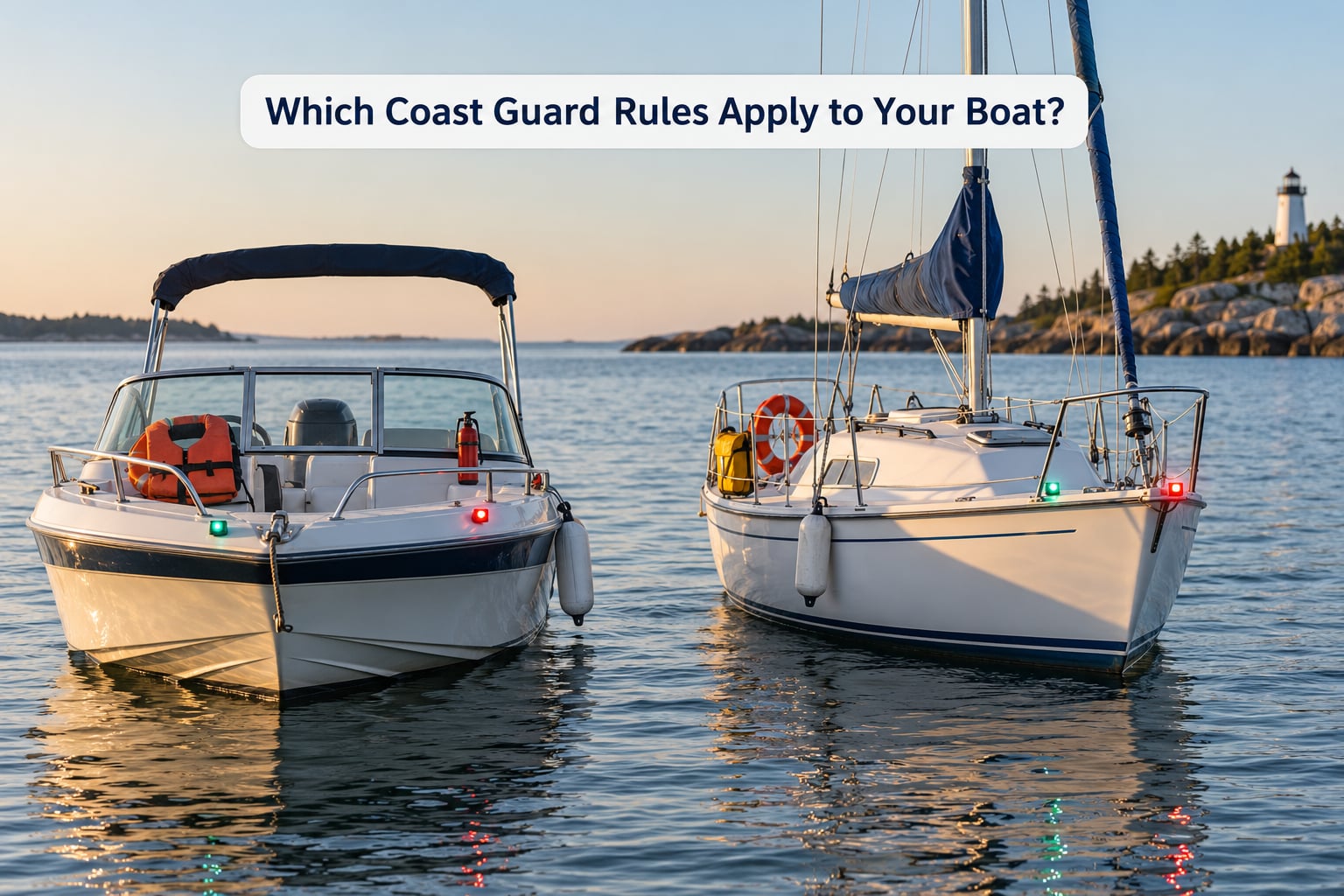
Start by measuring overall length, which the Coast Guard defines as measured in a straight line from the foremost point of the bow to the rearmost point of the stern, excluding projections such as pulpits and outboards. That single number places you in one of four equipment groups. Official requirements are laid out in 46 CFR 175, with approval standards for each item in 46 CFR 161.
Then sort by service. A recreational boat is subject to the small-vessel equipment rules. A personal watercraft carries its own dedicated requirements, including a wearable flotation device for every rider regardless of age. A federally documented vessel follows documentation rules that a state-registered recreational boat does not. A small passenger vessel carrying six or more passengers, or one that is being operated for compensation, falls under a heavier, Coast Guard-inspected regime with a certificate of inspection.
Finally, note where you operate. Navigable waters, the Great Lakes, and waters subject to federal jurisdiction follow federal rules, which states may extend. Inland waters that are not navigable fall almost entirely under state law, and in practice the state layer is what you will meet most often.
Registration and Boat Documentation
Yes, virtually every boat that operates on U.S. waters needs to be registered, and registration happens through your state rather than the Coast Guard. Recreational boats receive a certificate of number and a set of validation decals, which must be displayed permanently on both sides of the hull with the registration number at least three inches high in block letters.
A certificate of number is a state document. A Certificate of Documentation is a federal one, and the two are not interchangeable. Federal documentation applies to vessels that qualify as vessel of the United States, including qualifying recreational vessels and most inspected vessels engaged in a coastwise or trade service. If your boat holds a Certificate of Documentation, it is exempt from a state certificate of number, and the documentation must be carried aboard and produced on request.
Every qualifying boat also carries a hull identification number, a 12-character code permanently affixed to the hull in a specific spot, plus a capacity plate. The capacity plate lists the maximum number of persons, the maximum total load in pounds, and the maximum engine or horsepower the hull was designed for. Exceeding any figure on that plate is a real violation, not a technicality, and it is one of the more commonly cited deficiencies on small boats.
Carry your registration or documentation with you. Boating without it is one of the simplest citations a boarding officer can write, and it is entirely avoidable.
Required Safety Equipment for Small Vessels
This is the table most boaters actually want. Find your length group, then read across. Every item must be Coast Guard approved or certified, in serviceable condition, and readily accessible, which means you can reach it quickly without dismantling anything.
| Equipment | Under 16 ft | 16 to under 26 ft | 26 to under 40 ft | 40 to under 65 ft |
|---|---|---|---|---|
| Wearable life jackets (PFDs) | One per person aboard | One per person aboard | One per person aboard | One per person aboard |
| Throwable flotation device (Type IV) | Not required | Required | Required | Required |
| Fire extinguisher | Not required | Required, 5-B rating minimum | Required, 10-B rating minimum | Required, 20-B rating minimum |
| Visual distress signals | Coastal, Great Lakes, and connected waters only | Coastal, Great Lakes, and connected waters only | Coastal, Great Lakes, and connected waters only | Coastal, Great Lakes, and connected waters only |
| Sound-producing device | Whistle, horn, or bell | Whistle, horn, or bell | Whistle, horn, or bell | Whistle, horn, or bell |
| Navigation lights | For night and reduced visibility | For night and reduced visibility | For night and reduced visibility | For night and reduced visibility |
| Anchor and adequate rode | Not federally required | Required | Required | Required |
| Bailer, bucket, or manual pump | Not federally required | Required | Required | Required |
| Fire main and fuel shutoff valves | Not federally required | Not federally required | Required | Required |
| Ventilation system | Open boats only | Required | Required | Required |
| Backfire flame arrestor | Outboard with inboard fuel tank | Outboard with inboard fuel tank | Outboard with inboard fuel tank | Outboard with inboard fuel tank |
Three rules above the table catch owners out repeatedly. First, the engine cut-off switch: since 2021, a planing hull with three horsepower or more must have an engine cut-off switch that stops the boat if the operator falls off, plus a lanyard worn by anyone driving it. Second, since boats built after June 1, 2018, the engine and fuel tank must be supported by the flotation structure, so a swamped boat floats rather than sinks. Third, an automobile fire extinguisher does not qualify. It has to be a marine-rated unit carrying the USCG 5-B, 10-B, or 20-B classification appropriate to your length group.
Non-motorized craft are not exempt from everything. A kayak, canoe, or paddleboard used on federally controlled waters is still subject to personal flotation device rules, and wearing a properly fitted one is the expectation rather than a formality.
Life Jackets, Capacity, and Passenger Safety
A USCG-approved personal flotation device for every person aboard is the one universal requirement, and it applies at every length, on every type of craft, in every state. On a personal watercraft, every rider must wear one regardless of age. Children under 13 must wear one at all times while underway, and children under 6 must wear one that is both worn and properly fitted, because a child’s flotation device that is merely present does not help a child who cannot swim.
Fit matters more than most owners expect. An adult PFD that is too large will ride up over the wearer’s chin and will not keep their face clear of the water. Check that the device fits snugly enough that you cannot lift the shoulder straps past your ears, and check it with the child, not the box.
Types differ mainly in how they are worn and how much buoyancy they carry. A Type I is a bulky vest for offshore and rough water. A Type II is a buoying vest that will turn an unconscious wearer face up. A Type III is a flotation aid for calmer water, essentially a jacket with foam. A Type IV is the throwable cushion or ring, meant to be tossed rather than worn. A Type V is a special-use device accepted only when it has a label covering a specific use, such as a kayak or a sailboat harness.
Capacity is a separate rule from equipment. Read the plate, and stay under all three numbers at once. The old one-third load guideline that floats around forum threads is good practice and nothing more; it is not a legal standard, and the legal standard is the plate. Boating on r/boating and The Hull Truth, the question people argue about most is where a small boat crosses into small passenger vessel territory, where six passengers is the commonly cited threshold and a certificate of inspection becomes the deciding factor.
Navigation Lights, Sound Signals, and Distress Equipment
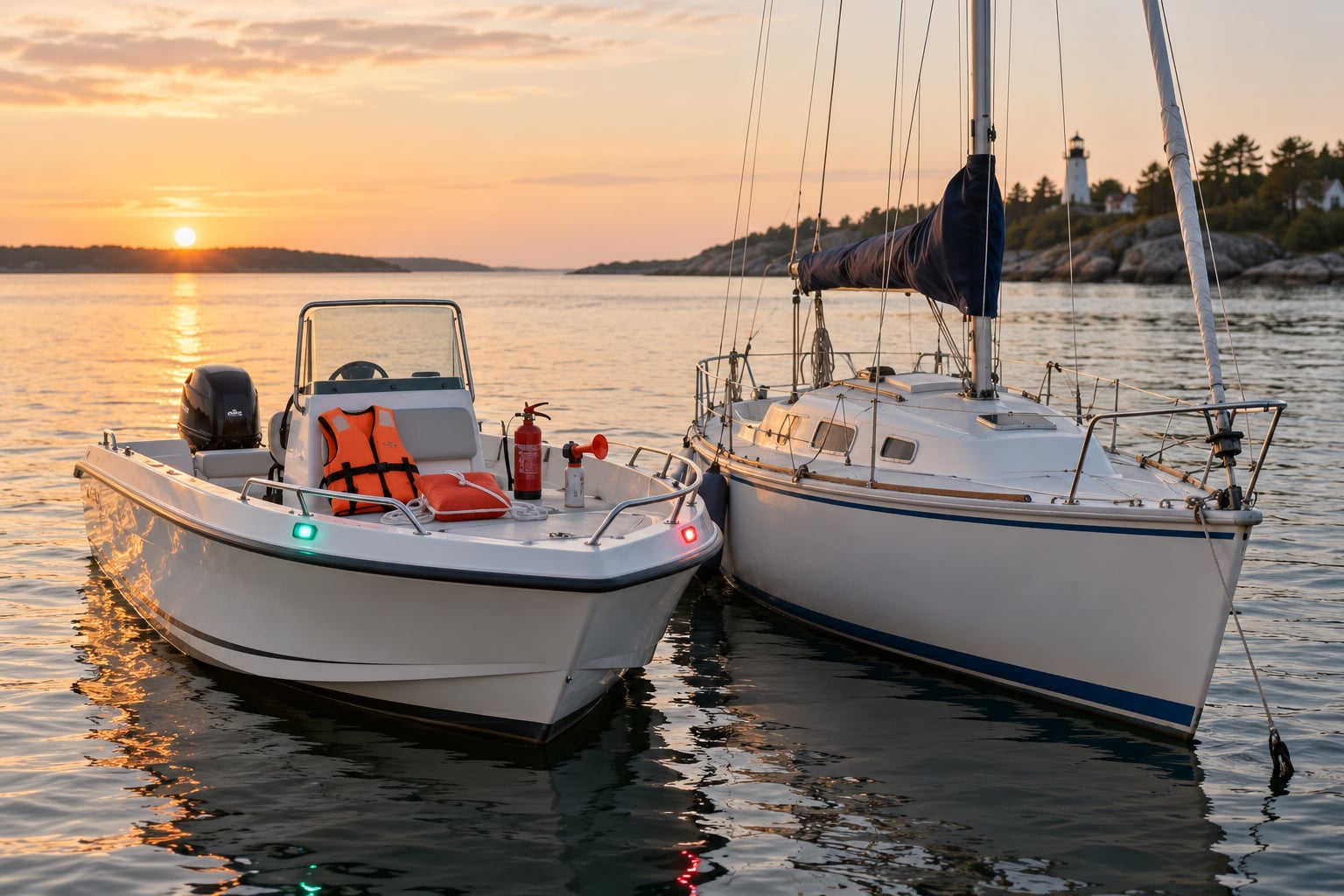
Navigation lights are required from sunset to sunrise and any time visibility is restricted by fog, rain, snow, or haze. A small powerboat shows red to port, green to starboard, and a white masthead light visible all around. A boat under about 26 feet that cannot show a masthead light can substitute a 360-degree white light combined with the sidelights. A paddler carrying a light at night shows the same red-and-green combination at the bow plus a white light, which is what paddling forums consistently describe as the practical minimum.
Sound signals are required for meeting and overtaking situations. The rules distinguish overtaking, where the overtaking vessel holds clear and signals, from crossing, where the vessel with the other on its port side gives one short blast and holds clear, and for vessels in sight of each other on a converging course, where both signal five or more short and rapid blasts. A single whistle or horn satisfies the carriage requirement.
Visual distress signals are required on coastal waters, the Great Lakes, and connected waters, and they are where the most common silent failure happens: expired pyrotechnics. Flares and smoke signals carry printed expiration dates, and expired ones do not count. Day signals, night signals, and flares are not interchangeable, and neither is a signal reserved for use by professionals. Beyond the legal minimum, an orange flag, a smoke signal, and a flashlight all have real value offshore.
Fire Extinguishers and Marine Sanitation
The marine extinguisher rating system is straightforward once you know it. The letter B refers to the size of the space the unit can handle, and the number indicates square feet of that space. Boats 16 to under 26 feet need at least 5-B, boats 26 to under 40 feet need 10-B, and boats 40 to under 65 feet need 20-B. The 2022 rule aligned the accepted ratings, and units that do not carry the right classification are treated as no extinguisher at all. That is why a car extinguisher never counts, and why an in-date, mounted, reachable unit matters more than a larger one in a locker.
Marine sanitation is where federal and state rules diverge sharply. Federally, 33 CFR 136 requires that sewage be discharged through an approved marine sanitation device, either a holding tank or a functioning incinerator or treatment system, and holds that discharge is prohibited in most waters. State and local rules go further and more locally, restricting or banning discharge in designated no-discharge areas, shellfish beds, and near shore. The stricter rule is the one that applies, so check the state map before you plan to run a head or a holding tank overboard.
Rules for Leaving the Dock
Equipment is only half of it. Once underway you are bound by the operating rules in 33 CFR 167, which include a proper lookout by sight and hearing, safe speed, and compliance with the navigation rules, including right-of-way, overtaking, crossing, and the requirement to avoid a collision by whatever means work.
Impaired operation is treated seriously. A blood alcohol concentration of 0.08 percent or higher, or any amount of a Schedule I drug, is a violation, and so is operating while under the influence in a way the officer determines from your conduct. A first conviction can mean fines, and it reaches your boating privileges as well as your driving license in most states.
There are also area-specific rules. Race courses, regattas, fireworks displays, dredging operations, and military exercise areas carry temporary restrictions in 33 CFR 165, and Coast Guard local notices sometimes close a channel, a anchorage, or a stretch of shoreline. Anchoring can be restricted or banned outright in sensitive areas. In national parks, national marine sanctuaries, and some state preserve systems, your gear and your engine are regulated by rules that have nothing to do with the Coast Guard.
Float Plans, Emergency Readiness, and Coast Guard Assistance
A float plan is not a federal document requirement, and no inspector will ask to see one. It is still the single habit that experienced cruisers treat as mandatory, and it is cheap. Tell a responsible person ashore where you are going, when you expect to return, who is aboard, how many people, what boat, and where it is docked. If you are overdue, that person has the information Search and Rescue needs to start looking hours earlier.
When you do put out a distress call, give position, nature of distress, number of persons aboard, injuries, and any hazards you know about, then keep the radio clear. A DSC-equipped VHF radio sends a formatted distress signal with your position attached once you transmit; a fixed-mounted or handheld EPIRB, or a personal locator beacon, does the same on a dedicated distress frequency, and a registered beacon is a subscription, not a purchase, so file the registration before you need it. A waterproof phone in a floating pouch is a useful backup but not a substitute.
Channel 16 is the calling and distress channel. Coast Guard policy is that you never have to be in danger to request assistance, and a pan-pan call for information or a mayday for a grave and imminent danger are the two to be clear about.
Boat Inspection, Policing, and Proof of Compliance
A Coast Guard officer conducting a vessel safety check walks the boat with you. They will ask for the registration or documentation, look at the certificate of compliance label in the cockpit or cabin area, check the capacity plate and the hull identification number, test navigation lights, and confirm that required gear is present, in date, and reachable. The check is free, takes about a half hour, and ends with a sticker and a report. The Coast Guard Auxiliary volunteer fleet runs the same program, and forum consensus treats it as the practical way to verify compliance before a trip rather than after a citation.
Boarding with a deficiency present is the enforcement path. Common findings are expired flares, a PFD stowed under a cooler, a burnt-out stern light, a lapsed extinguisher tag, and an out-of-date registration. A federal requirement for safety equipment is a civil matter. Coast Guard policy for a related civil penalty issued under 33 CFR 1.05-1 runs up to a per-day cap adjusted periodically for inflation, and it is formally a violation of a regulation, not a crime, though it is a violation the Coast Guard states it refers to other agencies.
Keep a simple file aboard: registration or documentation, the certificate of compliance, the vessel safety check report, and your state boating license or education card. The state marine patrol enforces a parallel layer of rules that can be stricter than the federal set, and it is the agency that catches you on a state lake. The two agencies share a compact, and a boat that passes one often passes the other, but only because the standards are similar, not because they are the same list.
Federal Rules Are Not the Only Rules
The Coast Guard does not issue every rule that applies on a particular waterway. Before you launch, run a short jurisdiction check. Your state boating agency sets registration, titling, safety equipment additions, and education requirements, and many states require a boating safety course and a boating license card. The local harbor authority, port district, or marina sets rules for the docks and basin you leave from. Your county or city may regulate noise, wake, and mooring. Federal agencies run protected areas with their own gear limits, and vessel size limits and no-wake zones show up in local ordinances more often than people expect.
State education requirements are the layer people miss most, because they have no federal equivalent. A safety course and a license card are required in a large majority of states, and the testing is handled through the National Association of State Boating Law Administrators network, so a course you took in one state often satisfies a reciprocity agreement in another. The specific card, its expiration, and the age it applies from are all state details, and the state boating agency is the only place to get them right.
A Practical Compliance Checklist
Run this before the dock lines come off, and again before any trip that takes you more than an hour from help.
- Confirm your registration or documentation is current, decals are on the hull, and the paperwork is aboard.
- Read the capacity plate and count planned passengers and gear against all three numbers.
- Confirm one properly fitted USCG-approved wearable PFD per person, worn or immediately within reach, with children under 13 wearing theirs.
- Add a Type IV throwable if the boat is 16 feet or longer, and make sure it is not the only flotation you have.
- Check the fire extinguisher rating against your length group and confirm the gauge reads full and the pin is sealed.
- Check every visual distress signal for expiration and confirm you carry both day and night means.
- Test navigation lights, horn or whistle, and bilge pump. A burnt-out stern light is the single most cited navigation defect.
- Confirm ventilation is clear, the flame arrestor is fitted if required, and the engine cut-off lanyard works and is worn.
- File a float plan with someone ashore and note your departure and return times.
- Check local notices, weather, special event restrictions, and any no-discharge zone on your route.
- Brief passengers on where the PFDs, throwable, extinguisher, and ditch bag are, and on the three things they should never touch.
- Re-run the whole list if the boat changes length, changes service, changes waterway, or crosses a state line.
Frequently Asked Questions
Does the Coast Guard require every small boat to be registered?
Almost all of them, yes. Registration is handled by the states, not the Coast Guard, and applies to recreational boats, personal watercraft, and most non-motorized craft operated on state waters. The exceptions are narrow: a boat that holds a federal Certificate of Documentation instead of a state certificate of number, and craft exempt by statute such as pure paddleboards in some states. Registration numbers must be displayed on both sides of the hull, and the certificate should be carried aboard.
What documents should I carry when operating a small vessel?
Carry your state certificate of number and registration decals, or your federal Certificate of Documentation if you hold one. On board you should also have the certificate of compliance label location noted, your state boating license or education card, and the vessel safety check report if you have had one. Officials can ask to see any of these, and operating without proof of registration is one of the easiest violations to be cited for.
Is a state boating license or safety course required everywhere in the U.S.?
A large majority of states require a boating safety course and a license or education card, though the rules differ on which operators need one, at what age, and how long the card lasts. There is no federal boating license for recreational boats. Courses are usually delivered through the National Association of State Boating Law Administrators network, so many states honor a course completed in another state. Your state boating agency is the only reliable source for the exact requirement.
Do I need Coast Guard documentation for a recreational boat?
Usually not. A federal Certificate of Documentation is for vessels that qualify as vessel of the United States, including qualifying larger recreational boats and most inspected vessels in coastwise or trade service. It is not the same as a state registration and the two are not interchangeable. Recreational boats are normally covered by a state certificate of number with validation decals, and holding a Certificate of Documentation exempts you from that state registration.
Can I operate a small vessel without a float plan?
Yes, because a float plan is not a federal requirement and no inspector asks for one. It is the habit that experienced cruisers treat as mandatory, especially offshore or in cold water where a capsized boat and a hypothermia call are separated by hours. Give a responsible person ashore your route, return time, passenger count, boat description, and dock. If you are overdue, that is the only thing that gets a search started early.
Where can I verify the current requirements for my boat and waterway?
Start with the Coast Guard’s Boater’s Guide to Federal Requirements for the federal equipment rules, then read 46 CFR Part 175 and Part 183 on the Electronic Code of Federal Regulations for the controlling text. For a free in-person check, request a vessel safety check from the Coast Guard or the Coast Guard Auxiliary. For state, local, and protected-area rules, go to your state boating agency and the local harbor authority directly.
Conclusion
Start with the length table above and confirm your group’s equipment, then check your registration or documentation and your state boating card. The fastest way to close the remaining gaps is a free vessel safety check from the Coast Guard or the Coast Guard Auxiliary, and it is worth booking before a long trip rather than after a citation.
When this article and an official source disagree, go with the Coast Guard’s Boater’s Guide to Federal Requirements, the current eCFR text, your state boating agency, and the local harbor authority for the waterway you are on. Those four sources control. Everything else, including this page, is a starting point for a conversation with them.