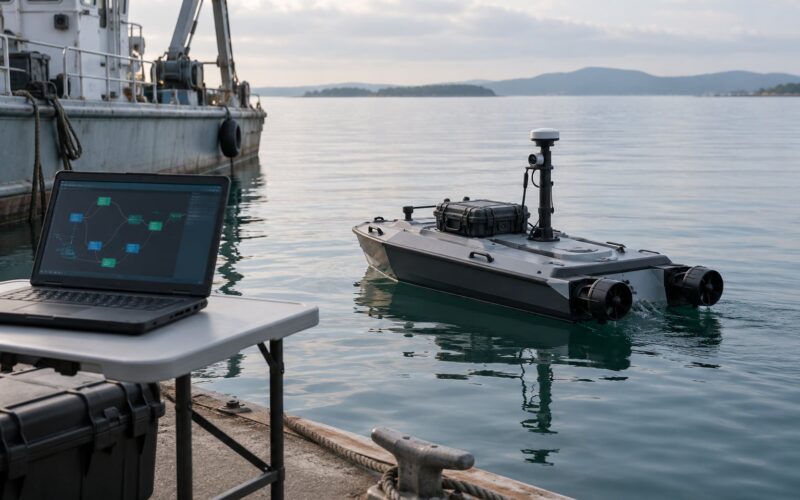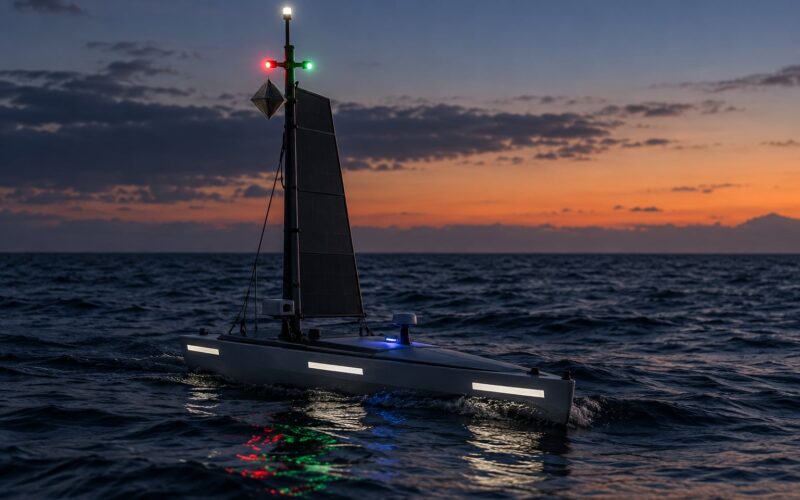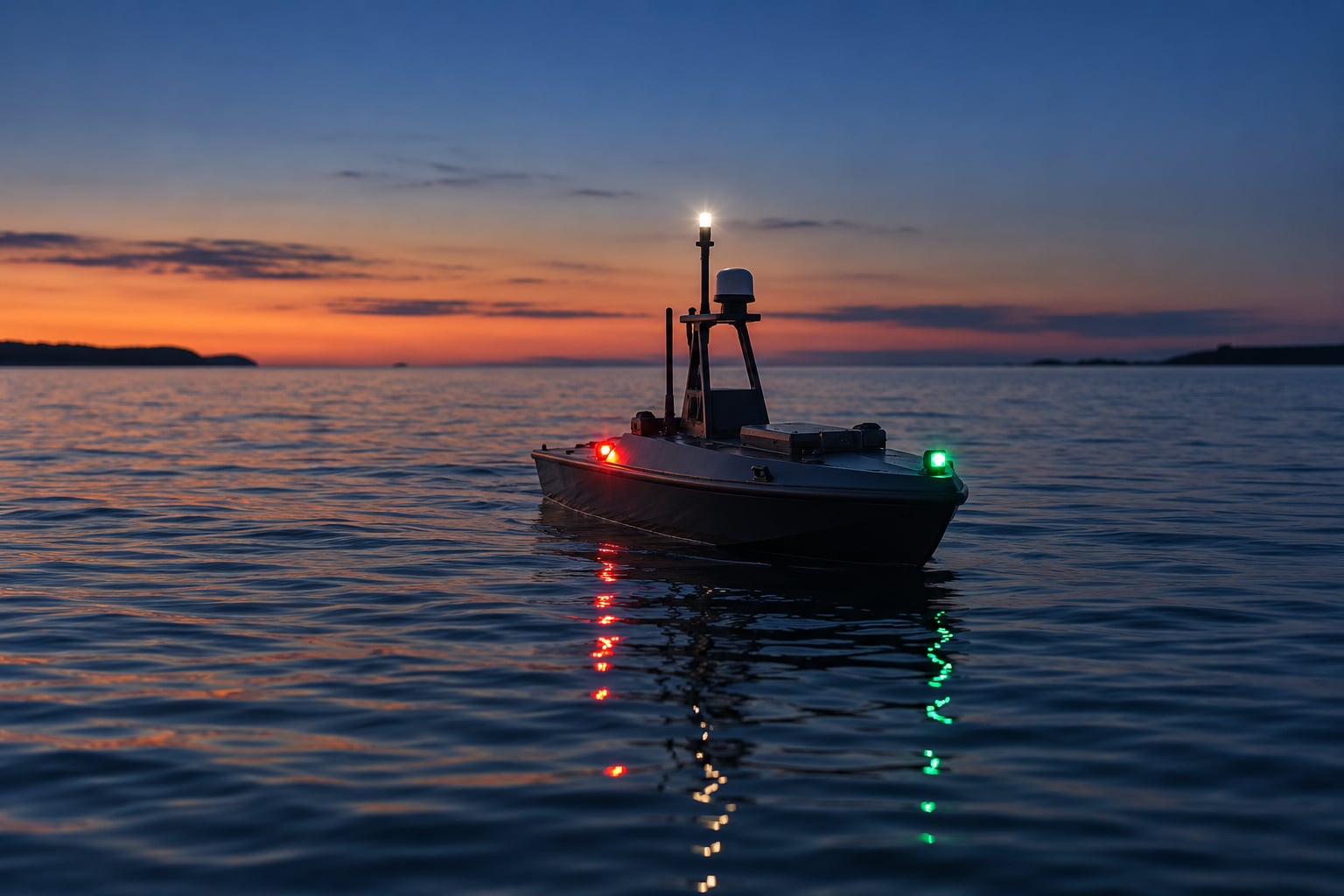
A small unmanned surface vessel normally carries the same navigation light set as a crewed boat of its size: a red port sidelight, a green starboard sidelight, an all-round white masthead light and an all-round white stern light, with an all-round white anchor light shown when it is not making way. Below 7 metres the full set is often exempted, but the craft must still be capable of showing a white all-round light, and because nobody is aboard to operate it, activation has to be automatic and fail-safe.
The rest of this guide covers what the rules actually say, how bright the lights need to be, how to power them on a small hull, and how to install them so they read correctly from a distance.
Table of Contents
- What Lights a Small Unmanned Boat Needs
- Which Marine Lights Are Required?
- Navigation Lights vs. Visibility Lights
- How Bright Should the Lights Be?
- How Do You Power Lights on an Unmanned Boat?
- How Should Navigation Lights Be Installed?
- Special Cases for Unmanned Boats
- Marine Lighting Safety and Testing Checklist
- Frequently Asked Questions
- Conclusion: the first three things to do
What Lights a Small Unmanned Boat Needs
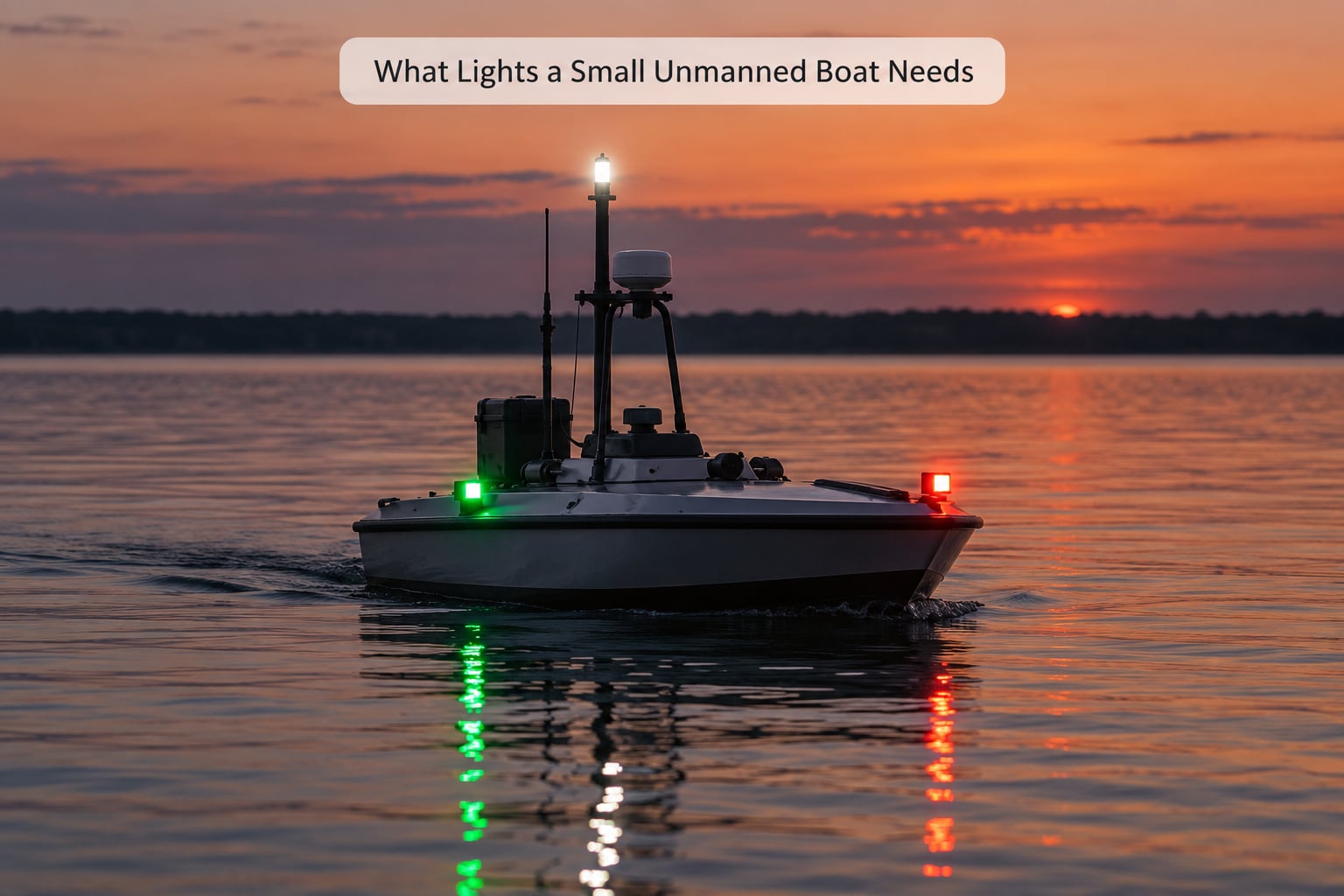
Six light groups cover almost every small unmanned boat. Only the first four are legal signals; the rest are conspicuity and task aids.
- Sidelights. Red to port, green to starboard, each covering a 112.5 degree sector.
- Masthead light. An all-round white light at or near the top of the mast, forward of the stern light.
- Stern light. An all-round white light abaft the extreme stern, visible from behind.
- Anchor light. An all-round white light shown when the craft is at anchor, on station, or aground.
- Conspicuity lighting. Deck floods, a searchlight, high-visibility hull colour and retroreflective tape that help a mariner see the hull rather than identify it.
- Task lighting. Deck and hold illumination, and backlit control panels, for the payload and the service crew on shore.
Sound signals sit alongside these. An unmanned craft in restricted visibility still has a voice problem, and the usual answer is a horn or bell triggered on the same schedule as the lights.
Which Marine Lights Are Required?
The COLREGs, the International Regulations for Preventing Collisions at Sea adopted in 1972, set which light is shown in which state. Rule 20 is the application rule; the others below give the actual configurations.
| Light | Colour | Arc | When shown | Rule |
|---|---|---|---|---|
| Sidelights | Red port, green starboard | 112.5 degrees each | Sunset to sunrise, restricted visibility | 21 |
| Masthead light | White | 225 degrees or all-round | Making way, sunset to sunrise | 22, 23 |
| Stern light | White | 225 degrees or all-round | Making way, sunset to sunrise | 22, 23 |
| Towing light | White, yellow or orange | 225 degrees | Towing or pushing, masthead higher than the tow light | 22 |
| Anchor light | White | All-round, 360 degrees | At anchor or on station | 30 |
| Aground or restricted in ability to manoeuvre | Red over white over red | All-round | Only when actually restricted | 27 |
| Fishing vessel | Red, white, green combinations | Varies | Only when engaged in fishing | 26 |
Two length thresholds decide how much of that set applies. A power-driven vessel of 12 metres or more shows the full combination. Under 12 metres it may carry a single all-round white light instead of the masthead and stern pair. Under 7 metres, with a maximum speed below 7 knots, it is not required to carry navigation lights at all, but it must be capable of showing an all-round white light.
That last clause is where most small USVs actually sit, and it is worth reading carefully. Exempt is not the same as unlit. A boat under the threshold still has to be able to show a white light, and a vessel that has no crew cannot raise one by hand when someone finally notices it.
What a sub-7 m unmanned craft still owes
A craft below 7 metres normally keeps a single all-round white light permanently available and easy to switch on, even if it is not always lit. Many operators go further and carry the full red, green and white set anyway, because a manned vessel closing at speed needs to know the heading of whatever is in front of it. Showing sidelights tells the mariner which way the boat is pointing. An all-round white light alone tells them only that something is there.
Where the requirement changes by state
Lighting alone is never the whole answer on an unmanned boat. Rule 5 requires a proper look-out by all available means, and a vessel with no eyes of its own pushes that burden onto equipment: AIS transponder, radar reflector, lights, cameras. Operational stacks on working survey and cleanup hulls look exactly that way, with navigation lights as one layer among several rather than the answer on their own.
Navigation Lights vs. Visibility Lights
Navigation lights encode identity: vessel type, heading and status. They are tightly defined by sector, colour and range, and they are what a mariner reads to decide who has right of way. Visibility lights do something simpler. They make the object easier to see.
Searchlights, deck floods and work lights belong to the second group. So do retroreflective tape, flagging and high-visibility hull colours. None of them carry legal meaning, and none should be bright enough to be mistaken for a signal. A deck flood pointed forward is common on USVs because it lights the mission area, but it must be masked so it does not bleach out the operator’s night vision or wash across an onboard camera.
The failure mode to avoid is glare. Bright shore lighting and vehicle headlights from a nearby dock or road can destroy a watchkeeper’s night vision and mask navigation lights entirely, and the same effect happens inside a small hull where a white LED lamp sits a few centimetres from a camera or an optical sensor. Photopic and scotopic vision respond very differently, so a lamp that looks mild on the bench can be blinding at night.
One more category sits between the two: lights of special significance. A flashing yellow light may be shown only in the situations the rules describe, and an all-round yellow flashing light is a recognised signal. Use them only where the rule gives you permission.
How Bright Should the Lights Be?
There is no single lumen figure to hit. Brightness in the rules is expressed as luminous range, the distance at which a light is visible in clear night conditions, and as candela, the intensity of the source. Marine navigation lights are specified by range in nautical miles, not by lumens, and quoting a workshop number like 300 lumens tells you nothing useful about how far the light will carry.
What you can hold yourself to is the geometry. Sidelights must be visible over an arc of 112.5 degrees, running from dead ahead to two points abaft the beam on each side. That is the arc that lets a mariner tell whether they are seeing your port side, your bow, or your starboard side.
Screening matters as much as output. Two unscreened all-round lights mounted less than 1.28 metres apart appear as a single light to the naked eye at one nautical mile. That detail comes up constantly in practical discussions because it changes what the other vessel believes it is looking at. On a compact hull with a mast light and a stern light only a few centimetres apart, you need physical screening, not just distance, to keep them reading as two separate signals.
Practical selection criteria for LED lights on a small unmanned hull:
- Luminous range specified in nautical miles, at the regulation colour, rather than raw lumen output.
- Sector geometry documented by the manufacturer, including the two-points-abaft-the-beam limit.
- An IP67 or IP68 ingress rating, since spray comes over the bow on most small craft.
- A 12V or 24V DC input with regulated output, since the supply on a solar hull sags.
- Low-voltage cutoff behaviour that fails dark rather than flickering, or fails bright if you have wired it as fail-on.
- A steady output with no PWM flicker that would band in an onboard camera sensor.
How Do You Power Lights on an Unmanned Boat?
Three approaches are common, and the honest answer is that most small solar USVs end up with a battery bank sized by the payload, with lighting as one more load on it rather than a separate system.
Battery only. The simplest to wire and the most work to size. Lights are a small fraction of consumption on most hulls, but a hull that idles for weeks with no solar gain will eventually drain the bank for a set of lamps that nobody will notice going out.
Vessel electrical system. Feed the lights from the main bus so they share the battery management and the low-voltage cutoff. You get consistent behaviour across the whole boat and a single place to monitor. The cost is that a bus fault takes the lights down with everything else.
Solar with storage. The default for endurance missions. Charge a controller through the day, run the lamps from the bank at dusk. The controller’s low-voltage cutoff becomes the thing that decides when your lights die, which is why it has to be set deliberately rather than left at a default.
Here is a rough budget for a 4 metre solar USV, typical figures for sizing rather than measured values:
| Load | Typical draw | Night hours | Night energy |
|---|---|---|---|
| Two sidelights | 0.5 W total | 10 | 5 Wh |
| Masthead all-round white | 0.5 W | 10 | 5 Wh |
| Stern light | 0.5 W | 10 | 5 Wh |
| AIS transponder | 5 W | 10 | 50 Wh |
| Science payload average | 15 W | 10 | 150 Wh |
The lighting sits well under 10 percent of the night load. That is the useful finding: spending the power budget on lights is rarely the problem, and trimming the payload matters more. The real risk is not watts, it is that a lighting failure is silent. Nobody is on watch to notice.
Activation and the sensor failure case
Navigation lights run from sunset to sunrise, and on an unmanned craft that means a photocell, a light sensor or a schedule synced to a computed sunrise and sunset for the operating area. The question every operator eventually asks is what happens when the sensor itself fails.
A photocell stuck in the dark keeps the lamps on, which burns power but keeps the craft legal. A photocell stuck in daylight leaves the boat dark at dusk, which is the dangerous direction. Design for the second case. A hardware watchdog that forces the lights on after a period of daylight with no dusk transition, or a dual arrangement where a light sensor and a time-based schedule both have to agree before switching off, turns an unobservable failure into a survivable one.
Pair that with telemetry. A lamp current sense reported back to shore tells you the light failed; silence tells you nothing.
How Should Navigation Lights Be Installed?
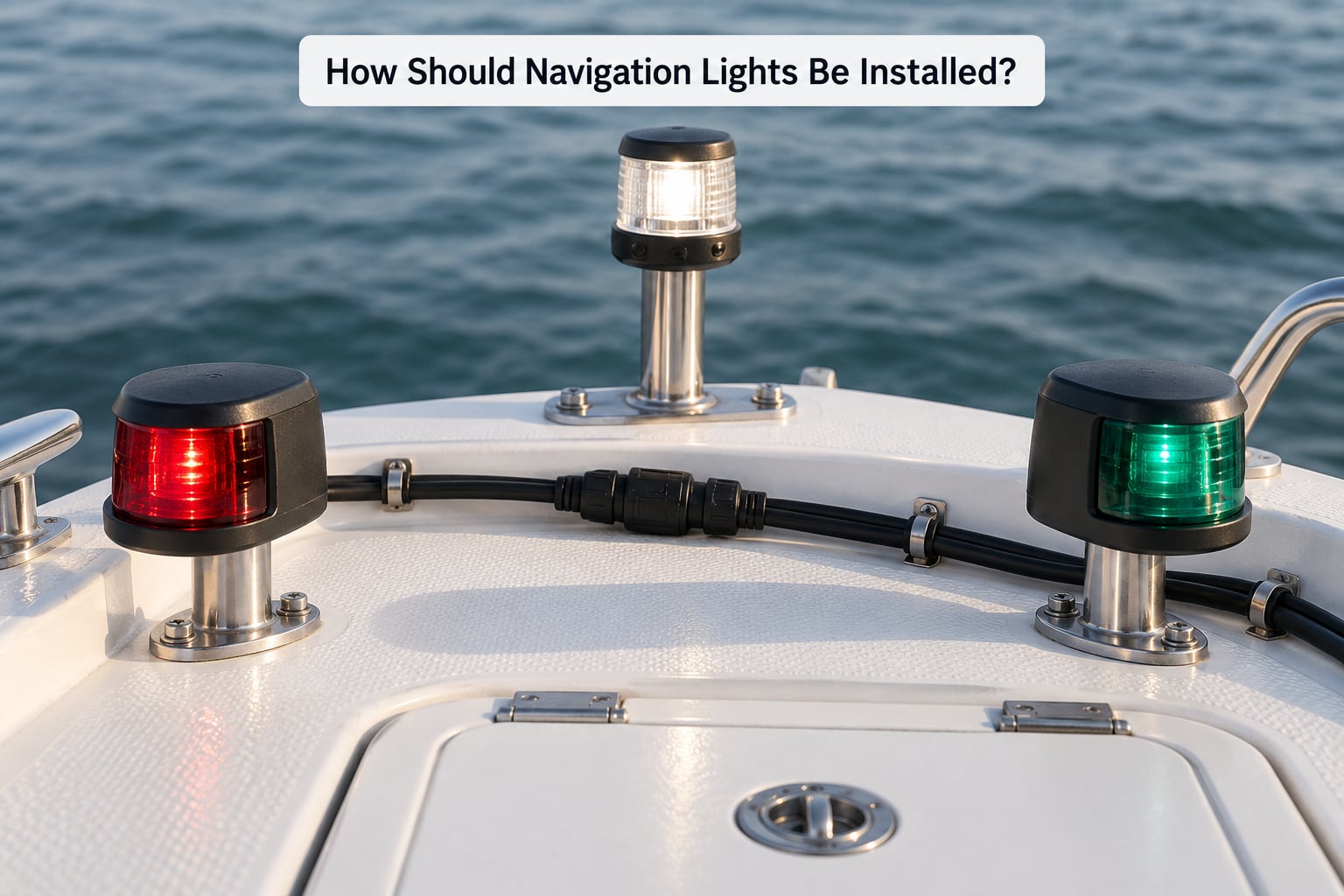
Position comes first. Sidelights go as far outboard as the hull allows, on or near the widest point, so their arcs are not blocked by deck hardware. The masthead light goes forward on the centreline, or as high as is practical, and the stern light goes at the extreme stern. On a very small hull the masthead light is often replaced by an all-round white light mounted as high as the antenna mast allows, with the antenna kept clear of the light’s arc.
Keep the lights rigidly fixed. Nothing on an unmanned boat swings, so there is no excuse for a light on a loose mount; a mast that flexes moves the sector far more than you would expect.
- Aim, don’t just mount. Check each sidelight’s arc against its own body and against anything you added later. A camera bracket can silently eat 20 degrees.
- Screen properly. Where two all-round lights sit within 1.28 metres, fit opaque baffles so they cannot merge visually at a nautical mile.
- Wire for service. Use twisted pair or shielded cable, sealed connectors, strain relief at every entry point, and a route that avoids chafe on deck edges and thruster wash.
- Protect against corrosion. Salt fog destroys terminals faster than anything else on the boat. Marine-grade terminals, dielectric grease, and stainless or bronze fasteners.
- Seal the hull penetration. Every cable through the deck is a leak path. Use proper sealed glands and keep penetrations above the static waterline.
- Keep the lights serviceable from shore. Any screw that has to be undone on a moored hull in the dark will not be undone. Make the common failure, a blown lamp or a pulled connector, replaceable from a tender.
Backwash deserves its own check. Stand on the recovery vessel at night, look at the boat from a few metres, and see whether your own lights are washing out the camera you steer by.
Special Cases for Unmanned Boats
Remote supervision. A craft with a human on shore controlling it is not automatically a vessel not under command. If it is being actively navigated, showing Rule 27 lights tells other traffic it is unable to manoeuvre when it is not, which erodes the whole signalling system.
Low-profile hulls. A flat-bottomed ASV with no mast has nowhere to put a masthead light. An all-round white on a short post at the highest point of the canopy is the usual compromise, and it pushes the light closer to the sidelights, which makes the 1.28 m screening rule harder to satisfy. Plan the baffles early.
Launch and recovery from a support vessel. When an unmanned boat is carried aboard or towed, the towing light rules apply, and the tow light sits lower than the masthead light of the vessel being towed. The launching craft is a towing vessel for the duration of the tow.
Restricted visibility. Fog is where an unmanned craft is most vulnerable and least capable. Lights stay on, sound signals trigger automatically, and this is a good argument for over-specifying the luminous range on a hull that works in open ocean.
Daytime conspicuity. Between sunrise and sunset, lights do nothing. Retroreflective tape, a high-visibility hull colour and large registration markings carry that window instead.
What not to display. Do not show not-under-command or restricted-in-ability-to-manoeuvre lights, day shapes or lights of special significance for routine survey, cleanup or monitoring work. Using signals you have no right to show is the fastest way to make a small autonomous boat look like a hazard, and mariners encountering unexpected craft near fishing grounds is already driving demand for better lighting.
Marine Lighting Safety and Testing Checklist
Run this before every night launch.
- Confirm every lamp draws current at the sensor, not just that the housing is lit.
- Walk a circle around the boat at night and verify the sectors visually: red only on the port side, green only to starboard, nothing white showing forward that should not be.
- Check the screening between any two all-round lights under 1.28 metres apart.
- Watch a full dusk transition, not a simulated one. Cover the photocell and confirm the watchdog forces the lights on.
- Verify the low-voltage cutoff point and decide deliberately whether failure leaves the craft dark or lit.
- Confirm the supply voltage at the lamps under load, since a sagging solar bus is the usual cause of dim or flickering output.
- Verify the lights survive a soak: every connector sealed, every gland tight, no water in a junction box.
- Log the lamp current to telemetry so a failure reaches shore.
- Check that the AIS transponder and radar reflector are working alongside the lights, since no single layer is sufficient.
- File the operation through the Local Notice to Mariners and notify the Coast Guard district or Captain of the Port where the mission runs near a channel or approach.
- Confirm visual distress signals are carried where the operating area requires them, and that nobody is signalling distress unless assistance is genuinely needed.
Frequently Asked Questions
Does an unmanned boat have to show navigation lights at night?
Yes, in almost every case. An unmanned surface vessel is still a vessel under COLREG and must show the navigation lights appropriate to its length and state from sunset to sunrise and in restricted visibility. Below 7 metres a power-driven craft under 7 knots is exempt from carrying the full set, but must be capable of showing an all-round white light. Many operators fit the complete red, green and white set regardless, because sidelights also tell a closing mariner which way the hull is pointing.
What colour light does a small unmanned boat need?
Red to port, green to starboard, and white forward and aft. That applies to any vessel showing sidelights, crewed or not, and it is the first thing a mariner reads. If the craft sits under the 7 metre exemption and shows only a single all-round white light, it has no sidelights at all, so it cannot communicate heading. That is the main argument for fitting the full set on a small unmanned hull.
How bright should navigation lights on a small USV be?
Judge them by luminous range in nautical miles, not by lumens. Sidelights must cover a 112.5 degree arc from dead ahead to two points abaft the beam. Because nobody is aboard, err toward the longer range. Shore lighting and vehicle headlights can mask navigation lights completely, so specify a light that still reads through that wash and screen any pair of all-round lights within 1.28 metres of each other.
Can small LED lights replace incandescent navigation lights?
Yes, provided the LED unit meets the same specification: correct sector geometry, correct colour, and the specified luminous range. Converting an older craft often means miniature bayonet bulbs that are bright enough but sit in the wrong housing, so the sector is wrong and the light reads incorrectly. Buy sealed marine units with documented arcs, and test the geometry in the water before a mission rather than trusting a bench measurement.
Should an autonomous boat display not under command lights?
Usually no. Rule 27 lights signal that a vessel cannot manoeuvre or is keeping out of the way. An autonomous craft under active remote supervision is being navigated and is not restricted in its ability to manoeuvre, so showing those lights misinforms other traffic and devalues the signal. Display them only when the craft is genuinely adrift, being towed or unable to respond. Routine survey and monitoring work takes the normal running and anchor lights.
Conclusion: the first three things to do
Start by fitting the full red, green and white set even if your hull length exempts you, because sidelights are what tell a mariner your heading. Then choose lamps by luminous range in nautical miles and sector arc rather than lumens, and screen any pair sitting within 1.28 metres. Finally, wire activation so a failed sensor errs toward darkness being obvious rather than silent: a watchdog, a deliberate low-voltage cutoff setting and a lamp current alarm back to shore.