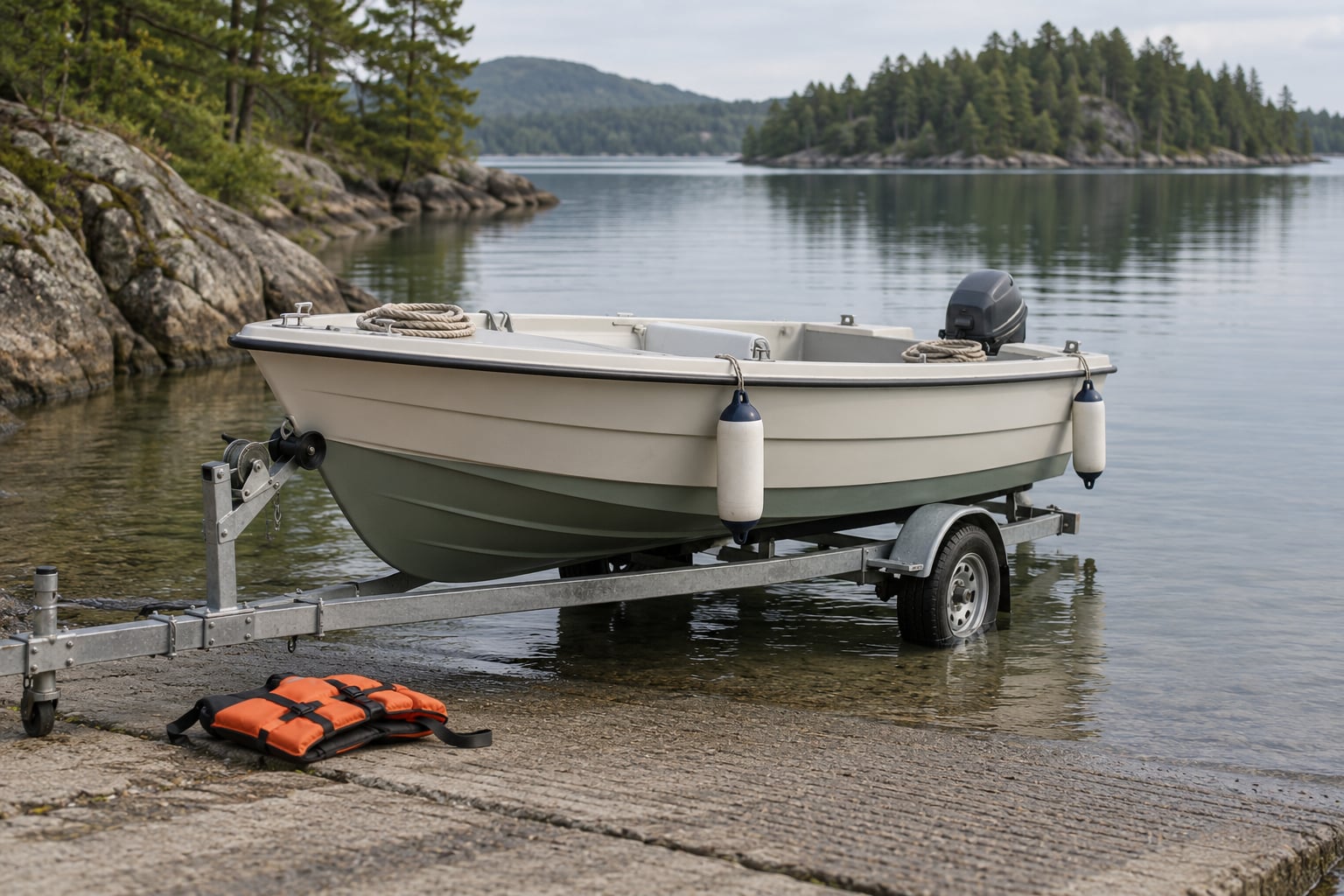
You can launch a small boat from a ramp alone, and after a handful of runs it goes faster with one person than with two. The routine is simple: rig a long bow line into a loop you can grab with one hand in the staging area, back the trailer down until the stern floats, put the vehicle in park with the parking brake set, release the winch strap before the safety chain, then walk the hull to a tie-off point and move the vehicle out of the lane.
Once that sequence is repeatable, most solo launches take under 10 minutes. Budget 15 to 20 minutes for your first few attempts, and remember where the hard part actually is. It is not the backing, and it is definitely not any single piece of gear. It is line handling.
Table of Contents
- What You Need to Launch a Small Boat from a Ramp Alone
- Step-by-Step
- 1. Inspect the Ramp and Operating Conditions
- 2. Prepare the Boat for a Controlled Release
- 3. Rig Bow and Stern Control Lines
- 4. How to launch a small boat from a ramp alone without losing control
- 5. Release the Lines in the Right Order
- 6. Move Clear and Confirm the Boat Is Stable
- 7. Recover the Boat Using the Reverse Process
- Common Mistakes
- Frequently Asked Questions
- Conclusion
What You Need to Launch a Small Boat from a Ramp Alone
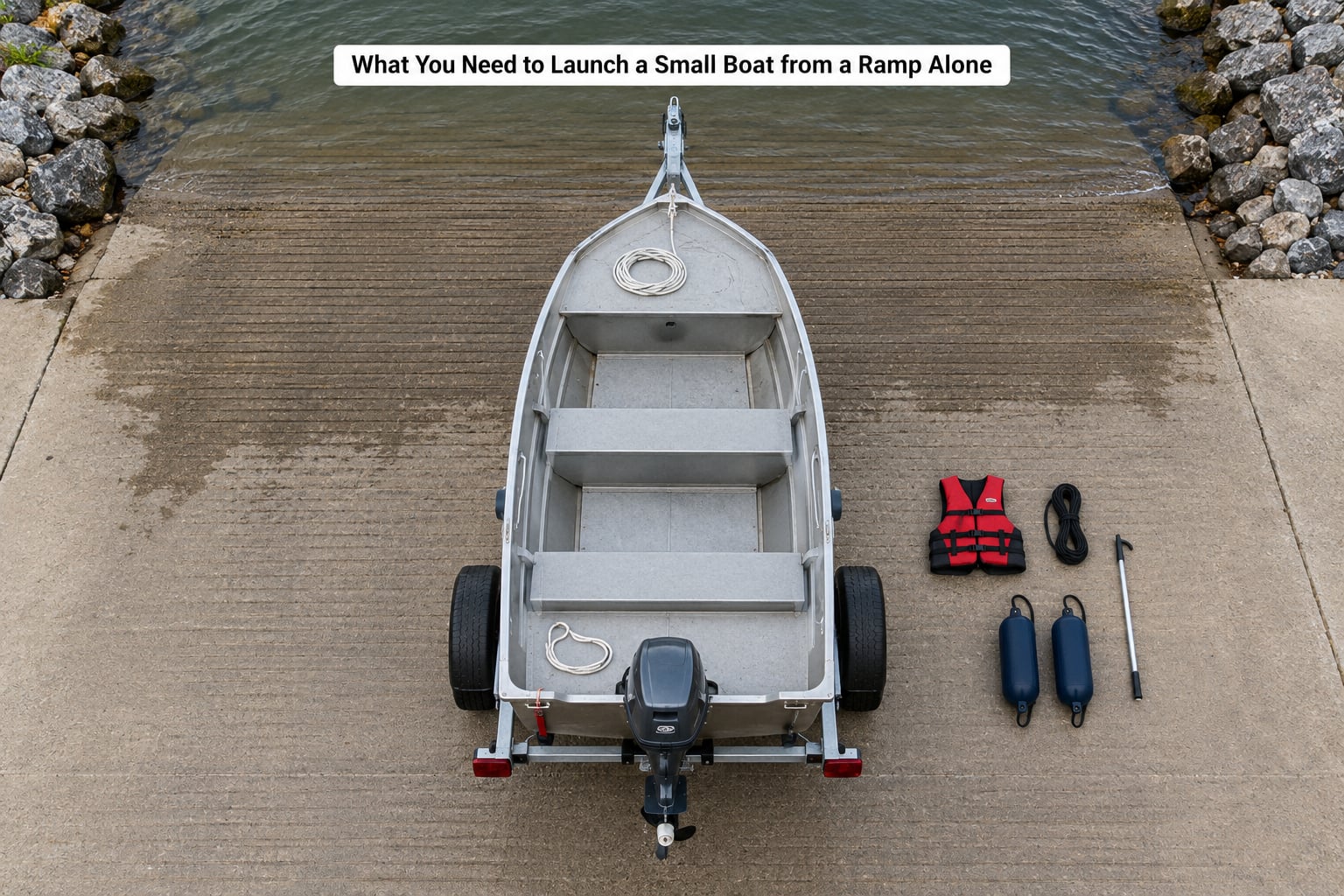
A solo launch needs four things working in sequence: a line already rigged and in reach, a tie-off point you trust, a way to keep the vehicle from rolling back, and enough water depth that the propeller and lower unit stay safe. Everything else is comfort.
- Bow line, 20 ft minimum. This is the number that keeps a solo launcher from being dragged. If the ramp has no dock, a 20 ft line is the floor, and 25 to 30 ft buys you the reach to a shore bollard, a piling, or a stump without stepping into the water.
- Stern line, 10 to 15 ft. Shorter than the bow line on purpose. Its job is holding the stern square while the bow line sets the heading, not reaching a tie-off.
- A tie-off point. A cleat, bollard, dock piling, or a solid shore object. If your ramp has none of those, launch with the stern anchor down first so the boat has somewhere to go when you let go.
- Fenders, if you will tie to a dock or piling. Two is enough for a small boat. They turn a clumsy approach into a non-event.
- Wheel chocks for steep ramps. On a slope the vehicle wants to leave. Parking brake plus gear is usually enough, but a chock behind one rear wheel costs nothing.
- PFD, kill switch lanyard, and a whistle. Put the PFD on before your feet leave the truck, not after you are aboard.
- A VHF handheld or a phone in a waterproof float. A ramp with no dock is usually a ramp with poor cell coverage.
- A line knife or sharp utility blade. Snagged rope gets cut, not pulled.
Rig the bow line in the parking lot, not at the water. Tie it into a large loop so it is already in your hand the moment the hull floats free, then coil it loosely on the bow deck so it runs off away from your feet instead of under them. Walk the ramp before you queue for it. Look at the surface for algae, gravel, mud, and potholes, check that the water at the end is deep enough for your draft, and note where you would put the boat if you had to abort. Practicing the backing in an empty lot is the single most useful thing a new solo launcher can do.
Step-by-Step
1. Inspect the Ramp and Operating Conditions
Walk the ramp before you put the trailer in the water. You are checking slope, surface condition, depth at the end, and what is underneath: rocks, rebar, old pilings, stumps, and drop-offs. A ramp that looks like sand in August can be a mud trench in March.
Then read the conditions, not just the forecast. Note other boats in the lane and whether anyone is queued behind you, the wind direction and gusts, and any chop on the water at the ramp’s foot. Check the local launching rules: permit, launch window, staging-lot time limits, and whether trailers park above or below the waterline.
Set your no-go threshold before you commit. If you cannot see where the ramp meets the water clearly, if whitecaps are running onto the ramp, if the wind is steadily pushing the bow toward the shore, or if another boat is sitting where you need to work, come back later. Before you start backing, identify the abort plan: hold the bow line and never release the winch strap, then back up the ramp, or if the boat is already free, walk it back up the bunks and re-hook the strap.
2. Prepare the Boat for a Controlled Release
Confirm flotation first. The drain plug goes in hand-tight with the spare in the same pocket, and the bilge plug goes in if your boat has one. Distribute the load low and even, with heavy gear forward of the transom and nothing loose that can shift when the hull comes off the bunks.
Check the mechanical bits while they are still dry. The tank or battery box is strapped down, the fuel cap is on and the line is not kinked, the battery terminals are tight, the steering wheel turns hard both ways, and the prop and lower unit are clear of line, plastic, and fishing line. Coil the kill switch lanyard and clip it to the motor, not to your wrist, until you are actually aboard.
Position the boat so it stays aligned when the lines come off. The keel needs to sit centered on the bunks and rollers, and the bow eye needs to be square over the bow roller. Before you go down the ramp, unplug the trailer light connector, coil it on the tongue and zip it. A hot bulb dropped into cold water cracks the glass and corrodes the socket, and you will find out next season with no trailer lights.
3. Rig Bow and Stern Control Lines
Attach the bow line to the bow eye or a dedicated bow cleat. Never use a handle, a cleat that is not rated for the pull, or the winch strap itself. On the bollard side, use a bowline or a round turn with two half hitches; slip knots that draw up tight are a problem you do not want while standing at a shoreline.
Length is a function of the ramp. Going up on a rising tide or a steep slope, take more line. The test is whether you can reach a secure tie-off with the hull clear without wading in, and without the line going under the boat’s chine.
Now take up the slack carefully. Gather the coil aboard first so nothing trails in the water, then run the line out to the tie-off and set it with just enough tension that the hull cannot swing. Coil the excess and secure it so it cannot go over the side. Never wrap a working line around your hand or wrist. That is how hands end up in the bunks, and a hand loop you can slip out of does the same job safely.
4. How to launch a small boat from a ramp alone without losing control
The direct technique: keep the hull tracking straight, feed the bow line out gradually rather than all at once, and hold the stern line just snug enough to keep the stern square. The lines are not there to push the boat. They are your brakes and your steering, and they only work if they stay loaded lightly and continuously.
If the ramp is flat or shallow at the end, angle the boat a few degrees so the stern leads. That stops the bow from running up onto the ramp as the hull settles. On a steep ramp, keep it straight and let the trailer guides do their job.
Do not try to pivot the boat while the bow is still on the bunks. Get the hull completely free first. Then hold the bow line, let the boat swing to the heading you want, and take the tension back up. If the wind is pushing the bow in, ease the bow line a foot, let the boat drift until the wind passes, then retake the load. Always stand uphill or abeam of the loaded line, never downhill of it.
5. Release the Lines in the Right Order
Release the winch strap first, then the safety chain. The strap is what holds the bow on the trailer, and the chain is the backup. Dropping the chain first leaves you with nothing but the strap if the hull surges on a wave or the ramp slope, which is exactly when a second connection is worth having.
Open the ratchet so the strap runs out through the fairlead, and lay the loose strap on the bunks. Take the bow eye or bow roller connection off last. Once the hull is moving, coil each line as you walk it back aboard rather than dragging it behind you, and step over nothing. Pick the line up if you must cross it, but never walk backwards over a loaded one.
Keep hands, feet, and loose clothing out of pinch points: the winch drum, the bow roller, the bunk adjusters, the gap between the hull and the guide posts, and the propeller. Closed-toe shoes with grip matter more here than most people expect. If the bow starts turning shoreward while the hull is still on the trailer, hold the bow line, let the stern line come slack, and re-hook the winch strap rather than trying to haul the bow back one-handed.
6. Move Clear and Confirm the Boat Is Stable
As soon as the boat is secure, move the vehicle and trailer up out of the launch lane. This is the unspoken rule at a ramp: your staging time is now, not when the boat is loaded with people and tackle. Set the parking brake, leave it in gear, and chock it on a slope.
Then board. Sit down before you start the motor, clip the kill switch lanyard to your wrist, and run through it in order. Steering responds. The throttle and shift work in both directions from neutral. The bilge is dry and the plug is in. The battery reads charged, or the fuel gauge shows a full tank. The radio gets a response. Lights work if you will be out after dark.
One quick aside that fits here: the one-third fuel rule. Leave a third in the tank for the return, a third for the trip, and a third for the unexpected. A solo boater has no second set of judgment about a bad headwind, and running out of fuel at the ramp end is the most expensive kind of bad day at a boat ramp.
7. Recover the Boat Using the Reverse Process
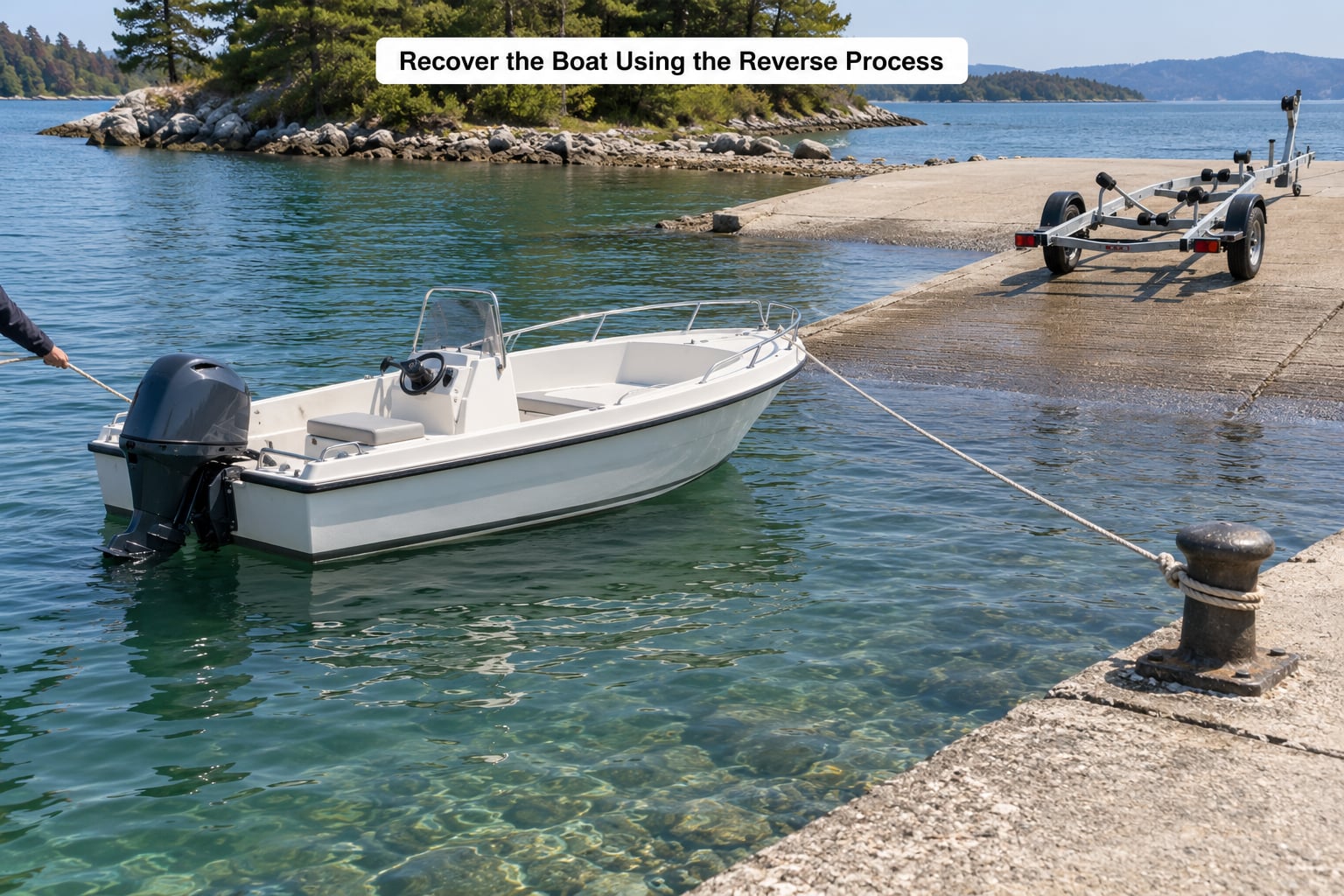
Retrieval is the launch in reverse, and the order matters just as much. Approach slowly at idle speed. Keep clear of other boats’ prop wash and wakes, because the last three feet are where a bow gets set broadside. Line up with the trailer early and use the control lines to bring the bow eye over the bow roller.
Most light aluminum boats go on the trailer on the winch strap. Ratchet the strap closed while the hull is still floating, winch until the bow eye seats on the roller, then put the trailer in position and take the weight. Never try to muscle a boat ashore one-handed, and never back the trailer deeper than its own submerged rating. If you do not have a winch, a hand winch with a rope and a short anchor strap is the usual solo answer.
Once she is on: plug in the drain and bilge, wipe the bunks and rollers, pull the rear tie-down straps and transom saver snug, hook the safety chain, and stow the lines before you move a foot. Drive out of the water slowly, then check the trailer lights, tire pressure, and anything you left in the grass at the bottom of the ramp. If you see a solo launcher behind you stuck at the top of the lane with no bow line, stop and ask before you take their boat away.
Common Mistakes
Every one of these has a two-second fix once you know it is happening. Work down the list before your next launch.
- Standing downhill of a tensioned bow line. A loaded line can take your feet out from under you. Stand uphill or abeam, never in the bight.
- Wrapping the working end around your hand or wrist. Use the loop you rigged in the parking lot so you can slip free instantly.
- Leaving a big loop of slack. The hull will swing into it. Take the slack up before you release anything, and pay it out gradually afterward.
- Releasing the safety chain before the winch strap. Strap first, chain second, bow connection last.
- Launching the bow into a chop. The bow takes waves on the bunks and can hop. Wait for flat water, or back in with the stern to the wave direction.
- Standing behind or in line with a tensioned winch strap. Stand off to the side, clear of the drum and the strap path.
- Tieing to a handle or a piece of hardware. Bow eye or a rated bow cleat, always. Cleats on a boat have load ratings.
- Loading the boat bow-heavy. Weight forward of the transom makes the trailer hard to back and can let the hull slide off the bunks. Respect the trailer’s tongue weight too.
- Skipping the depth check at the end of the ramp. Find the depth before you commit. A bent lower unit in mud is a repair bill you pay in a parking lot.
- Parking in the launch lane while you sort gear. Get the vehicle up out of the lane and do your work in the staging area.
One last safety tip: the habit that prevents most solo launch accidents is to leave your launch lane before you leave the ramp. Everything you can still tighten, drain, or stow can be done while the boat is tied off and the truck is parked. The water is the part you cannot fix from the shore.
Frequently Asked Questions
Can I launch a small boat from a ramp alone if it has a trailer?
Yes, and a trailer is the normal setup for a solo launch. Rig your bow line in the staging area, back down until the stern floats, set the parking brake and leave the vehicle in park, then release the winch strap before the safety chain. If you have never trailered a boat, practice backing an empty trailer in a flat lot before you do it at the water.
What wind speed makes a solo ramp launch unsafe?
There is no universal number, so judge it by what the wind does to the boat. Walk away if whitecaps are running onto the ramp, gusts swing the bow shoreward faster than you can correct, or another boat is nosed in beside you. Steady light wind is manageable because you can hold the bow line; steady onshore wind during the walk-out is not.
Should I use a winch to launch a small boat by myself?
The trailer’s own winch and bow eye strap should stay on until the hull is fully floating, and the order matters: winch strap off first, safety chain off second, bow connection off last. For loading, a winch is a solo launcher’s best friend because it does the heavy lifting while the hull is still buoyant. Do not try to muscle a boat ashore one-handed.
How do I stop a boat from turning toward shore during a solo launch?
Hold the bow line loaded lightly and pay out just enough for the boat to swing, rather than pulling hard against it. A short stern line keeps the stern square while you do this. If the bow is still on the bunks, re-hook the winch strap and settle again. Never wrap the line around your hand to get more leverage on it.
What should I do if the launch has to be abandoned halfway?
Keep the winch strap on and back the trailer up the ramp if the boat is still on the bunks. If the hull is already floating, hold the bow line, either walk it back onto the trailer bunks or let it lie to the anchor you dropped, and move the vehicle out of the lane. Abandoning a launch slowly is a normal outcome, not a failure.
Conclusion
The safest solo launch is the one that happens in a fixed order: inspect the ramp, prepare the boat and rig both control lines in the staging area, back down until the stern floats, park with the brake set, release the winch strap before the safety chain, hold the bow and stern lines while the hull comes free, and move the vehicle out of the lane before you do anything else.
If you only remember three things, remember these. Rig the line before you reach the water. Release the winch strap first. Get the truck up out of the lane. Start the next one by backing an empty trailer around a flat lot until it feels ordinary.
And keep in mind what this routine does not do. It does not replace the safety equipment your boat is required to carry, a properly fitted life jacket, a charged radio, or the local boating rules that apply to the water you are launching into. Those still apply on your first solo launch and your hundredth.