If your outboard is not peeing water, the raw water pump is not moving cooling water through the engine, and the cause is usually something you can clear yourself in about ten minutes. In order of likelihood it is a clogged telltale (pee) hole, a blocked cooling-water intake, or a worn impeller. Shut the engine down the moment you confirm there is no flow, because an outboard running without cooling water can warp a cylinder head or seize a piston in minutes.
This guide walks the checks in the order that costs the least and rules out the most. Nothing here requires opening the power head, and nothing here needs a boat ramp until you have already confirmed the telltale is quiet on the dock.
Before you start pulling anything apart, it is worth refreshing how the whole loop works, because most confusion comes from not knowing which opening is supposed to discharge what. Our field guide to logging test data on the water is useful later, once you have a motor that flows reliably and want actual numbers from a sea trial.
Table of Contents
- What You Need
- Step-by-Step: Why Is My Outboard Not Peeing Water?
- Common Mistakes
- Frequently Asked Questions
- Is it safe to keep running an outboard that is not peeing water?
- Does every outboard motor have a cooling-water telltale?
- Why does my outboard discharge water only when the engine is cold?
- Can a blocked cooling-water intake damage an outboard motor?
- What does it mean if the telltale flows but the temperature warning comes on?
- Should I replace the impeller before checking the cooling-water intake?
- Conclusion
What You Need
Gather this before the engine goes on the water. Most of it is cheap, and half of it you probably already own.
- The owner's manual for your exact model. It tells you where the telltale discharges, whether the engine should stream at idle, and whether a low unit is required to stay fully submerged while running.
- Model and serial identification. The horsepower, two-stroke or four-stroke, and year all change where the intake and telltale sit.
- Basic hand tools. Screwdrivers, a socket set, needle-nose pliers and a small wrench. A trim-head screw and a Phillips bit cover most power head shrouds.
- A small bucket. For catching water and for the bucket test described below.
- 50 to 60 lb test monofilament, a standard paperclip and a pipe cleaner. The three tools that clear a telltale hole. Owners on the outboard forums consistently report monofilament as the one that works when nothing else fits the passage.
- Nitrile gloves and eye protection. Salt water and old scale are not pleasant to handle, and a spring-loaded clip can go somewhere you do not want it.
- A garden hose with a flush adapter matching your brand. Needed for the flushing step that keeps this from happening again.
- The correct coolant, only if your manual specifies it. Many outboards are water-cooled only and take no coolant at all. Check before you pour anything in.
Two notes on gear. If you are working around the wiring harness with the motor tilted up, follow our guide to how to clean salt water off electronics afterwards, since a tilted motor drains salt water straight across every connector on the boat. And if your boat has steering or throttle servos near the transom, our piece on how to protect servos from salt water is worth reading before you flood the lower unit.
Everything in this guide is an external check. Anything that means splitting the lower unit, removing the power head, cutting into a sealed housing or working on a charged cooling system belongs to a qualified marine technician.
Step-by-Step: Why Is My Outboard Not Peeing Water?
Identify the Outboard and Its Normal Discharge
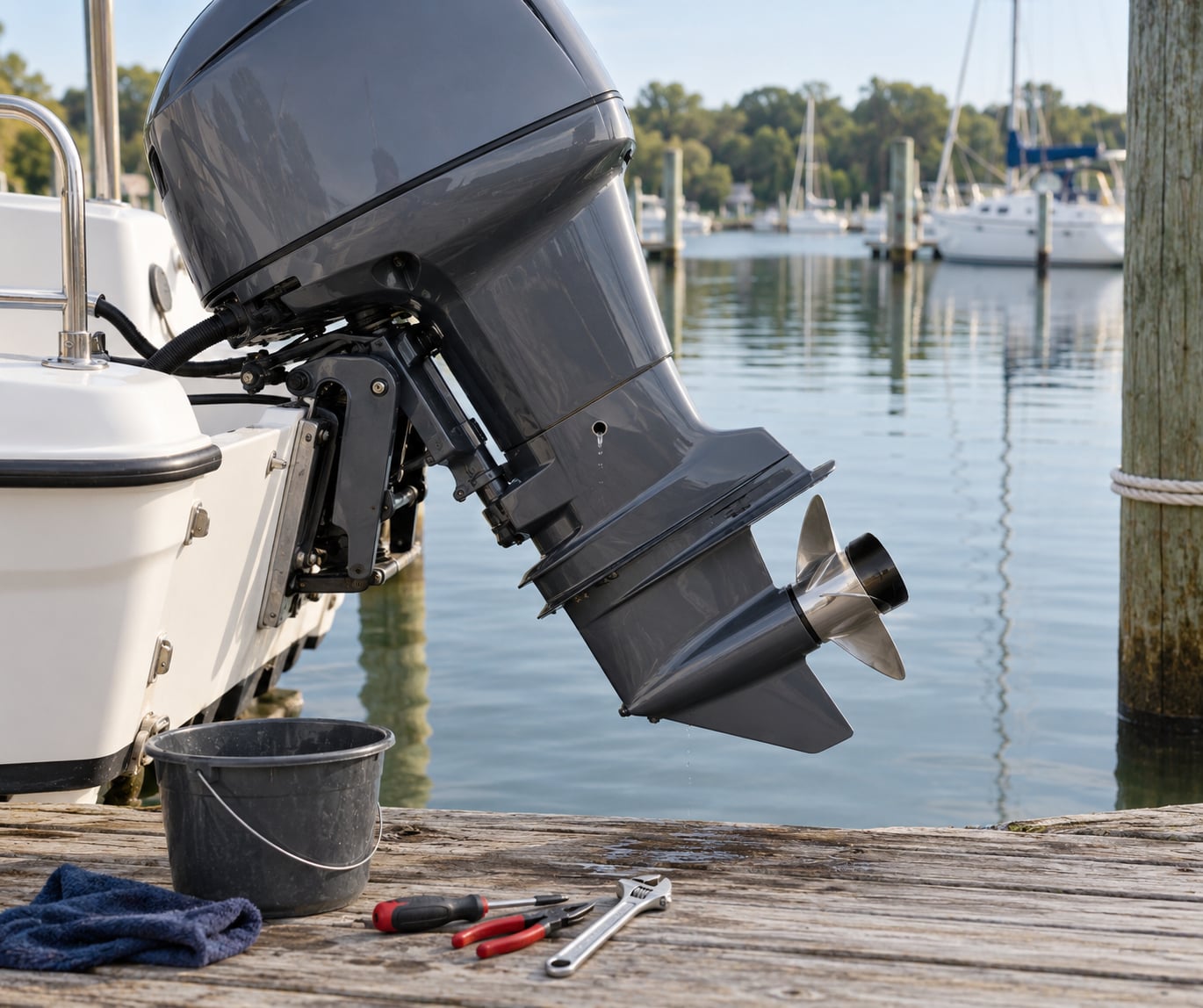
Start by finding out what normal looks like for your engine, because not every outboard behaves the same. The owner's manual will show where the telltale exits, and on most engines it is a small hole on the starboard side of the power head, just below the exhaust outlet, that runs a steady stream of clear water.
Design matters here. Some engines stream a fat ribbon from the first second of idle, some only dribble until the thermostat opens and then flow properly, and some are quiet at idle and only discharge under way. A handful of four-strokes route the telltale through a separate hose and a check valve, so the stream pulses with engine speed rather than sitting still.
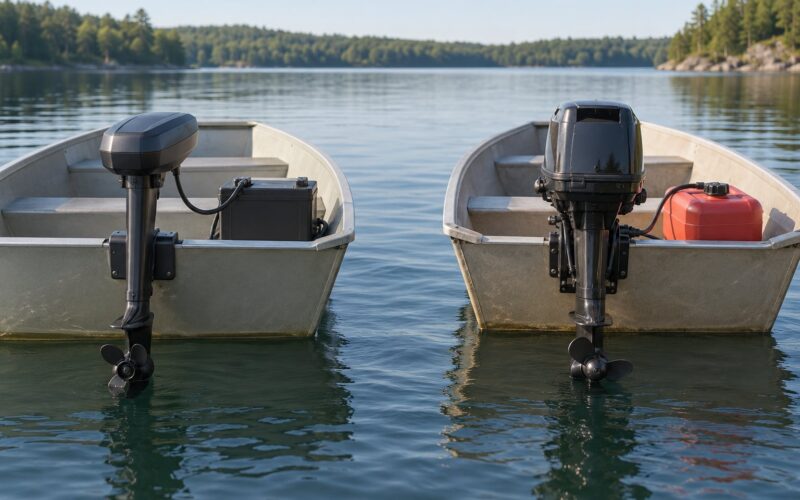
Two-strokes differ again. A two-stroke generally needs its lower unit immersed to prime the raw water pump, so a shallow bucket is a common reason owners conclude something is broken when nothing is.
Why Is My Outboard Not Peeing Water? Confirm the Symptom
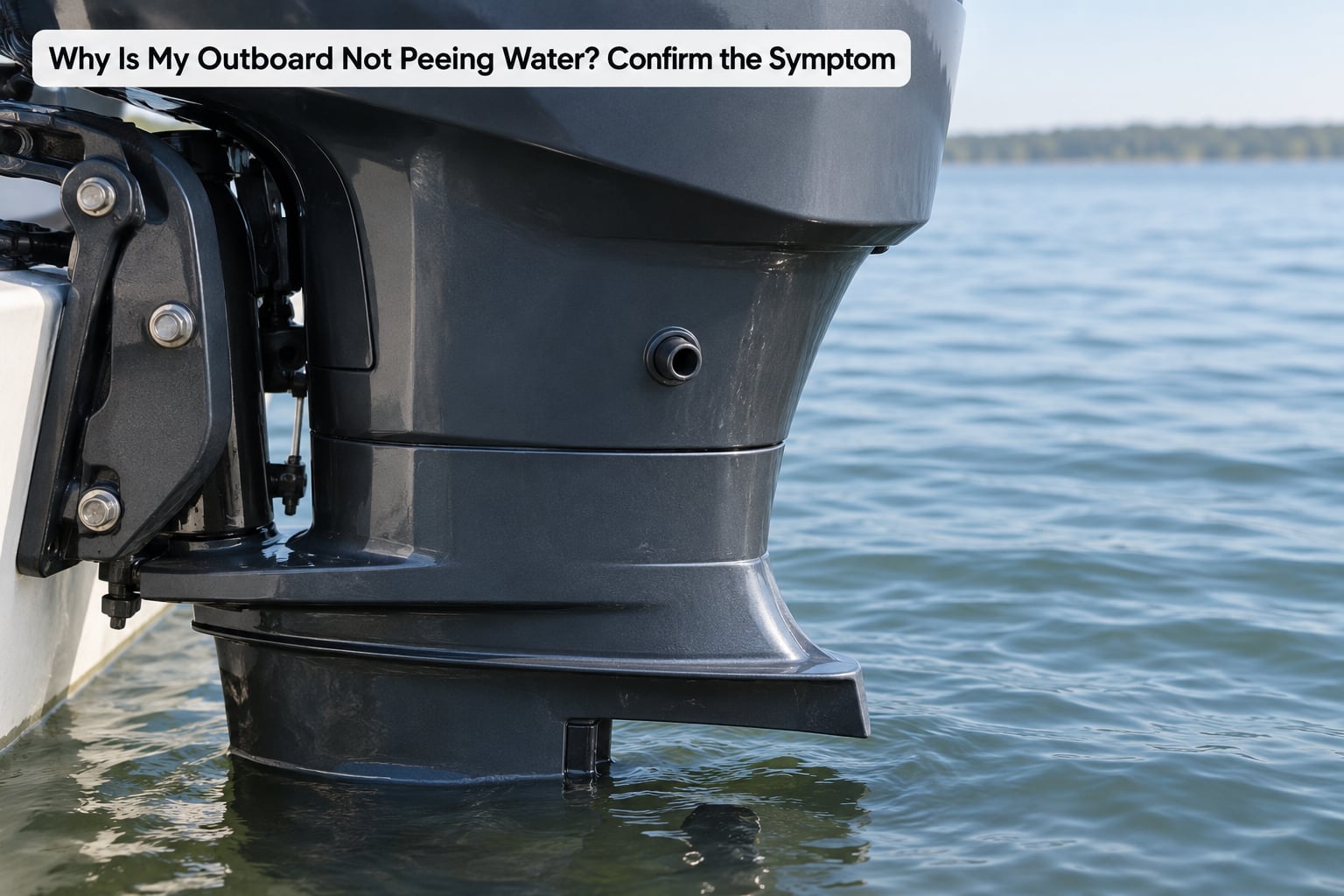
Warm the engine the way the manual describes, then look at the designated discharge point and watch it for a full minute. A healthy engine streams continuously once warm, and the stream should not stop when you trim the motor down into the water, because the intake is drawing from a deeper, cleaner source then.
Work through the test options in this order, cheapest first:
- Muffs or a water telltale adapter. The cheapest test, but the least reliable. A garden hose adapter gives steady pressure and will reveal an open flow. Muffs on the ground often fail to prime the pump, so a weak stream there tells you very little.
- Bucket test. Lower the motor into a bucket deep enough to submerge the intake screen and keep it there. If a two-stroke needs full submersion, the bucket has to be deeper than most people assume. A steady stream in a correctly sized bucket rules the pump and passages in or out quickly.
- On the water. The only test that reflects reality, because it shows flow at idle, at cruise and against a lightly loaded boat. Watch the telltale at several RPM ranges rather than a single one.
While you are running, log what you see. A simple written record of engine hours, water conditions and stream behaviour turns a vague complaint into something a technician can act on, and our guide to logging test data on the water sets out a format that takes about two minutes per trip.
| What you see | Most likely cause | Check first |
|---|---|---|
| No stream at all, warm, on the water | Clogged telltale hole, blocked intake or failed impeller | Telltale hole, then intake screens |
| Weak dribble that stops when you trim down | Intake drawing air, so the pump is losing prime | Water depth, intake screen condition |
| Strong stream at idle, nothing at high RPM | Thermostat stuck closed, or a partially blocked passage | Thermostat and internal passages |
| No stream, engine running hot with a temperature warning | Pump or flow failure with the engine still being run | Stop the engine immediately |
| No stream after a pump or impeller job | Reassembly error, or a second blockage downstream | Impeller direction, key way, gasket seating |
| Stream only while the engine is cold | Thermostat stuck open, or air trapped in the passages | Thermostat operation and bleed points |
Check for Overheating Before Continuing
If the engine is hot, the situation is no longer a hobby. Warning indicators, a temperature gauge climbing past normal, steam from the exhaust, a hot cylinder head and a sudden drop in oil pressure all point the same way, and on some engines the engine will also cut back RPM on its own to protect itself.
Trim the motor clear of the water, shut it down and let it cool where you are before you touch anything. Do not restart it to see whether the warning comes back, and do not run it around the block hoping the flow returns. Once a head warps, the repair stops being a telltale hole and starts being an engine.
Inspect the Cooling-Water Intake
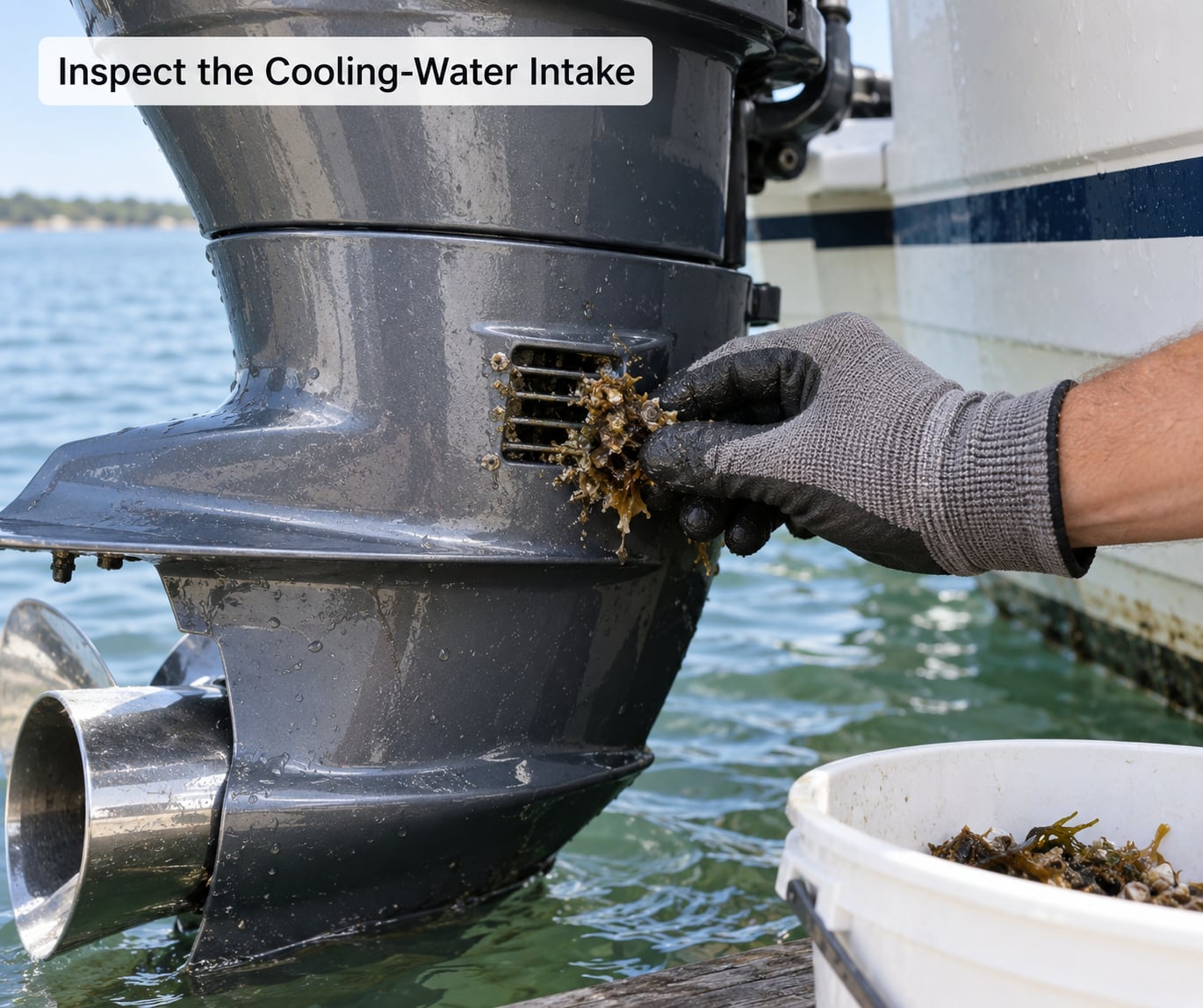
Find the intake on the forward and side faces of the lower unit. The screens are small mesh grids, and they catch everything the boat runs over: marine growth, weeds, plastic, fishing line, a discarded bag, sand and silt. A single weed blade drawn across the mesh cuts flow dramatically, and owners on the classic outboard forums describe finding fishing line and mud wasp nests wedged into exactly these screens after a season in the water.
Clear them the way the manual allows. On most engines you can lift the lower unit and lift the screens out with needle-nose pliers, then rinse them with fresh water and a soft brush. Work gently, because bent or missing screen frames let debris straight past the impeller, which turns a simple clog into a pump failure.
Then trace the water path forward. Push 50 to 60 lb monofilament through the telltale hole until it breaks through, work a pipe cleaner through the discharge tube, and check that the telltale hole itself is not packed with scale. This is the single most common fix and the cheapest, which is why it is worth doing before anything else.
If the flow returns, run the engine on the hose flush adapter for the interval your manual specifies, with the telltale streaming the whole time. Salt residue in the cooling passages is what turns a small blockage into a recurring one, and the same guide that covers salt water protection for the boat's other gear applies to your flushing habits at the transom.
Assess the Impeller, Thermostat, and Internal System
If the telltale and intake are clear and the engine still does not flow, the problem has moved inside. Four things account for most of it.
- The rubber impeller. It spins in a metal housing, driven by the driveshaft, and pushes water from the intake into the power head. Look for collapsed or missing vanes, and for a hub chewed by a piece of wire or shell. A brand new impeller that does not pump is often installed backwards, with its vanes curving the wrong way, or fitted without its key onto the shaft.
- The thermostat. A stuck-closed thermostat can block the path to the telltale on some designs, and a stuck-open thermostat can leave you with a stream that vanishes once the engine is warm.
- The poppet valve or pressure relief valve. These are easy to misdiagnose as impeller failure because the symptom looks identical, and on several brands they sit right where the owner can reach them.
- Internal blockage and corrosion. Salt and scale inside the cooling passages, or broken impeller vanes lodged further along, will stop flow no matter how good the new pump is.
All four are internal work. If you are at the point of pulling the lower unit, the right call is a technician who will flush the passages, seat the water tube properly and confirm the alignment on reassembly. Our advice is not that you cannot do it, but that the parts list, the torque figures and the sealing steps come from the manual for your model, and a mistake here costs more than the diagnostic did.
| Point of difference | Two-stroke | Four-stroke |
|---|---|---|
| Typical telltale behaviour | Often a strong stream from idle, provided the lower unit is submerged | More models route flow through a hose with a pulsing check valve |
| Effect of a shallow bucket | Pump may not prime, which looks like a fault but is not one | Less prone to this, but still needs the screen covered |
| Where salt trouble shows up | Quickly, in the water passage and the exhaust route | More often in the exhaust gas leader, which strands the telltale flow |
| Common internal suspect | Thermostat in an accessible location on many models | Exhaust gas leader blockage before the impeller is ever suspected |
Common Mistakes
Almost every failed diagnosis traces back to one of these.
- Checking too soon. Some engines delay telltale flow until warm. Give it a minute at idle and recheck before you start taking things apart.
- Watching the wrong outlet. The telltale is usually a small hole on the starboard side, not the exhaust outlet above it. Owners have spent a whole teardown looking at the wrong pipe.
- Treating exhaust water as cooling flow. Water from the exhaust and water from the telltale come from different paths, and one can run while the other is dead.
- Ignoring overheating. If the engine is hot, the diagnostic session is over. Shut it down and let it cool.
- Opening a sealed or pressurised system. Do not crack a housing, coolant fitting or a cap while the engine is hot. Pressurised coolant and hot scaling are the two things most likely to put you in a clinic.
- Adding coolant where none is specified. Check the manual. Engines that take no coolant should never have it added, and the wrong mix will not help a blocked passage anyway.
- Replacing the impeller before finding the blockage. The impeller is frequently innocent. Swapping it and finding no change tells you the real cause is still in the engine.
And if you have already done the pump work, the same symptom usually comes back for a mechanical reason rather than a new one: the impeller vanes curved backwards, the key missing from the shaft or misaligned in the key way, a gasket fitted the wrong way round, broken old vanes still lodged in a passage, or a water tube not fully seated with its seal compressed. Check those before ordering another part.
Two habits prevent most of this. Flush with fresh water after every trip in salt, and treat an impeller as a consumable item to check on the same schedule as your oil changes rather than a part that fails without warning. If the boat sits in a slip over winter, the telltale hole and the discharge tube should be checked before the layup, because that is exactly where insects nest.
Frequently Asked Questions
Is it safe to keep running an outboard that is not peeing water?
No. The telltale confirms the raw water pump is moving cooling water through the engine. Without that flow the cylinder head and exhaust ports heat fast, and damage can start within minutes. Trim the motor clear of the water, shut it down, and let it cool where it is. Do not restart it to see whether the warning returns, and do not run it at low power around the dock hoping the flow comes back.
Does every outboard motor have a cooling-water telltale?
Nearly all do, but the location and the expected behaviour vary. On most engines it is a small hole on the starboard side of the power head, just below the exhaust outlet. Some four-strokes route the stream through a hose with a check valve so the flow pulses with RPM, and some models dribble at idle then flow properly once warm. Your owner’s manual shows the exact point for your engine.
Why does my outboard discharge water only when the engine is cold?
Two causes are common. A thermostat stuck open lets water bypass the engine and out the telltale cold, then closes once the engine reaches temperature and the stream stops. Air trapped in the cooling passages from refilling or a long layup shows the same pattern. Either way the telltale is doing its job, which is telling you the engine is no longer being cooled, and the engine should be shut down once it reaches temperature.
Can a blocked cooling-water intake damage an outboard motor?
Yes, and that is the main reason to treat a missing stream as an emergency rather than a nuisance. The pump keeps spinning against a restricted inlet, loses prime, and cavitates while the engine runs with no coolant. A single weed blade, a plastic bag or fishing line across the intake screen is enough. Clearing the screens and the telltale hole usually restores flow within minutes, and the fix is far cheaper than the head it prevents.
What does it mean if the telltale flows but the temperature warning comes on?
It means the pump is moving water but not enough of it, or the water is not reaching the hottest parts of the engine. Salt and scale in the cooling passages, a blocked exhaust gas leader, a failing thermostat or a partly blocked water tube all reduce flow without stopping it. Compare the stream against what a healthy engine of that model should produce, and treat a visibly weaker stream as a fault rather than a variation.
Should I replace the impeller before checking the cooling-water intake?
No. Always clear the telltale hole, the discharge tube and the intake screens first, because they cost nothing to check and account for most cases. On many engines the impeller is fine and the blockage sits around it. If the external checks come back clean, then the impeller becomes the next suspect, along with the thermostat, the poppet valve and internal scale. Fitting a new impeller without finding the blockage usually means replacing the part twice.
Conclusion
Start with the simplest possible explanation and work outward. Check the manual for what your engine's telltale should do, then look at the telltale hole, the discharge tube and the lower unit intake screens, because those three account for the majority of cases and cost almost nothing to clear.
If the engine is running hot at any point during the diagnosis, stop it and let it cool instead of continuing. And if the external checks come back clean and the motor is still not flowing, that is the point to hand it to a marine technician who can open the engine, flush the passages and verify the alignment on reassembly.