The fastest way to get rust stains off a boat hull is to find the corroding metal that left them, then treat the surface with an acid that dissolves iron oxide rather than scrubbing it away. On fiberglass gelcoat, an oxalic-acid product works within minutes and rinses clean; the same acid is a poor choice on aluminum or on a painted hull. Whole job takes an afternoon, most of it waiting for the hull to dry.
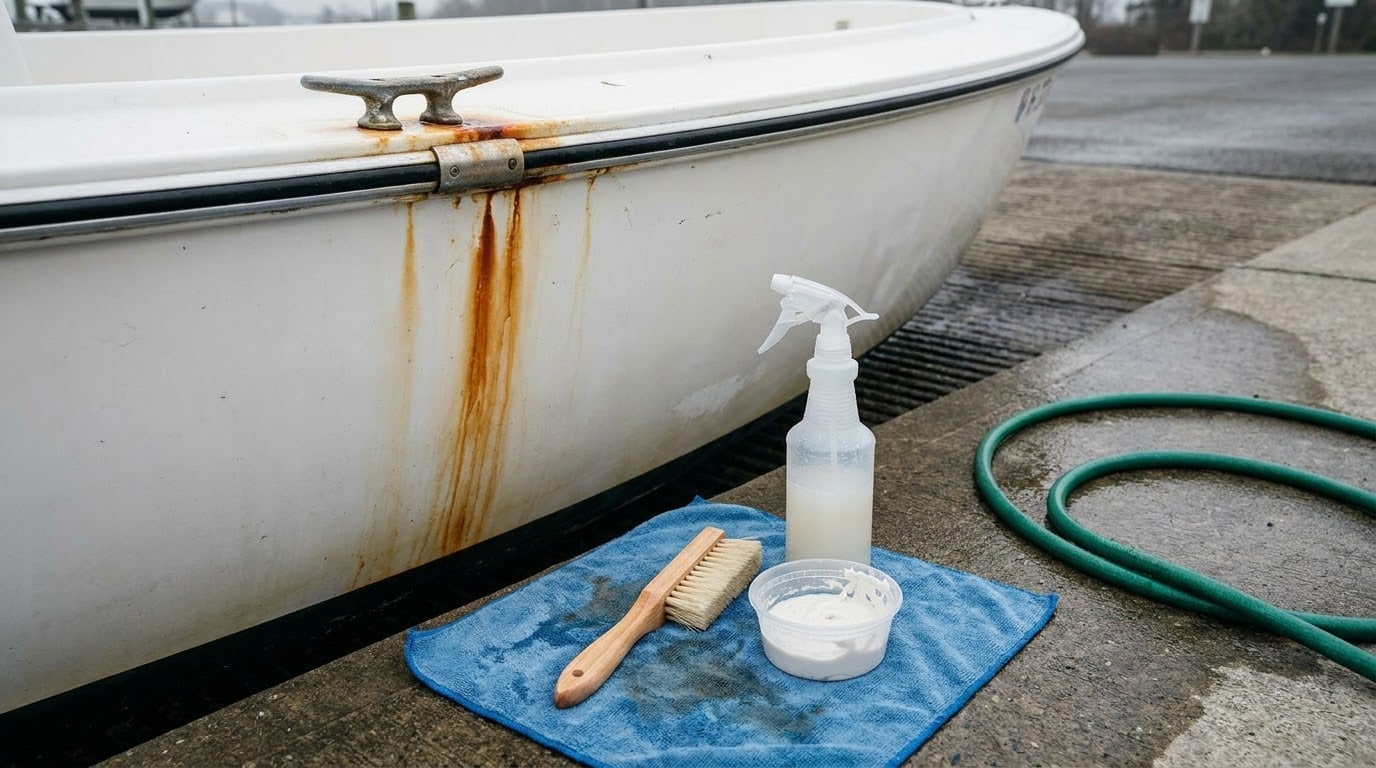
One correction first, because it changes everything downstream: fiberglass does not rust. Gelcoat is polyester resin over fiberglass cloth, and neither corrodes. Every orange streak on a fiberglass hull is iron oxide transferred from something else, usually a cleat, an anchor chain, a through-hull fastener, a tank strap or a trailer bunk sitting wet against the gelcoat. Find that piece of metal before you clean, and you stop the stain cycle. If you only scrub the hull, the next trip puts it right back.
Table of Contents
- What You Need Before You Start
- How to Get Rust Stains Off a Boat Hull, Step by Step
- Common Mistakes That Ruin a Hull Finish (and the Fix for Each)
- Frequently Asked Questions
- Can I use bleach to remove rust stains from a boat hull?
- What is the safest rust remover for fiberglass or gelcoat hulls?
- Why does rust keep coming back after I clean the hull?
- Should I remove a rust stain before repairing a corroded metal fitting?
- Does rust staining mean the hull itself is damaged?
- How do I prevent rust stains from metal hardware and trailer parts?
- Conclusion
What You Need Before You Start
Most of the supply list is cheap and ordinary. The two things people skip are gloves and a rinse plan, and both matter more than the product.
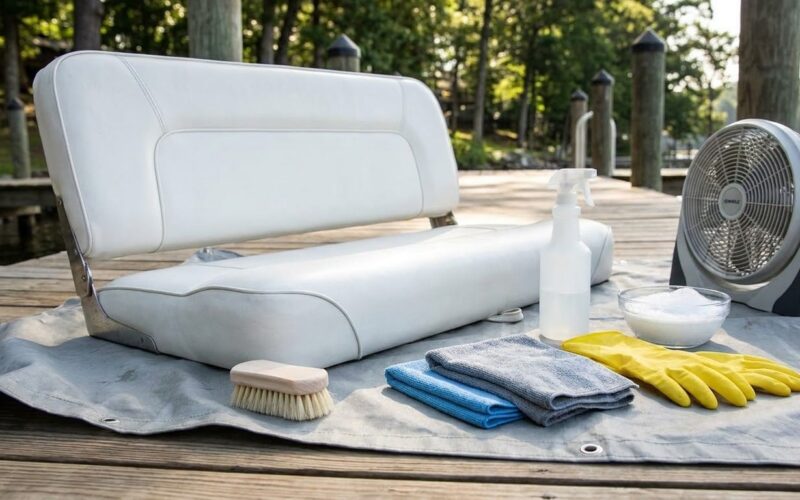
Safety gear. Chemical-resistant gloves with cuffs, splash goggles, long sleeves and closed-toe shoes. A respirator is worth adding if you are working with phosphoric acid products in an enclosed slip or garage.
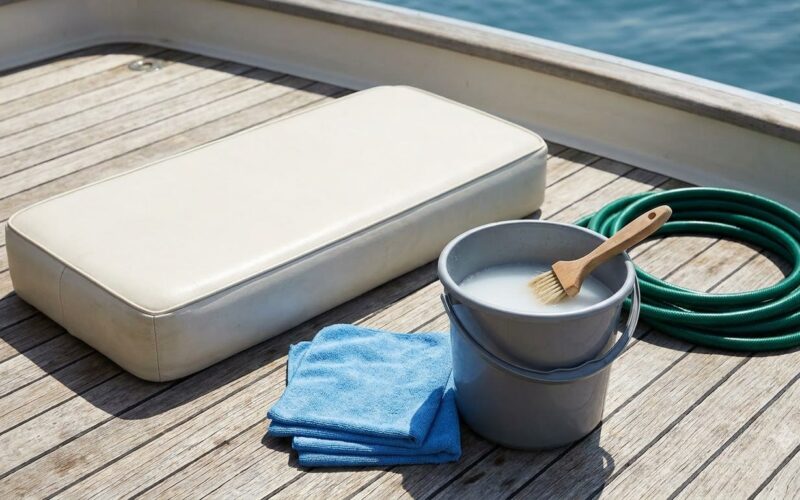
Wash gear. A pressure washer or a garden hose with a decent nozzle, plus boat soap or a biodegradable marine wash. You are cleaning twice, before and after.
Tools. A soft-bristle brush, a nonabrasive pad for smooth gelcoat, a stiff nylon brush for non-skid texture, a plastic scraper and plenty of microfiber cloths. Keep steel wool, green abrasive pads and 80-grit sandpaper in the shed. They leave fresh iron particles or cut into the gelcoat.
Remover. For light surface stain, a paste oxalic-acid product such as Bar Keepers Friend works. For anything darker, dilute household oxalic acid powder at roughly 1:5 to 1:10 with fresh or distilled water. For stains already etched into the gelcoat, a phosphoric-acid product such as naval jelly. Baking soda and water handles neutralising if you go the acid route.
Protection. A rubbing or polishing compound, marine-grade wax, and a corrosion inhibitor spray for the metal hardware once it is clean and dry.
Reach for a metal file, a scraper or a stronger acid-based product only when the substrate is bare metal that has actual scale on it. Once you are dealing with deep pitting, water tracking into a stringer or corrosion around a structural fastener, call a marine fabricator or surveyor rather than working through it.
| Stain | What it looks like | Best treatment |
|---|---|---|
| Surface runoff | Light orange haze or a single drip trail, no texture change | Dilute oxalic acid, 3 to 5 minute dwell, rinse |
| Moderate | Solid orange streaks, several inches long, wipes off with a cloth | Oxalic acid paste or gel, 5 to 10 minute dwell, soft brush |
| Deep or etched | Dark brown to black, dull spot, gelcoat feels rough under a fingernail | Phosphoric acid, then wet sand 600 to 1000 grit, polish, wax |
| Active corrosion | Flaking metal, weeping rust, stain returns within days | Stop cleaning. Replace the fitting or anode first |
| Aluminum | Chalky white bloom or grey pitting, not orange | Different problem. Wet sand and polish oxidation, never acid |
How to Get Rust Stains Off a Boat Hull, Step by Step
Read these in order. The first two take ten minutes each and save you from a ruined finish.
Identify the Hull Surface and the Rust Source
Start by telling the surfaces apart, because the treatment changes completely. Fiberglass with gelcoat feels smooth and slightly soft when wet, and you can often see the weave or a shallow print-through under the paint. Bare aluminum has a metallic ring when you tap it, feels cool, and shows chalky white oxidation. Painted steel or a metal hull over wood core has a harder, colder feel and takes a magnet.
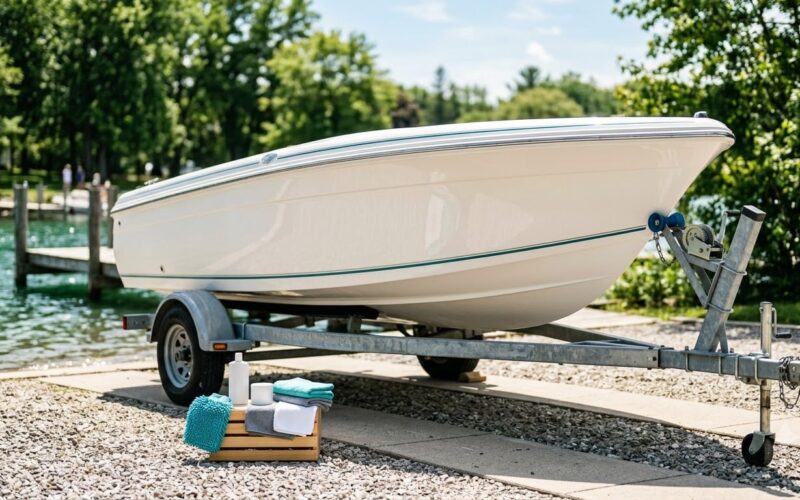
Next, trace the stain back to its source. Follow the streak uphill; it almost always terminates at a specific fitting. Check every screw, bolt and backing plate that passes through the hull, plus the tank straps and brackets inside the boat, the anchor and its chain, the cleats, the rod holders, the drain plugs and the through-hull fittings. On a trailered boat, inspect the bunk carpet and the frame hardware directly, since a trailer sits wet against gelcoat for hours and is the most common repeat offender.
Look for the pattern, not just the spot. A clean, even band along one side usually means a bracket. Streaks from one point downward mean a fitting. Stains that appear in the same place every launch come from the trailer. If the stain sits where the boat rubs the dock or the pilings, that is shoreline staining transferring off a metal source in the water, not hull damage.
Test the Cleaner on a Hidden Area
Patch test before you commit. Find a spot under the trailer bunks, inside a locker or low on the transom where the boat always sits, and put the product on exactly as you plan to use it on the visible area.
Leave it for the full dwell time you intend to use, then rinse and dry. Walk away for an hour. Gelcoat etching shows up as a dull spot, a soft or tacky surface, a change in gloss, or a faint lighter halo around the test patch. Any of those means the product is too strong or the dwell is too long for this finish.
On painted surfaces, check the paint for dulling or colour shift. On vinyl, canvas and lettering, do not test with the acid at all, and mask those areas before any broad application.
Remove Light Rust Stains Gently
Work in shade, out of direct sun, when the surface is cool. Heat and wind make acid dry on the hull, and dried acid is what dulls gelcoat. This is the single most common way a careful job goes wrong.
Wash the area first with boat soap and water, then rinse. Grit and trailer dust under an acid pad scratch the finish and grind the stain deeper.
Wet the hull surface. Apply the product generously so it stays wet and active, and work in sections no larger than a door panel. For a spray gel or a paste, spread it with a nonabrasive pad; for a liquid, a spray bottle or a sponge works. Count the dwell time from application. As a rough guide, light surface haze reacts in 3 to 5 minutes, moderate streaks in 5 to 10. Never let it dry and never exceed the label time, which is the number the manufacturer actually tested.
Agitate with a soft brush on smooth gelcoat, or a flat nonabrasive pad for stubborn areas on the hull sides. On a non-skid deck, push a soft-bristle brush down into the texture instead of using a flat pad; owners on sailing and small-craft forums consistently report that a pad just rides over the peaks and leaves the stain in the valleys. Keep the surface wet while you work, and rinse each section thoroughly with a hose or pressure washer before moving on. Acid left in the non-skid grit is what creates the bleached-looking patch later.
You will know it worked when the gelcoat is uniformly glossy and the stain no longer transfers to a damp white cloth. A faint shadow of the old streak that disappears in direct sun is normal; that is residue in the surface, not stain.
Treat Remaining Marks by Hull Material
Fiberglass or gelcoat. Repeat with a slightly stronger solution, a full-strength oxalic-acid paste, or a phosphoric-acid product for marks that survived the first pass. Work one small panel at a time and rinse between attempts. If the stain still shows but the gelcoat now feels rough rather than dull, it has etched into the surface, and no chemical will finish it. Wet sand that area with 600 to 1000 grit wet-or-dry paper, keep the surface soaked so the paper cannot scratch dry, then work up through 1500 grit and finish with a rubbing compound and marine wax. Change paper often. Sanding is the last resort, not step one.
Aluminum. Alodine blooms on aluminum are oxidation, not rust, and acids will pit bare alloy and leave permanent grey marks. Clean the area with a mild marine wash, then handle the chalky bloom with a mild metal polish and a soft cloth, or wet sand heavily oxidized areas through 1000 to 2000 grit while the surface stays wet. Bare aluminum is soft, so change paper the moment grit turns grey, or you will be removing metal rather than oxidation. Acid-based rust removers have no place on an aluminum hull.
Painted steel or metal over a wood core. Do not sand through the paint to chase a stain. Clean the paint as you would gelcoat with a pH-neutral marine wash, and use a metal polish on the bare metal. If corrosion has lifted the paint, that is a paint and hardware job, not a cleaning job. A professional assessment is the right call when the corrosion sits at a stringer, a keel bolt or a through-hull fitting, or when the metal is flaking and weeping.
Dry, Protect, and Prevent Returning Stains
Let the hull dry fully. Any moisture trapped under wax locks the residue in, and a damp surface going into storage invites a new bloom. Remove dried white residue with a damp cloth and a little straight marine soap, rinse, and dry again.
On smooth gelcoat, apply a rubbing compound to knock down any faint residue haze, then a coat of marine-grade wax. The wax is what buys you time; a waxed surface sheds the next stain before it bonds. Re-wax every season or twice a year if you keep the boat outside.
Now deal with the source. Replace corroding fasteners with 316-grade stainless, coat remaining hardware with a corrosion inhibitor, inspect sacrificial anodes and replace any that are more than half consumed, and rinse the boat and the trailer frame with fresh water after every trip. If the trailer bunks are the culprit, replace the bunk carpet or paint over bare steel with fresh marine paint, then rinse the bunk after each launch. On non-skid, if cleaning has flattened or bleached the texture, a non-skid brightener or a coloured non-skid paint will make the repaired patch match the rest of the deck.
Common Mistakes That Ruin a Hull Finish (and the Fix for Each)
Scrubbing before testing. You end up with a dull patch and a stain that may already be gone. Fix: test first, then work, and hold the pad off the surface until the chemistry has done the work.
Using chlorine bleach. Bleach does nothing for iron oxide and can bleach the gelcoat, the graphics and the nonskid colour, leaving a light patch that reads as a repair. Fix: use an acid that dissolves the iron instead.
Using steel wool, green pads or a wire brush. They deposit fresh iron particles that rust right back, and they scratch. Fix: soft brush, nonabrasive pad, plastic scraper only.
Applying acid to gelcoat in full sun, or letting it dry. Concentrated acid left on gelcoat dulls and etches permanently. Fix: work in shade on a cool hull, keep the surface wet, honour the label dwell time, rinse each panel immediately.
Using an acid-based remover on aluminum. It attacks the alloy and leaves grey pitting that polishes out only with more metal removal. Fix: treat aluminum oxidation as an oxidation job.
Ignoring the rust source. The stain comes back every trip, and repeated treatment eventually damages the finish. Fix: replace the fitting, anode or bunk covering before you do any more cleaning.
Rinsing with dirty or cold lake water. You redeposit the iron you just dissolved. Fix: use fresh water, and collect runoff with a tarp or a bucket where local rules on discharge are strict.
Coating over damp or still-corroding metal. Wax or inhibitor over a wet surface traps the corrosion and seals the problem in. Fix: dry thoroughly and stop the corrosion first.
Two habits cover most of the maintenance side. Rinse the hull and trailer with fresh water after every outing, and touch hardware with corrosion inhibitor each spring. That pair of habits stops most stains before they start.
Frequently Asked Questions
Can I use bleach to remove rust stains from a boat hull?
No. Chlorine bleach does not dissolve iron oxide, so it will not remove a rust stain at all. What it does is attack the gelcoat pigment and any graphics, decals or non-skid colour nearby, leaving a pale patch that looks worse than the original stain. Use an oxalic-acid product instead, and keep the bleach away from the hull entirely.
What is the safest rust remover for fiberglass or gelcoat hulls?
An oxalic-acid product is the safest useful option. A paste such as Bar Keepers Friend, or household oxalic acid powder diluted roughly 1:5 to 1:10 with fresh water, dissolves iron oxide without cutting into the gelcoat. Patch test it first, work in shade on a cool hull, keep the surface wet, and rinse within 3 to 10 minutes depending on the stain.
Why does rust keep coming back after I clean the hull?
Because the metal that produced the stain is still there, corroding and touching the hull. Clean the streak, replace the cleat, reseal the through-hull fitting, or swap the corroded trailer bunk, and the staining stops. If you skip that step you will be repeating the same acid treatment every season, and each round dulls the finish a little more.
Should I remove a rust stain before repairing a corroded metal fitting?
Yes, but repair the fitting first if it is still weeping or flaking, otherwise you clean a surface that is about to be stained again. Take the old hardware off, replace corroded fasteners with 316-grade stainless, coat the remaining metal with a corrosion inhibitor, then clean and wax the area once everything is dry and quiet.
Does rust staining mean the hull itself is damaged?
On a fiberglass hull, usually not. The gelcoat is stained and possibly lightly etched, which is cosmetic, but the underlying glass and core are intact. Signs of a real problem are flaking or weeping metal, a firm or spongy area under the stain, corrosion at a stringer or through-hull fitting, or a leak. Have any of those checked by a marine surveyor.
How do I prevent rust stains from metal hardware and trailer parts?
Rinse the hull, hardware and trailer frame with fresh water after every trip, before the corrosion has time to dry onto the gelcoat. Inspect the trailer bunks and replace bare or rusted steel with fresh marine paint or new bunk carpet. Coat remaining hardware with a corrosion inhibitor, check sacrificial anodes twice a season, and keep stainless hardware on the hull to 316 grade.
Conclusion
Start with the two steps that prevent most repeat work: work out what the hull is made of, and find the piece of metal leaving the stain. Once you know that, clean the surface with a diluted oxalic-acid product, in shade, without letting it dry, and rinse each panel within the label dwell time. Treat etched marks with wet sanding, polish and wax; leave aluminum and structural corrosion to the appropriate specialist. Replace or protect the offending hardware, rinse the hull after every trip, and the stain stays gone.