If you are choosing a propulsion motor for a small boat, sailing robot or ocean drone, the brushed vs brushless motor decision comes down to one trade: a brushless motor costs more and needs an electronic speed controller, but it runs cooler, quieter, more efficiently and with far less maintenance. Brushed motors stay hard to beat for cheap, simple prototypes where you only need the thing to move.
Both designs drive a propeller the same way. The difference is how the motor keeps its magnetic field turning once the motor spins up, and that single mechanical detail shapes everything else you care about on a boat: battery runtime, noise on the water, corrosion exposure, and whether you can service the vessel out at sea.
This guide is aimed at makers and marine engineers building anything from a 2 kg autonomous surface vessel to a small sailing robot that has to survive weeks of unattended operation. I have kept the numbers honest, including the efficiency claims that get repeated far more often than anyone measures them.
Table of Contents
- Brushed vs Brushless Motor at a Glance
- How Brushed and Brushless Motors Work
- Efficiency and Battery Life
- Torque, Power, and Thrust
- Speed Control and Electronics
- Maintenance, Wear, and Lifespan
- Noise, Cooling, and Environmental Exposure
- Cost and Total Ownership
- Which Motor Is Better for Marine Robotics?
- Choosing the Right Motor for a Small Boat Project
- Which Should You Choose?
- Frequently Asked Questions
- Conclusion
Brushed vs Brushless Motor at a Glance
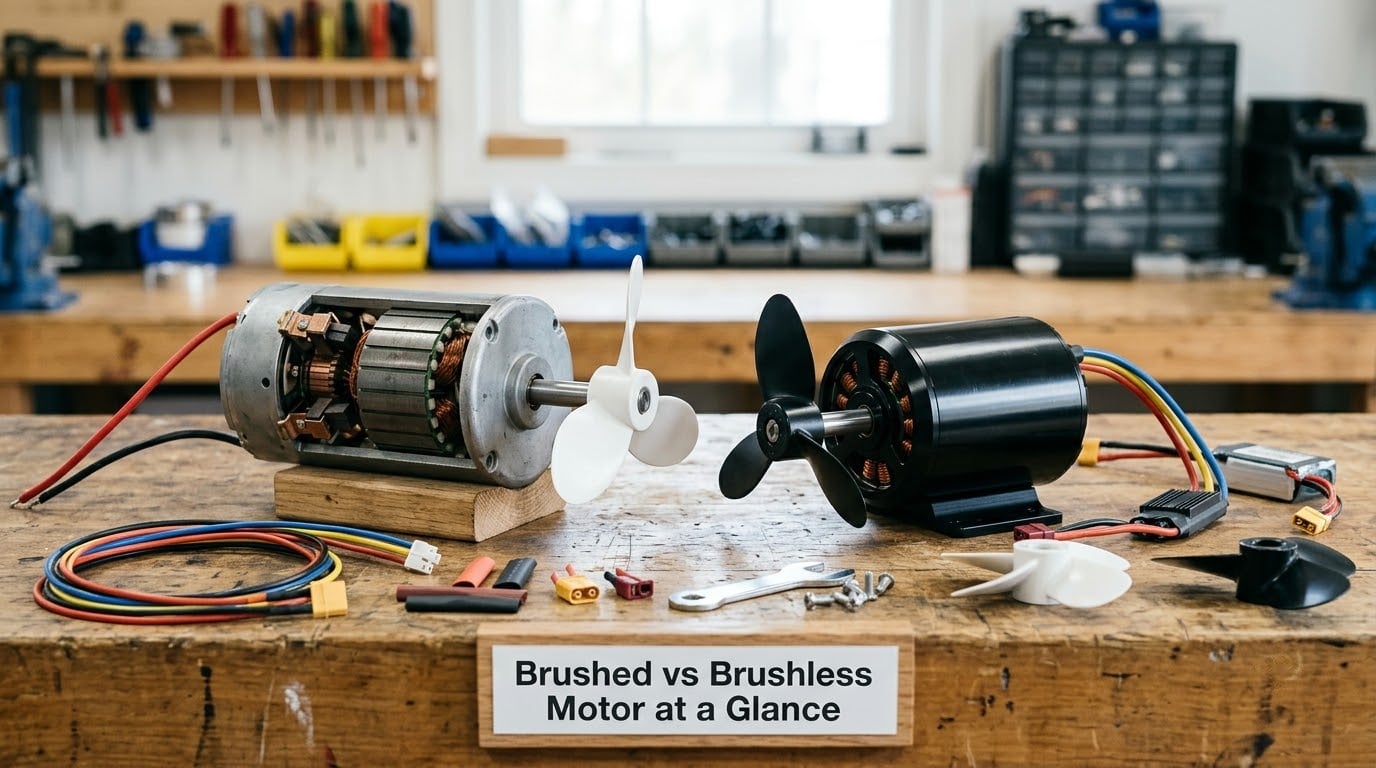
The table below is the fastest way to narrow the field. Every row is a criterion you will actually hit when a motor is bolted to a hull.
| Criterion | Brushed DC motor | Brushless (BLDC) motor |
|---|---|---|
| How current is switched | Carbon brushes against a mechanical commutator | Electronic speed controller switches three-phase current |
| Typical motor efficiency | About 75-80% | About 85-90% |
| Parts that wear | Brushes, commutator, bearings | Bearings only |
| Maintenance | Brush replacement and commutator checks | None beyond bearing and seal checks |
| Noise | Audible brush chatter and coil steps | Quiet; mostly propeller and water noise |
| Low-speed smoothness | Smoother, less torque ripple | Depends on sensored vs sensorless control |
| Control complexity | Two wires, simple PWM or a switch | Three phase wires plus a matched ESC |
| Upfront cost | Lower | Higher, once the controller is counted |
| Best marine use | Proof-of-concept hulls and short test runs | Long deployments, sailing robots, ASVs, thrusters |
If you read only one row, read the controller row. A brushed motor wires straight to a battery through a throttle. A brushless motor is really half a system, and you cannot judge it without the ESC that goes with it.
How Brushed and Brushless Motors Work
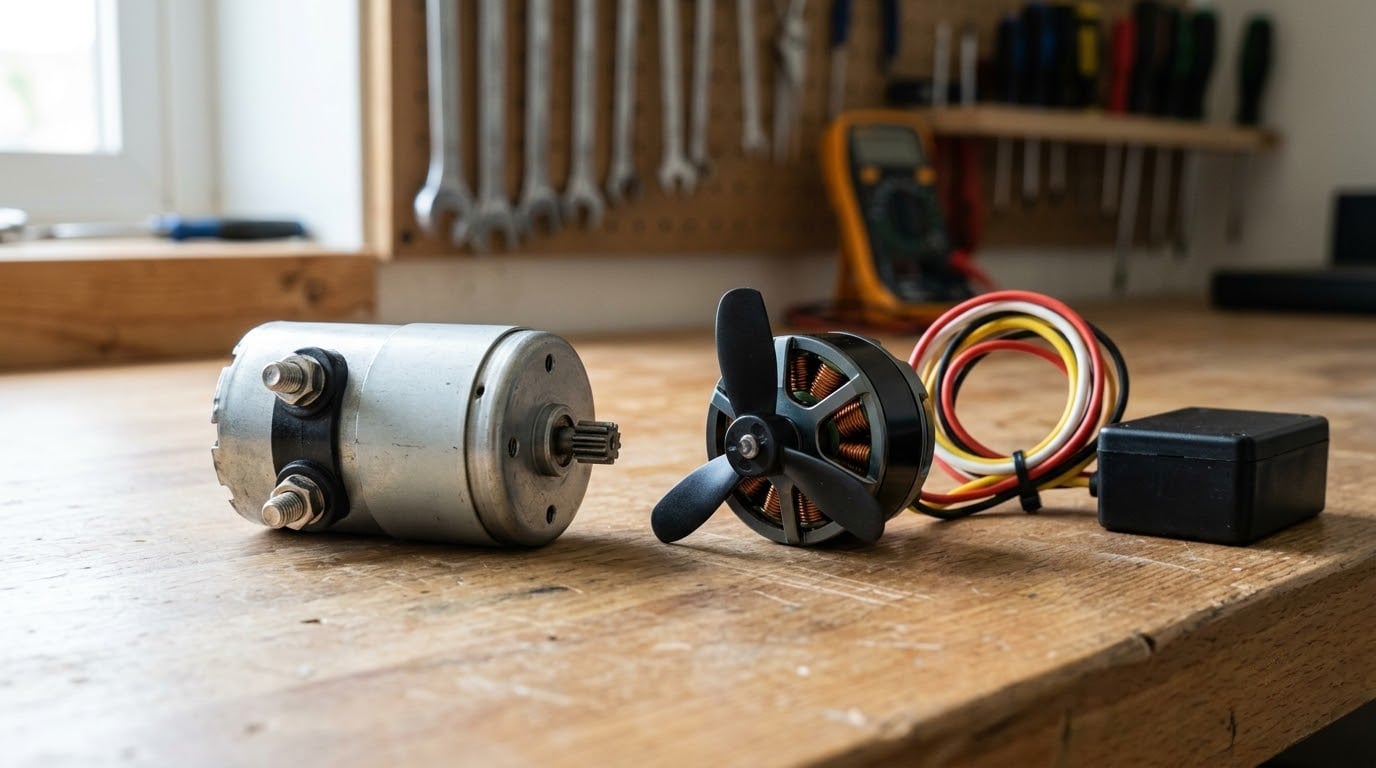
A brushed motor reverses the direction of current in its coils roughly every half revolution so the magnetic field keeps pushing the rotor forward. A split-ring commutator and a pair of carbon brushes do that switching by touching each other.
That mechanical switch is simple, which is why brushed motors have dominated small DC machines for over a century. The cost is friction, heat and a small spark at the brush contact, plus two wear surfaces that shorten the motor’s life.
A brushless motor moves the permanent magnets onto the rotor and puts the windings on the stator. The ESC then energises those coils in a timed sequence so the field rotates electronically, with no contact anywhere.
Kollmorgen describes the trade neatly: a brushless motor is simple mechanically and complex logically, while a brushed motor is the reverse. That is the honest summary of everything below.
In practice the sequence looks like this on a brushless motor:
- Hall sensors or back-EMF readings tell the ESC where the rotor sits.
- The ESC energises one coil pair to create a field a set angle ahead of the rotor.
- The rotor is pulled forward, generating back-EMF that confirms the new speed.
- The controller advances to the next coil pair and the cycle repeats thousands of times a second.
Efficiency and Battery Life
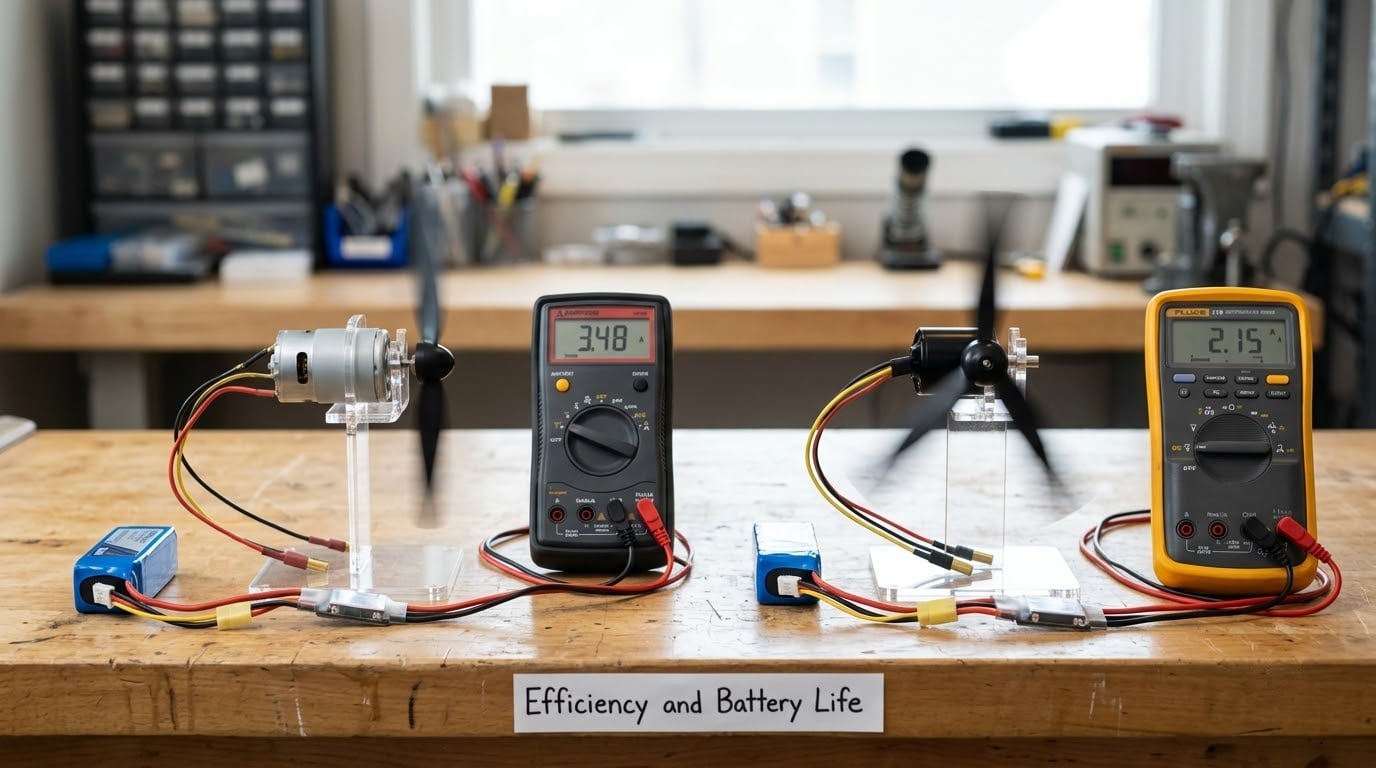
Brushless motors are typically quoted at 85-90% efficiency against 75-80% for brushed, so less of your battery ends up as heat in the motor housing. On a small unmanned boat that difference shows up as more minutes on station and a lighter battery for the same endurance.
Builders tend to argue about the real-world figure, and they have a fair point. On r/Tools, one commenter put it at 10-15% more efficient than a brushed motor of the same form factor, which translates into a marginal runtime gain rather than a transformation.
Both numbers can be true. The datasheet comparison is motor to motor at the same output; the 10-15% figure is what a fixed-size, fixed-voltage motor delivers in practice, where the ESC losses and any under-sizing of the controller eat into the advantage.
For a boat, the honest way to compare is current draw at the propeller for the same thrust. Measure it at the battery, since that is what determines mission time, and size the ESC so it is not the limiting factor.
Torque, Power, and Thrust
Neither motor type produces more thrust by itself. Thrust comes from propeller diameter, pitch, RPM and how much current the motor can actually push through the water.
Brushed vs brushless motor thrust: where the difference actually shows
For the same shaft output, a brushless motor usually spins faster at lower torque, which suits a smaller, faster propeller. A brushed motor at the same voltage tends to give more low-speed torque, which suits a larger, slower propeller that pushes harder on the water at low RPM.
That distinction decides hull design more than motor choice does. A displacement hull wants low-RPM pushing power, and a brushed motor can be a reasonable match. A planing or fast ASV wants sustained high RPM, where the brushless motor’s higher efficiency and power density pay off.
There is one place brushed motors genuinely win: torque ripple. Commutation steps create a small speed variation, and a brushed motor with many armature slots spreads that out more smoothly than a typical outrunner. For a sailboat autopilot or a camera gimbal, that smoothness can matter more than efficiency.
Speed Control and Electronics
A brushed motor takes two wires and a PWM signal. A brushless motor takes three phase wires and expects a controller that knows what it is driving. This is where most first builds go wrong, so it is worth being specific.
Sensorless vs sensored brushless motors
A sensorless ESC has no rotor position sensors. It infers rotor position from the back-EMF the spinning motor generates, which works well at speed and at low current. The catch is start-up: at a standstill there is no signal to read, so sensorless control needs an open-loop start sequence and can lose sync if the load changes suddenly.
A sensored motor carries hall effect sensors that report rotor position directly. Start-up is reliable, torque is better at low RPM, and recovery from a stall is quick. The tradeoff is three more wires, a sealed sensor harness, and more to keep dry on a boat.
On a small autonomous vessel, sensorless is usually fine if the propeller is always unloaded at start. If your hull starts its thruster against a wake, stopped line, or a fouled prop, pay for sensored.
Why a brushless motor cannot run straight off a battery
The motor has no internal switch, so power must reach the phases in the correct sequence, thousands of times per second. Connecting it directly to a battery does nothing useful, and on some controllers it does something harmful.
Match the ESC on four points: battery voltage range, continuous current, burst current, and motor KV. A controller that is under-rated on current will cook its own MOSFETs, and thermal problems get blamed on the motor when they are really in the controller.
For fail-safe behaviour on an unmanned boat, look for an ESC that drops throttle signal to stop rather than one that needs a valid signal to run. The failure mode differs between controllers, and it is worth confirming before the boat is in the water.
Maintenance, Wear, and Lifespan
The brushes are the wear item. They rub continuously, they shed carbon dust into the hull, and they shorten the life of both the motor and the bearings that run in carbon-loaded air. On a boat, that dust is also a corrosion risk.
Do brushless motors last longer than brushed motors?
Yes, in service life terms, because there is nothing to replace but bearings and seals. A brushless motor can outlast a brushed motor several times over, though the exact multiplier depends heavily on duty cycle, load and cooling rather than on the label alone.
Can a brushless motor burn out?
It can, but the failure mode is different. Electrical failures look like damaged windings, a failed hall sensor or a shorted phase. Mechanical failures look like a seized bearing or a bent shaft after a grounding.
Most destroyed brushless motors are not faulty at all. They were driven by an ESC that could not supply the current, ran with the wrong timing, or was fed current while stalled. A good motor with a mismatched controller still ends up as scrap metal.
Symptom to cause, from the failures builders report most often:
| Symptom | Likely cause | What to check |
|---|---|---|
| Stuttering or twitching on startup | Bad ESC-to-motor connection | Re-seat the phase wires and check the solder joints |
| Jerky run, loss of sync | Sensorless desync or wrong timing | Timing setting, or fit hall sensors |
| Motor too hot to touch | Under-rated ESC or oversized load | Continuous current rating and cooling airflow |
| Runs backwards unexpectedly | Phase order swapped | Swap any two of the three phase wires |
| No movement at all | Dead controller or open phase | Measure ESC output, then check continuity |
For a prototype hull you will pull apart regularly, brush replacement is a normal Saturday. For a sailing robot that deploys for weeks, the absence of wear parts is the whole argument.
Noise, Cooling, and Environmental Exposure
Brushed motors chatter. The brush contact produces a distinct buzz that rises and falls with load, and on a quiet water surface at dawn it carries a long way. Brushless motors remove that source, leaving mostly propeller cavitation and water noise over the hull, which for a listening-equipped vessel or an acoustic survey is often the deciding factor.
Heat works the other way round. A brushed motor dumps more of its input as heat into a housing that is already wet, so thermal management is a bigger problem on a boat than on a bench. Brushless motors run cooler and, with coils in the stator, can often be cooled through the housing or the shaft.
Environmental exposure matters more than the efficiency argument. Salt spray and humidity attack the commutator and brush leads first, because they are exposed and conductive dust sits nearby. A sealed brushless motor has no such path, though its shaft seal, connector and cable entries are now the weak points instead.
Sparking and hazardous-location considerations
Brushed motors spark at the brushes by design, which is why they are ruled out in some hazardous locations. A brushless motor is spark-free at the motor itself. That does not automatically make the installation safe; the ESC and its wiring have to be rated for the same space.
Cost and Total Ownership
Price comparisons usually look at the motor and stop there, which is misleading for boats. A brushed motor needs almost nothing around it. A brushless build adds an ESC, heavier gauge phase wiring, a larger fuse or breaker, and possibly a sealed connector set to keep the harness dry.
Against that, the brushed motor brings consumables and downtime: brushes, commutator dressing, hours in a workshop instead of on the water, and a hull that cannot stay deployed while you service it.
Add battery runtime to the calculation and the picture shifts again. If your vessel runs on a battery, more efficiency per watt translates directly into either longer endurance or a smaller battery for the same endurance.
The practical rule: compare the whole drive system over the life of the project, not the motor sticker price. For a single-season prototype, the brushed total usually wins. For anything that keeps running, brushless usually wins back the difference many times over.
Which Motor Is Better for Marine Robotics?
For a proof-of-concept hull that exists to answer one question and then get torn apart, a brushed motor is the sensible choice. Two wires, no controller tuning, and a failure you can diagnose with a meter.
For an autonomous surface vessel that has to complete missions unattended, a brushless motor is the better answer. It is quieter, cooler, more efficient, and it has no wear parts that decide when the boat comes home.
If you have not yet worked out the sizing, start with how to choose a motor for a small boat project. The thrust and current calculation comes before the motor category, not after it.
Sailing robots and ocean drones lean brushless for endurance reasons. Underwater thrusters usually demand brushless anyway, because sealed motors with no carbon dust inside are easier to design around.
There is a legitimate brushed case in boats: a heavy displacement hull running at low RPM, or a boat where maximum low-speed torque matters more than efficiency. Test the drive train before committing.
Choosing the Right Motor for a Small Boat Project
Work through these in order and the motor type usually decides itself.
- Calculate required thrust. Estimate from hull weight, displacement and speed rather than picking a motor first.
- Convert thrust to shaft power. Use propeller efficiency figures appropriate to your diameter and pitch.
- Choose the battery voltage. Higher voltage means lower current for the same power and lighter wiring.
- Size current, not just watts. Continuous and burst current both matter, and both go into the ESC choice.
- Match the propeller. A motor fighting a badly matched prop is the most common cause of overheating.
- Confirm controller compatibility. Voltage, current, KV and sensor type, plus the throttle signal your controller expects.
- Plan the sealing. Enclosure rating, connector type, cable glands and a strain relief loop that keeps water out of the hull.
- Decide the failure behaviour. Know what the drive does on signal loss, throttle failure and brownout before launch.
- Leave thermal margin. Continuous running temperature matters more than peak numbers on a data sheet.
If your vessel sits in saltwater between runs, add galvanic isolation and corrosion monitoring to that list. Motor selection is only part of the endurance plan.
Which Should You Choose?
Choose a brushed motor when the build is a prototype, the budget is tight, the wiring should stay simple, and the motor will be opened regularly anyway. It also makes sense when low-speed smoothness or high stall torque at low RPM matters more than efficiency.
Choose a brushless motor when the boat runs on battery, runs unattended, runs long, or runs quietly. That covers most autonomous surface vessels, sailing robots and ocean drones, plus any thruster that has to live inside a sealed housing.
There is a third answer for some builders: use both. A brushed motor for development runs and a brushless motor for the final deployment is a common and sensible path when the hull geometry changes between the two.
Frequently Asked Questions
Are brushless motors always more powerful than brushed motors?
No. Motor power depends on voltage, current, winding design, RPM, cooling, and propeller matching. A properly sized brushed motor can produce ample thrust for a small prototype, while a brushless motor that is undersized for the propeller will overheat just the same. Compare the two by measured current draw at the propeller for the same thrust, not by the label.
Can I connect a brushless motor directly to a battery?
Usually not. A brushless motor needs an electronic speed controller, or ESC, that switches power to the motor phases in the correct sequence. The ESC must also match the motor voltage, current rating, and KV. Connecting the motor straight to a battery will not spin it correctly and can damage the motor or the controller.
Which motor type is better for a small autonomous boat?
Brushless motors are generally better for long-running autonomous boats because they are quieter, more efficient, and have fewer mechanical wear parts. Brushed motors can work for an inexpensive proof of concept where the hull is rebuilt often. Choose sensored brushless control if the thruster has to start against a wake or a fouled propeller.
Do brushless motors need waterproofing?
Yes, any motor exposed to spray, rain, or temporary immersion needs an appropriately rated enclosure or sealing arrangement. Water resistance is not the same as waterproofing, and cable entries, connectors, and the shaft seal are usually the weak points rather than the motor body. Give the assembly a soak test before it goes in the water.
Conclusion
The brushed vs brushless motor decision is not really about the motor at all. It is about whether your boat is a prototype or a vessel you trust to come home on its own.
Start by calculating the thrust you need and the current that thrust demands, then select the motor and its controller as one matched system. Once those two numbers are on paper, the right motor type usually makes itself obvious.
Everything else in this guide follows from that one calculation, and it is the step most builds skip.