A sensor grant proposal is won by framing the work as a knowledge gap, not a product to be built. Pick one funder, read its aims, write two to four testable specific aims, specify detection limits, calibration and drift, prove feasibility with bench data, and justify every hardware line against an aim.
If you have never written one, that is the whole process in miniature. This guide walks through how to write a grant for a sensor project from the first solicitation search to the final portal submission, with the instrumentation detail that general grant advice leaves out.
Most first-time applicants lose time in the wrong place. They draft a beautiful narrative, then discover the program does not fund hardware builds, or they describe a sensor without stating its limit of detection, so a reviewer cannot tell whether it will work. Ten to twenty hours of preparation before a single paragraph gets written usually saves a rewrite.
One framing note up front, because it changes everything downstream. A proposal whose central object is the sensor artifact usually reads as an engineering development proposal, and many research programs will not fund it. If the goal is a better instrument, look at SBIR/STTR or technology-transfer programs. If the goal is learning something the instrument lets you see that nobody can see today, you have a research proposal. Marine sensing is a good example: a cheaper temperature logger is development, but a distributed thermistor chain that reveals how a fjord’s thermal layer overturns through winter is research.
Table of Contents
- What You Need
- Step-by-Step: How to Write a Grant for a Sensor Project
- 1. Identify the funding opportunity
- 2. Define the problem and the project objective
- 3. Explain the proposed sensor project and approach
- 4. Set measurable outcomes and deliverables
- 5. Build the evidence and need case
- 6. Create a realistic budget and work plan
- 7. Write the narrative and assemble supporting evidence
- 8. Review, revise, and submit
- Common Mistakes
- Frequently Asked Questions
- Conclusion
What You Need
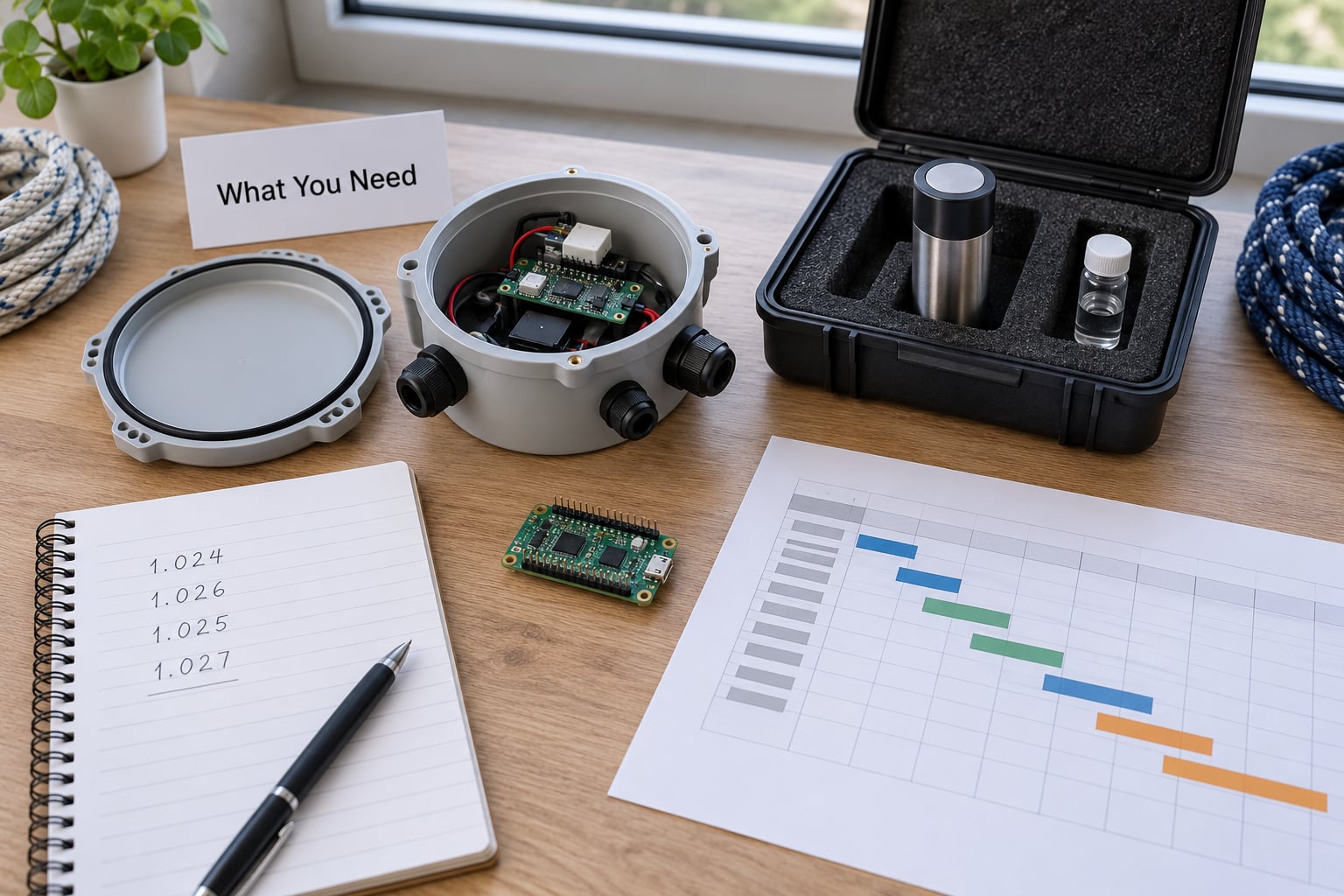
Most of the writing is downstream of decisions you should make first. Gather these six things before drafting, and the writing becomes assembly rather than invention.
- One project definition, one page. The problem, the sensing approach, and the question you will answer. If this page cannot be written, the proposal is not ready.
- The solicitation text. Not a summary from a colleague, not the program page you skimmed last year. Read the aims of the opportunity, the eligibility rules, the page limits, and the required sections.
- Your evidence folder. Bench logs, calibration curves, drift plots, failure notes, deployment photos, advisor feedback. Raw files, not just the figure you made for it.
- A list of previously funded projects under the same call. Award abstracts are usually public. Two or three of them tell you more about what the panel rewards than the guidance document does.
- Roles and effort, in person-months. Who does what, and roughly how much of their time. Vague allocations are the fastest way to lose credibility with a review panel.
- A real budget. Component costs, test equipment access, calibration hardware, deployment travel, data storage, and personnel. Assumptions stated, arithmetic that adds up.
Add one more item that costs nothing and gets skipped: the deadline arithmetic. Portal submission for federal systems often closes before the funder’s own deadline, and internal university review sits in front of that. Work backwards from the portal time, not the announcement date.
Step-by-Step: How to Write a Grant for a Sensor Project
1. Identify the funding opportunity
Read the solicitation for its aims, not its title. Program titles promise broad territory; the aims section defines what a panel will actually fund, and applications outside those aims are desk-rejected before anyone reads page one.
For federal science work, start at grants.gov and filter by topic, then check the awarding program directly. Sensor projects commonly sit under electrical and computer engineering clusters, health-related instrumentation, environmental monitoring solicitations, and the small-business innovation programs. Foundations and nonprofits run their own calendars, and many only fund work with a stated community or conservation benefit.
Build a one-page requirements checklist before writing anything: eligibility of the applicant, whether hardware build costs are allowable, page limits, required formats, required sections, submission route, and deadline including any internal review. The checklist is short, and it becomes your compliance pass in step 8. It also protects you from spending a weekend on a proposal that was never eligible.
2. Define the problem and the project objective
Turn the broad sensing idea into a specific, testable problem statement with one primary objective and clearly bounded deliverables. A panel should be able to tell, in one sentence, what will be different at the end of the project.
Work through the chain: what is measured today, what the current method cannot do, and what new knowledge becomes available if your instrument works. “Improve low-cost dissolved oxygen measurement” is not a problem statement. “Existing optodes drift by more than the seasonal oxygen swing we are trying to detect, so we cannot resolve hypoxia onset in a shallow bay” is one.
Then write the objective as a claim that could be wrong. If it cannot fail, it is a deliverable, not an objective, and reviewers will treat it as such. Note that grant consultants working with sensor developers flag the artifact-versus-question confusion constantly: a proposal built around the device rather than the unknown gets read as a development task.
3. Explain the proposed sensor project and approach
Describe the sensing method, the hardware, the deployment setting, and the workflow, in enough detail that a reviewer outside your subfield can picture the system running. This is the section where instrumentation specificity pays off, because a panel is judging feasibility without being able to build your instrument.
Cover the sensing principle, what makes it different from existing instruments, the signal path from the transducer to the stored value, and the physical platform: mooring, glider, buoy, shore station, or bench. Then give the engineering constraints that come with deployment, such as available power, pressure at depth, fouling and biofouling, temperature extremes, and the servicing interval.
The research strategy should follow from the method rather than sit beside it. State your hypotheses, the variables you control, the sampling design, the sample sizes and how you chose them, and the analysis you will run. A panel that cannot connect aim to hypothesis to method sees a device proposal, not a research program.
4. Set measurable outcomes and deliverables
Write a results framework that covers technical outputs, data products, performance in the field, value to users, and what will be shared openly. Each aim needs a success condition a reviewer could audit, not a description of activity.
Useful framings for sensor work are performance thresholds and data deliverables. Instead of “improve the sensor,” write “hold calibrated accuracy within a stated tolerance across the operating range after a stated deployment duration.” Instead of “collect data,” write “produce a quality-controlled time series from N sites for a stated period, released under an open license with a documented QA procedure.”
Deliverables can be physical, documentary, or data products: a built and tested instrument, a validated calibration procedure, a dataset, a methods paper, a workshop, or published hardware designs. Sequence them across the project period so that something meaningful exists by the halfway mark, in case the project runs short. Reviewers reward a plan that produces knowledge even when the hardware disappoints.
5. Build the evidence and need case
Show why the work is necessary using prior deployments, field observations, stakeholder need, and a clearly stated gap. The gap statement is the hinge of the whole proposal: everything else exists to close it.
Evidence comes in several layers. Published work establishes that the gap is real and studied. Your own observations from prior deployments establish that you have been there and know the conditions. A short account of what a stakeholder group currently cannot do, from a fisheries manager, a water utility, or a shipping operator, establishes that someone needs it.
Then state the gap in one sentence, in the present tense, with no hedging: nobody has yet been able to measure X under Y conditions with sufficient accuracy and at a cost that makes continuous deployment practical. Everything after that sentence is your argument that your approach can do it.
6. Create a realistic budget and work plan
Connect every cost to a project activity. When a panel reads line items, it is really asking whether the request matches the science, so a hardware budget reads as part of the methods section.
For instrumentation, the categories that draw scrutiny are unit cost times build quantity, calibration and reference standards, test equipment, facility access versus equipment purchase, deployment travel and shipping, data storage, and consumables. Justify unit cost against sourcing and quantity against deployment design, not against wishful thinking. Building four units when the design calls for two and a spare is a line item reviewers notice.
Choose test equipment access over purchase when a shared facility or instrument already exists, and say so. If you are buying a calibration source, explain why the lab standard is insufficient and what accuracy you need. If deployment travel is a large share of the request, justify it against the deployment schedule in the work plan.
Pair the budget with a phased schedule: tasks on one axis, months on the other, and an owner column. Milestones should be checkable, such as “bench calibration complete to stated tolerance,” not calendar events. Every milestone attaches to an aim, and each aim has at least one milestone.
Because the schedule carries a stated risk, add mitigation. The strongest section in most instrumentation proposals is the alternative plan: what you do if the new transducer shows drift faster than projected, if the deployment window closes, or if a component is unavailable. Name the failure, the trigger, the fallback, and the cost effect. A plan that only works if everything goes right reads as confidence rather than realism.
7. Write the narrative and assemble supporting evidence
Draft concise sections that connect problem, approach, impact, team capability, and budget, then attach the diagrams, letters, and technical documents the solicitation requests. Write each section to do one job.
Significance argues the gap is important and unresolved. Innovation argues what is new and why the field needs it now. Approach describes the science and the engineering together. Preliminary data proves you can do part of it. Broader impacts covers who benefits and how that reaches beyond your paper. Facility and management documents describe the environment your team works in.
Assemble supporting material early, because missing attachments are a common reason administrative review bounces a proposal. Check current requirements for anything generative-AI tooling touches. Several agencies now ask proposers to disclose AI-generated content in narrative sections, and the disclosure expectation has changed over the last few years, so read the program policy page rather than relying on memory.
For anything the program allows as a supplement, use it for the material that breaks the main narrative flow: the full bill of materials, calibration derivation, wiring detail, extended data schema, and the raw bench log behind your key figure.
8. Review, revise, and submit
Run a compliance pass, a technical pass, and a reviewer simulation, in that order, then submit through the correct portal before the internal deadline. Panels read hundreds of proposals, and most rejections are about clarity rather than science.
The compliance pass is mechanical: eligibility, page and character limits, required sections, margins and font, references, human subjects or animal approvals where relevant, budget totals, and every attachment named in the instructions. Do this first, because a formatting violation can end the review before content is considered.
The technical pass is about internal consistency. Numbers quoted in the aims must match the aims section, the work plan, and the budget. Milestone dates must fall inside the project period. Effort totals must match the personnel section. A mismatch in any of these is the kind of thing a careful reviewer notices and does not forgive.
The reviewer simulation is the single most useful habit practitioners report. Trade the draft with someone in a different subfield and ask them to restate the question, the method, and why it matters. If they cannot, or if they restate it differently from your intention, the draft is not finished. Check reproducibility the same way: could a competent lab repeat the build and the calibration from what you wrote? If your design depends on a part only one person knows how to source, that is a gap to close before submission.
Common Mistakes
Sensor and instrumentation proposals fail in predictable ways, and most of them are fixable in an afternoon of revision. These are the errors that show up repeatedly in review feedback, plus the fix for each.
- Leading with the device instead of the gap. Fix: move the artifact to the methods. State the unknown in the first paragraph of significance.
- Specifications a reviewer cannot check. Unverifiable performance numbers invite doubt. Fix: give the method used to obtain the figure, the calibration reference, and the test conditions.
- No preliminary data. For hardware work this is close to fatal, because feasibility cannot be assumed. Fix: report bench tests, prototype runs, or a documented failure with what you learned.
- An artifact with no research question attached. Fix: state what the instrument makes knowable that is currently unknown, and what result would change your understanding.
- Budget lines with no project connection. A request that does not map to an aim reads as padding. Fix: map each line to an activity or an aim, and cut the ones that map to nothing.
- Single-point-of-failure on a custom component. Fix: name the risk, describe the alternative, and state the cost and schedule effect of switching.
- Passive-voice work plans. Reviewers read passive phrasing in the work plan as unassigned responsibility. Fix: name the owner and the deliverable for every task.
- Impact claims sized to the wrong funder. Bold projections for a conservative program, and vague ones for an aggressive one, both fail. Fix: match the ambition to the call, and anchor numbers in technoeconomic or field data.
- Jargon without explanation. Fix: expand any term on first use and keep a short glossary, since panels span subfields.
- Ignoring administrative deadlines. Fix: work backwards from the portal close, with internal review inserted ahead of it.
One more failure mode sits outside the proposal: not calibrating against prior awards. Before you finalize, read three funded abstracts from the same program. You will usually find that the funded projects are narrower than yours in ambition and more specific in evidence, which is a useful correction to make while revision is still cheap.
Frequently Asked Questions
What are the 5 R’s of grant writing?
The five R’s are a memory device for the core components of a competitive proposal: Research question, Rationale for why it matters, Research plan or approach, Resources (people, equipment, facilities, budget), and Results with a clear evaluation plan. Some versions use Rigor and Relevance instead. The list is useful because panels score roughly along these lines, so each R maps to a section a reviewer can check.
What are the four types of grants?
Grants are commonly grouped into four types. Discretionary grants are competitions where you apply against published aims, run by agencies such as NSF or NOAA. Institutional and foundation grants come from a university, nonprofit, or private foundation with its own priorities and deadlines. Formula or block grants go to institutions rather than individuals. Cooperative agreements fund work shared across organizations, often with cost sharing. Sensor projects usually start with discretionary calls.
Can an LLC get grant money?
Yes, depending on the program. Federal SBIR and STTR programs are designed for small businesses, including LLCs that meet ownership and size requirements, with separate research and small-business requirements. Most traditional research grants go to universities, nonprofits, and their principal investigators rather than to for-profit entities. Some states and foundations fund for-profit environmental or applied work. Verify the eligibility clause in the specific solicitation before drafting.
What are common reasons NSF proposals get rejected?
The recurring reasons are a weak or absent knowledge gap, insufficient preliminary data, methods that cannot answer the aims, an unrealistic timeline or budget, and broader impacts that do not reach beyond the project itself. For instrumentation work, unverifiable sensor specifications and single-point-of-failure designs are frequent additions. Reviews are also scored for intellectual merit and broader impacts, so a strong idea with an unaddressed impact section still loses.
What is the success rate of NSF funding proposals?
NSF has historically reported overall success rates in the low-to-mid twenties, meaning roughly one proposal in four or five is funded. Rates vary considerably by program, year, and career stage, and individual divisions publish their own numbers. Treat any published figure as a general expectation rather than a forecast. For a first submission, the practical lever is fit with the program’s aims, since mismatched proposals are declined before merit review.
How do you justify equipment and build costs for a sensor project?
Tie every line to an activity or an aim, and give the reviewer the arithmetic. State unit cost and why, quantity and why that quantity, calibration standards and what accuracy they buy, and facility access versus purchase. Large deployment travel shares should track the deployment schedule in your work plan. Expect scrutiny on whether the build count matches the design, including spares, and on consumables for maintenance cycles.
Conclusion
Start with one funder, not a list. Read its aims, build the requirements checklist, and draft four things in this order: the problem and the knowledge gap, the specific aims, the measurable outcomes, and the budget with every hardware line tied to an aim. Everything else, including the innovation case, the broader impacts statement, and the supplements, gets stronger once those four hold together.
When the first draft is done, hand it to a colleague in another subfield and ask them to explain it back to you. Whatever they cannot restate is what a panel will not score.