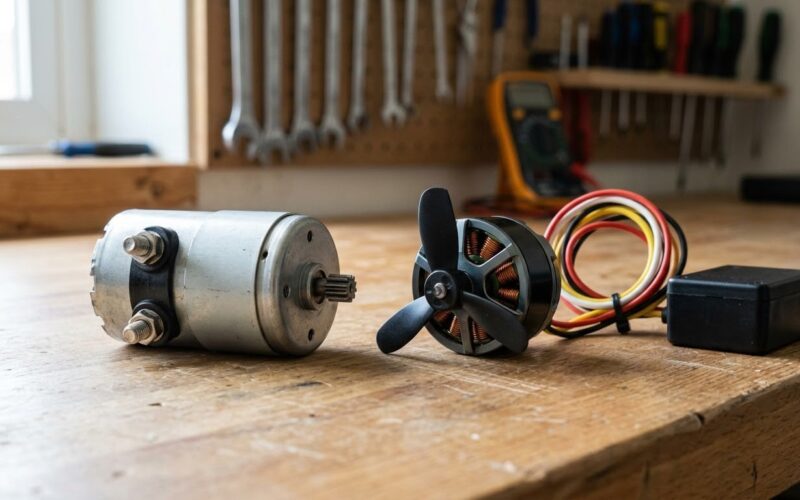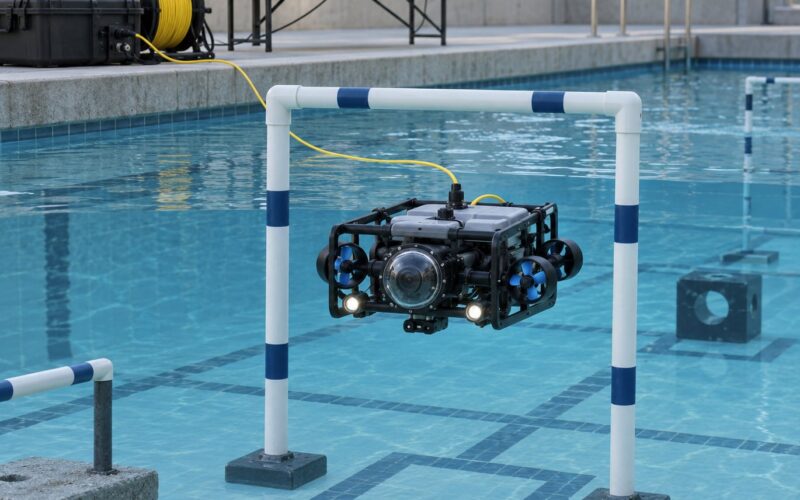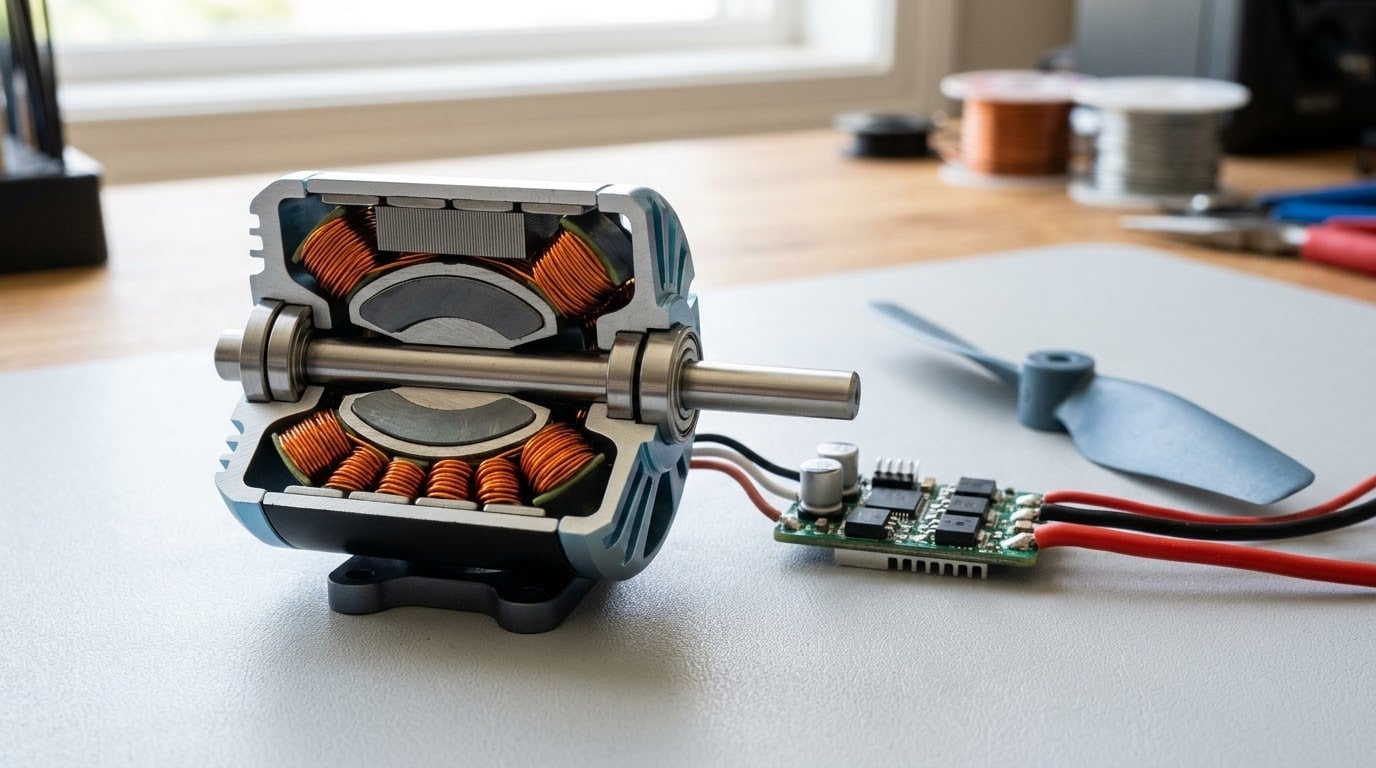
A brushless motor works by switching current through stationary coils in a controlled sequence, which creates a rotating magnetic field that pulls a permanent-magnet rotor around. An electronic speed controller does that switching thousands of times a second, so the mechanical brushes and commutator found in an older DC motor are simply gone. On a sailing robot or an ocean drone, that combination of low maintenance, precise speed control and compact packaging is why brushless motors show up everywhere from thrusters to winches.
The rest of this guide walks through the parts, the switching sequence, the differences from a brushed motor, and what changes when the motor lives in salt water. The systems around the motor matter just as much, so our guide to how IMU sensors work in marine robotics is worth a look before you start laying out a hull.
Table of Contents
- How a Brushless Motor Works
- What Are the Main Parts of a Brushless Motor?
- What Is Electronic Commutation?
- How Does a Brushless Motor Differ from a Brushed Motor?
- Why Are Brushless Motors Useful on Boats and Ocean Drones?
- How Does a Brushless Motor Control Speed and Torque?
- What Are the Common Types of Brushless Motors?
- What Problems Can a Brushless Motor Have?
- Frequently Asked Questions
- Can a brushless motor run without a controller?
- How do I use a brushless motor for the first time?
- Are brushless motors quieter than brushed motors?
- What is the working principle of a BLDC motor?
- What is the difference between an inrunner and an outrunner BLDC motor?
- What are the downsides of a brushless motor?
- Conclusion
How a Brushless Motor Works
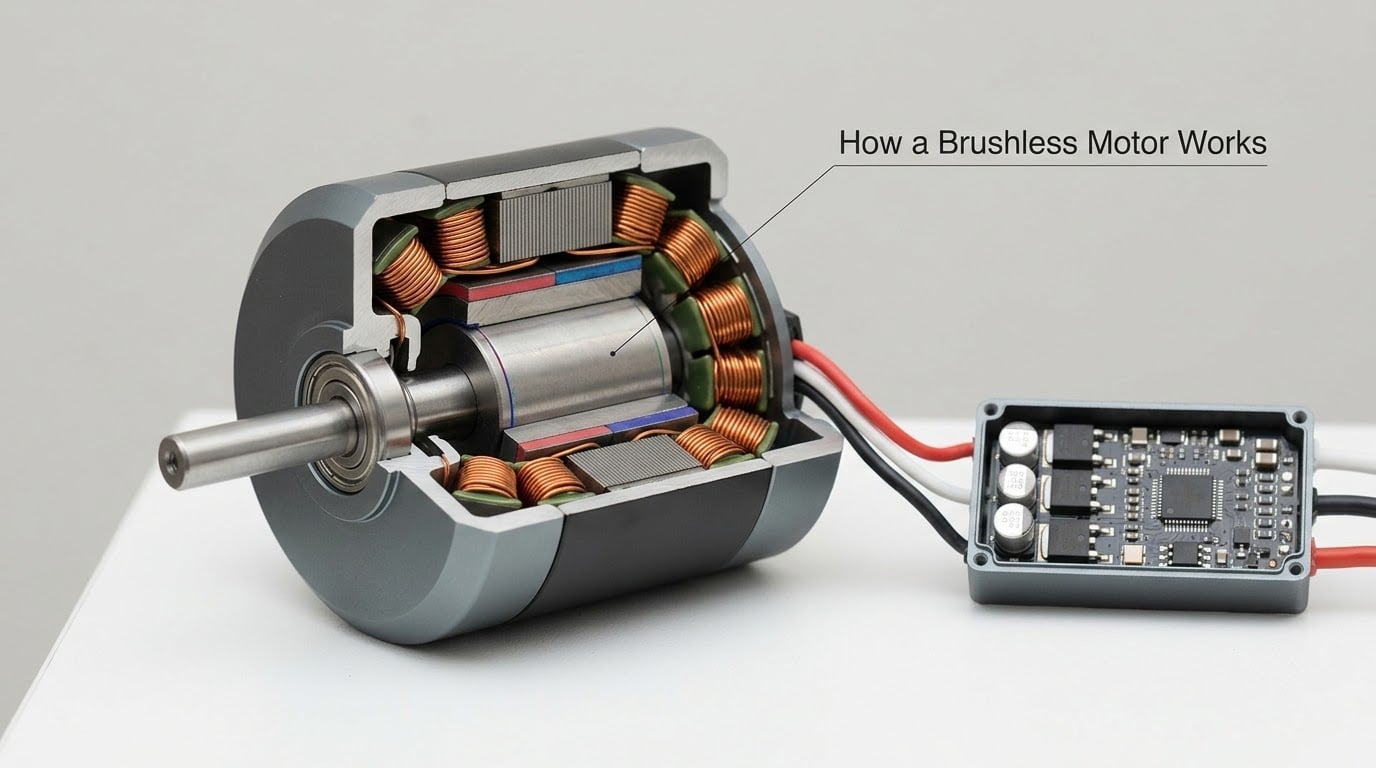
The short version: current in a coil makes that coil a temporary magnet, and moving the magnetic field around the rotor pulls the rotor around with it. In a brushed motor, a physical switch inside the motor flips the polarity of the coil at exactly the right moment. In a brushless motor, a controller outside the motor does the same job with transistors and timing signals.
That external switching is called electronic commutation, and it is the whole trick. Most small brushless motors are three-phase, meaning three sets of windings sit around the stator. The controller energizes one phase, then another, then the third, six times per electrical revolution. Each switch re-points the magnetic field, the rotor magnet follows, and the shaft turns.
Because nothing physically rubs against the rotor, there is no brush wear and no dust. The friction that limits a brushed motor’s speed and life largely disappears, which is why brushless motors reach higher rpm and run for far more hours.
What Are the Main Parts of a Brushless Motor?
Eight parts matter when you are sizing or replacing one. Here they are in plain language.
Rotor
The rotor is the part that spins. It carries permanent magnets arranged around a shaft, usually in a ring of two poles, four poles, or eight poles depending on the design. More poles let the controller switch more often per revolution, which suits high speed and low torque. Fewer poles suit low speed and high torque.
Stator
The stator is the stationary shell around the rotor. It holds the copper windings and the iron laminations that guide the magnetic flux. Stator slots are angled rather than straight, and that skew reduces noise, cogging and torque ripple.
Shaft and bearings
The shaft carries torque out to the propeller, winch drum or actuator arm. Bearings support both the shaft and the housing. In a wet environment, the bearing is usually the first part to complain, because salt water gets past the seals and starts working at the grease.
Hall effect sensors
Three small sensors sit in the stator and report the rotor’s magnetic position to the controller. They do not measure speed; they report where the rotor is right now so the controller knows which phase to energize next.
Electronic speed controller
The controller is the brain and the power stage combined. Six transistors, arranged as three half H-bridges, do the switching. The controller decides how wide the pulses are, how much current to allow, and when to change phase based on the sensor feedback.
If you want a wider look at how these pieces feed into a build, our guide on choosing a motor for a small boat project covers sizing after you have settled on the motor type.
What Is Electronic Commutation?
Commutation is the act of keeping the rotor’s magnetic field aligned with the stator’s field. Without it, the rotor would simply lock in place and get hot. The sequence in a sensored brushless motor runs like this.
How the switching sequence works
- The controller reads the three Hall sensors and works out the rotor’s electrical position.
- It energizes one phase to create a magnetic field roughly ahead of the rotor magnets.
- The pull from that field spins the rotor forward slightly.
- At the next position interval, the controller turns that phase off and energizes the next one in sequence.
- Torque keeps pulling because the field is always slightly ahead of the rotor.
- Repeat at a rate set by the pulse-width modulation signal and the actual load.
The field is deliberately positioned ahead of the rotor rather than directly at it. That offset is what produces continuous torque instead of a motor that twitches back and forth in place.
Where the position comes from
Two feedback methods cover almost every marine and robotics build you will meet.
| Method | How position is found | Strong at | Watch out for |
|---|---|---|---|
| Sensored (Hall) | Three Hall sensors report the rotor sector directly | Starting from rest, low speed, holding a position | Sensor wiring and calibration; Hall parts are not cheap to replace |
| Sensorless (back EMF) | The controller infers position from the voltage the spinning magnets induce in an unpowered phase | Higher speeds, simple installations, lower cost | Weak signal near zero speed, so start-up is unreliable and low-speed noise shows up |
That last row matters more on a boat than it does on a bench. A thruster that has to push at a standstill needs position data at zero rpm, which means a sensored motor or a good open-source controller that can estimate position well.
Six-step, sinusoidal and field-oriented control
Six-step commutation is the simple version described above: full current to one phase, then the next. Sinusoidal commutation varies the current smoothly so the field behaves more like a continuously rotating wave. Field oriented control, usually shortened to FOC, goes further and commands current along a chosen axis to hold an exact torque, which gives the smoothest feel and the quietest running. FOC is widely praised for smoothness but it is genuinely harder to set up, which is why most hobby ESCs still use six-step.
How Does a Brushless Motor Differ from a Brushed Motor?
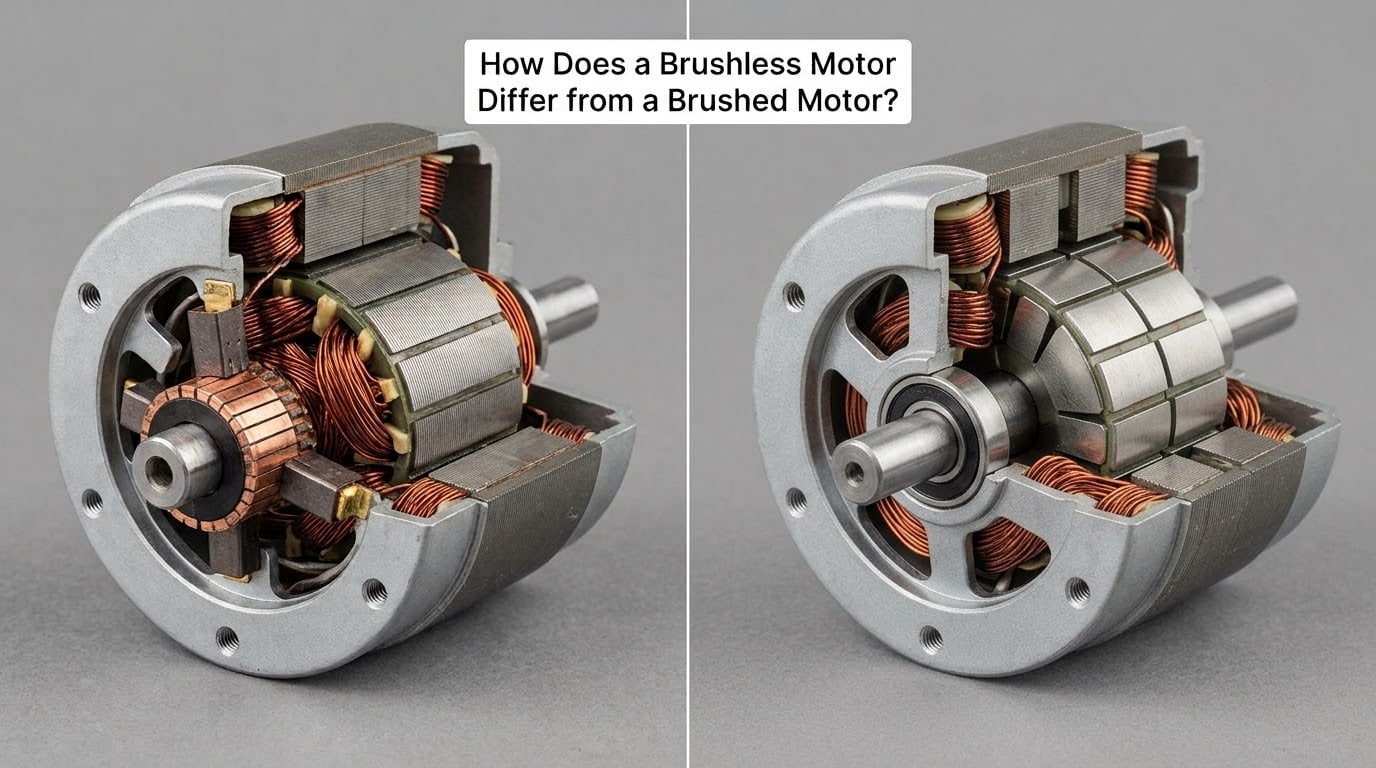
The headline difference is where the switching happens. A brushed motor switches with two carbon blocks rubbing against a copper segmented ring; a brushless motor switches with transistors on a controller. Everything else follows from that.
| Factor | Brushed DC motor | Brushless motor |
|---|---|---|
| Commutation | Mechanical, via brushes and commutator | Electronic, via the controller |
| Typical efficiency | Often around 60 to 75 percent | Often around 85 to 90 percent |
| Wear parts | Two brushes, commutator, bearings | Bearings only |
| Top speed | Limited by brush and commutator heating | Limited mainly by bearing and windage |
| Heat management | Heat concentrated at the brushes and in the armature | Heat in the windings, often held by the outer housing |
| Noise | Mechanical brush noise plus electrical hum | Quieter, though PWM can still produce coil vibration |
| Control | Speed roughly follows supply voltage | Needs an ESC for commutation, and PWM for speed |
| Servicing | Brushes can be changed in the field | Usually replaced as a unit |
| Cost at low power | Simple and inexpensive | Motor plus controller together cost more |
One clarification worth keeping: no brushes does not mean no electronics. A brushless motor cannot spin sensibly straight off a battery. The controller is not an optional accessory, it is part of the motor’s working principle, and buyers regularly underestimate the cost of the whole chain including controller and battery.
Why Are Brushless Motors Useful on Boats and Ocean Drones?
The operating principle maps neatly onto marine work. No brush wear means a motor that can sit idle for weeks between deployments without attention. Speed is commandable rather than implied, so a controller can hold a steady position, run a slow survey speed, or push hard when the current picks up. And the whole assembly fits into a hull where space is measured in millimetres.
That makes them useful for the propeller and thruster on a small surface vessel, for winches that raise an instrument package, and for the small actuators that trim a rudder or move a sensor. Our piece on how servo rudders work on autonomous boats covers the steering side in more detail.
The trade-offs are environmental rather than mechanical. Salt water is conductive and corrosive, so every cable gland, connector and shaft seal matters more than it would in a dry enclosure. Vibration from waves and from the propeller works at solder joints and sensor mounts, which is why strain relief is not a nicety on a small boat. Propeller cavitation adds a noise and vibration source of its own, and a cavitating propeller will quietly shake a frame apart. Thermal margin matters too: sealed housings cannot dump heat into moving air, so a motor that looks adequate on the bench can overheat in a sealed nacelle on a hot day.
Field experience backs this up. Builders on hobby forums consistently report that outrunners are noisier than inrunners because the windings can buzz under PWM, and that they prefer inrunners for boats because the outer can stays put and only the shaft spins. Electric propulsion owners also tend to compare noise against a four-stroke outboard rather than against another electric motor, and that is a high bar.
How Does a Brushless Motor Control Speed and Torque?
The controller sets speed with pulse-width modulation. It switches the phases on and off rapidly and varies the proportion of time each cycle is energized. A narrow pulse means low average current and low speed; a wide pulse means more current and more speed. The switch frequency is usually tens of kilohertz, high enough that it sits above audible range.
Speed and torque are separate things. A motor turns fast when there is little load holding it back, and pushes hard when there is a lot of load and the current is high. Torque follows current, roughly in proportion, because torque is the product of the current in the windings and the strength of the magnetic field.
This is why the same motor behaves so differently between an unloaded propeller and a loaded one. The load sets the operating point, and the controller only sets how much current is allowed to reach that point. Give the motor more load than it can deliver and it stops turning while continuing to draw heavy current, which heats the windings fast. That stall condition, not overspeed, is what destroys most marine brushless motors.
Two ratings help here. The KV figure describes how many rpm the motor produces per volt of applied supply, so a 3300 KV motor turning a one-turn equivalent load is a high-speed motor and a low-torque one at the same amperage. The controller’s current limit sets how much load the motor is allowed to meet before it starts to sag. Right-sizing the controller to the motor matters as much as right-sizing the propeller.
What Are the Common Types of Brushless Motors?
Two axes describe almost every motor you will meet: where the magnets sit, and how the controller knows the rotor position.
Inrunner versus outrunner
| Factor | Inrunner | Outrunner |
|---|---|---|
| Magnets | On the inside of the rotating can | On the outside of a rotating bell |
| Heat dissipation | Poorer, stator sits inside | Better, outer bell sheds heat |
| High-speed torque | Weaker | Stronger |
| Noise | Quieter, the housing is still | Louder, coils can buzz |
| Marine fit | Commonly preferred for boats and thrusters | More common in air vehicles |
| Mounting | Housing bolts to the structure | Stator bolts to the structure |
Sensored and sensorless motors
A sensored motor ships with Hall sensors wired out to a 5 to 6 pin connector, so it starts reliably and holds low speed. A sensorless motor has a smaller cable bundle because the controller works it out from back EMF, which suits larger, faster machines where a clean sensor signal is easier to get.
Gimbal-style motors
These are low-pole, low-speed motors built to hold a camera steady. Their low inertia and tight position control make them useful for pointing a sensor pod, though their torque limits suit small payloads rather than propulsion.
What Problems Can a Brushless Motor Have?
Most faults trace back to one of four places: the motor mechanically, the windings, the wiring, or the controller. Working through them in that order saves a lot of guessing.
What fails, and how to spot it
- Overheating. A motor that is hot to the touch after a short run is being asked for more current than it can deliver. Check that the propeller matches the motor and that the controller’s current limit is not set well above what the windings are rated for.
- Wiring errors. Swapped phase wires or a poor connector produce a motor that jerks, spins backwards or refuses to start. Sensored motors also need correct Hall phase order, which is why calibration sometimes fails and the controller offers a handful of combinations to try.
- Bearing damage. A dry or pitted bearing shows up as grinding, a hot housing that stays hot even with the motor off, or a wobble in the shaft. On a boat this usually means water got past the seal.
- Moisture intrusion. Salt water creeping into the windings or the sensor pocket causes erratic behaviour that comes and goes with humidity. Corrosion on the connector pins is a strong clue.
- Demagnetization. Heat above the magnet’s rating, or long periods near stall, can weaken the magnets. The motor still runs, just with less torque than it should, which is an annoying failure to diagnose.
- Vibration. A failing propeller, a loose mount or unbalanced rotating parts can shake a frame apart far faster than the motor itself wears.
- Controller failure. A dead controller looks a lot like a dead motor if you test it only with a supply. Checking for the low-level signal the controller gives at startup separates the two quickly.
Start with the simplest test every time: spin the shaft by hand. It should feel smooth with no gritty or scraping noise. That one check rules out the mechanical half of the problem before you open a single connector.
Frequently Asked Questions
Can a brushless motor run without a controller?
No. A brushless motor needs an electronic speed controller, because the controller performs commutation, the switching that keeps the stator field aligned with the rotor. Without it the motor either sits still and heats up or twitches in place. The controller also regulates speed by varying how much current reaches the windings.
How do I use a brushless motor for the first time?
Start by matching the motor’s voltage rating to your supply, then wire the three phases and any sensor wires to the controller before plugging in the battery. Many controllers refuse to arm until you run a throttle calibration so they learn the neutral and maximum positions. Test the motor on the bench with the propeller removed first, then fit the propeller and set the current limit before running it in the water.
Are brushless motors quieter than brushed motors?
They are usually quieter, mostly because there is no mechanical brush noise. But quiet is not silent. Outrunners in particular can buzz when the windings vibrate under pulse-width modulation, and a badly matched propeller or a cavitating propeller can be louder than anything the motor does. Quiet also falls apart at very low speed on sensorless setups, where the controller keeps guessing at rotor position.
What is the working principle of a BLDC motor?
The principle is that current flowing through a coil makes it act as a magnet, and a field that moves around a rotor pulls the rotor around. In a BLDC motor the coils stay still in the stator while permanent magnets spin on the rotor. The controller energizes the phases in sequence so the magnetic field travels ahead of the rotor and produces continuous torque.
What is the difference between an inrunner and an outrunner BLDC motor?
In an inrunner the magnets are on the inside of a rotating can, leaving the windings at the centre and the housing still. In an outrunner the magnets are on the outside of a rotating bell, so the outer shell sheds heat well. Inrunners tend to be quieter and suit boats; outrunners handle higher speed and give better cooling, which is why they dominate aircraft.
What are the downsides of a brushless motor?
The costs are electronics and serviceability. A brushless motor needs a controller, and the whole chain of motor, controller, battery and wiring is more expensive than a small brushed setup. It cannot be repaired in the field the way brushes can, Hall sensors are expensive to replace, and failure modes like overheating or demagnetization need more care than a brush change. If the controller is mismatched, the motor can be damaged too.
Conclusion
How does a brushless motor work, in one line: the controller switches current through the stator windings in sequence so a rotating magnetic field drags the permanent-magnet rotor around, and that switching replaces the brushes a DC motor would need.
Before you commit to a motor for a marine robotics project, check five things in order: the load it has to move, whether the controller suits that motor and the feedback method you need, how position is detected at low speed, how the motor is sealed against salt water, and how much thermal margin the sealed housing leaves you. Get those right and the rest of the design gets much easier.