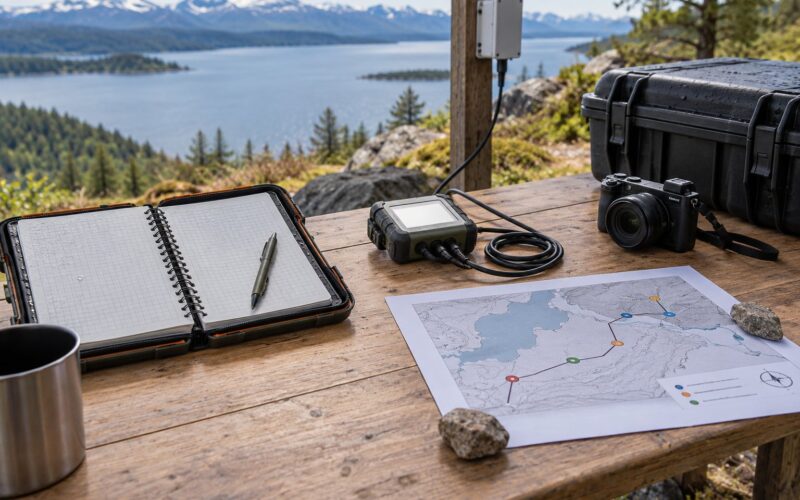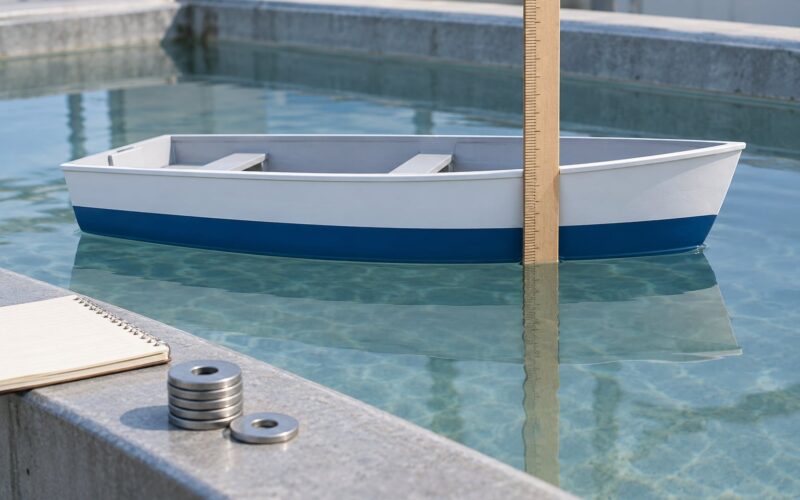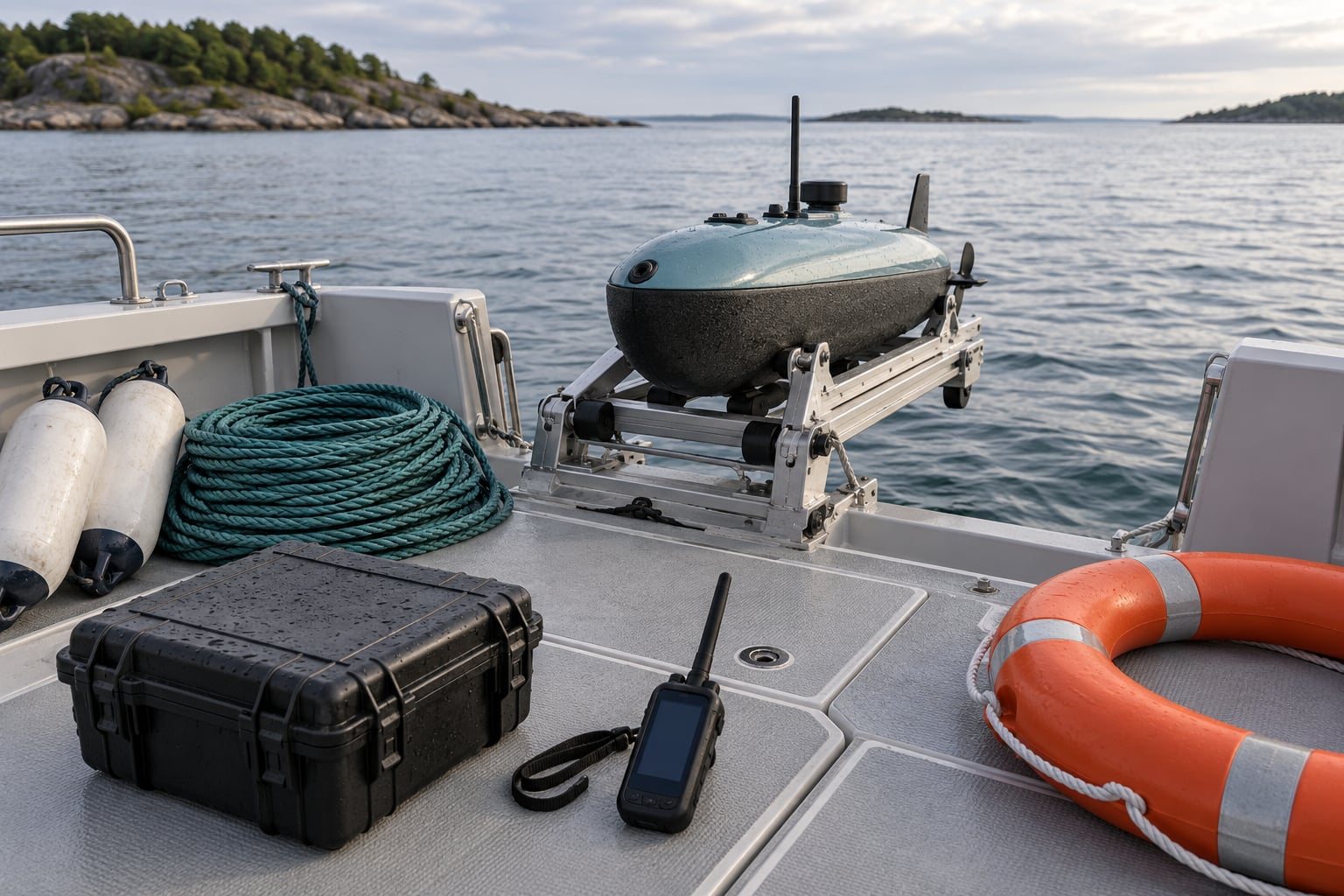
A sea trial is a controlled test run on open water, and planning one for a marine robot means deciding in advance exactly what you are testing, what would make you stop, and how you get the robot back. Most first-time failures come down to those three things being left vague on the day. Get them written down and the trial becomes routine.
This guide covers the whole sequence: the one-page test plan, the risk assessment, launch and recovery, weather and current limits, monitoring, emergency decisions, and the closeout paperwork. Budget a few hours of planning for every hour on the water, plus a sheltered-water rehearsal before you go offshore at all.
Table of Contents
- What You Need Before the Boat Leaves the Dock
- Step-by-Step: From One-Page Plan to Closeout
- How to plan a sea trial by defining its purpose
- How to plan a sea trial with a risk assessment
- How to plan a sea trial for safe launch and recovery
- How to plan a sea trial around weather and currents
- How to plan a sea trial with dependable monitoring
- How to plan a sea trial for emergency decisions
- How to plan a sea trial to recover the robot safely
- How to plan a sea trial by documenting results
- Common Mistakes That Ruin a Sea Trial
- Frequently Asked Questions
- Conclusion
What You Need Before the Boat Leaves the Dock
Everything below has to exist on paper before the support boat is fueled. If a line item is missing, the trial does not start.
Test objectives
One primary objective, written as a single sentence you could hand to a stranger. “Confirm the robot holds station within a 5 metre box in a 1.5 knot current” works. “Test the robot” does not. Everything else that day is secondary.
Pass or fail criteria
Decide in advance what counts as a successful run and what counts as a failed one. If you cannot state the number before you launch, you will argue about it afterwards with no data to settle it.
Support vessel and crew
You need a boat that can carry the robot, the team, and the recovery gear with room to spare. Minimum crew is one person driving the support vessel, one person operating and monitoring the robot, and one person logging. A two-person team can work, but only if the trial is simple.
Safety and recovery equipment
Personal flotation devices for everyone on deck, a throwable flotation device, a working VHF radio charged and tested, a first aid kit, a knife and line cutters, a recovery line with a floating grab point, and a waterproof container for the record sheet. A hand-held radio tracker independent of the robot’s own telemetry is not optional.
Robot readiness
Confirmed watertight closure, known flotation margin, a charged battery pack, thrusters and sensors logged as working on the bench, kill switch tested, and a known state of charge at launch. Write the expected endurance down and set a hard return time based on it, not on how it feels.
Weather criteria and comms plan
A forecast checked and agreed on the morning, go/hold/cancel thresholds written down, and a check-in schedule with a shore contact who knows what to do if you miss a check-in.
Permits and site rules come next: any navigation authority permission for your test area, notice to the coastguard or harbourmaster where local practice requires it, and confirmation that you are not planning into a shipping lane or a swim beach.
Step-by-Step: From One-Page Plan to Closeout
Eight steps, in order. Each one states what you do and how you confirm it worked, so you know whether you are allowed to move on.
How to plan a sea trial by defining its purpose
Turn the trial into a bounded test. Set one primary objective, attach a measurable pass-or-fail number to it, write down the operating limits you will not exceed, pick a test area with enough open water, and set a time limit for the run.
Also set the abort threshold in the same sentence as the objective. “If the robot has not returned within 10 minutes of losing telemetry, we abort” is usable. “We will judge it” is not.
You have defined the trial properly when someone else could read your plan and predict what you will do at any point during the run.
How to plan a sea trial with a risk assessment
Work through the hazards one by one: the robot itself, the support vessel, weather and sea state, boat traffic, people in the water, equipment failure, and local conditions like tides, debris, and restricted areas.
For each hazard, assign a control, name who owns it, and write the contingency action. One name per line. The owner is the person who acts, not the person who suggested the fix.
The risk assessment is done when the longest table you have is short. If it runs to pages, you have not prioritised it yet.
How to plan a sea trial for safe launch and recovery
Choose the launch site before the day, based on water depth, shelter from swell, room to deploy without drifting into traffic, and how close the recovery zone sits to the test area. Shorter transit means more usable test time.
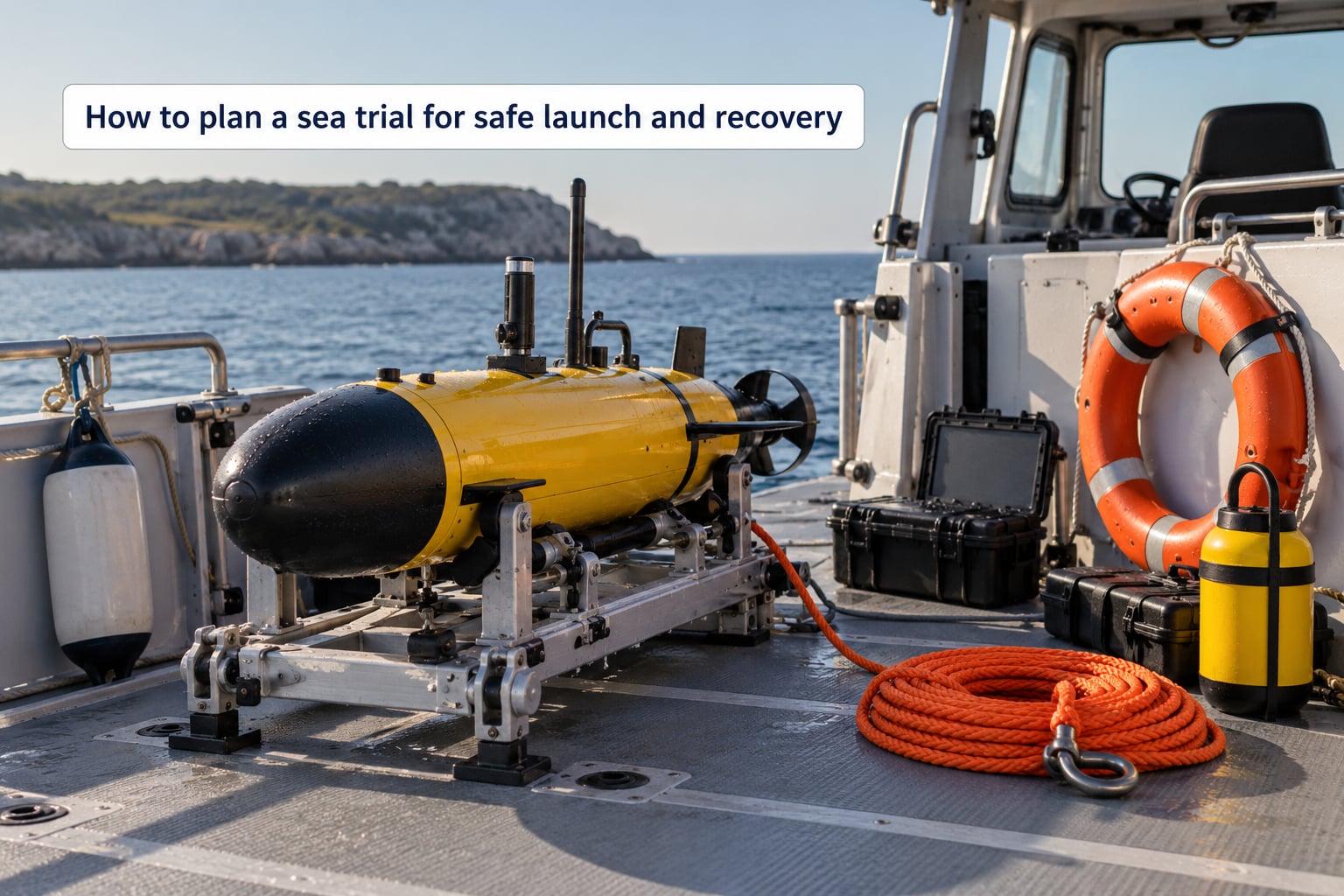
Decide in advance how the robot leaves the boat. A cradle or davit with a controlled lift is safer than a hand-held drop, because it sets the robot into the water at a known attitude rather than letting it fall in however it lands.
Agree the vessel approach speed for recovery before you need it. Slower is better. A support boat closing at planing speed turns a routine pickup into a hull strike.
Brief the backup method for a robot that never returns normally: who drives toward the last known position, who keeps watch on the independent tracker, and what the team does if the robot surfaces on its own somewhere unexpected.
You will know the launch plan works when every crew member can state their own role without being asked.
How to plan a sea trial around weather and currents
Check the forecast on the morning of the trial, not the night before, and look at swell, wind, tide, current strength, visibility, lightning risk, and water temperature.
Set three thresholds in advance. Below the go threshold you launch. Between go and hold you wait, often for an hour, because conditions are usually improving rather than worsening. Above the cancel threshold you reschedule, and you tell everyone the same thing so nobody pushes.
Current matters as much as weather for a robot. A steady 1.5 knot set will drag a surface unit downrange for the whole run and quietly distort every station-keeping result. Check the tidal stream for your window and note the expected set and drift in the record before you leave.
Water temperature is not a comfort question. A cold layer changes buoyancy response and battery output, and it is a genuine risk factor for anyone in the water.
How to plan a sea trial with dependable monitoring
Decide what the team watches and who watches it. Position, heading, speed over ground, battery state of charge, motor output, sensor readings, communications quality, and the environmental conditions around you.
Pick fixed reporting intervals so nobody has to remember to speak. A verbal position report every five minutes costs nothing and tells you immediately when something has gone quiet.
Keep the independent tracker running on someone else’s screen, not the same laptop running the robot’s control software. One screen failure should not take your tracking with it.
Set the thresholds that trigger a return before you launch, not during. A battery level that means turn around now, a telemetry dropout longer than a set number of seconds, a motor temperature reading out of its expected band.
How to plan a sea trial for emergency decisions
Give the operator a short decision sequence covering normal running, degraded performance, lost communications, unexpected current, equipment failure, and the point at which you abort immediately.
Write the abort conditions as absolutes, because that is what a stressed operator needs. Loss of telemetry beyond a set time means recovery, not troubleshooting. A person in the water means recovery, full stop, nothing else considered until they are back aboard.
Whoever is at the helm of the support boat has unilateral authority to call abort. Say that out loud during the brief so nobody hesitates later.
Rehearse the decision out loud once before you launch. A sequence nobody has spoken aloud has never actually been tested.
How to plan a sea trial to recover the robot safely
Define the return protocol while the robot is still healthy: the trigger for returning, the expected approach, and the hand signals between the operator on the water and the boat.
Cover the lost-signal case explicitly. Last known position plus drift calculation gives you a search box, and the search box has a time limit on it. Set that limit in the plan.
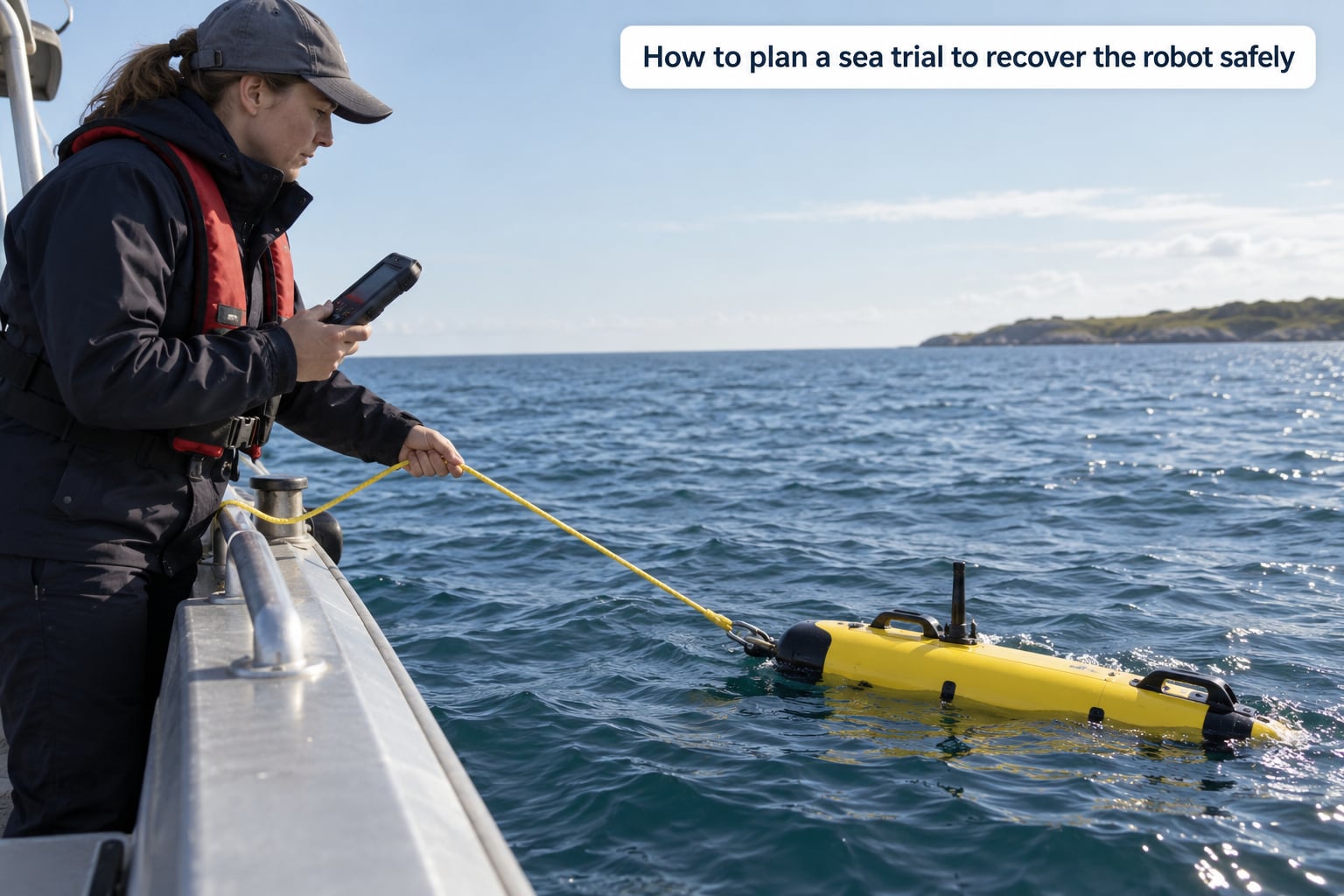
Know the lifting points and the flotation before you need them. A robot with a lifting eye that has never been load tested is a plan on paper, so prove it in the pool or on the slipway first.
After recovery, handle the robot the way you would handle any wet marine equipment: rinse it with fresh water, keep the connectors dry until they are clean, and log the condition you found it in before you start fault-finding.
Confirm the recovery worked when the robot is aboard, dry where it should be dry, and accounted for in the record with its final battery and fault state noted.
How to plan a sea trial by documenting results
Write the observations as you see them, not as diagnoses. “Vibration felt in the deck plate at a steady mid-range setting during a port turn” is useful to a specialist. “Bad bearings” is a guess that sends someone to the wrong part.
Record telemetry, timings, incidents, deviations from the plan, and any equipment changes made during the run. Deviations matter as much as results, because an unplanned change invalidates the comparison.
Then compare everything against the criteria you set before launch and mark each objective pass, fail, or inconclusive. Inconclusive is a legitimate result and usually means the next trial needs a better instrument, not a braver guess.
End with the next-test plan written while the details are still fresh. What you did not measure, and why, is the most useful line in the whole record.
Common Mistakes That Ruin a Sea Trial
Testing recovery for the first time on the day
Everything else fails behind this one. If nobody has lifted the robot out of the water before, you are gambling on a task with no margin. Do every recovery step in sheltered water or on a slipway, with the same crew, before the real trial.
Vague success criteria
“See if it handles well” produces no decision. Fix it by writing the number and the threshold next to the objective. If you cannot write it down, you cannot score it later.
Trying the whole mission on day one
A first sea trial that attempts the full route, the full payload, and the full sensor suite will end early for reasons unrelated to the robot. Test one objective. Add the rest when the first run is boring, which is the goal.
Depending on the robot’s own link for tracking
The telemetry link is the first thing that fails and the last thing you want to be relying on. An independent tracker with its own battery costs a small amount and has repeatedly been the difference between a quick recovery and a lost unit.
Testing in weather you would not choose twice
A rough day hides your data in noise and puts the crew under pressure you did not budget for. Pick calm conditions for the first open-water trial. Test in rough water deliberately, later, as its own planned step with its own limits.
Filling the log after you get home
Memory fills in the gaps with confident fiction. Record timings and readings as they happen, on a waterproof sheet or a phone in a dry bag. An entry made at the time is evidence; an entry made that evening is a story.
Frequently Asked Questions
What weather is safe for a marine robot sea trial?
For a first open-water trial, choose a day with low swell, steady moderate wind, good visibility, and no thunderstorm risk in the forecast. Set your go, hold, and cancel thresholds in writing before you leave, and re-check the forecast on the morning of the run. Wind and swell matter more than a favourable temperature, because they decide how the support vessel handles alongside the robot during recovery.
How far offshore should a marine robot be tested?
Stay inside sight or reliable radio range of the support vessel for early trials, and never farther than the robot’s battery reserve allows at the planned speed against the expected current. A common rule of thumb is to keep a third of your fuel or charge for return, but a robot on a tether or with a fixed endurance figure needs its own calculation. Rehearse the full distance in sheltered water first.
What safety equipment does a small ocean robot need?
At minimum, a personal flotation device for everyone on deck, a throwable flotation device, a tested VHF radio, a first aid kit, line cutters, and a recovery line with a floating grab point. Add a hand-held radio tracker that works independently of the robot’s own telemetry, a waterproof container for the record sheet, and a kill switch reachable from the support vessel. Test the lifting points before the trial, not during it.
Should I use a support boat for every sea trial?
For any open-water test, yes. A support boat carries the crew, the recovery gear, and the fallback, and it lets you retrieve the robot without swimming after it. The exceptions are tethered pool and tank testing, and very short sheltered-water runs from a dock where a technician and a lift are already in place. Even then, have a second person watching from the shore.
How long should a first marine robot sea trial last?
Plan on one to two hours on the water for a first controlled run, which is enough for a briefing, a launch, a single objective, and a recovery without rushing the closeout. Add time for the sheltered-water rehearsal and the paperwork afterwards. Longer sessions are not safer; they just raise the chance of drifting past your battery or weather limits on an unremarkable afternoon.
What should I do if the robot stops responding?
Note the time and last known position first, then work the written procedure rather than improvising. Start the independent tracker, calculate drift from the last known position, and begin the search box within the time limit you set during planning. If the robot surfaces, recover it without a powered approach. If the search window expires, notify the shore contact and escalate. Never send a person into the water to chase it.
Conclusion
Start with a one-page test plan: one objective, one number that decides pass or fail, one abort threshold, and one recovery method. Then prove the recovery method in sheltered water with the same crew, and only then go offshore.
Most people get this backwards and treat the first open-water run as the test. It is not. It is the second test, and the first one happened on a trailer or in a pool, where a failure costs a morning instead of a unit.