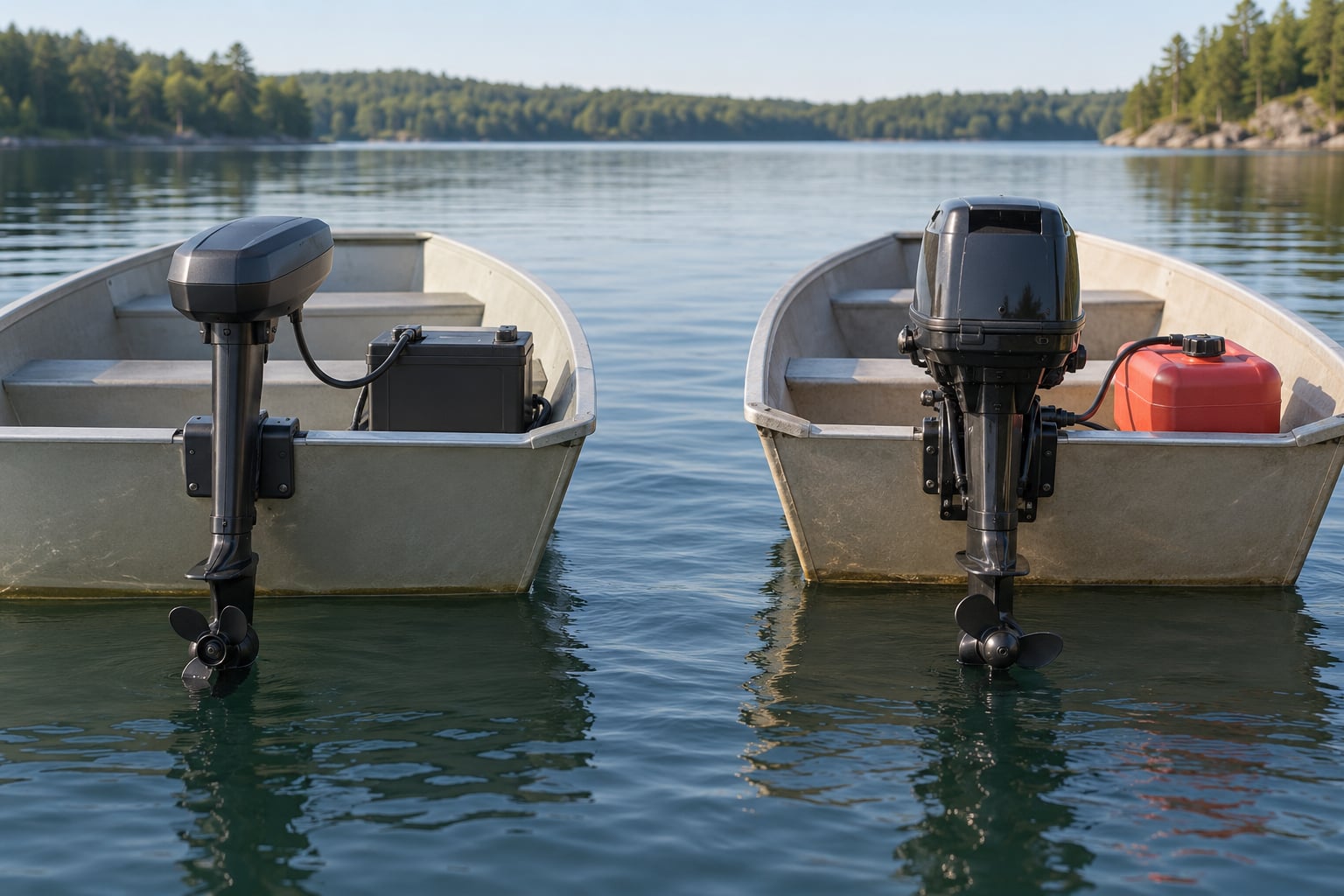
Electric outboards win where gas engines are weakest: silence, low-speed efficiency, near-zero routine maintenance and short trips you make every week. Gas outboards still win on range, refuelling access, sustained high speed and the cost of anything above roughly 10 hp. If your boat spends its weekends on a lake within charging distance of a socket, electric is usually the better answer; if it crosses open water between fuel docks, gas remains the honest choice.
The reason this comparison keeps generating bad decisions is that the headline numbers are not measuring the same thing. A 3 hp electric outboard and a 15 hp gas outboard are not comparable products, and comparing them is how buyers end up convinced electric is feeble. They are also not the same as trolling motors, which sit in a lower tier again.
Here is what the differences actually come down to, with the field-reported figures owners give rather than the brochure peaks, and a clear verdict on which type of boat each one suits.
Table of Contents
- How Electric Outboards Compare to Gas at a Glance
- Power, Speed, and Boat Compatibility
- Range and Runtime: What Changes in Real Conditions
- Charging Time and Fueling Convenience
- Upfront Cost and Long-Term Operating Expenses
- Maintenance, Reliability, and Serviceability
- Noise, Comfort, and Environmental Impact
- Which Should You Choose?
- Frequently Asked Questions
- What are the downsides of electric motors?
- What is the electric equivalent to the 9.9 hp outboard?
- Are electric outboard motors worth it?
- Can I replace my gas engine with an electric motor?
- How long do electric outboard batteries take to charge?
- What are the pros and cons of electric outboards compared to gas outboards?
- Conclusion
How Electric Outboards Compare to Gas at a Glance
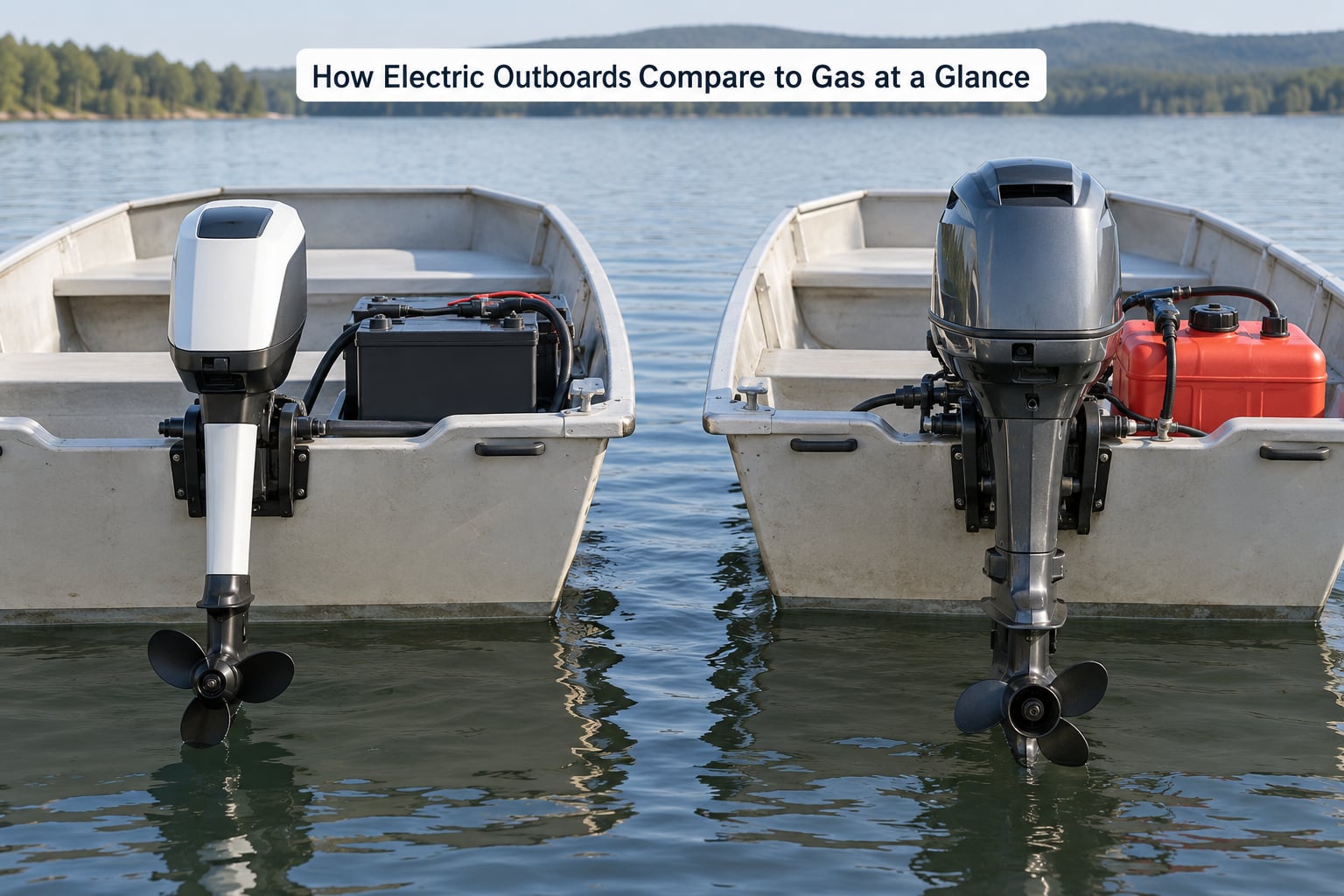
The table below is the honest summary. Everything after it explains the rows that people most often get wrong.
| Factor | Electric outboard | Gas outboard |
|---|---|---|
| Peak power | Strong and immediate; full torque from zero RPM | Strong, but built around a combustion cycle |
| Overall efficiency | Roughly 35-55% of stored energy to wake | Roughly 5-15% of fuel energy to wake |
| Energy density | Low; batteries are heavy for the energy they hold | Very high; liquid fuel stores enormous energy per kilo |
| Typical range | Hours of cruising per charge, dependent on hull and speed | A full tank; refuelled in a few minutes |
| Refuelling or charging time | Overnight on shore power, or a generator, solar or swap | A few minutes at a dock |
| Noise | Near silent; mostly hull and water noise remain | Loudest at low throttle and on a two-stroke |
| Local emissions | None at the boat | Exhaust gases, including carbon monoxide |
| Routine maintenance | Rinse, inspect, keep terminals clean | Oil changes, spark plugs, fuel system, winterising |
| Upfront cost | Higher, including battery and charger | Lower for the motor alone |
| Running cost | Very low; electricity is cheap per mile | Low but variable with fuel prices |
| Cost above about 10 hp | Rises steeply; not cost-competitive | Remains affordable |
| Best fit | Tenders, dinghies, lakes, restricted and quiet waters | On-plane transit, long distance, heavy loads, remote trips |
Here is the same comparison as a short list, because that is usually how people make up their minds.
Where electric wins
- It is quiet enough to row back from a mooring at 6am without waking the anchorage.
- Throttle response is immediate and smooth, with no gearshift clunk or starting rope.
- There is no carburettor, no spark plugs and no fuel line to leak in a swamped cockpit.
- A non-technical partner can start and stop it without a pull cord or a fuel primer.
- It is permitted on lakes and reserves where combustion motors are banned outright.
- Running cost per mile of travel is a fraction of fuel cost.
Where gas still wins
- Range is measured in a tank, not a charge, and refuelling takes minutes.
- A full gallon of petrol holds about 33-34 kWh of energy; a battery bank holding the same usable energy weighs far more.
- Top speed and getting a loaded dinghy on plane remain unchallenged.
- Motors above 10 hp stay affordable, where the electric price gap widens sharply.
- A well-maintained four-stroke is genuinely reliable for a decade or more.
- Long trips through areas with no shore power simply are not a conversation you can have with a battery.
Power, Speed, and Boat Compatibility
An electric outboard and a gas outboard of the same nominal horsepower feel different because they deliver power differently. The electric motor makes full torque at zero RPM and holds it through the entire rev range. The gas engine makes a burst of torque, settles into a plateau, and needs a propeller sized to it.
Why horsepower numbers are not comparable across the two types
A small electric outboard rated at 3 hp is not the same machine as a 3 hp two-stroke, and it is certainly not the same as the 15 hp gas motor it is often compared against. Electric manufacturers quote input power to the motor; gas manufacturers quote shaft output at a specific speed. The two numbers describe different ends of different chains.
The correction that circulates most usefully on the trawler forum comes from a long-running thread on dinghy propulsion: electric motors are as fast as gas motors of the same power, so it is not fair to compare a 3 hp electric to a 15 hp gas. That is the right instinct. The wrong comparison still happens in every showroom conversation, so do the conversion yourself.
What peak and continuous power mean on the water
Every electric outboard has a headline figure that it can produce for a short burst, and a lower figure it holds indefinitely once the battery voltage sags under load. The burst figure is what gets quoted. The continuous figure is what you get on a two-hour run with four people and a full cooler aboard.
That distinction explains most of the disappointing first outings people report. A motor that hits a high number for the first thirty seconds and then settles lower feels exactly like an underpowered engine if you did not know what was happening. Ask for the continuous rating at your cruise speed, not the peak.
For boat compatibility, the practical split is clean. Electric outboards suit displacement-speed work in dinghies, tenders, RIBs, jon boats and small skiffs, where propulsive efficiency and low-speed torque matter most. Gas retains a clear advantage for heavy loads, surf, strong current, planing hulls under way and anything sustained above hull speed.
Speed is the sharpest edge. Owners report a dinghy with a 9.9 hp-equivalent electric package reaching roughly 5-6 knots, where the gas 9.9 runs at 18 mph or better. Both can be correct. They are optimised for different jobs, and only one of them gets you across a wide, windy bay before the weather turns.
Range and Runtime: What Changes in Real Conditions
Electric range is not a fixed figure printed on a battery case. It is a function of hull weight, speed, load, wind, waves and how conservative you want to be with your reserve, and the same battery can differ by a factor of two between two dinghies. That hull sensitivity is the single most useful thing an owner can tell you.
The reported figures below come from owners on the trawler forum, all on the same general class of electric package, and they illustrate the spread better than any manufacturer number.
| Hull | Battery setup | Reported result |
|---|---|---|
| Whaly 270 hard dinghy | One pack, Torqeedo 1103 CS | About 4 hours shown remaining at 5 km/h on GPS |
| Zodiac inflatable | One pack | 6-10 shore round trips per charge |
| Avon 310 rigid inflatable | Same pack | Only 4 round trips; hull weight was the difference |
| Three-year owner’s cruising boat | ePropulsion | About 8 miles of real cruising range |
The Zodiac against the Avon comparison is the one to remember. Same motor, same battery, same operator, and the heavier hull cut usable range by more than half. When you are sizing a system, the hull weight and the crew weight matter more than the motor model on the transom.
Gas range works the opposite way. A tank is a tank, and the boat carries its own energy reserve in liquid form with a density nothing else in this comparison approaches. As one forum contributor put it plainly, nothing matches hydrocarbons for portable energy density.
A workable method for estimating electric range is simpler than most published formulas. Work out your typical trip length in hours, not miles, at your actual cruising speed rather than the advertised top speed. Add a reserve of roughly 20-25% for wind, current and detours. Multiply the usable energy you need by an allowance for charge losses, since only about 60% of what comes out of the plug typically reaches the water. Anything tighter than a 20% reserve and you are designing a boat that strands its owner at the far shore.
Also weight your boat for the trip, not for the dock. The power lost to moving a heavier hull is power the battery pays for on every single outing.
Charging Time and Fueling Convenience
Charging an electric outboard takes hours, not minutes, and the number people want is rarely the one on the charger’s face. A large battery bank on shore power typically needs a full night, sometimes a night and a morning. That is completely workable for a boat that returns to the same slip every evening. It is a serious problem for a boat that moves, for a rental fleet that turns boats over twice a day, or for a skipper who wants to reach a cove that has no grid connection.
What to do when the boat has no shore power
- Tow it. Most small outboards charge from a trailer connection while you drive, which turns the charge into part of the journey.
- Solar. A small panel on the console keeps a tender topped up between outings. One owner runs a 50 W panel and describes charging as never being a consideration, which is not true for anyone away from a dock for days.
- Carry a generator. A portable petrol generator recharges on demand and turns an electric boat into a hybrid. One owner paddled plus solar for 120 miles, then lost charging to wind and overcast and spent three extra days on a beach waiting. In that moment a small fuel motor would have been the better tool.
- Swap the battery. Removable packs let you charge indoors or in a car park and travel with a spare. The pack itself is the heaviest awkward object in the whole arrangement.
None of these options is as simple as pulling into a fuel dock with a jerry can and driving away in three minutes. When you compare electric outboards to gas outboards, this is where the comparison is hardest on electric, and it has almost nothing to do with the motor.
Gas refuelling is the strongest single argument for combustion propulsion, and it is an argument about infrastructure and time rather than about thermodynamics.
Upfront Cost and Long-Term Operating Expenses
Electric propulsion costs more to buy and less to run. How much more, and how quickly it comes back, depends almost entirely on how much you use the boat and what class of motor you need.
The upfront line is not just the motor. A complete electric system includes the motor, the battery bank, the battery management system, the throttle or tiller control, a charger sized for the bank, and often a modified electrical system to run it. A gas installation adds a fuel tank, a fuel line, a steering or tilt system and a wiring harness. Comparing the sticker price of two bare motors is the most common costing error in this whole topic.
On the running side the gap is stark. At 5 mph, tests reported on the trawler forum put a 20 hp-equivalent electric package below the energy of one cup of petrol per hour. Electricity at household rates is a rounding error next to fuel per mile. That is not a marginal gain; it is the whole reason the efficiency argument exists.
Three costs offset it, and buyers consistently underestimate the first one:
- Battery replacement. Lithium packs age, lose usable capacity and are the single most expensive part of the system. A pack that is cheap when new becomes a large line item eight or ten years in.
- Charging infrastructure. A charger capable of filling the bank overnight, plus any wiring or shore-side work, belongs in the purchase budget.
- Time. Charging hours are a real cost if you wanted to leave at 7am.
The maths shifts with the power class. Below about 5 hp, where the pack is small, the total system cost stays in a reasonable band and the operating saving recovers it over a few seasons of regular use. Around 9-10 hp the premium grows but remains defensible for boats used often. Above that, the battery bank needed for equivalent performance pushes the price away from gas quickly, and the fuel saving is too small to close the gap.
Owners on the forums tend to value honesty here more than a sales pitch. The most useful thing you can tell someone considering the switch is that the switch is not always cost-effective. If the boat gets four outings a year, fuel cost was never the problem.
Maintenance, Reliability, and Serviceability
An electric outboard has fewer moving parts than a four-stroke and a completely different maintenance profile. That difference is real, and it is also frequently oversold as maintenance-free ownership.
What electric actually needs is a rinse after every outing in salt water, connectors and contacts kept clean and dry, the battery terminals checked and occasionally tightened, the propeller hub inspected for line and fishing debris, and the vents kept clear. Motor internals are sealed and have nothing to lubricate or service. There are no oil changes, no spark plugs, no carburettor to clean or rebuild, no impeller to change and no winterisation ritual.
What that does not cover is firmware and diagnostics. The battery management system, the controller and the display are electronics, and a fault in any of them is not a workshop job at the back of a boat ramp. Sealed packs are also expensive to replace rather than cheap to repair, which is the trade you make when you leave the carburettor behind.
Gas engines carry the maintenance that keeps them alive: oil changes at the right intervals, spark plugs, fuel filters, an impeller that degrades with age, corrosion in the cooling passages, and carburettor or fuel injection issues if fuel has been sitting. A fuel system left full of old petrol in a garage is a genuinely common failure, and a two-stroke kept gumming up is why many owners quietly switch to a four-stroke and stop thinking about it.
The claim that gas is unreliable does not survive contact with ownership records. Forum owners report 2011 Yamaha four-strokes that failed to start twice in a decade with basic upkeep. That is the real comparison: not electric against a neglected engine, but electric against a maintained one.
On the safety side, the gas case has genuine items that rarely get mentioned. Carbon monoxide accumulates in a swamped cockpit and around a transom in still air. Fuel vapour is flammable, spilled fuel stains water and destroys the foam in a hull, and a lit engine in a garage is a serious hazard. Electric propulsion has none of that. No fuel, no fumes, no fire risk, and nothing to spill when the tender takes a wave.
Noise, Comfort, and Environmental Impact
The noise difference is the first thing anyone notices and the hardest to argue with. One owner with an ePropulsion describes it as so quiet that you mostly hear the water against the hull. A four-stroke at part throttle is louder than most people expect, and a two-stroke under load is louder still.
That gap is what makes electric the only realistic choice on some waters. Many lakes and nature reserves restrict combustion motors, cap noise levels or ban two-strokes outright. A quiet motor also changes where you can go and when: dawn approaches in a cove, an anchoring where another engine would end the evening, or drifting through a wildlife area.
Vibration matters too. An electric motor at cruise speed produces far less structure-borne noise, which is the difference between a boat that is tiring over an hour and one that is not.
Grid-to-wake accounting, not zero emissions
Electric propulsion has no exhaust at the boat, and that is exactly what it says. It is not a claim about the atmosphere, and the distinction is worth stating plainly because vendor copy frequently blurs it.
Start at the wake and work backwards. A useful yardstick from the C-Brats forum thread is that one gallon of petrol holds roughly 33-34 kWh of energy. Then account for what happens along the way: charging a battery is not free of loss, with roughly 60% of the energy drawn from the plug typically reaching the pack, and upstream of that the grid itself converts most fuel into electricity at an efficiency well below one.
So the honest framing is local, not global. At the point of use, an electric outboard emits nothing, creates no noise and spills no fuel into the water. Overall emissions depend on where your electricity comes from, and on a grid that still runs largely on fossil generation, an electric boat is lower-emission than a gas boat but not emission-free. If your charging comes from solar, that gap closes almost entirely.
Wildlife disturbance is a separate argument and a stronger one for some waters. A silent hull leaves no noise trail for nesting birds or mammals to react to.
Which Should You Choose?
Choose electric if your boat lives within reach of reliable charging and its work is displacement-speed cruising, and choose gas if any of that is false. That is the whole decision, and the sections below break it into the cases people actually argue about.
Electric fits these boats and trips
- Inland cruising on lakes, canals and rivers where you return to a slip nightly.
- Dinghy and tender work where the run is a mile or two from the anchorage.
- Restricted lakes, nature reserves and any water where combustion motors are banned or noise-capped.
- Wildlife watching, birding and quiet dawn approaches, where sound is the thing ruining the trip.
- Skinny water and shallow anchors where the hull matters more than the motor.
- Research, survey and demonstration platforms that log hours near sensitive water.
- Rental and charter fleets that hand the boat to non-technical operators.
- Boats where the electric package replaces a small auxiliary engine rather than a main one.
Gas still fits these
- Crossing open water on plane, where sustained speed is the requirement.
- Long distances where refuelling is minutes and charging is a night.
- Remote trips where there is no grid within reach and no plan to wait for sun.
- Heavy loads, big crew, surf and current, where continuous power matters more than efficiency.
- Anything above roughly 10 hp, where the price gap stops closing.
- Boats you need to move quickly, immediately, without planning the night before.
Who makes the best electric outboard motor?
There are several credible manufacturers of true electric outboards, and the honest answer is that the better motor for a given boat depends on the hull rather than the badge. Torqeedo and ePropulsion cover most of the displacement and tender market, Mercury Avator sits further up the power range, and Yamaha and Suzuki’s electric programmes target larger craft where gas still dominates the market.
One category worth separating clearly: trolling motors. They are cheaper, lighter and widely available, and owners regularly report them as the reason they finally got off a troublesome petrol outboard. But they are a different product with different thrust, different mounting and no gear or reverse in many cases. Compare them against a small gas outboard, not against a 9.9 hp gas motor.
Six questions to answer before you buy
- Where does the electricity come from? Not what you hope for on the best weekend, but every time.
- What is your actual trip pattern? Hours out, typical cruising speed, and how many trips a month.
- What is your boat’s real loaded weight? Including gear and a full crew.
- What reserve do you insist on? Twenty percent or more changes the battery size significantly.
- What happens if you miss the return? If the answer is a long wait, plan for a generator or a gas backup.
- Can the whole crew operate it? Push-button start with no fuel procedure is one of the strongest arguments for electric.
Mistakes buyers make
Comparing a 3 hp electric against a 15 hp gas motor and concluding electric is underpowered is the first and most expensive error. The second is sizing the motor from hull length instead of loaded weight; the Zodiac and Avon example above shows how much the heavier hull costs on every trip. The third is buying too little battery to hit a range target, then resenting the motor for a decision the battery bank caused.
A pattern worth naming: plenty of owners end up running both, an electric outboard for tenders and short trips and a gas motor aboard for distance. That is not indecision, it is two motors doing two jobs.
Frequently Asked Questions
What are the downsides of electric motors?
The main drawbacks are range, weight and charging dependence. A usable battery bank is heavy and stores far less energy per kilo than liquid fuel, so electric range is measured in hours rather than distance. Charging takes overnight hours on shore power and does nothing without a socket, trailer hook-up, generator or spare pack. Above roughly 10 hp the battery cost climbs faster than the fuel saving. Electronics such as the controller and battery management system are also sealed and costly to replace.
What is the electric equivalent to the 9.9 hp outboard?
There is no clean conversion, because the ratings describe different things. Electric quotes input power to the motor, gas quotes shaft output, and the electric headline figure is a peak that the motor holds only briefly. In practice a 9.9 hp-equivalent electric package in a dinghy cruises at roughly 5-6 knots, where a gas 9.9 runs at 18 mph or better. Match boats to jobs, not numbers.
Are electric outboard motors worth it?
They are worth it when the boat is used often, stays near charging and does displacement-speed work, because fuel and maintenance costs drop sharply and the motor starts with a button. They are not worth it on four outings a year, for long open-water crossings, or above about 10 hp where the battery cost climbs faster than the savings. Many owners also choose them for silence and for who can operate them, not for the environment.
Can I replace my gas engine with an electric motor?
Usually, but check four things first: whether the electric motor can push your loaded hull to the speed you actually need, whether the transom can carry both the motor and the added battery weight in the right fore-aft position, where the battery bank fits without shifting your trim, and whether your charging setup can fill it overnight. Control wiring and the old fuel tank both need dealing with during the swap.
How long do electric outboard batteries take to charge?
A full bank typically needs an overnight charge on shore power, sometimes a night plus a morning, and charge time scales with bank size. Charging while towing the boat to the ramp works well, solar keeps tenders topped up between outings, and a portable generator covers long trips. A spare removable pack is the fastest option if you travel, since you carry the charged one and swap it in.
What are the pros and cons of electric outboards compared to gas outboards?
Electric advantages are silence, immediate throttle response, no exhaust or carbon monoxide, no fuel spills, minimal routine maintenance, low running cost and access to restricted and noise-sensitive waters. Gas advantages are far greater range, refuelling in minutes, sustained high speed and heavy-load performance, and much lower cost above about 10 hp. The decision comes down to your trip pattern and your charging access, not on the headline horsepower figures.
Conclusion
How electric outboards compare to gas comes down to four numbers you should calculate before anything else: the hours you actually run, the loaded weight of your boat, the speed you need rather than the speed you want, and how often you can reach a charger or a fuel dock.
Start there. If the answers point to short trips near a socket, electric will give you a quieter, simpler, cheaper-to-run boat that anyone aboard can start. If they point to long distances, open water or loads above about 10 hp, a gas outboard remains the more honest machine, and the efficiency gap will never close that gap in range.
Updated for 2026.