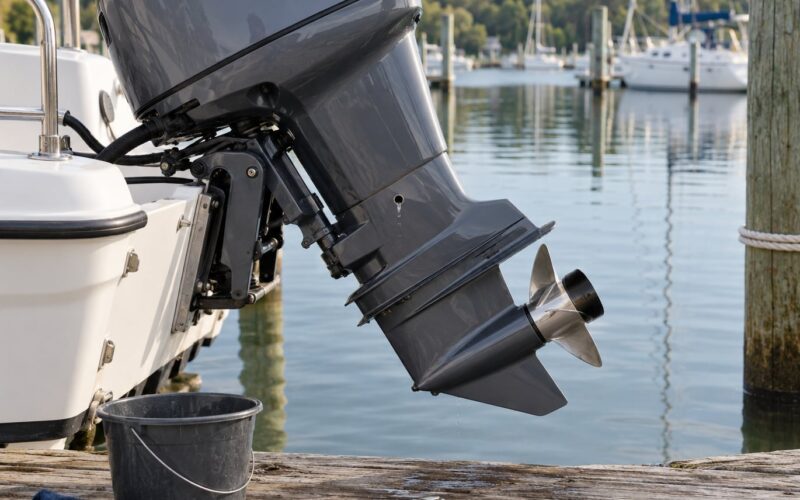
Shaft length is not a preference you get to guess at. It is the distance from the inside of the motor’s clamp bracket, where it rests on the transom, down to the anti-ventilation plate just above the propeller, and it has to match the height of your transom closely enough that the plate sits level with the bottom of your hull or slightly below it. Get that right and the propeller stays fully submerged, the motor runs cool, and the boat gets on plane. Get it wrong and you get a screaming prop, a boat that will not plane, wasted fuel, or a gearcase you can strike in a foot of water. That is how to choose outboard shaft length in practice: two measurements, one manual, and a check before you drill anything.
Most people get it wrong because they measure from the wrong point, or because they trust the label on the spec sheet instead of the tape measure. It takes about fifteen minutes to do properly, and you only need a tape measure, the boat’s paperwork and the new motor’s installation manual.
Table of Contents
- What You Need
- Step-by-Step: How to Choose Outboard Shaft Length
- Measure the Boat’s Transom Height and Mounting Position
- Check the Motor Manufacturer’s Shaft Specifications
- How to Choose Outboard Shaft Length by Comparing Standard Ranges
- Account for the Motor Bracket and Installation Height
- Match Shaft Length to the Boat’s Operating Conditions
- Confirm Clearance, Steering, and Propeller Position
- Test the Final Choice Before Installation
- Common Mistakes
- Frequently Asked Questions
- Final Check Before You Buy
What You Need
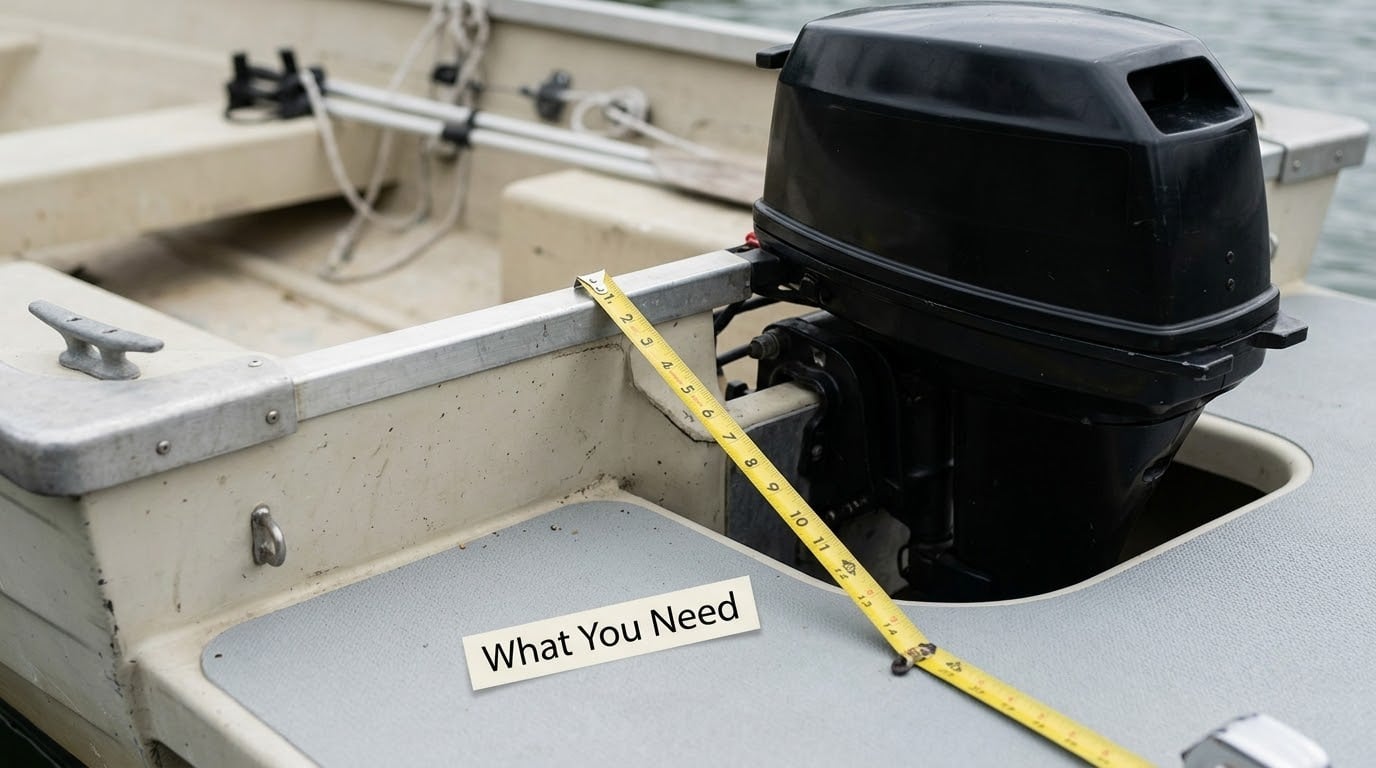
You do not need much, but you do need all of it before you start choosing sizes rather than after.
- A tape measure, ideally a tape long enough to run from the top of the transom to the keel without doubling back, plus a straight edge or a spirit level so the boat sits square.
- The boat’s build sheet or owner’s manual. Nearly every production boat lists transom height in inches, and it is printed in the specifications chart or on the hull’s capacity plate.
- The motor’s installation manual or the dealer’s spec sheet, which lists the nominal shaft length and, more usefully, the range of transom heights that motor is approved for.
- A jack plate or transom shim in hand if your measurement lands between two standard sizes, so you can check the correction before you commit to a motor.
If you are buying a used motor rather than a new one, add a second tape measure and the lower unit in your lap. The shaft length can be checked directly on a used motor, which is the most reliable source you will get.
Step-by-Step: How to Choose Outboard Shaft Length
Measure the Boat’s Transom Height and Mounting Position
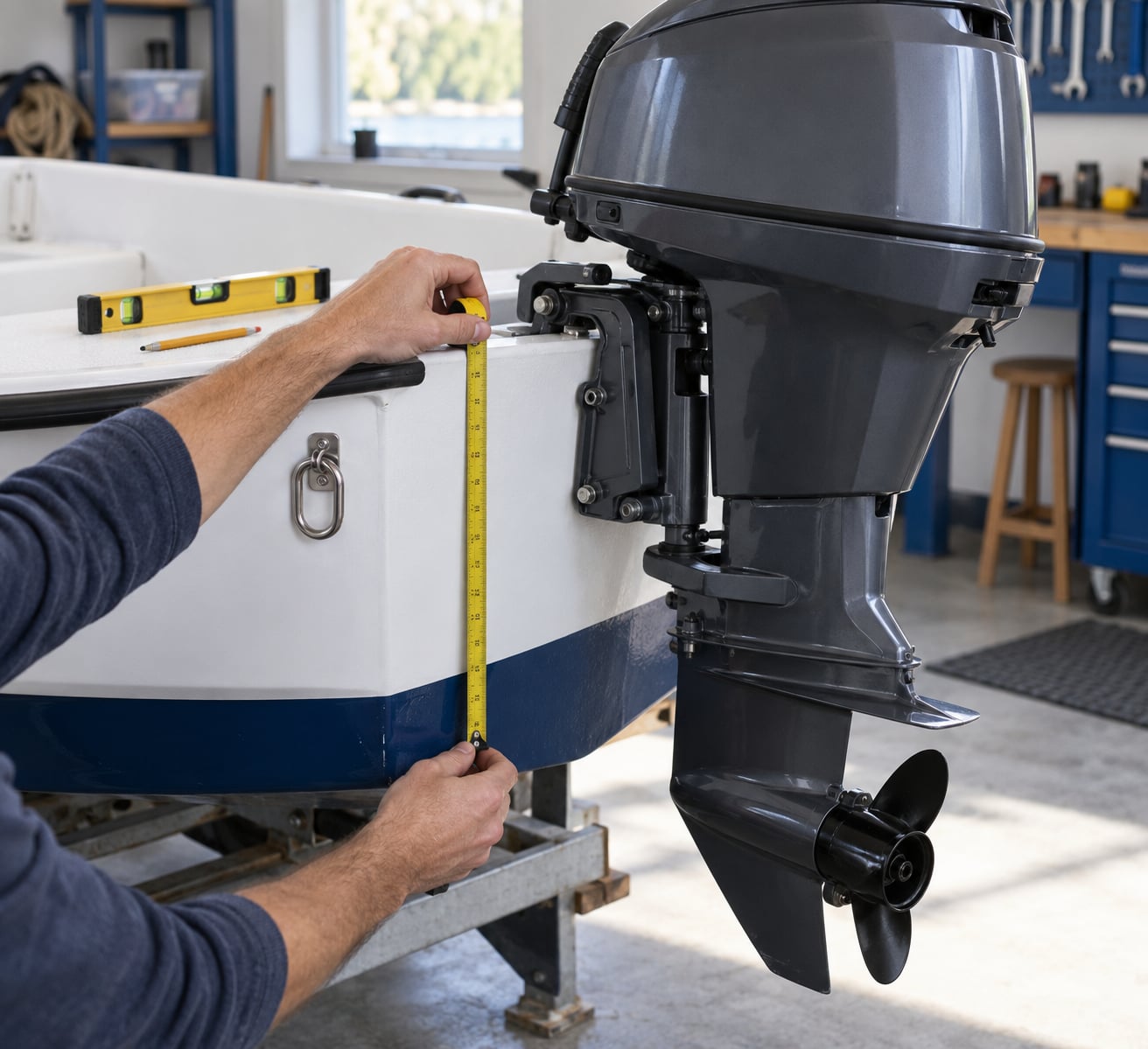
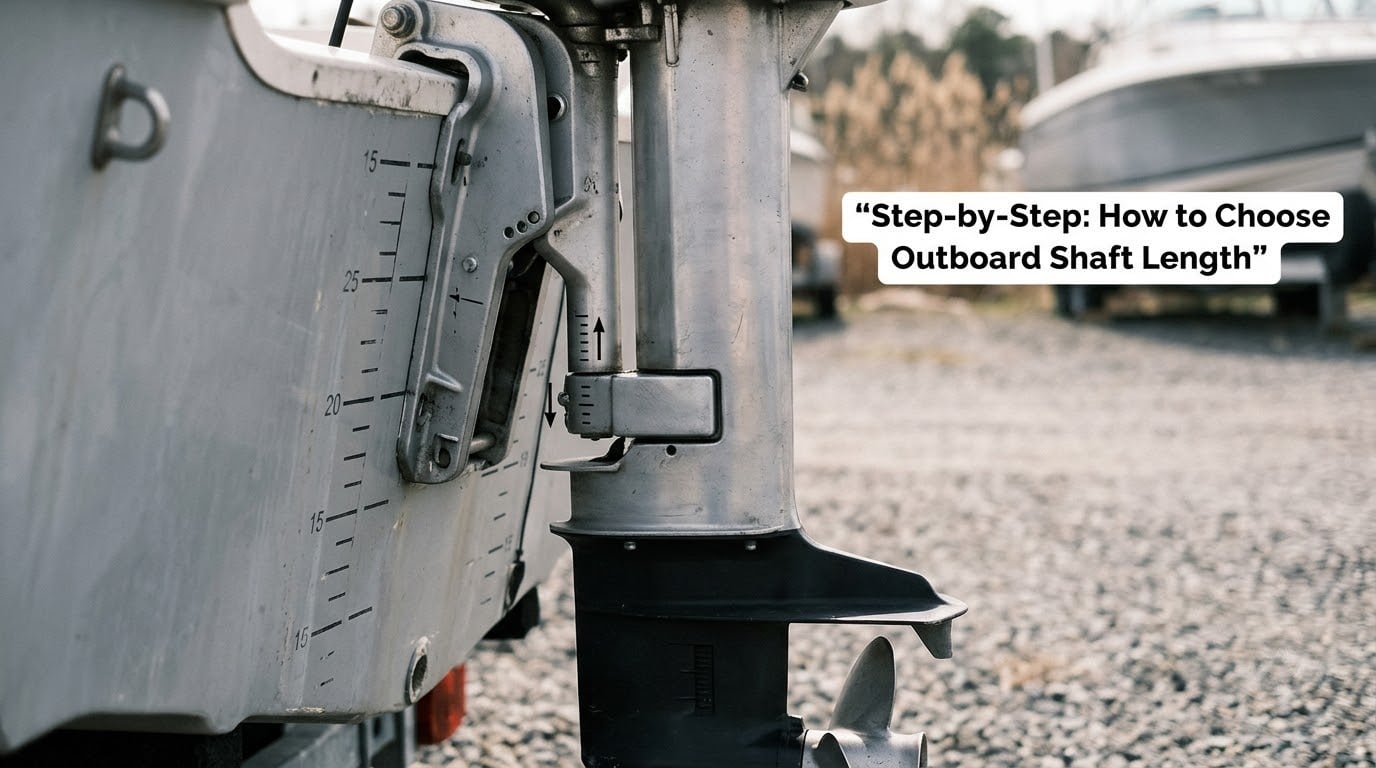
Transom height is the vertical distance from the top of the transom, at the point where the motor bracket will clamp down, straight down to the lowest point of the hull. On a flat or pontoon-style transom those are the same place. On a deep-V hull they are not, and this is where most bad measurements come from.
Set the boat level first. On a trailer, chock the wheels and level the tongue so the boat sits at its running attitude rather than nose-up on the trailer. Then take three measurements: from the top of the transom to the bottom edge of the transom, from the top of the transom to the keel where the keel meets the hull bottom, and from the top of the transom straight down to whatever pad, kicker plate or mounting block the bracket will actually rest on. Write all three down.
For a deep-V, the number you want is the one to the keel, measured vertically, not an angled measurement to the bottom corner of the transom. If you measure on an angle you will come up short and reach for a shaft that is too long.
Check the Motor Manufacturer’s Shaft Specifications
Open the motor’s manual and look for the transom height table. It will list shaft classes and the transom height range each one is approved for, and that range is the real specification. The nominal label is a convenience.
Most makers build combustion outboards in three or four nominal sizes, using a roughly five inch step between them:
| Nominal shaft class | Nominal shaft length | Typical combustion transom height range |
|---|---|---|
| Short | 15 inch | up to about 16 inch |
| Long | 20 inch | about 16 to 21 inch |
| Extra long (XL) | 25 inch | about 21 to 26 inch |
| Extra extra long (XXL) | 30 inch | about 26 inch and above |
Check the manual for the specific motor, because the range shifts with horsepower and with model year. If your transom measurement falls outside every range listed for that motor, it is the wrong motor for the boat, and the fix is a different motor rather than a creative mounting arrangement.
Owners often pair this decision with a broader how to choose a motor for a small boat project, and it is worth doing the shaft check before you fall for a horsepower number that does not suit the hull.
How to Choose Outboard Shaft Length by Comparing Standard Ranges
Use the transom height you measured as the lookup key and take the nominal class whose range contains it. Here is the practical version of the same decision, with the in-between case included because that is where people get stuck.
| Your measured transom height | Nominal shaft class to look for | If you land in between |
|---|---|---|
| 14 inch or less | Short, 15 inch | Check whether the bracket sits high enough on a shallow transom |
| 16 inch and over | Long, 20 inch | The commonly used rule of thumb: 16 inch or more centre to centre, take the long shaft |
| 17 to 18 inch | Long, 20 inch | A 17 inch transom is a long shaft boat, not a short shaft boat |
| 21 inch | Long or XL | Use a shim or jack plate to settle it against the manufacturer’s range |
| 22 inch and over | XL, 25 inch | Compare the XL range against the keel measurement, not the transom face |
| 26 inch and over | XXL, 30 inch | Confirm the motor is approved for saltwater and for your hull deadrise |
Those nominal sizes are approximate. Two motors both sold as a long shaft can differ by as much as half an inch because each brand builds to its own bracket geometry. Treat the label as “closest to this standard size”, and treat the manufacturer’s transom range as the number that decides it.
Electric outboards follow a different convention, and this trips people up constantly. The same physical measurements are called a short shaft at 25 inch and a long shaft at 30 inch, because electric motors have no power head above the shaft and the naming convention shifted up by a class.
| Nominal class | Combustion outboard | Electric outboard |
|---|---|---|
| Short | 15 inch | 25 inch |
| Long | 20 inch | 30 inch |
| Extra long | 25 inch | not commonly used |
If you are repowering with electric, measure the boat the same way and read the electric column, not the combustion one. Carrying over a combustion class name is the most common electric repowering error in the tables I have seen on the major boating forums.
Account for the Motor Bracket and Installation Height
The shaft length label describes the motor on its own, from bracket to plate. What matters on your boat is the total installed height, which includes everything the bracket sits on and everything that holds it up.
Count each of these separately and add them to your raw transom measurement: a transom pad or mounting board, a shim, the height of a jack plate or transom elevator, and the boat’s own kicker mounting plate if the bracket sits on it. Most clamp brackets have two or three sets of holes, which gives you roughly 1 to 2 inches of vertical adjustment. Boaters use that travel to fine-tune where the plate ends up, and you can too, but only within what the manufacturer approves.
The direction you need to move matters as much as the amount. Raising the motor with a jack plate is a way to correct a transom that measures short of the next class up. It is not a way to fit a motor two classes too long onto a small transom.
Match Shaft Length to the Boat’s Operating Conditions
Once the numbers line up, let the way you use the boat settle the remaining choices, because two motors that both fit can behave very differently in different water.
Shallow-draft work, sandbars, grass flats and a soft launching ramp all favour the shorter option that still puts the plate below the hull. Deeper hulls, heavy loads, big water and bay and offshore boats tend to sit higher on their transom as they come up out of the water, and there the longer shaft holds the propeller submerged through more of the pass.
Kicker motors and trolling motors follow their own rule. A kicker that is too long barely fits under the hull, so pick the longest kicker the boat’s transom allows and no longer, and measure it the same way you measure any motor. A trolling motor is a different measurement entirely, from the deck or mounting bracket down to the prop, and the transom height table does not apply to it.
Older, lighter boats up to about 18 feet often tolerate a short shaft better than their size suggests, because the transom is stiffer and the hull does not squat as much when loaded. Newer deep-V hulls move a lot more at the transom once weight goes in, which is why the same nominal shaft can feel wrong on two boats with the same transom height.
Confirm Clearance, Steering, and Propeller Position
Before the motor goes on the transom, check the parts you cannot see once it is installed. The propeller needs clearance from the hull, the transom and anything hanging below, such as a transducer or a paddle wheel. In rough water the hull moves, so leave enough gap that the gearcase never contacts the transom at full trim.
Watch the steering through its whole arc. The gearcase and propeller sweep well outboard of the pivot point, and a motor sitting too low on the transom changes how that sweep looks. Nothing should touch through full lock.
The propeller matters too. A taller gearcase designed for a longer shaft changes where the hub sits relative to the waterline, and the prop that came with a different shaft class may no longer suit the transom depth and the hull’s deadrise. Manufacturers specify prop sizes per shaft class for exactly this reason.
One more item while the motor is still accessible: if your boat has a splash well, check that its drains run clear. A shaft that is too short puts the lower unit right where spray and exhaust gas collect, and blocked drains turn a small water problem into a flooded well and a ruined motor.
If the lower unit will be off at any point, check the driveshaft seal while it is open. Our guide on how to make a watertight shaft seal covers the detail, and it is far easier to confirm before assembly than to chase a leak afterwards.
Test the Final Choice Before Installation
Run a trial fit before you commit. Bolt the motor to the transom, tighten the clamp bracket exactly as the manual specifies, then put the boat in the water and check three things at idle: the anti-ventilation plate sits level with the hull bottom or between a quarter inch and an inch below it, the propeller runs fully submerged with no spray coming off the plate at a steady cruise, and the steering moves freely through its full range.
If the plate sits level or a quarter inch low, the shaft is correct. That tolerance is worth trusting over the vaguer brand guidance that just says level with the hull bottom, because it is the figure people running these motors on the water consistently report back.
Then cross-check the paperwork. The manual’s transom range, the spec sheet, your own measurement and the boat’s build sheet should all agree. If any two disagree, resolve it with the manufacturer before you drill anything or cut a transom. If any of the boat’s and motor’s manuals call for a licensed marine technician, that is the person to make the final call.
Common Mistakes
Almost every wrong shaft choice traces back to one of these, and all of them are free to fix.
- Measuring the boat at an angle. A tape held out to the bottom corner of a V-hull gives a longer number than the vertical drop, and it sends you shopping for a shaft that is too long. Measure vertically, from the top of the transom to the keel.
- Measuring the boat on a trailer that is not level. A nose-up trailer adds several inches that do not exist on the water. Chock the wheels and level the tongue first.
- Measuring from the top of the cowling. The engine cover has nothing to do with shaft length. Measure the motor from the inside of the clamp bracket down to the anti-ventilation plate, with the motor upright, not tilted up.
- Taking the nominal label as an exact number. A brand’s long shaft may be 19.5 inch and a competitor’s 20.25 inch, and the brackets differ too. Compare the manufacturer’s approved transom range, not the label.
- Choosing by horsepower. Horsepower has nothing to do with shaft length. Pick the motor that fits the hull, then look at what it can drive.
- Ignoring the bracket adjustment holes. Two or three hole positions give 1 to 2 inches of travel that people leave unused, then chase an expensive riser to gain the same adjustment.
- Ignoring the pontoon exception. On a pontoon, the relevant measurement is from the top of the mounting board the motor rests on down to the bottom of the pod, not from the deck. Boats also vary widely between the three pontoons, so measure each position.
- Forgetting the electric offset. A 25 inch electric short shaft and a 25 inch combustion extra long shaft are the same measurement under different names. One of them will not clear your hull.
- Cutting a transom to fit a short shaft. It is the last resort, not a shortcut, and it changes the boat’s structural and drain layout. A jack plate or shim solves most in-between cases without cutting anything.
Frequently Asked Questions
How do I know what size shaft I need for my boat?
Measure the vertical distance from the top of your transom, where the clamp bracket rests, straight down to the keel with the boat level. Match that number against the manufacturer’s approved transom height range for the motor. A measurement near 16 inch or under points to a short shaft, 16 to 21 inch to a long shaft, 21 to 26 inch to an extra long shaft.
Is a 17 inch transom short or long shaft?
A 17 inch transom is a long shaft boat. The rule of thumb boaters use is that once your centre-to-centre measurement reaches 16 inch, you move up to a long shaft. A 17 inch transom leaves little room in a short shaft’s range, so the anti-ventilation plate tends to break the surface under power and you get aeration and cavitation.
Can I put a 25 inch shaft outboard on a 20 inch transom?
Not directly. A 25 inch extra long shaft on a 20 inch transom leaves the gearcase well below the hull, adding drag, raising the bow and risking a strike in shallow water. If the manufacturer lists that motor as approved for your transom range, a jack plate or transom elevator can lift it into position. Otherwise choose a long shaft motor or get advice from the manufacturer first.
What happens if your outboard shaft is too long?
The gearcase and propeller drag through water below the hull. You get extra drag, the bow rides higher, fuel consumption climbs, and the boat plans poorly. In shallow water the gearcase can strike the bottom. Buoyancy also changes as you add trim, so the boat may feel stiff or nose-heavy out of the hole.
How is transom height measured?
With the boat level, measure straight down from the top edge of the transom at the point where the motor bracket clamps, to the lowest point of the hull. Measure vertically, not on an angle. On a deep-V, go to the keel rather than the bottom corner of the transom face, and level the trailer tongue first if the boat is on a trailer.
Are electric outboard shaft lengths measured differently?
The measurement is identical, from the clamp bracket down to the anti-ventilation plate, but the naming runs one class higher. Electric makers call 25 inch a short shaft and 30 inch a long shaft, where the same measurements on a combustion motor are extra long and XXL. Read the electric column when you repower, or you will order a motor a class too tall for your transom.
Final Check Before You Buy
Do it in this order and you will not guess once. Level the boat, measure straight down from the top of the transom to the keel, and note any pad, shim or kicker plate the bracket will rest on. Pull the motor’s manual and find the transom height range for the shaft class you are considering, not the nominal label.
Then confirm the fit with the manufacturer before you buy, especially if your number falls between two classes, if you are repowering to electric, or if anything about the mounting needs a jack plate or riser. If the boat’s or the motor’s manuals call for a licensed marine technician, that is the person to make the final call. Bring the motor spec sheet to the dealer and let them confirm the fit in writing. That is the whole of how to choose outboard shaft length: measure, match the range, then confirm.