What wave height means for small craft comes down to one sentence: a forecast wave height is a statistical average of the tallest third of waves over a period, not the size of the biggest wave you will meet. For a boat, the number you must read next to it is wave period, then direction of travel relative to the waves, then how exposed your route is. Get those three right and the height number starts to mean something concrete instead of a vague “rough”.
Most confusion comes from treating a single number as a verdict. Two days with identical forecasts of 4 ft can feel completely different: one is a short, steep, confused chop thrown up by a passing front, the other is long, organised ground swell rolling in from a storm a thousand miles away. One knocks you down, the other just lifts the bow.
This guide connects the official numbers in a marine forecast to what they do to a hull, a cockpit and a crew. It also covers the places where the forecast is least reliable: bars, inlets, tidal races and shallow water.
Table of Contents
- What Wave Height Means for Small Craft
- Wave Height at a Glance
- How Wave Height Is Measured
- Why Wind Sea and Swell Affect Small Craft Differently
- What Wave Height Means for Small Craft in Practice
- How Wave Height Affects Different Types of Boats
- Wave Period, Steepness, and Direction
- How to Read a Wave Height Forecast
- How Small-Craft Limits Are Expressed
- Wave Height and Boat Design Decisions
- Practical Safety Takeaways
- Frequently Asked Questions
- Is a wave height forecast the height of the biggest wave I will see?
- Why can small waves be more dangerous than taller waves for a small boat?
- Does a calm-looking gap between waves mean conditions are safe?
- Should I use wind wave height or swell height for trip planning?
- How do I choose a safe wave limit for a specific small craft?
- Conclusion
What Wave Height Means for Small Craft
Start with the number in the sea area description. If the forecast says seas 3 to 5 ft, that is a range of significant wave height, written Hs. The mean of the highest one third of waves in the forecast period is close to the middle of that range, so think of 4 ft as a typical rough-water figure rather than a ceiling. Individual waves inside that sea state routinely reach 6 to 7 ft, and the very largest ones in an hour can go further still.
For a small craft, the useful translation is about motion rather than a number to be afraid of. At 2 ft with a 4-second period, a 16 ft open boat gets hit by a wall of water every four seconds and it never gets a chance to settle. At 2 ft with a 14-second period, the same hull rides up and down a slow lift with a gentle push at the bow. Same height, completely different boat handling problem.
Three variables matter together, and forgetting any one of them is what causes most bad launches:
- Height — how far from trough to crest, and how much of that is a steep face your hull has to climb.
- Period — the seconds between crests, which sets how much of your own motion survives before the next wave arrives.
- Direction — where the waves are coming from relative to your course, and whether wind and current are making them steeper than the forecast expects.
Add a fourth, unofficial variable: exposure. A 4 ft forecast for open water 20 miles offshore says very little about the inlet you have to cross first.
Wave Height at a Glance
These are the terms you will meet in a forecast, a buoy report or a chart annotation, and what each one actually describes.
| Term | What it measures | How to use it |
|---|---|---|
| Significant wave height (Hs) | Average height of the highest third of waves in the period | The headline number in every forecast; expect individual waves well above it |
| Mean wave height | Average of all waves, roughly 0.6 of the significant height | Rarely quoted on its own; useful for understanding energy in the sea |
| Maximum observed wave height | Tallest single wave recorded in the sampling window | Buoy reports show it as a separate line; it is the number most likely to be missed by skippers |
| Crest-to-trough | Vertical distance from the top of one wave to the bottom of the next | How a wave height is physically defined before any averaging is applied |
| Wave period (T) | Seconds between successive crests passing a fixed point | The second half of the forecast line and often the more important half |
| Forecast uncertainty | The band of heights the forecast could reasonably produce | Widens with lead time and in shallow or complicated coastal water |
Note what is missing: none of these describe direction on its own. You have to read the swell line and the wind line separately to know where the energy is coming from.
How Wave Height Is Measured
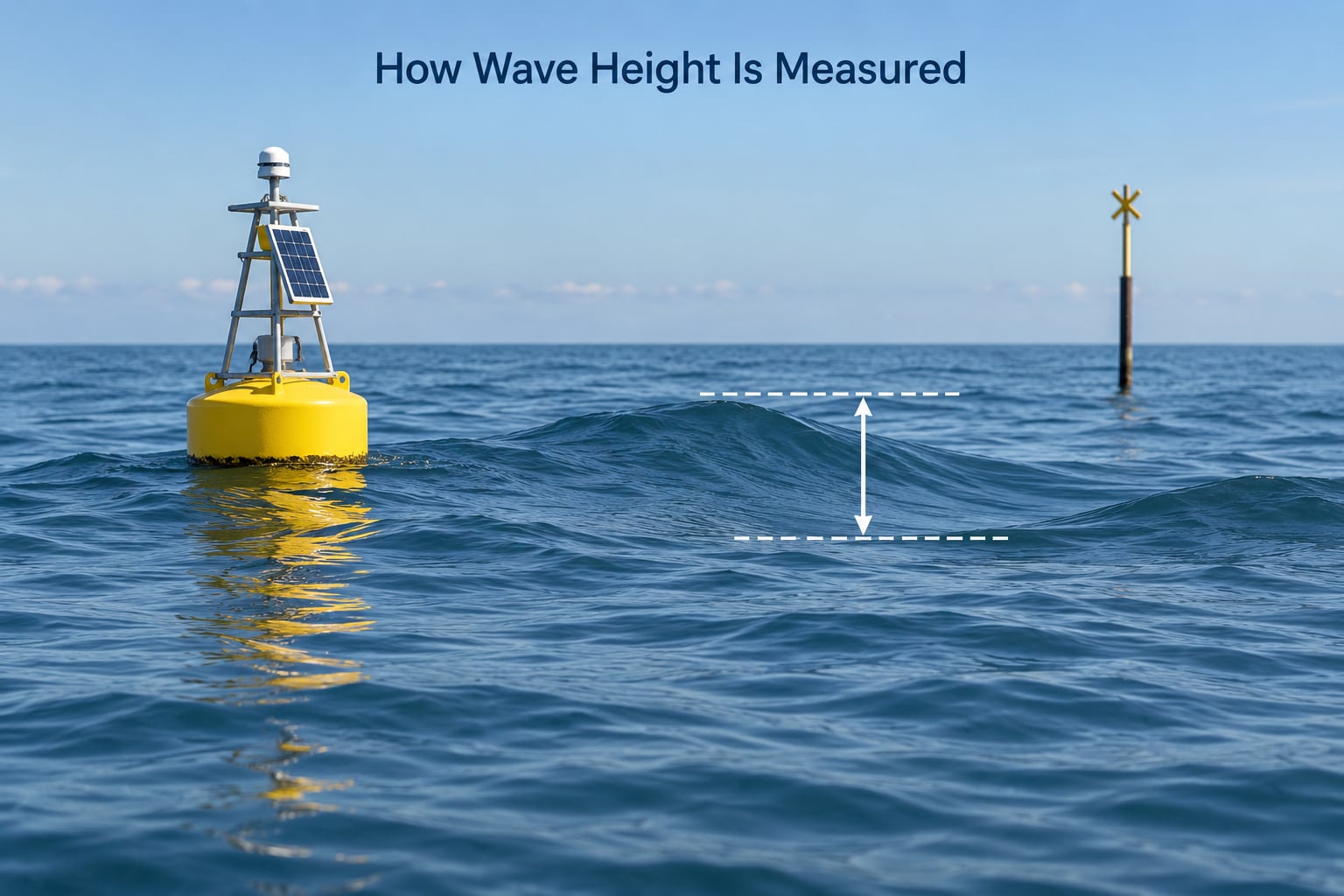
A single wave’s height is simply the vertical distance from its crest to the trough in front of it, measured at the same instant, in the vertical, not along the sloping face. That part is easy. The statistics built on top of it are where the meaning shifts.
Buoys do the basic work. A heaving buoy rides the surface, and an accelerometer or inertial unit inside measures how fast the hull is moving up and down as waves pass. Filtering that motion gives a surface elevation time series, from which crest heights, trough depths and periods are extracted. Satellite buoys add directional wave sensors so the sea state can be split by direction rather than reported as one lumped number.
For a well-mixed sea following a Rayleigh distribution, the significant wave height is derived from the variance of the surface record, and the standard deviation is multiplied by roughly 4 to give the average height of the highest third. The commonly quoted relationship is Hs = 4 × standard deviation of the surface elevation, with 3.1 appearing in simplified textbooks as an approximation of that factor. In practice, moored buoys apply a calibration constant that depends on the sensor and the sea state, which is one reason two buoys a few miles apart can report slightly different heights for the same water.
Averaging also has a window. A buoy reporting every few minutes and averaging over an hour gives a different number than a coastal station averaging over ten minutes, and a model forecast may use a 3-hour, 6-hour or 12-hour block. The sampling window is part of the number and it is rarely printed next to it.
Forecasts are a different measurement entirely. A wave model takes wind speed, wind direction, fetch, duration and bathymetry, runs them through a spectral model, and produces a grid of Hs and period values for a future time. That is a prediction, not a reading, and it cannot know about a ship anchored in a particular spot, a squall line that did not exist when the model ran, or the local bottom shape a coarse grid smoothed away.
That gap between buoy and model is normal. Check both, and weight the buoy heavily for the last few hours, because it is the only one describing the water that is actually there.
Significant Wave Height Is Not an Exact Wave Size
Significant wave height describes a group of waves, not a wave. In a well-developed sea the statistics follow a predictable pattern, and for a forecast of 4 ft Hs the wave field usually looks roughly like this:
| Wave statistic | Approximate height in a 4 ft sea | How often you meet one |
|---|---|---|
| Significant height (Hs) | 4 ft | The average of the highest third of waves |
| Highest tenth (H1/10) | about 5 ft | Roughly one wave in ten |
| Highest hundredth (H1/100) | about 6 ft | Roughly one wave in a hundred |
| Single highest wave in an hour | 7 to 8 ft | Expect one, especially if a group of big waves arrives |
| Mean height of all waves | about 2.5 ft | The whole sea, including the small ones |
Two consequences follow. First, a forecast of 4 ft is not a promise of 4 ft as a maximum, and a boat that can just about handle 4 ft of Hs will be pushed beyond it within the hour. Second, waves come in groups, and a group of five or six larger waves arriving back to back is where most knock-downs and broaches happen. The individual wave is rarely the problem; the run of them is.
The reverse also holds. A forecast of 5 ft does not mean you will never see 3 ft. Inside an hour of mixed wind sea and old swell there are quiet stretches, and in the lee of a headland the whole character changes. What that lull means is not that the sea has dropped, only that you are seeing a less energetic part of it.
This is also why experienced skippers apply their own margin. A common practice among forum regulars on sailing and small-craft boards is to mentally add roughly half again to the forecast height before deciding whether a trip is comfortable for their boat. It is a crude adjustment, and it replaces the number that actually matters, which is period.
Why Wind Sea and Swell Affect Small Craft Differently
Wind waves and swell are both water moving up and down, but they are made in completely different ways and they behave nothing alike on a small boat. Understanding the difference explains most forecast surprises.
Wind waves are built by friction. Wind drags on the surface, transfers energy to the water, and the water keeps growing for as long as the wind acts over a long enough fetch. The result is short, steep, slightly irregular waves whose crests are pointed and whose length is set mostly by how strong the wind has been recently. Wind sea looks messy: no clean pattern, crests in different places, small ones crossing big ones. A forecast calls this confused sea, and it is common in the hours after a wind shift or a squall line.
Swell is water that was organised somewhere else, usually by a storm days earlier and hundreds or thousands of miles away. Because the generating wind is no longer there, the waves spread out, lose height slowly, and settle into a much longer period. Swell arrives as an almost regular train with visible spacing, and it is remarkably consistent. On a calm day a groundswell of 3 ft from 12 to 14 seconds can keep running while the local wind is nearly calm, which surprises people who assume waves stop when the wind does.
The practical difference for small craft comes down to steepness and to where the energy sits. A short-period wind sea is steep: the height is large compared with the wavelength, so the face of the wave is close to vertical and the water has to be thrown upward and over. A long-period swell is gentle: the same height spread over a much longer slope, so the bow climbs rather than hits. Long swell also carries far more energy for its height, which is why a long, slow swell can be worse for a small hull than a shorter, taller wind sea of the same Hs.
When both are present, the sea gets more complicated rather than simply bigger. Wind chop riding on top of long swell gives a surface that never repeats, and the resulting motion is a constant low-grade instability that is tiring long before it is dangerous. It also makes the boat harder to handle, because small steering corrections produce large changes in heading.
What Wave Height Means for Small Craft in Practice
Height becomes real the moment the hull meets water. Here is what it does, and what on board you will notice first.
Pitching. A bow that rises and falls with each wave is doing normal work in a moderate sea. The problem starts when the boat cannot complete its rise before the next wave arrives, so the bow is still high when the next crest reaches it. The result is a bow that stops and drops, then lands hard, and a hull that takes a punishing vertical acceleration every period.
Slamming. Slamming is the bow entering the water instead of the wave moving down around it. One hard slam is a jolt; a run of them is how a hull gets holed at a stem or a chine, and it is the fastest way a small boat gets water inside it. If you can hear the outboard shifting and the steering loading up, you are slamming.
Broaching and knock-down. A wave striking the beam or the quarter while the boat is slow creates a yaw moment that can turn the bow into the sea. On a displacement hull that is merely alarming; on a planing craft with a light helm, it can put the boat on its side. Sea kindliness and speed relative to the wave both matter here, which is why the same sea is unremarkable at speed and unpleasant at low speed in the same boat.
Reserve buoyancy. Freeboard is the hull’s spare flotation. A small boat with a high bow and plenty of reserve can be driven into a head sea, recover, and carry on. A low-freeboard open boat with occupants seated on the sole has almost none, and the crew becomes the ballast question instead of the hull’s problem. Ditching happens when water on deck finds a way below.
Hull speed and directional handling. In a head sea, a planing boat has to work against resistance from every wave face and may never get on plane. In a following sea, the same boat is usually faster and more comfortable but has a real risk of broaching, especially if it is lightly loaded aft. Beam seas and quartering seas sit between: more comfortable than head seas, and the ones most likely to roll a boat in a short steep chop.
Spray, visibility and crew fatigue. Spray at 20 knots of apparent wind dries faster than it sounds, and cold water makes the difference between an unpleasant day and a hypothermic one. The under-rated hazard in small craft is cumulative fatigue: a crew that has been getting knocked about for two hours makes worse decisions in hour three than any forecast number would justify.
Two modifiers sit on top of all of that. Direction of travel changes the impact completely, as above. And exposure does too: a 4 ft forecast means something very different inside a bay with a 20-mile fetch than it does on an open coast with a swell arriving from the open ocean.
How Wave Height Affects Different Types of Boats
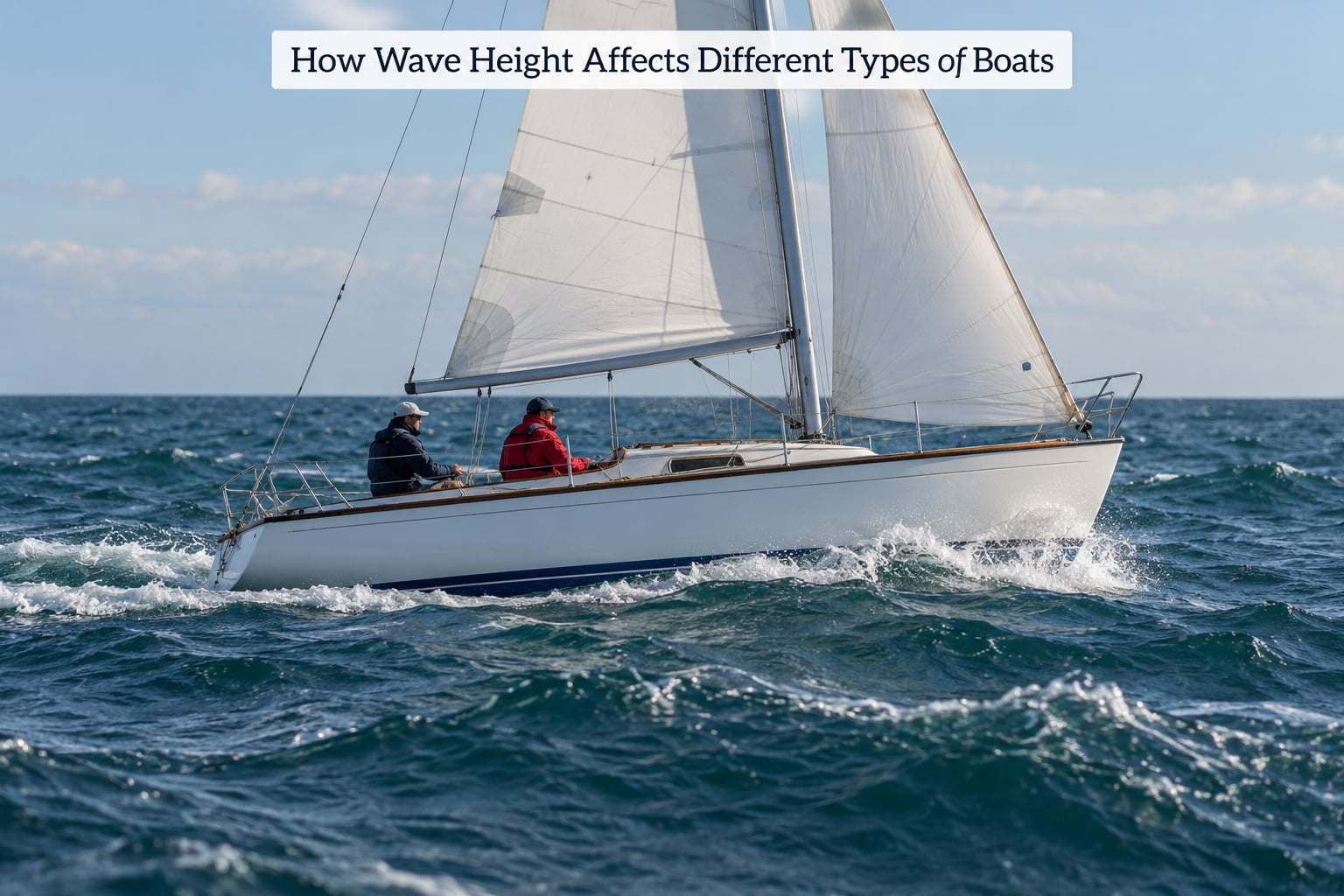
There is no universal height at which a given length of boat becomes unsafe. The comparisons below are about character of motion, using the same forecast of, say, 4 ft at 6 seconds, and they assume the vessel is used as intended with its designed loading.
| Boat type | What height does to it | Failure mode to watch |
|---|---|---|
| Small inflatable or RIB | Rides over chop well; long steep faces can fold tubes against the transom and push the bow under on a following sea | Water loading at the transom in a following sea; poor tracking in a cross sea |
| Open motorboat, low freeboard | Sprays heavily from the first feet of chop; occupants on the sole have no reserve when a wave comes over the side | Slamming, broaching at low speed, swamping from a following sea |
| Displacement cruiser or keelboat | Ignores short-period chop almost entirely; long swell at an angle produces a slow, uncomfortable motion and reduced speed | Broaching if under-canvassed or slow; hull slamming if driven at a short period |
| Planing boat at speed | Best in a following or quartering sea at power; worst in a head sea, where it may not plane at all | Knock-down in a beam sea at speed; bow-down burying in a following sea |
| Sailboat under sail | Short steep chop makes steering heavy and drives leeway; long swell on the bow slows progress and strains the rig | Broaching on a wave with no way on; lee helm as the boat slows in a head sea |
| Personal watercraft | Very small turning circle, so it gets hit repeatedly by the same wave; handles a following sea well | Loss of control in a cross or quartering sea at low speed |
| Small unmanned surface vessel | Little freeboard and a high centre of gravity; waves exceed hull height in conditions a manned boat shrugs off | Loss of control, capsize, mooring and antenna failure, or the craft being swept under a wave and surfacing inverted |
For the autonomous case the geometry is even tighter. A small unmanned craft usually has no crew to shift ballast, and its antenna, mast or sensor dome may well be the highest point on the boat, so a wave that clears the hull can still put water into the electronics. Wave period matters twice as much there, because a long-period swell changes the vessel’s pitch attitude slowly and predictably, while short chop at the same height scrambles the control loop.
For a person in a small boat, the honest summary is that hull size sets the envelope, hull form decides whether you feel it, and where everyone is sitting decides what happens when you do. A comfort rule of thumb that circulates among small-craft skippers is to keep significant wave height below roughly a third of the hull length for a comfortable day, with the understanding that it is a comfort guideline, not a limit, and that a long swell breaks it well before a short chop would.
Wave Period, Steepness, and Direction
If you read only one number from a wave forecast, read the period. It is the one that tells you what the boat is about to go through.
Wavelength in deep water is roughly 1.56 times the period squared, in metres and seconds. A 4-second wave is about 25 m long, a 10-second wave about 156 m, and a 16-second wave about 400 m. That is why a long swell has a gently sloping face and a short chop has a wall in front of you, even at identical heights. Steepness is that ratio made concrete: height divided by wavelength.
| Period | Approximate deep-water wavelength | What it feels like in a small boat |
|---|---|---|
| 2-3 s | 10-14 m | Hard chop, constant small slaps, boat will not settle, very wet |
| 4-5 s | 25-40 m | Short steep sea, frequent hard pitching, spray |
| 6-7 s | 56-76 m | Moderate sea, boats over about 6 m begin to move noticeably |
| 8-10 s | 100-156 m | Comfortable for most small craft, slow rolling motion |
| 12 s and above | 225 m and up | Long rollers, usually easy on height but demanding if they arrive from ahead or the beam |
A widely repeated piece of small-craft advice is that anything under 6 seconds is uncomfortable in boats under about 25 ft almost regardless of height, and forum skippers consistently describe the 4 ft at 4 second combination as the worst common sea they meet. It is steep, it never lets the boat settle, and it makes the helm work continuously. The opposite case is long swell: 3 ft at 12 seconds is frequently described as barely noticeable, because the hull simply follows the surface up and down.
Direction changes the force delivered, and three cases deserve their own warning.
Cross seas arise when wind waves and swell run from different directions. The surface never repeats, and small craft tend to yaw unpredictably. It is widely agreed among experienced skippers to be the most unpleasant combination in ordinary coastal conditions, and it is the sea state in which steering inputs need to be small and early.
Confused and choppy seas come from a recent wind shift or a squall. The water still carries the old pattern while the new wind piles new waves on top, and a forecast written an hour ago can describe a sea that is still forming.
Opposing current is the case a forecast is least able to show. Waves travelling against a tide or a strong current shorten in wavelength while keeping their energy, so they become steeper and begin to break where nothing in the forecast said they would. The harbour entrance at ebb tide with an onshore swell is the classic example, and it is discussed repeatedly on small-craft forums as the place where a routine trip turns into a survival event.
Two other features round out the picture. Tidal races and overfalls form where strong currents run over shallow bottom or around headlands, producing standing waves and rough water in a fixed, repeatable place. Shoaling is the same energy concentrating as depth decreases, which is why a bar can be rougher than the open water behind the same forecast.
How to Read a Wave Height Forecast
Here is the order I use, and it takes about two minutes once you know where the lines are.
1. Identify your zone. Coastal waters extend from the shoreline out to roughly 6 to 10 nautical miles, offshore waters run to about 50, and high seas covers everything beyond. The numbers differ between every forecast office, and the same 4 ft can be coastal in one area and high seas in another. Forecast boundaries are published as small lat/lon boxes, so check which box your route actually lies in rather than assuming your home port’s zone covers you.
2. Read the sea line as a range and take the middle. A 3 to 5 ft sea is a significant height of about 4 ft, and you should expect individual waves above that. A range with a large spread, say 2 to 7 ft, is a sign the forecaster is less confident, often because a front or a swell arrival is in progress.
3. Read the period immediately after it. If the period is short, say 4 to 6 seconds, treat the trip as rougher than the height alone suggests. If it is long, 12 seconds and up, the ride will be slower and more rolling than choppy. This is the single most useful habit on the list, and it is the one people skip.
4. Separate the swell line from the wind sea line. Forecasts usually give seas from wind and swell from a direction separately, plus the dominant swell period. A long swell running against a short wind sea creates the confused surface described earlier, and it is the case where the total is much worse than either number alone.
5. Note the wind direction and compare it with your course. Wind from directly astern builds the steepest head-on sea for the trip home, and a following wind plus a following swell is the classic setup for an unmanageable broach on the return. Plan the return leg with the forecast in mind, not just the outward one.
6. Check the advisories in force. A small craft advisory is issued when sustained coastal winds or gusts reach roughly 15 to 25 knots, and some zones also trigger it on seas of 7 ft or more. It is a statement about conditions, not about your boat, and the definition of small craft is not standardised, so a 30 ft boat may be outside the intent of the advisory and a 18 ft one well inside it.
7. Compare the buoy to the model. Look at the nearest real-time buoy, read the significant height and dominant period, and note the trend over the last three hours. Rising quickly means wind is building ahead of you. A buoy that is much rougher than the forecast is telling you the model is behind, and the offshore wind forecast is usually the more accurate of the two anyway.
8. Add tide, depth and local knowledge. Check the tidal state for your arrival time, note any bar or shallow shoal on your route, and if you are heading somewhere unfamiliar, ask the harbormaster or a local operator what the bar is doing. Local accounts consistently beat a forecast for the last mile of any trip.
9. Make the decision and write it down. Compare the height and period you now have against your boat’s demonstrated behaviour, not against a rule from the internet. Then leave a float plan with someone ashore: route, launch and recovery times, boat description, number of people aboard, and a check-in time.
How Small-Craft Limits Are Expressed
Several different numbers get called a safe wave limit, and they do not mean the same thing. Knowing which one you are looking at prevents a lot of misplaced confidence.
- Significant wave height in a forecast — a prediction of a statistic, with a range and an uncertainty that grows with lead time. It is not a limit; it is a description of what is likely.
- Wind sea versus swell — forecasts quote these separately because they behave differently. A 4 ft wind sea at 5 seconds and a 4 ft swell at 13 seconds are two different days on the water.
- Small craft advisories — wind-based alerts from the national weather service, with thresholds that vary by zone and no legal definition of the vessel type they refer to. They tell you the atmosphere is capable of making dangerous seas, not that your boat will.
- Harbour and bar restrictions — local rules about swell height, tide height and time of day at a specific entrance, often stricter than the offshore forecast because conditions there are amplified.
- Manufacturer test conditions — the wave heights a boat was designed and tested for, usually a specific standard condition rather than a promise. Useful, and often better documented than anything on an app.
- Design wave height — a figure from naval architecture, chosen so structural loads and motions stay within limits. It tells you about survivability, not comfort, and it is rarely the number that stops you launching.
There is no universal safe limit for small craft, and anyone offering a single number is selling something or oversimplifying. The honest approach is to use the manufacturer’s information for what the boat was built for, the forecast for what is coming, and your own experience of how this boat behaved last time the numbers were similar.
One frequently quoted rule deserves a caution. The claim that capsizing becomes likely once waves reach about half the boat’s length, and near certain above about 60 percent, is a coarse guide that ignores hull form, loading, speed and direction entirely. It is a reasonable reminder that hull length matters. It is not a threshold to plan against.
Wave Height and Boat Design Decisions
For designers and builders of small craft, the same forecast numbers feed directly into design choices, and the goal is to make the boat’s motion predictable rather than merely survivable.
Freeboard sets how much energy the hull can absorb before water comes aboard, and it is the single strongest link between wave height and capsize risk. A high bow on a small workboat buys reserve that a low-freeboard skiff does not have at any length.
Hull deadrise decides how a wave face meets the bottom. A shallow-V or flat hull slams in a short sea because it cannot deflect water upward quickly enough; deep-V and multi-chine hulls soften the same encounter but carry more wetted surface and drag. Round-bilge and deep-vee forms handle a wider range of conditions at the cost of efficiency in light air.
Mass distribution and centre of gravity control how the boat responds once a wave has moved it. Weight low and centred reduces roll, and keeping it fore and aft where possible improves the boat’s resistance to being turned by a beam sea. A design that works empty may be far less stable with the standard load of fuel, battery and gear.
Structural loads for a small boat are usually driven by slamming rather than by average wave height, which is why the fatigue design case is a single severe wave impact repeated, not a static load. For an unmanned craft this is even more direct: the hull must survive being hit by a wave with nobody aboard to shift the ballast.
Control surfaces and control authority. A small boat needs enough rudder area and throttle range to hold a heading through a wave face, and that need scales with the wave energy rather than the hull length. Remote and autonomous craft need the same, plus control loops that stay stable as the hull pitches, which is a function of wave period and of where the sensors and antennas are mounted.
Sensor placement on small and autonomous craft deserves its own note. An accelerometer or antenna mounted high in a pitching hull gives a noisy, biased estimate of the vessel’s motion, and a hull that is repeatedly dunked will produce gaps in the data exactly when the data matters most. Mounting near the centre of rotation, and sealing everything above the design waterline, is a large part of reliable operation in a 3 to 4 ft sea.
For autonomous operations, the honest engineering position is that a wave height above the freeboard of an unmanned craft is an operation-stopping condition regardless of what the hull could physically survive, because control and communication are lost before the structure is at risk.
Practical Safety Takeaways
The habits that keep small-craft trips boring are simple, and most of them happen before the engine starts.
Compare height with period and direction together. A number on its own is not a decision, and the most common mistake is letting a moderate height at a short period get treated as a moderate height.
Leave when conditions are building rather than when they are already past your limit. Wind builds seas over hours, and the sea you launch into at 10 knots of wind is not the sea you will be coming back into at 20.
Carry a float plan and a check-in time with someone ashore, a working VHF radio, and a personal locator beacon if you regularly work outside reliable coverage. Waterproof the essentials, and remember that cold water kills long before anyone realises how cold it is.
Watch the trend, not just the reading. A rapid drop in barometric pressure, a squall line on radar, or a buoy climbing steadily over two or three hours all tell you more than the current number does.
Know your local hazards: the bar that breaks on an ebb, the tidal race behind the headland, the spot where an onshore swell stacks up. Ask someone who works there, and take the answer seriously.
We keep this guide current as official products and advisory thresholds are revised, so it reflects the practice in 2026. For conditions that matter to your own boat, your national weather service and your local harbormaster are the two authorities worth trusting first.
Frequently Asked Questions
Is a wave height forecast the height of the biggest wave I will see?
No. A forecast wave height is significant wave height, the average of the highest third of waves over the forecast period. In a 4 ft sea, roughly one wave in ten reaches about 5 ft, one in a hundred reaches about 6 ft, and the tallest in an hour can be 7 or 8 ft. It also means the opposite: 5 ft on the forecast does not rule out seeing 3 ft at times.
Why can small waves be more dangerous than taller waves for a small boat?
Because period sets steepness, and steepness sets how hard the boat is hit. Two feet at four seconds is a short, near-vertical face that knocks a small hull down and never lets it settle. Two feet at fourteen seconds is a long, gentle slope the boat simply follows. Long-period swell also carries far more energy for its height, so a slow 4 ft swell can be worse than a choppy 3 ft wind sea.
Does a calm-looking gap between waves mean conditions are safe?
No. Lulls are normal in any mixed sea and they usually mean you are seeing the smaller part of the wave field, not a change in conditions. The dangerous pattern is a run of larger waves arriving close together, and a lull is often where people stop paying attention. Check the period, the buoy trend and the advisories before treating a quiet patch as an all-clear.
Should I use wind wave height or swell height for trip planning?
Use both, and treat them as separate problems. Wind wave height with its short period is usually the bigger handling issue close to shore, while long swell arriving from a direction against your course can dominate the trip and slow you down. When both run from different directions you get a confused sea, which most experienced skippers rate as the most unpleasant common condition.
How do I choose a safe wave limit for a specific small craft?
There is no universal limit, so build your own from three sources: the conditions your boat was designed and tested for, what the forecast gives for height, period and direction on the day, and your own record of how this boat behaved in similar conditions. Then subtract a margin. Add local factors like tide, bars and tidal races, and let a harbormaster or local operator override the numbers.
Conclusion
Wave height is one variable in a three-variable decision, and it is the one people overweight. Start every morning by reading the significant height, then the period, then the direction against your planned course, and check what a nearby buoy is actually reporting. Compare that with what your boat has demonstrated in conditions you recognise.
If the numbers and your experience disagree, go with the boat and the buoy. And if a number is all you have, treat it as the first third of a story you have not finished reading.