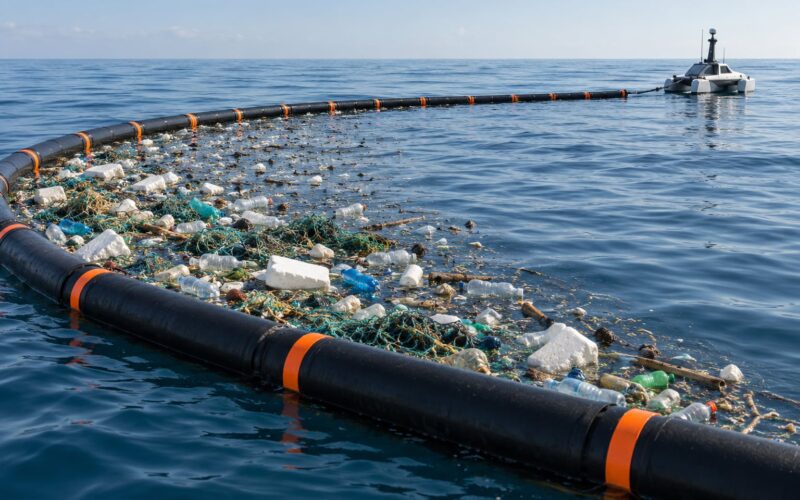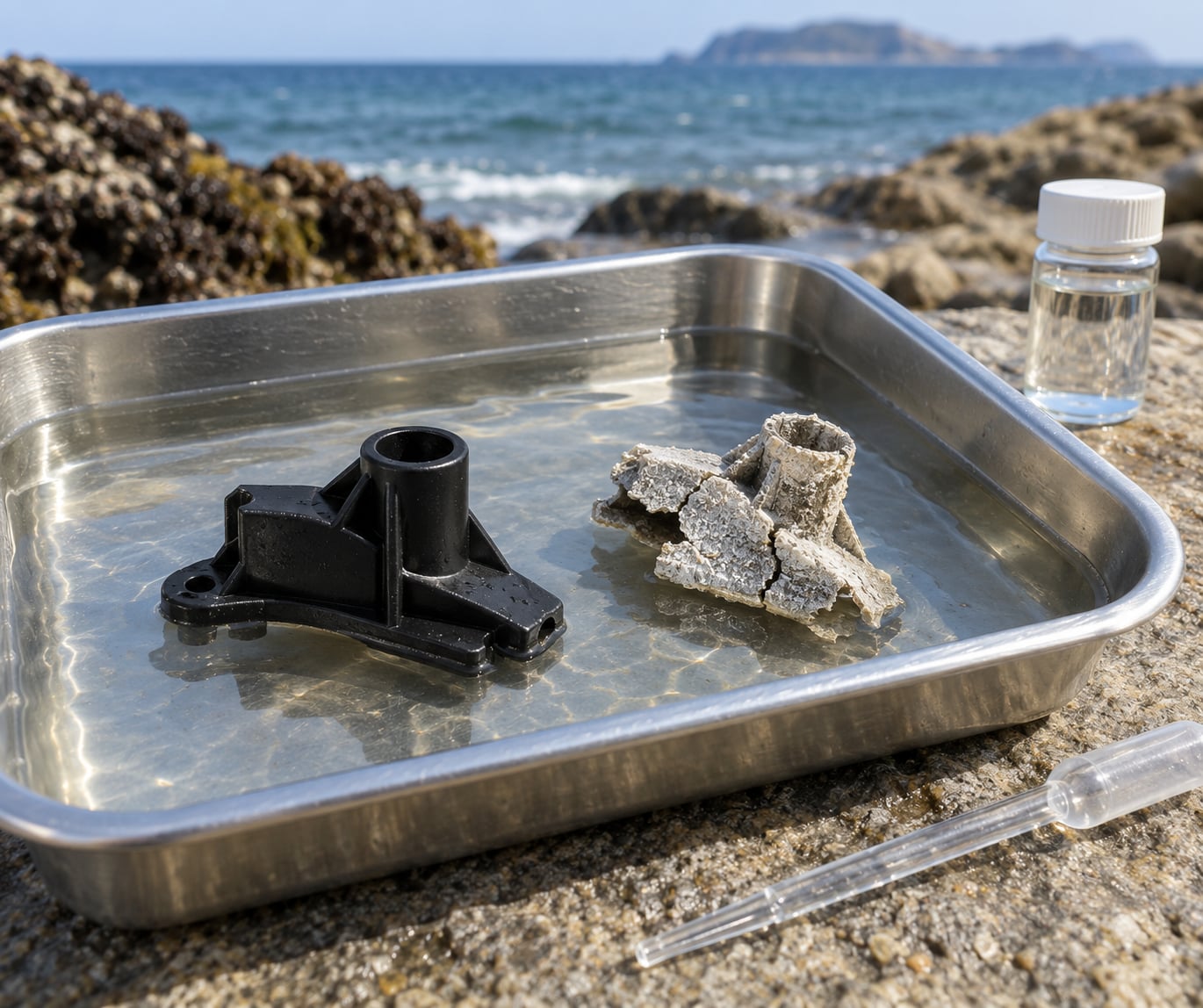
Plastics break down in seawater through a slow cascade of chemical and physical weathering, not by dissolving. Sunlight-driven photo-oxidation, water-driven hydrolysis, abrasion and microbial colonization weaken the polymer until it crumbles into microplastics and then nanoplastics. For conventional plastics, fragmentation is the normal end state, and at human timescales it is effectively permanent.
The confusion starts with the word break down. It covers two very different processes, and the search results mix them constantly. One is true dissolution, where a material comes apart into its building blocks in solution. The other is weathering, where a solid polymer degrades, embrittles and fragments while staying solid the whole way. Almost everything floating in the ocean is doing the second thing.
Key takeaways
- Conventional plastics do not dissolve in seawater. They weather, embrittle and fragment.
- UV light is the main engine at the surface. Without it, degradation slows by orders of magnitude.
- The usual endpoint is microplastic (5 mm and below), then nanoplastics, not harmless disappearance.
- Polyolefins such as polyethylene and polypropylene have no hydrolyzable bonds, which is why they persist for centuries.
- Headline figures like 450 years are extrapolations from short lab exposures, not direct measurements of the same item.
- Design choice matters more than most people expect: material, fasteners and inspection intervals decide how much debris you release.
Table of Contents
- What Happens When Plastic Enters Seawater?
- How Plastics Break Down in Seawater
- Which Plastic Types Last Longest?
- From Macroplastics to Microplastics
- What Environmental Conditions Control Plastic Breakdown?
- Do Microplastics Fully Biodegrade in the Ocean?
- How Can Researchers Test Plastic Degradation in Seawater?
- How to Reduce Plastic Release from Marine Equipment
- Frequently Asked Questions
- Does seawater dissolve plastic?
- How long does plastic take to break down in seawater?
- Does salt water make plastic degrade faster?
- Why does ocean plastic become microplastic instead of disappearing?
- Can biodegradable plastic safely break down at sea?
- How do scientists measure plastic degradation in seawater?
- Conclusion
What Happens When Plastic Enters Seawater?
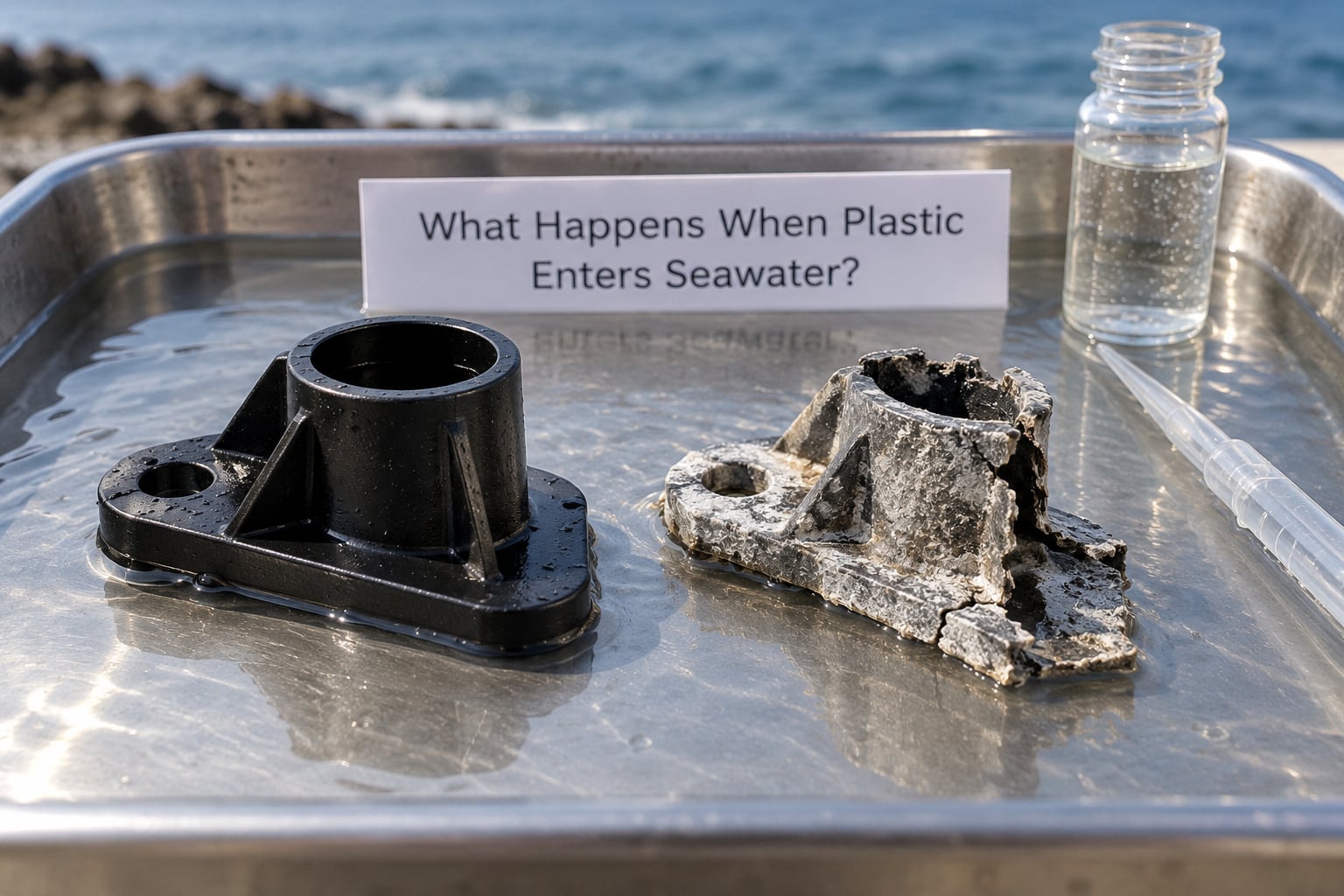
When plastic enters seawater it does three things at once: it absorbs water, it heats up and cools with the water around it, and it starts collecting a biofilm on every roughened patch of its surface. None of that is degradation yet. It is preparation for degradation.
The useful way to think about how plastics break down in seawater is as a sequence rather than a single reaction. Light attacks the polymer chains first. Those shortened, oxygen-burdened chains lose their strength. Wave action then does the physical work of tearing the weakened material into pieces. Once the pieces are small, chemistry and biology pick up again at the new surfaces.
Dissolves or degrades: why the distinction matters
A 2024 paper from a RIKEN team with the University of Tokyo described a supramolecular polymer held together by reversible salt bridges between charged monomers. Seawater reverses those ionic bonds, and the material dissociates into its original monomers within one to two hours, leaving no fragments behind.
That is a genuine and impressive result, and it is the source of most headlines claiming a plastic that breaks down in seawater. But dissociation into monomers is a different physical event from environmental weathering. The monomer solution then biodegrades further, and the material reportedly disappears from soil in about ten days while releasing phosphorus and nitrogen that plants can use.
So when you see a news story about a plastic that vanishes in salt water, the honest question is whether the material was engineered to disassemble in water. That is not what happens to the polyethylene rope, the polypropylene bottle or the ABS housing on a drifting buoy.
How Plastics Break Down in Seawater
Plastic degradation in seawater runs through five stages in order, and each one makes the next one faster. Nothing is dramatic on any single step.
1. Photo-oxidation at the surface
Ultraviolet radiation between roughly 290 and 400 nm is absorbed by chromophores in commercial polymer formulations, including leftover catalysts, pigments and stabilizers. The absorbed energy breaks carbon-carbon and carbon-hydrogen bonds, and oxygen from the air and water fills the broken ends with hydroxyl, peroxy and carbonyl groups. This is chain scission, and the carbonyl peak is the signal researchers track to prove it happened.
The surface layer yellows, goes chalky and loses its original gloss. It does not get thinner evenly. Damage concentrates where the surface is roughest, under stress points and around scratches.
2. Embrittlement
Shortened chains mean lower molecular weight, which means the material can no longer stretch before it fails. Elongation at break is the sensitive measure here. A polyethylene film or rope can lose most of its ductility while its mass is essentially unchanged, which is exactly why weight alone tells you very little about how far a piece has degraded.
3. Mechanical fragmentation
Brittle plastic in moving water breaks along crack lines. Wave action, tidal cycling, sand and suspended sediment grind the surface, and each fresh surface becomes another site for light and chemistry. This is the step that produces the pieces people now measure. A crate that entered the sea whole may reach the seabed as thousands of pieces, none of them large enough to be picked out.
4. Hydrolysis of susceptible bonds
Polyesters such as PET and PLA, along with polyamides and polyurethane, contain ester, amide or urethane linkages that water can split. Salt ions and the slightly basic nature of seawater participate in this process, and hydrolysis gets faster as the material heats up and as acids released by earlier oxidation build up on the surface.
Polyolefins sit outside this pathway entirely. Polyethylene and polypropylene are built from carbon and hydrogen only, with nothing for water to attack. That single fact explains most of their persistence in the marine environment.
5. Microbial colonization and pit formation
Biofouling starts within days on any surface rough enough to hold a little organic film. Bacteria and fungi settle, secrete polysaccharides that glue them and other organisms to the plastic, and the biofilm changes the local chemistry at the interface. Microbial enzymes such as hydrolases, lipases and peroxidases attack accessible bonds, and pits form around colonised sites.
Scanning electron micrographs of deep-sea polyethylene recovered from the South China Sea at depths between 746 and 3997 m showed exactly this corrosion-pit morphology. Photo-induced force microscopy measurements put the volume loss from those pits at 1.08 to 13.72 percent of the polyethylene, which is a meaningful fraction for material that had spent years in cold, dark water with no ultraviolet light at all.
Does salt water make plastic degrade faster?
Salinity helps, but it is not doing the work people imagine. Salt water does not dissolve plastic, and the presence of salt does not turn a bottle into something that disappears. What salinity does is change the chemistry at the surface: ions screen charges, shift the local pH slightly toward alkaline conditions, and keep dissolved oxygen available in a form microbes can use.
The conditions that actually control the rate are sunlight, temperature, mechanical energy and time. Ultraviolet exposure dominates at the surface, where water absorbs almost all of it below the first metre or two. Warm water speeds hydrolysis and keeps microbial enzymes active. Cold, dark water slows everything, which is why deep-sea material shows measurable but small degradation even after years.
The dissolved oxygen matters too. Low-oxygen zones and anoxic sediments slow oxidation-driven chain scission, and low temperatures suppress the psychrophilic and barophilic organisms that would otherwise drive mineralization. Residence time is the multiplier on everything else, and it is the reason a bottle on a beach and the same bottle on a mid-ocean gyre can be in very different condition despite the same polymer.
Which Plastic Types Last Longest?
Polymer chemistry sets the ceiling on how fast seawater can work on a material. Families with no hydrolyzable bonds rely almost entirely on light and mechanical action, which makes them the most persistent.
| Polymer family | Dominant degradation route | UV dependence | Typical uses | Relative persistence in seawater |
|---|---|---|---|---|
| Polyethylene (PE, HDPE, LDPE) | Photo-oxidation then brittle fracture; minimal hydrolysis | Very high at the surface | Bottles, film, rope, buoys, liners | Highest; fragments rather than degrades |
| Polypropylene (PP) | Photo-oxidation, chain scission, crazing and cracking | Very high at the surface | Strapping, rope, packaging, housings | High; known for brittle cracking after weathering |
| PVC (rigid) | Photo-dechlorination, plasticiser leaching, embrittlement | High | Pipe, cable, buoys, marine hardware | High; loses strength and sheds additives |
| Polyurethane | Hydrolysis of urethane bonds, then chain scission | Moderate | Seals, hoses, coatings, fenders | Moderate; moisture-sensitive by design |
| PET | Hydrolysis of ester bonds plus photo-oxidation | Moderate | Beverage bottles, strapping, films | Moderate; embrittles and sheds fibres |
| Polystyrene (PS) | Photo-oxidation, chain scission, crazing | Very high | Foams, floats, packaging, optics | High; foams fragment into light rigid grains |
Order matters here. Polyethylene and polypropylene sit at the top of the table because water has nothing to attack in them. PET and polyurethane degrade faster because water has somewhere to start. Polystyrene floats easily and its foamed form breaks into small light fragments that stay in suspension.
What does not change with polymer type is the endpoint for any of them at sea. These are the families behind a 292-year maximum residence estimate for deep-sea polyethylene, which is itself an extrapolation built from pit-volume measurements rather than a directly observed lifetime.
From Macroplastics to Microplastics
Fragmentation is where seawater degradation stops being a chemistry problem and becomes a pollution problem. The usual size classes are straightforward: macroplastics are larger than 25 mm, microplastics are 5 mm down to about 1 micrometre, and nanoplastics sit below that, measured in micrometres and nanometres.
Fragments form wherever mechanical energy exceeds the local strength of the weathered material. That means the surf zone, rocky shorelines, breakwaters, and anything repeatedly flexed or abraded. A rope under tension fails differently from a crate being tossed on a beach, and a foam float sheds far smaller particles per event than a solid housing does.
Weathering changes more than size. Density shifts as the surface roughens and traps air, bubbles and biofilm, and a fragment that started denser than seawater can begin to float. Shape shifts too: flakes stay suspended longer than spheres, and long thin fibrils tangle with marine snow more readily. Surface area rises faster than volume, which speeds up every surface-driven process and makes the fragments far easier for organisms to ingest.
What Environmental Conditions Control Plastic Breakdown?
Degradation rate is set by a handful of conditions, and knowing which one dominates tells you what a specific item will look like at recovery.
| Condition | Effect on plastic degradation in seawater | Direction of the effect |
|---|---|---|
| Ultraviolet light | Drives photo-oxidation and chain scission in the surface layer | Strongly speeds it up |
| Depth | Reduces light, then drops temperature and slows biology | Slows it sharply below the photic zone |
| Temperature | Increases hydrolysis rates and microbial enzyme activity | Speeds it up |
| Salinity | Ion screening and local pH shift at the surface film | Modest speed-up for polyesters |
| Dissolved oxygen | Feeds oxidation chemistry and aerobic colonisers | Slows it in anoxic zones |
| Mechanical energy | Wave, tide, sand and sediment abrasion breaks brittle material | Governs the fragmentation rate |
| Biofouling | Adds mass, roughens the surface, hosts enzymes and pits | Slow, steady contribution |
| Residence time | Accumulates every other effect | The dominant multiplier |
Two items made of the same polymer at the same depth can look completely different if one is being ground against rock in a tidal race and the other is sitting inside a sheltered mooring. The physical environment usually matters more than the chemistry of the water itself.
Do Microplastics Fully Biodegrade in the Ocean?
No, not at any rate that matters, and there is an important reason. Fragmentation and mineralization are different reactions. Fragmentation makes smaller plastic. Mineralization converts carbon into carbon dioxide and water through microbial metabolism, and that is the only route that removes plastic from the environment.
Mass loss from washing and abrasion is easy to measure and gets called degradation in headlines. Oxidation by itself, for example, adds oxygen to the material, so a sample can gain weight while its chains are being cut. Oxidation followed by dissolution of those products is real loss, but it is slow for polyolefins and it is the part of the process nobody has good field data for.
This is why a piece of coastal plastic with a heavy biofilm on it is often described as biodegrading. Attachment is not the same as mineralisation. Microorganisms do colonise plastic at depth, and cold-adapted enzymes from psychrophilic and barophilic species are known to work on some polymers, but the measured rates in field studies remain very low relative to the input of plastic.
Additives complicate it further. Plasticisers, stabilisers, pigments and flame retardants leach out of the matrix as it weathers, so a fragment can lose several percent of its mass while leaving a stiff, brittle residue behind. Those released chemicals are also the fraction most likely to be available to organisms.
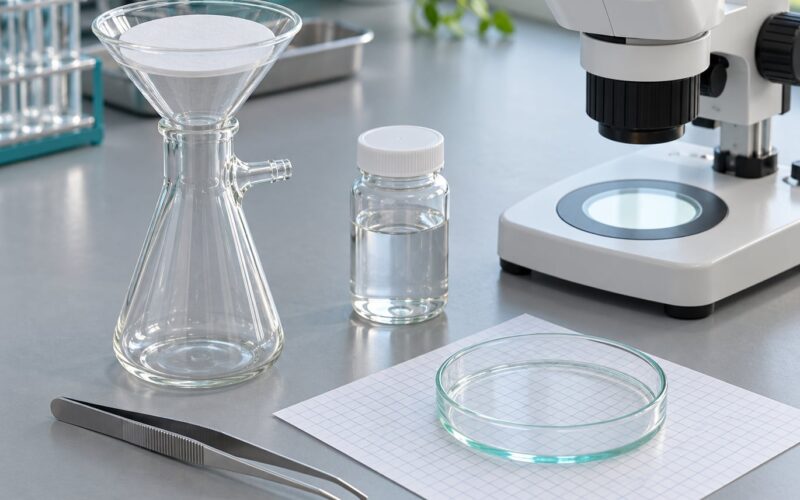
How Can Researchers Test Plastic Degradation in Seawater?
Standard test designs pair controlled exposure with several independent measurements, because no single method tells the whole story.
- Exposure setups. Mesocosms or in-situ cages hold a known polymer sample in natural or synthetic seawater at a defined depth, with sacrificial coupons so each timepoint has its own specimen.
- Mass change. Gravimetry after conditioning, with the caveat that oxidation can add mass. Mass-loss rates from short exposures get extrapolated to headline lifetimes, and that extrapolation is where figures like 450 years come from.
- Spectroscopy. FTIR and Raman track the appearance and growth of carbonyl bands, giving a semi-quantitative index of photo-oxidation that is far more sensitive than weighing the sample.
- Mechanical testing. Tensile strength and elongation at break show functional loss well before any visible change.
- Microscopy. SEM images pit formation and surface erosion directly; photo-induced force microscopy and profilometry turn that imagery into pit depth and volume numbers, as the South China Sea polyethylene study did.
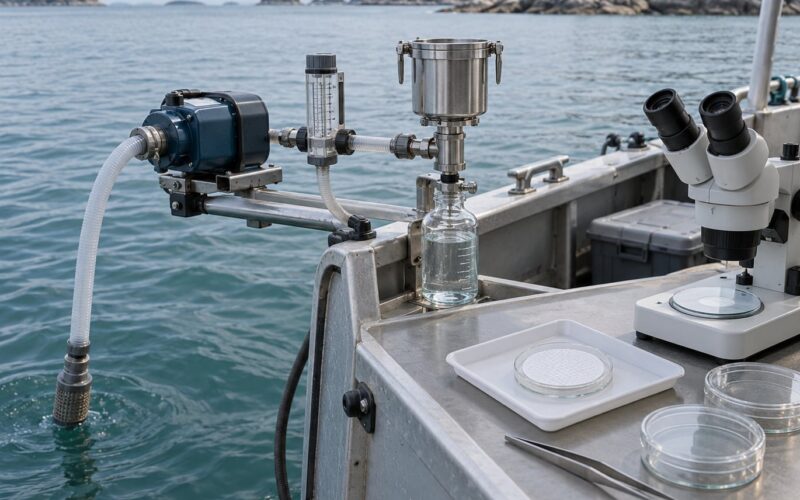
- Fragment sampling. Pumps, nets and sieves on the water column and sediment traps catch what the material broke into, which is how microplastic counts and shape distributions are produced.
- Mineralisation assays. Respirometry and evolved carbon dioxide tracking separate true biodegradation from physical loss, which is the measurement most often missing from headline claims.
Confounders are everywhere. A cage traps sediment and abrades a sample mechanically. Lab seawater is cleaner and warmer than real coastal water. A coupon suspended at one depth says nothing about an item that drifts and beaches. Results from one polymer formulation do not transfer to another, because stabiliser packages differ wildly between grades of the same nominal material.
How to Reduce Plastic Release from Marine Equipment
If you build or maintain anything that lives in seawater, the science above turns into a short list of practical choices.
- Pick polymers for the environment. Polyesters and polyurethanes give you more chemical routes to break down than polyolefins do. That is not an argument for degradation as a disposal plan, but it removes the worst case of a single material dominating the debris field.
- Reassess every tie-down and fastener. Fittings, cable ties and bolt heads fail far more often than the housings they hold. Secure them positively, and choose metal or captive fasteners over small plastic components that can escape into the water column.
- Design for retrieval. A sensor with a lifting eye, a bright surface and a written recovery procedure is gear you get back. Gear you get back never becomes marine debris, whatever polymer it is made from.
- Replace on condition, not on schedule. Inspect housings and float modules for chalking, stress whitening, crazing and crazed fastener holes. UV-damaged material often looks intact until it is loaded, then fails suddenly.
- Keep wear surfaces off the sea. Moving parts, bearing surfaces and rotating joints abrade faster than static ones. Where the duty cycle allows, shield them or swap in a sacrificial polymer component you expect to lose.
- Contain what abrades. Filters and catch bags on intakes stop fragments that a part has already shed. On a cleanup or aquaculture system, that is usually the difference between recovering debris later and recovering it on the spot.
- Plan the end of life. Have a route for retired equipment before it goes in the water. Gear headed for a landfill or a recycling stream never spends twenty years chewing itself apart offshore.
Fishing gear deserves its own note. Nets, ropes and floats are the items most often recovered in degraded condition, and they are also the items with an obvious owner. Marking gear, maintaining it and recovering it is more effective than any material choice available today.
Frequently Asked Questions
Does seawater dissolve plastic?
No. Conventional plastics are insoluble in seawater and do not dissolve into it. What seawater does is help break the polymer down chemically and physically over long periods, which produces smaller solid fragments rather than a solution. The exception is an engineered polymer held together by reversible ionic bonds, which can be designed to disassemble into its monomers on contact with salt water.
How long does plastic take to break down in seawater?
Longer than any useful timescale, and the honest answer is that nobody has measured a single item from release to disappearance. Figures such as 450 years or 1000 years are extrapolations from short exposure tests, usually by measuring what percentage of mass or molecular weight disappears per year and scaling up. Surface items fragment in months to years; deep-sea polyethylene shows measured degradation around 1 to 14 percent over multi-year exposures.
Does salt water make plastic degrade faster?
Marginally, and only for polymers with bonds water can attack. Salt ions screen charges at the surface and slightly shift local pH, which modestly speeds hydrolysis in polyesters such as PET. Polyethylene and polypropylene contain no hydrolyzable bonds, so salinity changes almost nothing for them. For those materials, ultraviolet light, temperature, abrasion and time dominate the rate.
Why does ocean plastic become microplastic instead of disappearing?
Because chain scission breaks plastic into more plastic. Ultraviolet light and oxidation shorten polymer chains and make the material brittle, then waves, tides and sand grind it into fragments. Each new fragment has a larger surface area, so the same reactions continue faster on it. Nothing in that sequence converts the carbon into carbon dioxide and water, which is what true biodegradation would require.
Can biodegradable plastic safely break down at sea?
Rarely, at least not on the timescale people assume. Most biodegradable and compostable products are certified for industrial composting at around 60 degrees Celsius, not for cold, oxygen-limited seawater. PLA in particular hydrolyses far too slowly at marine temperatures to disappear on its own. Look for a marine-degradation certification with a stated environment, temperature and time, and treat compostable labelling as a waste-stream instruction rather than an ocean claim.
How do scientists measure plastic degradation in seawater?
They combine exposure tests with several independent measurements, because no single one is enough. They weigh conditioned specimens for mass change, use FTIR and Raman spectroscopy to track carbonyl growth as an oxidation index, run tensile tests to catch mechanical losses early, and image surfaces with SEM to quantify corrosion pits. Mineralisation assays that track evolved carbon dioxide are the ones that actually prove biodegradation rather than physical loss.
Conclusion
The short version is that seawater does not dissolve plastic. It weathers it, through photo-oxidation, hydrolysis, abrasion and microbial colonization, and the material survives as smaller pieces of itself. For the polyolefins that make up most marine debris, the sequence ends in microplastics and nanoplastics rather than harmless disappearance, and that outcome is effectively permanent at any human timescale.
Three things follow from this for anyone working with marine hardware. Assess the actual exposure: light, depth, temperature and mechanical energy tell you more than the polymer name alone. Choose materials and fittings for the environment they will really sit in. Then inspect on condition rather than on schedule, because UV-damaged polymer loses most of its ductility while still looking fine.
As of 2026, the most promising work is not in making conventional plastic vanish faster but in engineering materials that disassemble on purpose in salt water, and in the measurement science that lets us tell those apart from plastic that merely falls apart into smaller plastic.