Skimmers recover oil from water by floating an intake at the oil-water interface, holding back the water underneath, and diverting the floating oil layer into a collection chamber. The oil is then separated from any water and debris that came along, and moved to storage. That is a different job from filtration, chemical dispersion or biodegradation, which all work on oil the skimmer can never reach.
Everything interesting about skimmers happens in that first sentence. An interface is a moving target, waves fold and stretch it, cold water thickens the oil, and any water that slips past the weir has to be dealt with later. What follows is a look at how the mechanisms work, where each design gives up its advantage, and how operators actually measure whether a skimmer is doing its job.
Table of Contents
- How Skimmers Recover Oil from Water
- What Is an Oil Skimmer and What Does It Do?
- How Skimmers Recover Oil from Water: The Basic Process
- The Main Types of Oil Skimmers
- Weir Skimmers vs. Suction and Drum Skimmers
- What Affects an Oil Skimmer’s Recovery Rate?
- Why Some Skimmers Recover More Water Than Oil
- How to Choose a Skimmer for a Particular Cleanup Job
- How Field Operators Test and Monitor Recovery
- Safety, Environmental Limits, and Maintenance
- Frequently Asked Questions
- What is the basic principle of how skimmers recover oil from water?
- Are weir skimmers better than drum or suction skimmers?
- Can an oil skimmer remove oil that is already underwater?
- How much water should a well-designed skimmer collect with the oil?
- Which skimmer works best for waves and rough sea conditions?
- How do operators measure a skimmer’s actual recovery rate?
- Conclusion
How Skimmers Recover Oil from Water
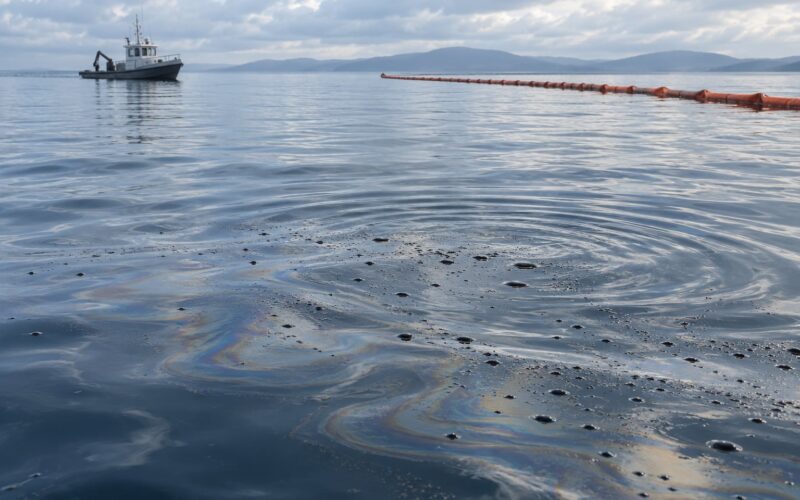
A skimmer brings surface oil to a collection interface, separates that oil from the water and any floating debris beneath it, and transfers the recovered product to a tank or drum. Because most crude products and refined fuels are less dense than water, they float and can be intercepted mechanically. Skimming removes only free product: submerged oil, oil trapped under ice or sediment, and oil dispersed into small droplets are all outside what a surface skimmer can do.
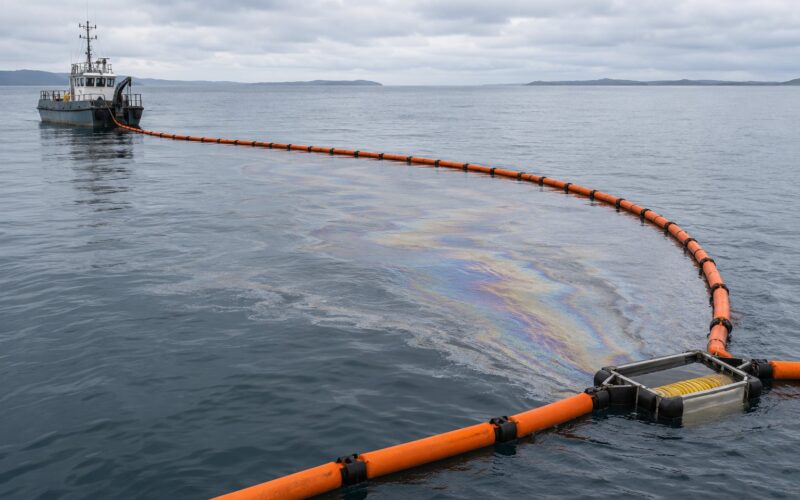
That last limit explains why skimmers rarely finish a cleanup on their own. Booms concentrate the oil first, skimmers lift it, and separation equipment cleans up what the skimmer carried in with it. When a slick thins out to a sheen, or when waves break the surface into foam, the mechanical advantage disappears and other techniques take over.
What Is an Oil Skimmer and What Does It Do?
An oil skimmer is a floating or fixed intake device that collects oil floating on the surface of water, coolant, or process liquid, and delivers it to a holding point. In site remediation the target is usually light non-aqueous phase liquid, the industry term for light hydrocarbons that float on groundwater, sometimes abbreviated LNAPL.
Three properties of the oil decide how a skimmer should be built:
- Density. Petroleum products sit close to the density of water. Light crude, diesel, and jet fuel float readily; some heavy residual fuels and bunker residues are only marginally less dense and behave differently once chilled.
- Viscosity. Thin oil flows and re-forms a slick quickly. Heavy oil resists flow, which makes it easier to catch but harder to pump and to wipe off a moving surface.
- Interfacial tension. The surface tension between oil and water is what creates a coherent film. Strong interfacial tension lets a slick hold together as it spreads; weak tension lets waves break it into fragments that a single intake may miss.
In a monitoring well or a pit, oil depth might be measured in centimetres. On open water during a spill response, the layer may be a millimetre thick and thousands of metres across. A skimmer built for the first case is useless in the second, which is why nominal capacity on a spec sheet tells you very little on its own.
How Skimmers Recover Oil from Water: The Basic Process
Every skimmer, whatever its moving parts, performs the same five stages in the same order. Some designs combine stages; none can skip them. Understanding which stage is losing you oil is usually more useful than comparing brand names.
The Recovery Sequence Step by Step
- Interception. The oil reaches the intake. For a weir skimmer this means the floating layer meets the overflow edge; for a drum or brush it means the moving surface passes through the oleophilic material. What goes wrong: the intake sits too deep, too high, or on the wrong side of the wind, so the layer simply flows past.
- Collection. The oil is confined in a chamber, tube, or film. Baffles and set liquid depth hold the oil while water drains back. What goes wrong: turbulence at the intake brings a large slug of water along and the chamber cannot drain fast enough.
- Separation. Water and free solids are removed by gravity, baffles, a stilling well, or a settling stage downstream. What goes wrong: the recovered stream looks like oil in a clear sample bottle but settles out half a tank of water in storage.
- Transfer. A pump, an airlift, or gravity moves the recovered oil to storage. What goes wrong: transfer lines run long, run uphill, or run through water below the oil line, which quietly adds water back into the product.
- Verification. The operator measures what actually arrived: oil volume, water volume, and how both changed with sea state and throughput. What goes wrong: nobody measures, so the recovered stream looks like oil until it is pumped off and half of it turns out to be water.
Stages three and five are where most complaints about skimmers come from. A device can collect beautifully and still deliver a poor result if the separation or measurement stage was never designed.
The Main Types of Oil Skimmers
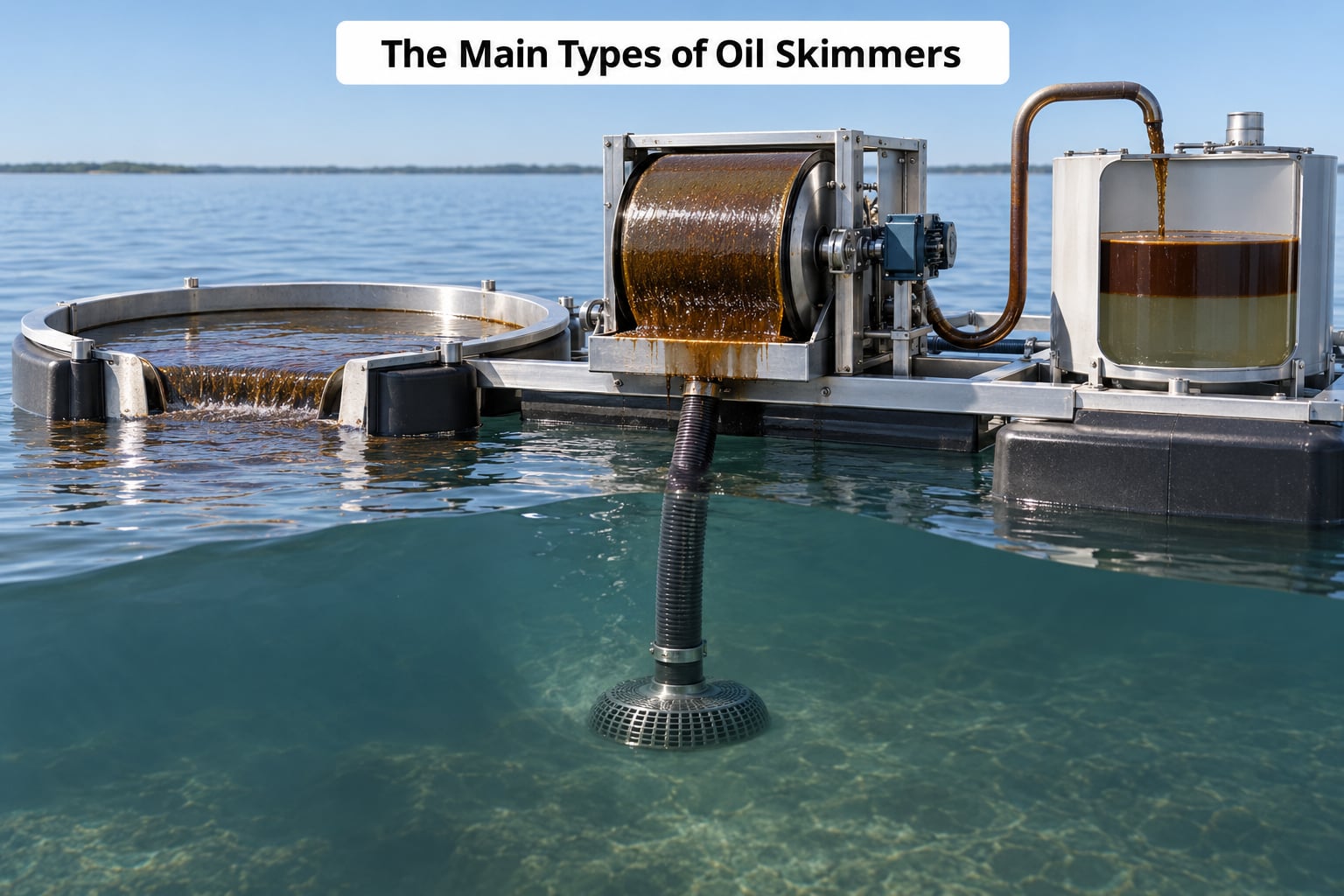
Skimmers divide into families by how the oil is intercepted. The weir family uses a gravity overflow edge, the oleophilic family uses moving surfaces that oil sticks to, the suction family uses a controlled draw, and hybrid designs combine them.
Weir skimmers
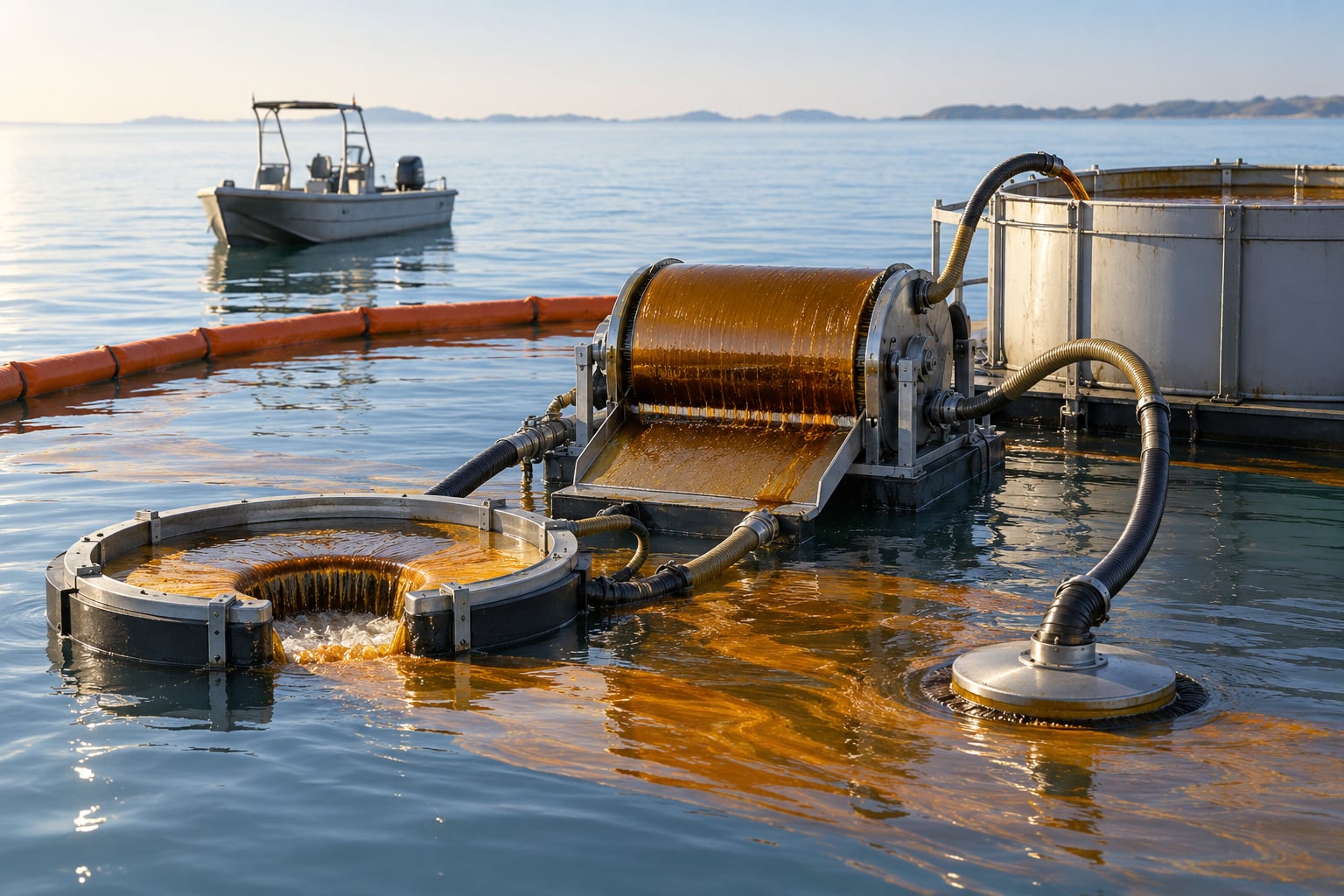
A weir skimmer floats at the surface with its overflow edge set a few millimetres below the top. Oil accumulates against the edge, builds up a head, and spills over into a collection chamber. Water that comes over with it drains back down inside the body of the skimmer. The weir height is adjustable so operators can match the set depth to the layer thickness, and many designs ride a cable or tensioned membrane rather than a rigid hull so they follow the surface in short waves.
Simplicity is the main argument for weir skimmers: no moving parts in the oil path, no power at the point of recovery, and very little that can fail in a swell. The weakness is selectivity. A weir skimmer takes whatever crosses the edge, so in any real wave condition the recovered stream carries water with it.
Oleophilic drum, brush and belt skimmers
Oleophilic materials have a strong affinity for oil and a poor one for water. A rotating drum, a bristle brush, or an endless belt passes through the floating layer, the oil adheres to the surface, and a scraper or wiping mechanism pushes it off into a tray or down a tube. Because water does not stick, the oil film leaving the surface is far more concentrated than what a weir overflows.
This is why drum and belt designs show recovered streams in the 80 to 95 percent oil range where weir skimmers on the same oil might deliver 50 to 85 percent. That advantage comes with costs: a drive, a scraper to maintain, and a sensitivity to waves. In a following sea the drum submerges, the film is washed off, and the machine recovers water while the oil goes past.
Suction skimmers
A suction skimmer draws the surface layer into a hose using a controlled vacuum or a low-flow pump. The intake is set to sit just inside the top of the floating layer, and the operator controls the flow so the draw does not pull water from underneath. Suction gives very good selectivity on thin, light oils in calm conditions, and it needs no surface-following hardware.
Its weakness is wave pumping. A vessel in a seaway heaves and pitches, and the intake alternately rises into air and drops below the layer, pulling alternating slugs of air and water. Without a stilling well or an accumulator, water pickup climbs sharply as the sea state gets worse.
Brush, disc, and hybrid designs
Disc skimmers use a stack of oleophilic discs that rotate through the surface and shed oil into a sump, which suits sumps and small water bodies where a weir would over-collect. Belt and tube skimmers extend the oleophilic surface into long narrow collectors, giving high area coverage in confined spaces like pits and sumps where a floating weir cannot sit. Hybrid skimmers pair a weir head with oleophilic elements or a suction pump, aiming for the weir’s tolerance of rough water and the oleophilic unit’s cleaner discharge.
| Type | Collection principle | Typical oil concentration | Suited to | Main limit |
|---|---|---|---|---|
| Weir | Gravity overflow of the floating layer | 50 to 85 percent | Open water, rough sea states, high debris | Carries water with the oil |
| Oleophilic drum | Oil adheres to a rotating surface, scraped off | 80 to 95 percent | Calm water, sites needing clean product | Needs calm water and power |
| Brush or belt | Oil adheres to moving bristles or belt, wiped off | 75 to 95 percent | Sumps, pits, coolant tanks | Debris clogs the surface |
| Suction | Controlled vacuum or low-flow draw | 70 to 95 percent | Thin light oils in calm or slight conditions | Wave pumping on a moving platform |
| Disc | Stacked oleophilic discs shed oil into a sump | 80 to 95 percent | Small sumps and lagoons | Limited area coverage |
| Tube | Long oleophilic tube wiped and drained | 75 to 95 percent | Narrow spaces, variable levels | Manual wiping, labour |
These concentrations are what operators report for free product under workable conditions. Treat them as a range to test against, not a specification: the same machine on a different oil in a different sea state can sit at either end of it.
Weir Skimmers vs. Suction and Drum Skimmers
The three most common designs differ on the same handful of criteria, and each one gives something up to get its advantage. Comparing them side by side is more useful than ranking them, because the deciding factor is usually the sea or the sump, not the mechanism.
| Criterion | Weir | Oleophilic drum | Suction |
|---|---|---|---|
| Intake method | Adjustable gravity overflow edge | Rotating oleophilic surface | Hose draw at set depth |
| Oil-water separation | Gravity drain back through the body | Selective adhesion, little water pickup | Depends on stilling and flow control |
| Debris tolerance | Good; solids tend to stay outside the edge | Poor; vegetation and plastics foul the surface | Moderate; depends on inlet screening |
| Energy use | None at the point of recovery | Drive power for rotation | Pump or vacuum power |
| Maintenance | Occasional cleaning, edge adjustment | Frequent scraper and surface cleaning | Line and pump servicing, leak checks |
| Suitable sea conditions | Calm through moderate, with surface-following hulls | Calm to slight; loses performance quickly | Calm to slight, or vessel-mounted with a stilling well |
| Thin light oils | Recovers volume, low concentration | Adhesion drops as the layer thins | Good selectivity if the draw is controlled |
| Very heavy oils | Good capture, may need heating | Poor wiping when cold and stiff | Poor, often outside hose capacity |
There is no universally best design. A weir skimmer in a two-metre swell recovers a great deal more total oil than a drum skimmer does in the same water, even though the drum returns cleaner product. A drum or belt unit on a still pond in a machine shop, on the other hand, will hand back a container of nearly pure oil while a weir puts half a container of emulsified sludge in the same space.
What Affects an Oil Skimmer’s Recovery Rate?
A skimmer rated at a given flow rate is rated for a condition it rarely sees. The number on the plate describes pump or weir capacity, not oil delivered. Usable throughput is the flow multiplied by the oil concentration actually achieved, and that figure moves constantly.
How Skimmers Recover Oil from Water in Rough Sea States
Wave height matters more than any other variable because it changes the geometry of the interface itself. In a long swell, a floating hull rises and falls with an almost vertical motion that leaves the weir edge below the surface long enough to draw water in. Short steep chop is harder still, because the crest and trough pass over the edge between one control movement and the next.
Wind pushes floating oil downwind at roughly two to four percent of wind speed, which is why a fixed or anchored skimmer eventually ends up on the downwind side of the slick with nothing left to collect. Operators work downwind of the boom and re-position the vessel as the slick moves.
Current and tide add a horizontal component, and a strong current carries a slick past the intake faster than the skimmer can be repositioned. Both wind and current also stretch the slick, thinning it until a fixed-position skimmer can no longer intercept enough of it.
Temperature acts on viscosity. Cold water and cold air stiffen crude and heavy fuel oil, and a slick that was mobile in warm conditions can go sluggish and patchy. The same oil in summer flows back together after a wave passes; in winter it may stay broken into rafts that drift apart.
Emulsification is the hardest limit. Wave action mixes water into oil with enough energy to create a water-in-oil emulsion that can be stable for months. Emulsified oil does not behave like a slick, does not adhere reliably, and does not separate by gravity. A skimmer cannot recover it, and adding more mechanical energy to the water makes the problem worse.
Layer thickness decides whether a fixed-depth intake is even in the right place. A drum skimmer that works well on a 5 mm layer in a harbour basin may see nothing at all on the same oil spread over open water, where the layer is measured in microns. Debris, seaweed, and floating plastics foul oleophilic surfaces and can lodge against a weir edge, and vessel motion in a following sea causes the intake to submerge repeatedly.
Why Some Skimmers Recover More Water Than Oil
Water in the recovered stream is the most common complaint about skimmers, and the causes are mechanical rather than mysterious. Entrainment comes first: when the intake opening is large and the flow is high, the local pressure drop pulls small droplets of water along with the oil.
Wave pumping adds to it. As a floating skimmer rises, the intake draws air; as it drops, it draws water, often at a much higher rate than the oil layer can supply. Poor draw is the same effect from a different cause, an intake set too deep or a pump running above the rate the layer can sustain.
Overloading is the underrated one. Turn the pump up to recover more oil and you usually recover more of everything. Once the collection chamber, stilling well, or separator downstream cannot handle the extra water, it backs up into the intake and the balance collapses.
Several fixes help, and none of them is universal:
- Stilling wells give the incoming stream time to settle, with a water leg at the bottom that drains back to the water body. They are the single most effective addition to a suction system.
- Adjustable draw means throttling the pump rather than running it flat out, and trimming the vessel so the skimmer sits level.
- Baffles and set depth inside a weir body slow the flow so water drains before it can escape.
- Settling capacity downstream buys time. Field operators have long used a two-tank arrangement, one settling while the other fills, because a storage tank given half an hour settles a surprising amount of water.
Every one of these has a limit in real conditions. A stilling well in a following sea is a well that fills with air. That is why the number that matters to an operator is the oil concentration in the storage tank, measured after settling, not the concentration at the intake.
How to Choose a Skimmer for a Particular Cleanup Job
Choose by working backwards from the oil and the water, not from a capacity figure. The order below is the sequence I would use, and each answer removes options from the list.
- Is the oil free-floating? If it is emulsified or dispersed below the surface, no surface skimmer is the right tool and the money belongs in separation, aeration, or sorbents instead.
- What is the layer thickness? Thick layers suit weirs and oleophilic collectors. Thin sheens and light fuels favour a carefully controlled suction draw or a wide-area oleophilic belt.
- What sea state can you work in? Above about 1.5 m significant wave height, expect a floating skimmer to lose effectiveness regardless of design, and plan for recovery during lulls.
- What platform is available? A workboat with power and a stable trim can run suction or drum units. A fixed pontoon with no power is limited to weirs and gravity-fed tubes.
- How much debris is in the water? Heavy weed and plastics argue for a weir, and against brush and drum surfaces.
- What is the storage and separation capacity? A skimmer that recovers three times faster than your tank can settle is not a faster skimmer, it is a separator problem.
| Situation | Starting point |
|---|---|
| Coolant sump or CNC machine bay | Belt, brush or disc skimmer, scheduled emptying |
| Monitoring well or small pit | Passive float with a visual alarm, or a tube skimmer |
| Industrial lagoon, still water | Drum or disc with a pump and settling tank |
| Coastal or marine spill response | Weir skimmer on a workboat, with two settling tanks |
| Contaminated site free product | Passive unit first, then pumped skimmer as drawdown deepens |
| Cold or ice-infested water | Expect low performance; plan containment and sorbents around it |
On cold work, plan the campaign around the constraint rather than the equipment. Ice and frazil slush obstruct intakes and prevent booms from doing their job, so recovery is slower, more hands-on, and dependent on weather windows. Operators report drift-ice conditions as the point where response plans get rewritten mid-incident.
How Field Operators Test and Monitor Recovery
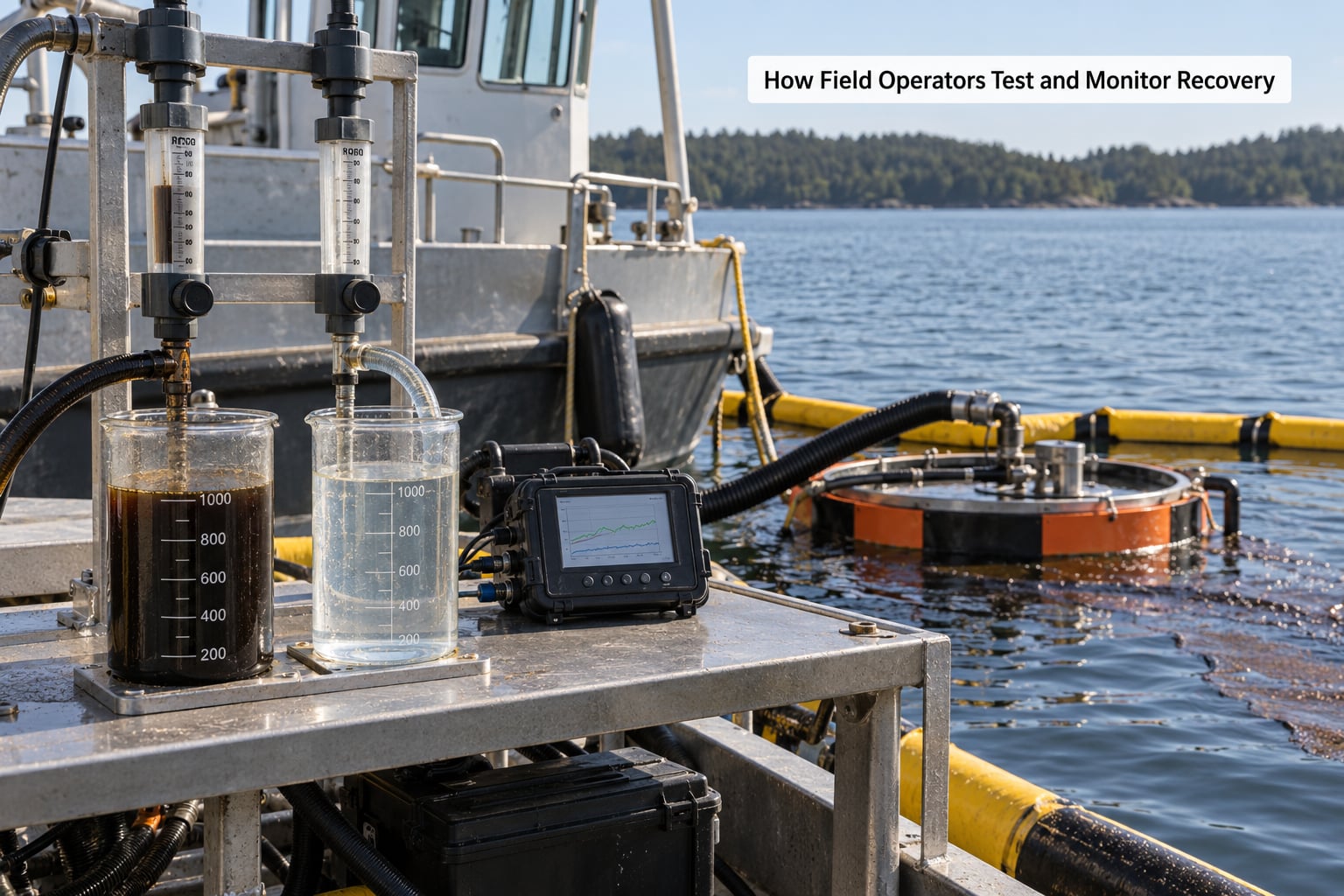
Anyone can say a skimmer recovered forty barrels. The useful question is how much of that was oil. Field measurement is straightforward once the vessels are set up properly.
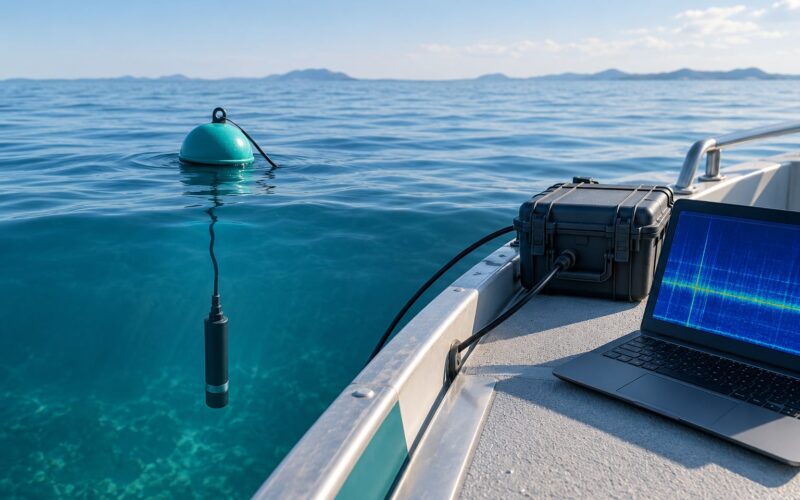
Collect the recovered stream into graduated, transparent vessels so the water and oil volumes can be read directly after the stream settles. A sight glass or sight tube on the discharge line shows the water layer forming in real time, which is often the fastest way to spot a draw problem. Flow meters on the transfer line give total volume; subtracting the measured water gives the oil figure.
Record the conditions alongside the volumes: significant wave height, wind direction and speed, oil type and temperature, and the setting of the weir or the pump rate. A number without those conditions attached cannot be compared to anything later.
Free water in the stored product is the number that drives operations, and it is usually the number that surprises people. A skimmer delivering 95 percent oil for an hour and 55 percent for the next hour can produce a tank that averages out to an acceptable concentration and still fills storage far faster than downstream handling can manage.
For bench comparisons, operators use standardised stationary skimmer efficiency protocols, with ASTM F2709 as the reference many buyers ask about. A controlled tank test gives a repeatable baseline for one oil at a known layer thickness, which is a fair way to compare two designs before either goes in the water. Field conditions will not reproduce it, which is exactly why both numbers are worth having.
Power draw and downtime belong on the log too. A unit that needs constant attention to keep a scraper clean will, over a multi-week campaign, deliver less oil than a simpler machine that ran unattended for a week.
Safety, Environmental Limits, and Maintenance
Recovered product is a concentrated hazard, and the skimmer that concentrates it concentrates the risk too. Ignition control comes first: vapour from fresh oil can be well below its flash point, so sources of ignition are kept away and equipment is bonded and grounded. Where hydrocarbons are present, electrical equipment is selected for the classified area it sits in rather than the general deck standard.
Operators also manage vapour exposure for people, moving-part hazards for the drum, belt and brush mechanisms, hot surfaces near pumps and engines, and slip hazards around the recovered oil. The recovered stream itself has to be treated as hazardous waste until it is characterised, and discharge of anything that is not recovered product goes through an approved route.
It is worth being blunt about what skimming does not do. It does not remove oil under the water column, oil held in sediment, or oil that has weathered into persistent emulsions. It does not recover oil that has dispersed into droplets small enough to stay suspended. No skimmer recovers all of a spill, and any plan claiming otherwise is not a plan.
Maintenance is mostly discipline rather than complexity. Daily: skim the surface, clear debris from the intake, check the oil level in the collection chamber, and look for leaks at every hose connection. Weekly: clean the oleophilic surface or brush if fitted, check the scraper, and inspect the float or tension band. Monthly or quarterly: verify the weir setting against the current layer thickness, service the pump, and re-run the concentration check to confirm the skimmer still behaves as it did at commissioning.
Frequently Asked Questions
What is the basic principle of how skimmers recover oil from water?
Oil floats because it is less dense than water and forms a film at the surface. A skimmer positions an intake at that film, holds the water back while the oil is diverted into a collection chamber, then separates water and debris before transferring the oil to storage. Weir designs do this with a gravity overflow edge, oleophilic designs with moving surfaces that oil sticks to, and suction designs with a controlled draw.
Are weir skimmers better than drum or suction skimmers?
Weir skimmers are better when the water is rough, debris is heavy, or no power is available, because they have no moving parts in the oil path. Drum skimmers return a much more concentrated oil in calm conditions, often above 80 percent, while suction skimmers handle thin light oils well if the flow is controlled. In waves, the weir keeps collecting while the others start collecting water.
Can an oil skimmer remove oil that is already underwater?
No. A skimmer only intercepts oil floating at the surface, so oil carried below the interface, trapped in sediment, or held under ice stays where it is. Water-in-oil emulsions and chemically dispersed droplets are also out of reach, because they no longer behave as a surface film. Recovering that oil takes separation equipment, aeration, or sorbents rather than a surface skimmer.
How much water should a well-designed skimmer collect with the oil?
It depends on the design and the sea state. Weir skimmers typically deliver somewhere between 50 and 85 percent oil, drum, belt and disc designs between 75 and 95 percent, and well-controlled suction 70 to 95 percent. Any figure assumes a layer thick enough to sustain the intake. Measure it in a graduated vessel after settling rather than trusting the sample taken at the discharge.
Which skimmer works best for waves and rough sea conditions?
A floating weir skimmer on a surface-following hull is usually the most forgiving in a seaway, because it keeps collecting through the wave motion instead of losing the film. Above roughly 1.5 m significant wave height, expect reduced performance from any design, and plan recovery for calmer windows. Oleophilic drum and suction units need a stilling well or a vessel with steady trim to cope with the same conditions.
How do operators measure a skimmer’s actual recovery rate?
They collect the recovered stream into graduated vessels, let it settle, and read the oil and water volumes separately, subtracting the water from the metered total flow. Operators log significant wave height, wind, oil temperature and the weir setting or pump rate next to each reading, since recovery without those conditions cannot be compared. For a repeatable baseline, bench testing against a stationary skimmer efficiency protocol such as ASTM F2709 is the reference point many buyers specify.
Conclusion
Start with the oil and the water, not the equipment list: is it free-floating, how thick is the layer, how rough is the surface, and what can you do with the recovered stream. Pick a design that matches those answers, then measure oil and water separately in the field under the conditions you actually work in. That measurement, not the capacity on the nameplate, tells you whether skimmers are recovering oil from the water in front of them.