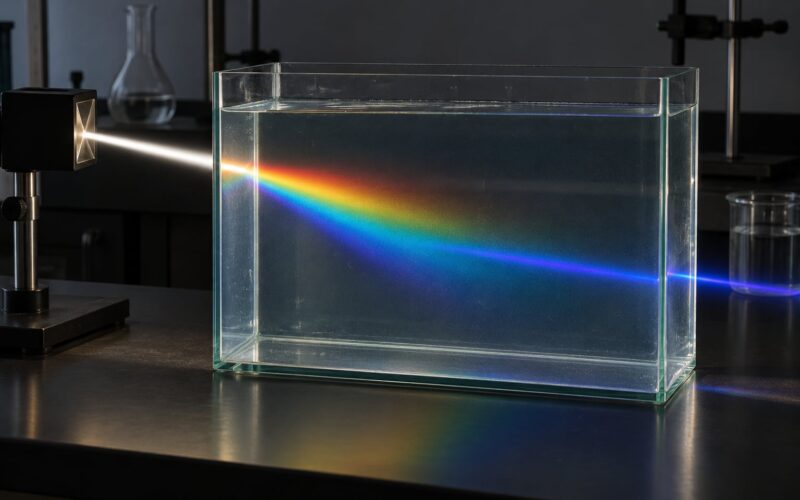
How sound travels in water is simpler than most people expect: it moves as a pressure wave at roughly 1,480 meters per second in seawater, about 4.4 times faster than in air at room temperature. The mechanism is easy to watch in a glass of water — a vibrating source pushes its neighbors, they push theirs, and the disturbance races outward while the water itself stays put.
That single sentence explains most of what sonar operators, ocean robot builders and marine biologists rely on every day. The rest of this guide covers what bends that wave, what kills it, and how the ocean’s temperature structure turns a fast signal into one that can cross an entire ocean basin without touching the surface.
Table of Contents
- How Sound Travels in Water
- What Is Sound Made Of in Water?
- Why Does Sound Travel Faster in Water Than in Air?
- How Does Depth Change Underwater Sound?
- How Do Temperature and Salinity Affect Sound Speed?
- What Happens When Sound Hits the Seafloor or a Surface?
- How Does This Matter for Marine Sensors and Ocean Robots?
- Frequently Asked Questions
- Conclusion
How Sound Travels in Water
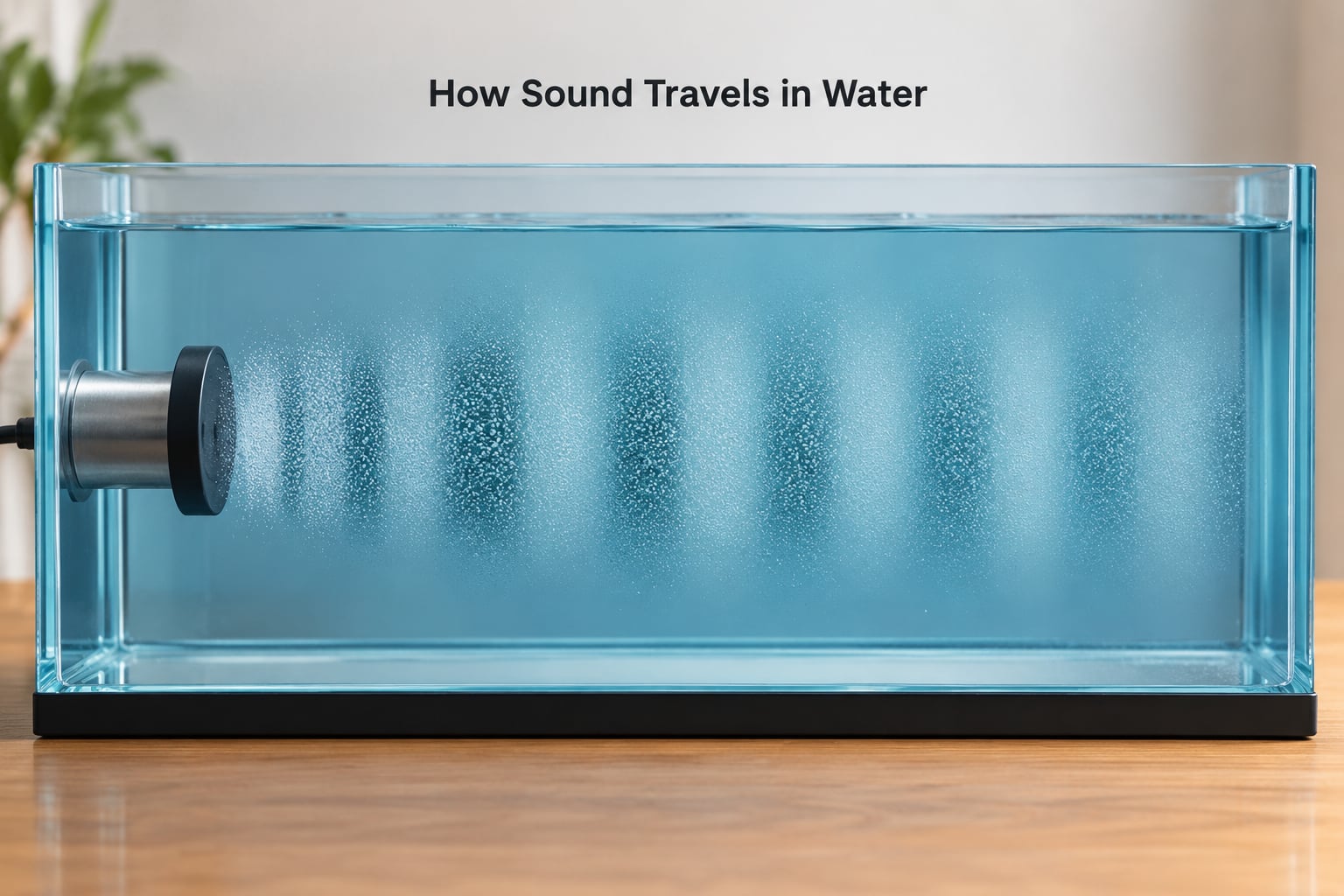
How sound travels in water comes down to three things: a vibrating source, a medium that can be compressed, and a chain of particle-to-particle energy transfer. Water molecules are never pushed across the ocean by a sound wave — they swing back and forth around a near-fixed position while the energy moves on.
Typical speeds land between about 1,480 and 1,500 meters per second in ordinary seawater, against roughly 340 meters per second in air at 20 degrees Celsius. Sound in water is also usually quieter to lose, so a signal that would die within a few hundred meters in air can stay detectable for tens or hundreds of kilometers underwater.
Four factors set the number: water temperature, pressure (which rises with depth), salinity, and the frequency of the signal itself. Get those four and you can predict where a transducer will hear something back from.
What Is Sound Made Of in Water?
Sound in water is a mechanical wave made of alternating compressions and rarefactions — zones where molecules crowd together and zones where they spread apart. Each molecule nudges the next, each nudge is smaller than the one before, and the whole chain of shrinking pushes is what reaches the receiver.
The relay race analogy works well here. Runners do not travel from the start line to the finish; they hand a baton along. Water molecules do the same with pressure, except they hand it along about 1,500 meters every second in seawater.
A sonar transducer or underwater speaker makes the first push. A piezoelectric element inside the housing flexes inward, pressurizing the water against its face; a few milliseconds later that pattern is somewhere else entirely. A hydrophone on the far end does the same trick in reverse, converting returning pressure swings back into an electrical signal.
Frequency matters too, because wavelength is speed divided by frequency. A 10 kHz signal in seawater has a wavelength near 15 cm, while a 1 kHz signal stretches out to about 1.5 m. Long wavelengths bend around obstacles and scatter less, which is why low frequencies carry much farther.
Why Does Sound Travel Faster in Water Than in Air?
Water wins on both properties that set wave speed: it is far denser and far less compressible than air. Speed follows roughly the square root of bulk modulus divided by density, so a medium that resists compression while carrying heavy molecules passes a pressure disturbance along quickly and with little loss.
Density works against you here, and that trips people up. Packed molecules have more inertia to move, which is exactly why it is hard to start a loud sound underwater in the first place. Water only wins because its resistance to compression is proportionally larger still.
| Medium | Speed | Notes |
|---|---|---|
| Air | 343 m/s | Drops to about 331 m/s at 0 degrees Celsius |
| Helium | about 965 m/s | Faster than air because it compresses more easily |
| Fresh water | about 1,482 m/s | Slower than seawater by a few m/s |
| Seawater | about 1,480 to 1,500 m/s | Varies with temperature, salinity, pressure |
| Steel | about 5,960 m/s | Solids use atomic bonds instead of loose collisions |
| Granite | about 6,000 m/s | Little change with temperature |
Fresh water and seawater sit within a few meters per second of each other, which surprises people who picture the ocean as salty soup. Salinity is a real lever, it is just a small one next to temperature and depth.
How Does Depth Change Underwater Sound?
Deeper water is almost always faster water. Pressure rises by roughly one atmosphere for every 10 meters of descent, and that pressure squeezes water into a stiffer medium that carries pressure waves quicker. Sound speed therefore climbs steadily with depth even when temperature is constant.
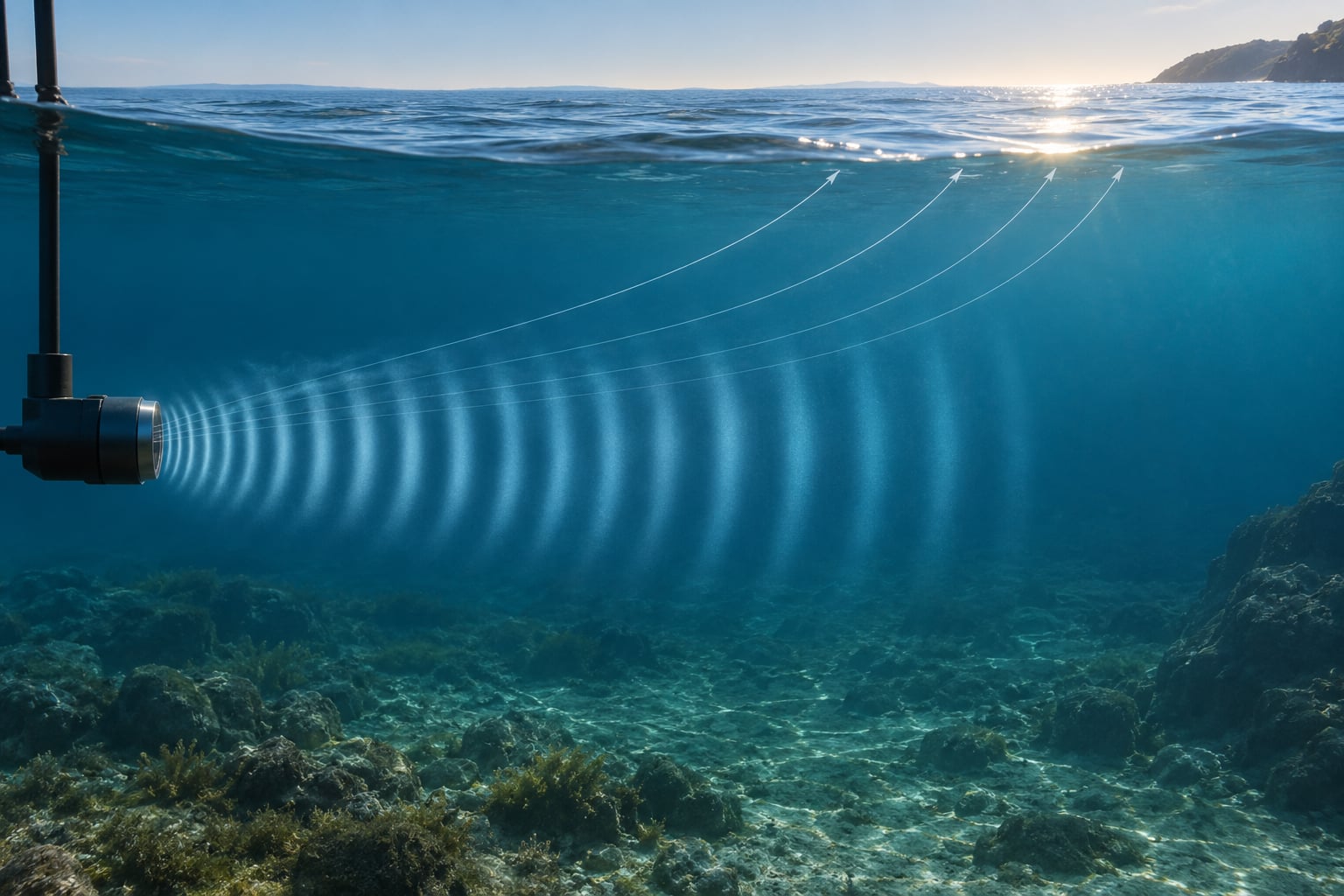
A steadily rising speed is not a neutral condition, because sound bends toward slower water. With speed increasing downward, rays curve back up toward the surface instead of running straight, and shallow-going rays can trap in a duct near the top.
Where the trend reverses — warmer water sitting on cold water near the surface — rays curve downward instead. Where the minimum sits in the middle of the water column, you get the SOFAR channel, also called the deep sound channel, where sound can travel thousands of kilometers while bouncing between neither the surface nor the seafloor.
This is the single biggest reason long-range ocean communication works. A signal injected into the channel axis can reappear at a fixed range again and again, at what propagation models call convergence zones, so a receiver on the other side of a basin hears a burst that sounds local.
How Do Temperature and Salinity Affect Sound Speed?
Temperature and salinity pull in opposite directions on sound speed. Warm water is fast, cold water is slow, and salty water is fast while fresher water is slow, so the net result depends on which one dominates at a given depth.
Temperature wins decisively near the surface. A shallow tropical layer sitting at 28 degrees Celsius can run 50 to 60 meters per second faster than the same water at 4 degrees Celsius, which is far more than any realistic salinity change of a few practical salinity units will move the needle.
Salinity takes over in the deep ocean, where temperature is nearly constant and horizontal differences in salt content are measurable. Water that is both cold and salty, such as the dense water formed in high latitudes, travels among the fastest anywhere in the ocean.
Oceanographers combine these inputs — temperature, salinity, and depth — in a standard empirical relation often called the equation of sound speed in seawater, which predicts speed from measured conditions rather than theory alone. Most field programs take that trio from a CTD cast before deploying anything that has to hear.
Surface weather drives most of the short-term variation. A passing front mixes the top layer and wipes out the warm cap, which can shift a sound speed profile enough to move a convergence zone by tens of kilometers within a day.
What Happens When Sound Hits the Seafloor or a Surface?
Most of what reaches a boundary is reflected, some is transmitted, and the rest is absorbed as heat. The seabed and the sea surface are both large acoustic mirrors, and their makeup decides how much energy bounces and how much disappears.
A hard rock or sand seafloor returns a strong echo, which is what multibeam sonar relies on to map bathymetry. Soft sediment, especially gas-bearing mud, swallows the signal instead, so a target can hide acoustically without being physically hidden.
The air-sea interface is unusual: water and air differ enormously in density, so almost all upward-going energy reflects back down. Wave action and bubbles make it worse, since entrained air scatters sound in every direction and fills shallow water with noise.
The thermocline and a well-mixed surface layer are the other two places energy disappears. Sound that reaches the boundaries of a thermocline can bend along it rather than cross it, and that ducting is either the reason you hear something or the reason you hear nothing.
How Do Temperature, Salinity, and Depth Change Sound Speed?
A sound speed profile is just sound speed plotted against depth, and reading it tells you where to put a sensor. Near the surface in mid-latitude summer you might see about 1,540 m/s in a warm mixed layer, falling to roughly 1,495 m/s in the thermocline, then climbing again under pressure toward about 1,500 m/s at depth.
That shape — a fast layer on top, a slow layer beneath — traps shallow rays and sends deep rays back up, so the energy converges toward depths where the gradient is small. If your hydrophone sits just below the minimum, it sits in the duct and hears a long-range path; park it in the thermocline and it hears mostly its own noise.
The practical checklist is short: sample temperature, salinity and depth at the site, build the profile, then place sensors near a sound speed minimum and repeat the cast seasonally. Profiles in shallow coastal water can change enough between two dives to move the optimum listening depth by tens of meters.
How Does This Matter for Marine Sensors and Ocean Robots?
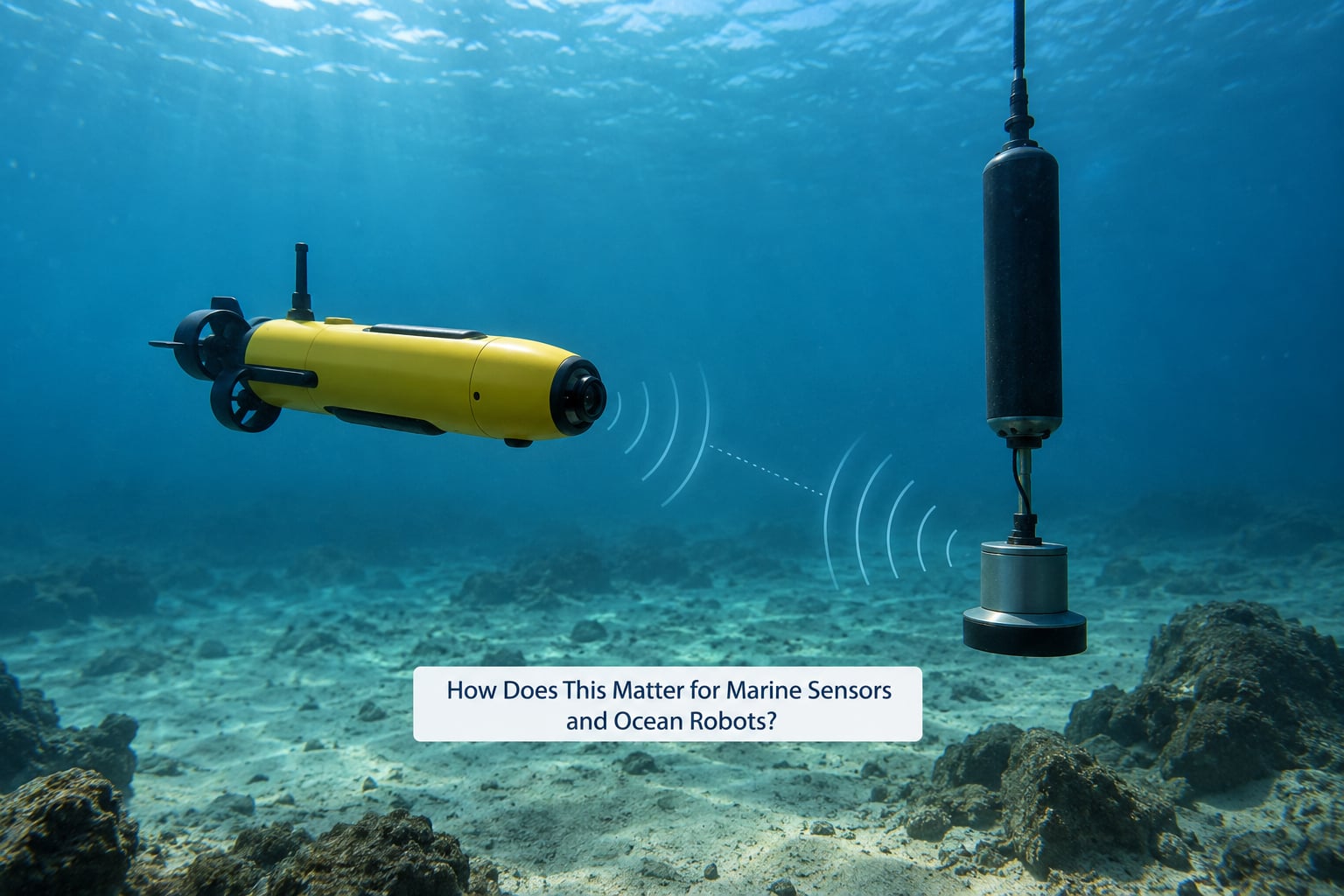
Underwater systems use acoustics because radio does not work there. Electromagnetic waves in seawater are absorbed within meters, so a vehicle that surfaces can stream data freely while submerged it has to talk acoustically or store everything for later.
Acoustic modems are the slow-but-useful option. They trade bit rate for range, sending coded pulses at a few kilobits per second over hundreds of meters to kilometers, which is enough for commands, position fixes and health checks on an AUV or a moored node.
Sonar covers detection and imaging. Forward-looking sonar and multibeam systems map the seabed ahead of a vehicle or across a survey line, while side-scan sonar reads texture and shadow from a towed body. Range depends on frequency, target strength and the path the ray actually took.
Passive listening is the quiet half of the field. Hydrophone arrays left on the seabed record ambient noise, shipping, piling and marine mammal calls without transmitting anything, and long deployments use the deep sound channel to collect sounds from hundreds of kilometers away.
Acoustic telemetry works the same way in miniature. Small coded acoustic tags on fish, turtles or buoys pinger at intervals and are picked up by a receiver, giving researchers range and depth for animals that will never carry a satellite tag.
The environment is not a passive listener’s friend. Low-frequency ambient noise from distant storms and shipping can sit right on top of the band you care about, and a warming, acidifying ocean changes absorption and biological activity enough to alter what those recordings mean over a decade.
Frequently Asked Questions
How quickly does sound travel in water?
In seawater, sound travels at roughly 1,480 to 1,500 meters per second, depending on temperature, salinity and pressure. That is about 4.4 times the speed in air at 20 degrees Celsius, which is roughly 343 meters per second. Cold, salty, deep water runs at the faster end of that range, and warm shallow water at the slower end.
Why can’t we hear well underwater?
Water is a poor medium for hearing because of impedance, not speed. Your eardrum is built to move air, so a dense medium like water loads it and it barely responds. On top of that, sound reaches both ears almost at the same instant, which strips away the timing cues your brain uses to locate a source. Divers report muffled audio alongside a total loss of directional sense.
Does sound travel better in water or air?
Water carries sound faster and loses less of it with distance, so a signal propagates better underwater. Air loses a large fraction of its energy within a few hundred meters; the same low-frequency signal can travel tens or hundreds of kilometers in the ocean, especially inside the deep sound channel. Generating loud sound in water is harder, though, because water resists being moved.
Why do ocean noises calm people?
Slow surf and low-frequency wave rumble sits in the same band as human heartbeat and breathing, which tends to slow the listener’s own rate. Broadband hiss of breaking waves also masks sudden sharp sounds, so the environment feels predictable rather than alerting. It is a short-term effect: chronic low-frequency noise from ships and machinery has the opposite effect on sleep and stress.
Why is it hard to tell which direction sound comes from underwater?
Your brain locates a sound mainly from the small timing and level differences between your two ears. Underwater, the speed difference between your skull and the water is small, and sound from a distant source arrives at both ears within a fraction of a millisecond. With no usable interaural delay, the location cue collapses, which is why divers cannot point at a noise they hear clearly.
What is underwater sound called?
The physics of sound traveling through water is called underwater acoustics, or hydroacoustics. The instruments are hydrophones, the analysis discipline is often called bioacoustics when the focus is marine life, and propagation modeling typically uses ray tracing, normal modes or parabolic equations to predict where a signal goes.
Conclusion
Sound in water is a pressure wave passed from molecule to molecule, moving at about 1,500 meters per second and losing far less energy than it would in air. Temperature, salinity and depth set the speed, and the resulting gradients bend rays into ducts and convergence zones that let a signal cross an entire basin.
Start with the question in front of you: a sensor that hears too little, a modem link that drops, or a target you cannot detect. Then collect temperature, salinity and depth data for the site, build the sound speed profile, and place your sensor near a sound speed minimum rather than wherever the cable happened to reach.