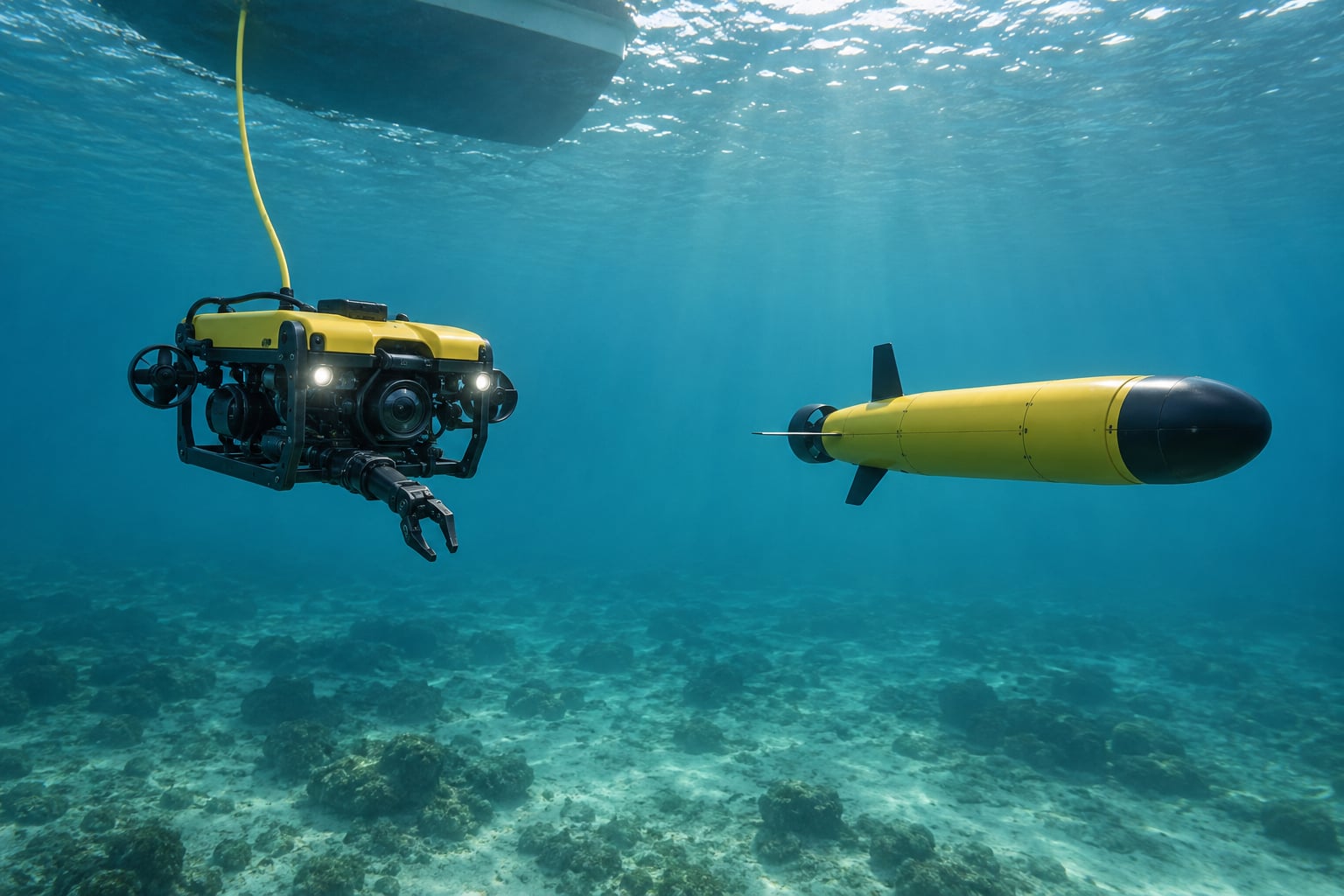
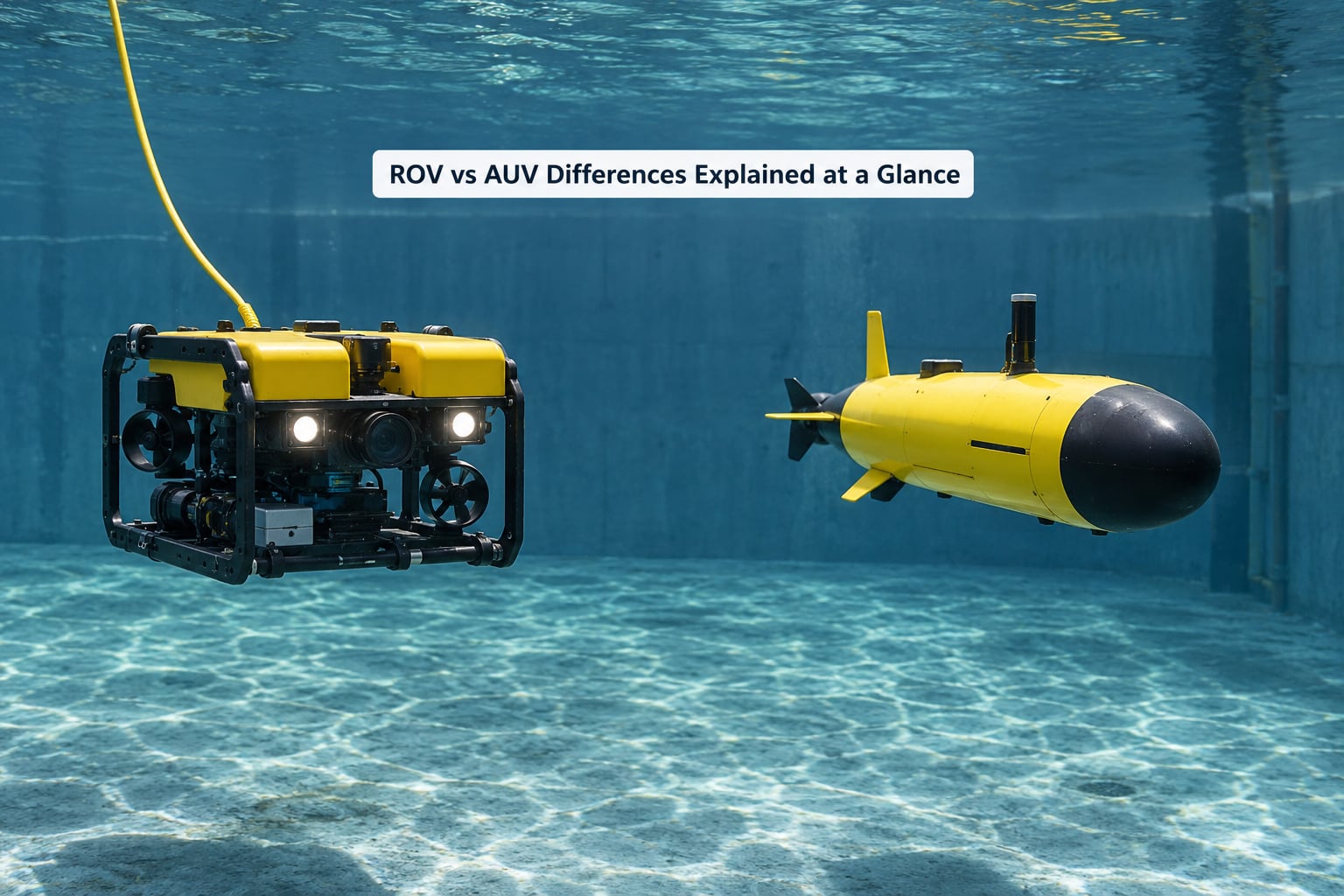
An ROV (remotely operated vehicle) is tied to the surface by a tether and steered in real time by a pilot, with live video and commands running through that cable. An AUV (autonomous underwater vehicle) has no cable at all: it follows a pre-programmed mission on its own power, navigation and sensors, then returns to a recovery point. Everything else about ROV vs AUV differences explained here follows from that one split.
The word rov vs auv differences explained usually comes from someone with a real job attached to it. Maybe you have a hull to inspect before the next sailing, a pipeline route to survey, a dam wall nobody wants to dive on, or a research line that has to cover forty square kilometres. Each of those pushes you toward a different vehicle class, and buying or building the wrong one burns a season of vessel time.
Table of Contents
- ROV vs AUV Differences Explained at a Glance
- What Is an ROV?
- What Is an AUV?
- ROV vs AUV: The Main Technical Differences
- How Control, Navigation, and Communications Work
- Power, Endurance, and Mission Duration
- Depth, Maneuverability, and Environmental Performance
- Payloads, Sensors, and Data Collection
- Cost, Logistics, and Operating Requirements
- Which Should You Choose?
- Frequently Asked Questions
- Conclusion: Start With the Mission
ROV vs AUV Differences Explained at a Glance
| Criterion | ROV | AUV |
|---|---|---|
| Definition | Uncrewed underwater robot piloted live from the surface through a tether | Uncrewed underwater robot that runs its own mission with no surface link |
| Connection to surface | Tether, usually a combined power and data umbilical | None once submerged |
| Control | Human operator gives continuous commands | Pre-programmed route with onboard decision logic |
| Video and telemetry | Live continuous feed both directions | Acoustic or satellite burst data at best, no live video |
| Power | Delivered down the tether, so effectively unlimited | Onboard battery, limited by capacity and thruster load |
| Endurance | Hours to days while connected; battery ROVs run roughly a working day | Several hours to multiple days, faster drains the battery |
| Depth | Set by the pressure housing and tether strength, from shallow to full ocean depth | Set by hull design, typically shallower than work-class ROVs of the same size |
| Payload | Cameras, sonar, manipulators, cutting tools, samplers, jaws | Sonar, cameras, CTD and chemical sensors, sometimes a small grabber |
| Payload recovery | Lift it straight back to the vessel with the tether and a crane | Vehicle must return to a rendezvous point, or be recovered later from a seabed |
| Typical range | Bound by tether length and current drag | Bound by battery energy and mission speed |
| Cost profile | Vehicle plus deck equipment, crew and constant vessel time | Vehicle plus a shore team, lower day rate, higher mission-planning effort |
| Best missions | Inspection, maintenance, manipulation, sampling, live troubleshooting | Wide-area mapping, repeat transects, search patterns, long-range survey |
What Is an ROV?
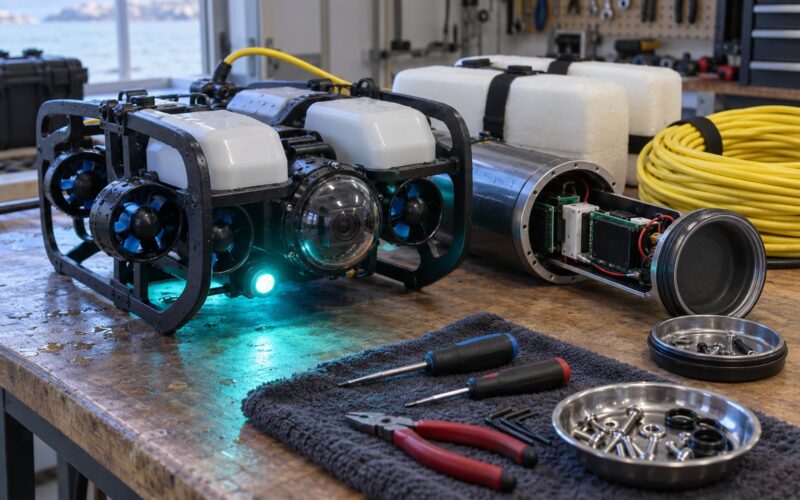
A remotely operated vehicle is a submersible robot with no pilot inside it. A person on the surface, usually in a van or a control container on the vessel deck, flies it through a tether that carries power down and video, sensor data and commands back up.
That tether, more often called an umbilical, is the whole story. Power arrives continuously, so a tethered ROV can run heavy tools, bright lights and multiple thrusters for as long as the job lasts without carrying a battery large enough to weigh it down. The cable also means the vehicle cannot be permanently lost, which is why small tethered robots remain the sensible choice for anyone building a first subsea vehicle.
ROVs come in a few sizes. Observation-class vehicles are small, light and cheap, mostly for video and light payloads. Inspection-class vehicles, often called work-class ROVs in loose speech, add hydraulic manipulators and tools for cleaning, cutting and sampling. True work-class vehicles run in the oil and gas industry, reach full ocean depth, and usually fly with a dedicated pilot, a tether management system and a crane on deck.
Crewed submersibles sit beside this class rather than inside it. A human-occupied vehicle puts a pilot inside a pressure sphere, which lets a specialist touch a sample directly and work without a tether. It costs far more per dive, carries people, and every hour is an hour of someone’s life underwater. For anything repetitive or long, an ROV is usually the sensible answer.
What Is an AUV?
An autonomous underwater vehicle runs without any cable and without a pilot watching in real time. You program the mission on deck, choose a route and depth profile, load the vehicle, and let it go. On the way down it takes a GPS fix at the surface, then follows that track using its own navigation systems.
Because there is no live link, an AUV has to be right before it submerges. It collects data onboard as it flies, and at the end of the track it either surfaces at a rendezvous point, rises to a radio or satellite link to report a summary, or gets picked up by a recovery vessel hours later. Mid-course corrections are possible but slow, sent through acoustic modems that carry a few bits per second rather than a video stream.
The family splits by how they move. Survey AUVs fly fixed transects at speed with a multibeam or side-scan sonar for mapping work. Gliders are slower, buoyant vehicles that change depth to climb and glide along a corridor, which buys endurance at the cost of fine detail. Hovering AUVs stay in place and use thrusters to hold station, which suits water-column sampling. Hybrid vehicles, such as Saab’s Sabertooth class or WHOI’s Nereus concept, switch between autonomous flight and tethered work modes on the same hull.
ROV vs AUV: The Main Technical Differences
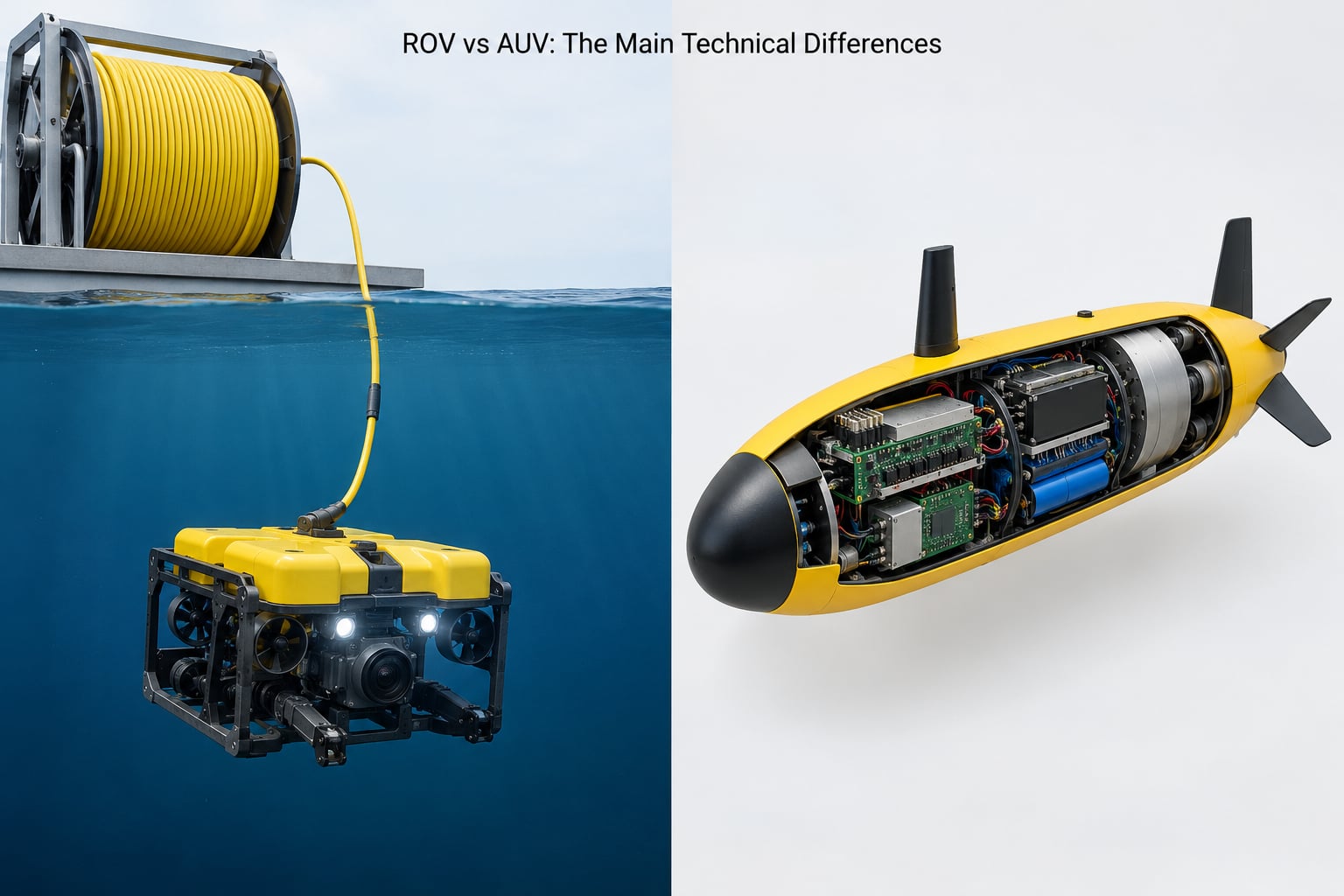
The practical rov vs auv differences explained by engineers come down to control architecture, power and data. One vehicle is a remote joystick with a very long, very strong cable. The other is a small aircraft that happens to fly underwater. Comparing them starts with how each one is commanded, because that single difference ripples into every other specification.
Control architecture and the role of the pilot
An ROV pilot works in something close to real time. Joystick inputs translate to thruster commands within a fraction of a second, so the pilot can hover inches from a fouled propeller, thread a manipulator around a cable and step back when something is not right. Every judgement call is made by a human who can see what is happening.
An AUV pilot is really a mission planner. The route, speed, altitude, sensor triggers and abort logic are settled before launch. Onboard, the vehicle’s guidance software follows that plan. Modern AUVs can detect obstacles and replan around them, which is a real improvement, but it is still a rules-based response, not a person reacting to a surprise.
Tether communication against acoustic telemetry
A tether carries power, video and control data at the same time, which is why it is heavy and why it limits range. Radio waves barely penetrate saltwater, so an untethered vehicle has to use sound. Acoustic modems are reliable at short range, but the link is measured in bits per second with second-scale latency. You can send a summary or a stop command. You cannot send a video stream, and you cannot talk the vehicle out of a bad decision in real time.
Navigation and positioning
An ROV gets its position the easy way. It knows where the boat is, it feels the tether’s direction, and a topside system or an acoustic beacon on the tether gives range and bearing. That is why ROVs stay on station well and why pilots can work close to a structure without worrying about drift.
An AUV has no such reference. Below the surface it runs on an inertial navigation unit, corrected by a Doppler velocity log that measures speed over the seabed, and often by terrain or bathymetric matching against a known chart. Fix that against a bad chart or a weak bottom return and the vehicle drifts metres per hour. Every self-contained survey vehicle we have watched from a support boat logs its own position error continuously, because it knows the same thing you do.
Propulsion, maneuverability and intervention
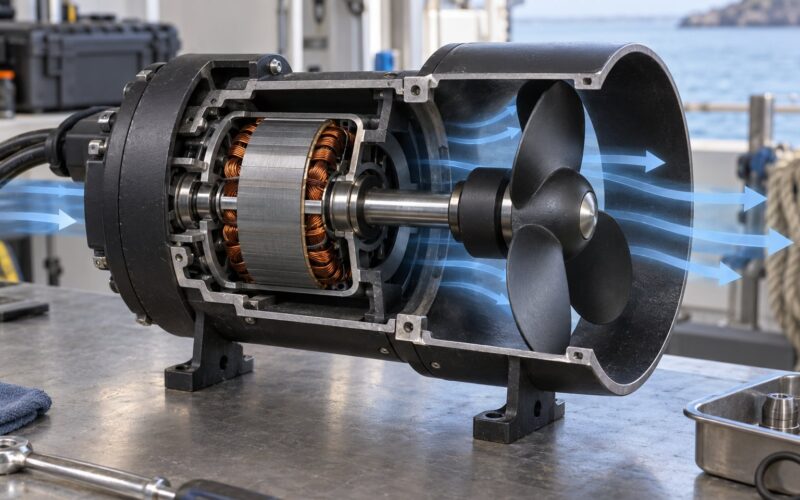
Both classes usually use electric thrusters. The difference is the thruster layout and the power budget. Tethered ROVs commonly use vectored thrusters for station keeping and hover, and they can afford the current draw because power arrives from the surface. AUVs carry every watt they will ever use, so they fly with fewer, smaller, more efficient thrusters. An AUV that hovers hard is draining a battery it may need for the trip home.
Intervention capability is the sharpest dividing line. A work-class ROV carries a hydraulic manipulator, a seven-function arm that can grip, turn a wrench, cut a cable, place a mat or bag a sample, and the pilot guides every movement. Most AUVs carry sensors only. Some small AUVs have a simple grabber, but a grabber cannot improvise, and once the vehicle leaves, it leaves.
How Control, Navigation, and Communications Work
Underwater radio is the constraint that shapes everything, and it is worth being blunt about it. Sound travels roughly 1,500 metres per second in seawater, the speed of sound limits how much information a channel can carry, and the usable band is narrow. Designers squeeze useful rates out of it with spread-spectrum and coded signals, but the result is measured in hundreds of bits per second to a few kilobits per second over a few kilometres of range. A compact video stream needs orders of magnitude more.
That is why AUVs do not stream. Modern vehicles surface periodically, hold a GPS fix and push a summary of mission progress over satellite or radio, then descend again. A few vehicles use an uncrewed surface vessel as a floating relay that can follow the AUV, sit on station above it and hold an acoustic link, which is the standard answer to the bandwidth problem.
Failure and recovery look different on each platform. An ROV loses the tether and its pilot flies it back to the vessel, or the deck crew winches it home and you change the plug. An AUV that fails its mission, drifts or suffers a navigation error has no live link and cannot be told to turn around. Recovery depends on where it finished, what the sea state is doing, and whether a surface vessel is standing by. That recovery risk is the single most common argument against untethered vehicles, and builders on engineering forums raise it every time.
There is a useful middle path that more operations now use: fly the AUV out for the survey, then bring an ROV in for the close look. The AUV maps the structure at speed, the pilot reviews the data onshore, and the ROV goes back to the specific anomaly with lights, arms and judgement.
Power, Endurance, and Mission Duration
This is the cleanest trade-off in the whole comparison. A tethered ROV carries power down the umbilical, so endurance is set by the tether and the deck supply rather than by a battery. Small battery-powered ROVs typically get around eight hours of useful work before they need a charge, which is why deck teams carry spare packs and swap them between dives.
An AUV trades that supply for freedom of movement. Endurance runs from a few hours on a large survey vehicle doing fast, high-power transects to more than a day on a smaller, slower vehicle, and gliders reach much longer durations by climbing and gliding instead of fighting drag the whole way. Slow speed is the lever: energy cost rises steeply with speed, so mission planners routinely cut the survey speed to stretch the battery.
Recharging changes too. A battery ROV is back on deck and back in the crate within the hour. An AUV needs a handling cradle or crane, a charge or swap cycle, and a checks list before it can go again. Neither vehicle is clearly faster to turn around; the AUV simply does more work per hour of hull time, which is the whole point for wide survey lines.
The supervision trade-off follows from the same physics. With an ROV someone is watching the vehicle and the video the entire time. With an AUV a shore-based operator watches progress reports and waits for recovery, which is fine for a planned line and nerve-wracking for a first mission.
Depth, Maneuverability, and Environmental Performance
Depth rating is set by the pressure housing and the tether. A small observation ROV may be rated to a couple of hundred metres, while full work-class ROVs reach the full ocean depth and are routinely used at several thousand metres. AUVs span a similar overall range, but the practical ceiling for a given hull is often lower, because the vehicle has to be buoyant and streamlined enough to fly, and that leaves less room for thick walls and syntactic foam.
Maneuverability in close water is where ROVs pull ahead. A work-class ROV can hover, hold a position in a one-knot current, approach a riser at centimetre range and work with the manipulator while the pilot watches the jaws. AUVs fly. They hold altitude and cover lines, but they are deliberately not built for slow, precise hovering in a cluttered space, and the physics fight you: hovering burns battery and thrusters cavitate when you slow down.
In poor visibility both classes fall back on sonar. Low light is rarely the deciding factor since both carry lights and low-light cameras, but turbid water is, and in a silt-heavy harbour a sonar-led ROV inspection often produces better evidence than a video-led one. Obstacle avoidance also differs. ROV pilots use forward-looking sonar to steer around obstacles in real time. AUVs use obstacle avoidance and terrain-following logic, which handles an open seabed well and a wreck site or a fish farm far less well.
Docking and confined spaces are worth a mention because so many inspection jobs happen inside a flooded structure, a pipe or a pen. Working in a tank with no GPS, no room for error and no second vehicle is where a tethered ROV’s value is hardest to argue with.
Payloads, Sensors, and Data Collection
ROVs carry the heavy end of the payload range: high-definition and low-light cameras, lighting arms, multibeam and side-scan sonar, hydraulic manipulators, grippers, jaws, wire cutters, jet cleaners, water and sediment samplers, and scanning sonar for close structural detail. Because the pilot is there, the payload can be improvised mid-dive, which is how an inspection turns into an unplanned sample or a realignment.
AUV payloads skew toward measurement: multibeam and side-scan sonars for bathymetry, water quality and optical sensors such as CTD and chlorophyll probes, current meters, side-scan and sub-bottom profilers, and cameras on a fixed path. Recent systems add selective sampling, so the vehicle can park over a chemical anomaly and take a sample rather than collecting a bottle every time.
The output shape differs as much as the hardware. ROV inspection produces a video record with a human in the loop deciding what matters, which is excellent evidence and poor statistical coverage. AUV survey data is repeatable: the same line flown twice gives comparable numbers, bathymetry comes back as a full grid rather than a set of observations, and one deployment covers an area no ROV could reach. If your question is “what is the shape of this seabed”, that repeatability is worth more than the pilot’s eyes.
Cost, Logistics, and Operating Requirements
Vehicle hardware is only part of the bill, and the two classes hide their costs in different places. Exact figures move around with configuration and region, so treat these as relative rather than quoted numbers, and get current pricing from suppliers directly.
An ROV costs more to run than to buy. The vessel is the biggest line item: it must be on station for the whole dive, and a dive is not a stopwatch. Two pilots and a tether technician work minimum, and skilled pilots are the scarcest resource in the industry. Tether handling adds time nobody puts in the estimate, because snagging is the most common cause of a wasted dive, and cranes or winches are needed on deck to launch and recover a large vehicle.
An AUV carries a much smaller surface footprint. A small boat can launch one, the day rate is lower, and one operator can supervise several vehicles. The trade moves into planning and post-processing: mission design, navigation calibration, data cleaning, and the slow grind of turning bathymetry into a deliverable a client can use.
Neither is cheap for a small organisation. Building your own tethered ROV is a weekend project for a competent maker, and open-source designs have made that genuinely practical. Building a comparable autonomous vehicle is a different order of difficulty, because you are also solving underwater navigation, energy management and acoustic telemetry. Teams we have talked to trying to shortcut it usually find the tether is the easy part.
Which Should You Choose?
Pick the class that matches the question you need answered, not the vehicle that looks more impressive.
- Choose an ROV for hull and infrastructure inspection. Fouling, corrosion, cracks, growth on a propeller or a wind turbine monopile. Live video is the deliverable, and a pilot decides what to look at twice.
- Choose an ROV for anything involving a manipulator. Clearing a blockage, cutting a cable, placing or retrieving hardware, deploying a sensor, or taking a physical sample.
- Choose an ROV when the failure modes matter more than the coverage. Working near live infrastructure, inside a flooded structure, or where a mistake costs more than a missed measurement.
- Choose an AUV for seabed mapping and hydrographic survey. Repeatable lines, full bathymetric coverage, and a fraction of the vessel time per square kilometre.
- Choose an AUV for pipeline and cable route pre-lay survey. Long corridors, consistent data quality, and a traceable record before anyone commits to a route.
- Choose an AUV for environmental monitoring and water-column sampling. Deployments at fixed stations, repeated on a schedule, without a pilot in the water every time.
- Choose an AUV for search patterns and environmental sensing in places where a tether is dangerous. Under ice, near live structures, in mine-countermeasure work where an untethered vehicle is the point of the exercise.
- Consider doing both. Many survey contracts now pair an AUV pass with a targeted ROV intervention, using the map to decide where the robot needs to go.
Frequently Asked Questions
What is the main difference between an AUV and a ROV?
A remotely operated vehicle is connected to the surface by a tether and controlled in real time by a pilot, with live video and continuous power arriving through the same cable. An autonomous underwater vehicle has no cable at all: it runs a pre-programmed mission on onboard power, navigation and sensors, then returns to a recovery point when the track is finished. Tether and live control versus untethered autonomy is the whole distinction.
Are underwater drones tethered?
It depends on the class. Observation and work-class ROVs are tethered, which gives them live video, continuous power and a way to be recovered if something goes wrong. Survey AUVs, gliders and hovering AUVs are untethered once submerged, so they carry their own battery and use acoustic or satellite links for data. Hybrid vehicles such as the Nereus and Sabertooth class can fly autonomously and then switch to tethered work mode on the same hull.
Can an AUV be controlled in real time?
Only loosely. Radio does not work underwater, so an AUV relies on acoustic modems that deliver small amounts of data at second-scale latency, or on brief surfacing windows where it gets a GPS fix and can exchange a summary over satellite. You can send a mission update or an abort command, but you cannot fly one by joystick or watch live video. Command and control happens before launch, which is the main practical constraint on autonomous work.
What are the disadvantages of autonomous underwater vehicles?
The main drawbacks are limited bandwidth, no live intervention, navigation drift without GPS, and recovery risk if a mission fails. An AUV cannot be talked out of a bad situation in real time, its position estimate degrades when the Doppler log loses the seabed, and a vehicle that finishes early or drifts may be hours from the support boat. All of that makes autonomous platforms a poor fit for close work and a good fit for planned survey lines.
How long can ROVs and AUVs stay underwater?
A tethered ROV is not battery-limited; it runs while the tether is connected, and deck crews simply swap in fresh batteries for battery-powered vehicles between dives, which is why inspection-class ROVs typically manage a full working day. AUV endurance runs from a few hours on a large fast survey vehicle to more than a day on a smaller, slower one. Glider designs extend this further by climbing and gliding, trading speed and detail for duration.
Why is an ROV better than a submersible for some tasks?
A crewed submersible puts a specialist inside a pressure sphere, so every hour underwater is a person’s hour underwater, at a much higher cost per dive. It also limits how often and how long you can work. An ROV sends tools and eyes instead of a person: it can stay on station far longer, carries heavier payloads like manipulators, and removes the human safety question entirely, which matters near live infrastructure, in cold water and in contaminated harbours.
Conclusion: Start With the Mission
The rule of thumb is short. Choose an ROV when a person has to make a decision underwater, and choose an AUV when the job is to cover ground and collect consistent data while nobody is watching.
Before you compare hardware, write down one requirement: how large an area, how deep, for how long, with what payload, and what must happen if something goes wrong. Answer that honestly and the vehicle class usually picks itself. Answer it vaguely and you will end up reading specification sheets instead of planning a mission.