Water does absorb red light before it absorbs blue, and the reason sits inside the molecule. The O-H bonds in water vibrate at frequencies whose overtone bands land in the red end of the visible spectrum, so red photons are converted to heat while blue photons pass through almost untouched. That is why the question why water absorbs red light first deserves a real answer rather than the folk explanation most pages repeat.
That folk explanation goes: red light has the lowest energy, so water absorbs low-energy colours first. It is wrong. Photon energy is inversely proportional to wavelength (E = hc/λ), so a 700 nm red photon carries roughly 1.75 electronvolts while a 450 nm blue photon carries about 2.76. Red light is the highest-energy light still visible to the human eye, and it is absorbed because of a resonance in a molecular vibration, not because it is weak.
The second common confusion is what absorption does to the colour of a body of water. Absorbing red does not make the sea red; it removes red from the light that comes back out. What is left reads as blue or green. A second widespread claim, that the ocean is blue purely because it reflects the sky, is only half right — and indoor pools with white walls read cyan with no sky in sight.
This matters well beyond trivia. Divers, underwater photographers, and anyone designing an AUV, ROV, or lake-monitoring sensor runs into the same physics every day. I wrote this after seeing the same question asked again and again on diving and robotics forums, and the confident one-line answers out there are mostly wrong.
Table of Contents
- Does Water Really Absorb Red Light First?
- What Happens to Sunlight as It Moves Through Water?
- Why Water Absorbs Red Light First: Light, Depth, and Scattering
- Step 1: a photon is absorbed only when its frequency matches a molecular vibration
- Step 2: those infrared bands leak into the visible red
- Step 3: hydrogen bonding pushes the band further into the red
- Step 4: nothing overlaps the blue end
- Step 5: the loss compounds with distance
- Step 6: the heavy water check
- Why the Sea Can Look Blue or Green
- How Water Depth Changes the Available Light
- Why Water Absorbs Red Light First in Everyday Observations
- How Marine Sensors Measure Underwater Color
- What Factors Can Change the Absorption Pattern?
- Frequently Asked Questions
- Does pure water absorb red light more than blue light?
- Why does a red object usually look darker or lose color underwater?
- Is blue water blue because water absorbs every other visible color equally?
- Why can muddy or green water absorb red light differently from clear ocean water?
- Can a phone camera measure the true color of water reliably?
- Sources and further reading
- Conclusion: Start with a Controlled Wavelength Test
Does Water Really Absorb Red Light First?
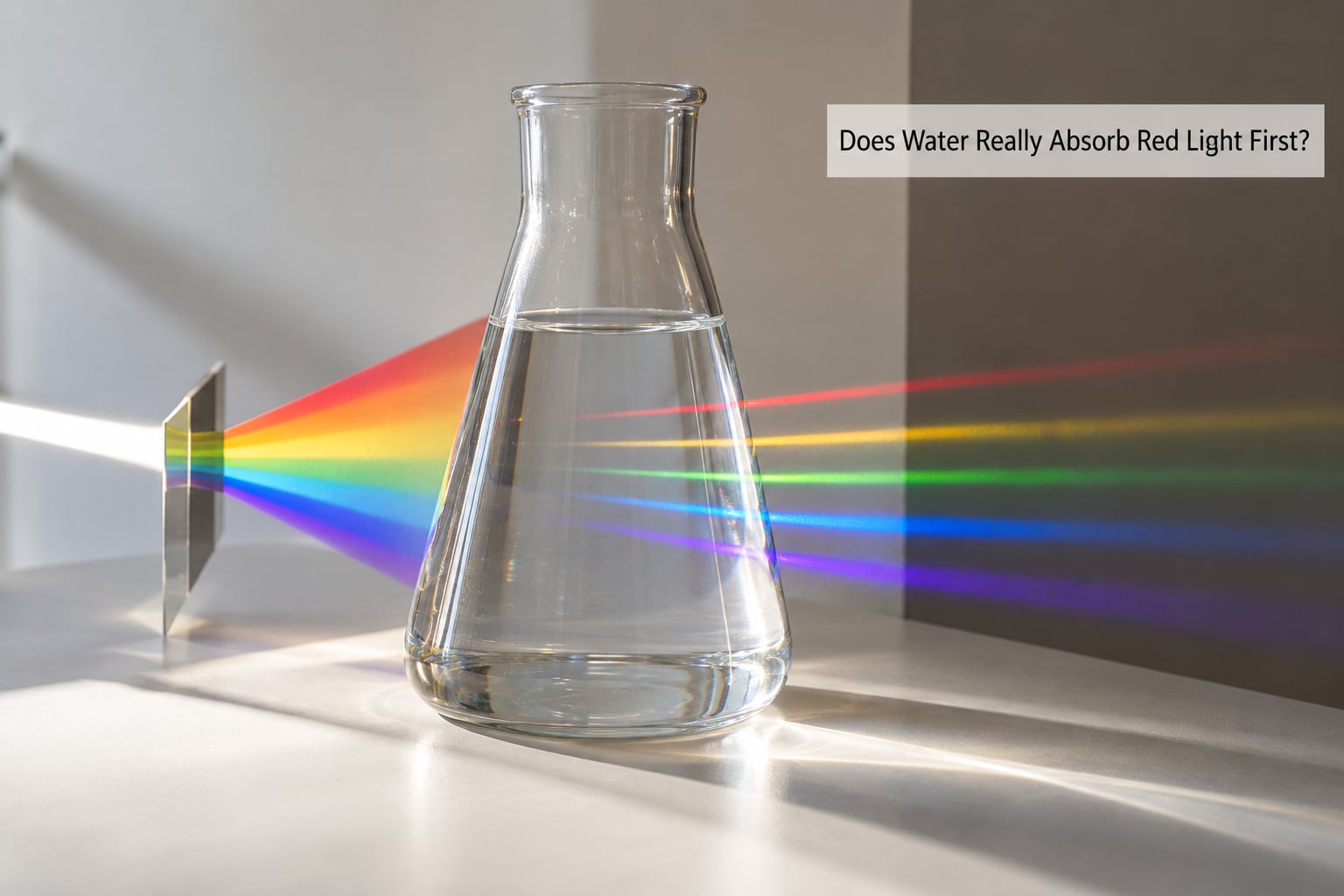
Yes — among visible wavelengths, red is the band pure water removes most strongly. The clearest way to say it: measured at 450 nm, water absorbs roughly 0.009 per metre; at 650 nm it absorbs about 0.34 per metre, nearly forty times as much. At 750 nm the figure climbs past 2 per metre.
So the premise holds. What does not hold is the usual reasoning attached to it. Absorption is a resonance effect, and “first” refers only to the order in which bands drop out as light travels downward. It says nothing on its own about what colour the water appears.
Absorption coefficient of pure water at a glance
| Wavelength | Colour | Approx. absorption (per metre) | Depth where 1% remains |
|---|---|---|---|
| 400 nm | Violet | 0.015 | about 320 m |
| 450 nm | Blue | 0.009 | about 500 m |
| 500 nm | Cyan-green | 0.021 | about 220 m |
| 550 nm | Green | 0.065 | about 70 m |
| 600 nm | Orange | 0.22 | about 21 m |
| 650 nm | Red | 0.34 | about 13 m |
| 700 nm | Deep red | 0.65 | about 7 m |
| 750 nm | Far red | 2.4 | under 2 m |
Values are from the standard absorption spectrum of pure water compiled by Pope and Fry using an integrating cavity technique, and they are rounded hard because that is the level at which they are useful. The last column is the path length you would need for the light to fall to one percent of its starting intensity — effectively where that colour has gone.
Note what the table says: blue wins by a wide margin, and green sits in between. Neither of those is what most people expect from a rainbow-ordered intuition, which is exactly why the myth persists.
What Happens to Sunlight as It Moves Through Water?
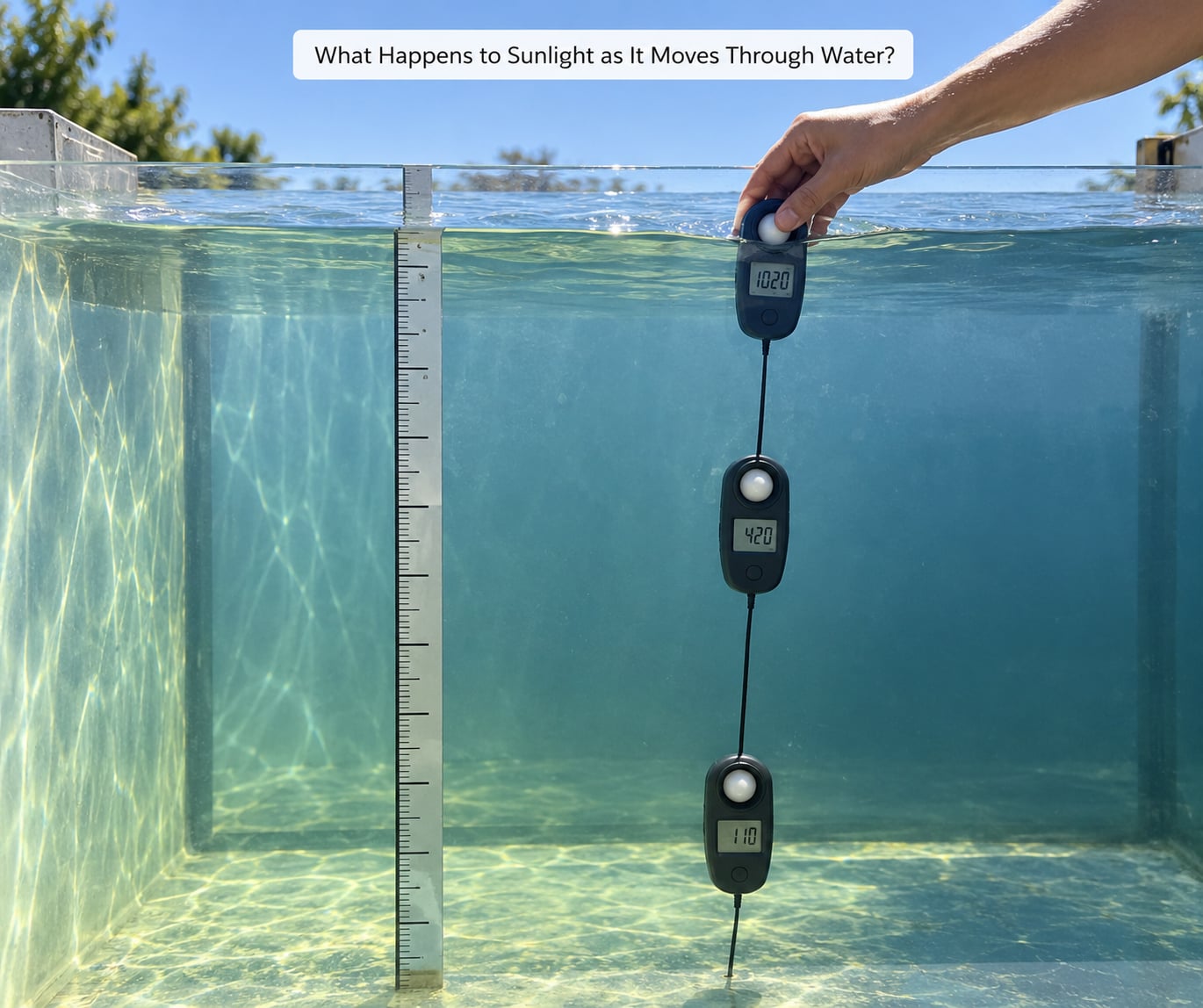
Sunlight hits the surface, part of it reflects off, and the rest refracts downward into a denser medium. Because water’s refractive index is about 1.33, everything below the surface appears shifted upward and compressed into a narrower cone — roughly the whole above-water field of view is squeezed into about 97 degrees. That geometry is why a submerged object looks closer and taller than it measures.
Once inside, light does three things at once: it is absorbed, it is scattered, and it continues forward. Those are separate processes, and confusing them is the source of most of the bad explanations out there.
Absorption versus scattering versus reflection
| Process | What happens to the photon | Effect on what you see |
|---|---|---|
| Absorption | Converted to heat inside a water molecule | Red, orange and yellow weaken fastest with depth |
| Scattering | Redirected, sometimes many times, then partly absorbed or returned | Blue haze in the distance; a milky look in silty water |
| Surface reflection | Bounces back to the sky at the air-water boundary | Makes shallow water look brighter and bluer than it is |
Along the way, intensity falls off exponentially rather than linearly, which is what makes “red is gone by 15 m” and “blue is still fine at 50 m” both true at the same time.
One more wrinkle that catches people out: a sensor on a vehicle has a longer path to work with than the light did on the way down. Downward light travels one path length; an underwater camera gets a return signal that has gone down and back up, plus bounced around inside the backscatter field. Double the path, square the loss.
Typical observations by colour band
| Colour | In pure water | Where people get it wrong |
|---|---|---|
| Red | Strongly absorbed; gone within roughly 15 m of clear water | Assumed visible far deeper because red surfaces and lava look bright |
| Green | Partly absorbed; the last colour visible around 70-80 m | Assumed to disappear at the same time as red |
| Blue | Weakly absorbed; penetrates hundreds of metres | Assumed to disappear because the sea looks dark at depth |
If nothing reflects light back, deep water with no scatterer looks black rather than blue. It looks blue because blue is the colour that survives absorption and because some of that blue is scattered back toward your eye. Remove the backscatter and the blue goes too.
Why Water Absorbs Red Light First: Light, Depth, and Scattering
Here is the mechanism, step by step, without the hand-waving.
Step 1: a photon is absorbed only when its frequency matches a molecular vibration
A water molecule has three internal vibrational modes. The symmetric O-H stretch sits at about 3650 wavenumbers, the asymmetric stretch at about 3755, and a bend near 1640. All three are in the infrared, far above the visible range.
Step 2: those infrared bands leak into the visible red
Overtones and combination bands of those stretches appear at sums of the fundamental frequencies. The band most often cited is the combination v1 + 3v3 at roughly 14318 wavenumbers, which works out to about 698 nanometres — deep red. Another combination, v1 + v2 + 3v3, falls near 660 nm.
Step 3: hydrogen bonding pushes the band further into the red
In liquid water, the O-H bonds are constantly locked into hydrogen bonds, which stretches the bonds and lowers their vibration frequencies. That shifts the visible-band absorption out to around 740 nm and widens it. This is why the mechanism differs between a water molecule in the gas phase and a glass on your desk.
Step 4: nothing overlaps the blue end
Water has no vibrational absorption band anywhere near 400 to 490 nm. Pure water absorption reaches its minimum in that region, roughly 0.009 per metre at 450 nm. Blue light survives because there is no resonant way for the molecule to take it, not because blue is somehow protected or invisible.
Step 5: the loss compounds with distance
Each metre multiplies the light intensity by a fixed factor for that wavelength — the Beer-Lambert relationship. Over 13 m, 650 nm light has fallen to about one percent. Over 500 m, 450 nm light has fallen to the same level. Absorption is relentless and the colour that survives longest wins the argument.
Step 6: the heavy water check
Deuterium has roughly twice the mass of hydrogen, so the O-D bond vibrates at about a third of the frequency of the O-H bond. Heavy water, D2O, absorbs at longer wavelengths overall, and its visible-band red absorption is correspondingly weaker. The red band moves rather than disappears. That shift is difficult to explain with any explanation other than a vibrational resonance, which is why it settles the argument so cleanly.
Infrared is the stark demonstration of the same physics. It is absorbed within the first ten centimetres or so of surface water, because it sits directly on the fundamentals of those stretches.
Why the Sea Can Look Blue or Green
Water colour is not one rule. Two different things get called “the colour of water” and they behave differently.
Intrinsic colour is what remains after you subtract scattered light and surface reflection. That is pure selective absorption, and it makes water transmit blue and green while killing red and orange.
Apparent colour is what you actually see, which mixes intrinsic colour with backscatter, any surface reflection, and whatever is suspended or dissolved in the water. Green water usually means biological productivity rather than a change in the water molecule. Chlorophyll absorbs red and blue for photosynthesis and reflects green, so a bloom turns clear blue water into a green soup. Brown and tan water is sediment and tannin, which scatter and absorb across the visible range. Red or pink water has entirely different causes: iron oxidation in some conditions, or a bloom dense enough that pigment in the cells supplies the colour the water itself would never produce.
Sky reflection adds brightness and shifts shallow water toward azure, which is why a beach at midday looks almost tropical. Take that same water indoors over white tile and it still reads cyan, just darker.
Depth zones give the same story in slices. In the euphotic zone, enough light comes down for photosynthesis, and the range runs from about 80 m in clear tropical water to under 10 m near the poles or in turbid water. The disphotic zone below it runs a few hundred metres, faint and blue-only. Then the aphotic zone, where photosynthetically useful light is simply gone.
How Water Depth Changes the Available Light
Depth matters because absorption is cumulative. The same red light that is invisible at 20 m is perfectly usable at 1 m.
| Condition | Red | Green | Blue |
|---|---|---|---|
| Shallow, clear, 0-5 m | Strongly reduced, still present | Slightly reduced | Nearly full strength |
| Intermediate, clear, 15-40 m | Effectively gone by about 40 m | Visible, thinning | Dominant |
| Deep, 100 m and below | None | Faint or absent | Roughly one percent of surface visible light at 100 m |
More than half of the visible light energy is gone in the first ten metres of even very clear ocean water. At 100 m, around one percent remains, and almost all of it is blue.
The Beer-Lambert idea in plain language: doubling the path halves the difference in how much light survives, over and over. It is why a shallow reading and a deep reading of the same water can look like contradictory evidence, and it is why comparing one sensor at 3 m to another at 30 m tells you about depth, not about the instrument.
For a robot, the sensor geometry adds its own complication. A downward-looking sensor near the surface reads mostly light that went straight down. A camera looking sideways reads light that travelled across the field, so the effective path is longer and oblique, and backscatter fills the frame with blue haze that no calibration fully removes.
Why Water Absorbs Red Light First in Everyday Observations
Several ordinary situations make the myth feel true when the measurement is really measuring something else.
Looking at the surface from above
What you see at the surface is dominated by reflected sky light. That reflection is broadband, so the surface of any water looks blue regardless of the absorption spectrum underneath. It tells you about the sky, not about the water.
A red object underwater
A red object looks dark almost immediately. Two things combine: the light reflecting off it is already depleted in red after a few metres of travel down, and the return trip is equally depleted. Underwater photographers report reds being substantially reduced at only about 3 m, which is why they put their own strobes close to the subject instead of relying on ambient light.
An unfiltered phone camera
Cameras white-balance toward the dominant colour of the frame, which underwater is blue or green. That auto-correction pushes red channel values toward saturation and clips detail, so a phone straight down a reef gives you a cyan cast and dead reds. It is a processing artefact layered on top of a real physical loss.
A long test path
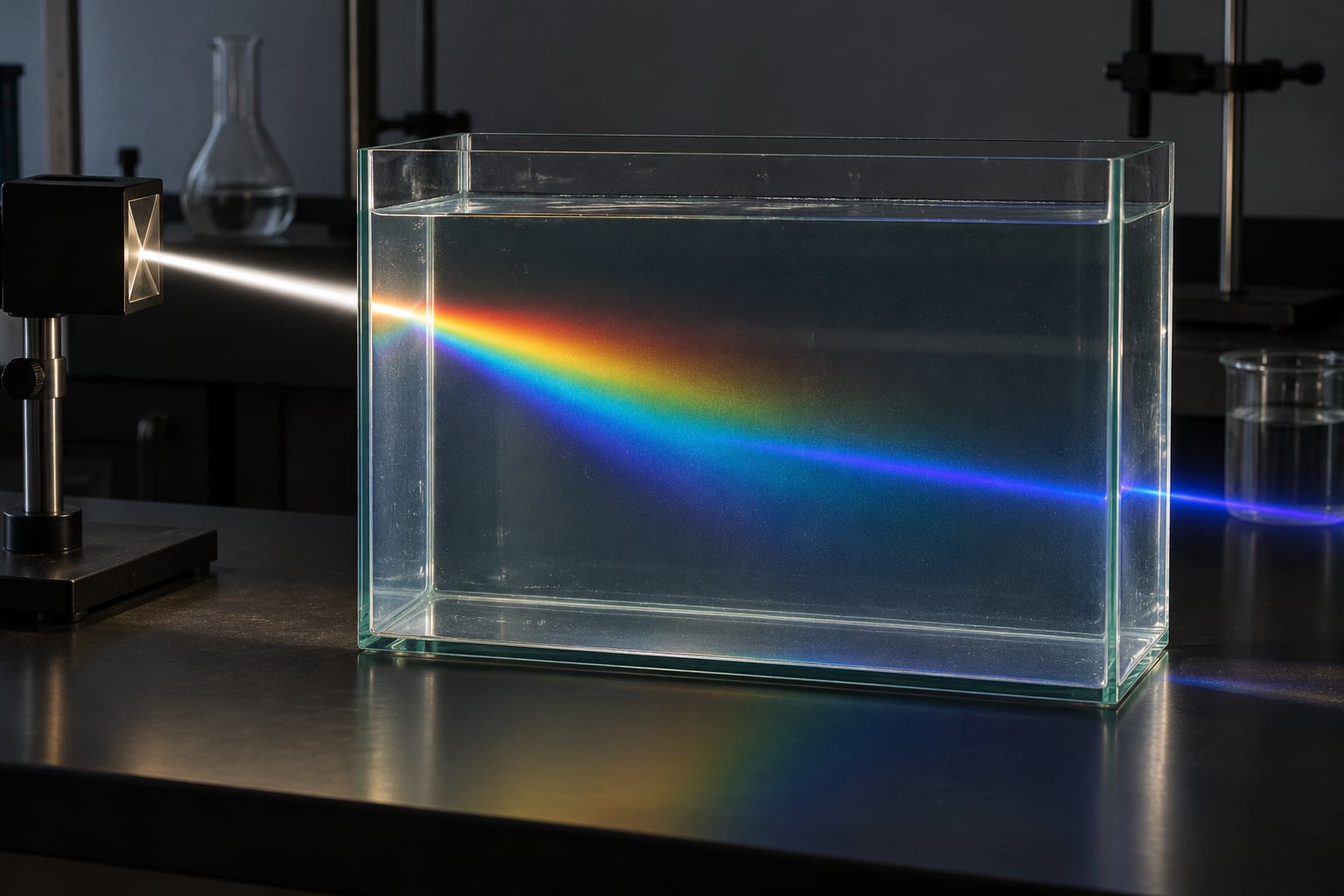
The classic demonstration is a metre-long clear pipe of purified water with a white light at one end. Over about a metre, sky-blue water becomes visible. In a glass you need 10 cm or 20 cm, so the effect is invisible. Anyone who concludes “water is colourless” has measured path length, not absorption.
Sunset on the surface
At low sun angles, the light reaching the water has already lost much of its red content in the atmosphere. The water then absorbs the little red that remains, leaving a surface that reads deep orange or bronze. The water is not doing anything unusual; the incoming light is already depleted.
How Marine Sensors Measure Underwater Color
If you need a real number rather than a colour impression, the measurement is straightforward but easy to get wrong.
Use separate wavelength channels, not one white channel
A single broadband light and a single broadband sensor cannot separate absorption from scattering. Multi-channel systems with narrow filters at chosen wavelengths can, because each channel gives its own attenuation measurement.
Calibrate radiometrically
Raw pixel values mean nothing until they are converted to physical units. Sensor characterisation, integration time, and gain all have to be known before a reading can be compared to another.
Take white and dark references every dive
A white reference panel gives the incoming illumination at the sensor, a dark reference gives the offset. Without both, every downstream number is a guess that drifts with ambient conditions.
Correct for depth and geometry
Record the sensor depth, the sun angle, and the distance to the surface, because the path length to the water you care about is not the depth of the sensor. Two vehicles at the same depth with different tilt angles will not measure the same column of water.
Know when to stop using raw RGB
A raw RGB frame is not an absorption measurement. It mixes absorption, scattering, surface reflection, and camera processing. If the goal is water clarity or chlorophyll, a calibrated water-quality sensor or a spectral instrument answers the question, and the RGB camera is documentation rather than data.
Choose the illumination wavelength deliberately
Blue-green emitters in the 470 to 520 nm range maximise returned signal per watt underwater, because they sit near the absorption minimum. White or red sources spend most of their output being absorbed before they reach the subject, and they return less light through a long backscatter path. This is why strobe placement and angle matter as much as power.
What Factors Can Change the Absorption Pattern?
The molecular absorption of pure water is fixed. Almost everything that changes what you observe is something else added to it.
| Factor | What it changes | Typical effect on observed colour |
|---|---|---|
| Path length | How much absorption accumulates | Colourless glass versus blue metre-long pipe |
| Depth and sun angle | Total light reaching the sensor | Red disappears first as depth increases |
| Suspended sediment | Mie scattering, which is nearly wavelength-neutral | Turbid brown or grey, not blue |
| Phytoplankton | Chlorophyll absorption of red and blue | Green water in productive areas |
| Dissolved organic matter | Absorption weighted toward blue and green | Tea-coloured freshwater, darker surface |
| Surface conditions | Fresnel reflection and glint | Brighter, bluer, less representative reading |
| Temperature and salinity | Small shifts in refractive index and density structure | Minor compared with the factors above |
| Air bubbles and plankton | Additional scattering sites | Milky haze, reduced contrast |
Three measurements are worth keeping separate in your notes: molecular absorption of pure water, optical backscatter in the water you are actually in, and apparent colour as perceived. They correlate, and they are not the same thing. Most confused explanations collapse them into one.
Frequently Asked Questions
Does pure water absorb red light more than blue light?
Yes. Pure water absorbs red light far more strongly than blue. Measured at 650 nm the absorption coefficient is about 0.34 per metre, compared with roughly 0.009 per metre at 450 nm. Blue is absorbed least of all visible wavelengths, which is why it travels furthest and dominates what reaches depth.
Why does a red object usually look darker or lose color underwater?
A red object works by reflecting red wavelengths and absorbing the rest. By the time light reaches it, the downward path has already stripped out most of the red content, and the return trip strips out more. The object therefore receives little red light to reflect back, so it reads dark. Close-range strobes restore it because the light never travels far.
Is blue water blue because water absorbs every other visible color equally?
No. Water absorbs wavelengths very unevenly, and blue is the least absorbed band in the visible range. The sea looks blue because red and orange are stripped away by absorption while blue survives and part of it is scattered back toward the eye. Surface reflection of the sky adds brightness and makes shallow water look even more azure.
Why can muddy or green water absorb red light differently from clear ocean water?
Suspended particles, sediment, algae, and dissolved organic matter each add their own absorption and scattering on top of the water molecule. Chlorophyll absorbs red and blue and reflects green, so blooms shift the colour toward green. Sediment scatters across the visible range and produces brown or grey water. In those cases the colour comes from the material, not from H2O.
Can a phone camera measure the true color of water reliably?
Not on its own. Auto white balance pushes the red channel toward saturation and clips detail, and a raw RGB frame mixes absorption, backscatter, surface reflection, and camera processing into one number. It is fine for documentation. For real measurements use a calibrated sensor with known channels and white and dark references.
Sources and further reading
Pope, R. H. and Fry, E. P. (1997), “Optical absorption spectra of pure water,” Applied Optics 36(33):8710-8723 — the reference absorption spectrum behind the table above.
Braun, C. D. and Smirnov, V. (1993), “Why is water blue?,” Journal of Chemical Education 70(8):612-614 — a short, readable walk through the vibrational explanation.
University of Hawaii Manoa, Exploring Our Fluid Earth: Light in the Ocean — depth-zone figures and the infrared absorption note. NOAA Ocean Explorer’s Light and Color in the Deep Sea factsheet contains the commonly repeated claim that red light has the lowest energy, which this article corrects; its depth observations are still useful.
Conclusion: Start with a Controlled Wavelength Test
Red light is absorbed before blue because the O-H stretching vibration of the water molecule has an overtone band that lands in the red, near 698 nm and pushed out toward 740 nm by hydrogen bonding. Blue survives because no water vibration overlaps it. That is the whole mechanism, and it does not depend on photon energy being low.
The first practical step is a controlled test rather than a guess. Take known red, green, and blue readings over a measured underwater path, and hold depth, clarity, angle, and sensor calibration constant while you do it. Log path length with every reading, because without it the numbers are not comparable. Once you see red fall away and blue hold steady, the physics stops being folklore and starts being something you measured yourself.